WordPress数据库错误: [您的 SQL 语法有误;请查阅与您的 MariaDB 服务器版本对应的手册,以了解第 1 行附近的正确语法。]SELECT * FROM wp_mica_ecta WHERE cta_id =
WordPress数据库错误: [您的 SQL 语法有误;请查阅与您的 MariaDB 服务器版本对应的手册,以了解第 1 行附近的正确语法。]SELECT * FROM wp_mica_ecta WHERE cta_id =
WordPress数据库错误: [您的 SQL 语法有误;请查阅与您的 MariaDB 服务器版本对应的手册,以了解第 1 行附近的正确语法。]SELECT * FROM wp_mica_ecta WHERE cta_id =
WordPress数据库错误: [您的 SQL 语法有误;请查阅与您的 MariaDB 服务器版本对应的手册,以了解第 1 行附近的正确语法。]SELECT * FROM wp_mica_ecta WHERE cta_id =
A crypto miner turning its machines into AI computers, a trading bot that watches 400 accounts at once, a hacker’s AI agent that can crack open a smart contract faster than any human ever could. This is what AI crypto looks like in 2026, and it is not science fiction. It is happening right now, with real money on the line.
The AI crypto market is worth about 如今价值21亿美元, depending on which tokens you count. That number has swung by billions of dollars in a single week more than once this year.
On the other side of the ledger, security researchers have built AI agents that can find and exploit smart contract bugs with an 88.5% success rate under lab conditions. Both of those facts are true at the same time, and that is the whole story of AI crypto: huge upside, sitting right next to a genuinely new kind of danger.
This guide walks through both sides. No hype, no fear-mongering, just what is actually happening, what it means for your money, and how to make decisions you won’t regret.
ID #0 没有行动号召。关键精华
- The opportunity is real, but so is the risk. AI crypto isn’t a scam category, but it is one of the most volatile corners of an already volatile market. Treat it as a small, high-conviction slice of a portfolio, not a core holding.
- Security has to come first. AI agents that touch your wallet are a genuinely new attack surface. Limit what they can access before you limit anything else.
- Infrastructure is currently the stronger bet than flashy applications. Projects that provide the computing power, data, or blockchain rails for AI tend to have clearer, more durable business models than agent tokens riding a hype cycle.
- Rules are still being written. The EU, the US, and other regulators are building AI rules and crypto rules at the same time, and those rules overlap in unexpected ways, so expect surprises.
What Is AI Crypto? A Plain Definition
| AI crypto refers to blockchain projects that use artificial intelligence, or that exist to build AI infrastructure using blockchain technology. This covers decentralized computing networks like Render and Bittensor, AI-powered trading tools, autonomous agents that can act on their own, and AI-focused blockchains like NEAR Protocol. The category is currently valued at roughly $20 to $27 billion, based on data from CoinGecko and CoinMarketCap, though the exact number depends on which tokens are included. |
Think of it as two technologies feeding each other. Crypto gives AI a way to pay for computing power, share data, and let software agents transact without a human clicking “approve” every time. AI gives crypto a way to automate trading, catch fraud, and build tools that are actually useful instead of just speculative.
There are three broad types of projects in this space:
- 人工智能基础设施: This is the plumbing or funnel. Render and Bittensor, for example, let people rent out spare computer power for AI tasks instead of that power sitting idle.
- 人工智能应用: These refer to the tools built on top. For instance, Ocean Protocol lets people sell data for AI training without giving up ownership of it.
- AI-enhanced crypto tools: These are regular crypto functions made smarter with AI, like trading bots or fraud detection systems.
The AI Crypto Market in 2026: What the Numbers Actually Say
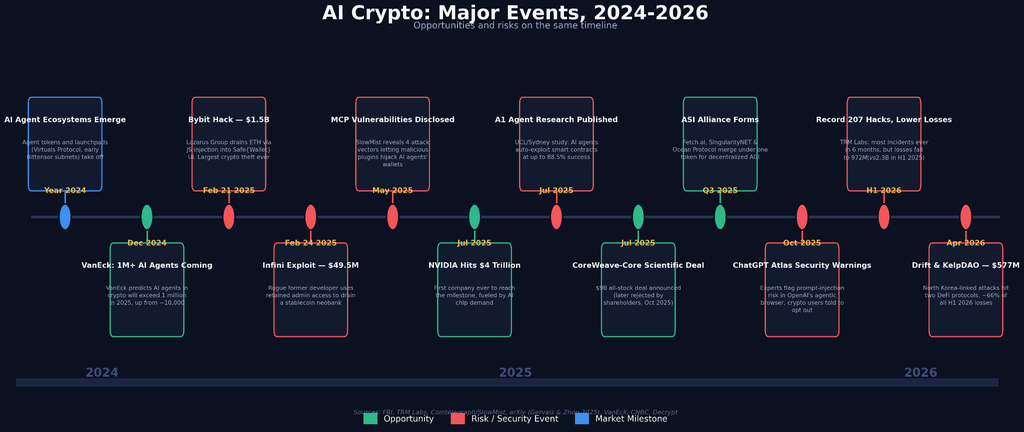
The crypto-AI sector remains a major area of interest in 2026, with a market cap around $20.8 billion, 根据CoinGecko的说法.
The platform’s current AI & Big Data category puts major projects such as NEAR Protocol, Bittensor, Internet Computer, and Render among its largest tokens, with Bittensor alone valued at roughly $1.8 billion.
A bigger trend is also taking shape: crypto miners are repurposing their power and data-center infrastructure for AI workloads. CoreWeave’s proposed $9 billion all-stock acquisition of Core Scientific in July 2025 highlighted this shift, although Core Scientific shareholders rejected the deal in October, ending the merger.
The failed acquisition did not stop the broader pivot. CoreWeave and Core Scientific already had a long-term AI infrastructure partnership, while other miners, including Riot Platforms, TeraWulf, and Cipher, have also moved into high-performance computing.
The shift reflects where investors increasingly see growth: AI infrastructure is becoming an important new revenue opportunity for crypto-native companies, even as the crypto-AI sector itself remains in an early stage of development.
Market Composition by Category 2026
| 类别 | 预计市场份额 | 示例项目 | 2026性能 |
| 人工智能基础设施 | 45-50% | Bittensor (TAO), NEAR (NEAR), Render (RENDER), Internet Computer (ICP), Akash (AKT), Filecoin (FIL) | Strong / leading segment |
| 人工智能应用 | 25-30% | Venice Token (VVV), The Graph (GRT), Quack AI (Q), ChainGPT (CGPT) | Mixed to positive |
| AI-Enhanced Trading / DeFAI | 10-15% | AIXBT, Velvet Capital (VELVET), Numeraire (NMR), Derive (DRV) | High growth but volatile |
| Emerging AI Agents | 10-15% | Virtuals Protocol (VIRTUAL), Artificial Superintelligence Alliance (FET), Phala (PHA), Kite (KITE) | Strong momentum, very volatile |
注意:: There is no standardized market-share breakdown for AI crypto into infrastructure, applications, trading and agents because CoinGecko’s AI categories overlap. For example, the same token can appear in AI Agents, AI Applications and AI Frameworks.
Top 10 AI Crypto Projects by Market Cap
The table below ranks the 10 largest projects listed in CoinGecko’s Artificial Intelligence category, using market capitalization as the selection criterion. Market-cap figures are current snapshots and can change continuously.
| 项目 | 市值 | 主要用例 | Opportunity Score (1–10) | 风险评分(1-10) | 2026 Performance* |
| 链环(LINK) | $ 6.21B | Decentralized data oracles & AI/agent infrastructure | 9 | 5 | +15.3% (30D) |
| NEAR协议(NEAR) | $ 2.16B | AI-ready Layer 1 & decentralized computing | 9 | 6 | +8.1% (30D) |
| 比特张量 (TAO) | $ 1.87B | Decentralized machine-learning network | 9 | 7 | +2.0% (30D) |
| 互联网计算机(ICP) | $ 1.15B | Decentralized computing and AI applications | 8 | 6 | +1.8% (30D) |
| 渲染(渲染) | $ 724M | Decentralized GPU rendering and AI compute | 9 | 7 | +7.2% (30D) |
| 威尼斯代币(VVV) | $ 580M | Private, decentralized AI access | 8 | 7 | +3.3% (30D) |
| Talus (US) | $ 490M | Blockchain infrastructure for AI agents | 8 | 8 | +529.1% (30D) |
| Unibase(UB) | $ 404M | Decentralized AI-agent data and infrastructure | 8 | 8 | +89.0% (30D) |
| 虚拟协议(VIRTUAL) | $ 372M | AI-agent creation and autonomous economies | 9 | 7 | +8.8% (30D) |
| 人工智能超级联盟(FET) | $ 319M | Decentralized AI development and machine intelligence | 9 | 7 | +17.4% (30D) |
注意:: CoinGecko’s live category table provides rolling performance periods rather than a single standardized 2026 YTD figure, so the final column uses the latest available 30-day performance as a current 2026 performance indicator.
Chainlink is listed under CoinGecko’s Artificial Intelligence category because its decentralized oracle network acts as the critical secure middleware required to connect AI models and off-chain data feeds to on-chain smart contracts.
7 Real Opportunities in AI Crypto
These are the opportunities AI crypto offers
1. Decentralized AI Computing
Training and running AI models takes enormous computing power, and right now that power is mostly controlled by a handful of giant cloud companies. Networks like Render and Bittensor let anyone with a spare graphics card rent it out to AI developers, often at a real discount to what Amazon or Google charge.
Render has processed over a million rendering jobs for artists, architects, and AI researchers, and it charges real fees for that work rather than just running on token hype.
“Owning this foundational layer of our platform will enhance our performance and efficiency,” CoreWeave’s CEO said of the industry’s broader move toward vertically controlling AI compute infrastructure.
最适合: long-term investors who believe cheaper, decentralized computing has real staying power against big cloud providers.
2. AI-Powered Trading and Yield Tools
AI 交易机器人 read on-chain data, social sentiment, and news far faster than a person can. They’re used to catch arbitrage opportunities, rebalance DEFI positions, and manage risk across dozens of protocols at once.
Numeraire is a good example of the model: it rewards data scientists for building accurate prediction models, and it penalizes bad ones by making them stake tokens on their own accuracy.
最适合: active traders and DeFi users who are comfortable with smart contract risk and want automation, not a hands-off, buy-and-forget investment.
ID #0 没有行动号召。3. 自主人工智能代理
This is the newest and fastest-growing part of the space. Virtuals Protocol, built on Coinbase’s Base network, lets anyone launch an AI agent that mints its own token and can earn revenue through tasks like social media monitoring or gaming.
One agent, AIXBT, reached a peak valuation near $700 million in January 2025 by tracking hundreds of crypto influencers for trending narratives. It later fell more than 80% from that high, which tells you everything you need to know about how fast this corner of the market moves in both directions.
最适合: investors with a high tolerance for risk who understand both AI and crypto well. Not a starting point for beginners.
4. Data Monetization and Privacy-Preserving AI
AI companies need huge amounts of data to train their models, but the people who actually generate that data rarely see a cent for it.
Ocean Protocol built a system where data owners can let AI models learn from their data without ever handing over the raw files, and get paid for it. It’s a smaller, slower-growing corner of the market, but it lines up well with a growing public appetite for data privacy and ownership.
最适合: long-term, values-driven investors who believe data ownership will matter more over time, not less.
5. AI-Native Blockchains
年长 块链 weren’t built with AI’s speed and data needs in mind. NEAR Protocol has rebuilt itself around what it calls “agentic commerce,” where AI agents can transact on a person’s behalf, and its architecture is built for speed rather than retrofitted for it. Newer, AI-optimized chains are trying to solve the same problem Ethereum and Solana are also racing to fix.
最适合: investors who want exposure to foundational infrastructure rather than a single application.
6. 监管合规自动化
This one gets far less attention than trading bots, but it’s a genuinely useful business. AI now handles a lot of the identity verification and suspicious-transaction flagging that crypto exchanges are legally required to do, cutting the manual workload dramatically. It’s not exciting, but it’s a real service that real companies pay real money for, which makes it a lower-drama, more stable niche than most of this sector.
最适合: conservative investors who want AI-crypto exposure without the wild price swings of agent tokens.
7. Long-Term AGI Networks
The most speculative bet in the space is the idea of open, decentralized artificial general intelligence, as opposed to AGI built and controlled by one or two companies.
The Artificial Superintelligence Alliance merged three existing projects, Fetch.ai, SingularityNET, and Ocean Protocol, under one token to chase this vision, with a unified blockchain planned for later in 2026. It’s a real effort with real teams behind it, but nobody knows if or when true AGI arrives, and centralized labs like OpenAI currently have a massive head start.
注意:: Ocean Protocol officially withdrew from the alliance in October 2025 to pursue independent development and treasury paths, creating some friction in the unified Web3 AI roadmap
最适合: a very small, “lottery ticket” slice of a portfolio for investors who are philosophically committed to decentralized AI. Not a core holding for anyone.
9 Critical Risks You Need to Understand
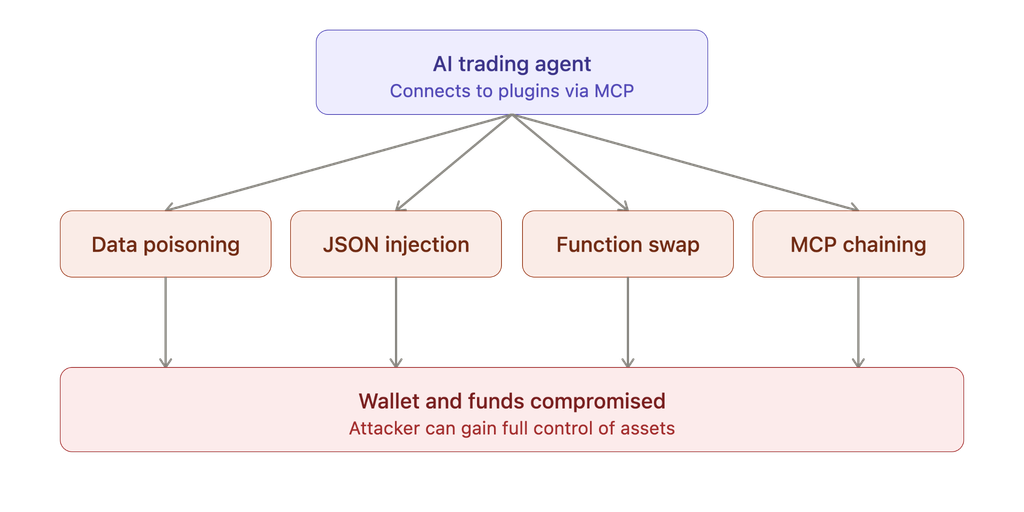
These are the risks to be aware of when it comes to AI crypto
1. AI Agents Are a New Kind of Attack Surface
This is the risk that should worry you most if you plan to let an AI agent manage any part of your crypto. Security firm SlowMist studied how AI agents connect to outside tools through a system called the Model Context Protocol, or MCP.
They found four separate ways attackers can hijack that connection: feeding the agent misleading data to trick it into bad actions, sneaking malicious data through local calls the agent trusts, quietly swapping out legitimate commands for malicious ones, and getting one AI agent to call another, less secure one to widen the opening.
“The moment you open your system to third-party plugins, you’re extending the attack surface beyond your control” .
SlowMist’s co-founder, who goes by Monster, described finding a flaw during one audit that could have exposed users’ private keys entirely, handing an attacker complete control of their funds.
该怎么办: Never give an AI trading agent full wallet access. Set hard transaction limits, use agents in read-only or “logged out” modes when they support it, and check what permissions any AI tool has before connecting it to a real wallet.
2. AI Is Making Hackers Faster, Not Just Smarter
Academic researchers at University College London and the University of Sydney built an AI agent called A1 specifically to test how well AI could find and exploit 聪明的合同 bugs on its own.
The results were sobering: under the best conditions, OpenAI’s o3-pro model successfully generated a working exploit 88.5% of the time. Tested against a broader, more realistic set of 27 real-world vulnerable contracts, it succeeded in about 63% of cases, and in some of those it extracted over $8 million in a single exploit.
The researchers found something else worth remembering: attacking a contract stays profitable at values as low as $6,000, while defending one properly costs closer to $60,000. That’s a lopsided fight, and it’s the clearest evidence yet that manual code review alone won’t keep up.
该怎么办: Only use protocols with multiple independent audits and a track record of staying live under pressure. Be extra cautious with newly launched contracts, since they haven’t had time to be tested by real attackers yet.
3. AI Tokens Are Extremely Volatile
AIXBT’s 80%-plus drop from its January 2025 peak isn’t an outlier in this sector, it’s closer to normal. AI tokens are exposed to two hype cycles at once, crypto sentiment and AI sentiment, and when either one cools off, prices can fall hard and fast. Roughly 83% of AI tokens launched since 2023 are still trading below their initial listing price.
该怎么办: Cap AI crypto at a small slice of your total crypto holdings. Spread it across several projects rather than betting on one. Expect and plan for 50% or larger drawdowns, because they are common here, not rare.
4. Regulation Is Genuinely Unsettled
AI crypto projects sit at the intersection of two 监管 regimes that are both still being built.
在欧盟, 加密资产市场(MiCA) governs crypto assets while the 欧盟人工智能法案 separately classifies AI systems by risk level, and a trading agent making financial decisions could plausibly fall into the “high risk” category, which comes with real compliance costs.
In the US, the United States Securities and Exchange Commission (SEC still has to decide, case by case, whether specific AI tokens count as securities. None of this is settled law yet, and smaller projects without a legal team are the ones most likely to get caught out.
该怎么办: Favor projects with visible legal teams and a track record of engaging with regulators rather than avoiding them. Assume rules can and will change.
ID #0 没有行动号召。5. “Decentralized” AI Often Isn’t, Underneath
Here’s a contradiction worth knowing about: a lot of projects that market themselves as decentralized AI actually run on centralized AI models from OpenAI, Google, or Anthropic behind the scenes, or rent computing power from the same big cloud providers everyone else uses.
If one of those providers changes its pricing or its terms of service, entire categories of “decentralized” apps could break overnight. True decentralization, all the way down the stack, is still mostly aspirational.
该怎么办: Ask what a project actually controls versus what it rents from a centralized provider. Favor projects like Bittensor that have built genuinely independent infrastructure over ones that are essentially a wrapper around someone else’s API.
6. The Technology Is Still Immature
Running AI computation directly on a blockchain is slow and expensive compared to a regular server, and combining two complex, fast-moving technologies multiplies the number of things that can go wrong. Most AI crypto startups don’t survive their first two years. That’s not a scandal, it’s just what happens at the frontier of any new technology, but it means due diligence matters more here than in more established parts of crypto.
该怎么办: Favor teams with a working product and real users over teams with only a roadmap and a token.
7. Algorithmic Designs Can Fail Suddenly
Terra’s UST stablecoin wiped out more than $40 billion in value in May 2022 when its algorithmic design broke down under pressure.
Any AI crypto project that uses machine learning to manage a token’s supply, price stability, or treasury in real time carries a version of that same risk. AI models make assumptions about how markets behave, and a black swan event can break those assumptions fast.
该怎么办: Treat any project claiming AI can maintain price stability without solid collateral backing it as a serious red flag.
8. Automated Systems Can Amplify a Crash
As more capital gets managed by AI agents that all respond to similar signals, there’s a real risk of many agents pulling liquidity at the same moment, turning one protocol’s problem into an ecosystem-wide one.
This isn’t hypothetical: traditional markets saw exactly this pattern in the 2010 Flash Crash, caused by automated trading systems reacting to each other. Crypto’s DeFi ecosystem, more interconnected and less regulated, could see something similar play out faster.
该怎么办: Diversify across protocols that don’t share the same underlying code or oracle dependencies, so one failure doesn’t cascade into all of your holdings at once.
9. Quantum Computing Is a Longer-Term Watch Item
This isn’t a 2026 problem, but it’s worth knowing about. Sufficiently powerful quantum computers could eventually break the cryptography that both blockchain wallets and AI security systems rely on.
Most serious estimates put a practical threat somewhere in the 2030s at the earliest, but cryptographers are already starting to build quantum-resistant alternatives now, before it becomes urgent.
该怎么办: Not an immediate action item, but worth favoring projects that are at least paying attention to post-quantum cryptography over ones that aren’t.
投资策略与风险管理
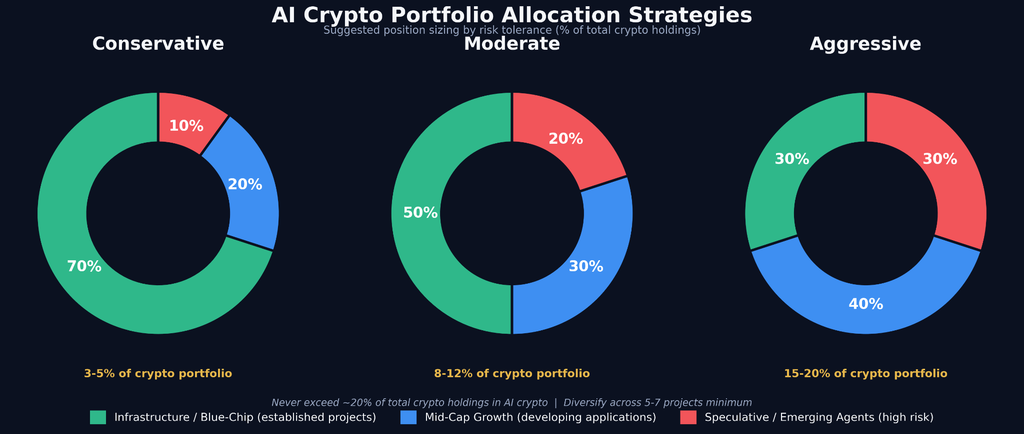
Below are investment strategies to follow
1. Build a Risk-Based Portfolio
AI crypto remains highly volatile, so position sizing should match your risk tolerance rather than return targets.
- Conservative (3–5% of portfolio): 70% established infrastructure, 20% mid-cap applications, and 10% emerging projects. Suitable for first-time AI-crypto exposure.
- Moderate (8–12%): 50% established infrastructure, 30% growth projects, and 20% emerging AI-agent plays. Best for experienced crypto investors.
- Aggressive (15–20%): 30% established projects, 40% high-growth mid-caps, and 30% speculative agents or new launches. Only for investors who can withstand severe drawdowns.
核心规则: Keep AI crypto below 20% of your total portfolio, spread exposure across at least 5–7 projects, rebalance quarterly, and maintain 20–30% in stablecoins for opportunities during major market corrections. Treat return multiples as scenarios, not expectations.
2. Evaluate Every Project Before Buying
Use a 15-point due-diligence framework covering four areas:
- Technology (5): Independent security audits, active GitHub development, credible architecture, genuine AI functionality and secure smart contracts. Prioritize verifiable audit reports rather than marketing claims.
- Tokenomics (4): Clear utility, sustainable supply dynamics, transparent vesting, adequate liquidity, sensible valuation, and a well-managed treasury.
- Team & governance (3): Relevant AI and crypto expertise, credible advisors, transparent governance, and meaningful community participation.
- Adoption (3): Real users, revenue or network activity, legitimate partnerships, and a healthy developer community.
得分了: 13–15 = strong candidate for deeper research; 10–12 = monitor closely; 7–9 = high risk; below 7 = generally avoid.
3. Control Security, Volatility and Regulatory Risk
- Restrict AI-agent or trading-bot permissions and transaction limits; never give automated systems unrestricted wallet access.
- Store most long-term holdings in hardware or multisig wallets and review dApp permissions regularly.
- Dollar-cost average over several months instead of committing everything at once.
- Establish profit-taking rules before prices surge and avoid relying solely on hard stop losses.
- Track correlation with BTC and AI equities to prevent excessive exposure to the same market narrative.
- Maintain accurate cost-basis and tax records and favor projects with transparent compliance practices.
Regulatory conditions continue to evolve. The SEC’s 2026 crypto-asset interpretation provides updated guidance on areas including staking and token classifications, while the European Commission’s MiCA framework remains central to EU crypto regulation.
ID #0 没有行动号召。4. Stay Informed and Know When to Exit
Monitor official project announcements, security disclosures, on-chain usage, developer activity and regulatory updates. Consider reducing or exiting when you identify:
- An unpatched critical vulnerability
- Sudden team departures or governance problems
- Regulatory action that materially threatens the project
- Sustained deterioration in users, revenue or network activity
- Loss of access to a critical AI infrastructure provider
The goal is not to predict every winner. It is to control downside, verify fundamentals, and preserve capital long enough to capture genuine AI-crypto growth.
If you’re serious about this space, don’t stop at market cap charts. Read through UEEX’s 加密安全最佳实践 before connecting any wallet to an AI tool, and review the 加密货币风险管理 guide if you plan to use AI-powered yield tools
另请阅读:如何选择最佳人工智能加密货币交易机器人
常見問題解答
What are AI crypto opportunities and risks in simple terms?
AI crypto opportunities include decentralized computing, smarter trading tools, and new blockchain infrastructure built for AI. The risks include hackable AI agents, extreme price swings, and unclear regulation. Both sides are real, and the sector rewards careful research over hype-chasing.
Should I invest in AI crypto in 2026?
Only if you already have a solid, diversified crypto portfolio and can treat AI crypto as a small, high-risk slice of it. It’s not a safe entry point for someone new to crypto, given how volatile and technically complex this corner of the market is.
What’s the difference between AI crypto and regular crypto?
Regular crypto is mainly about payments, store of value, or general-purpose smart contracts. AI crypto specifically powers or uses artificial intelligence, whether that’s decentralized computing for AI training, AI-driven trading, or autonomous AI agents that act on-chain.
Can AI crypto agents really steal my funds?
Yes, if you give one too much access. Security researchers have documented real ways malicious actors can hijack AI agents connected to wallets through vulnerable plugins. Limiting an agent’s permissions and never handing over full wallet control is the single best protection you have.
免责声明: This article is for educational purposes only and does not constitute financial, investment, legal, or tax advice. AI cryptocurrency investments carry extreme risk, including the potential loss of your entire investment. Prices, regulations, and security conditions in this sector change quickly, and information here may become outdated. Always do your own research and consult a licensed financial advisor before making investment decisions.