Investing in blockchain technology is no longer just about Bitcoin or Ethereum. The global blockchain market is projected to reach $94 billion by 2027 from approximately $20 billion in 2024. In 2025, real results from publicly listed blockchain companies revealed both the opportunity and the risk: Coinbase generated $7.2 billion in annual revenue, MARA Holdings held 52,850 BTC on its balance sheet, and the sector delivered extraordinary returns for investors who chose the right companies at the right time.
Key Takeaways
- Coinbase (COIN) generated $7.2 billion in full-year 2025 revenue, a 9% increase year-over-year, with trading volume surging 156% to a record $5.2 trillion. The company now has 12 products each generating over $100 million in annualised revenue.
- MARA Holdings (MARA) reported Q2 2025 revenue of $238.5 million (up 64% year-over-year), net income of $808.2 million, and Bitcoin holdings of 49,951 BTC (up 170% year-over-year), making it the second-largest corporate Bitcoin holder globally.
- HIVE Digital Technologies (HIVE) diversified beyond pure mining into high-performance computing for AI in 2025, with HPC revenue targeting a $20 million annualised run rate from NVIDIA H100 and H200 clusters.
- Nvidia (NVDA) remains the dominant GPU supplier for both AI and blockchain applications, with demand growth from AI training accelerating far beyond crypto mining as the primary revenue driver.
- The 2025 regulatory environment improved significantly for all blockchain stocks: the US GENIUS Act, MiCA in Europe, and the SEC’s withdrawal of major enforcement actions reduced sector-wide regulatory uncertainty.
- Blockchain stocks vary dramatically in their risk profiles. Pure-play miners are highly correlated with Bitcoin’s price; enterprise blockchain companies like IBM and Accenture offer lower volatility with more stable revenue streams.
Why Invest in Blockchain Stocks in 2026?
Investing in blockchain technology is no longer just about Bitcoin or Ethereum. According to market research, the global blockchain market is expected to grow from approximately $20 billion in 2024 to $94 billion by 2027, representing a compound annual growth rate exceeding 60%. This growth reflects genuine enterprise adoption across financial services, supply chain management, healthcare, and digital payments.
Blockchain stocks offer a way to gain exposure to this growing ecosystem through regulated stock market investments. The 2025 cycle produced meaningful financial results from publicly listed blockchain companies, moving the sector beyond narratives and into documented performance metrics. The key challenge for investors in 2026 remains identifying which companies are executing on genuine business models versus those riding cryptocurrency price momentum without underlying operational substance.

Read Also: Crypto vs Stocks: Which Investment Is Right for You?
Coinbase Global Inc. (COIN)
2025 Financial Performance
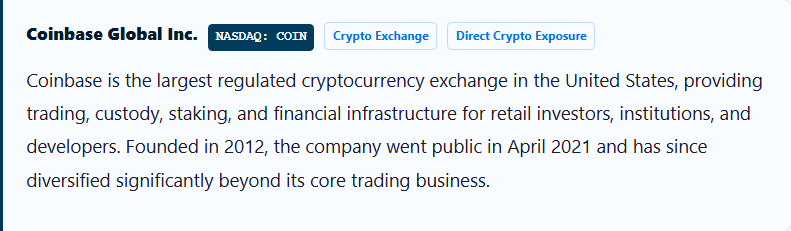
Coinbase delivered strong 2025 results with total annual revenue of $7.2 billion, up 9% year-over-year. Trading volume surged 156% year-over-year to a record $5.2 trillion, and the company doubled its crypto trading volume market share. Subscription and services revenue reached $2.8 billion, up 23% year-over-year and 5.5 times higher than the prior cycle peak in 2021. The company achieved its twelfth consecutive quarter of adjusted EBITDA profitability with full-year adjusted EBITDA of $2.81 billion. Coinbase now has 12 products generating over $100 million in annualised revenue, an all-time high reflecting meaningful business diversification. The company maintained a strong cash position of $11.3 billion at year-end.
Q4 2025 was more challenging: revenue declined 5% quarter-over-quarter to $1.78 billion as crypto market activity slowed following Bitcoin’s late-2025 correction, and the company reported a GAAP net loss of $667 million driven by $718 million in unrealised crypto investment losses. Adjusted net income for Q4 remained positive at $178 million, confirming the core business continued to generate value despite market headwinds.
Key Strengths
Coinbase’s strategic pivot to an “Everything Exchange” vision, where it aims to be the single platform for trading every asset class, represents a significant long-term growth opportunity. Its acquisition of Deribit, the world’s largest crypto options exchange, in 2025 expanded its derivatives capabilities materially. The Base Layer-2 blockchain built by Coinbase continued to grow as a developer ecosystem. Its regulatory relationship with US authorities, while historically contentious, improved significantly in 2025 following the SEC’s withdrawal of its enforcement action against Coinbase.
Growth Prospects for 2026
For Q1 2026, Coinbase guided subscription and services revenue between $550 and $630 million. The company’s international expansion, growing institutional custody business, and stablecoin infrastructure (average USDC balances held in Coinbase products reached $17.8 billion in 2025) provide structural revenue streams less dependent on trading volume cycles. With nearly one million paid Coinbase One subscribers, a three-fold increase in three years, the subscription business continues to diversify Coinbase’s revenue base.
MARA Holdings Inc. (MARA)
MARA Holdings Inc.NASDAQ: MARABitcoin MiningDirect Bitcoin Exposure
MARA Holdings (formerly Marathon Digital Holdings) is one of the largest publicly listed Bitcoin mining companies, operating large-scale mining infrastructure globally. The company has pivoted toward positioning itself as a vertically integrated digital energy and infrastructure company, expanding beyond pure Bitcoin mining into AI infrastructure and power management solutions.
2025 Financial Performance
MARA delivered record results across 2025. Q2 2025 revenue increased 64% year-over-year to $238.5 million, and Q2 net income reached $808.2 million, a dramatic improvement from a $199.7 million loss in Q2 2024. The company’s energized hash rate grew 82% year-over-year to 57.4 EH/s in Q2 2025 and expanded further to 60.4 EH/s in Q3 2025 (up 64% year-over-year). Bitcoin holdings grew 170% year-over-year from 18,488 BTC to 49,951 BTC by Q2 2025, and reached approximately 52,850 BTC by Q3 2025, making MARA the second-largest corporate Bitcoin holder globally. Fleet efficiency improved to 18.3 J/TH, a 26% year-over-year enhancement. The company’s energy cost per Bitcoin reached $33,735, among the lowest in the sector.
Key Strengths
MARA’s scale, operational efficiency, and Bitcoin treasury strategy provide multiple simultaneous levers for value creation. Its HODL strategy means Bitcoin price appreciation benefits the balance sheet directly. Nearly 60% of operations now use renewable energy, addressing the environmental criticism that has historically weighed on mining company valuations. The company raised $950 million in new capital in 2025 to fund expansion and Bitcoin purchases, reinforcing its long-term strategic commitment to growing its position as a digital infrastructure company.
Growth Prospects for 2026
MARA is pursuing several initiatives to diversify beyond core Bitcoin mining. Its expansion into AI infrastructure, offering data centre services for AI model training, aligns with the broader trend of mining companies repurposing their energy and compute infrastructure for higher-margin AI and HPC workloads. Q4 2025 results are scheduled for release in February 2026, with investors focused on hash rate targets, cost per Bitcoin, and BTC holdings.
HIVE Digital Technologies Ltd. (HIVE)
2025 Financial Performance
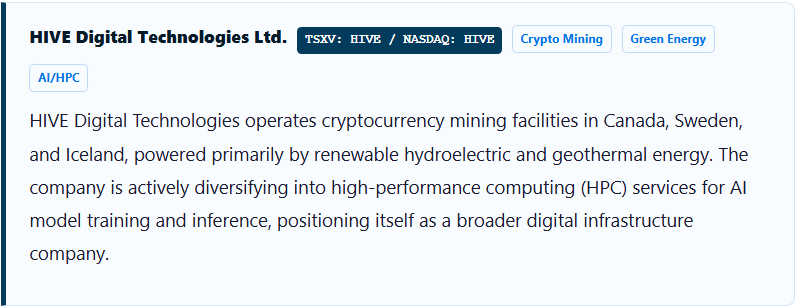
HIVE reported Q3 FY2025 (calendar Q4 2024) total revenue of $29.2 million, comprising $26.7 million from digital currency mining and $2.5 million from HPC services. The company’s Bitcoin mining hash rate grew 7.1% from 5.6 EH/s to 6.0 EH/s during that quarter, driven by upgrades to its Bitcoin mining fleet with Avalon machines from Canaan Inc. HIVE’s Paraguay expansion, a 100 MW project targeting 6.5 EH/s of additional capacity from Bitmain S21+ hydro-cooled ASICs, was on track for energisation in mid-2025, targeting an interim hash rate of 13 EH/s.
Key Strengths
HIVE’s renewable energy commitment is a genuine competitive differentiator as ESG-focused institutional investors increasingly screen for environmental practices in mining companies. Its geographic diversification across three countries with abundant clean energy provides both operational resilience and a lower carbon intensity per Bitcoin mined than most competitors. The strategic pivot to HPC services for AI, targeting a $20 million annualised run rate from its NVIDIA H100 and H200 clusters, addresses the structural challenge of declining Bitcoin block rewards by building higher-margin recurring revenue streams that utilise the same energy and compute infrastructure.
Growth Prospects for 2026
HIVE’s HPC and AI infrastructure strategy has a clear 2026 catalyst: as its Paraguay expansion fully energizes and NVIDIA H100/H200 cluster revenue scales toward the $20 million annualised target, the company’s revenue mix should shift meaningfully toward higher-margin compute services. This dual-revenue model, mining for Bitcoin production while renting compute capacity for AI workloads, represents the emerging template for next-generation mining company evolution.
Nvidia Corp. (NVDA)
2025 Performance and Position
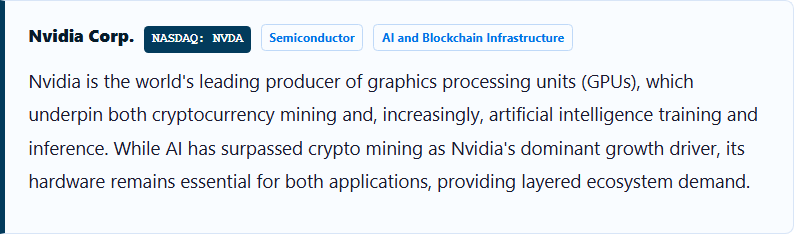
Nvidia’s data centre revenue surpassed $100 billion in annualised run rate by mid-2025, driven predominantly by AI training demand for its Hopper (H100/H200) and Blackwell GPU architectures. The cryptocurrency mining GPU market, while a smaller portion of Nvidia’s revenue than during the 2021 mining boom, continues to generate meaningful demand as altcoin miners upgrade to more efficient architectures. Nvidia’s stock appreciated substantially over 2024 and 2025, making it one of the best-performing stocks in the S&P 500 across both years, driven primarily by AI rather than crypto demand.
Key Strengths and Growth Prospects
Nvidia’s competitive moat in the GPU market, built through its CUDA software ecosystem over two decades, means that even as AMD and Intel develop competing products, the switching costs for developers and enterprises are extremely high. For blockchain investors, Nvidia represents an indirect play on both crypto mining and the broader digital asset infrastructure ecosystem. Its exposure to AI additionally provides a growth runway that is not dependent on cryptocurrency price cycles.
Read Also: Best Hardware Wallets for Cryptocurrency Storage
PayPal Holdings Inc. (PYPL)
2025 Developments
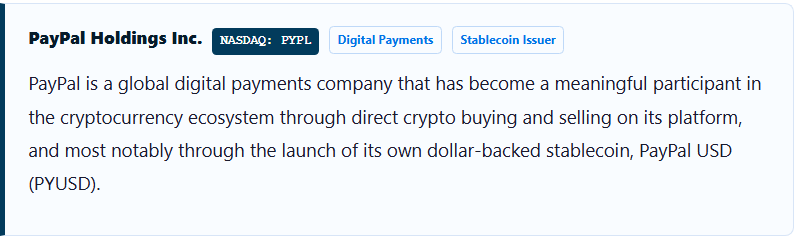
PayPal’s most significant 2025 blockchain development was the expansion of its PYUSD stablecoin infrastructure. After launching PYUSD on Ethereum in 2023 and Solana in 2024, PayPal accelerated PYUSD’s integration across payment networks in 2025. Solana’s partnership ecosystem in 2025 included PayPal, Shopify, Stripe, Visa, Cash App, and Western Union for real-time stablecoin payment infrastructure, positioning PYUSD as a potential cross-platform settlement currency. PayPal also benefited from the GENIUS Act’s passage in the US in 2025, which established the first federal stablecoin framework and legitimised dollar-backed stablecoins as payment infrastructure at the legislative level.
Key Strengths and Growth Prospects
PayPal’s 400-million-plus active user base gives it an unmatched distribution advantage for any new financial product it introduces, including stablecoins and crypto services. If PYUSD achieves scale as a payments stablecoin, it could provide a meaningful new revenue stream from float income on reserves and transaction fees. PayPal’s integration with DeFi infrastructure and cross-border payment corridors represents a potential long-term growth story that is still early in its development.
Read Also: Securing Blockchain: Smart Contract Auditing Essentials
Accenture PLC (ACN)
Key Strengths and 2025 Position
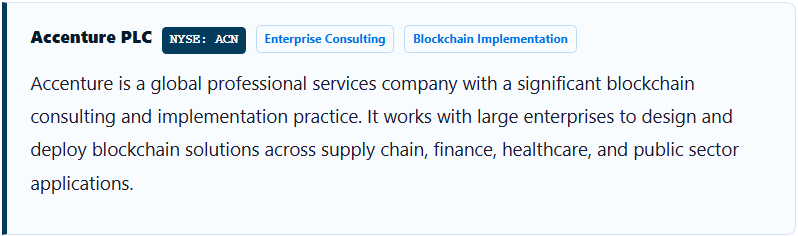
Accenture’s blockchain practice benefits from the accelerating enterprise adoption of distributed ledger technology. As the EU’s European Health Data Space regulation came into force in 2025 requiring robust consent, provenance, and data integrity systems, and as MiCA brought new compliance demands for financial institutions, demand for Accenture’s blockchain implementation expertise grew. The company has formed strategic alliances with IBM and other major technology platforms to deliver integrated blockchain solutions. Accenture’s revenue diversification across more than 120 countries and multiple industry verticals provides resilience that pure blockchain startups lack.
Growth Prospects for 2026
Accenture’s growth in blockchain consulting is tied to enterprise adoption cycles. As real-world asset tokenization grew 245% in 2025 to surpass $22.5 billion on-chain, financial services clients increasingly need consulting support for integrating tokenized assets into existing infrastructure. Accenture is well-positioned to capture this workflow given its existing banking and capital markets client relationships.
Read Also: Top 12 Stock Market Books for Novice Investors
International Business Machines Corp. (IBM)
Key Strengths and 2025 Position
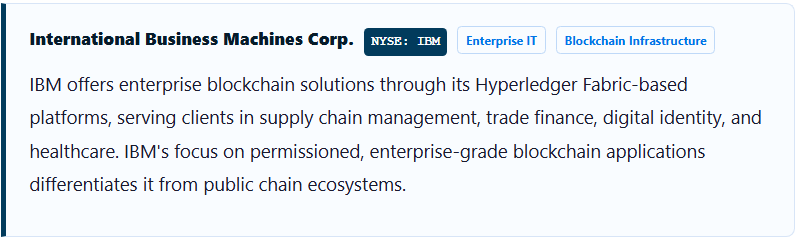
IBM’s TradeLens platform with Maersk, its Food Trust supply chain blockchain, and its digital identity solutions demonstrate real deployments at significant commercial scale. IBM’s integration of AI with its blockchain offerings through the watsonx platform creates additional value by enabling intelligent analysis of blockchain data alongside automated compliance and audit functions. The adoption of its Instana monitoring technology under India’s Ayushman Bharat Digital Mission, which created approximately 739.8 million digital health IDs by early 2025, also showcases IBM’s reach into large-scale national blockchain-adjacent implementations.
Growth Prospects for 2026
IBM’s growth in blockchain is tied to enterprise digital transformation cycles. As real-world asset tokenization, CBDC pilots, and cross-border payment infrastructure investments accelerate globally, IBM’s existing relationships with central banks, major financial institutions, and government agencies position it to win significant implementation work. IBM’s competitive advantage is its ability to deliver integrated solutions that combine blockchain infrastructure with AI, quantum computing research, and legacy system integration expertise that newer blockchain-native companies lack.
Advanced Micro Devices Inc. (AMD)
Key Strengths and 2025 Position
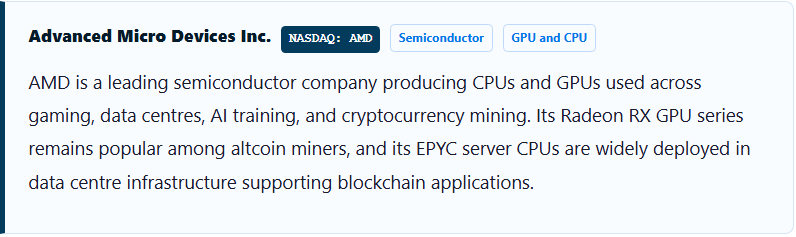
AMD’s primary blockchain relevance in 2025 is through GPU demand for altcoin mining (Kaspa, Ergo, Ravencoin) and increasingly through data centre GPUs for AI workloads at mining companies that are pivoting to HPC. HIVE Digital Technologies’ deployment of NVIDIA H100/H200 clusters for AI underscores how the mining-to-HPC transition is driving premium GPU demand from the very companies that previously drove AMD’s mining sales. AMD’s MI300 series accelerator chips, competing with Nvidia’s H100 for AI training workloads, represent its most important growth opportunity in the blockchain and AI infrastructure overlap.
Growth Prospects for 2026
AMD’s blockchain exposure in 2026 is more indirect than in prior cycles, as Bitcoin mining shifted entirely to ASICs years ago and AMD’s primary GPU market among miners is Ethereum-era miners who have largely pivoted to other coins or other applications. Its more important 2026 thesis is the broader AI accelerator market, where AMD is the primary challenger to Nvidia’s dominance.
DocuSign Inc. (DOCU)
Key Strengths and 2025 Position
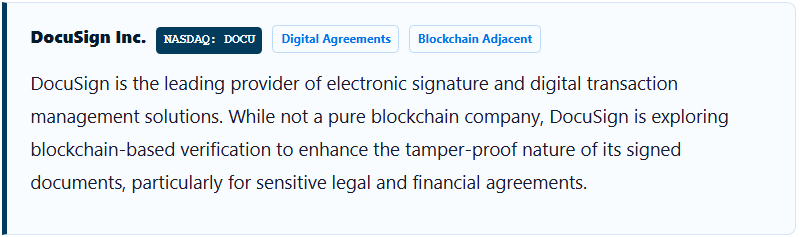
DocuSign’s blockchain exploration focuses on creating immutable, independently verifiable records of signed agreements that cannot be disputed even if the DocuSign platform itself were unavailable or compromised. As smart contract adoption grows in legal and financial services, DocuSign has a strategic opportunity to bridge traditional e-signature infrastructure with on-chain verification. The company’s extensive customer base across real estate, finance, healthcare, and legal services provides a built-in distribution network for any blockchain-enhanced features it deploys.
Growth Prospects for 2026
DocuSign’s blockchain exposure remains more potential than realised. Its primary growth catalysts for 2026 are in AI-powered contract analysis and the expansion of its Intelligent Agreement Management platform rather than pure blockchain features. Blockchain integration is most likely to appear as a verification and audit trail feature within its existing products rather than as a standalone blockchain product category.
Read Also: 15 Must-See Stock Market Movies about Wall Street
Bakkt Holdings Inc. (BKKT)
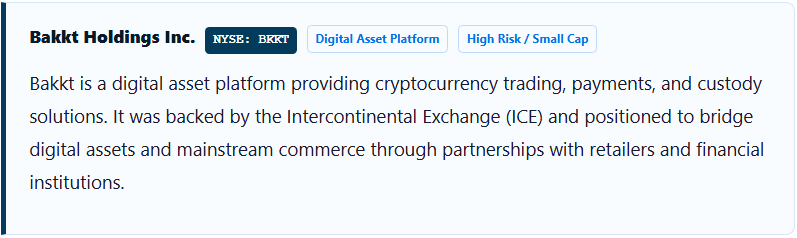
Important 2025 update: Bakkt underwent significant financial and operational difficulties in 2025. Investors considering BKKT should conduct thorough independent due diligence on the company’s current financial status, partnership roster, and business model before making any investment decisions. The company’s strategic direction and financial health have changed materially from its earlier positioning described in the original article.
Key Strengths and 2025 Position
Bakkt’s original thesis was compelling: using Intercontinental Exchange’s infrastructure credibility to bridge institutional and retail digital asset access. Its partnership with Starbucks for crypto-to-purchase conversion and its custody solutions for institutional clients represented genuine market needs. However, competitive pressure from Coinbase, Fidelity, and other established players with larger user bases and regulatory relationships has made Bakkt’s path to profitability more difficult.
Read Also: How Blockchain Sharding Boosts Scalability and Efficiency
What Key Factors Should You Consider Before Investing in Blockchain Stocks?
| Stock | Blockchain Role | BTC Price Correlation | Key 2025 Metric | Risk Level |
|---|---|---|---|---|
| COIN | Crypto exchange; stablecoin infrastructure | High (trading volume-driven) | $7.2B revenue; 156% trading volume growth | Medium-High |
| MARA | Bitcoin mining; BTC treasury | Very High | 52,850 BTC held; 60.4 EH/s hash rate | High |
| HIVE | Mining + HPC/AI services | High (declining as HPC grows) | $20M HPC annualised run rate target; 13 EH/s interim target | High |
| NVDA | GPU supplier (AI primary; crypto secondary) | Low-Medium | Data centre revenue above $100B annualised | Medium |
| IBM / ACN | Enterprise blockchain consulting and implementation | Low | Stable; blockchain is one revenue line among many | Low-Medium |
| PYPL | Stablecoin issuer (PYUSD); crypto payments | Low-Medium | PYUSD expansion across Solana payment ecosystem in 2025 | Medium |
Understanding the Company’s Role in Blockchain
The most important analytical step before investing in any blockchain stock is understanding exactly how the company makes money from blockchain and how dependent that revenue is on cryptocurrency prices. A miner like MARA is essentially a leveraged Bitcoin price bet wrapped in an equity structure: when Bitcoin rises, MARA typically outperforms Bitcoin; when Bitcoin falls, MARA typically underperforms. An enterprise company like Accenture earns consulting fees regardless of whether Bitcoin is at $50,000 or $100,000. Understanding this distinction prevents mismatched expectations.
Assessing Financial Health and Blockchain Strategy Integration
Investors should closely examine revenue growth, profitability, cash flow, and debt levels alongside the company’s strategic commitment to blockchain. Companies where blockchain is core to the business model, like Coinbase or MARA, will rise and fall with the sector. Companies where blockchain is one of many revenue lines, like IBM or Accenture, offer more stability. For long-term blockchain investing, the companies that demonstrate genuine product-market fit and diversified revenue streams tend to outlast those riding a single cryptocurrency price cycle.
What Are the Risk Factors in Blockchain Investments?
| Risk Type | Description | Stocks Most Affected |
|---|---|---|
| Bitcoin Price Risk | Bitcoin’s 36% correction from its October 2025 ATH caused mining company stocks to fall 40 to 60%+ from their own peaks | MARA, HIVE, RIOT, and all mining-focused stocks |
| Regulatory Risk | Improved significantly in 2025 (GENIUS Act, MiCA, SEC withdrawals) but not eliminated; future administrations could reverse policy | Coinbase most exposed; all crypto-native companies |
| Halving and Difficulty Risk | April 2024 halving cut block rewards 50%; Q1 2025 profitability for miners declined sharply; next halving around 2028 | All Bitcoin mining companies |
| Competitive Landscape Risk | Rapid technology evolution; new entrants; more efficient hardware depreciating older equipment | Mining companies, exchange companies, semiconductor firms |
| Lack of Historical Data | Blockchain industry is less than 15 years old; limited track record for long-term performance prediction; sector is still evolving rapidly | All blockchain stocks; especially pure-play companies |
Read Also: How to Diversify Your Cryptocurrency Portfolio
Frequently Asked Questions
Are blockchain stocks a good investment in 2026?
Blockchain stocks offer genuine exposure to the growing digital asset ecosystem, but carry higher risk than most traditional investments. Pure-play miners like MARA and HIVE are highly correlated with Bitcoin’s price. Technology platforms like Coinbase are subject to regulatory risk and trading volume cycles. Enterprise blockchain companies like IBM and Accenture offer more stability. The right choice depends on your risk tolerance, investment horizon, and whether you want direct Bitcoin price exposure or indirect blockchain infrastructure exposure.
What is the difference between buying blockchain stocks and buying Bitcoin directly?
Buying blockchain stocks provides exposure to companies in the crypto ecosystem within a regulated stock account with familiar investor protections. Bitcoin ETFs and mining company stocks can provide Bitcoin price exposure without requiring a crypto wallet. Direct Bitcoin ownership gives you actual ownership of the asset without company-level risk or operational costs. Mining companies carry additional risks including hardware depreciation, energy costs, management expenses, and equity dilution that reduce the per-share benefit of Bitcoin price appreciation compared to owning Bitcoin directly.
Which blockchain stocks have the most direct Bitcoin price exposure?
The stocks with the most direct Bitcoin price exposure are Bitcoin mining companies and companies with large Bitcoin treasury holdings. MARA Holdings holds approximately 52,850 BTC as of Q3 2025 and its stock price closely correlates with Bitcoin. Strategy (formerly MicroStrategy, MSTR), holding approximately 640,000 BTC, has the highest Bitcoin treasury exposure of any public company. HIVE Digital Technologies also provides Bitcoin price exposure through mining operations in Canada, Sweden, and Iceland.
What regulatory risks do blockchain stocks face in 2026?
Blockchain stocks face evolving regulatory risks across jurisdictions. The 2025 regulatory environment improved significantly with the GENIUS Act establishing the first US federal stablecoin framework, MiCA providing a unified EU licensing regime, and the SEC withdrawing major enforcement actions. However, regulatory risk has not been eliminated: future administrations could reverse policy, new asset classification guidance could emerge, and energy regulations could affect mining operations. Companies with proactive compliance programmes and diversified jurisdictional exposure are better positioned to navigate ongoing regulatory evolution.
What factors should I consider before investing in blockchain stocks?
Key factors include: the company’s specific role in the blockchain ecosystem and how directly its revenue depends on blockchain activity; financial health including revenue growth, profitability, and balance sheet strength; how much value depends on Bitcoin’s price (critical for miners and treasury holders); regulatory exposure in operating jurisdictions; competitive position and differentiation; management’s track record; and whether the stock trades at a premium or discount relative to its net asset value, particularly relevant for mining companies whose primary asset is Bitcoin or mining infrastructure.