The approval of spot Bitcoin exchange-traded funds (ETFs) by the US Securities and Exchange Commission in January 2024 was a watershed moment for the cryptocurrency industry. For the first time, investors in the United States could gain regulated, brokerage-account exposure to Bitcoin’s price movements without ever setting up a crypto exchange account, managing private keys, or navigating custodial risk. The door opened simultaneously for retail investors, registered investment advisors, pension funds, endowments, and institutional asset managers, all of whom had been waiting years for a compliant on-ramp.
The results exceeded even the most optimistic projections. Collectively, spot Bitcoin ETFs accumulated over $114 billion in total assets by the end of 2025, representing one of the most successful product launches in ETF history. BlackRock’s iShares Bitcoin Trust became the fastest-growing ETF ever launched, briefly crossing $100 billion in assets under management on its own. Major institutions, including Goldman Sachs, Morgan Stanley, and Wells Fargo now offer Bitcoin ETFs to qualified clients. Vanguard, a longtime crypto holdout, opened its brokerage platform to Bitcoin ETF trading for its 50 million customers in late 2025.
Yet with more than a dozen Bitcoin ETFs now available and more than 120 cryptocurrency-focused ETFs trading across US markets as of early 2026, choosing the right one is not as simple as it might appear. While all spot Bitcoin ETFs hold the same underlying asset and track its price, they differ meaningfully in expense ratios, custody arrangements, trading liquidity, options availability, and the type of investor they are best suited for.
This guide reviews the 10 best Bitcoin ETFs, covering both spot and futures-based options, with fully updated 2025 data on AUM, expense ratios, custody, and the investor profile each fund serves best.
Key Takeaways
Spot Bitcoin ETFs hold actual Bitcoin and track its price directly. Futures-based ETFs hold Bitcoin futures contracts and can diverge from spot price over time due to contract rolling costs.
Spot Bitcoin ETFs are far preferable for long-term investors. Futures-based ETFs are best suited to short-term tactical positions and hedging strategies.
Since all spot Bitcoin ETFs hold the same asset, the primary differentiators are expense ratio, trading liquidity, custody structure, and options availability.
BlackRock’s IBIT is the largest and most liquid spot Bitcoin ETF, making it the default choice for most investors. Grayscale’s Bitcoin Mini Trust (BTC) offers the lowest expense ratio at 0.15%.
Spot Bitcoin ETF total assets crossed $114 billion in December 2025, with IBIT alone accounting for roughly 60% of the category.
Bitcoin ETFs are taxed like stocks in a regular brokerage account: short-term gains at ordinary income rates, long-term gains at preferential capital gains rates. They are not subject to the complex on-chain tax tracking required for direct crypto ownership.
For maximum tax efficiency, consider holding Bitcoin ETFs in a tax-advantaged account such as a Roth IRA.
What Is a Bitcoin ETF?
An exchange-traded fund (ETF) is a type of investment fund that trades on a stock exchange like a share. It pools investor capital to buy a basket of underlying assets and issues shares that represent proportional ownership of that basket. ETFs offer the diversification of a fund combined with the intraday tradability of a stock.
A Bitcoin ETF applies this structure to Bitcoin exposure. Instead of buying and holding Bitcoin directly on a crypto exchange, an investor can buy shares of a Bitcoin ETF through any brokerage account, including an IRA or 401(k), using the same interface they use to buy Apple stock or an S&P 500 index fund. The ETF holds Bitcoin (or Bitcoin futures contracts) on the investor’s behalf and issues shares whose price tracks Bitcoin’s performance, minus the fund’s expense ratio.
This structure solves several challenges that have historically prevented institutional and mainstream retail investors from accessing Bitcoin. There is no need to set up a crypto exchange account, complete crypto-specific KYC, manage a digital wallet, secure private keys, or navigate the tax complexity of on-chain transactions. The ETF handles all of that, and shares can be held in existing brokerage and retirement accounts.
Spot Bitcoin ETFs vs Futures-Based Bitcoin ETFs
The single most important distinction to understand before evaluating any Bitcoin ETF is whether it is a spot fund or a futures-based fund. These are fundamentally different products despite both being labeled “Bitcoin ETFs.”
Feature
Spot Bitcoin ETF
Futures-Based Bitcoin ETF
What it holds
Actual Bitcoin in secure custody
Bitcoin futures contracts traded on CME
Price tracking
0.15% to 1.50% (most clusters at 0.20% to 0.25%)
Can diverge significantly from spot price over time due to rolling costs
Typical expense ratio
0.15% to 1.50% (most cluster at 0.20% to 0.25%)
0.95% or higher
Rolling costs
None
Ongoing cost of rolling expiring futures contracts into new ones (can be significant)
For the vast majority of investors seeking Bitcoin exposure over a medium to long time horizon, spot Bitcoin ETFs are the superior choice. They eliminate the structural performance drag inherent in futures rolling and provide cleaner, more direct price tracking. Futures-based ETFs serve a legitimate purpose for sophisticated traders who want leveraged exposure, inverse bets, or who were investing before spot ETFs became available, but for a buy-and-hold investor, the case for futures is weak.
The fee drag matters more than it looks. The difference between a 0.15% and a 0.95% expense ratio might seem trivial on a single year’s return. On a $50,000 investment over 10 years at Bitcoin’s historical average return rate, the compounding difference in fees can amount to thousands of dollars in reduced wealth. In a category where every fund holds the same underlying asset, fees are the primary driver of long-term performance differences.
How to Choose the Best Bitcoin ETF for Your Situation
Before reviewing individual funds, it helps to understand the key selection criteria that differentiate them.
Expense Ratio
The expense ratio is the annual fee charged as a percentage of assets under management, deducted automatically from the fund’s performance. Because all spot Bitcoin ETFs hold the same asset, a lower expense ratio almost always means better long-term returns, all else being equal. Current spot Bitcoin ETF expense ratios range from 0.15% (Grayscale Bitcoin Mini Trust) to 1.50% (GBTC). Most of the major new funds cluster between 0.20% and 0.25%.
Assets Under Management (AUM)
AUM reflects how much investor capital the fund has attracted. Higher AUM generally indicates greater investor confidence, but more importantly it drives liquidity. A fund with $70 billion in AUM will have dramatically tighter bid-ask spreads, deeper options markets, and more efficient execution than one with $500 million. For active traders, AUM is as important as expense ratio. For long-term passive investors who buy and hold, it matters less.
Liquidity and Trading Volume
Daily trading volume determines bid-ask spreads. A wide spread means you pay more to enter and receive less when you exit, eroding returns even if the expense ratio is low. IBIT’s median bid-ask spread is 0.02%, the tightest in the category, because of its enormous daily volume. Smaller funds may have spreads several times wider, which can matter significantly for larger position sizes.
Custody Structure
Who holds the Bitcoin on behalf of the ETF? Nine of the twelve U.S.-listed Bitcoin ETFs use Coinbase Custody as their custodian. Fidelity’s FBTC uses Fidelity Digital Assets, its own proprietary custody subsidiary. VanEck’s HODL uses Gemini. This matters for investors who are concerned about custodian concentration risk. If something were to go wrong at Coinbase (regulatory action, security failure, etc.), nine funds would be simultaneously affected.
Options Availability
Join UEEx
Experience the World’s Leading Digital Wealth Management Platform
Options trading on Bitcoin ETFs enables sophisticated strategies, including covered calls, protective puts, spreads, and cash-secured puts. The SEC approved options on IBIT in late 2024, and by 2025, several other funds also had listed options. However, IBIT’s options market is by far the deepest and most liquid. For investors interested in options-based income strategies on Bitcoin exposure, IBIT is the dominant choice.
Issuer Reputation and Track Record
Bitcoin ETF issuers range from the world’s largest asset manager (BlackRock, $10+ trillion in AUM) to dedicated crypto specialists (Bitwise, Grayscale) to established investment managers with crypto divisions (Fidelity, ARK, VanEck). Issuer reputation affects the likelihood of long-term fund viability, quality of operations, and investor services. Smaller funds from less-established issuers carry the risk of closure if assets do not reach a sustainable level.
The 10 Best Bitcoin ETFs to Buy Right Now
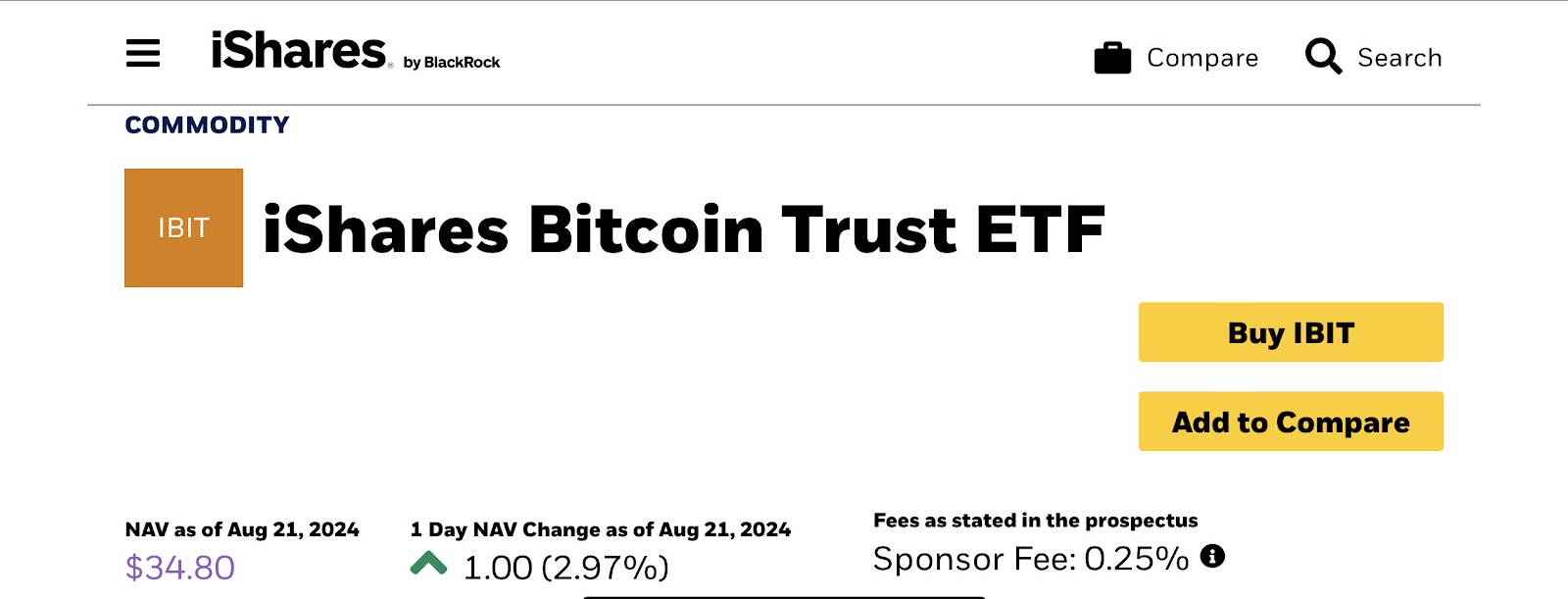
IBIT
iShares Bitcoin Trust ETF
BlackRock | NASDAQ | Spot
Expense Ratio
0.25%
AUM (approx.)
$70+ billion
Custodian
Coinbase
Options
Yes (Deep market)
Best For: Most Investors / Maximum Liquidity
iShares Bitcoin Trust, managed by BlackRock, is the largest and most liquid spot Bitcoin ETF in the world. It launched in January 2024 as one of the first SEC-approved spot Bitcoin ETFs and quickly became the fastest-growing ETF in history, attracting tens of billions in assets within months. By late 2025, IBIT held roughly 60% of all assets in the US spot Bitcoin ETF category, with over $70 billion in AUM.
IBIT holds Bitcoin directly through Coinbase Custody and tracks the CME CF Bitcoin Reference Rate New York Variant as its benchmark. Its 0.25% expense ratio is competitive with most other major spot funds. What truly sets IBIT apart is its liquidity: it trades over 50 million shares on average daily, with a median bid-ask spread of just 0.02%. This makes it the most efficient choice for large trades, institutional-scale positions, and active investors who enter and exit frequently.
IBIT was also the first spot Bitcoin ETF to receive SEC approval for options trading, and its options market has since developed the greatest depth and liquidity in the category, enabling sophisticated strategies like covered calls and protective puts for income-oriented Bitcoin investors.
Strengths
Largest AUM and deepest liquidity of any Bitcoin ETF
Tightest bid-ask spreads (0.02% median)
Most developed options market in the category
Backed by BlackRock, the world’s largest asset manager
Best For: Fidelity Customers / Self-Custody Preference
Fidelity Wise Origin Bitcoin Fund is the second-largest spot Bitcoin ETF, with roughly $17 to $21 billion in assets under management. It launched alongside IBIT in January 2024 and benefits enormously from Fidelity’s established brand recognition among retirement and retail investors.
FBTC’s most distinctive feature is its custody arrangement. Unlike the nine other major spot Bitcoin ETFs that rely on Coinbase Custody, FBTC’s Bitcoin is held in-house by Fidelity Digital Assets, Fidelity’s own regulated crypto custody subsidiary. For investors who are concerned about the systemic risk of so many funds depending on a single custodian, FBTC’s in-house arrangement represents genuine differentiation. Fidelity Digital Assets also provides investors with an integrated digital asset trading platform, making FBTC particularly convenient for Fidelity brokerage and IRA account holders who want a seamless, single-platform experience.
Performance between IBIT and FBTC has been virtually identical since both launched in January 2024. With the same 0.25% expense ratio, the choice between them often comes down to which brokerage platform you already use and whether the custody distinction matters to you.
Strengths
Unique in-house custody via Fidelity Digital Assets
Seamless for existing Fidelity brokerage and IRA customers
Fidelity’s trusted brand and robust investor services
Second-largest AUM and strong liquidity
Options available
Considerations
Same expense ratio as IBIT with lower liquidity
Less developed options market than IBIT
Most advantageous for existing Fidelity customers
3.BTC
Grayscale Bitcoin Mini Trust ETF
Grayscale | NYSE Arca | Spot
Expense Ratio
0.15%
AUM (approx.)
$4–5 billion
Custodian
Coinbase
Options
Yes
Best For: Cost-Conscious Long-Term Investors / Fee Minimizers
Grayscale Bitcoin Mini Trust, ticker BTC, holds the distinction of being the lowest-cost spot Bitcoin ETF available to US investors, with an expense ratio of just 0.15%. Grayscale launched it in August 2024 by spinning out roughly 10% of its legacy GBTC assets into this new, lower-cost vehicle, specifically designed to compete with the tight-fee products from BlackRock and Fidelity.
For long-term passive investors who buy and hold Bitcoin ETF shares for years or decades, the compounding benefit of a 0.15% expense ratio versus 0.25% is real and meaningful. On a $100,000 position held for 20 years, even a seemingly small 0.10% fee difference compounds into thousands of dollars of additional wealth retained.
BTC has options available and is backed by Grayscale, the most experienced pure-play digital asset manager in the industry, with over a decade of Bitcoin custody and management history. Its AUM is smaller than IBIT and FBTC, which means slightly wider bid-ask spreads, but for buy-and-hold investors who execute infrequently, this trading cost difference is negligible compared to the long-term fee savings.
Strengths
Lowest expense ratio of any US spot Bitcoin ETF (0.15%)
Backed by Grayscale’s decade-plus Bitcoin management experience
Options available
Ideal for tax-loss harvesting paired with IBIT or FBTC
Considerations
Lower AUM means slightly wider spreads than IBIT
Less liquid options market
May be overlooked by investors focused on GBTC’s legacy
4.BITB
Bitwise Bitcoin ETF
Bitwise Asset Management | NYSE Arca | Spot
Expense Ratio
0.20%
AUM (approx.)
$3.9–4.5 billion
Custodian
Coinbase
Options
Yes
Best For: Crypto-Informed Investors / Low-Fee Spot Exposure
Bitwise Bitcoin ETF stands as one of the most compelling options in the mid-tier of the spot Bitcoin ETF market. At a 0.20% expense ratio, BITB is cheaper than IBIT and FBTC, while remaining slightly more expensive than Grayscale’s Bitcoin Mini Trust. It launched alongside the other approved funds in January 2024 and has gathered a solid asset base of approximately $3.9 to $4.5 billion.
Bitwise Asset Management is one of the most respected pure-play crypto asset managers in the industry. Unlike BlackRock and Fidelity, which are broad financial institutions with crypto as one product line among thousands, Bitwise was built entirely around digital asset investing and brings deep cryptocurrency expertise to every aspect of its ETF operations. This focus appeals to more sophisticated crypto investors who value issuer specialization.
Bitwise also pledged to donate 10% of BITB’s profits to Bitcoin open-source development organizations, a differentiated commitment that resonates with the Bitcoin-native investor community. BITB has tight trading spreads for its asset size and options are available, though the options market is smaller than IBIT’s.
Strengths
0.20% expense ratio, below the 0.25% standard
Bitwise is a dedicated crypto asset specialist
Commitment to Bitcoin open-source funding
Options available
Solid four-year performance track record alongside spot peers
Considerations
Smaller AUM than top-tier funds
Less name recognition among non-crypto investors
Options market less liquid than IBIT
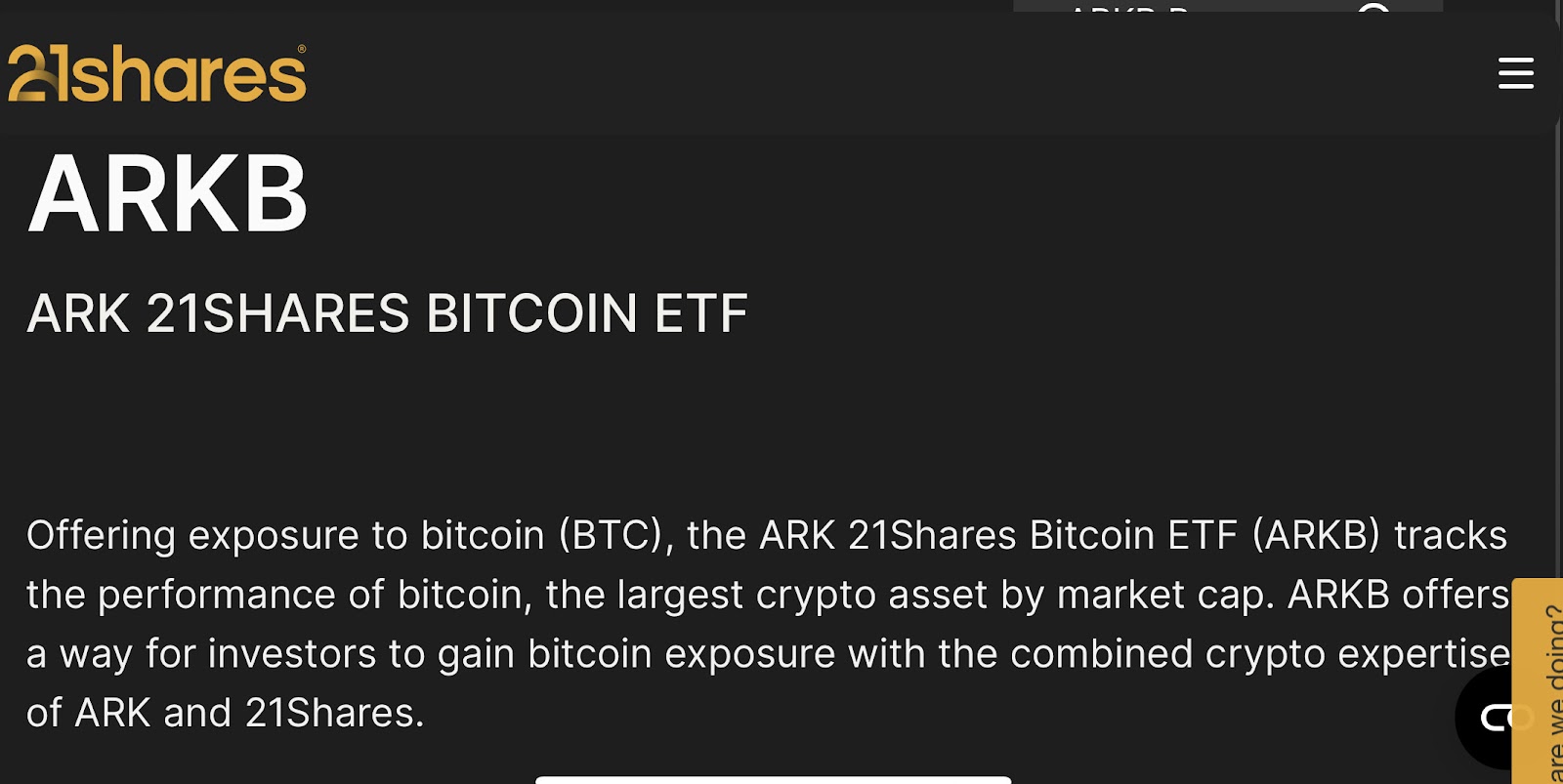
5. ARKB
ARK 21Shares Bitcoin ETF
ARK Invest / 21Shares | CBOE BZX | Spot
Expense Ratio
0.21%
AUM (approx.)
$3.6–4.7 billion
Custodian
Coinbase
Options
Yes
Best For: ARK Ecosystem Investors / Disruptive Innovation Focus
ARK 21Shares Bitcoin ETF is the product of a collaboration between ARK Invest, Cathie Wood’s flagship asset management firm known for its high-conviction bets on disruptive technology, and 21Shares, a Swiss digital asset ETP specialist with one of the longest track records in European crypto ETPs. Together they bring a distinctive investor profile: tech-forward, high-conviction, and long-term oriented.
ARKB’s 0.21% expense ratio is competitive, sitting between the 0.15% to 0.20% low-cost options and the 0.25% charged by IBIT and FBTC. It tracks the CME CF Bitcoin Reference Rate New York Variant and holds Bitcoin through Coinbase Custody. Performance has been virtually indistinguishable from other spot Bitcoin ETFs since launch, as expected given the identical underlying asset.
ARKB’s roughly $3.6 to $4.7 billion in AUM makes it the fifth or sixth largest spot Bitcoin ETF, with reasonable liquidity and options availability. For investors who already hold ARK funds and want their Bitcoin ETF to be held within the same ecosystem and investment philosophy, ARKB is the natural choice.
Strengths
Competitive 0.21% expense ratio
Strong brand affinity among growth and tech investors
21Shares brings deep international ETP expertise
Options available
Aligns naturally with ARK’s broader disruptive innovation thesis
Considerations
Slightly higher fee than BITB or BTC
Smaller AUM than top-tier funds
Options market less developed than IBIT
6. HODL
VanEck Bitcoin Trust
VanEck | CBOE BZX | Spot
Expense Ratio
0.20% (waived to 0% until Jul 2026 or $2.5B AUM)
AUM (approx.)
~$1.4–1.6 billion
Custodian
Gemini
Options
Limited
Best For: Fee-Sensitive Investors / Gemini Custody Preference
VanEck Bitcoin Trust earns a special place on this list for two reasons: its memorable ticker HODL, a direct nod to the Bitcoin community’s defining investment philosophy, and a fee waiver that makes it effectively free to hold during the waiver period. VanEck pledged to waive HODL’s 0.20% expense ratio entirely until July 31, 2026 (or until the fund’s assets reach $2.5 billion, whichever comes first). With approximately $1.4 billion in AUM at the time of writing, the waiver is still in effect, meaning current holders pay 0% in annual fees.
HODL is also one of only two major spot Bitcoin ETFs that does not use Coinbase as its custodian. VanEck partners with Gemini Custody, offering investors a meaningful alternative to the Coinbase-dominant custody landscape of the category.
VanEck is also committed to donating 5% of HODL’s profits to Bitcoin developers, mirroring Bitwise’s community-oriented commitment. HODL’s AUM is smaller than the top funds, which means slightly wider spreads and a thinner options market, but for cost-conscious buy-and-hold investors during the fee waiver period, the value proposition is difficult to beat.
Strengths
0% expense ratio during fee waiver (until July 2026 or $2.5B AUM)
Gemini custody (non-Coinbase differentiation)
VanEck’s strong track record and asset management reputation
5% of profits donated to Bitcoin open-source development
Considerations
Standard 0.20% fee applies after waiver ends
Lower AUM means wider spreads and thinner options market
Less institutional recognition than IBIT or FBTC
7. GBTC
Grayscale Bitcoin Trust ETF
Grayscale | NYSE Arca | Spot (converted from trust)
Expense Ratio
1.50%
AUM (approx.)
$14–20 billion
Custodian
Coinbase
Options
Yes
Best For: Legacy Holders with Embedded Gains / Institutional History
Grayscale Bitcoin Trust is the original Bitcoin institutional investment vehicle, launched in 2013 as a private closed-end trust before converting to an ETF in January 2024 when the SEC approved spot Bitcoin ETFs. It was the dominant way for institutional and accredited investors to gain Bitcoin exposure through traditional financial accounts for over a decade before alternatives existed.
GBTC’s defining challenge post-conversion is its 1.50% expense ratio, which is six times higher than the lowest-cost spot Bitcoin ETFs. This fee level is a legacy of its closed-end trust structure and the near-monopoly pricing it maintained before competition arrived. Since conversion, GBTC has experienced significant net outflows as investors rotate into lower-cost alternatives, losing tens of billions in assets to IBIT and FBTC in the process. To address this, Grayscale created the Bitcoin Mini Trust (BTC) as its low-cost product line while maintaining GBTC for legacy holders.
The reason GBTC remains on this list is that its high fee structure actually serves a specific investor: those who have held GBTC since the trust era and have large unrealized capital gains. Selling GBTC to buy a cheaper fund would trigger a taxable event on those gains. For these holders, the cost of the tax may exceed the cost of staying in GBTC, at least for the near term. Fresh capital, however, should almost never flow into GBTC when cheaper alternatives exist.
Strengths
Decade-plus track record and institutional recognition
Large AUM provides strong liquidity
Grayscale’s deep crypto expertise
Options available
Considerations
1.50% expense ratio is by far the highest in the spot Bitcoin ETF category
New investors should generally choose a lower-cost alternative
Ongoing net outflows as investors rotate to cheaper funds
8. BTCO
Invesco Galaxy Bitcoin ETF
Invesco & Galaxy Digital | CBOE BZX | Spot
Expense Ratio
0.25%
AUM (approx.)
~$555 million
Custodian
Coinbase
Options
Limited
Best For: Invesco Platform Investors / Galaxy Digital Ecosystem
Invesco Galaxy Bitcoin ETF is a joint product of Invesco, the fourth-largest US ETF issuer by AUM, and Galaxy Digital, the prominent crypto-native financial services firm led by Mike Novogratz. The combination of Invesco’s institutional distribution network and Galaxy Digital’s deep cryptocurrency expertise made BTCO one of the more highly anticipated launches among the January 2024 cohort.
Despite those credentials, BTCO has attracted more modest assets than its backers’ reputations might suggest, with approximately $555 million in AUM. This is partly a result of the fierce competition from IBIT and FBTC and partly because BTCO’s 0.25% expense ratio does not give it a fee advantage over the dominant funds. For investors who use Invesco-managed products extensively or who want to access Galaxy Digital’s market expertise within an ETF wrapper, BTCO offers a credible option. Its trading spreads are somewhat wider than the top-tier funds given its smaller asset base.
Strengths
Backed by Invesco’s institutional reach and Galaxy Digital’s crypto expertise
Solid issuer reputation and operational quality
Familiar to Invesco platform investors
Considerations
Lower AUM limits liquidity relative to top-tier funds
0.25% expense ratio offers no fee advantage
Has not gained the traction initially expected
9. BITO
ProShares Bitcoin Strategy ETF
ProShares | NYSE Arca | Futures-Based
Expense Ratio
0.95%
AUM (approx.)
~$1.8 billion
Structure
Bitcoin Futures (CME)
Launched
October 2021
Best For: Tactical Short-Term Positions / Pre-2024 Legacy Holders
ProShares Bitcoin Strategy ETF holds the distinction of being the first US-listed Bitcoin ETF, launching in October 2021 after the SEC, which had long resisted approving spot Bitcoin ETFs, greenlighted futures-based products. BITO attracted over $1 billion in its first two days of trading, demonstrating the enormous pent-up investor demand that had built up over years of regulatory delays.
BITO is a futures-based ETF, meaning it does not hold actual Bitcoin. Instead it holds CME Bitcoin futures contracts and rolls them continuously as they approach expiration. This structure introduces two structural costs that spot ETFs do not have: the 0.95% expense ratio (nearly four times higher than the lowest-cost spot funds) and the rollover cost from continuously selling expiring futures and buying new ones. In markets where futures trade at a premium to spot price (a condition called contango), rolling futures adds a persistent performance drag.
For long-term buy-and-hold investors, BITO is inferior to spot ETFs on almost every dimension: higher fees, potential price divergence from spot Bitcoin, and more complex tax treatment. However, BITO serves a legitimate purpose for short-term tactical traders, those who want intraday exposure using existing brokerage accounts that were accessible before 2024, and sophisticated investors running specific futures-based strategies. Its deep liquidity, well-established options market, and track record since 2021 make it a functional tool for these purposes.
Strengths
First US Bitcoin ETF with a multi-year track record
Deep liquidity and well-established options market
Accessible at virtually every brokerage platform
Useful for tactical short-term positions and derivatives strategies
Considerations
0.95% expense ratio is nearly 4x higher than best spot ETFs
Structural futures rolling costs add additional drag beyond the stated ratio
Can diverge significantly from Bitcoin’s spot price over time
Not recommended for long-term passive Bitcoin exposure
10.BRRR
CoinShares Valkyrie Bitcoin Fund
CoinShares | NASDAQ | Spot
Expense Ratio
0.25%
AUM (approx.)
~$544 million
Custodian
Coinbase
Options
Limited
Best For: European Institutional Crossover / CoinShares Ecosystem
CoinShares Valkyrie Bitcoin Fund (BRRR) represents the US market presence of CoinShares, one of Europe’s leading digital asset investment companies with operations across France, Sweden, and the United Kingdom. CoinShares acquired Valkyrie, which had originally launched this fund under the same ticker, and retained the BRRR ticker as part of the integration.
BRRR tracks the CME CF Bitcoin Reference Rate New York Variant, the same benchmark used by ARKB, and charges a 0.25% expense ratio. With approximately $544 million in AUM, it sits in the smaller tier of the spot Bitcoin ETF market. Its appeal lies primarily in CoinShares’ established European institutional relationships and its positioning as a bridge product for European asset managers seeking a US-listed vehicle that aligns with issuers they already know from the European ETP market.
For most US retail investors, BRRR does not offer compelling advantages over IBIT, FBTC, BTC, or BITB. Its differentiated value is most evident for institutional investors with existing CoinShares relationships or those building cross-Atlantic exposure strategies.
Strengths
CoinShares’ deep European digital asset management expertise
Strong positioning for cross-Atlantic institutional investors
Tracks the same well-established benchmark as ARKB
Considerations
Lower AUM limits liquidity
No fee or structural advantage over top-tier US competitors
Limited options market
Best suited to specific institutional use cases
Quick-Reference Comparison: All 10 Bitcoin ETFs Side by Side
Ticker
Issuer
Type
Expense Ratio
AUM (approx.)
Custodian
Best For
IBIT
BlackRock
Spot
0.25%
$70B+
Coinbase
Most investors, max liquidity
FBTC
Fidelity
Spot
0.25%
$17–21B
Fidelity Digital Assets
Fidelity customers, in-house custody
BTC
Grayscale
Spot
0.15%
$4–5B
Coinbase
Fee minimizers, long-term holders
BITB
Bitwise
Spot
0.20%
$3.9–4.5B
Coinbase
Crypto-native investors, low fees
ARKB
ARK / 21Shares
Spot
0.21%
$3.6–4.7B
Coinbase
ARK investors, innovation focus
HODL
VanEck
Spot
0.20% (waived to 0%)
$1.4–1.6B
Gemini
Fee-sensitive, Gemini custody
GBTC
Grayscale
Spot
1.50%
$14–20B
Coinbase
Legacy holders with embedded gains
BTCO
Invesco/Galaxy
Spot
0.25%
~$555M
Coinbase
Invesco platform, Galaxy ecosystem
BITO
ProShares
Futures
0.95%
~$1.8B
N/A (futures)
Tactical short-term traders, hedging
BRRR
CoinShares
Spot
0.25%
~$544M
Coinbase
European institutional crossover
Bitcoin ETF Tax Treatment
One of the most important advantages of owning Bitcoin through a regulated ETF rather than directly on a crypto exchange is the simplicity of the tax treatment. Bitcoin ETF shares are taxed like stocks and bonds, using the same rules that apply to every other investment in a standard brokerage account.
Short-term capital gains apply to ETF shares held for one year or less before selling. These gains are taxed at your ordinary income rate (10% to 37% for 2025).
Long-term capital gains apply to ETF shares held for more than one year. These are taxed at the preferential long-term rates of 0%, 15%, or 20% depending on your total taxable income.
No per-transaction tracking required. Unlike holding Bitcoin directly, where every trade, purchase, or staking reward creates a separate taxable event that must be tracked and reported, a Bitcoin ETF held in a brokerage account only generates a taxable event when you sell your shares.
Tax-advantaged accounts. Holding a Bitcoin ETF in a Traditional or Roth IRA defers or eliminates capital gains tax on Bitcoin’s appreciation, which can be extraordinarily powerful given Bitcoin’s historical volatility and return profile. A Roth IRA holding IBIT that grows from $5,000 to $50,000 over 15 years would generate zero federal tax on that $45,000 gain at qualified withdrawal.
Tax-loss harvesting. Because multiple spot Bitcoin ETFs track the same asset (Bitcoin), you can sell one fund at a loss to realize a capital loss for tax purposes and immediately purchase a different fund (for example, sell IBIT and buy FBTC) to maintain Bitcoin exposure. This is possible because the two funds are from different issuers and are not “substantially identical” under current IRS interpretation, avoiding the wash sale rule. This strategy can allow investors to harvest losses during Bitcoin downturns while staying fully invested.
Tax-loss harvesting with Bitcoin ETFs:
Selling IBIT at a loss and immediately buying FBTC (or vice versa) maintains your Bitcoin exposure while realizing a tax-deductible capital loss. Current IRS rules have not defined spot Bitcoin ETFs from different issuers as “substantially identical,” making this strategy available to investors in a way that it would not be if you owned Bitcoin directly and tried to sell and immediately repurchase the same coin.
Risks to Consider Before Investing in Bitcoin ETFs
Bitcoin ETFs reduce several of the operational and custodial risks of direct Bitcoin ownership, but they do not eliminate the underlying asset’s risks. Every investor should understand these before committing capital.
Bitcoin price volatility. Bitcoin has experienced drawdowns of 70% to 90% from peak to trough in multiple historical bear markets. An investment in any Bitcoin ETF is fully exposed to this volatility. Only capital that you can genuinely afford to lose or hold through extended drawdowns belongs in a Bitcoin position.
Regulatory risk. While the SEC’s approval of spot Bitcoin ETFs was a landmark shift, the regulatory environment for cryptocurrency in the United States and globally remains subject to change. Future policy developments could affect the operation, tax treatment, or legal status of Bitcoin ETFs.
Custodian concentration risk. Nine of twelve US spot Bitcoin ETFs custody their Bitcoin at Coinbase. Any significant operational, regulatory, or security event at Coinbase could simultaneously affect the majority of the spot Bitcoin ETF market, at least in the short term.
Tracking error. Spot ETFs track Bitcoin’s price very closely, but small deviations can occur due to the timing of creations and redemptions, the mechanics of NAV calculation, and the expense ratio drag. Futures-based ETFs can diverge far more significantly from spot price over extended periods.
Expense ratio drag on returns. Even a 0.25% annual expense ratio compounds over time. Over 20 years on a large position, the cumulative cost of the fee is meaningful. This is why choosing the lowest reasonable expense ratio matters for long-term investors.
Liquidity risk for smaller funds. Funds with very low AUM may face closure if they do not reach a sustainable asset threshold. Investors in smaller funds should monitor AUM trends. A fund closure would return capital to investors at NAV, but the timing may be inconvenient.
Important risk reminder:
Bitcoin ETFs expose investors to the full price volatility of Bitcoin. Past performance, including extraordinary historical returns, does not guarantee future results. Do not invest more than you are prepared to hold through a multi-year drawdown of 50% to 80% or more. Financial advisors generally recommend limiting speculative assets like Bitcoin to a small percentage of a diversified portfolio.
Join UEEx
Experience the World’s Leading Digital Wealth Management Platform
The question of whether to hold a Bitcoin ETF or buy Bitcoin directly on an exchange is one that many investors will encounter. The right answer depends on your priorities.
Factor
Bitcoin ETF
Direct Bitcoin Ownership
Custody and security
ETF handles custody; no private key management required
You are responsible for securing your own private keys
Account access
Standard brokerage account, IRA, 401(k)
Crypto exchange account or self-custody wallet
Tax complexity
Standard capital gains, only when you sell shares
Every transaction (trade, purchase, staking) is a taxable event requiring detailed tracking
Annual cost
Expense ratio (0.15% to 1.50%)
Exchange trading fees only; no ongoing management fee
True ownership
No direct ownership of Bitcoin; ETF holds it on your behalf
You own actual Bitcoin and control it directly
Self-sovereignty
Dependent on the ETF issuer and custodian
Complete self-sovereignty with hardware wallet
On-chain utility
None (cannot use in DeFi, lightning network, etc.)
Full access to all Bitcoin network functionality
Best for
Traditional investors, IRA holders, those who want simplicity
Bitcoin ETFs have fundamentally changed the accessibility of Bitcoin as an investment asset. The January 2024 SEC approvals opened the door to a wave of institutional capital and mainstream investor participation that has already transformed the Bitcoin market structure. With over $114 billion in collective assets by the end of 2025, spot Bitcoin ETFs have validated the long-held thesis that regulated, traditional-finance-compatible Bitcoin exposure would attract enormous demand.
Join UEEx
Experience the World’s Leading Digital Wealth Management Platform
For most investors seeking Bitcoin exposure through a brokerage account, the choice comes down to a handful of well-differentiated options. IBIT offers unmatched liquidity and the deepest options market. FBTC provides the unique advantage of Fidelity’s in-house custody and seamless integration for Fidelity customers. Grayscale’s Bitcoin Mini Trust (BTC) delivers the lowest expense ratio in the category at 0.15%. BITB and ARKB offer competitive fees with the added appeal of crypto-specialist and disruptive-innovation issuer brands. HODL is temporarily free to hold during VanEck’s ongoing fee waiver. GBTC remains the right choice only for legacy holders with significant tax-trapped gains who cannot afford the tax cost of switching. BTCO and BRRR serve specific institutional audiences. BITO remains useful only for short-term tactical traders who do not need the long-term efficiency of spot funds.
Whatever fund you choose, ensure it aligns with your investment horizon, fee sensitivity, brokerage platform, and tax situation. For long-term retirement savings, explore holding your chosen Bitcoin ETF in a tax-advantaged account. And always size your Bitcoin allocation to what you can genuinely afford to hold through Bitcoin’s historically extreme volatility cycles.
Abeeb is a goal-oriented content writer with over 4 years of experience in crafting compelling and insightful content across various genres, including tech, news, entertainment, and blockchain. Known for building strong connections with clients and stakeholders, Abeeb is dedicated to delivering clear, concise, and impactful writing that captivates audiences.
Disclaimer: This article is intended solely for informational purposes and should not be considered trading or investment advice. Nothing herein should be construed as financial, legal, or tax advice. Trading or investing in cryptocurrencies carries a considerable risk of financial loss. Always conduct due diligence before making any trading or investment decisions.
Trade with proof of Reserves
UEEx publish monthly audits and third party verification on every listed market.