Crypto trading moves fast, 24 hours a day, and it can be hard to keep up. Prices can jump or drop in minutes, and missing the right moment can cost you.
This is where crypto trading bots come in. These smart tools can automatically buy and sell cryptocurrencies based on rules you set, working tirelessly day and night. They react instantly to market changes, follow strategies without emotion, and help traders take advantage of opportunities they might otherwise miss.
In this guide, we’ve simply broken down everything you need to know about crypto trading bot strategies. You’ll learn about the most popular strategies, how to manage risk safely, the best platforms to use, and how to choose a strategy that fits your experience, capital, and time.
By the end, you’ll be ready to use trading bots to trade smarter, stay consistent, and make the most of the fast-moving crypto market.
Key Takeaway
- Crypto trading bots can monitor the market 24/7, execute trades instantly, and remove emotions from your trading decisions.
- Beginners should stick to simple bots, intermediate traders can explore trend or scalping strategies, and advanced traders can use custom or AI-driven bots for maximum flexibility.
- Using proper trade sizing, stop-losses, take-profits, and avoiding over-leverage ensures your bot can trade safely over the long term.
- Even automated trading requires monitoring, adjustments, and periodic evaluation to keep strategies effective and prevent unnecessary losses.
What is a crypto trading bot?

A crypto trading bot is a software program that automatically buys and sells cryptocurrencies for you.
Instead of placing trades manually, you tell the bot what rules to follow. The bot then watches the market and executes trades on your behalf when those rules are met.
Trading bots connect to crypto exchanges (like Binance or Coinbase) using secure API keys. Once connected, they can read market data and place trades without needing constant human input.
What a trading bot strategy means
A trading bot strategy is the set of rules and logic that tells the bot when to buy, when to sell, and when to do nothing. Think of a strategy as the bot’s “instruction manual.”
- A trading bot strategy usually includes:
- Entry rules (when to buy)
- Exit rules (when to sell)
- Risk rules (how much money to use per trade)
- Market conditions (trend, range, volatility)
For example, a simple strategy might be:
- Buy when the price drops by 5%
- Sell when the price rises by 5%
- Stop trading if losses reach a certain limit
Different strategies work in different market conditions. Some strategies perform well when prices move sideways, while others are better during strong uptrends or downtrends.
Popular types of crypto trading bot strategies
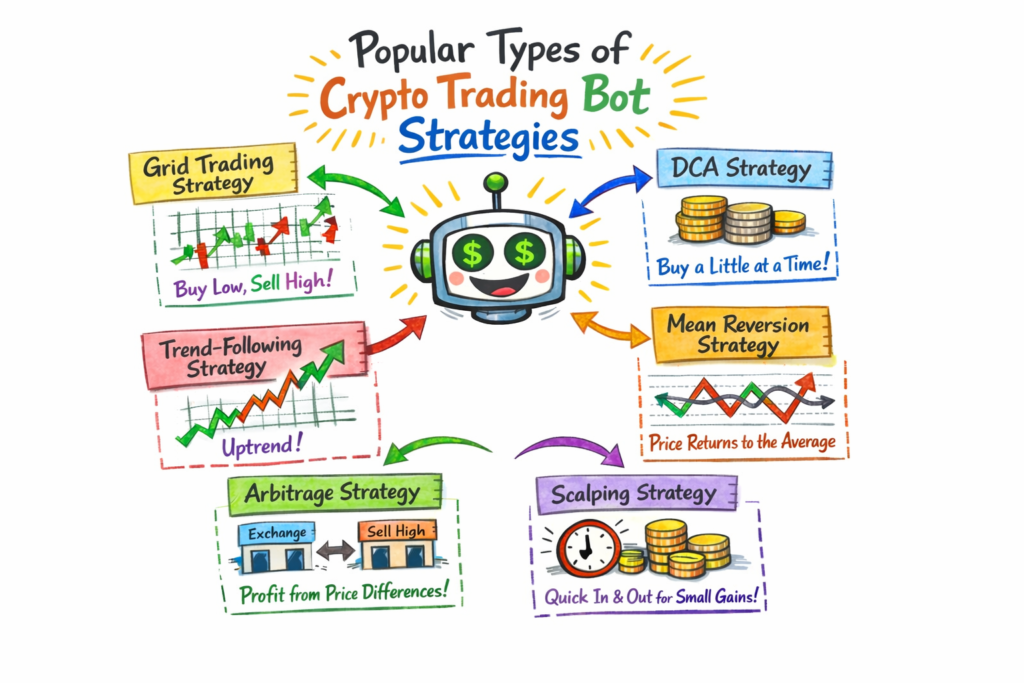
There are many types of crypto trading bot strategies, but most of them fall into a few common categories. Each strategy is designed for a specific market condition and trading goal. Below are the most popular and widely used bot strategies, explained in a simple and clear way.
Grid trading strategy
Grid trading is one of the most popular and beginner-friendly crypto bot strategies. It works by placing multiple buy and sell orders at different price levels within a set price range.
Instead of trying to predict the market direction, the bot profits from normal price movements. Grid bots do not perform well during strong breakouts or sudden crashes, because prices may move outside the grid range.
Pros
- Easy to understand and set up
- Can generate steady small profits
- Does not require predicting market direction
Risks
- Large price moves can break the grid
- Poor performance in strong trends
- Trading fees can reduce profits if not managed
Dollar-cost averaging (DCA) strategy
The DCA strategy involves buying crypto gradually over time instead of all at once. DCA bots automate this process by placing regular buy orders based on set rules.
This strategy is commonly used by long-term investors rather than short-term traders.
Pros
- Reduces the risk of buying at the wrong time
- Simple and beginner-friendly
- Good for long-term investing
- Helps manage emotional trading
Cons
- Not designed for short-term profits
- Can suffer losses in long bear markets
- Requires patience and long holding periods
- Misses profits from active trading opportunities
Trend-following strategy
Trend-following strategies aim to profit by trading in the direction of the market trend. Instead of buying low and selling high in ranges, these bots buy when prices are rising and sell when prices start falling. These bots try to capture larger price moves rather than small frequent trades.
Pros
- Captures large price moves
- Works well in strong bull or bear markets
- Clear rules for entry and exit
- Scales well with larger capital
Cons
- Performs poorly in sideways markets
- Can enter trades late after the trend starts
- False signals can cause losses
- Requires good stop-loss management
Mean reversion strategy
Mean reversion strategies are based on the idea that prices often return to their average level after moving too far up or down.
This strategy focuses on buying when prices are unusually low and selling when prices are unusually high. This approach works best when markets move in cycles rather than strong trends.
Pros
- Effective in range-bound markets
- Clear “buy low, sell high” logic
- Can produce frequent trading opportunities
- Easy to automate using indicators
Cons
- Fails during strong trends
- Requires accurate timing
- Can suffer repeated losses if the market keeps moving in one direction
- Needs careful parameter tuning
Also Read: Automated Crypto Trading bots
Arbitrage strategy
Arbitrage strategies take advantage of price differences for the same cryptocurrency across different exchanges or markets.
Instead of predicting price direction, arbitrage bots focus on price mismatches. An arbitrage bot buys a crypto asset on an exchange where the price is lower, sells the same asset on another exchange where the price is higher and locks in the price difference as profit.
Pros
- Does not rely on market direction
- Lower exposure to market volatility
- Can generate consistent small profits
- Useful in inefficient markets
Cons
- Opportunities disappear quickly
- Fees can remove profit margins
- Requires fast execution and large capital
- Exchange and transfer risks apply
Scalping strategy
Scalping strategies focus on making many small trades to capture tiny price movements. Scalping bots aim for speed and volume rather than large profits per trade.
Scalping bots open and close trades within seconds or minutes, target very small price changes and place many trades throughout the day.
Pros
- Generates many trading opportunities
- Short exposure time reduces overnight risk
- Can work in most market conditions
- Profits accumulate from many small trades
Cons
- Highly sensitive to trading fees
- Requires fast and reliable execution
Tools and platforms for bot strategies
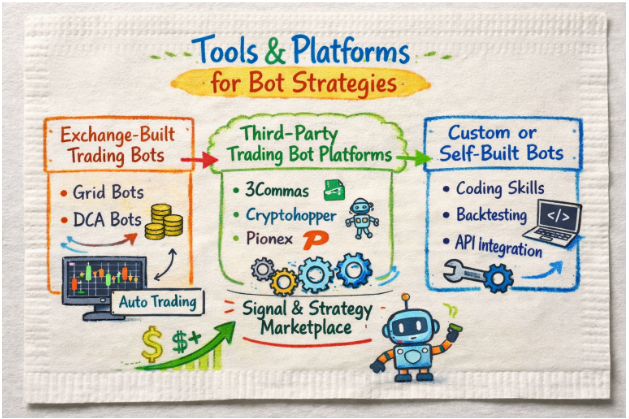
To use a crypto trading bot strategy, you need the right tools or platforms to run it. These tools determine how trades are executed, how much control you have, and how easy the setup process will be.
Broadly, trading bots fall into three main categories: exchange-built bots, third-party bot platforms, and custom or self-built bots.
Exchange-built trading bots
Exchange-built trading bots are bots that are provided directly by crypto exchanges. Many major exchanges now offer built-in bot features such as grid trading, DCA bots, and copy trading.
These bots are usually easy to access and set up since they are already integrated into the exchange’s trading interface. Traders do not need to connect external services or manage complex technical settings. Because the bots are part of the exchange, execution is fast and there is no need to worry about API connection issues.
Pros
- Very easy to set up and use
- No need for API connections or external tools
- Fast trade execution since bots run directly on the exchange
Cons
- Limited strategy options and customization
- Only works on the specific exchange offering the bot
- Little control over advanced settings
Also Read: Top 8 Volume Indicators for Traders
Third party trading bot platforms
Third party trading bot platforms are independent services that connect to multiple exchanges using API keys. These platforms typically offer a wide range of strategies, automation features, and user-friendly interfaces.
Many third party platforms provide pre built strategies, backtesting tools, and performance analytics. Backtesting means testing your trading bot strategy on past market data to see how it would have performed.
This is one of the most important steps before using real money. Backtesting helps you understand how a strategy reacts to different market conditions such as bull runs, crashes, and sideways markets.
It allows you to spot weaknesses, adjust settings, and reduce risk. No trader, beginner or experienced should skip backtesting. It is a mandatory step before going live.
This makes them popular with traders who want more control than exchange built bots but do not want to build a bot from scratch.
Pros
- Works with multiple exchanges from one dashboard
- Offers more strategy types and settings than exchange bots
- Often includes backtesting and performance tracking
Cons
- Usually requires a paid subscription
- Requires API access, which introduces security risks
- Dependent on the reliability of the platform
Custom or self-built bots
Custom or self-built bots are created by traders themselves using programming languages or open-source frameworks. These bots offer the highest level of flexibility and control.
With a self-built bot, traders can design unique strategies, use custom indicators, connect to multiple data sources, and fine-tune execution logic. This approach is ideal for experienced traders or developers who want full ownership of their strategy and infrastructure.
Pros
- Full control over strategies and execution logic
- Highly customizable and flexible
- Can integrate custom indicators and data sources
Cons
- Requires programming and technical knowledge
- Time-consuming to build, test, and maintain
- Higher risk of bugs or system failures
Risk management in bot trading strategies
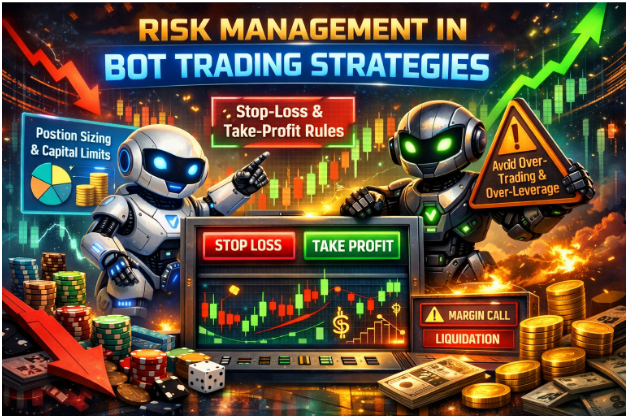
Risk management is one of the most important parts of any crypto trading bot strategy. Even a well-designed bot can fail if proper risk controls are not in place.
Because bots trade automatically and can place many trades quickly, losses can grow fast when the market moves against a strategy. Good risk management helps protect capital and keeps losses under control so trading can continue over the long term. Follow these risks management for better results.
Position sizing and capital limits
Position sizing refers to how much money a trading bot uses for each trade. Capital limits define how much of the total account balance the bot is allowed to risk at any time. Choosing the right position size is one of the most effective ways to control risk, even more important than finding perfect entry points.
When position sizes are too large, a few bad trades can cause heavy losses. When they are controlled properly, losses remain small and manageable, allowing the strategy to perform as intended over time.
Stop-loss and take-profit rules
Stop-loss and take-profit rules define when a trading bot should exit a trade. A stop-loss sets a maximum acceptable loss, while a take-profit locks in gains once a target price is reached.
For example, a bot may be set to exit a trade if the price drops by 3% or to take profit when the price rises by 5%. These rules prevent losses from becoming too large and ensure profits are secured instead of being lost to sudden market reversals.
In automated trading, stop-loss rules are especially important because bots cannot rely on human judgment in real time. Clear exit rules remove emotions from trading and help maintain consistency across many trades.
Avoiding over-trading and over-leverage
Over-trading happens when a bot places too many trades in a short period, often in response to small or unclear signals. This can lead to excessive fees, lower trade quality, and faster capital loss. Limiting how often a bot trades helps maintain discipline and improves overall performance.
Over-leverage occurs when borrowed funds are used to increase trade size. While leverage can increase profits, it also magnifies losses and raises the risk of liquidation. In highly volatile crypto markets, excessive leverage can wipe out an account very quickly.
To manage these risks, traders should limit the number of trades a bot can place, set daily or weekly loss limits, and use low or no leverage, especially when starting out. Pausing or adjusting the bot during extreme market conditions is also an important safety measure.
Why risk management is important
Crypto markets are highly volatile and unpredictable. Prices can rise or fall sharply within minutes due to news, large trades, or sudden shifts in market sentiment. Without risk management, a trading bot may continue to trade during unfavorable conditions and quickly drain an account.
Risk management exists to protect trading capital and limit the impact of losing trades. It helps ensure that no single trade or short losing streak can cause major damage.
By controlling risk, traders give their bot the ability to survive market downturns and recover when conditions improve. In the long run, staying in the market is often more important than chasing quick profits.
Choosing the right crypto trading bot strategy

Choosing the right crypto trading bot strategy is not about finding the “best” strategy overall. It is about finding the strategy that fits your market environment, experience level, available capital, and the amount of time you can commit.
A strategy that works well for one trader may perform poorly for another if these factors are ignored. This section explains how to choose a suitable bot strategy in a simple and practical way.
Based on market conditions
Market conditions play a major role in determining which bot strategy will work best. Crypto markets generally move in three main ways: upward, downward, or sideways.
Bull markets
Bull markets are periods when prices are generally rising. During these times, strategies that follow momentum tend to perform better.
- Trend-following bots are commonly used in bull markets because they aim to enter trades as prices move upward and stay in the trade while the trend continues.
- Grid and mean reversion strategies are usually less effective in strong bull markets, as prices may move upward without returning to lower grid levels.
Bear markets
Bear markets occur when prices are falling or trending downward for an extended period. Risk management becomes especially important during these phases.
Sideways markets
Sideways markets happen when prices move within a range without a clear upward or downward trend. These conditions are often ideal for certain bot strategies.
- Grid trading and mean reversion bots usually perform best in sideways markets because they profit from repeated price swings within a range.
Based on experience level
Your experience level should strongly influence which bot strategy you choose.
- Beginners are usually better off with simple strategies such as grid trading or DCA bots. These strategies are easier to understand, require fewer settings, and are more forgiving of mistakes.
- Intermediate traders may review trend following or basic scalping strategies. At this level, traders are more comfortable with indicators, risk management, and strategy adjustments.
- Advanced traders often use complex strategies such as market-making, arbitrage, or data driven and AI based bots. These strategies require deeper market knowledge, technical skills, and active monitoring.
Based on available capital
The amount of capital you have also affects which strategy is suitable. Choosing a strategy that matches your capital helps avoid unrealistic expectations and unnecessary risk.
- Traders with smaller capital often prefer grid trading, DCA, or trend-following strategies, as these can be started with relatively low amounts and still function effectively.
- Arbitrage and market-making strategies typically require larger capital to generate meaningful profits, as the margins per trade are usually small. Scalping can also become more effective with higher capital, but only if fees and execution are well managed.
Based on time commitment
Even though trading bots automate execution, they still require some level of oversight. Highly active or advanced strategies often demand frequent attention to market changes, bot settings, and risk controls.
- Traders with limited time may prefer low-maintenance strategies such as DCA or simple grid bots. These strategies usually require minimal monitoring once set up correctly.
- Those who can dedicate more time may use trend-following, scalping, or arbitrage strategies, which often need regular monitoring, adjustments, and performance reviews.
Conclusion
Crypto trading bots can make trading easier, faster, and more disciplined, but they are not a magic solution for guaranteed profits. Choosing the right bot strategy and platform depends on several key factors, including market conditions, your experience level, the capital you have available, and the amount of time you can dedicate to monitoring your trades.
Risk management is essential no matter which strategy or bot you choose. Proper position sizing, stop-loss and take-profit rules, and avoiding over-leverage help protect your capital and ensure your bot can trade safely over the long term.
Finally, while bots can automate trading and save time, they still require attention, monitoring, and adjustments. Understanding how each strategy works, choosing the right platform, and managing risk effectively are the keys to making crypto trading bots a useful and profitable tool in your trading journey.
Also Read: 5 Best Open-Source Crypto Analysis Software in 2026
FAQs
Are crypto trading bots safe to use?
Crypto trading bots can be safe if used correctly. Safety depends on the platform you choose, how you manage API keys, and whether you apply proper risk management. Using trusted platforms and limiting permissions reduces risk.
Can beginners use crypto trading bots?
Yes, beginners can use crypto trading bots. Many bots are designed with simple strategies like grid trading or DCA, which are easy to set up and understand. Beginners should start small and avoid complex strategies.
Do crypto trading bots guarantee profits?
No, crypto trading bots do not guarantee profits. Bots follow rules and strategies, but market conditions can change. Profits depend on the strategy, risk management, and how well the bot is monitored.
How much money do I need to start using a trading bot?
The starting amount depends on the exchange and strategy, but many bots can run with small capital. It’s best to start with an amount you can afford to lose and increase gradually as you gain experience.
Do I need to monitor my trading bot all the time?
No, bots automate trading, but they are not fully “set and forget.” Regular checks are needed to ensure the strategy is still working and market conditions haven’t changed.
Which crypto trading bot strategy is best?
There is no single best strategy. Grid and DCA bots are popular for beginners, trend-following works well in strong markets, and advanced strategies suit experienced traders. The best choice depends on your goals and market conditions.