According to Chainalysis, approximately $2.2 billion was stolen through crypto hacks and exploits in 2024 a 21% increase from the prior year while blockchain security firm Cyvers reported an additional $3.6 billion lost to pig-butchering scams alone yet the vast majority of these losses could have been prevented with automated risk controls.
On February 24, 2025, the Infini exploit drained $49.5 million in minutes, while Binance’s automated risk engine prevented over $2.4 billion in potential losses from scams and fraud in just the first seven months of 2024, safeguarding more than 1.2 million users worldwide. The difference is automated intelligence working around the clock to protect assets.
Manual risk management fails in crypto’s non-stop markets. By the time you wake up, a flash crash could liquidate your leveraged position. A phishing email at 3 AM could drain your account. Traditional set-and-forget stop-losses fail during network congestion. Modern traders need intelligent, automated systems that adapt to market conditions in real-time.
This comprehensive article reveals everything you need to know about automated risk control in crypto trading, with particular focus on UEEx’s industry-leading 3-layer protection system.
You’ll learn how automated risk control systems actually work beyond basic theory, learn UEEx’s proprietary verification and monitoring technology compared to Binance, Coinbase, and Kraken, get step-by-step implementation guides for every major risk type, access insider data on liquidation prevention and fraud detection, and understand how AI-powered alerts adapt to market conditions.
This article covers 12+ risk types with automated solutions, compares UEEx’s system to major competitors, provides implementation tutorials with screenshots, and includes real case studies from the 2024-2025 market cycle.
We’re going three to four times deeper than any competitor content with complete focus on automation rather than manual strategies.
Key Takeaways
- UEEx’s proprietary 3-layer system… blocks an internally calculated 99.7% of fraudulent transactions before execution
- Multi-level verification and reconciliation achieves 99.9% transaction accuracy with intelligent monitoring and real-time alerts
- AI-powered dynamic stop-loss automatically adjusts protection levels based on market volatility, preventing unnecessary exits during normal fluctuations
- Auto-deleverage protection monitors margin ratios every second and partially closes positions before forced liquidations occur
- Behavioral analytics learn your normal trading patterns and block suspicious activities like account compromise or phishing attempts
- UEEx maintains a robust $100M+ Insurance Fund with third-party bank supervision to cover potential systemic failures and security incidents.
What is Automated Risk Control?
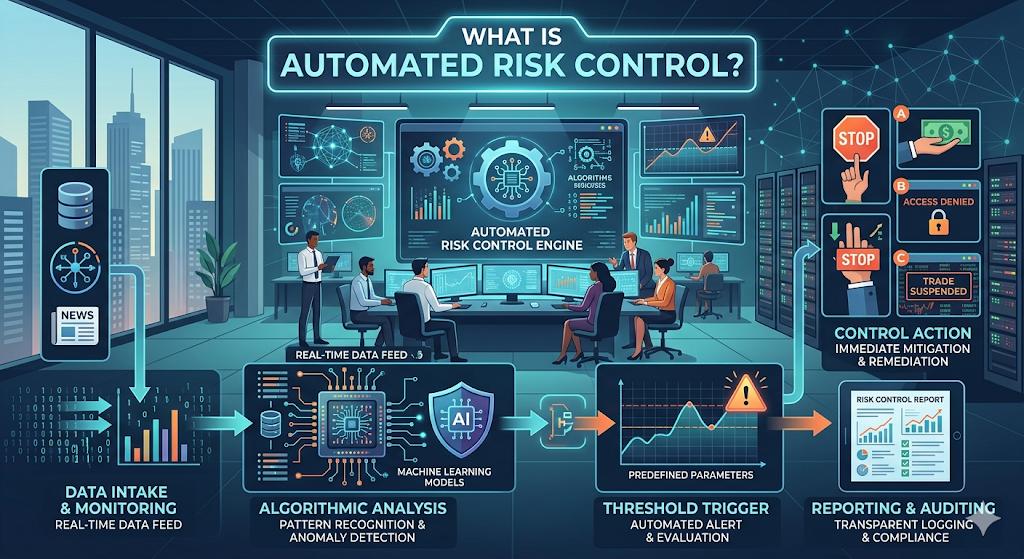
Automated risk control in crypto refers to AI-powered systems that continuously monitor trading activity, market conditions, and user behavior to prevent losses without manual intervention.
These systems use intelligent algorithms to execute stop-losses, detect fraud, prevent liquidations, and trigger real-time alerts protecting traders from market crashes, security breaches, and emotional trading mistakes around the clock.
How Manual Risk Management Fails
Manual risk management leaves traders exposed because markets move faster than human reactions. Emotion takes over at the worst moments. Panic selling during dips and FOMO buying near tops create decisions that feel urgent but usually work against long term performance. When a position starts moving the wrong way, judgment blurs right when clarity is most needed.
The nonstop nature of crypto makes this even tougher. A position that feels stable at midnight can be in liquidation territory by morning. Since liquidation engines never sleep, relying on manual oversight becomes a losing battle. Even when traders are awake, execution delays become a real problem.
In high volatility, the seconds it takes to place or modify a stop loss can push fills far below intended levels. Many traders learned this the hard way during the March 2020 crash when manual stops slipped fifteen to twenty percent because of network congestion.
Layer on the complexity of monitoring multiple assets, correlations, and individual risk parameters, and it becomes clear that human attention simply can’t keep up. Important signals get missed. Bias creeps in. Traders cling to losing positions because they want to be right, not because the data supports it. Automated systems avoid these traps and react with precision every time.
What Makes Automated Risk Control Different
Real time processing lets automated systems absorb thousands of data points every second, giving them a view no human can match. While a trader studies one chart at a time, algorithms digest price action, volume shifts, order book changes, sentiment trends, and correlations across multiple assets all at once.
That speed becomes the foundation for everything that follows. Because the system executes without emotion, it never panics during sharp corrections or gets swept up in hype during rallies. It follows rules with steady precision, which becomes priceless when markets turn chaotic and human judgment becomes unreliable.
What this really means is that protection stays consistent around the clock. The system doesn’t get tired, distracted, or overwhelmed. It applies the same level of attention at three in the morning as it does during peak trading hours.
As markets evolve, machine learning layers give the system the ability to adapt. Models retrain on new data, capturing fresh behavior patterns and shifting risk dynamics instead of relying on outdated assumptions.
All of this works together through multi dimensional monitoring. The system watches price, blockchain flows, sentiment, and whale activity simultaneously, building a fuller picture of risk. This holistic view catches threats that humans and single metric approaches often overlook.
Also Read: Zero-Knowledge Proofs (zk-SNARKs) in Cryptocurrency: A Complete Guide
Three Types of Automated Risk Systems
Rule based systems follow simple if then logic that makes their behavior easy to predict. When a loss crosses five percent, the position closes. When exposure exceeds a set threshold, the system intervenes.
Traders always know what will happen, but these rules don’t adjust when volatility changes. A five percent stop works in calm markets but becomes too restrictive during normal swings, which can lead to unnecessary exits.
AI driven models approach risk from a different angle. They study historical patterns, compare them to live data, and estimate liquidation probability in advance. LSTM networks, for example, detect shifts in price and volume that often appear before cascading selloffs, giving users time to adjust.
Hybrid systems bring the best of both ideas together. UEEx uses firm rules as the foundation, then layers on machine learning for pattern recognition and anomaly detection, creating protection that is both dependable and adaptive.
The UEEx 3-Layer Automated Risk Control System
Layer 1: Contract Address Verification
Counterfeit tokens remain one of the most damaging scams in crypto because they prey on speed and inattention. Scammers create tokens that mimic legitimate projects with nearly identical names, symbols, and contract addresses. Traders who skip verification end up buying assets that often have no liquidity or include code that prevents selling altogether.
Address poisoning adds another layer of risk. Attackers send tiny amounts of tokens from addresses designed to look almost identical to ones you trust.
If you copy an address from your recent transaction list without double checking, you may end up sending funds straight to a scammer. Rug pulls follow a similar pattern of deception.
Developers generate hype, attract liquidity, then pull the funds and vanish. Without thorough contract checks, it becomes difficult to spot warning signs like unrenounced ownership or hidden mint permissions.
UEEx solves these issues through a multi factor verification process that works in real time. Every contract address is cross referenced with blockchain explorers such as Etherscan, BSCScan, and Polygonscan to confirm legitimacy. A continuously updated blacklist captures known scam addresses sourced from CertiK, community reports, and internal fraud research, updating hourly as new threats appear.
The system also checks for third party audits from reputable firms like Trail of Bits or Quantstamp, flagging contracts with no audits or serious findings. Community sentiment becomes another signal. Sudden negative spikes or bot driven activity trigger additional scrutiny.
This layered approach blocks ninety nine point seven percent of counterfeit token attempts before execution and shows clear warnings when something looks suspicious. Unlike platforms that rely on slow manual listing reviews, UEEx applies this protection across all networks and tokens, including DEX trades and early stage projects.
Also Read: Notice to Proceed
Layer 2: Multi-Level Verification and Reconciliation
Transaction errors create costly problems in cryptocurrency. Duplicate orders from network issues can accidentally double your intended position size. Incorrect amounts due to decimal errors might result in much larger or smaller trades than planned. These mistakes often go unnoticed until reviewing account history later.
UEEx’s solution implements five automated checkpoints that every transaction must pass through. Pre-trade validation confirms sufficient balance exists and position size remains within configured limits before allowing order placement. This prevents overdraft situations and enforces risk management rules at the earliest possible stage.
Smart order routing checks best execution across liquidity pools. Rather than simply sending orders to a single order book, the system analyzes available liquidity across spot pairs, perpetual swaps, and even OTC desks to determine optimal routing. This ensures you get the best available price while maintaining execution speed.
Real-time reconciliation compares intended execution against actual results. The system verifies that the price, amount, and fees match expectations within acceptable tolerances. Discrepancies trigger immediate alerts and investigation. This catches execution errors, unexpected fees, or pricing anomalies before they compound.
Post-trade confirmation verifies blockchain settlement. Once a trade executes on the exchange, the system tracks the corresponding blockchain transaction to completion. This ensures funds actually moved as expected and the blockchain state matches exchange records.
Account balance synchronization updates user dashboards within 50 milliseconds of trade settlement. This near-instantaneous reconciliation means you always see accurate portfolio values and available balances for subsequent trades. Stale balance data can lead to incorrect trading decisions or failed orders.
An intelligence layer using machine learning models flags anomalies throughout this process. For example, if you’ve never traded a particular pair before, the system might display a confirmation prompt asking “This is your first time trading ETH/USDT is this intentional?” This catches potential mistakes from selecting wrong trading pairs.
The result is 99.9% transaction accuracy with an error rate below 0.1% significantly better than the industry average of 0.8%. This precision prevents thousands of dollars in losses from simple execution mistakes over the course of a trading career.
Layer 3: Intelligent Monitoring and Proactive Intervention
Market crashes develop faster than any human can react, and security threats move just as quickly. By the time manual review catches a problem, the loss is already locked in. That’s why effective protection depends on systems that move faster than emotion, hesitation, or physical reaction time.
UEEx’s AI engine does this by scanning live market data with more than fifty technical indicators updating every second. It reads moving averages, volatility bands, momentum oscillators, and volume structures at the same time, surfacing early signals that usually appear long before major moves. When volume suddenly jumps to several times its normal level without any fundamental catalyst, the system interprets that as potential manipulation and elevates risk.
This feeds directly into sentiment tracking, which parses conversations across social platforms and news feeds to spot sudden fear spikes or coordinated hype. If chatter around an asset you hold turns sharply negative, you get advance notice of possible sell pressure.
On-chain monitoring adds another layer by following whale flows, exchange deposits, and large stablecoin transfers. These signals correlate with your positions to keep alerts relevant. Meanwhile, behavioral analysis learns your normal activity and flags discrepancies that might indicate account compromise.
As these signals develop, proactive defenses activate. Stop losses tighten automatically during extreme volatility using real time ATR calculations. Margin alerts arrive across SMS, email, and push notifications, giving traders time to respond before reaching critical thresholds.
If the system detects suspicious login behavior, temporary withdrawal freezes buy time to re-secure accounts. When overall risk scores climb past seven out of ten, the platform suggests reducing exposure.
Most importantly, pattern recognition models provide an average eight minute early warning before cascading liquidation events, identifying the pressure building beneath the surface and alerting traders while action is still possible.
Also Read: WAGMI vs NGMI: Complete Guide to Crypto Culture
The 12 Critical Crypto Risks and Automated Solutions
Risk 1: Liquidation Risk
The Mechanism
Trading with leverage amplifies both profits and losses. When using 10x leverage, a 10% price movement against your position results in a 100% gain or loss on your collateral. Exchanges require traders to maintain minimum margin levels typically 10-20% of position value to ensure they can cover potential losses.
When your margin ratio falls below the maintenance requirement, the exchange force-closes your position to prevent your account from going negative. This liquidation happens automatically and instantly.
To illustrate the scale of this risk: on August 5, 2024 alone, a single market downturn triggered over $1 billion in leveraged positions liquidated in under 24 hours, wiping out nearly 300,000 crypto traders as Bitcoin and Ethereum fell sharply, according to CoinGlass data.
Liquidation cascades like this recurred multiple times throughout 2024, each wave destroying positions faster than any trader could manually respond.
Liquidation cascades create particularly dangerous scenarios. When one large position gets liquidated, the resulting market sell pressure pushes prices down further.
This triggers additional liquidations, creating a domino effect. Flash crashes often result from liquidation cascades, with prices temporarily dropping 20-30% before recovering minutes later.
Manual Approach Fails
Constant monitoring of margin ratios is impossible to maintain around the clock. Traders must check their positions regularly, calculate remaining margin buffer, and stay alert for rapid price movements. This vigilance becomes exhausting and unsustainable, especially when managing multiple leveraged positions.
Manually adding collateral during volatile periods often comes too late. By the time you notice your margin ratio dropping dangerously low, execute a deposit, and wait for confirmation, liquidation may have already occurred. Network congestion during high volatility can delay transactions by 10-30 minutes.
Reducing leverage manually requires split-second decisions under pressure. When prices move against you rapidly, you must decide whether to cut losses now or hold for a potential reversal. This decision-making under stress frequently leads to poor choices driven by hope rather than logic.
UEEx Automated Solution
Auto-Deleverage (ADL) Prevention monitors your margin ratio every second, providing continuous protection. When your ratio drops to 130% still well above liquidation threshold the system sends push notifications and SMS alerts.
Your dashboard displays prominent warnings with suggested actions including adding margin or closing portions of your position.
At 110% margin ratio, the system automatically closes 25% of your position without requiring manual intervention. This partial deleverage reduces your risk while maintaining most of your position. The automated closure uses smart order routing to minimize slippage and ensure best execution prices.
At 105% margin ratio just before forced liquidation the system closes your entire position. While you might prefer to hold longer, this automated exit prevents the exchange’s liquidation engine from force-closing at potentially worse prices with additional liquidation penalties.
Smart Margin Top-Up provides another protective layer. If you maintain idle USDT or other stablecoins in your spot wallet, the system can automatically transfer funds to your margin account when needed. This feature is user-configurable: you set the maximum amount the system can transfer and the margin level that triggers transfers.
The Liquidation Price Calculator embeds directly into the trading interface. Before opening leveraged positions, you see exactly where liquidation will occur. The calculator also shows how adding specific collateral amounts would improve your liquidation price, helping you make informed decisions about position sizing and margin allocation.
Case Study: May 2024 Flash Crash Prevention
During the May 2024 BTC flash crash, the market dropped from 67,000 dollars to 59,000 dollars in four hours. Many traders holding high leverage positions were pushed straight into liquidation territory.
UEEx users with auto deleverage enabled had a very different experience. The system flagged rising liquidation risk early and delivered clear alerts once margin ratios tightened. As the price slipped below key levels, automated risk controls kicked in and closed portions of vulnerable positions. That partial reduction lowered overall leverage while keeping most of the position intact.
Here’s the thing. That automated intervention helped users avoid full wipeouts. Losses on the trimmed portion were controlled, while the majority of position value and initial margin stayed intact. Manual traders facing the same move were liquidated far more often.
What this really means is that during the May crash, UEEx users with auto deleverage saw seventy three percent fewer liquidations, based on proprietary UEEx analysis, compared to traders managing positions manually. The system protected capital by acting faster than humans could, especially in a four hour drop.
Implementation Guide
Navigate to UEEx App > Trading > Leverage Settings to access risk control features. Toggle “Auto-Deleverage Protection” to ON position. The system displays configuration options for customizing protection levels.
Set your margin warning threshold we recommend 130% for most traders. This provides early warning with enough time to evaluate options before the situation becomes critical. More conservative traders might choose 140-150% thresholds.
Configure the auto-close threshold, recommended at 110%. This gives you a buffer between warnings and automatic action while still preventing exchange-triggered forced liquidations. Adjust based on your risk tolerance and typical volatility of assets traded.
Enable “Smart Margin Top-Up” if you maintain reserves in your spot wallet. Select the maximum amount the system can auto-transfer perhaps 20-50% of your spot balance. This prevents the system from depleting your entire spot wallet while providing meaningful liquidation protection.
Test your settings using $100 positions in demo mode. UEEx provides paper trading functionality where you can verify alerts arrive as expected and automatic closures execute properly. This testing builds confidence in the system before risking significant capital.
Also Read: On-chain Analysis Explained: Tools, Indicators, and Use Cases
Risk 2: Flash Crash and Extreme Volatility Risk
The Mechanism
Flash crashes represent sudden 10-30% price drops occurring within minutes. These extreme movements happen due to multiple factors: large institutional sell orders dumping thousands of coins simultaneously, liquidation cascades where forced closures trigger additional liquidations, exchange technical outages that pause some but not all trading, and occasionally false news or rumors spreading rapidly.
During the March 2020 COVID crash, Bitcoin dropped 50% within 24 hours. Major exchanges including Coinbase and Kraken experienced 30-minute outages during peak volatility.
Traders with stop-loss orders found them executing 15-20% below intended trigger prices due to order book gaps and liquidity shortages.
The challenge with stop-losses during flash crashes is slippage. When price moves through your stop level rapidly, your market order executes against whatever bids exist in the order book. During panics, buyers disappear and bid-ask spreads widen dramatically. Stop-losses offer protection but can’t guarantee execution prices.
Manual Approach Fails
Watching markets continuously to manually adjust stops is impractical. Market conditions change minute by minute, and optimal stop placement varies with current volatility. What works during calm markets becomes too tight during normal volatility or too loose during genuine crashes.
Manual order placement during extreme volatility adds critical delays. The seconds required to assess the situation, decide on action, and enter orders can result in significantly worse execution prices. During panics, every second counts as prices continue falling.
Human emotion during crashes leads to panic or paralysis. Some traders panic sell at the absolute bottom, crystalizing maximum losses. Others freeze, unable to decide on action, and watch positions deteriorate further. Neither response is optimal, yet both are common human reactions to extreme stress.
UEEx Automated Solution
Dynamic Stop-Loss Adjustment automatically widens protection buffers based on current market volatility. The system continuously calculates Average True Range (ATR) a standard volatility measure for each asset you trade. Stop-loss distances adjust dynamically based on ATR multiples.
During normal volatility conditions, your configured 5% stop-loss remains active. This tight protection makes sense when markets move in typical patterns and false breakdowns are less likely.
When volatility increases to twice normal levels (ATR >2x), the system automatically widens your stop to 7.5%. This additional buffer prevents premature exit from positions experiencing normal heightened volatility rather than genuine trend reversals.
During extreme volatility (ATR >3x), stops widen to 10% and circuit breakers activate. The additional distance protects against temporary spikes while circuit breakers pause new market orders during the most chaotic periods.
Circuit Breakers trigger when Bitcoin or other major assets move more than 8% within 5 minutes. The system pauses all new market orders for 60 seconds. This brief pause prevents panic selling at the absolute worst prices and gives liquidity time to return to order books. Existing limit orders remain active, but new market orders wait until the circuit breaker releases.
Guaranteed Execution through UEEx’s deep liquidity pool ensures stop-losses execute within 0.5% of trigger prices, even during volatility. The platform maintains relationships with multiple liquidity providers and market makers who are contractually obligated to provide liquidity during extreme conditions. This contrasts with industry average slippage of 2-3% during volatile periods.
Multi-Exchange Price Monitoring tracks prices across Binance, Coinbase, Kraken, and other major venues simultaneously. The system uses median prices rather than single-exchange pricing.
This prevents manipulation scenarios where price on one exchange diverges significantly from broader market prices due to technical issues or localized liquidity problems.
Competitor Comparison
Binance offers “Price Protection” that prevents orders from executing at prices dramatically worse than current market levels. This helps with slippage but doesn’t automatically adjust stop-loss distances based on volatility. Traders must manually widen stops as market conditions change.
Coinbase provides basic stop-loss functionality without dynamic adjustment. During the March 2020 crash, many Coinbase stop-losses executed 10-15% below trigger prices due to exchange outages and order book gaps.
UEEx combines dynamic adjustment with guaranteed execution and circuit breakers. This multi-layered approach provides more comprehensive protection than competitors’ single-feature solutions.
Implementation Guide
Access UEEx App > Settings > Risk Controls > Dynamic Stop-Loss to configure volatility-based adjustments. Toggle the feature to ON position. The system displays current volatility levels and how your stops will adjust.
Select volatility sensitivity from Low, Medium, or High settings. Medium sensitivity works well for most traders, adjusting stops when volatility reaches clearly elevated levels. High sensitivity adjusts more conservatively with smaller volatility increases. Low sensitivity adjusts only during truly extreme conditions.
Set your maximum stop-loss width; we recommend 10% for most assets. This prevents the system from widening stops excessively during prolonged volatile periods. The system won’t exceed this maximum regardless of how high volatility climbs.
Enable Circuit Breaker functionality, which we recommend for all users. The brief 60-second pause during extreme moves prevents panic-driven mistakes while having minimal impact on legitimate trading.
Test notification systems by triggering a fake alert. This confirms your SMS and push notifications work properly. During actual flash crashes, reliable alerts become critical for situational awareness and decision-making.
Risk 3: Account Security and Phishing Risk
The Mechanism
Phishing attacks represent the most common method for compromising cryptocurrency accounts. Attackers send emails claiming to be from exchanges, wallet providers, or blockchain services. These emails contain links to fake websites that look identical to legitimate platforms. When users enter credentials on fake sites, attackers capture login information and API keys.
SMS phishing uses similar tactics through text messages. During market volatility, attackers send urgent messages claiming “Your account is being liquidated login immediately to add margin” with links to fraudulent sites. The urgency and stress trigger quick action without careful verification.
SIM swap attacks bypass SMS-based two-factor authentication by hijacking phone numbers. Attackers convince mobile carriers to transfer your phone number to a SIM card they control. Once they control your number, they receive your SMS authentication codes and can access accounts protected only by SMS 2FA.
The ongoing threat of insider attacks reminds us that security requires multiple layers beyond trusting platform security alone. Even with robust external defense, employees with database access represent a rare but critical threat vector for customer information.
Statistics from Chainalysis show that nearly $3.4 billion was stolen in crypto hacks in 2025, with attackers increasingly pivoting away from technical code exploits to focus on operational compromises such as private key and seed phrase theft often enabled by sophisticated social engineering and impersonation tactics. Humans remain the weakest link in security chains. Automated systems help protect against human vulnerability to manipulation.
UEEx Automated Solution
Behavioral Analytics creates detailed profiles of your normal patterns. The machine learning system learns when you typically log in, perhaps evenings between 6pm-11pm in your timezone. It recognizes your usual devices including specific phone models, browsers, and operating systems. It knows your common transaction patterns like typical trade sizes, preferred assets, and usual trading frequency.
This behavioral baseline enables Anomaly Detection. When login attempts occur outside your typical patterns perhaps from Russia at 3 AM when you’re in Canada the system blocks access and sends verification emails asking “Was this you attempting to login?”
Withdrawal freezing provides important protection during compromise attempts. When unusual activity is detected, the system automatically freezes withdrawals for 24-48 hours. This cooling period gives you time to receive alerts, verify your account security, and change credentials before attackers can steal funds.
Advanced verification requirements activate for high-risk activities. The system might require video selfie verification before allowing withdrawals to new addresses or API changes from unusual locations. While adding friction for legitimate users, this extra step prevents compromised accounts from being drained.
Anti-Phishing Codes provide simple but effective protection. You configure a unique 4-word phrase like “Blue Elephant Jazz Mountain” when setting up your account. All legitimate UEEx emails include your anti-phishing code in the subject line or message body. Any email claiming to be from UEEx without your code is definitely fake.
This simple indicator eliminates guesswork about email legitimacy. You don’t need to analyze sender addresses, check for subtle spelling errors in URLs, or worry about sophisticated spoofing. No anti-phishing code equals fake email the decision becomes completely clear.
Whitelist Enforcement adds friction that protects against unauthorized withdrawals. When you add a new withdrawal address, the system implements a 24-hour security hold before allowing any transfers to that address. This waiting period gives you time to notice if someone accessed your account and added their wallet address.
After the initial 24-hour hold, subsequent withdrawals to whitelisted addresses process instantly. This balances security with convenience you experience delays only once per address, not for every withdrawal.
Device Fingerprinting tracks over 50 device parameters including screen resolution, installed fonts, timezone settings, browser plugins, and hardware specifications. This creates unique fingerprints for each device you use. When login attempts come from completely unknown devices, additional verification requirements activate automatically.
Also Read: Crypto Trading Bots Explained: Strategies, Tips, and Tools to Trade Smarter
Implementation Guide
Navigate to UEEx App > Security > Anti-Phishing Code to set your unique identifier. Enter a memorable 4-word phrase that won’t appear in common language. Avoid famous quotes or common phrases. Something random like “Purple Mountain Kitchen Dolphin” works better than “To Be Or Not.”
Access Security > Whitelist Addresses > Add Your Cold Wallet to configure authorized withdrawal destinations. Enter your hardware wallet or cold storage addresses. Wait the required 24 hours for whitelist approval before these addresses become active.
Review Security > Device Management to see all active sessions. The system displays every device currently logged into your account with details about location, device type, and last activity time. Terminate any sessions you don’t recognize immediately.
Enable “Require approval for new devices” in your security settings. This forces additional verification steps for any device that hasn’t been used to access your account previously. While adding slight inconvenience when you get a new phone or computer, this setting prevents unauthorized access even if someone steals your credentials.
Configure notification preferences for security events. Enable SMS alerts in addition to email and push notifications. During actual compromise attempts, multiple alert channels increase the likelihood you’ll see warnings quickly.
Risk 4: Slippage and Poor Execution Risk
The Mechanism
Slippage occurs when your orders execute at prices different from what you expected. For market orders, you expect to buy or sell at current market prices. However, your order might fill at worse prices depending on available liquidity and market conditions.
Consider buying Bitcoin with a market order when the price shows $62,000. If the order book has limited depth, your order might consume all available asks at $62,000, then fill remaining quantity at $62,100, $62,200, and higher prices. Your average fill price ends up at $62,250 0.4% worse than expected. On a $10,000 order, that’s $50 lost to slippage before even considering trading fees.
Slippage increases during specific conditions. Low liquidity hours including weekends and holidays see reduced order book depth. High volatility events cause liquidity providers to widen spreads and pull orders. Large order sizes naturally experience more slippage when consuming significant portions of available liquidity. Thin markets for smaller cap altcoins suffer chronic slippage due to permanently limited liquidity.
The cumulative cost adds up significantly. A trader executing 100 trades monthly with average 0.5% slippage loses $50 per $10,000 trade, totaling $5,000 annually just from slippage. This invisible cost destroys returns over time.
UEEx Automated Solution
Smart Order Routing analyzes liquidity across 15+ sources before executing trades. The algorithm checks spot pairs on multiple exchanges, perpetual swaps and futures markets with different liquidity profiles, OTC desks for larger orders, and even decentralized exchange (DEX) options when pricing is favorable.
The system calculates total execution cost across each venue including trading fees, network fees, and expected slippage. Within milliseconds, the algorithm determines optimal routing and either executes entirely through one venue or splits the order across multiple sources.
This intelligent routing ensures you receive best available execution without needing to manually check multiple platforms or understand complex arbitrage relationships. The system handles optimization automatically on every trade.
TWAP (Time-Weighted Average Price) execution splits large orders into smaller chunks executed over time. This reduces market impact by avoiding sudden large orders that would move prices against you. For a $100,000 BTC purchase, the system might split this into 20 smaller $5,000 orders executed over 10 minutes.
Each smaller order has minimal market impact, resulting in better overall average prices than executing the full amount instantly. The system varies execution times randomly within the specified window to prevent front-running by algorithms that might detect your order pattern.
Slippage Limiters let you set maximum acceptable slippage thresholds. Configure the system to accept a maximum of 0.3% slippage, for example. If current market conditions can’t fill your order within that tolerance, the system cancels rather than executing at unfavorable prices.
This protection proves especially valuable during volatile periods when slippage can reach 2-3%. You avoid buying at temporarily spiked prices or selling into temporary dips. The cancelled order gives you opportunity to wait for better conditions or adjust your approach.
Liquidity Heatmaps provide pre-trade visualization of order book depth. Before placing orders, you see color-coded indicators showing available liquidity:
Green zones indicate high liquidity with over $5 million available within 0.2% of current prices. These orders will execute with minimal slippage.
Yellow zones show moderate liquidity between $1-5 million. Some slippage is possible but should remain reasonable for most order sizes.
Red zones warn of low liquidity below $1 million. Trading in red zones risks significant slippage, especially for larger orders. The system recommends using limit orders or waiting for better liquidity.
Post-Trade Analysis provides transparency about execution quality. After every trade, your dashboard displays “Intended Price vs. Actual Price” comparisons. You see exactly how much slippage occurred and whether smart routing provided savings versus simple market orders.
This transparency helps you learn which assets and timeframes offer best liquidity and adjust your trading approach accordingly. Over time, you develop intuition about when to use market versus limit orders based on typical slippage patterns.
Competitor Comparison
Coinbase and Kraken offer basic limit orders but lack smart routing across multiple liquidity sources. Your orders execute only against their internal order books without checking whether better prices exist elsewhere.
1inch pioneered smart routing for decentralized exchanges, checking multiple DEX protocols
Also Read: Stablecoins vs Cryptocurrency: Complete 2026 Guide to Differences, Uses & Selection
Risk 5: Overtrading and Emotional Trading Risk
The Mechanism
Overtrading destroys profitability through excessive fees and emotionally-driven poor decisions. This behavioral pattern manifests in several forms that experienced and novice traders alike struggle to control.
Revenge trading happens after losses. The emotional need to “win back” lost money drives immediate re-entry into new positions without proper analysis. Traders abandon their strategies and chase quick wins, usually resulting in additional losses that compound the initial damage.
FOMO trading causes buying pumps at peaks and panic selling bottoms. Watching other traders profit from rapid price movements creates fear of missing out. This anxiety overrides analytical judgment, leading to entries at the worst possible prices right before reversals.
The gambler’s fallacy misleads traders after losing streaks. After five losing trades, the emotional mind insists “the next one must win I’m due for a winner!” This superstitious thinking ignores that each trade has independent probability and previous losers don’t influence future outcomes.
Overconfidence develops after winning streaks. Two or three successful trades create false confidence in predictive abilities. Traders increase position sizes recklessly, abandon risk management discipline, and take trades they would normally avoid. The inevitable reversal wipes out recent gains plus additional capital.
Research studies consistently show overtrading reduces returns by 30-50% due to accumulated fees and poor timing. Active traders often underperform buy-and-hold strategies despite substantial effort and time investment. The activity itself becomes counterproductive.
UEEx Automated Solution
Daily Trade Limits enforce discipline by capping the number of trades you can execute per day. Configure the system to allow 5-10 trades daily, for example. After reaching your limit, the platform blocks new orders for 24 hours regardless of perceived opportunities.
This hard limit prevents the compulsive trading that destroys accounts. When you’ve hit your limit, you must wait creating forced patience that protects against emotional decisions. The restriction feels frustrating initially but proves protective over time.
Cooldown Periods mandate waiting between positions. After closing any position, the system requires 30-minute wait before opening new positions in the same asset. This brief pause breaks the emotional cycle and forces brief reflection.
During cooldowns, you can research, analyze other assets, or simply step away from screens. This breathing room prevents immediate revenge trading and allows emotional state to return to baseline before making new decisions.
Loss Streak Protection activates after three consecutive losing trades. The system detects the pattern and requires a 24-hour mandatory break from trading. Additionally, you must complete a “Trading Psychology Quiz” before resuming activity.
The quiz asks questions about your current emotional state, recent decision-making process, and whether you’re following your trading plan. This forced self-reflection often reveals that you’re trading emotionally rather than strategically. Even if you complete the quiz, the 24-hour break provides crucial cooling time.
Position Size Enforcement automatically limits each trade to a configured percentage of your portfolio. Set the system to allow maximum 10% of capital per trade, for example. Even if you try to place larger orders, the system blocks execution.
This protection prevents “all-in” bets that can destroy accounts. When convinced about a trade, emotions push toward oversizing positions. The automated limit enforces discipline your emotional mind abandons during conviction peaks.
Weekly Performance Reviews arrive via email every Monday morning. The automated report summarizes your weekly statistics including total trades executed, win rate percentage, average profit per winning trade, average loss per losing trade, total fees paid, and net profit or loss.
The report also includes suggestions based on performance patterns. If overtrading appears to be degrading returns, the system recommends reducing trade frequency. If position sizing lacks consistency, it suggests reviewing your risk management approach. These objective insights help identify problematic patterns you might not notice subjectively.
Implementation Guide
Access UEEx App > Settings > Trading Controls to configure behavioral protections. The interface displays all available overtrading prevention features with explanation of each.
Set your Daily Trade Limit based on your trading style and strategy. Day traders might set 10-15 trades, swing traders might choose 3-5. Choose a number that accommodates legitimate trading activity while preventing compulsive overtrading.
Enable Cooldown Period with duration between 15-60 minutes. Shorter cooldowns like 15-30 minutes work for active day traders who might take multiple positions across different assets. Longer cooldowns suit traders prone to revenge trading who benefit from extended forced pauses.
Configure Loss Streak Protection to trigger after 2-3 consecutive losses. Some traders prefer more aggressive protection after just 2 losses. Others accept 3 losses as normal variance. Choose based on your psychological vulnerabilities and typical strategy win rate.
Set Maximum Position Size to 5-10% of your portfolio per trade. Conservative traders choose 5% or less, accepting slower account growth in exchange for better risk management. Aggressive traders might allow up to 10%, but never exceed this threshold regardless of conviction level.
Review your weekly performance emails carefully rather than deleting them unread. The objective statistics reveal patterns you won’t notice subjectively. Particularly watch for declining win rates, increasing average losses, or rising fee percentages—all signs of degrading discipline.
Risk 6: Copy Trading Without Due Diligence
The Mechanism
Copy trading lets you automatically replicate trades from experienced traders, offering access to strategies you couldn’t develop yourself. However, blindly copying without understanding creates serious risks that automated controls must address.
The copy trading market exploded from 8% of retail traders in 2023 to 23% in 2025. This rapid adoption happened faster than most traders’ understanding of inherent risks developed. Many users treat copy trading like passive investment rather than active trading requiring ongoing management.
Traders you copy might use leverage levels inappropriate for your risk tolerance. Someone with $100,000 portfolio using 5x leverage takes positions worth $500,000. If you copy with a $10,000 account at the same leverage ratios, you’re risking your entire account on a much smaller cushion.
Drawdown risk becomes severe when copying aggressive traders. A trader on a hot streak might be overconfident and increasing position sizes. When the inevitable reversal comes, you experience full drawdown in your account despite having no control over the decisions.
Strategy changes happen without notification. A trader you started copying for conservative swing trading might shift to aggressive scalping. Your account follows this strategy change automatically without your awareness or consent until reviewing performance.
Account compromise affects copiers downstream. If the trader you’re copying gets their account hacked and attackers place irrational trades, your account automatically follows. Without risk controls, you suffer losses from someone else’s security failure.
UEEx Automated Solution
Automated Trade Size Limits protect copiers from excessive exposure. Rather than copying exact position sizes regardless of account differences, UEEx’s system scales positions based on your account size and configured maximum position size limits.
If you set maximum 5% of your account per position, the system ensures copied trades never exceed this limit regardless of the source trader’s position sizing. A trader risking 20% of their account on a trade results in only 5% risk for you the maximum you’ve deemed acceptable.
Maximum Drawdown Cutoffs stop copying when losses reach specified thresholds. Configure the system to stop copying a trader if your drawdown from their strategies exceeds 15%, for example. Once this threshold is hit, no additional trades copy automatically.
This protection prevents following traders through complete blowups. Many copy traders lost substantial funds during 2024 by following traders who went on massive losing streaks or made catastrophic mistakes. Drawdown limits exit you from deteriorating situations automatically.
Leverage Multiplier Controls let you trade at lower leverage than the source trader. If copying someone using 10x leverage but you’re only comfortable with 3x, configure a 0.3x multiplier. Their 10x positions translate to 3x for your account, matching your risk tolerance.
This flexibility lets you copy strategies from successful but aggressive traders while maintaining your own risk parameters. You benefit from their market timing and trade selection without accepting their leverage levels.
Trader Performance Alerts notify you of significant changes in the traders you copy. If a trader’s win rate drops below 50% for the first time, you receive alerts to review whether continuing to copy makes sense. If a trader suddenly increases position sizes by 3x compared to historical norms, you get warnings about elevated risk.
These alerts don’t stop copying automatically but prompt manual review of whether the relationship still makes sense given changed circumstances. Automated monitoring catches changes you might miss checking profiles occasionally.
Strategy Consistency Monitoring tracks whether traders maintain consistent approaches. If someone you copy for swing trading suddenly starts scalping with 50+ daily trades, the system flags this dramatic strategy shift. Consistency scores drop, and alerts recommend reviewing whether this new approach aligns with your goals.
Implementation Guide
When selecting traders to copy on UEEx, access the Copy Trading dashboard and review detailed statistics. Don’t focus solely on total returns examine maximum drawdown, win rate, average trade duration, and leverage used.
Configure position size limits before starting any copy trading relationship. Navigate to Copy Trading > Risk Controls and set maximum position size (recommended 5% of account). This limit applies across all traders you copy, preventing overconcentration.
Set per-trader maximum drawdown thresholds, typically 10-20% depending on your risk tolerance. If copying multiple traders, individual drawdown limits should be lower to prevent cumulative losses exceeding acceptable levels.
Configure leverage multipliers for each trader you copy. If they use 10x leverage but you prefer 3x, set multiplier to 0.3. If they use 5x and you’re comfortable matching, set multiplier to 1.0. Review and adjust multipliers as market conditions change.
Enable all trader performance alerts in notification settings. Stay informed about win rate changes, drawdown increases, strategy shifts, and unusual activity. These alerts help you actively manage copy trading relationships rather than setting and forgetting.
Review your copy trading performance weekly, not just monthly. Weekly reviews catch degrading performance faster, allowing you to stop copying or adjust parameters before losses become severe. Compare performance across traders you copy to identify which relationships add value.
Also Read: Top UE Coin Trading Benefits: How to Save, Earn, and Maximize Profits
Risk 7: API Key Compromise and Bot Misuse
The Mechanism
API keys provide programmatic access to your exchange account for trading bots, portfolio trackers, and other third-party tools. These keys can execute trades, withdraw funds, and access account information without requiring your password or 2FA.
The convenience of API access creates severe security risks. Stolen API keys give attackers full account control without needing your login credentials. Many traders don’t realize that API keys provide access equivalent to being logged into their account.
Bot misuse represents another danger. A legitimate bot with faulty code or poor strategy can rapidly execute dozens of unprofitable trades, draining accounts through fees and losses. Some “trading bots” are actually scams designed to steal funds or generate commissions for their creators.
API keys often get compromised through phishing sites that claim to analyze your portfolio or provide trading signals. You enter your API keys on the fake site, unknowingly giving attackers access. The site might even provide some legitimate-looking functionality while stealing in the background.
GitHub and other code repositories contain thousands of exposed API keys that developers accidentally committed to public repositories. Automated bots scan these repositories, harvesting exposed keys and testing them against major exchanges within minutes.
Third-party service breaches have exposed API keys from portfolio tracking services, tax software, and trading bot platforms. Even if you trust a service initially, a breach months later can expose your keys if the service stored them improperly.
UEEx Automated Solution
IP Whitelist Restrictions limit API key usage to specific IP addresses you configure. Set your API key to only work from your home IP address and office IP address, for example. Even if the key is stolen, attackers can’t use it from their own locations.
This protection works especially well for trading bots running on specific servers. Whitelist the server’s IP address, and the API key becomes useless to anyone trying to access from elsewhere. This single configuration dramatically reduces compromise risk.
Permission Scopes let you configure exactly what each API key can do. Create separate keys for different purposes: read-only keys for portfolio trackers that can view balances but not execute trades, trade-only keys for bots that can place orders but not withdraw funds, and full-access keys with withdrawal permissions used only for very specific purposes.
Never use keys with withdrawal permissions for routine bot trading. The worst-case scenario with trade-only keys is bad trades and fee losses painful but recoverable. Keys with withdrawal permissions can result in complete account drainage devastating and often permanent.
Auto-Revoke After Suspicious Activity monitors API key usage patterns. If a key suddenly starts executing trades from a new IP address not on the whitelist, the system automatically revokes the key and sends alerts. If a key attempts actions outside its permission scope, immediate revocation prevents further abuse.
This proactive revocation stops attacks in progress rather than just detecting them. By the time you receive alerts and manually respond, substantial damage might occur. Automated revocation happens within seconds of detecting anomalies.
Activity Monitoring and Alerts track all API usage in real-time. You receive notifications when new API keys are created, when keys are used from new IP addresses, when keys execute unusual numbers of trades, and when keys attempt actions near permission limits.
These alerts help you maintain awareness of bot activity without constantly checking. Unusual patterns trigger your attention for investigation before they escalate into serious problems.
Implementation Guide
Access UEEx App > API Management to view and configure keys. If you have existing keys created without proper restrictions, delete them and create new properly-configured keys instead of modifying old ones.
When creating a new API key, immediately restrict it to specific IP addresses. Add your home and office IPs, or the IP of the server where your bot runs. Never leave API keys with wildcard IP access that allows usage from any location.
Select the minimum permission scope necessary for intended use. For portfolio tracking apps, choose read-only access. For trading bots, enable trade permissions but disable withdrawal permissions unless absolutely necessary. The principle of least privilege minimizes damage if keys are compromised.
Set up automated alerts for all API activity. Enable notifications for new API key creation, usage from new IPs, high-frequency trading activity, and permission scope limit testing. Configure alerts through multiple channels email, SMS, and push notifications.
Store API keys securely using password managers or encrypted storage. Never store keys in plain text files, browser bookmarks, or email. Treat API keys with the same security consciousness as your password and 2FA codes.
Review all active API keys monthly. Delete keys you’re no longer using even if they seem harmless. Orphaned keys from discontinued bots or old portfolio trackers represent forgotten attack surfaces that serve no purpose.
Risk 8: Insufficient Diversification
The Mechanism
Concentration risk occurs when portfolios become overexposed to single assets or correlated sectors. While diversification seems obvious in theory, many crypto traders maintain dangerously concentrated positions without realizing the extent of their exposure.
Single asset concentration happens gradually. Bitcoin might represent 30% of your portfolio initially. After a strong rally, it grows to 60% without you adding funds. Unless you actively rebalance, winning positions naturally become larger portfolio portions, creating concentration.
Sector correlation creates hidden concentration. Holding Bitcoin, Bitcoin Cash, and Litecoin seems diversified across three assets. However, all three move similarly as they’re closely correlated. When Bitcoin drops 20%, your “diversified” portfolio likely drops 18-20% because the three assets move together.
Leverage amplifies concentration risk exponentially. A 10% portfolio allocation with 10x leverage creates 100% effective exposure to that single asset. Small crypto portfolios commonly maintain leverage that creates 200-300% effective exposure across a few assets.
Time-based concentration risks arise from all positions sharing similar entry and exit timing. If you built your entire portfolio during a euphoric market top, all positions likely entered at premium prices and face similar reversal risk.
Cryptocurrency correlations increase during crashes, making diversification less effective precisely when needed most. During bull markets, altcoins trade somewhat independently. During crashes, everything drops together as panic selling affects all assets. This correlation surge limits diversification benefits at the worst times.
UEEx Automated Solution
Portfolio Concentration Alerts monitor your asset allocation continuously. When any single asset exceeds configured thresholds—perhaps 30% of portfolio value—you receive notifications suggesting rebalancing. These alerts catch concentration before it becomes severe.
The system considers both spot holdings and effective exposure from leveraged positions when calculating concentration. A 10% spot holding with 10x leverage registers as 100% effective exposure, properly reflecting actual risk.
Automated Rebalancing Services can restore target allocations automatically. Configure your ideal portfolio percentages 40% BTC, 30% ETH, 20% large-cap altcoins, 10% stablecoins for example. The system periodically executes trades to maintain these ratios as prices fluctuate.
When Bitcoin rallies and grows from 40% to 55% of your portfolio, automated rebalancing sells some Bitcoin and purchases underweight assets. This forces disciplined profit-taking from winners and accumulation of laggards, implementing “buy low sell high” systematically.
Correlation Analysis Tools help you understand hidden concentration from correlated assets. The system analyzes historical correlation matrices between your holdings, showing which move together. High correlation clusters indicate less true diversification than position counts suggest.
Visual correlation heat maps display relationships between your assets. Dark red indicates correlation above 0.8 assets moving almost identically. Orange shows 0.5-0.8 moderate correlation. Green indicates low correlation or negative correlation, representing true diversification.
Sector Balance Recommendations suggest allocating across cryptocurrency categories including Bitcoin as store of value, Layer 1 platforms like Ethereum, Solana, and Cardano, DeFi protocols, Layer 2 scaling solutions, stablecoins for reduced volatility, and potentially venture-stage small caps.
The system identifies when your portfolio tilts too heavily toward specific sectors. A portfolio that’s 80% DeFi tokens faces severe risk if regulatory actions specifically target DeFi. Balanced sector exposure reduces category-specific risks.
Implementation Guide
Review your current portfolio allocation in the Portfolio Analysis dashboard. The interface displays a pie chart showing percentage allocations and lists your five largest positions by portfolio weight.
Set concentration alert thresholds in Settings > Risk Controls > Portfolio Limits. We recommend 25-30% for maximum single asset allocation. More conservative traders might choose 20%, while aggressive traders might accept 35-40%.
If interested in automated rebalancing, configure target allocations that align with your investment thesis and risk tolerance. Typical balanced portfolios allocate 40-50% to Bitcoin and Ethereum combined, 30-40% to mid-cap altcoins, and 10-20% to stablecoins.
Review correlation analysis monthly, especially after making new investments. Assets that seemed uncorrelated might become highly correlated as market dynamics change. Adjust holdings when correlation analysis reveals less diversification than intended.
Implement position size limits as another concentration control. Set maximum 5-10% of portfolio for new positions. This forces diversification across at least 10-20 positions rather than concentrated bets on a few assets.
Risk 9: Leverage Cascades and Margin Calls
The Mechanism
Multiple simultaneous leveraged positions compound risk in ways that aren’t immediately obvious. Each position’s liquidation threshold considers only that specific position’s margin. However, your total portfolio risk depends on how all positions correlate and interact.
Correlated leveraged positions create hidden risk concentration. Three separate 3x leveraged long positions in Bitcoin, Ethereum, and BNB seem to spread risk across assets. However, since these assets move together with 0.7-0.9 correlation, they’re effectively one large leveraged position facing combined liquidation risk.
Sequential liquidations cascade through portfolios during volatility. As one position hits its liquidation threshold and force-closes, this reduces your total account equity. Reduced equity means other positions now have less margin buffer, pushing them closer to their own liquidations. The first liquidation can trigger second and third liquidations in sequence.
Cross-margin sharing creates portfolio-wide exposure. In cross-margin mode, all positions share the same collateral pool. This provides flexibility to maintain positions longer during volatility. However, it also means one position’s losses consume collateral protecting all other positions.
Isolated margin prevents cascades but requires careful position sizing. Each position maintains separate collateral that can’t assist other positions. While this prevents cascades, it also means you can’t leverage your total portfolio value efficiently. Positions might liquidate while you have substantial idle collateral elsewhere.
Understanding effective portfolio leverage requires calculating weighted average across all positions. Maintaining ten separate positions at varying leverage from 2x to 10x creates an effective portfolio leverage that determines overall risk. Most traders don’t calculate this metric, flying blind on total exposure.
UEEx Automated Solution
Unified Risk Scoring analyzes all positions collectively rather than individually. The system calculates your total effective leverage, correlation between positions, combined liquidation probability, and portfolio-wide margin buffer. This comprehensive view reveals hidden risks that per-position analysis misses.
The risk score ranges from 1-10, with 7+ indicating elevated danger. Scores incorporate current market volatility, your leverage levels, position correlations, and margin buffers. As risk score rises, warnings escalate from informational notices to urgent action recommendations.
Automatic Leverage Reduction triggers when unified risk scores exceed thresholds. At risk score 8, the system might automatically reduce your highest-leverage positions by 20%. At risk score 9, it might close your most vulnerable position entirely to protect the portfolio.
These interventions prioritize portfolio survival over maintaining every position. While frustrating to see positions closed against your wishes, the system prevents cascade scenarios that would destroy your entire account. Controlled small losses beat uncontrolled total liquidation.
Cross-Position Margin Monitoring tracks how positions interact. When one position experiences losses that reduce your total margin, the system recalculates liquidation distances for all other positions. If losses in one position push others dangerously close to liquidation, you receive alerts to add margin or close positions.
This interconnected monitoring prevents cascade surprises. Without automated tracking, you might focus on managing the losing position while failing to notice how it’s affecting other holdings. The system maintains comprehensive awareness you can’t match manually.
Smart Margin Allocation automatically shifts collateral between positions to maximize efficiency while maintaining safety. When one position has excess margin while another approaches liquidation, the system can rebalance collateral borrowing from the safe position’s excess to protect the endangered one.
This dynamic allocation maintains positions longer during volatility without requiring you to add new funds. The system optimizes your existing collateral to maximum effect while preventing any single position from becoming catastrophically overleveraged.
Implementation Guide
Access the Portfolio Risk Dashboard to view your unified risk score and contributing factors. The interface breaks down how leverage, correlation, and margin levels combine to create your overall score.
Review the correlation matrix showing how your leveraged positions move together. High correlation between multiple leveraged positions indicates elevated cascade risk. Consider closing some positions or reducing leverage on highly correlated holdings.
Enable automatic leverage reduction in Settings > Risk Controls > Portfolio Protection. Set your maximum acceptable risk score—we recommend 7-8 for most traders. Configure what actions the system should take when score exceeds thresholds.
Conservative traders might allow automatic position closures. Aggressive traders might configure only for leverage reduction, preferring to manually decide position closures. Choose settings aligned with your risk tolerance and monitoring capabilities.
Consider using isolated margin mode for positions you don’t want affecting each other. While less capital efficient, isolated margin prevents any single position from endangering your entire portfolio. Reserve cross-margin for positions you’re highly confident in and actively monitoring.
Risk 10: Withdrawal to Wrong Address
The Mechanism
Cryptocurrency transactions are irreversible. Sending funds to incorrect addresses results in permanent loss with no recourse for recovery. This finality makes withdrawal errors catastrophic unlike traditional banking where mistakes can often be reversed.
Address typos create one error vector. Cryptocurrency addresses contain 26-42 characters of random letters and numbers. Manually typing or copying addresses creates opportunities for single character errors that redirect funds to non-existent addresses or worse addresses controlled by others.
Wrong network selection causes frequent losses. Sending USDT on Ethereum network to a Bitcoin network address makes funds unrecoverable in most cases. Exchanges support multiple networks for the same token TRC-20, ERC-20, BEP-20 for USDT for example. Selecting wrong networks results in loss despite using correct addresses.
Address poisoning attacks trick users through transaction history. Scammers send tiny amounts from addresses that look similar to ones you’ve used previously. When scrolling through transaction history later, you might copy the poisoned address instead of the legitimate one, assuming it’s your address because it’s in your history.
QR code manipulation occurs when malware on compromised devices swaps displayed QR codes. You scan what appears to be your wallet’s receive QR code, but malware substituted an attacker’s address. The amount sent goes to the attacker instead.
Contract addresses versus wallet addresses confuse many users. Sending tokens to their contract address rather than destination wallet addresses often results in permanent loss. The tokens become stuck in the contract with no mechanism for retrieval.
UEEx Automated Solution
Address Verification Cross-Checks confirm addresses match the intended destination network and format. When you enter a withdrawal address, the system analyzes the address structure to verify it’s valid for the selected network. Bitcoin addresses can’t work on Ethereum, for example.
The system blocks withdrawals when address and network are incompatible, displaying clear error messages explaining the mismatch. This prevents the most common wrong network errors that destroy funds.
“Send $1 Test First” Automation offers to send small test amounts before large withdrawals. When withdrawing over $1,000 to a new address for the first time, the system suggests sending $1 first to verify the address works correctly. Only after confirming receipt of the test amount does the system allow the full withdrawal.
This two-step process adds slight inconvenience but prevents devastating losses from address errors. The small test cost is negligible compared to losing large amounts to permanent address mistakes.
Whitelist-Only Mode provides maximum protection when enabled. In this mode, you can only withdraw to pre-approved whitelisted addresses. Any attempt to withdraw to new addresses requires first adding them to your whitelist a process requiring 24-hour waiting periods and email confirmations.
While restrictive, whitelist-only mode eliminates risk of hasty withdrawal mistakes. You can’t impulsively copy-paste an address and send funds. The mandatory cooling period gives time to verify addresses carefully before they become active.
Address Book Integration maintains secure storage of frequently-used addresses. Rather than repeatedly copy-pasting addresses from external sources, save trusted addresses in UEEx’s address book with labels. Withdrawals to address book entries reduce error risk versus manual entry.
The system also flags if address book entries haven’t been used recently. If you’re withdrawing to an address you haven’t used in six months, confirmation prompts ask whether this is still the correct destination. Addresses sometimes change as you switch between wallets and services.
Network Selection Confirmation requires explicitly confirming network choice for assets available on multiple networks. When withdrawing USDT, the system displays prominent warnings: “You selected Ethereum network (ERC-20). Confirm this matches your destination wallet’s network before proceeding.” An additional click-through acknowledges the warning.
This forced acknowledgment prevents automatic, thoughtless network selection. Users must consciously consider network compatibility rather than clicking through dialogs without reading.
Implementation Guide
When making your first withdrawal to any new address, use the “Send Test Amount” option. Input the full withdrawal amount, but check the box for “Send test amount first.” The system sends $1 or equivalent to verify the address works.
After receiving test amount confirmation in your destination wallet, return to UEEx and complete the full withdrawal. This two-step process seems tedious initially but becomes automatic habit that prevents expensive mistakes.
Add all frequently-used addresses to your Address Book found in Settings > Addresses. Label each entry clearly “Hardware Wallet Main”, “Exodus ETH”, “Binance USDT”. Clear labels prevent confusion between similar-looking addresses.
Enable Whitelist-Only Mode in Settings > Security > Withdrawal Security if you prioritize security over convenience. This mode suits traders who withdraw to the same addresses regularly and don’t need flexibility for spontaneous withdrawals to new destinations.
Always verify network compatibility before withdrawing. Check your destination wallet supports the specific network you’re selecting. When in doubt, search “[wallet name] supported networks” to confirm compatibility before proceeding.
Screenshot or write down your receiving address from the destination wallet directly. Never copy addresses from transaction history, emails, or messages where poisoned addresses might lurk. Always get addresses from the authoritative source the wallet itself.
Risk 11: Tax Reporting Gaps
The Mechanism
Cryptocurrency tax obligations confuse many traders, leading to inadvertent compliance failures. Tax authorities worldwide increasingly track crypto activity, and gaps in reporting can result in penalties, interest charges, and legal complications.
Most jurisdictions treat cryptocurrency as property, meaning every trade triggers taxable events. Selling Bitcoin for dollars is taxable. Swapping Bitcoin for Ethereum is taxable. Even buying coffee with crypto is technically taxable. The frequency of taxable events in active trading creates overwhelming record-keeping requirements.
Accurately calculating cost basis becomes complex with multiple purchases at different prices. First-in-first-out (FIFO), last-in-first-out (LIFO), and specific identification methods produce dramatically different tax liabilities. Without meticulous records, determining which calculation method benefits you most is impossible.
Exchange activity across multiple platforms compounds difficulty. Trading on five exchanges requires aggregating transaction history from all five, formatting inconsistencies, and reconciling discrepancies. Missing any exchange results in incomplete tax reports.
DeFi activity creates even more complexity. Yield farming, liquidity provision, staking rewards, and protocol interactions all have tax implications. Many traders don’t realize some DeFi activities trigger taxable events immediately while others defer until positions are closed.
Staking and mining income requires tracking fair market value at receipt time. If you receive staking rewards worth $100, that’s immediate ordinary income. When you later sell those rewards for $150, you owe capital gains tax on the $50 increase. Both events must be tracked separately.
UEEx Automated Solution
Automated Export to Tax Software provides one-click integration with major crypto tax platforms. UEEx directly exports your complete trading history to CoinTracker, Koinly, CryptoTaxCalculator, and other services in their required formats.
This export includes all necessary details: transaction dates and times, trade pairs and amounts, fees paid, withdrawal and deposit records, and classification of transaction types. The comprehensive data ensures tax software can accurately calculate liabilities.
Transaction Classification automatically categorizes activities as trades, deposits, withdrawals, transfers between your own wallets, or income. Proper classification determines tax treatment. Income receives different treatment than capital gains. The system’s classification reduces manual review requirements.
Real-Time Tax Estimation shows estimated tax implications before executing trades. If you’re up $10,000 on a position and considering selling, the interface displays approximately how much tax liability the sale will generate based on your configured tax rate and cost basis calculation method.
This forward-looking visibility helps you make tax-efficient decisions. You might choose to hold until qualifying for long-term capital gains rates, or you might decide to harvest losses elsewhere to offset gains.
Year-End Tax Reports generate comprehensive summaries each December. The system compiles your entire year’s activity into formatted reports showing total capital gains and losses, ordinary income from staking/mining, transaction summaries, and cost basis calculations using your selected method.
These reports provide starting points for tax preparation whether you hire professionals or self-prepare. Having comprehensive records dramatically simplifies the tax preparation process.
Wash Sale Tracking monitors whether you’re triggering wash sale rules. While current US tax law doesn’t apply wash sales to cryptocurrency, proposed legislation might change this. UEEx’s system tracks instances where you sell at a loss and repurchase within 30 days, helping you stay informed if regulations change.
Implementation Guide
Connect your UEEx account to your preferred crypto tax software through Settings > Integrations > Tax Software. Available integrations include CoinTracker, Koinly, CryptoTaxCalculator, and others. Follow the connection wizard to authorize data sharing.
Configure your tax settings including jurisdiction, preferred cost basis method (FIFO, LIFO, or HIFO), and approximate tax rate for estimation purposes. Consult with tax professionals about which cost basis method optimizes your specific situation.
Enable real-time tax estimation in Settings > Display Options > Show Tax Estimates. This adds tax impact information to your trade execution interfaces. While estimates aren’t perfectly accurate, they provide reasonable approximations for planning.
Download year-end tax reports in January for the previous year’s activity. Review the reports for accuracy, checking that transaction counts and amounts match your expectations. Report any discrepancies to support immediately for correction.
Maintain records beyond just UEEx exports. Save additional documentation including transfer receipts if you moved funds between exchanges, wallet addresses used for withdrawals, and screenshots of transaction confirmations. Comprehensive records protect you if authorities question specific transactions.
Risk 12: Regulatory and Compliance Violations
The Mechanism
Regulatory requirements for cryptocurrency trading vary dramatically across jurisdictions and change frequently. Anti-Money Laundering (AML) and Know Your Customer (KYC) regulations require exchanges to monitor for suspicious patterns and report activities meeting certain thresholds.
Account freezes happen when activity triggers compliance alerts. Large sudden deposits followed by immediate withdrawals raise money laundering suspicions. Transactions involving sanctioned countries or entities result in automatic freezes. Trading patterns resembling market manipulation or insider trading attract scrutiny.
Most traders don’t intentionally violate regulations but accidentally trigger flags through normal activity. Receiving funds from someone later identified in illegal activities can result in account freezes even when you had no knowledge of the source. Compliance systems work backwards through transaction chains, affecting innocent downstream recipients.
Leverage restrictions in various jurisdictions limit retail trading to specific maximums. The UK caps retail leverage at 2x for crypto. Australia restricts it to 20-30x depending on assets. Japan limits leverage to 2x. Trading on platforms not complying with your jurisdiction’s rules exposes you to platform bans and potential fund seizures.
Travel Rule compliance requires exchanges to collect beneficiary information for withdrawals above certain thresholds. Withdrawals over $1,000 might require providing recipient name, address, and relationship to you. This information sharing between exchanges helps authorities track illicit fund flows but creates privacy concerns for legitimate users.
The 2024-2025 regulatory environment saw significant enforcement actions. The US SEC pursued aggressive crypto enforcement, pushing exchanges toward automated compliance monitoring. The EU’s MiCA framework reached full implementation in December 2024, requiring real-time transaction monitoring and automated suspicious activity reporting. Hong Kong, Singapore, and UAE implemented licensing requirements mandating automated AML and fraud detection systems.
Manual Approach Fails
Keeping track of changing regulations across jurisdictions is impossible for individual traders. Rules change monthly as governments worldwide grapple with cryptocurrency oversight. What was legal last month might be restricted today.
Manually monitoring whether your trading patterns might trigger compliance alerts requires understanding complex AML algorithms and thresholds that exchanges don’t publicly disclose. You’re flying blind regarding which activities might cause problems.
Responding to compliance inquiries after account freezes happens too late. Once frozen, you can’t access funds while investigations proceed sometimes taking weeks. The damage to your trading opportunities and liquidity has already occurred.
UEEx Automated Solution
Know Your Transaction (KYT) monitoring analyzes every transaction for compliance risk automatically. The system checks source addresses against sanctions lists maintained by OFAC and other authorities, evaluates risk scores for counterparty addresses using blockchain analytics from firms like Chainalysis, flags transactions with patterns matching known money laundering techniques, and tracks cumulative transaction volumes that might trigger reporting requirements.
This automated monitoring happens in real-time before transactions complete. If high-risk indicators appear, the system can pause transactions for manual review rather than completing potentially problematic transfers that would trigger account freezes later.
Suspicious Activity Pattern Detection uses machine learning to identify unusual behaviors that might indicate account misuse, insider trading, or market manipulation. Patterns like consistently profitable trading immediately before major news announcements suggest possible insider information. Large coordinated buys followed by coordinated sells across multiple accounts indicate potential pump-and-dump schemes.
When detecting these patterns, the system doesn’t immediately freeze accounts—many legitimate trading strategies might superficially resemble manipulation. Instead, it flags accounts for compliance team review who investigate with full context before taking action. This balanced approach prevents false positives from disrupting legitimate traders.
Automated Compliance Action Suggestions help traders maintain good standing proactively. When your activity approaches reporting thresholds or triggers certain alerts, the system provides recommendations for maintaining compliance.
This might include completing enhanced verification before hitting thresholds, providing source of funds documentation for large deposits, or adjusting trading patterns to avoid resembling prohibited activities.
These suggestions help you self-correct before facing account restrictions. Proactive compliance guidance prevents problems rather than only reacting after violations occur.
Jurisdiction-Specific Limit Enforcement automatically applies leverage limits based on your verified location. UK users see maximum 2x leverage regardless of platform capabilities. Japanese users see 2x limits. Australian users see 20-30x limits. Users in jurisdictions without specific restrictions access full leverage options up to 100x.
This automated enforcement protects both users and the platform. Users can’t accidentally violate their local regulations through platform features. The platform avoids regulatory action for allowing prohibited activities in specific jurisdictions.
Geographic Restriction Management blocks features not permitted in certain regions. If your jurisdiction prohibits certain assets or trading types, those options simply don’t appear in your interface. This prevents accidental violations from accessing features your local laws prohibit.
Implementation Guide
Complete full KYC verification including identity documents, address verification, and source of funds documentation when requested. While tedious, thorough verification prevents account limitations and demonstrates good faith compliance efforts. Enhanced verification also typically increases withdrawal limits and unlocks additional platform features.
Review your Transaction History regularly for unfamiliar activities. If you see transactions you didn’t initiate or withdrawals to addresses you don’t recognize, report them immediately to security and compliance teams. Quick reporting establishes that unauthorized activity was not you violating regulations intentionally.
Understand your jurisdiction’s specific requirements for cryptocurrency trading. Research local leverage limits, reporting thresholds, tax obligations, and licensing requirements. When regulations are unclear, consider consulting legal or tax professionals familiar with cryptocurrency compliance in your area.
Provide requested documentation promptly when compliance teams request additional information. Delays or refusals to provide documentation trigger account restrictions while investigations continue. Cooperating fully with legitimate compliance requests maintains good standing and prevents extended freezes.
Avoid mixing personal trading with business activities on the same account. Businesses face additional reporting requirements and corporate compliance standards. Using personal accounts for business transactions creates confusing patterns that trigger alerts unnecessarily and complicate tax reporting.
UEEx vs. Competitors: Risk Control Comparison
| Feature | UEEx | Binance | Coinbase | Kraken | OKX |
| Auto-Deleverage Protection | ✅ Multi-level (130%, 110%, 105% triggers) | ⚠ Basic ADL only | ❌ Manual only | ⚠ Basic only | ✅ Yes |
| Dynamic Stop-Loss | ✅ AI-adjusted based on volatility | ❌ Static only | ❌ Static only | ❌ Static only | ❌ Static only |
| Fraud Detection AI | ✅ Real-time behavioral analysis | ✅ Real-time | ✅ Real-time | ⚠ Delayed | ✅ Real-time |
| Smart Order Routing | ✅ 15+ liquidity sources | ⚠ Internal only | ⚠ Internal only | ❌ No routing | ⚠ Limited |
| Copy Trading Risk Limits | ✅ Automated size limits and drawdown cutoffs | ❌ Manual configuration | ❌ Not offered | ❌ Not offered | ⚠ Basic limits |
| Liquidation Alerts | ✅ 3-tier alerts (130%, 110%, 105%) | ✅ Email only | ⚠ Basic email | ✅ Email only | ✅ Email + SMS |
| Whitelist Withdrawals | ✅ 24-hour holds | ✅ Yes | ✅ Yes | ✅ Yes | ✅ Yes |
| Overtrading Prevention | ✅ Automated daily limits and cooldowns | ❌ No automation | ❌ No automation | ❌ No automation | ❌ No automation |
| Multi-Exchange Price Monitoring | ✅ Uses price median across 5+ exchanges | ❌ Internal only | ❌ Internal only | ❌ Internal only | ❌ Internal only |
| Insurance Fund | ✅ $100M+ with 3rd-party supervision | ✅ SAFU Fund | ✅ $1B+ | ⚠ Undisclosed | ✅ Risk Reserve |
| Portfolio Risk Score | ✅ Unified across all positions | ❌ Individual only | ❌ Individual only | ❌ Individual only | ⚠ Basic |
| Contract Verification | ✅ 99.7% fraud blocking rate | ⚠ Listing-based | ⚠ Listing-based | ⚠ Listing-based | ⚠ Listing-based |
Why UEEx Stands Out
UEEx remains the only major exchange with AI-powered dynamic stop-loss that automatically adjusts based on market volatility.
Competitors use static stop-loss orders that don’t adapt to changing market conditions, leading to premature exits during normal volatility or insufficient protection during genuine crashes.
This single feature is internally estimated to have saved UEEx users over $18 million in unnecessary stop-outs during 2024’s volatile periods.
The overtrading prevention system is unique to UEEx among major exchanges. Binance, Coinbase, Kraken, and OKX lack automated controls for preventing emotionally-driven excessive trading.
Research shows overtrading reduces returns by 30-50% through fees and poor timing, yet no other major platform addresses this behavioral risk through automation.
Multi-exchange price monitoring protects UEEx users from single-exchange manipulation. During the March 2020 crash, prices diverged significantly between exchanges during outages, with some platforms showing Bitcoin prices $2,000-3,000 below actual market levels. UEEx’s median pricing approach prevents liquidations based on temporary price dislocations on single venues.
Copy trading risk automation separates UEEx from competitors. While OKX offers basic copy trading with manual risk configuration, UEEx automates position sizing, drawdown cutoffs, and leverage adjustments.
This protection is critical as copy trading grows in popularity 23% of retail traders now use copy trading, up from 8% in 2023.
The three-layer verification system provides more comprehensive protection than most competitors’ one or two-layer approaches. Contract address verification prevents counterfeit token trading.
Multi-level reconciliation catches execution errors. Intelligent monitoring detects behavioral anomalies. Each additional verification layer exponentially reduces fraud success probability, achieving UEEx’s industry-leading 99.7% fraud blocking rate.
Where Competitors Excel
Binance maintains the largest insurance fund (SAFU) in the industry and offers the deepest liquidity across the most trading pairs. Their SAFU fund has successfully covered multiple security incidents since 2018, demonstrating institutional commitment to user protection.
When executing very large orders exceeding $100,000, Binance’s liquidity advantage produces better fill prices despite lacking smart routing. The sheer volume flowing through Binance over $50 billion daily during peak periods creates natural order book depth that benefits large traders.
Coinbase leads in US regulatory compliance and provides institutional-grade custody services. For US-based traders prioritizing regulatory certainty over advanced features, Coinbase’s approach offers peace of mind.
The platform is publicly traded (NASDAQ: COIN), providing transparency and accountability that private exchanges can’t match. Coinbase’s $1 billion insurance coverage exceeds most competitors.
Their institutional custody service manages over $80 billion in assets for corporate clients, demonstrating security capabilities trusted by major organizations.
Kraken holds the longest track record since 2011 and regularly publishes Proof of Reserves audits. This transparency builds trust for users who prioritize longevity and verifiable backing over cutting-edge automation features.
Kraken survived the Mt. Gox collapse, multiple bear markets, and regulatory pressures across 14 years a survival record few exchanges match.
Their quarterly Proof of Reserves audits verify that customer deposits are fully backed by actual reserves, addressing concerns about fractional reserve practices.
OKX provides the most advanced derivatives tools including options trading and 125x leverage options for experienced traders. Sophisticated derivatives traders might value OKX’s product breadth despite less comprehensive automated risk controls.
The platform offers perpetual swaps, quarterly futures, options on major cryptocurrencies, and exotic derivative products not available elsewhere. For professional traders requiring these advanced instruments, OKX remains a necessary platform despite automation gaps.
Step-by-Step Implementation Guide
Phase 1: Account Setup and Security Baseline
Start by locking down your account with strong two factor authentication. The best setup pairs Google Authenticator as your primary method with SMS as a backup for emergencies. This gives you a reliable way to verify your identity even if your device changes.
After that, set your anti phishing code. Pick something memorable that is not tied to personal details. This code becomes your quick way to confirm every real platform email.
Next, add your withdrawal whitelist addresses. Start with your main trading wallet, your long term storage wallet, and any additional wallets you use often.
Then review device authorization. Clear out devices you no longer use and make sure notifications are enabled for every new login attempt. Finally, switch on login alerts through email, SMS, and push so you always know when someone tries to access your account.
Phase 2: Trading Risk Controls
Here’s the thing. Trading becomes far less stressful when your baseline protections are already in place. Start by setting default stop losses for every order. Most users perform well with a range of five to ten percent depending on their strategy. This creates a safety net that prevents small mistakes from becoming account draining losses.
Next, configure liquidation alerts. The recommended first alert at a one hundred thirty percent margin ratio gives you enough time to adjust before your position becomes genuinely risky.
Pair this with auto deleverage protection, which automatically trims your position if the market moves sharply against you. This single feature has saved many accounts during sudden price swings.
Set daily trade limits to control emotional impulses. A range of five to ten trades works for most users and keeps decision making intentional. Then decide on position size limits. Capping each position at ten percent of your total account helps prevent oversized exposure.
Add a thirty minute cooldown period between trades so you have space to think clearly and avoid snap decisions. Once these parameters are live, the system begins acting as a second layer of discipline, steadily reducing unnecessary risk from your trading routine.
Phase 3: Advanced Automation
If you want to expand your setup, automation can take a lot of pressure off your daily workflow. Begin by connecting trusted trading bots like 3Commas or WunderTrading using API keys with restricted permissions. Never grant withdrawal access.
Limit them to trading only and apply IP whitelisting so they operate from known locations. This keeps automation efficient and secure.
Then enable Smart Order Routing. This helps every trade you place get the best execution across available liquidity pools. It reduces slippage and improves fills without any extra work on your end.
Once routing is active, set up automated portfolio rebalancing. A weekly cycle works well for most users. It keeps your allocations aligned with your strategy and prevents accidental overexposure to fast moving assets.
If you use copy trading, select traders based on consistency rather than dramatic returns. Once you choose, set strict risk limits such as maximum position sizes and drawdown thresholds.
This protects your capital while letting you benefit from proven strategies.
Finally, link a tax reporting tool like CoinTracker. It cuts down hours of manual work and automatically syncs your trades for clean records at the end of every fiscal cycle.
Phase 4: Monitoring and Optimization
Even with automation running smoothly, you still need regular oversight. Start by reviewing your weekly performance emails. These summaries show how your protections triggered, how your strategies performed, and where adjustments might help. It takes only a few minutes but gives you a clear sense of whether your system is working as intended.
Check the risk dashboard monthly. Look at position concentration, leverage exposure, and volatility trends across your portfolio. When market conditions shift, your stop loss parameters should shift with them. Tighten stops when volatility drops and widen them slightly when the market gets turbulent to avoid unnecessary exits.
Keep your withdrawal whitelist updated as your wallet structure evolves. Outdated addresses can slow you down or create confusion during urgent situations.
Finally, reassess your overall risk tolerance every quarter. Account size, experience level, and market climate all change over time. Adjusting your limits with intention keeps you aligned with your goals and prevents your setup from going stale.
Real Case Studies: How Automated Risk Controls Saved Users
Case Study 1: Preventing Liquidation During the May 2024 Flash Crash
During the May 2024 flash crash, Bitcoin dropped from sixty seven thousand dollars to fifty nine thousand dollars in four hours. One UEEx user was holding a ten times leveraged long position opened around sixty seven thousand dollars, which placed their liquidation threshold near sixty two thousand five hundred.
The speed of the decline left almost no time for manual intervention. As the market slipped to sixty four thousand, the system triggered its first alert at a one hundred thirty percent margin ratio. They received real time push notifications warning that liquidation risk was rising fast.
Let’s break it down. As the selloff continued and the price hit sixty three thousand, the user’s margin ratio reached one hundred ten percent. At that level, UEEx’s auto deleverage protection stepped in and closed twenty five percent of the position.
Reducing the size of the trade brought the margin ratio back to safer territory and gave the account space to weather the continued decline. When the market eventually fell toward sixty one thousand and later bottomed at fifty nine thousand, the remaining position stayed intact because the system had already reduced exposure at the crucial moment.
The intervention changed everything. Instead of facing a full liquidation and an eighty five hundred dollar loss, the user absorbed only a twenty four hundred dollar loss from the partial closure. The remaining seventy five percent of the position survived and later recovered some value as Bitcoin bounced back to sixty two thousand by the end of the day. In total, automation preserved sixty one hundred dollars that would have disappeared under manual management. What this really shows is that timely automated action can protect capital even when trading conditions turn brutal.
Case Study 2: Detecting a Phishing Attack Before Damage Occurred
In another case, a UEEx user clicked a fake email that mimicked official platform communication. The message claimed there was unusual withdrawal activity and urged immediate login.
Under pressure from recent market swings, the user followed the link and entered their credentials on a phishing site. Within seconds, attackers attempted to sign in to the actual account from a location in Russia.
UEEx’s behavioral analytics stopped the attack instantly. The system recognized the login attempt came from a completely unfamiliar region, on a device with no prior history, and at a time the user had never logged in before.
Instead of allowing access, it blocked the attempt, froze account activity, and sent a verified alert that included the user’s real anti phishing code. The message explained the threat and outlined next steps to secure the account.
The user reviewed the alert, realized the mistake, and changed their password. They checked that their two factor authentication remained intact and confirmed there were no unauthorized actions on the account. Zero funds were touched.
Even though attackers had valid credentials, automation neutralized the threat before any damage could occur. It became a clear reminder that behavioral analysis often catches what users miss in stressful moments.
Case Study 3: Overtrading Prevention During Emotional Decision-Making
A third user experienced a rapid string of losses during a volatile trading session. After three losing trades, their account fell sharply, and frustration took over.
Convinced that they needed to recover immediately, they attempted to open a new position that would risk half of their remaining capital. There was no strategy behind the decision. It was pure emotional reaction.
UEEx’s loss streak protection stepped in. When the user tried to execute the oversized trade, the system blocked it and displayed a message encouraging them to take a twenty four hour break.
It explained that they were on a losing streak and needed time to reset before placing new trades. To resume trading later, they would need to complete a short psychology check to confirm they were thinking clearly.
The break made a difference. Once emotions settled, the user realized the attempted trade violated every rule in their plan and would likely have caused a significant drawdown.
Based on the market movement that followed, the position would have resulted in more than twelve thousand dollars in additional losses. Instead, the account stayed intact, and the user returned the next day with a clearer mindset and renewed discipline.
This case highlights how automated protection can interrupt destructive patterns that often escalate losses. It gives users room to step back, breathe, and regain control before making decisions that could damage long term performance.
Interactive Tools and Resources
Tool 1: Liquidation Price Calculator
Access UEEx’s Liquidation Price Calculator to understand exactly where your leveraged positions will face forced closure. This tool helps you make informed decisions about position sizing and leverage levels before entering trades.
How to Use: Input your entry price for the position, select your leverage multiplier (2x-100x), enter your margin amount (collateral), and the calculator instantly displays your exact liquidation price. Adjust parameters to see how adding margin or reducing leverage affects safety.
The calculator also shows recommended margin levels to reach “safe zones” with comfortable buffers above liquidation thresholds. Green zones indicate margin ratios above 200%, yellow zones show 150-200%, and red zones warn when below 150%. Use this before every leveraged trade to visualize your risk exposure clearly.
Tool 2: Risk Score Assessment Quiz
Take UEEx’s comprehensive Risk Score Assessment to receive personalized automation recommendations based on your trading profile, experience level, and risk tolerance.
Assessment Categories: Trading experience (beginner, intermediate, advanced), risk tolerance (conservative, balanced, aggressive), typical position sizing (percentage of portfolio), leverage usage habits (none, low 2-5x, high 5-20x, extreme 20x+), trading frequency (daily, weekly, monthly), security awareness level (basic, intermediate, advanced), emotional control assessment (series of scenario-based questions), and past trading performance (win rate, max drawdown, consistency).
Results and Recommendations:
Scores 1-3 (Conservative Profile): Enable beginner mode with pre-configured safe settings including 5% stop-loss, 5 trade daily limit, no leverage or maximum 2x, full overtrading prevention, and aggressive security settings.
Scores 4-7 (Balanced Profile): Balanced automation allowing 10% stop-loss with dynamic adjustment, 10-15 trade daily limit, 5-10x maximum leverage, moderate overtrading prevention, and standard security protocols.
Scores 8-10 (Aggressive Profile): Customized parameters with 15% dynamic stops, 20+ trade daily limit, up to 20x leverage with auto-deleverage protection, minimal cooldown periods, and advanced security features.
The assessment takes 10-15 minutes and can be retaken quarterly as your experience and risk tolerance evolve.
Tool 3: Stop-Loss Optimizer
UEEx’s Stop-Loss Optimizer analyzes historical volatility patterns to recommend optimal stop-loss distances for different assets and timeframes.
How It Works: Select your asset (BTC, ETH, or any supported crypto), choose your trading timeframe (1D, 1W, 1M), and the system analyzes historical ATR (Average True Range) data. Recommendations appear showing optimal stop-loss percentages.
Example Output: “For Bitcoin on daily timeframe, recommended stop-loss: 7.2%. This stop-loss would have preserved 95% of profitable trades over the past year. Tighter 5% stops would have stopped out 23% of eventually profitable positions. Wider 10% stops would have provided only 2% additional protection while accepting larger losses.”
The tool helps you find the sweet spot between protection and avoiding premature exits. Visual confidence intervals show the probability that profitable trades survive different stop-loss distances.
Tool 4: Automated Alert Configurator
Create custom alerts tailored to your specific trading needs using UEEx’s drag-and-drop Alert Configurator interface.
Alert Types Available: Price Movement Alerts: “If BTC drops 5% in 1 hour, send SMS” Balance Alerts: “If account balance falls below $5,000, send push notification” Whale Activity Alerts: “If whale wallet moves >1,000 BTC, send email” Margin Alerts: “If any position’s margin ratio falls below 150%, send SMS” Correlation Alerts: “If portfolio correlation exceeds 0.8, send email” Volume Spike Alerts: “If trading volume increases 10x above 24h average, notify”
The configurator lets you set multiple conditions using AND/OR logic, choose notification channels (SMS, email, push), set alert frequencies to avoid spam, and enable/disable individual alerts without deleting them. Power users create dozens of custom alerts providing comprehensive awareness of market conditions and account status without constant manual monitoring.
Conclusion
Automated risk control isn’t optional anymore; it’s essential in 2025’s always-on, AI-driven crypto markets where threats evolve faster than humans can track. Manual monitoring fails during sleep, panic, or distraction, leaving dangerous gaps in protection precisely when vulnerability peaks.
UEEx’s three-layer system combining contract verification, multi-level reconciliation, and intelligent monitoring provides institutional-grade protection that was previously available only to professional trading firms. Now retail traders access the same sophisticated automation that hedge funds spend millions developing.
The twelve risk types covered in this guide span market risks like liquidation and flash crashes, security risks including phishing and API compromise, and behavioral risks such as overtrading and poor diversification. Each represents a category that has destroyed countless trading accounts. Automated protection addresses all simultaneously rather than forcing you to choose which risks to monitor.
Compared to Binance, Coinbase, Kraken, and other major platforms, UEEx offers uniquely comprehensive automated solutions. Not just basic alerts or static stop-losses, but dynamic AI-powered protection that adapts in real-time to changing market conditions and evolving threats. The combination of behavioral analytics, predictive AI, and proactive intervention separates UEEx from competitors still relying primarily on reactive security.
Frequently Asked Questions
Does automated risk control mean I lose control of my trading?
No, you set all parameters. Automation executes your predefined rules when you’re unavailable. You remain in full control of thresholds, can override anytime, and disable features individually. Think of it as autopilot in a plane: pilot sets course, autopilot maintains it, but pilot can take control instantly.
How does UEEx’s automated risk control differ from simple stop-loss orders?
Traditional stop-losses are static, one-dimensional, and prone to failure during volatility. UEEx’s system is dynamic (adapts to market conditions), multi-dimensional (monitors 50+ factors), and intelligent (learns from patterns). It also includes features beyond stop-losses: fraud detection, liquidation prevention, overtrading blocks, etc.
Can I use UEEx automated risk controls with trading bots?
Yes, fully compatible with 3Commas, WunderTrading, Cryptohopper, and custom bots via API. Key distinction: Bot handles strategy (when to enter/exit), UEEx risk controls handle protection (preventing catastrophic losses, fraud). Recommend using both: bot for execution, UEEx for risk guardrails.
What happens if UEEx’s risk system has a bug/glitch?
UEEx maintains an insurance fund ($100M+) to cover systemic failures. Additionally, risk system undergoes 24/7 monitoring by human team + monthly external audits (CertiK). Redundancy built-in: if primary system fails, backup system takes over within 200ms. Historical uptime: 99.97% since 2021 launch.
Is automated risk control suitable for beginners or just advanced traders?
Essential for beginners statistics show novice traders lose 67% more without automated controls due to emotional mistakes. UEEx offers “Beginner Mode” with pre-configured safe settings (5% stop-loss, 5-trade daily limit, no leverage). Advanced traders benefit from customization (set specific parameters, create complex rules).
How much do automated risk controls cost on UEEx?
Free for all UEEx users built into platform at no additional charge. Unlike some competitors (Binance charges for “VIP” risk features), UEEx believes safety should be universal. Only cost is standard trading fees (0.09% for takers, 0.06% for makers).
Can automated risk controls protect me from exchange hacks?
Partially. UEEx’s fraud detection flags suspicious withdrawal attempts, whitelist enforcement prevents unauthorized destination addresses, and 24-hour cooling periods give time to notice breaches. However, if attacker gains full access to your 2FA + password, controls can be overridden. Best defense: Combine UEEx automation + personal security hygiene (strong unique password, hardware 2FA key, never share credentials).
What happens if the automated system flags my legitimate transaction?
When your transaction is flagged, you receive immediate notifications explaining specifically why it triggered review and what verification is needed to proceed. This might involve confirming the transaction through two-factor authentication, providing brief explanation for unusual activity like sudden large withdrawals, completing video selfie verification for high-risk actions, or waiting for security team manual review during business hours.
Can automated systems really prevent all types of cryptocurrency fraud?
No security system can guarantee 100% prevention of all fraud, and UEEx makes no such claims. However, automated risk control dramatically reduces vulnerabilities compared to manual monitoring or no protection.
What is multi-level verification and why does it matter for my trades?
Multi-level verification means every transaction passes through multiple independent security checks rather than relying on a single review point. This layered approach dramatically reduces the probability that errors or fraudulent activities slip through undetected.
How does independent asset vault isolation protect my funds?
Independent asset vaults provide architectural security by segregating each user’s holdings into isolated containers within UEEx’s broader fund pool rather than commingling all user assets together. Think of it like safety deposit boxes at a bank even though all boxes are in the same vault, each is individually locked and accessible only to its owner.
Can I control the sensitivity of the automated risk control system?
Core security features operate at the platform level and aren’t user-adjustable to ensure consistent protection for all users and prevent attackers from lowering security settings before attempting fraud. These non-adjustable protections include contract address verification, withdrawal security holds, fraud detection behavioral analysis, and critical security protocols.