Positions in crypto trading are a trader’s active market exposure – either owning an asset outright (long) or borrowing and selling it in anticipation of a price drop (short). Positions exist across spot markets, where real coins change hands, and derivatives markets – futures, options, and perpetual contracts – where traders speculate on price without holding the underlying asset. Knowing how each position type works, what it costs to hold, and how to size and exit it correctly is the most practical skill any crypto market participant can build.
What Is a Long Position in Crypto?
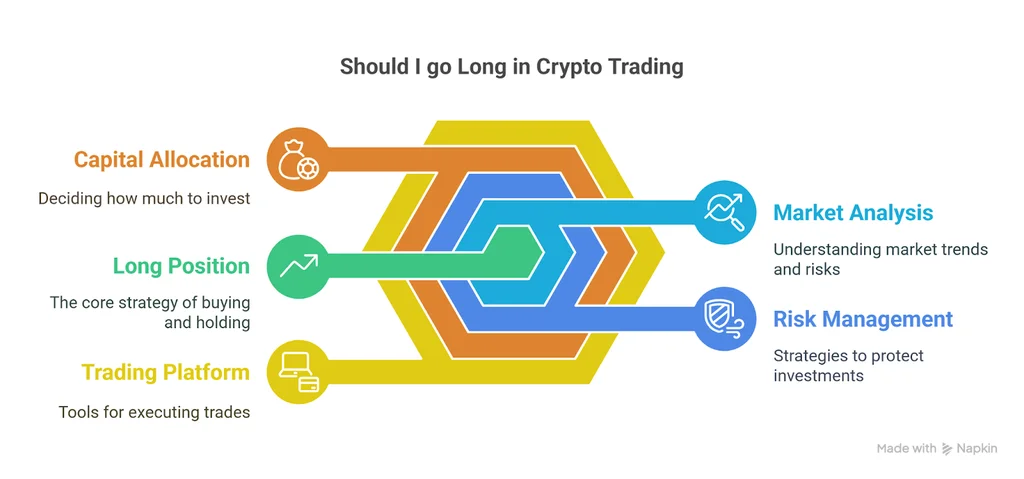
A long position is the most straightforward trade in any market: you buy an asset expecting its price to rise, then sell later at a profit. Going long on Bitcoin at $80,000 and closing at $85,000 returns $5,000 per coin before fees. This mirrors classic “buy low, sell high” logic and is the default mode for most retail participants.
Long positions are available across every market structure in crypto:
- Spot:You purchase actual coins using your own capital. Maximum loss is capped at the amount invested since an asset’s price cannot fall below zero.
- Margin/Futures:You go long with borrowed capital, amplifying potential profits and potential losses through leverage.
- Options:Buying a call option gives you the right to purchase a coin at a set price (the strike) before expiry, limiting downside to the premium paid.
For long-term holders (“HODLers”), the position never formally closes; the asset sits in a wallet until the holder decides to sell. For active traders, long positions typically run from hours to months depending on the strategy.
What Is a Short Position in Crypto?
A short position is a bet that a cryptocurrency’s price will fall. You borrow coins from a broker or exchange, sell them immediately at the current market price, then buy them back at a lower price and return them – pocketing the difference.
Example: You borrow 1 BTC and sell at $80,000. Bitcoin falls to $70,000. You buy 1 BTC back and return it, keeping $10,000 minus borrowing fees and platform commissions.
The critical risk with short positions is theoretically unlimited loss. If the price rises instead of falls, you must still buy back the asset at the higher price. A short entered at $80,000 on an asset that rallies to $120,000 produces a $40,000 loss per coin. This is why short positions typically operate over shorter timeframes and require active monitoring.
How Do Spot Positions Compare to Derivatives Positions?
Spot and derivatives markets serve different trader profiles. The table below shows the key structural differences:
| Feature | Spot Position | Futures/Perpetual Position | Options Position |
| Asset ownership | Yes – real coins | No – contract only | No – right to buy/sell |
| Capital required | Full purchase price | Margin collateral | Premium (cost of option) |
| Maximum loss (long) | 100% of investment | Collateral + liquidation | Premium paid only |
| Leverage available | No (or minimal) | Up to 100x on some platforms | Built-in via premium cost |
| Expiry date | None | Fixed (futures) or none (perps) | Yes – fixed expiry |
| Direction | Long only | Long or short | Long or short |
As of Q1 2026, derivatives positions continue to vastly outnumber spot activity by volume. Perpetual contracts alone accounted for approximately 78% of total crypto derivatives trading in 2026, and the crypto derivatives market posted $86 trillion in annual volume that year – reflecting how dominant leveraged positioning has become relative to outright coin ownership.
Also Read: What is Ichimoku Cloud in Trading: How to Use?
What Are Perpetual Contracts and How Do They Work as Positions?
Perpetual contracts (perps) are futures with no expiry date, making them the most widely used derivatives instrument in crypto. Unlike traditional futures, perps never force a settlement – a trader can hold a long or short position indefinitely, as long as their margin remains sufficient.
The mechanism that keeps perp prices anchored to spot prices is the funding rate: a periodic payment exchanged between long and short holders. When longs outnumber shorts (bullish market), longs pay shorts. When the market leans bearish, shorts pay longs. This incentivizes arbitrageurs to bring the contract price back in line with the underlying asset.
In Q3 2026, CME Group reported record crypto futures and options volume exceeding $900 billion, reflecting strong institutional appetite for perpetual and futures positions as portfolio tools rather than purely speculative instruments.
How Does Leverage Change a Position’s Risk Profile?
Leverage multiplies both gains and losses by borrowing capital against a collateral deposit. A 10x leveraged long on $10,000 of collateral gives you $100,000 in market exposure. A 10% price move in your favor becomes a 100% gain on your capital. The same 10% move against you wipes out the entire position – a liquidation.
Key leverage mechanics every trader must understand:
- Margin requirement: The minimum collateral needed to open a position. At 10x leverage, margin is 10% of the notional position size.
- Maintenance margin: The minimum balance required to keep a position open. Falling below this triggers an automatic liquidation.
- Liquidation price: The exact price at which the exchange closes your position to prevent losses beyond your collateral.
- Funding rate cost: On perpetuals, holding a leveraged long in a bullish market means paying funding rates to short holders – a recurring cost that erodes profits on long holds.
In April 2026, new tariff announcements caused the crypto market to shed nearly $500 billion in capitalization over 48 hours, triggering cascading liquidations across leveraged long positions – a clear illustration of how quickly leverage turns manageable drawdowns into account-ending events.
Also Read: Crypto Volume Analysis: How to Tell a Real Move From a Bluff
What Is the Difference Between Isolated and Cross Margin?
When opening a leveraged position, traders choose how their collateral is structured:
- Isolated margin: Only the collateral assigned to that specific position is at risk. If the position is liquidated, losses are capped at the isolated amount. This protects the rest of the account but limits the position’s capacity to absorb price swings.
- Cross margin: The entire account balance serves as collateral. Positions are less likely to be liquidated in isolation, but a single large losing position can drain the entire account if losses escalate.
Beginners are generally better served by isolated margin because it enforces hard limits. Experienced traders managing multiple correlated positions sometimes prefer cross margin for capital efficiency.
How Do Long and Short Positions Compare Across Market Conditions?
| Aspect | Long Position | Short Position |
| Market outlook required | Bullish (price rising) | Bearish (price falling) |
| Maximum loss (unleveraged) | Limited to investment | Theoretically unlimited |
| Capital requirements | Purchase funds only (spot) | Margin collateral required |
| Typical holding period | Days to years | Hours to weeks |
| Profit mechanism | Price appreciation | Price depreciation |
| Available in spot market | Yes | No (requires derivatives) |
| Ongoing cost | Funding rates (if leveraged) | Borrowing fees + funding rates |
What Is Position Sizing and Why Does It Matter?
Position sizing is the process of deciding how much capital to allocate to any single trade. Even accurate market analysis becomes irrelevant if an oversized position triggers a margin call before a trade has time to develop.
The most widely used approach in crypto is the fixed percentage rule: risk no more than 1–2% of total account equity on any single position. On a $50,000 account, that means accepting a maximum loss of $500–$1,000 per trade. Combined with a stop-loss order placed at the risk threshold, this rule prevents any single bad trade from causing permanent account damage.
A 1:3 risk/reward ratio is a common benchmark – risk $500 to target a $1,500 gain. This means a trader can be wrong more than half the time and still remain profitable overall.
Also Read: Peer-to-Peer Networks: How They Work, and How to Use Them Right Now
How Are Positions Managed Through Stop-Loss and Take-Profit Orders?
Open positions need clear exit rules before they are placed. Two order types serve this function:
- Stop-loss order: Automatically closes the position if price moves against you to a predefined level. Prevents a losing trade from growing into a catastrophic loss.
- Take-profit order: Closes the position automatically once a profit target is hit, locking in gains before the market can reverse.
Trailing stop-losses are a more flexible variation: the stop price moves up (for longs) as the market rises, locking in progressively more profit while still giving the position room to run. When price reverses by the trailing distance, the position closes automatically.
What Are the Main Risks When Trading Crypto Positions?
Beyond obvious price risk, traders face several structural risks specific to crypto markets:
- Liquidity risk: Small-cap coins may not have enough market depth to fill large orders near the expected price, causing slippage.
- Exchange risk: Platform outages, hacks, or insolvency can lock funds or cause forced liquidations at unfavorable prices.
- Funding rate drag: In trending markets, perpetual funding rates can erode profits on long-held leveraged positions even when price moves in the expected direction.
- Regulatory risk: Policy changes – including exchange bans or tax enforcement – can move markets suddenly and close trading access in certain jurisdictions.
- Flash crashes: Crypto markets operate 24/7 with no circuit breakers. Automated liquidation cascades can push prices far below fair value in seconds.
Practical Tips for Managing Crypto Positions
- Define your exit before entry. Set stop-loss and take-profit levels before placing any trade. Deciding under pressure – when a position is already losing – consistently produces poor outcomes.
- Start with spot before derivatives. Spot long positions expose you to real market dynamics without the added complexity of liquidation risk, margin calls, and funding rates. Master the basics first.
- Keep leverage low until you have a track record. Most professional traders using derivatives use 2–5x leverage. Double-digit leverage is rarely necessary and frequently catastrophic for accounts that haven’t been tested across multiple market cycles.
- Track your position cost basis. For tax and performance purposes, record the exact entry price, size, fees, and date of every position. Every closed crypto position is a taxable event in most jurisdictions, including the US, as of 2026.
- Review open positions before high-impact events. Regulatory announcements, macroeconomic data releases, and major protocol upgrades cause outsized price moves in crypto. Either close or tighten stops before known catalysts.
- Keep a trade journal. After closing each position, note what worked, what didn’t, and whether the outcome matched your pre-trade thesis. Systematic review is the fastest path to improving position management discipline.
Also Read: 5 Best Crypto Market Trend Indicators
Frequently Asked Questions About Crypto Positions
What does “opening a position” mean in crypto?
Opening a position means placing a trade that creates active market exposure – buying a coin (long) or borrowing and selling it (short). The position remains “open” until you execute a closing trade. In spot markets, opening a long is simply a purchase. In derivatives markets, it involves placing a contract on a margin-supported platform where the position is tracked against your entry price in real time.
Can you hold both a long and a short position on the same asset at the same time?
Yes – this is called a hedged position. Some traders simultaneously hold a spot long on Bitcoin while opening a short futures position to limit downside during uncertain periods. This approach reduces net exposure but does not eliminate it entirely, and the costs of holding both sides – funding rates, fees – can reduce overall returns. Many exchanges now support hedge mode as an explicit account setting.
What happens to a position if an exchange goes offline?
For spot positions, your assets remain in the exchange’s custody – access is restored when the platform comes back online, though recovery is not guaranteed in cases of insolvency. For derivatives positions, an extended outage during volatile conditions can prevent you from closing at your intended stop-loss, potentially resulting in larger losses than planned. Using exchanges with proven uptime records and keeping a portion of assets in self-custody wallets reduces this risk.
How does leverage affect the liquidation price for a short position?
For a short position, the liquidation price is above the entry price – the opposite of a long. At 10x leverage on a short entered at $80,000, a price rise of roughly 9–10% (to approximately $88,000) can trigger liquidation. The higher the leverage, the closer the liquidation price sits to the entry price, leaving almost no buffer for normal price fluctuations. As of Q1 2026, most major platforms display the liquidation price clearly at order entry, making it easier to assess risk before committing capital.
What is open interest and how does it relate to positions?
Open interest (OI) is the total number of outstanding derivative contracts – longs plus shorts – that have not yet been settled. Rising open interest while price increases suggests fresh money entering long positions, confirming an uptrend. Rising OI while price falls suggests new short positions are being opened. When open interest drops sharply, traders are closing positions – often a sign that a trend is losing conviction. In mid-2026, Bitcoin futures open interest across major exchanges reached as high as $66 billion, a level traders watched closely as a sentiment gauge.
Is it possible to profit from a position in a sideways market?
Directional positions struggle in range-bound markets because there is no sustained trend to capture. Options strategies like covered calls – selling a call option against an existing long – or short straddles generate income from low volatility itself. Range traders also use oscillators to buy near support and sell near resistance within an established channel, taking smaller but more frequent profits. Funding rates in perpetual markets can also be harvested by holding whichever side of the trade receives payments during low-volatility periods.
How do taxes apply to closed crypto positions?
In most major jurisdictions, every closed crypto position is a taxable event. In the US, as of 2026, short-term gains (positions held under one year) are taxed at ordinary income rates, while long-term gains benefit from reduced capital gains rates. Derivatives positions may be treated differently depending on jurisdiction – some countries tax futures gains as income regardless of holding period. Keeping detailed records of entry price, exit price, fees, and dates for every position is essential for accurate tax reporting.