A crypto bubble happens when prices climb far past what the technology or its actual use can justify, pushed up mostly by speculation, fear of missing out, and herd behavior.
The tricky part with crypto is that there’s no earnings report or cash flow to check the price against, so nobody can point to a clean number and say, this is what it’s really worth.
As Tal Elyashiv, cofounder of SPiCE VC, put it, stocks can be compared to the value of the company’s assets, but with crypto there’s no such intrinsic value to measure against.
A few things tend to show up together when a crypto bubble is forming:
Prices double or triple in weeks, with no matching jump in real usage
People buy because everyone else is buying, not because they understand what they’re holding
New investors with little crypto knowledge pile in
Traders use heavy borrowed money (leverage) to size up bets
Coverage of overnight millionaires shows up on mainstream news.
Join UEEx
Experience the World’s Leading Digital Wealth Management Platform
Crypto bubbles share a lot of DNA with older manias, from the 1630s Dutch tulip craze to the dotcom crash.
Investors convince themselves this time is different, new technology creates a real story that spins into pure speculation, and people buy assets they don’t understand, hoping to sell to someone else at a higher price.
But crypto bubbles move faster and hit harder. The 2017 Bitcoin bubble ran from around $3,000 to $20,000 in four months, then crashed 84% within a year.
Crypto trades 24/7 with no circuit breakers, no central bank standing by to backstop it, and leverage that can run 50x-100x, compared to 2x-4x on a typical stock trade.
On the flip side, Bitcoin has never gone to zero the way a failed dotcom stock or a Ponzi scheme does. Every crash has been followed, eventually, by a recovery to a new high.
Is Bubble Even the Right Word?
Economist Robert Shiller has called Bitcoin one of the clearest examples of a speculative bubble in modern markets, and JPMorgan’s Jamie Dimon once compared it to a Ponzi scheme.
Crypto supporters push back, pointing out that Bitcoin has survived multiple 70%+ crashes without dying and that real infrastructure now exists behind it: tens of thousands of merchants accept it, stablecoins move trillions of dollars a year, and pension funds now hold small allocations to it.
Whether you call it a bubble or a cycle, the boom-then-bust pattern is not in dispute. Understanding that pattern is what actually protects your money.
A Short History of Crypto Bubbles: 2011 to 2026
2011: The First Bubble ($1 → $30 → $2)
Bitcoin hit parity with the dollar in February 2011, then jumped to nearly $30 by June after Gawker’s story on the Silk Road dark web marketplace brought it mainstream attention.
By November, it had crashed roughly 94% to about $2. The whole market was worth less than $100 million at the time, small enough that a single large holder could move the price.
This cycle set the template: hype, mania, crash, survive.
2013: The Cyprus and China Cycle ($100 → $1,100 → $200)
Bitcoin’s digital gold story took off in 2013 after Cyprus seized bank deposits during its debt crisis. Chinese exchanges then poured in, pushing Bitcoin from about $100 to roughly $1,100 by November.
However, China’s central bank banned financial institutions from handling Bitcoin the next month, and the price fell more than 80% over the following year.
Meanwhile, the Mt. Gox exchange collapsed in 2014 after losing 850,000 BTC; forensic analysis later proved the vast majority of those coins were stolen gradually from hot wallets between 2011 and late 2013.
Researchers later found that Bitcoin’s price may have been artificially inflated by bots on Mt. Gox that created fake trades using Bitcoin they didn’t own.
2017-18: The ICO Mania ($1,000 → $20,000 → $3,200)
The 2017 bull run marked crypto’s first mainstream breakthrough. Bitcoin soared from below $3,000 in August to nearly $20,000 by December before plunging below $7,000 by February 2018, with Ethereum following a similar path.
The rally was largely fueled by the initial coin offerings (ICO) boom, which let blockchain startups raise capital by selling digital tokens in exchange for Bitcoin or Ether.
In 2017, more than 800 ICOs raised about $6 billion, with the cumulative total reaching roughly $20 billion across 2017 and 2018, but widespread speculation and weak projects ultimately triggered a sharp market correction.
However, most of it was noise, as regulators later found the large majority of ICOs were scams, frauds, or dead projects, and the lending platform BitConnect, a $2 billion Ponzi scheme, collapsed in January 2018.
Bitcoin lost 84% of its value over the following year.
Join UEEx
Experience the World’s Leading Digital Wealth Management Platform
2020-22: DeFi, NFTs, and the Fall of FTX ($10,000 → $69,000 → $15,800)
In late 2020, crypto experienced an unprecedented boom that lasted for almost two years. Stimulus money and rock-bottom interest rates during the pandemic fueled this run.
Decentralized finance projects, NFTs, and meme coins like Dogecoin all had their moment, and Bitcoin peaked near $69,000 in November 2021.
Then it unwound fast: the TerraUSD stablecoin collapsed in May 2022, wiping out $45 billion in a week, and lending platforms Celsius and Voyager followed.
The final blow came in November 2022, when the FTX exchange collapsed after its founder was found to have used customer funds for his own trading firm. Bitcoin bottomed near $15,800.
2024-26: The Institutional Cycle That Cracked Anyway
This is the cycle we’re still living through, and it looks genuinely different from the ones before it.
In January 2024, the U.S. Securities and Exchange Commission (SEC) approved the first spot Bitcoin ETFs.
This opened the door for pension funds, retirement accounts, and everyday brokerage investors to hold Bitcoin without touching a crypto exchange.
Trump’s election win in November 2024 added rocket fuel; he took office promising a pro-crypto agenda, launched the $TRUMP memecoin through Trump-affiliated companies days before his inauguration, and later moved to set up a federal Strategic Bitcoin Reserve using coins the government had already seized.
Bitcoin blew through $100,000 for the first time in December 2024 and kept climbing through the summer, hitting a fresh record above $126,000 on October 6, 2025, as ETF inflows surged during a U.S. government shutdown.
However, not everyone was celebrating. That same year, hedge fund Elliott Management sent clients a letter warning of an inevitable collapse of the crypto bubble, one it argued had been inflated by the White House’s closeness to the industry.
Greenlight Capital’s David Einhorn was blunter, writing that the market had reached the Fartcoin stage of the market cycle after a joke meme coin with no real purpose hit a $2 billion valuation.
Elliott Management warned clients that crypto’s inevitable collapse could ripple through markets in ways nobody could fully predict, a risk it tied directly to the industry’s closeness to the White House.
They weren’t wrong about the direction, if not the exact timing. The peak didn’t hold. A $19 billion forced liquidation event in October 2025 damaged market structure, and Bitcoin ETFs, which had absorbed close to $60 billion in inflows, flipped to sustained outflows; over $3.79 billion left in November 2025 alone, according to fund flow data reported by crypto news outlets.
By February 2026, Bitcoin had fallen more than 50% from its peak, and the crypto market had lost over $2 trillion in value.
Meanwhile, a hawkish Federal Reserve, rising oil prices tied to Middle East tensions, new Trump tariff announcements, and a surprise Bitcoin sale by corporate holder Strategy all piled on from March to May.
By July 2026, Bitcoin was consolidating in the low-to-mid $60,000s, down roughly half from its October 2025 high, with sentiment readings sitting closer to fear than greed.
Are We in a Crypto Bubble Right Now?
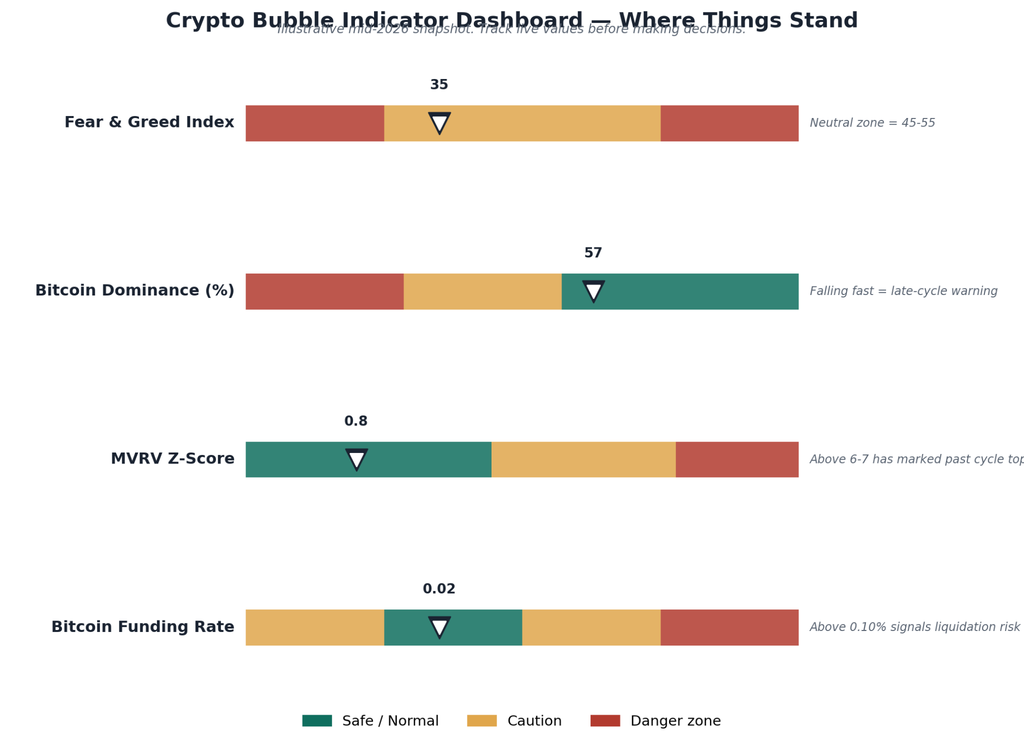
As of August 2026, crypto has already lived through one bubble-and-burst cycle this run. Bitcoin peaked above $126,000 in October 2025 and has since fallen roughly 50%, with Bitcoin dominance and Fear & Greed readings back near neutral.
The pure euphoria stage looks to be over for now, but the deeper structural questions, heavy ETF dependence, meme coin speculation, and leverage in futures markets haven’t gone away.
Another leg down, or another leg up, remains genuinely possible.
Here’s how this cycle stacks up against the two before it:
Metric
2017 Cycle
2021 Cycle
2024-26 Cycle
Primary driver
ICO mania, retail FOMO
DeFi/NFT boom, stimulus
ETF adoption, Trump policy
Institutional role
Almost none
Growing (Tesla, MicroStrategy)
Dominant (ETFs, treasuries)
Peak price
$20,000
$69,000
$126,000
Drawdown from peak
84%
77%
50% (so far)
Regulatory backdrop
Hostile, uncertain
Enforcement crackdowns
Comparatively friendly
Dominant narrative
Blockchain changes everything
“DeFi and Web3 future”
Digital gold, institutional adoption
The clearest sign that this cycle is different: the crash has been slower and shallower so far than 2017 or 2021, which analysts attribute to institutional holders behaving less like panicked retail traders and more like long-term allocators.
The clearest sign it isn’t entirely different: meme coins with no utility still hit multibillion-dollar valuations right before the top, exactly like they have in every cycle before this one.
Join UEEx
Experience the World’s Leading Digital Wealth Management Platform
You don’t need a finance degree to track this. A handful of indicators, checked together rather than alone, tell you roughly where the market sits in its cycle.
MVRV Z-Score
This compares Bitcoin’s current price to the average price everyone paid for their coins. When the gap gets historically wide, most holders are sitting on large paper gains, and history shows that’s when profit-taking and crashes tend to follow.
Readings above 6-7 have marked past cycle tops; a very low or negative reading has usually marked the bottom instead.
NVT Ratio
Think of this as crypto’s version of a price-to-earnings ratio. It compares Bitcoin’s total market value to how much value is actually moving through its network each day.
A high Network Value to Transactions (NVT) ratio means the price has run far ahead of real usage.
Puell Multiple
This looks at how much money Bitcoin miners are earning today compared to their yearly average. When miners are earning historically outsized profits, it’s often a sign the price has run too far, too fast.
Fear & Greed Index
The CoinMarketCap Fear & Greed Index measures crypto market sentiment on a scale of 0–100 using factors such as price momentum, volatility, derivatives activity, market composition, and investor behavior.
Extreme Greed (typically above 75–80) often signals an overheated market, while Extreme Fear (below 20–25) has historically coincided with attractive long-term buying opportunities.
However, it works best as a sentiment indicator alongside other market analysis and not as a standalone trading signal.
Bitcoin dominance
When Bitcoin’s share of the total crypto market falls sharply, below roughly 40-45%, it usually means money is rotating into riskier altcoins and meme coins, a classic late-cycle sign.
RSI (Relative Strength Index)
The Relative Strength Index (RSI) measures the speed and strength of an asset’s price movements on a scale of 0 to 100.
An RSI above 70 typically signals overbought conditions and due for a pullback, while a reading below 30 suggests the asset may be oversold and due for a bounce.
However, strong trends can keep RSI elevated or depressed for extended periods, so traders often use it alongside other indicators to confirm potential reversals
The Taxi Driver Test
One classic warning sign of a market bubble is when people with little or no crypto knowledge start confidently sharing investment tips, the modern version of the famous shoeshine boy indicator.
At the same time, crypto news outlets and influencers often flood social media with predictions of explosive gains.
While optimism has its place, when hype and emotion overwhelm fundamentals, speculation may be reaching bubble territory.
Note: None of these predict the exact top or bottom. However, used together, they tell you whether to lean cautious or lean confident, and they’re the same signals worth checking before you open any new position on UEEx or elsewhere.
Join UEEx
Experience the World’s Leading Digital Wealth Management Platform
How to Protect Your Money: Crypto Bubble Protection Strategies
You can’t control whether Bitcoin doubles or halves next, but you can protect your portfolio by controlling how much of that swing you’re exposed to.
Size Your Position to the Cycle:
Bear market / extreme fear: A smaller, steady position built through regular buying (dollar-cost averaging) rather than one big bet.
Early bull market: Keep adding gradually, but don’t chase.
Late bull market / extreme greed: Start trimming. Selling some of your gains isn’t timing the top; it’s protecting what you’ve already made.
Rules Worth Following:
Take profits on the way up: A simple step is that every time your investment doubles, sell enough to recover your original money, and let the rest ride.
Use trailing stop-losses: Set a sell point below the current price, and move it up as the price rises, never down. UEEx’s automated risk controls can handle this for you in real time instead of you having to watch the market all day.
Don’t put everything in one basket: Keep crypto to a slice of your overall savings, and inside that slice, don’t go all-in on meme coins or unproven altcoins. Parking part of your portfolio in a stablecoin during shaky periods is a simple way to hold your ground without fully exiting crypto.
Consider hedging tools if you’re an active trader: Options and futures can offset downside risk without forcing you to sell your actual holdings; UEEx’s guide to crypto risk management walks through how.
Move long-term holdings off exchanges: FTX, Mt. Gox, and Celsius all collapsed while holding customer money. A hardware wallet you control removes that risk entirely.
Only invest money you can afford to lose completely: Crypto has dropped 70-90% from its peak in every cycle so far. Rent money and emergency savings should never touch it.
Common Mistakes to Skip
Using high leverage (10x, 50x, 100x), thinking it’s a shortcut; it’s closer to a coin flip with extra steps
Buying at a fresh all-time high because you’re afraid of missing out
Ignoring warning signs because this time is different
Following crypto influencers’ calls without checking their track record or incentives
Checking prices every few minutes and letting short-term swings drive long-term decisions.
Join UEEx
Experience the World’s Leading Digital Wealth Management Platform
Crypto’s 2024-26 cycle followed the same script as every one before it: a genuine story (ETFs, institutional adoption, a friendly White House) turned into a bidding war, meme coins with no purpose hit billion-dollar valuations, and the price gave back roughly half its gains once the euphoria wore off.
That’s a bubble by any honest definition, even if institutional money made this one messier and slower to unwind than 2017 or 2021.
Bitcoin has recovered from every crash before this one, but recovery has never meant a straight line back up, and it has never been guaranteed.
Manage your position size, take profits along the way, and only risk what you can genuinely afford to lose.
This article is for educational purposes only and isn’t financial, investment, legal, or tax advice. Crypto markets are highly volatile; prices have dropped 70-90% from their peak in past cycles, and you could lose your entire investment. Talk to a qualified financial advisor before making investment decisions.
Disclaimer: This article is intended solely for informational purposes and should not be considered trading or investment advice. Nothing herein should be construed as financial, legal, or tax advice. Trading or investing in cryptocurrencies carries a considerable risk of financial loss. Always conduct due diligence before making any trading or investment decisions.
Trade with proof of Reserves
UEEx publish monthly audits and third party verification on every listed market.