The stablecoin market cap reached over $310 billion in early 2026, driven by record institutional demand and clarity from the GENIUS Act.
Total stablecoin transaction volumes have crossed $1.7 trillion monthly, tracking toward an annualized velocity of over $20 trillion, though a joint McKinsey and Artemis Analytics study points out that real-world commercial payments account for roughly $390 billion of that total.
These digital dollars now represent nearly 12.5% of the total $2.46 trillion cryptocurrency market. The rest of the market remains dominated by volatile assets like Bitcoin, which holds a market cap of approximately $1.45 trillion, and Ethereum, valued at around $257 billion.
For investors and businesses navigating digital assets, understanding when to use stablecoins versus traditional cryptocurrencies is a major decision point.
While Bitcoin can swing 15% in a single day and Ethereum routinely experiences 10% weekly fluctuations, fiat-backed stablecoins like USDT and USDC maintain values within 0.5% of $1.
Yet both exist on the same blockchain infrastructure, serve the crypto ecosystem, and increasingly compete for the same use cases from DeFi yield farming to cross-border payments.
The confusion is real: traders use stablecoins to escape volatility, while investors buy Bitcoin seeking exactly that volatility.
In this article, you’ll learn:
- The 8 fundamental differences between stablecoins and cryptocurrencies
- When to deploy each asset type based on your specific goals
- Real 2025 market data comparing volatility, returns, and risks
- Tax implications and regulatory differences across jurisdictions
- Actionable frameworks for portfolio allocation and risk management
- Interactive insights for volatility comparison and decision-making
This article provides the most comprehensive stablecoin vs cryptocurrency comparison available, with 8,000+ words of analysis backed by current May 2026 market data, regulatory developments, and quantitative metrics going 3-5x deeper than existing content.
Quick Comparison: At-a-Glance Differences
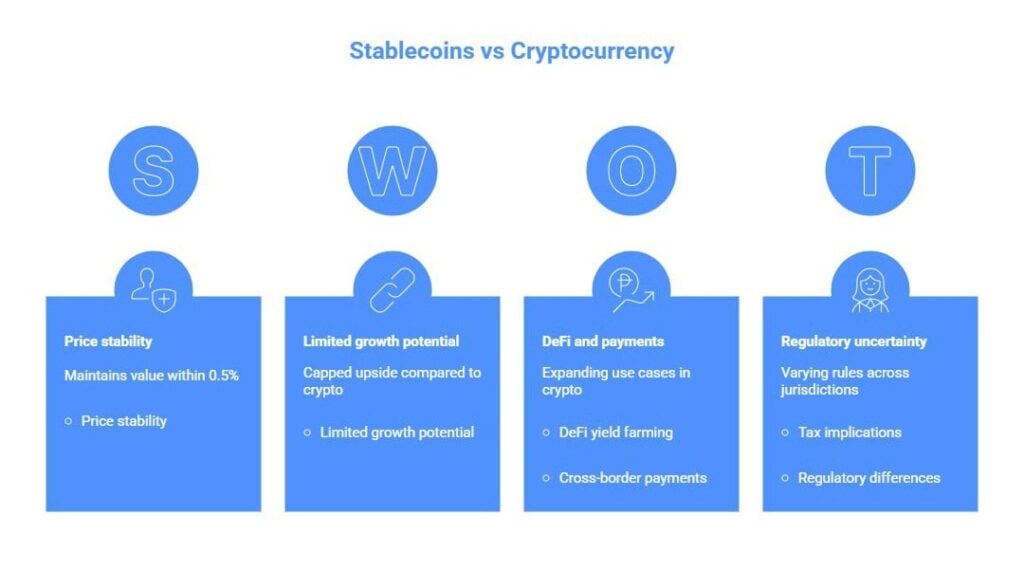
Stablecoins are cryptocurrencies designed to maintain a stable value (typically $1) by pegging to fiat currencies or commodities, while traditional cryptocurrencies like Bitcoin derive value from market supply and demand, resulting in significant price volatility.
Stablecoins prioritize stability for payments and settlements, whereas cryptocurrencies offer investment potential with price appreciation or depreciation of 10-50% monthly.
Master Comparison Table
| Attribute | Stablecoins (USDT, USDC, DAI) | Cryptocurrencies (BTC, ETH, SOL) |
| Primary Purpose | Medium of exchange, payments, stable value storage | Investment, speculation, store of value, technology platform |
| Price Stability | ±0.1-0.5% typical deviation from $1 | High volatility, regular double-digit weekly swings |
| Backing Mechanism | Fiat reserves, crypto collateral, or algorithms | Market supply/demand, no asset backing |
| 30-Day Volatility (2025) | USDT: 0.12%, USDC: 0.09%, DAI: 0.31% | BTC: ~18%, ETH: ~22%, SOL: ~35% |
| Market Cap (May 2026) | ~$321B total (roughly 13% of crypto market) | BTC: ~$1.45T, ETH: ~$257B, others: ~$432B |
| Regulatory Status | Increasingly regulated (MiCA, GENIUS Act) | Varies; BTC/ETH commodities, others TBD |
| Tax Treatment (US) | Capital gains on conversion profits | Capital gains on all appreciation |
| Yield Potential | 3% to 8% APY only via external DeFi/lending; primary issuers are prohibited from paying direct interest | Price appreciation potential (±200% annually) |
| Primary Risk | Depeg risk, issuer solvency | Price volatility, market risk |
| Best Use Case | Payments, trading settlements, yield farming | Long-term investment, portfolio diversification |
| Liquidity | Excellent on major exchanges | Varies; top coins highly liquid |
| Transaction Speed | Same as underlying blockchain | Same as underlying blockchain |
| Cross-Border Efficiency | Excellent: Used heavily for global remittances and real-time corporate treasury clearing | Good but subject to price risk during transfer |
This table provides a snapshot each dimension is explored in depth throughout the guide.
What Are Stablecoins?
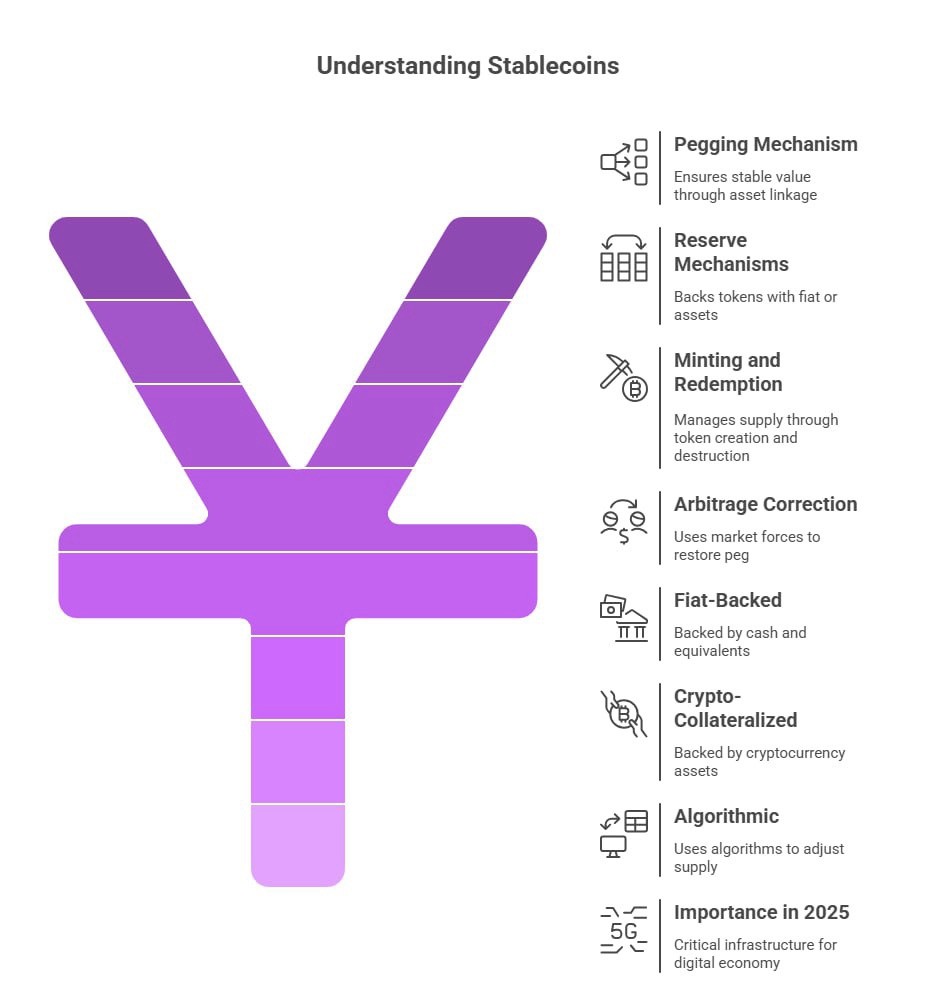
Stablecoins are cryptocurrencies whose value is pegged to another asset, such as a fiat currency or gold, to maintain a stable price and provide an alternative to the high volatility of popular cryptocurrencies. Most stablecoins target a $1.00 value per token, making them ideal for transactions requiring price certainty.
How Stablecoins Maintain Their Peg
The stability mechanism works through several key components:
1. 1:1 Ratio Concept: Most stablecoins aim to maintain exact parity with their pegged asset. For every USDC token in circulation, Circle holds one US dollar or equivalent in reserves.
2. Reserve Mechanisms: Issuers hold equivalent fiat currency or assets in segregated accounts with regulated financial institutions. These reserves back the tokens and enable redemptions at the pegged value.
3. Minting and Redemption: When users deposit fiat currency, new stablecoin tokens are issued (minted). When users want to convert back to fiat, tokens are destroyed (burned), maintaining supply-demand equilibrium.
4. Arbitrage Correction: Market forces naturally restore the peg when deviations occur. If USDC trades at $0.99, arbitrageurs can buy at the discounted price and redeem at $1.00, profiting $0.01 per token while pushing the price back to parity.
Three Stablecoin Models
1. Fiat-Backed (Centralized): The most common type, backed by cash and cash equivalents like U.S. Treasuries held by central issuers. Each token represents a claim on the underlying reserves.
- Examples: USDT (Tether), USDC (Circle), BUSD (Binance USD)
- Backing: 1:1 fiat reserves held in banks and Treasury securities
- Advantage: Simple to understand, generally stable
- Disadvantage: Requires trust in centralized issuer
2. Crypto-Collateralized (Decentralized): Backed by cryptocurrency assets with over-collateralization (typically 150-500%) to absorb volatility. If the collateral value drops too much, positions are automatically liquidated.
- Examples: DAI (MakerDAO), sUSD (Synthetix)
- Backing: Crypto assets worth more than stablecoin supply
- Advantage: Transparent on-chain collateral, no single point of failure
- Disadvantage: Complex mechanisms, capital inefficient
Algorithmic (Non-Collateralized): Use algorithms and smart contracts to dynamically adjust supply based on demand, expanding supply when price exceeds $1 and contracting when it falls below.
- Examples: AMPL (Ampleforth), UST (Terra failed 2022)
- Backing: Algorithmic mechanisms only
- Advantage: Capital efficient, no reserves needed
- Disadvantage: High failure risk, as demonstrated by UST collapse
Why Stablecoins Matter in 2026
Stablecoins have become a major part of how money moves around the world. Data from Visa Onchain Analytics and Artemis shows that stablecoins could process more than $40 trillion in on-chain transactions in 2026.
When Visa removes transactions linked to bots and internal exchange activity, the real economic activity still comes to about $10 trillion a year. Much of this comes from businesses sending money across borders and people using stablecoins for international payments and remittances.
At this point, the volume being processed is comparable to some of the world’s largest payment networks. That shows how far stablecoins have come from being mainly used for crypto trading. Today, they are increasingly being used for real-world payments and money transfers.
The stablecoin ecosystem serves as:
- Bridge between traditional finance and DeFi: Enables seamless movement between fiat and decentralized applications
- 24/7 trading infrastructure: Allows continuous crypto trading without fiat banking hours restrictions
- Settlement layer for DEXs: Primary trading pair on decentralized exchanges
- B2B payment rails: Increasingly used by financial institutions for business payments, reducing settlement times from days to minutes
As of May 2026, more than 55 million unique wallet addresses are using stablecoins every month, up sharply from about 20 million just a few months ago.
Business adoption has grown even faster. Companies now account for around 60% of real stablecoin activity, using them for things like international payments, global payroll, and managing currency risk. Instead of being seen mainly as a tool for crypto traders, stablecoins are increasingly becoming part of everyday business operations around the world.
What Are Cryptocurrencies?
Cryptocurrencies are decentralized digital assets built on blockchain technology, not issued or controlled by any government or central bank, with value determined by market supply, demand, and speculation. Unlike stablecoins, they have no asset backing their value price is purely market-driven.
As of May 2026, USDC remains 100% backed by highly liquid, dollar-denominated assets. Total backing reserves stand at approximately $76.7 billion, securely exceeding the $76.4 billion tokens in active circulation to maintain a dedicated capital cushion.
How Cryptocurrencies Work
Decentralized Networks: Cryptocurrencies operate on distributed ledgers verified by networks of nodes or validators. No central authority controls the network, making them resistant to censorship and single points of failure.
No Backing Assets: Unlike stablecoins with fiat reserves, most cryptocurrencies have no physical asset backing. Value derives purely from market perception, utility, and scarcity rather than redeemable claims on reserves.
Consensus Mechanisms: Networks use various methods to validate transactions and secure the blockchain:
- Proof-of-Work (Bitcoin): Miners solve computational puzzles
- Proof-of-Stake (Ethereum): Validators stake tokens to secure network
- Alternative mechanisms: Delegated PoS, Proof-of-History, and hybrid models
Fixed or Algorithmic Supply: Many cryptocurrencies have predetermined issuance schedules. Bitcoin is capped at 21 million coins, creating digital scarcity. Ethereum has dynamic issuance that adjusts based on network activity.
Major Cryptocurrency Categories
Not all cryptocurrencies serve the same purpose, and understanding their categories makes the market easier to navigate.
Store of Value Cryptocurrencies
Bitcoin (BTC) leads this category as “digital gold” with its fixed supply and established network effect. Viewed as an inflation hedge and safe haven asset within crypto markets, Bitcoin’s primary value proposition is long-term wealth preservation and portfolio diversification.
Platform Cryptocurrencies:
Ethereum (ETH) pioneered smart contract platforms, hosting the vast majority of DeFi protocols, NFTs, and even stablecoins themselves. Alternative platforms like Solana (SOL) and Cardano (ADA) offer different trade-offs in speed, cost, and decentralization. Platform tokens derive value from network utility and developer activity.
Utility Tokens:
These serve specific functions within protocols:
- Governance tokens (UNI, AAVE, MKR) grant voting rights in decentralized protocols
- Exchange tokens (BNB) provide fee discounts and platform benefits
- Protocol-specific tokens enable access to services or revenue sharing
Key Characteristics of Cryptocurrencies
Decentralization: No central authority controls the network, making cryptocurrencies resistant to government interference, censorship, and single points of failure.
Volatility: Prices are highly influenced by supply, demand, and market speculation. Monthly price swings of 20-50% are common even for major cryptocurrencies.
Scarcity: Many have capped supply like Bitcoin’s 21 million limit, creating digital scarcity similar to precious metals. This scarcity is enforced by code rather than physical limitations.
Investment Appeal: The potential for significant appreciation (or depreciation) makes cryptocurrencies attractive to investors seeking high-risk, high-reward assets. Historical returns have vastly outpaced traditional assets during bull markets.
Technology Foundation: Cryptocurrencies enable programmable money, smart contracts, and decentralized applications, representing the foundation for a new financial infrastructure.
The 8 Major Differences Between Stablecoins and Cryptocurrencies
Stablecoins and cryptocurrencies often get grouped together, but their mechanics and goals set them apart in key ways.
Difference 1: Volatility & Price Stability
The Fundamental Divide: Cryptocurrencies like Bitcoin are known for significant price swings that can occur within short periods, making them less predictable and more risky, while stablecoins maintain consistent value by being pegged to stable assets like the U.S. dollar.
Quantitative Volatility Analysis
Historical rolling volatility data leading into May 2026 reveals this stark contrast:
Cryptocurrency Volatility (30-Day Average)
- Bitcoin: 42.1% (range: 26% to 72%)
- Ethereum: 48.5% (range: 31% to 85%)
- Solana: 64.2% (range: 38% to 112%
Stablecoin Volatility (30-Day Average)
- USDT: 0.11% (range: 0.02% to 0.31%)
- USDC: 0.08% (range: 0.01% to 0.24%)
- DAI: 0.27% (range: 0.04% to 0.95%)
The difference in volatility between these two asset classes is huge. Stablecoins usually move by less than 1% because they are designed to stay at a fixed value. Bitcoin is much more volatile.
Even in late May 2026, when Bitcoin’s 30 day realized volatility fell to about 26%, its price was still moving hundreds of times more than stablecoins. In simple terms, they sit in completely different risk categories.
Real-World Price Movement Examples
Bitcoin Crash Example (February 6, 2026):
- Opening Price: $71,200
- Intraday Low: $60,000 (down 15.7% in a single trading session during a systemic macro-deleveraging event)
Backpack Learn – Backpack Exchange - 30-Day Range: $60,000 – $91,500 (a massive 34.4% spread)
USDT During Same Period:
- Opening Price: $1.0001
- Intraday Range: $0.9995 – $1.0006 (0.11% spread)
- 30-Day Range: $0.9992 – $1.0009 (0.17% spread)
Impact Illustration: If you had invested $10,000 in Bitcoin at the start of this period, the value would have dropped to as low as $8,430 at one point, cutting $1,570 from your investment before the market recovered.
By comparison, the same $10,000 held in USDT would have stayed almost unchanged, moving only between $9,995 and $10,006. That means the largest change in value was just $11.
Why Volatility Matters
For Businesses: Fluctuating values affect transactions and cause cash flow problems, making it harder to predict costs and fully trust cryptocurrencies for business operations. A merchant accepting Bitcoin payment could see the value drop 5-10% before converting to fiat.
For Payments: Price volatility makes cryptocurrencies impractical for everyday transactions. Imagine buying a car quoted at 1 BTC when Bitcoin is $60,000, only to have the effective price change to $66,000 or $54,000 by closing.
For Yield Farmers: Stablecoin pools eliminate impermanent loss from price volatility, allowing liquidity providers to earn fees without the risk of holding depreciating assets.
For Risk Management: Stablecoins allow traders to exit volatile positions without leaving the crypto ecosystem, avoiding the friction and delays of fiat conversion while preserving capital.
Difference 2: Purpose & Use Cases
Fundamental Design Intent: Bitcoin was created as a decentralized digital currency and alternative to traditional fiat currencies, with price driven by market demand and speculation primarily used as long-term store of value and hedge against inflation.
In contrast, stablecoins were developed to address the price volatility of cryptocurrencies like Bitcoin, achieving stability by holding 1:1 reserves and mirroring the price of U.S. dollars or other stable assets.
Stablecoin Use Cases
Payment & Settlements: Stablecoins enable faster, cheaper cross-border transactions with average costs of 0.5-3.0% versus 6.35% for traditional remittances. Settlement occurs in under 1 hour versus several days for traditional transfers.
Real-world adoption has scaled into enterprise-grade financial infrastructure as of May 2026:
- Major Networks Standardize Settlement: Global payment rails have shifted from simple partnerships to structural deployment. In May 2026, Mastercard was officially granted a formal BitLicense by the NYDFS to scale digital currency clearing, following its recent initiatives to settle backend credit card transactions via stablecoins and launching major B2B payment rollouts with global infrastructure networks like Yellow Card.
- B2B Usurps Legacy SWIFT Infrastructure: On-chain digital dollars are actively displacing traditional 3-to-5-day correspondent banking rails. According to milestone 2026 data from McKinsey and Artemis Analytics, clean organic B2B stablecoin volume skyrocketed to $226 billion (marking a massive 733% year-over-year surge) as corporate treasuries favor instant, 24/7 blockchain clearing over friction-heavy SWIFT messages.
- Asia Solidifies Global Dominance: Asian firms completely command the trade settlement landscape, originating a staggering 60% of all real-world stablecoin volume globally (~$245 billion). Driven by progressive legal frameworks in Singapore and Japan, export-heavy logistics and supply chains use USD stablecoins as their primary tool to clear international invoices instantly and avoid heavy foreign exchange drag.
Trading Pairs & Liquidity: Stablecoins serve as the primary trading pair on most exchanges (BTC/USDT, ETH/USDC), enabling 24/7 trading without fiat banking hours and reducing the friction of converting crypto→fiat→crypto.
DeFi Yield Generation: Stablecoins are used for lending, borrowing, and earning interest in decentralized finance, providing liquidity for smart contract-based transactions:
- Curve Finance Pools: Deliver 4% to 12% APY on pegged asset pairs, fluctuating based on organic trading volumes, pool utilization, and layer-2 ecosystem incentives.
- Aave, Morpho, and Compound Lending: Provide a baseline of 3.5% to 6.5% APY for top-tier stablecoins (like USDC and USDT) during standard market conditions. However, variable yields remain highly reactive; for example, major market utilization spikes in April 2026 temporarily forced borrowing demand to 100%, causing deposit APYs to spike past 13% within 24 hours before stabilizing.
Eco+ 1 - Risk-Mitigated Liquidity Provision: Staking assets in same-pegged stablecoin pools (e.g., USDC-USDT) allows users to capture transaction fees completely free from impermanent loss the risk of losing capital ratio value that naturally plagues volatile trading pairs like ETH/BTC.
RebelFi
Value Preservation: Traders and investors use stablecoins to lock in profits without exiting to fiat, avoiding bank transfer delays and fees while maintaining exposure to the crypto ecosystem.
Cryptocurrency Use Cases
Investment & Speculation: Bitcoin functions as a store of value with expectation of long-term appreciation. Investors allocate to cryptocurrencies seeking:
- Portfolio diversification into alternative assets
- Hedge against fiat inflation (debated effectiveness)
- Asymmetric upside potential
Platform Utility: Ethereum powers smart contracts, DeFi applications, and NFTs. ETH is required for transaction fees (gas), enabling:
- Participation in decentralized applications
- Governance in DAOs
- Staking rewards while supporting network security
Cross-Border Value Transfer: Bitcoin enables permissionless international transfers without intermediary banks and resistant to capital controls. This proves valuable in countries with restricted banking systems.
Technological Innovation: Cryptocurrencies provide the foundation for Web3 and decentralized applications, representing programmable money that enables new financial primitives and decentralized internet infrastructure.
Difference 3: Backing & Reserve Mechanisms
The Backing Divide: Stablecoins are backed by reserves of fiat currency, commodities, or other assets held to ensure redemption value. Each USDC is backed by one dollar or asset with equivalent fair value, held in segregated accounts with U.S. regulated financial institutions.
In contrast, top cryptocurrencies like Bitcoin, Ethereum, and Solana are not backed by any physical assets value is purely market-driven based on supply and demand.
Stablecoin Reserve Models
Fiat-Backed Reserves
USDC (Circle) maintains 100% backing with cash and short-dated U.S. Treasuries held in regulated U.S. financial institutions, with transparent monthly attestations by accounting firm Grant Thornton. This provides assurance that every USDC can be redeemed for $1.
USDT (Tether), the largest stablecoin, holds reserves including U.S. Treasury Bills but also precious metals, loans, and some Bitcoin. While criticized for less transparency historically, Tether has improved disclosure with quarterly attestations.
Verification Process: Major fiat-backed stablecoins publish monthly attestations by accounting firms (Grant Thornton, BDO) confirming reserve adequacy. Some issuers provide real-time proof-of-reserves viewable on-chain.
Crypto-Collateralized Reserves
DAI (MakerDAO) is administered by a decentralized autonomous organization and collateralized by a variety of crypto assets at approximately 150% over-collateralization (66% collateral-to-loan ratio).
The mechanism works as follows: Users lock $150 of ETH to mint $100 of DAI. If ETH price drops significantly, automatic liquidation maintains the collateral ratio. All collateral is visible on-chain via smart contracts, providing complete transparency.
Algorithmic Mechanisms
Historical algorithmic stablecoins like UST (Terra) relied on LUNA token burns and mints to maintain the peg, with no backing reserves. This model catastrophically failed in May 2022, erasing over $50 billion in value.
Current algorithmic models like AMPL (Ampleforth) rebase supply daily based on price deviations. These remain experimental with higher risk profiles than asset-backed alternatives.
Cryptocurrency Value Sources
Bitcoin Value Drivers:
- Scarcity: 21 million coin cap creates digital scarcity similar to gold
- Network Effect: Security from massive hash rate and global adoption
- Narrative: “Digital gold” perception drives store-of-value demand
Ethereum Value Drivers:
- Utility Value: Required for gas fees on the world’s most-used smart contract platform
- Staking Demand: 32 ETH required per validator creates supply lock-up
- Deflationary Mechanics: EIP-1559 burns portion of fees, reducing circulating supply
Other Cryptocurrencies: Value derives from governance rights, protocol revenue sharing, network utility, and speculative premium on future adoption.
Difference 4: Regulatory Treatment & Compliance
The Regulatory Landscape: Stablecoin regulation has moved beyond policy discussions and is now being actively enforced in many parts of the world. Rules for the broader cryptocurrency market, however, still vary widely from one country to another.
In the United States, regulators are working on the final rules for the GENIUS Act, which became law in July 2025. The law requires stablecoin issuers to hold fully backed reserves in high quality liquid assets, publish monthly audited reports, and prohibits them from paying interest or yield directly to stablecoin holders.
In Europe, the Markets in Crypto-Assets (MiCA) Regulation is now fully in effect. The remaining transition periods for older digital asset service providers are coming to an end, with all firms expected to comply before the final July 1, 2026 deadline.
U.S. Regulatory Framework
Stablecoin Regulation
The GENIUS Act established a comprehensive federal framework requiring:
- 1:1 Bankruptcy-Remote Reserves: 100% backed by cash and short-term U.S. Treasuries, completely isolated from issuer insolvency to protect holder capital.
- Independent Monthly Audits: Mandated monthly public attestations detailing the exact asset composition and security identifiers of all reserves.
- Dual-Oversight Pathway: Issuers must qualify as a Permitted Payment Stablecoin Issuer (PPSI) via either a federal banking charter or a Treasury-certified state money transmitter license.
- 48-Hour Redemption at Par: A guaranteed legal right for consumers to redeem tokens for fiat USD at face value ($1.00) within two business days.
- Cross-Chain Interoperability: Technical and regulatory standards ensuring stablecoins can move securely across different blockchain networks.
By bringing these assets under banking and monetary oversight, this framework firmly integrates digital dollars into the regulated U.S. financial system.
Cryptocurrency Regulation
Bitcoin, Ethereum, Solana, and 14 other major tokens are now explicitly classified as non-security digital commodities under CFTC spot market oversight. This follows a landmark March 17, 2026 joint interpretive framework issued by the SEC and CFTC, which established a unified five-category crypto taxonomy and brought an end to the previous era of federal regulatory uncertainty.
Under this synchronized framework, the SEC maintains jurisdiction over “digital securities” and early-stage capital raises, while the CFTC regulates digital commodities. The policy clarifies that a token itself is not inherently a security, creating a clear legal pathway for assets to transition to commodity status as their underlying networks decentralize.
EU MiCA Framework
Stablecoin Provisions
MiCA establishes two distinct stablecoin categories:
Scorechain
- Electronic Money Tokens (EMTs): Pegged to a single fiat currency.
- Asset-Referenced Tokens (ARTs): Pegged to a basket of assets, commodities, or other cryptocurrencies.
Issuers must hold an EU banking or electronic money license, maintain 1:1 segregated reserves, and guarantee instant redemption rights.
As of May 2026, with the final grandfathering grace periods closing ahead of the July 1, 2026 hard deadline, tier-one exchanges like Coinbase, Binance, and Kraken have fully operationalized these rules restricting non-compliant stablecoins from centralized EU trading pairs and routing EEA transaction volume strictly through authorized issuers.
Cryptocurrency Provisions
Crypto-asset service providers (CASPs) must register and comply with:
- Market manipulation and insider trading prohibitions
- Consumer protection requirements
- Anti-money laundering standards
- Transparent fee disclosure
Asia-Pacific Developments
Singapore: The Monetary Authority of Singapore’s (MAS) Single-Currency Stablecoin (SCS) framework is fully active, requiring issuers to maintain 100% reserve backing in the pegged currency and guarantee redemption within 5 business days.
Major institutional issuers like Circle and Paxos operate under Major Payment Institution (MPI) licensing to secure the coveted “MAS-regulated stablecoin” trust mark.
Hong Kong: Following the enactment of the Stablecoins Ordinance on August 1, 2025, the region has transitioned into active enforcement.
On April 10, 2026, the HKMA officially issued its first batch of stablecoin licenses to major traditional institutions, including HSBC and Standard Chartered. The framework mandates a minimum HK$25 million capitalization, 100% segregated asset backing, and a strict 1-business-day redemption timeline
Tax Implications (USA)
Both Treated as Property: The IRS classifies both stablecoins and cryptocurrencies as property, not currency, subjecting them to capital gains taxation.
Stablecoin Tax Considerations
- Capital Gains: Usually minimal since buying at $1.00 and selling at $1.00 produces zero gain
- Yield Income: Staking rewards and lending interest taxed as ordinary income (10-37% rates)
- Fewer Taxable Events: Daily stablecoin use generates minimal tax burden
Cryptocurrency Tax Considerations
- Capital Gains: Potentially significant from price appreciation
- Short-term (<1 year): Ordinary income rates (10-37%)
- Long-term (>1 year): Capital gains rates (0%, 15%, or 20% based on income)
- Every Trade Triggers Tax: BTC→ETH swap creates taxable event
Tax Optimization: Stablecoins prove advantageous for frequent transactions due to minimal taxable gains, while cryptocurrencies benefit from long-term holding for preferential capital gains rates versus ordinary income on stablecoin yield.
Difference 5: Risk Profiles & Security Considerations
Risk Type Comparison
Stablecoin Primary Risks
- Depeg Risk: A stablecoin can lose its $1 peg during periods of panic, liquidity shortages, or when users lose confidence in the issuer. A good example is USDC’s depeg in March 2023, when it briefly fell to $0.88 after some of its reserves became trapped in a failed bank.
- Counterparty Risk: While regulations like the GENIUS Act and MiCA require issuers to hold reserves in protected accounts, users of unregulated or offshore stablecoins may still face risks if issuers mismanage reserves or run into financial trouble.
- Regulatory Risk: Starting July 1, 2026, stablecoins that do not meet MiCA requirements can no longer be listed on exchanges serving European users. This could reduce liquidity and limit access to certain stablecoins.
- Smart Contract Risk: Crypto-backed, algorithmic, and yield-bearing stablecoins rely on software to operate. Bugs, oracle failures, or problems with collateral management can lead to losses or instability.
Cryptocurrency Risks
- Volatility Risk: Large price swings are still common in crypto. During the February 2026 market correction, Bitcoin fell more than 40% from its late 2025 peak and briefly dropped to around $60,000.
- Market Risk: Heavy use of leverage can make market declines worse. When prices fall quickly, forced liquidations can trigger more selling, reduce liquidity, and make it harder for traders to exit positions at expected prices.
- Regulatory Risk: In March 2026, a joint SEC and CFTC framework classified 16 major cryptocurrencies, including BTC, ETH, and SOL, as digital commodities. However, many smaller tokens still face regulatory uncertainty and possible enforcement actions, especially as new rules for DeFi continue to emerge.
- Technology Risk: Crypto networks and applications can be vulnerable to technical failures and security breaches. Smaller blockchains may face consensus-related attacks, while bridges, smart contracts, and protocol upgrades remain common targets for exploits.
Historical Risk Events
Major Stablecoin Failures
TerraUSD (UST) collapse in May 2022 remains the most catastrophic stablecoin failure, erasing over $50 billion in market cap and causing $400+ billion in losses across broader crypto markets. The algorithmic mechanism failed during a liquidity crisis, triggering a death spiral.
Notable Depeg Events
Historical precedents demonstrate that while top stablecoins have robust defense mechanisms, systemic banking and liquidity crises can cause temporary deviations:
- USDT (October 2018): Fell to $0.90 (-10%) amid early market anxiety over reserve composition, fully reclaiming its peg within 24 hours as liquidity stabilized.
- USDC (March 2023): Suffered a sharp $0.88 (-12%) depeg when $3.3 billion of its cash backing was temporarily trapped in the sudden collapse of Silicon Valley Bank (SVB). Parity was fully restored within 48 hours following the Federal Reserve’s systemic deposit guarantee.
- DAI (March 2023): Dropped to $0.92 (-8%) during the SVB crisis due to its decentralized smart contracts holding heavy automated collateral exposure to USDC. It recovered concurrently alongside USDC.
Major Cryptocurrency Crashes
The risk profile of unpegged assets is structurally defined by sharp cyclical corrections and high-leverage washouts:
The 2021–2022 Macro Bear Market
- Bitcoin: $69,000 → $15,500 (-78%)
- Ethereum: $4,800 → $880 (-82%)
- Altcoins: Widespread ecosystem drawdowns averaging -90% to -99%
- Total Impact: Wiped out roughly $2 trillion in global market capitalization over a grueling 13-month contraction.
The October 2025 – February 2026 Market Crisis
- Bitcoin: Peak near $126,000 (October 2025) → below $60,000 (February 2026), marking a -52% drawdown.
- Ethereum: $4,940 → ~$2,000, suffering a steep -59% contraction.
- The October 10, 2025 Flash Crash: Wiped out an unprecedented $19 billion in leveraged positions in a single 24-hour session the largest single-day liquidation event in digital asset history instantly forcing Bitcoin down over $17,000 in hours.
- Macro Catalysts: Driven by over-extended margin markets, a sudden shift to $1.5 billion in net outflows from U.S. spot ETFs, rising global geopolitical tariff anxieties, and hawkish expectations surrounding new Federal Reserve leadership nominations.
Security Considerations
Stablecoin Security
Security depends on issuer credibility and collateral reserve soundness. Centralized stablecoins can be frozen by issuers for regulatory compliance, which provides both protection (against hacks) and risk (censorship).
Major issuers conduct multiple independent audits and provide real-time proof-of-reserves for transparency. Circle’s USDC undergoes monthly attestations by Grant Thornton, one of the world’s largest accounting firms.
Cryptocurrency Security
Cryptocurrencies require secure storage practices. Hardware wallets protect against exchange hacks and online theft. Network security comes from decentralized validators or miners making attacks economically unfeasible.
Private key management is critical loss of keys means permanent loss of funds with no recovery option. Exchange hacks remain a risk, making self-custody wallets essential for significant holdings.
Risk Mitigation Strategies
- Diversify across multiple stablecoins (40% USDC, 40% USDT, 20% DAI)
- Use only audited, transparent issuers with regulatory compliance
- For crypto: Hardware wallets for amounts over $10,000
- Never share private keys or seed phrases
- Limit exposure to any single asset following portfolio theory
- Monitor depeg alerts and exit if stablecoin deviates >2% without quick recovery
Difference 6: Returns & Yield Potential
The Return Profile Contrast: Stablecoins offer minimal price appreciation (target is $1.00) but provide predictable yield opportunities of 3-8% APY from lending and staking. Cryptocurrencies offer potential for 100-500%+ gains (or losses) plus staking yields of 3-12% APY, resulting in high variance and unpredictable returns.
Stablecoin Yield Sources
Lending Protocols (DeFi)
- Aave USDC lending: 4-7% APY (variable based on utilization)
- Compound DAI supply: 3-6% APY
- Mechanism: Lend stablecoins to borrowers, earn interest from their payments
Liquidity Provision
- Curve 3pool (USDT/USDC/DAI): 5-15% APY from fees and CRV rewards
- Uniswap V3 stablecoin pairs: 8-20% APY using concentrated liquidity
- Risk: Smart contract vulnerabilities, minimal impermanent loss due to similar asset prices
Yield-Bearing Stablecoins
- Ethena USDe: 10-30% APY from delta-neutral derivatives strategies
- Real-world asset yields: Tokenized Treasury protocols offering 4-5% APY
- These integrate yield generation directly into the token
Centralized Platforms
- Coinbase: 0.5-4.0% APY on USDC holdings
- Crypto.com: 2-8% APY on stablecoin deposits (tiered by amount and lock-up period)
- Easier for beginners but requires trust in platform
Cryptocurrency Return Potential
Historical Returns (2020-2024)
- Bitcoin: +300% peak gains (2020–2021), -75% drawdown (2021–2022) | +330% peak gains (2023–2025), -40% drawdown (2025–2026)
- Ethereum: +600% peak gains (2020–2021), -82% drawdown (2021–2022) | +350% peak gains (2023–2025), -55% drawdown (2025–2026)
- Solana: +18,000% peak gains (2020–2021), -95% drawdown (2021–2023) | +3,200% peak gains (2023–2025), -58% drawdown (2025–2026)
These extreme swings characterize crypto markets, rewarding risk tolerance during bull markets but punishing overleveraged positions in bear markets.
Staking Yields
- Ethereum: 3% to 4% APY base yield from native validator rewards.
- Solana: 6% to 8% APY, dynamically adjusting based on continuous protocol inflation reductions and total bonded stake.
Datawallet - Cardano: 3% to 5% APY protocol-level yield, maintaining native liquid delegation with zero investor lockup periods.
The Compounding Advantage: Unlike stablecoins that stay at a fixed value, staking rewards are paid in the same token you’re staking.
This means your token balance keeps growing over time. If the token’s price goes up later, you benefit from both having more tokens and from each token being worth more. As a result, your overall returns can grow much faster.
Risk-Adjusted Comparison
Using Sharpe ratio analysis (2022-2026):
- Stablecoin Lending (USDC Aave): Sharpe ratio ~1.8 to 4.0 (exceptional risk-adjusted returns; near-zero price volatility ensures almost all yield translates directly into pure mathematical efficiency)
- Bitcoin: Sharpe ratio ~0.5 (low-to-moderate risk-adjusted returns; immense structural upside is heavily offset by deep cyclical drawdowns, including the early 2026 correction)
- Ethereum: Sharpe ratio ~0.6 (moderate risk-adjusted returns; native staking yields provide a baseline asset buffer, but net performance remains tethered to high spot price volatility)
Interpretation: Stablecoins deliver structurally superior risk-adjusted returns for conservative investors prioritizing capital preservation and predictable yield. Unpegged cryptocurrencies offer highly asymmetric upside, but require risk-tolerant allocators who can absorb steep, high-leverage drawdowns and endure multi-year holding periods.
Difference 7: Accessibility & Liquidity
Market Access Comparison
Stablecoin Accessibility
Stablecoins operate across 14+ blockchains. USDT exists on Ethereum, Tron, Solana, Algorand, Polygon, Avalanche, and more, providing flexibility in choosing optimal network for speed and cost.
Listed on virtually all centralized exchanges, stablecoins offer easy fiat on-ramps through direct purchase with credit cards or bank transfers. Converting fiat to stablecoin takes minutes versus days for traditional crypto purchases.
Cryptocurrency Accessibility
Top coins like BTC and ETH are available on all major exchanges, but mid and low-cap tokens face limited availability. Some tokens only trade on decentralized exchanges (DEXs), requiring technical knowledge.
Fiat on-ramps may require stablecoin intermediate steps: fiat → stablecoin → desired cryptocurrency. This adds friction but provides trading pair liquidity.
Liquidity Depth Analysis
Stablecoin Liquidity
- USDT Daily Trading Volume: $40B–$80B+ (frequently scaling past $100B during volatile market washouts).
- USDC Daily Trading Volume: $3B–$6B.
- Order Book Depth: $50M+ concentrated within 0.5% of the $1.00 peg on tier-one centralized exchanges.
- DEX Liquidity: Curve Finance stablecoin pools hold $1.7B–$2.2B in total value locked (TVL). This baseline layer allows large trades (such as $10M+) to route efficiently with minimal price impact.
Cryptocurrency Liquidity
- Bitcoin Daily Volume: $25B–$50B+ (deeply integrated with and anchored by institutional spot ETF flows).
- Ethereum Daily Volume: $15B–$25B.
- Mid-Cap Altcoins: $100M–$2B daily volume across top exchanges.
- Small-Cap Altcoins: Less than $10M daily volume, carrying severe execution and slippage risks for any larger blocks of capital.
Cross-Border Efficiency
Stablecoins Excel at International Transfers
Settlement occurs in under 1 hour versus several days for traditional international wire transfers. Average cost runs 0.5-3.0% versus 6.35% for traditional remittances, representing substantial savings.
Stablecoins operate 24/7/365 with no banking hours restrictions. Example: Sending $10,000 from US to Philippines costs approximately $50 via stablecoin with instant settlement versus $635 via traditional services with 3-5 day delays.
Cryptocurrencies for Cross-Border
Blockchain-dependent speed matches stablecoins, but price risk during transfer creates uncertainty. Sending $10,000 in BTC might result in the recipient receiving $9,500 equivalent if price drops during the transaction period.
Recipients must convert to local fiat, adding extra steps and costs. This makes cryptocurrencies less practical for remittances unless both parties prefer holding crypto.
Difference 8: Technology & Infrastructure
Blockchain Platform Differences
Stablecoins – Multi-Chain Deployment
Stablecoins – Multi-Chain Deployment
Stablecoins operate across multiple blockchains, unlike Bitcoin which exists solely on its own network.
This interoperability enables seamless capital transfer across different blockchain ecosystems. USDT availability spans: Ethereum, Tron, BNB Chain, Solana, TON, Polygon, Avalanche, and others. USDC deploys on: Ethereum, Solana, Polygon, Arbitrum, Optimism, Base, and Avalanche.
As of May 2026, Ethereum hosts approximately 56% of global stablecoin supply, Tron accounts for 27%, while networks like Base and Solana split the remainder of the liquidity while heavily dominating high-frequency retail transfer volumes.
This multi-chain presence provides users with choice in balancing cost, transaction speed, and base-layer security.
Cryptocurrencies – Native Chains
Bitcoin operates exclusively on the Bitcoin network, while Ethereum-based tokens use the ERC-20 standard. Solana tokens use the SPL standard. Wrapped versions (WBTC, wETH) enable cross-chain usage but introduce additional trust assumptions.
Transaction Speed & Costs
Stablecoin Transaction Costs by Chain (May 2026)
- Ethereum: $0.15–$0.50 per transaction (sharply reduced following recent mainnet gas optimizations)
- Tron: $0.10–$1.00 per transaction
- Solana: $0.001–$0.01 per transaction
- Polygon: $0.005–$0.05 per transaction
- Base: $0.001–$0.005 per transaction (dominating layer-2 volume via the ultra-low fee framework)
Cryptocurrency Transaction Costs
- Bitcoin: $1.00–$10.00+ per transaction (highly variable based on network congestion and ordinals activity)
- Ethereum: $0.15–$0.50 per transaction
- Solana: $0.001–$0.01 per transaction
- Litecoin: $0.01–$0.05 per transaction
Speed Comparison
- Bitcoin: ~10 minutes per block (6 confirmations = 60 minutes for deep finality)
- Ethereum: ~12 seconds per block (slot-level changes achieve economic finality in ~2.5 minutes)
- Solana: ~0.4 seconds per block (sub-second execution with near-instant finality)
- Stablecoins: Inherit the exact technical speed and processing time of their underlying blockchain network.
For day-to-day payments, Tron, Base, and Solana-based stablecoins offer the optimal combination of sub-second speed and sub-cent costs, while Ethereum layer-1 provides maximal base-layer security for large-value institutional settlements.
Smart Contract Integration
Stablecoins
Programmable via smart contracts on platforms like Ethereum, stablecoins enable complex DeFi operations including flash loans, automated yield optimization, and algorithmic trading strategies.
Composability allows easy integration into decentralized applications, lending protocols, and liquidity pools. Examples include Curve pools for stable swaps, Aave lending markets, and Uniswap V3 concentrated liquidity positions.
Native Cryptocurrencies
Platform tokens like ETH and SOL are required for smart contract execution, with gas fees paid in the native token. This creates baseline demand supporting token value.
Store of value tokens like Bitcoin have limited programmability, though the Lightning Network adds payment channel functionality for faster, cheaper transactions.
When to Use Stablecoins vs Cryptocurrency: Decision Framework

Choosing between stablecoins and cryptocurrencies comes down to what you’re trying to do with your money, not hype or trends.
The Strategic Decision Tree
Understanding when to deploy each asset class requires matching your needs to their strengths.
Use Stablecoins When
1. Making Payments or Settlements
- Merchant payments requiring price certainty
- Cross-border remittances with predictable value
- Business-to-business settlements
- Salary or payroll in crypto where recipients need stable purchasing power
2. Preserving Capital During Uncertainty
- Exiting volatile positions without leaving the crypto ecosystem
- Waiting for trading opportunities without fiat conversion delays
- Protecting gains during bear markets
- Maintaining emergency funds in crypto with stable purchasing power
3. Earning Predictable Yield
- Low-risk yield farming delivering 3-8% APY
- Lending protocols with transparent, stable rates
- Liquidity provision with minimal impermanent loss
- Conservative DeFi participation without price risk
4. Short-Term Holdings (<90 days)
- Parking funds between trades
- Temporary store of value
- Avoiding volatility during high-impact news events or uncertainty
Use Cryptocurrency When
1. Seeking Investment Returns
- Long-term portfolio allocation with 3-5 year horizon
- Conviction in specific blockchain technology or project
- Pursuing asymmetric upside potential (willing to accept downside)
- Diversifying into alternative assets
2. Believing in Decentralization
- Store of value outside traditional financial system
- Hedge against fiat currency inflation or devaluation
- Permissionless, censorship-resistant transactions
- Philosophical alignment with decentralized ethos
3. Accessing Platform Utility
- Participating in Ethereum DeFi ecosystem (need ETH for gas)
- Governance voting rights in DAOs
- Staking rewards combined with price appreciation potential
- NFT purchases, GameFi participation, or Web3 applications
4. High Risk Tolerance
- Can withstand 40-60% portfolio drawdowns
- Multi-year investment horizon
- Understanding of crypto market cycles
- Position sizing appropriate to extreme volatility
Portfolio Allocation Framework
Conservative Profile (Risk Aversion: High)
- Stablecoins: 80-90%
- Major cryptocurrencies (BTC, ETH): 10-15%
- Altcoins: 0-5%
Rationale: Prioritizes capital preservation with predictable yield generation. Suitable for near-retirees, businesses needing liquidity, or those who cannot afford losses.
Moderate Profile (Risk Aversion: Medium)
- Stablecoins: 40-50%
- Major cryptocurrencies: 35-45%
- Altcoins: 10-15%
Rationale: Balances yield stability with growth potential. Appropriate for long-term investors, diversified portfolios, and active DeFi participants who want both income and appreciation.
Aggressive Profile (Risk Aversion: Low)
- Stablecoins: 10-20%
- Major cryptocurrencies: 40-50%
- Altcoins: 30-40%
Rationale: Maximizes growth potential while accepting high volatility. Suitable for young investors with long time horizons, high net worth risk-takers, or crypto industry professionals.
Dynamic Allocation by Market Conditions
Bull Market Strategy:
- Reduce stablecoin allocation to 20-30%
- Increase crypto exposure to 70-80%
- Capture upside momentum while maintaining some dry powder
Bear Market Strategy
- Increase stablecoin allocation to 60-80%
- Reduce crypto exposure to 20-40%
- Preserve capital and accumulate quality assets during dips
Sideways/Uncertain Market
- Balanced allocation around 50% stablecoins, 50% crypto
- Focus on yield generation from both asset classes
- Wait for directional clarity before adjusting
Practical Decision Examples
Scenario 1: International Freelancer Paid in Crypto
Situation: Receives $5,000 monthly payment, needs stable income for living expenses
Solution: Convert 80-90% to stablecoins immediately upon receipt, maintain 10-20% in BTC/ETH as long-term investment
Why: Protects purchasing power for rent and bills, maintains predictable budget, retains meaningful crypto exposure for potential appreciation
Scenario 2: Long-Term Bitcoin Believer
Situation: Has $50,000 to invest with 5-year horizon and strong conviction in Bitcoin
Solution: Allocate 70% to BTC, 20% to ETH for diversification, 10% to USDC for rebalancing opportunities
Why: Conviction justifies concentrated Bitcoin position, Ethereum adds complementary exposure, stablecoins enable buying dips without selling winners
Scenario 3: DeFi Yield Farmer
Situation: Seeking 10-15% annual returns with moderate risk tolerance
Solution: 50% in stablecoin lending (Aave/Compound), 30% in BTC/ETH staking, 20% in liquidity provider positions
Why: Stablecoins provide baseline yield without price risk, crypto staking adds upside potential, LP positions boost returns while managing impermanent loss
Scenario 4: Business Treasury Management
Situation: Company holds $1M operational reserves requiring liquidity and capital preservation
Solution: 90% in USDC/USDT earning 3-5% via institutional custody (Coinbase Prime, Anchorage), 10% in BTC as strategic treasury diversification
Why: Capital preservation is critical for operations, modest crypto exposure provides potential upside, institutional-grade custody ensures security and compliance
Regulatory & Tax Considerations
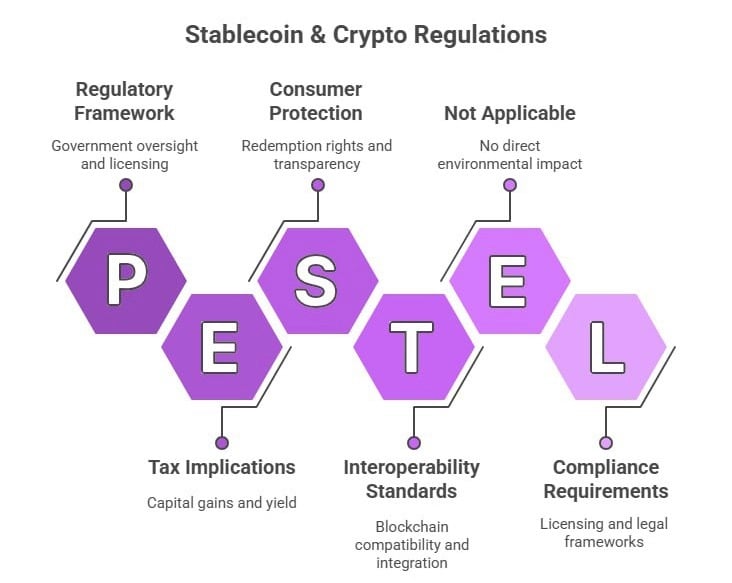
This section breaks down the legal and tax considerations that can affect outcomes long after the initial decision is made.
Also Read: Crypto Trading Bots Explained: Strategies, Tips, and Tools to Trade Smarter
2025 Regulatory Landscape
1. United States
Stablecoin Regulation
The GENIUS Act passed mid-2025 represents the most comprehensive stablecoin legislation to date. Key requirements include:
- Stablecoin issuers must maintain 1:1 reserves in bankruptcy-remote accounts
- Monthly independent audits with public attestations
- Federal oversight (OCC) or state money transmitter licenses required
- Consumer redemption rights within 48 hours at par value
- Interoperability standards ensuring stablecoins work across blockchains
Issuers must be either depository institutions or state-licensed money transmitters, bringing stablecoins firmly into the regulated financial system. This framework increases barriers to entry but provides consumer protection and institutional confidence.
Cryptocurrency Regulation
The regulatory landscape remains fragmented. Bitcoin and Ethereum are classified as commodities under CFTC jurisdiction, while most other tokens face case-by-case analysis using the Howey test to determine securities status.
The SEC maintains oversight for tokens deemed securities, requiring registration and disclosure. However, no comprehensive federal framework exists as of October 2025, creating ongoing uncertainty for projects and exchanges.
2. European Union
MiCA Implementation
The Markets in Crypto-Assets Regulation achieved full implementation on December 30, 2025, creating the world’s most comprehensive crypto regulatory framework.
Stablecoin Provisions
- E-money tokens (EMTs) pegged to single fiat currencies
- Asset-referenced tokens (ARTs) pegged to asset baskets
- Issuers require authorization and must maintain adequate reserves
- Redemption rights guaranteed to token holders
USDT faced delistings from several EU exchanges due to non-compliance, demonstrating MiCA’s enforcement impact. Compliant stablecoins like USDC and EURCV gained market share in Europe.
Cryptocurrency Rules
- Crypto-asset service providers (CASPs) must register
- Market abuse regulations apply to crypto markets
- Consumer protection requirements mandatory
- Anti-money laundering standards enforced
3. Asia-Pacific
Singapore
The Monetary Authority of Singapore finalized its Single-Currency Stablecoin framework requiring:
- 100% reserves equal to outstanding token value
- Redemption within 5 business days guaranteed
- Strict capital and operational requirements
- Regular audits and transparent reporting
Major issuers including Circle and Paxos are pursuing Singapore licenses, recognizing the framework as global best practice.
Hong Kong
Launched comprehensive licensing regime for stablecoin issuers in 2024 with strict requirements:
- Reserve assets limited to government securities and bank deposits
- Only licensed entities can issue stablecoins to Hong Kong public
- Consumer protection mechanisms mandatory
- Regular reporting to Hong Kong Monetary Authority
Tax Treatment Comparison (USA)
Both Classified as Property
The IRS treats both stablecoins and cryptocurrencies as property rather than currency, subjecting all transactions to capital gains taxation. This creates reporting requirements for every disposition.
Stablecoin Tax Considerations
Capital Gains (Usually Minimal)
Selling USDC purchased at $1.00 for $1.00 produces zero taxable gain. Most stablecoin transactions generate minimal tax liability unless significant depegs occur.
Redeeming stablecoins for fiat at par value typically creates no taxable event (no gain or loss). This makes stablecoins tax-efficient for payments and frequent transactions.
Yield Income
Staking rewards are taxed as ordinary income (10-37% rate based on tax bracket) at fair market value when received. Lending interest from protocols like Aave or Compound is similarly taxed as ordinary income.
DeFi yield must be reported on Schedule 1 (Form 1040) as “Other Income.” Taxpayers must track the fair market value of rewards when received.
Cryptocurrency Tax Considerations
Capital Gains (Potentially Significant)
Bitcoin purchased at $30,000 and sold at $60,000 produces $30,000 in taxable gains. Tax rate depends on holding period:
- Short-term (<1 year): Ordinary income rates (10-37%)
- Long-term (>1 year): Capital gains rates (0%, 15%, or 20% based on income level)
Staking and Mining
Rewards are taxed as ordinary income at fair market value when received. Subsequent sale creates additional capital gain or loss based on price change since receipt.
Every Transaction is Taxable
Trading BTC for ETH triggers a taxable event. Using crypto to purchase goods or services triggers taxation. This creates substantial record-keeping burden.
Tax Optimization Strategies
For Cryptocurrency
- Hold positions >1 year to qualify for long-term capital gains rates
- Tax-loss harvesting: Sell losing positions to offset gains
- Wash sale rules don’t apply to crypto (can repurchase immediately)
- Consider self-directed IRA for tax-deferred growth
For Stablecoins
- Use for frequent transactions to minimize taxable events
- Track yield carefully as ordinary income
- Consider the tax drag of ordinary income rates on yield
Record-Keeping Requirements
- Track cost basis for every transaction
- Document dates, amounts, and purposes
- Use crypto tax software (CoinTracker, Koinly, TaxBit)
- IRS requires Form 8949 for all capital gains and losses
- Digital asset checkbox on Form 1040 requires annual disclosure
Also Read: On-chain Analysis Explained: Tools, Indicators, and Use Cases
Risk Management & Security Best Practices
This section breaks down how to protect assets, data, and decisions without overcomplicating the process.
Stablecoin Risk Management
Issuer Due Diligence
Verify Regular Audits: Check for monthly minimum attestations by reputable accounting firms. Circle’s USDC undergoes monthly attestations by Grant Thornton. Tether publishes quarterly attestations.
Check Proof-of-Reserves: Transparent issuers publish real-time or daily proof-of-reserves showing exact backing. Look for on-chain verification where available.
Research Regulatory Compliance: Prioritize issuers compliant with GENIUS Act (US) and MiCA (EU). Regulatory compliance indicates institutional-grade risk management.
Review Reserve Composition: Prefer reserves in cash and short-dated Treasury securities over mixed assets including loans or cryptocurrencies. Simpler reserve structures carry less risk.
Recommended Issuers For 2026
- USDC (Circle): Fully compliant under the U.S. GENIUS Act and the only hyper-cap USD stablecoin fully cleared under MiCA for European distribution. Offers pristine transparency with audited monthly attestations and a strict cash/U.S. Treasury reserve structure, making it the premier choice for institutional compliance and capital security.
- USDT (Tether): Maintains its position as the largest and most liquid stablecoin globally, essential for cross-border liquidity and high-volume trading pairs. However, because it lacks MiCA compliance, it faces strict trading restrictions and delistings within the EU ahead of the July 1, 2026 hard deadline.
- USDS / DAI (Sky Protocol): Following MakerDAO’s evolution into Sky, the upgraded USDS circulates alongside legacy DAI, both backed by the same decentralized, over-collateralized on-chain asset pool. It remains the top choice for users seeking decentralized ecosystem infrastructure, though note that USDS includes a centralized freezing feature for regulatory compliance.
- Avoid: Unaudited issuers, purely algorithmic stablecoins with no asset backing, and offshore tokens with opaque reserve reporting that fail to meet modern GENIUS Act or MiCA consumer protection standards.
Diversification Strategy
Never concentrate all holdings in a single stablecoin. Recommended allocation:
- 40% USDC (regulatory compliance, transparency)
- 40% USDT (liquidity, trading pairs)
- 20% DAI (decentralization, different risk profile)
Spread holdings across different blockchains to avoid smart contract risk. Don’t hold >$100,000 with a single issuer without institutional insurance coverage.
Monitor Peg Stability
Set price alerts at $0.995 and $1.005 to detect early depegs. Check CoinGecko or DeFiLlama daily during market stress periods.
Exit protocol: If depeg exceeds -2% without recovery within 24 hours, consider converting to alternative stablecoin or fiat. Temporary 0.5-1% depegs are normal during high volatility.
Smart Contract Risk Management
Use only audited protocols with proven track records. Aave, Curve, and Uniswap have operated for years with billions in total value locked.
Limit exposure to new or unaudited platforms regardless of advertised yields. Consider protocol insurance through Nexus Mutual or InsurAce for large positions.
Cryptocurrency Risk Management
Position Sizing
Golden Rule: Never invest more than you can afford to lose completely. Crypto should represent a small portion of total investment portfolio for most investors.
Recommended Allocation
- Conservative investors: <5% of total net worth
- Moderate investors: 5-10% of total net worth
- Aggressive investors: 10-20% of investable assets maximum
- Crypto professionals: Up to 30% with deep understanding
Dollar-Cost Averaging
Invest fixed amounts monthly regardless of price to reduce timing risk and remove emotion from decisions.
Example: $500/month into Bitcoin and Ethereum over 2-3 years. During bear markets, this accumulates more coins. During bull markets, it prevents chasing tops.
DCA eliminates the pressure of “timing the bottom” and builds positions systematically during all market conditions.
Hardware Wallet Storage
Critical for Holdings >$10,000: Use hardware wallets like Ledger or Trezor to protect against exchange hacks and online theft.
Never Store Large Amounts on Exchanges: Exchanges represent custodial risk. “Not your keys, not your crypto” remains true. Recent exchange failures reinforce this principle.
Backup Seed Phrases Properly:
- Write on paper or metal (not digitally)
- Store in multiple secure locations (fireproof safe, bank vault)
- Never photograph or store in cloud services
- Consider multisig for very large holdings
Risk-Adjusted Allocation Within Crypto
Bitcoin (Lower Risk): 50-60% of crypto allocation
- Most established cryptocurrency
- Strongest network effect and security
- Least likely to fail completely
Ethereum (Moderate Risk): 30-40%
- Platform with actual utility and usage
- Strong developer ecosystem
- More volatile than Bitcoin but established
Altcoins (High Risk): 10-20% maximum
- Higher failure risk
- Potential for outsized returns
- Diversify across 3-5 projects maximum
Rebalance quarterly to maintain target allocations. This forces selling winners and buying dips systematically.
Stop-Loss Disciplines
Mental Stop-Loss: Set -30% threshold from purchase price. If fundamental thesis breaks, exit regardless of loss.
Scale Out During Gains: Take 25-50% of position off table after 100%+ gains. This locks in profits and reduces emotional attachment.
Never “HODL” Without Conviction: Diamond hands only make sense if long-term thesis remains intact. Don’t hold positions out of stubbornness.
Avoid Common Mistakes
- Don’t Chase Pumps: Buying during FOMO rallies typically leads to losses. Wait for consolidation or corrections.
- Don’t Panic Sell: -20% corrections are normal in bull markets. Only sell if fundamental thesis changes or position sizing was wrong initially.
- Don’t Leverage Trade: Crypto volatility makes liquidation nearly certain for leveraged positions. Spot holdings only for most investors.
- Don’t Share Keys: Never share private keys or seed phrases with anyone. No legitimate service will ask for these.
Also Read: WAGMI vs NGMI: Complete Guide to Crypto Culture
Future Trends & Market Outlook
Below, we look into future trends and the broader market outlook to help frame what’s likely to matter moving forward.
A. Stablecoin Trajectory
1. Institutional Adoption Accelerating
Mainstream financial institutions have fully integrated stablecoins into global market operations, pushing the total stablecoin market cap past $320 billion with single-month network settlement volumes exceeding $10 trillion.
Major market infrastructure has shifted directly on-chain; the Depository Trust & Clearing Corporation (DTCC) is launching live production trades of tokenized equities and U.S. Treasuries on public blockchain rails starting in July 2026.
Furthermore, global tier-one banks like BNY Mellon routinely act as regulated reserve custodians, while European institutions like BBVA have joined banking consortia to issue native, euro-denominated tokens.
PayPal’s PYUSD and alternative corporate issuers have seamlessly integrated into mainstream payment flows, bridging legacy merchant networks with institutional liquidity.
2. Regulatory Clarity Driving Growth
The formal enactment of the U.S. GENIUS Act has eliminated federal ambiguity, providing the explicit legal frameworks necessary for corporate treasuries and commercial banks to deploy stablecoins at scale.
Federal regulators are actively finalizing the operational guardrails; the FDIC issued updated rulemakings applying strict bank-grade anti-money laundering (AML) and sanctions-screening frameworks to Permitted Payment Stablecoin Issuers (PPSIs).
Concurrently, Europe’s MiCA framework is enforcing its July 1, 2026 hard deadline, permanently filtering out unregulated tokens from the EEA market.
Combined with Singapore’s mature MAS framework, this coordinated global guardrail has accelerated stablecoin supply to an active $320.9 billion, putting the asset class on a direct trajectory to eclipse $1 trillion in market capitalization by 2028.
3. Central Bank Digital Currencies (CBDCs)
While over 130 countries are actively researching or piloting Central Bank Digital Currencies, the market has pivoted toward a distinct division of labor rather than head-to-head competition.
Following the passage of the GENIUS Act, the United States has explicitly deprioritized a retail “Digital Dollar,” relying instead on highly regulated private stablecoin alternatives to project dollar liquidity.
Meanwhile, the European Central Bank is progressing through its technical design phase for a Digital Euro, positioning a 12-month pilot for late 2027 with an eye toward a 2029 target launch.
In emerging markets where retail CBDCs are fully live such as Nigeria’s eNaira or the Bahamas’ Sand Dollar organic consumer adoption remains low. Real-world transactional volume vastly favors private stablecoins like USDT for high-frequency commerce, cross-border remittances, and open decentralized finance integrations.
Emerging Use Cases
- Real-World Asset Tokenization: Real estate, bonds, and commodities are being tokenized with stablecoins serving as the settlement layer. This could unlock trillions in previously illiquid assets.
- Programmable Money: Smart contract integration enables automatic business logic paying suppliers instantly when delivery confirms, splitting payments among stakeholders automatically, or implementing compliance rules in code.
- Embedded Finance: Non-financial applications are integrating stablecoin payments. Gaming, social media, and e-commerce platforms increasingly offer crypto-native payment options.
B. Cryptocurrency Evolution
Bitcoin Maturation
Institutional ownership is increasing dramatically with BlackRock and Fidelity spot ETFs approved in 2024. Traditional financial institutions now offer Bitcoin exposure to clients, driving legitimacy.
Nation-state adoption expands beyond El Salvador. Several countries are accumulating Bitcoin as strategic reserve assets, potentially following models similar to gold reserves.
Lightning Network improvements are making Bitcoin practical for payments through instant, low-cost transactions. This addresses the “digital gold vs. payment system” debate by enabling both use cases.
The narrative continues shifting: from digital cash → digital gold → global reserve asset as institutional adoption grows.
Ethereum Transition
Post-Merge efficiency gains continue materializing. Energy consumption dropped 99.95% while maintaining security. Ethereum’s proof-of-stake model provides 3-4% staking yields plus potential price appreciation.
Layer 2 scaling solutions (Arbitrum, Optimism, Base) are reducing costs dramatically while maintaining Ethereum security. Transaction fees on L2s now rival or beat alternative L1 blockchains.
The DeFi ecosystem is maturing with regulatory-compliant protocols emerging. Real-world asset integration accelerates as traditional financial instruments get tokenized on Ethereum.
Blockchain Platform Competition
Solana challenges Ethereum with superior speed and cost advantages, processing thousands of transactions per second at fractions of a cent. However, occasional network outages raise reliability concerns.
Alternative L1s like Avalanche and Cardano are finding specialized niches—gaming, supply chain tracking, identity management. The “Ethereum killer” narrative has shifted toward multi-chain coexistence.
Interoperability solutions are connecting ecosystems. Cross-chain bridges, despite security challenges, enable asset transfers between networks. The future appears multi-chain rather than winner-take-all.
Regulatory Convergence
Global coordination on crypto regulation is increasing. G20 discussions and Financial Stability Board recommendations push toward harmonized standards.
Clearer securities versus commodities classifications are emerging through litigation and regulatory guidance. This reduces uncertainty for projects and investors.
Tax reporting requirements are standardizing internationally. Automatic exchange of information between countries makes tax evasion increasingly difficult.
Compliance is becoming a competitive advantage. Regulated entities gain access to institutional capital and mainstream adoption that non-compliant projects cannot access.
C. Market Outlook
Stablecoins: Expected to reach $500B-$1T market cap by 2027-2028 driven by:
- Payment adoption by merchants and consumers
- Regulatory clarity encouraging institutional use
- Corporate treasury management seeking yield
- Emerging market remittances replacing traditional services
Cryptocurrencies: Continued boom-bust cycles likely with:
- Long-term uptrend driven by increasing adoption
- Volatility gradually decreasing as market matures and institutions provide stabilization
- Bitcoin potentially reaching $100k-$150k by 2026-2027 (speculative)
- Ethereum benefiting from DeFi growth and institutional ETF flows
The overall crypto market is transitioning from speculative Wild West to regulated financial infrastructure. This process will be uneven but directional, with compliant projects and platforms gaining share.
Conclusion
Stablecoins and cryptocurrencies represent fundamentally different tools within the digital asset ecosystem. Stablecoins have grown to a $320+ billion market cap as of May 2026, processing over $33 trillion in annual transaction volume during 2025 alone, and serving as the stable backbone for global crypto payments, DeFi settlements, and capital preservation.
Meanwhile, Bitcoin and unpegged cryptocurrencies dominate the broader $2.3+ trillion digital asset market, offering massive investment appreciation potential but carrying standard annual volatility swings of 40% to 60%.
The distinction is clear: stablecoins prioritize price stability, predictability, and transactional utility, while cryptocurrencies offer speculative upside, technological innovation, and sovereign decentralization. Neither is “better” they serve entirely different purposes within a diversified digital asset strategy.
Comprehensive regulatory clarity has fully solidified with the implementation of the U.S. GENIUS Act and the final enforcement push of Europe’s MiCA framework ahead of its July 1, 2026 hard deadline.
These synchronized global rules are rapidly accelerating the institutional adoption of compliant tokens, while broader cryptocurrency regulation remains case-by-case and structurally fragmented.
This divergence suggests stablecoins will increasingly function as the ubiquitous “digital dollar” payment layer, while cryptocurrencies continue to evolve as alternative investment assets and core technological platforms.
Also Read: Zero-Knowledge Proofs (zk-SNARKs) in Cryptocurrency: A Complete Guide
Frequently Asked Questions
Are stablecoins safer than regular cryptocurrency?
Stablecoins are safer in terms of price stability but carry different risks. You won’t lose money to price crashes, but you face risks related to the reserves backing them and potential regulatory actions. Fiat-backed stablecoins depend on the issuer maintaining proper reserves. If the company fails or the reserves prove insufficient, the stablecoin could lose its peg.
Can stablecoins increase in value like Bitcoin?
No, stablecoins are designed specifically to maintain a constant value, typically one dollar. This stability is their core feature. You won’t see your USDC holdings grow from price appreciation.
Why do crypto traders use stablecoins?
Traders use stablecoins to preserve value between trades without exiting to traditional banking. When Bitcoin looks overpriced, a trader can sell for USDT and wait for better entry points. This keeps funds within the crypto ecosystem for quick deployment while avoiding price risk.
What happens if a stablecoin loses its peg?
When a stablecoin loses its peg, it trades above or below its target value. Small deviations happen regularly and usually correct quickly through arbitrage. Larger breaks indicate serious problems. If a stablecoin drops to 90 cents, holders lose 10% of their value. The issuer typically intervenes to restore the peg through various mechanisms, depending on the stablecoin type. Some stablecoins have failed completely, like TerraUSD, which collapsed to near zero. This highlights the importance of choosing well-established stablecoins with transparent reserves.
Do I need to pay taxes on stablecoins?
Tax treatment varies by country, but most jurisdictions consider stablecoin transactions taxable events. In the United States, exchanging one cryptocurrency for a stablecoin triggers capital gains or losses. Even though stablecoins maintain dollar parity, the IRS treats them like any other cryptocurrency. However, simply holding stablecoins usually isn’t taxable. Earning interest on stablecoins counts as income. Consult a tax professional familiar with cryptocurrency for your specific situation, as rules differ significantly between countries.
Can I use stablecoins for everyday purchases?
Yes, though acceptance remains limited compared to traditional payment methods. Some online merchants accept USDC or USDT directly. Crypto debit cards let you spend stablecoins at any business that accepts standard cards; the card converts your stablecoins to local currency automatically.
What makes USDC different from USDT?
Both are fiat-backed stablecoins pegged to the dollar, but they differ in transparency and backing. USDC, issued by Circle, publishes regular attestations from accounting firms showing dollar reserves held at regulated financial institutions. This transparency has made USDC popular with institutional users. USDT, issued by Tether, is more widely used and has deeper liquidity on exchanges, but has faced criticism over reserve transparency. USDT includes various assets beyond cash in its reserves. Both maintain their peg effectively, but USDC generally has a stronger reputation for transparency.
Should beginners start with stablecoins or cryptocurrency?
Beginners benefit from starting with small amounts of both. Put a small sum in stablecoins to learn wallet management, transactions, and how blockchain works without price risk. This hands-on experience builds confidence. Then allocate a small amount you can afford to lose into a major cryptocurrency like Bitcoin or Ethereum to understand volatility and market dynamics.
Can governments ban stablecoins?
Governments have the authority to ban or heavily restrict stablecoins within their jurisdictions. China has banned most cryptocurrency activity, including stablecoins. Other countries are developing regulations that might make certain stablecoins illegal or impractical to use. However, enforcement challenges exist due to blockchain’s decentralized nature. Even if a country bans stablecoins, people might still access them through decentralized exchanges or foreign platforms.