Every dollar you’ve ever saved has been working two jobs without you knowing. Your bank lends it out overnight, earns interest on it, and hands you back a fraction as a thank-you.
Yield-bearing stablecoins just cut out the part where the bank keeps the difference, letting your digital dollar finally keep the job it was always doing for someone else.
Yield-Bearing Stablecoins Meaning
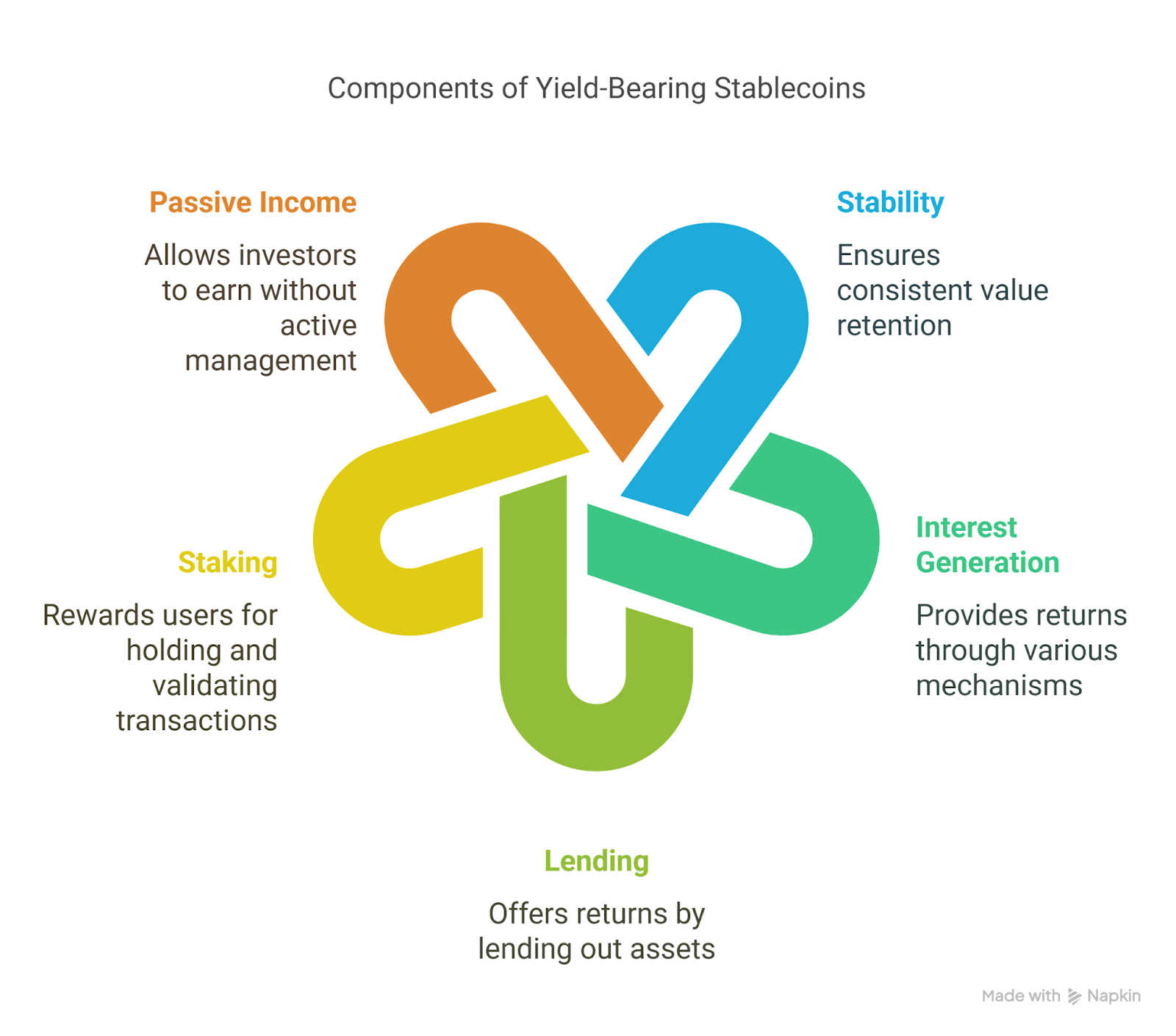
Yield-bearing stablecoins are a new type of cryptocurrency that combine the stability of traditional stablecoins with the ability to earn passive income.
See it as digital dollars that not only hold their value but also generate interest over time.
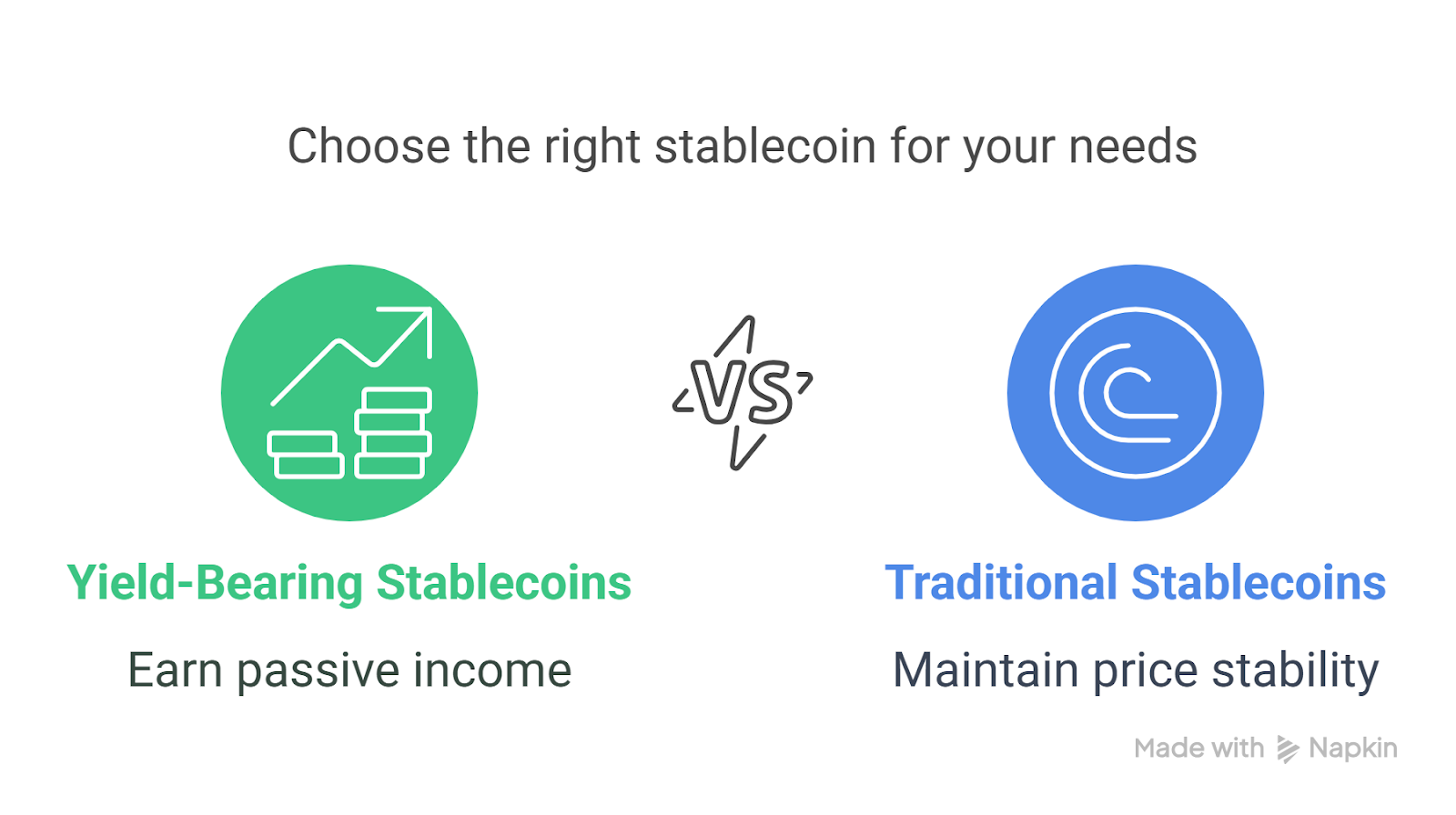
Unlike regular stablecoins like USDT or USDC, which maintain a 1:1 peg to the US dollar without offering any yield, yield-bearing stablecoins provide holders with returns simply by holding them in their wallets.
These stablecoins achieve this by using various mechanisms such as decentralized finance (DeFi) lending, staking rewards, or backing by real-world assets like U.S. Treasury bills.
How Yield-Bearing Stablecoins Differ from Traditional Stablecoins
1. Yield Generation
Traditional stablecoins like USDT, USDC, and DAI are designed to maintain a stable value, typically pegged to the US dollar, but they do not generate yield or interest for holders.
They serve primarily as a stable medium of exchange or store of value within the cryptocurrency ecosystem.
In contrast, yield-bearing stablecoins are designed to not only maintain a stable value but also generate passive income for holders.
They achieve this by leveraging various mechanisms such as decentralized finance (DeFi) lending, staking rewards, or backing by real-world assets like U.S. Treasury bills.
For example, USDe by Ethena Finance employs a delta-neutral strategy by holding cryptocurrencies like BTC, ETH, and SOL, while simultaneously shorting equal amounts of perpetual futures to earn yield from funding rates.
Similarly, USDY by Ondo Finance derives its yield from short-term U.S. Treasuries and bank demand deposits, offering a more traditional investment approach within the crypto ecosystem.
2. Risk Profiles
Traditional stablecoins are generally considered low-risk assets due to their backing by reserves and their widespread use in the crypto market.
However, they are not immune to risks such as regulatory scrutiny, counterparty risk, and potential de-pegging events.
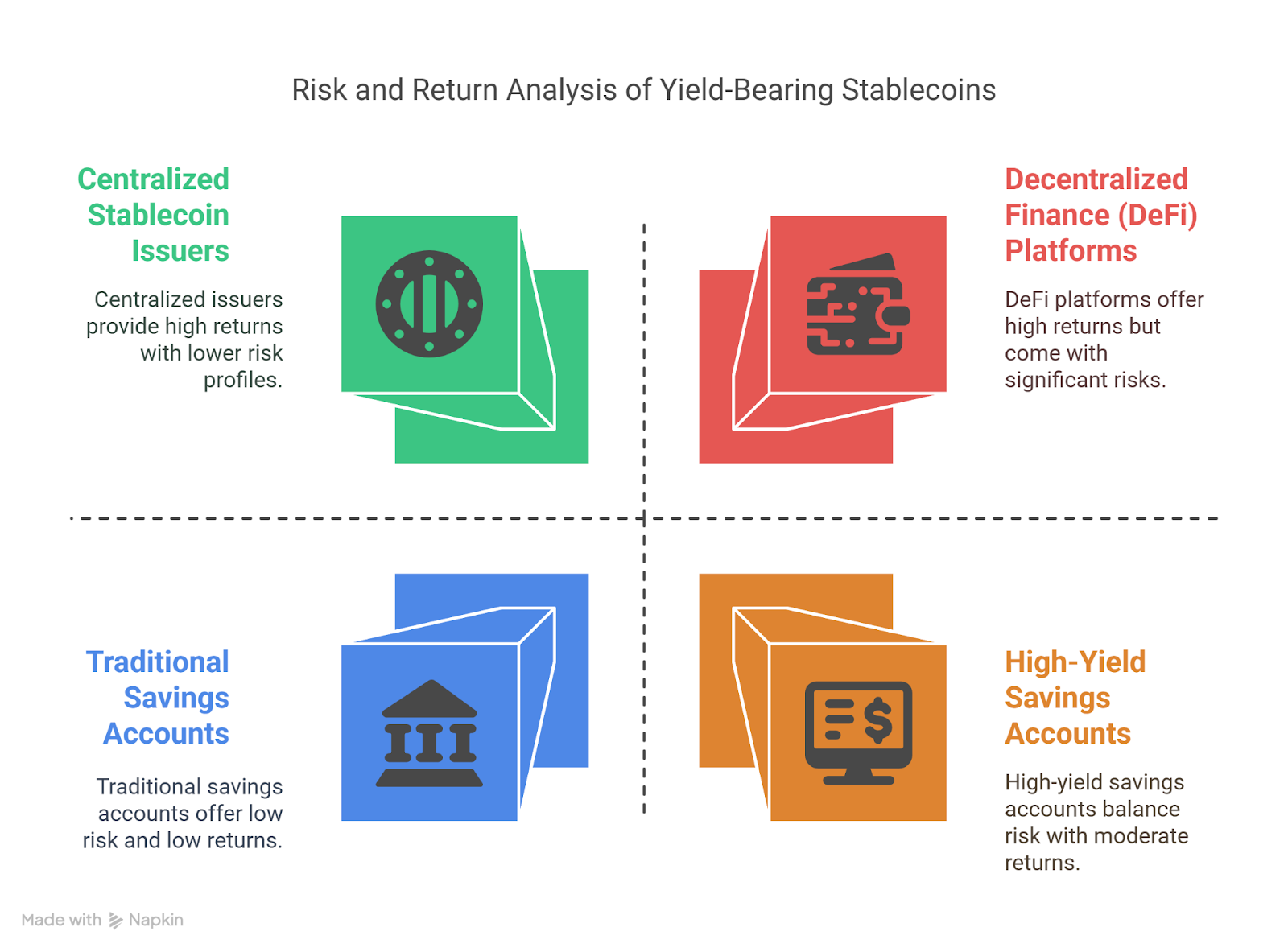
Yield-bearing stablecoins introduce additional risks due to their reliance on yield-generating mechanisms.
These risks include fluctuations in yield rates, exposure to DeFi protocol vulnerabilities, and potential regulatory challenges.
Join UEEx
Experience the World’s Leading Digital Wealth Management Platform
Traditional stablecoins are widely used in the crypto market for purposes such as trading, remittances, and as collateral in lending protocols.
They provide a stable and liquid asset that facilitates transactions and financial activities within the digital asset space.
Yield-bearing stablecoins, on the other hand, are primarily used by investors seeking to earn passive income while maintaining exposure to stable assets.
They are utilized in DeFi protocols, staking platforms, and treasury management strategies to generate returns.
For example, sDAI, a yield-bearing version of DAI, allows holders to earn interest through the Dai Savings Rate (DSR) within the MakerDAO protocol.
This makes yield-bearing stablecoins attractive to users looking to maximize the utility of their holdings beyond mere price stability.
4. Regulatory Considerations
Traditional stablecoins operate within a more established regulatory framework, particularly in jurisdictions like the United States and the European Union.
They are subject to regulations that govern their issuance, reserve backing, and redemption processes, providing a level of oversight and consumer protection.
Yield-bearing stablecoins, however, often operate in a more ambiguous regulatory environment.
Join UEEx
Experience the World’s Leading Digital Wealth Management Platform
Traditional stablecoins benefit from widespread adoption and liquidity across various cryptocurrency exchanges, DeFi platforms, and financial services.
Their established presence in the market ensures that they are easily accessible and can be traded or utilized in numerous applications.
Yield-bearing stablecoins, while gaining traction, have more limited adoption and liquidity. Their use is often confined to specific DeFi ecosystems or platforms that support their unique features.
For example, yield-bearing stablecoins like sDAI are primarily used within the MakerDAO ecosystem, and their liquidity may be restricted to platforms that integrate with MakerDAO’s protocols.
This limited adoption can affect the ease with which users can enter or exit positions in yield-bearing stablecoins.
Is It Legal to Earn Yield on Stablecoins in the U.S.? The GENIUS Act, Explained
Imagine a law that says banks can’t pay you for holding cash and then a dozen companies spring up offering “rewards” for holding cash at their partner banks. Technically compliant.
Practically the same thing the law was written to prevent.
That’s roughly the position U.S. regulators found themselves in by early 2026 with yield-bearing stablecoins and it’s why this section matters more than any indicator or mechanism described elsewhere in this article.
In July 2025, Congress passed the GENIUS Act , the first comprehensive federal framework for U.S. payment stablecoins.
One provision directly affects everything in this article: the GENIUS Act prohibits stablecoin issuers from paying interest or yield directly to holders.
This sounds like it should make yield-bearing stablecoins illegal in the U.S. In practice, it’s more complicated.
The Act regulates payment stablecoins issued by entities like Circle (USDC) or Tether, it doesn’t directly ban a separate category of tokens, like Ethena’s USDe or Ondo’s USDY, structured as investment-like products rather than payment instruments.
Many current yield-bearing stablecoins generate returns through affiliate or third-party arrangements rather than the issuer paying yield directly, a structural distinction the law’s authors left ambiguous.
That ambiguity is actively being closed. In February 2026, the Office of the Comptroller of the Currency (OCC) proposed sweeping rules to implement the GENIUS Act, including a presumption that indirect yield arrangements — rewards, affiliate payments, or third-party compensation tied to holding a stablecoin may also violate the law’s intent, even when the issuer itself isn’t the one paying.
The comment period on this rule closed May 1, 2026, with implementation targeted for 2027.
What this means practically: yield-bearing stablecoin products available today may look different or face new restrictions within the next 12-18 months.
This isn’t a reason to avoid the category, but it is a reason to treat current yield arrangements as something that could change, not a permanent fixture.
Benefits of Yield-Bearing Stablecoins
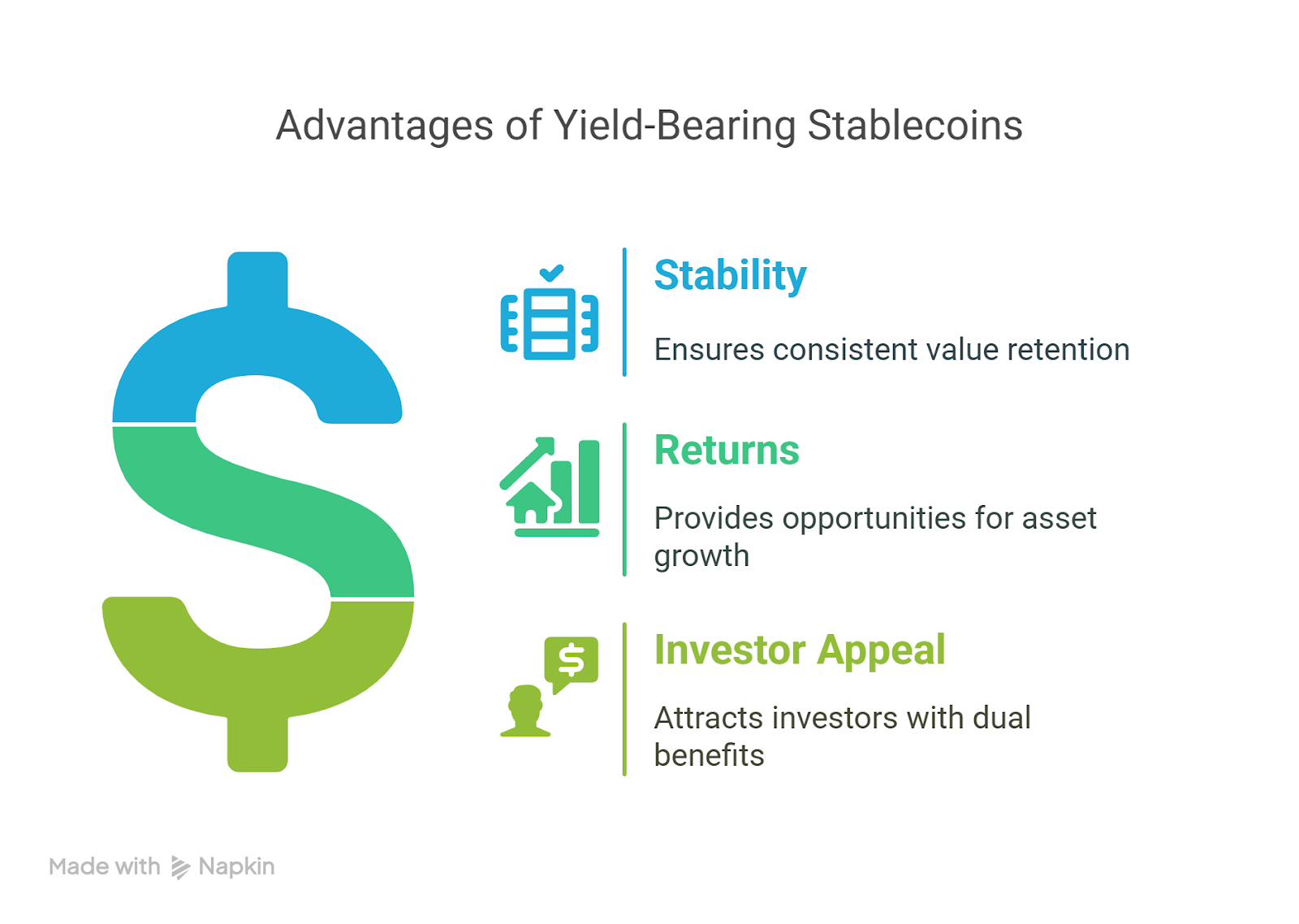
1. Earn Passive Income
Earn Passive Income
Maintain stability
Enhance capital efficiency
Access to traditional finance yields
Access to traditional finance yields
Mechanisms of Yield Generation in Yield-Bearing Stablecoins
1. DeFi Lending Protocols
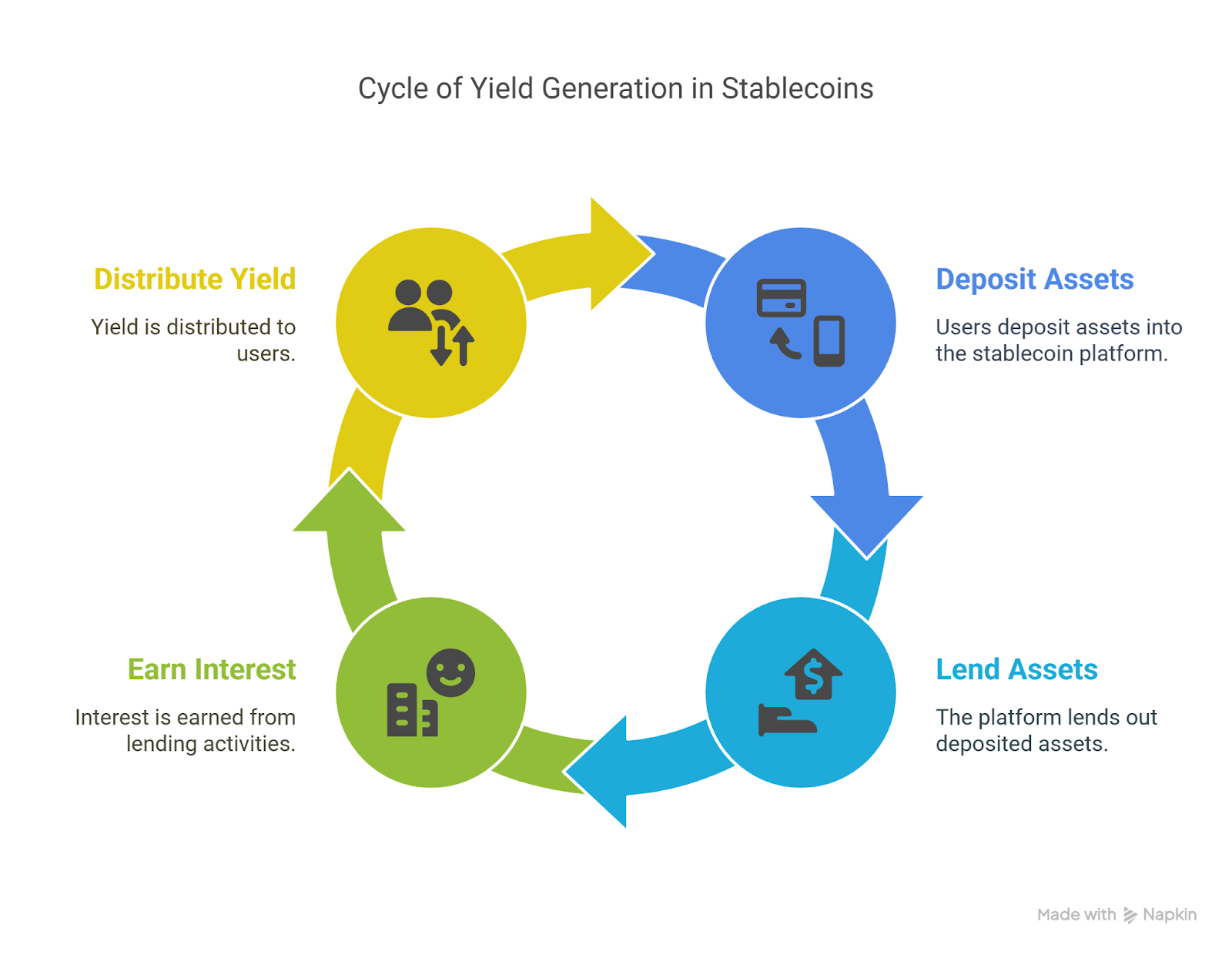
One of the most common and popular mechanisms for generating yield in the crypto space is through decentralized finance (DeFi) lending platforms.
These platforms allow holders of yield-bearing stablecoins to deposit their assets into liquidity pools or lending protocols.
The funds are then lent to borrowers, who pay interest on their loans, and that interest is shared with the depositors.
With decentralized protocols, these yield-bearing stablecoins are typically secured through smart contracts, reducing the need for intermediaries and making the lending process more efficient and transparent.
Ethena Finance’s USDe is an example of a yield-bearing stablecoin that generates yield by lending assets through DeFi protocols.
USDe holders can earn rewards without needing to directly engage in the lending process themselves by using the open-source nature of DeFi lending.
This passive earning potential makes DeFi lending a popular method for stablecoin yield generation.
What’s the Difference Between sDAI and sUSDS?
sUSDS is the successor to sDAI — Sky (formerly MakerDAO) is migrating its savings product from the legacy DAI Savings Rate to a new USDS-based system, and new deposits increasingly favor sUSDS.
sDAI holders earn the Dai Savings Rate by holding the yield-bearing wrapper of DAI. sUSDS performs the same function for Sky’s newer USDS stablecoin, paying the Sky Savings Rate.
The two will likely converge in yield over time as the migration completes, but currently operate as related, parallel products rather than identical ones.
For new deposits in 2026, sUSDS is generally the more forward-looking choice, since Sky’s protocol development is now centered on the USDS ecosystem rather than legacy DAI infrastructure.
2. Staking and Derivatives
Staking is another widely used method of yield generation. This process involves locking up your stablecoins (or other tokens) in a blockchain network to help secure and validate transactions.
In return for their contribution to the network, stakers earn rewards in the form of additional tokens or interest.
Yield-bearing stablecoins like USDe by Ethena Finance incorporate innovative staking mechanisms and derivatives.
For instance, USDe employs a delta-neutral strategy, where it holds cryptocurrencies such as BTC, ETH, and SOL and simultaneously shortens equivalent amounts of perpetual futures to generate yield from funding rates.
This allows the stablecoin to maintain a stable value while providing holders with consistent returns, making it less susceptible to the volatility of the underlying assets.
This mechanism combines the benefits of traditional staking with more advanced financial strategies, such as derivatives trading, to ensure that investors can still generate yield while avoiding exposure to large price swings.
The use of staking and derivatives creates a more stable and dynamic yield generation mechanism compared to traditional methods.
3. Real-World Asset (RWA) Integration
Some yield-bearing stablecoins are backed by real-world assets (RWAs), such as government bonds, real estate, or short-term Treasury bills.
These stablecoins bridge the gap between the cryptocurrency world and traditional finance by incorporating tangible assets that provide consistent and low-risk returns.
For example, USDY by Ondo Finance is a yield-bearing stablecoin backed by short-term U.S. Treasuries and bank demand deposits.
The backing from these stable and secure real-world assets enables USDY to offer consistent yield to holders, making it an attractive option for users who prefer lower-risk, traditional investment strategies within the crypto ecosystem.
Similarly, Figure’s YLDS stablecoin is backed by a portfolio of real-world assets, including prime money market fund securities and private assets such as asset-backed securities.
This integration with traditional financial assets offers yield-bearing stablecoin holders exposure to both the crypto market and real-world investment returns.
4. Automated Market Making (AMM) and Liquidity Pools
Another popular method for generating yield is through participation in Automated Market Making (AMM) protocols and liquidity pools.
AMMs are decentralized exchanges (DEXs) that allow users to provide liquidity to the platform in exchange for transaction fees and rewards.
When you deposit your yield-bearing stablecoins into a liquidity pool on platforms like Uniswap or Balancer, the stablecoins are used for trading pairs, and in return, you receive a portion of the transaction fees that the platform collects.
Join UEEx
Experience the World’s Leading Digital Wealth Management Platform
Ethena’s USDe is a synthetic dollar protocol that generates yield through delta-neutral strategies.
This approach involves holding cryptocurrencies such as Bitcoin (BTC), Ethereum (ETH), and Solana (SOL), while simultaneously shorting equivalent amounts of perpetual futures to earn yield from funding rates.
How It Works: USDe generates yield by interacting with DeFi lending protocols such as Aave and Compound.
Income Source: Yield is earned through trading fees, lending interest, and short positions.
Stability Mechanism: The use of a delta-neutral strategy helps ensure stability and reduces exposure to price swings.
2. Ondo USDY
USDY, developed by Ondo Finance, is a yield-bearing stablecoin backed by short-term U.S. Treasuries and demand deposits held by banks.
This stablecoin was designed with the goal of providing a safer and more traditional method of earning yield, making it appealing to conservative investors seeking reliable income.
How It Works: USDY’s yield comes from the interest generated by U.S. Treasuries and bank demand deposits.
Income Source: The yield is sourced from the secure, low-risk assets backing the stablecoin, making it highly reliable.
Stability Mechanism: USDY maintains its peg to the dollar through a combination of Treasuries and bank-backed assets, which provides inherent stability.
3. BlackRock BUIDL
BUIDL, developed by BlackRock, is a tokenized money market fund that is backed by real-world assets. It’s designed to bridge the gap between traditional finance (TradFi) and decentralized finance (DeFi).
Through its backing by highly liquid, short-term investment-grade assets, BUIDL is able to offer yield while maintaining stability.
This stablecoin offers a unique approach, using a traditional money market fund structure and offering liquidity and yield without the volatility that typically comes with cryptocurrencies.
BUIDL aims to be a bridge for institutional investors who want to access DeFi-like returns while minimizing risk.
How It Works: BUIDL generates yield by investing in a diversified portfolio of real-world assets, such as short-term corporate bonds and government securities.
Income Source: The yield is derived from interest payments on short-term bonds and high-quality debt instruments.
Stability Mechanism: BUIDL’s stability comes from its investment in real-world assets, which are liquid and conservative, providing consistent returns.
4. MakerDAO sDAI
sDAI is a yield-bearing version of DAI, one of the most popular decentralized stablecoins. It allows users to earn interest through the Dai Savings Rate (DSR), a feature available within the MakerDAO protocol.
DSR works by allowing users to lock their DAI into a smart contract, which then earns interest based on the rate set by the MakerDAO governance.
The advantage of sDAI is that it combines the decentralized nature of DAI with the opportunity for holders to earn a return.
As the DeFi ecosystem grows, DAI holders who use sDAI can benefit from their holdings in ways that weren’t possible with traditional stablecoins.
How It Works: Users lock their DAI in the DSR smart contract to earn interest.
Income Source: The yield is generated from the interest paid by borrowers within the MakerDAO ecosystem, who take out loans using DAI as collateral.
Stability Mechanism: Since DAI is backed by over-collateralized assets, the system remains stable even as it generates yield.
5. YLDS by Figure
YLDS, created by Figure Technologies, is the first yield-bearing stablecoin registered as a public security with the U.S. Securities and Exchange Commission (SEC).
YLDS offers a yield of about 3.85%, which is determined by the Secured Overnight Financing Rate (SOFR), minus a small fee.
The goal of YLDS is to combine the benefits of traditional finance such as access to stable, low-risk investments with the flexibility and ease of digital assets.
How It Works: YLDS generates yield by holding real-world assets such as U.S. Treasuries and asset-backed securities.
Income Source: The yield is earned through the SOFR, which reflects the overnight borrowing cost in the U.S. financial market.
Stability Mechanism: YLDS maintains its peg to the dollar through a combination of real-world assets and money market securities, offering predictable returns.
How Yield-Bearing Stablecoins Are Taxed
Yield earned from yield-bearing stablecoins is generally treated as taxable income in the U.S. at the time it’s received or accrued similar to interest income from a savings account, even though the underlying token is a crypto asset.
For rebasing tokens (where your token balance increases over time), each rebase event may be treated as a taxable income event under current IRS guidance, even if you haven’t sold or redeemed anything.
For appreciating tokens (where you hold a constant number of tokens that grow in value), tax treatment may instead apply at the time of redemption or sale, similar to capital gains though specific guidance varies by token structure.
This is genuinely unsettled territory.
The IRS has not issued comprehensive guidance specific to yield-bearing stablecoin mechanics, and treatment can vary based on the precise structure (rebasing vs. wrapper-appreciation) and your individual tax situation.
Risks and Considerations of Yield-Bearing Stablecoins
1. Smart Contract Vulnerabilities
Yield-bearing stablecoins often operate on decentralized platforms powered by smart contracts. These contracts are susceptible to bugs, coding errors, or exploits that can lead to loss of funds.
For instance, vulnerabilities in DeFi protocols have previously led to significant financial losses.
It’s essential to ensure that the protocols you engage with have undergone thorough audits and have a history of secure operations.
2. Platform Risk and Liquidity Concerns
The platforms facilitating yield generation for stablecoins can face operational issues, such as downtime, insolvency, or mismanagement.
Also, liquidity risks arise if there’s insufficient demand for borrowing, leading to reduced yields or potential loss of principal.
For example, during market downturns, some platforms have experienced liquidity crises, affecting users’ ability to withdraw funds.
Join UEEx
Experience the World’s Leading Digital Wealth Management Platform
The regulatory landscape for yield-bearing stablecoins is still developing. In some jurisdictions, there are discussions about classifying these assets as securities, which could impose stricter regulations on their use and issuance.
For instance, U.S. regulators have indicated that certain yield-bearing tokens might be subject to securities laws, depending on their structure and yield mechanisms.
This uncertainty can impact the stability and legality of such investments.
4. Yield Fluctuations and Market Volatility
The yields offered by yield-bearing stablecoins are not fixed and can fluctuate based on market conditions, demand for borrowing, and the performance of underlying assets.
During periods of high volatility or market stress, yields can decrease, and the value of underlying assets can drop, affecting the stability of the stablecoin.
5. Counterparty and Credit Risk
Some yield-bearing stablecoins are backed by real-world assets or issued by centralized entities. This introduces counterparty risk, where the issuer or underlying asset may default or face financial difficulties.
For example, if an issuer holds U.S. Treasuries and the value of these assets declines or the issuer faces insolvency, the value of the stablecoin could be affected.
It’s very important to assess the creditworthiness of the issuer and the quality of the underlying assets.
Frequently Asked Questions
Is Yield-Bearing Stablecoin Income Guaranteed?
No — yield on these products is not guaranteed and can fluctuate or drop to zero depending on the underlying mechanism.
Are Yield-Bearing Stablecoins Safe?
Yield-bearing stablecoins are generally safer than volatile cryptocurrencies but carry more risk than holding plain USDC or USDT — the yield itself is compensation for that added risk.
Conclusion
Yield-bearing stablecoins solve a real problem: money sitting still that could be working.
They also sit inside a regulatory framework that is actively being written in real time, with rules that could reshape how these products operate within the next two years.
The dollar peg you’re trusting is the same one you already trust in USDC. The yield mechanism on top of it is the part worth understanding before you size your position not after.
Oluwadamilola Olaniyan is a certified content writer. As a content writer and marketer, she is passionate about creating content that engages and inspires audiences. She is also skilled in turning complex ideas into impactful and easy to read content.
Disclaimer: This article is intended solely for informational purposes and should not be considered trading or investment advice. Nothing herein should be construed as financial, legal, or tax advice. Trading or investing in cryptocurrencies carries a considerable risk of financial loss. Always conduct due diligence before making any trading or investment decisions.
Trade with proof of Reserves
UEEx publish monthly audits and third party verification on every listed market.