In just over two years, the AI cryptocurrency sector grew from a modest $4.5 billion in 2023 to an astonishing ~$20B as of November 2025.
Its 1,400%+ rise has made it the fastest-growing trend in all of crypto. Bittensor (TAO) surged 75% in one week. Virtuals Protocol launched over 40,000 tokenized AI agents.
Despite the excitement and the influx of institutional money, such as Grayscale’s Decentralized AI Fund and $4.9 billion in VC funding in 2025, most investors feel completely lost due to a lack of resources.
When you search for “best AI crypto coins” or “Fetch.ai FET price prediction” today, you’ll find exchange blogs that rank only the coins on their platform. They rarely mention the EU AI Act, the U.S. GENIUS Act, or why some agents are earning millions each month from X/Twitter inference.
To help retail investors avoid hype and guide them while institutions quietly build actual infrastructure, this complete guide will help you understand the four AI-token types.
It also provides in-depth breakdowns of the top 15 projects with live data from November 2025, answers the commonly asked “how do AI tokens work?” question, and explains how autonomous agents generate millions in real revenue.
Retail investors will also learn to navigate the new regulatory space, build risk-adjusted portfolios with allocation strategies and staking guides, and leave with more knowledge about AI tokens than 99.9% of the market before the next increase begins.
Key Takeaways
- AI tokens are cryptocurrencies that support decentralized AI networks by converting compute, data, models, and autonomous agents into tokens. They currently account for nearly 1% of the total cryptocurrency market cap, with institutional investment at 48%.
- There are four categories of AI tokens: Infrastructure (38%, TAO/RNDR, medium risk); Agents (33%, VIRTUAL/ai16z, high risk); Data (18%, OCEAN/AGIX, medium-high risk); Platforms (11%, NEAR/ICP, low-medium risk)
- In the U.S. market, the GENIUS Act and FIT 21 classify most infrastructure tokens as commodities and allow for the taxation of bank-issued stablecoins. In the EU, the AI Act requires GDPR compliance for training data while promoting projects focused on privacy.
- New investors should consider starting with “blue-chip” AI tokens that generate real revenue, have institutional support, and receive regulatory treatment like commodities.
- Buy on UEEx or Binance and avoid using random DEXs for your initial purchases.
What Are AI Tokens?
AI tokens are cryptocurrencies that support decentralized artificial intelligence networks by motivating and governing contributions of computing power, training data, proprietary models, or fully autonomous AI agents. They differ from traditional cryptocurrencies because they address real demand for AI tasks like inference, training, and overall intelligence while operating natively on the artificial intelligence blockchain”.
AI tokens crypto is more than just another speculative investment; it marks the first time blockchain technology has tackled key issues in artificial intelligence: centralized computer control, data monopolies, and a lack of verifiable incentives.
Bitcoin can be seen as digital gold, and Ethereum serves as programmable money, while AI tokens represent programmable intelligence.
Every holder isn’t merely hoping for price increases; they have a stake in real decentralized GPU clusters, extensive crowdsourced training data, active inference marketplaces, or even autonomous agents that generate revenue around the clock on platforms like X, Discord, and DeFi protocols.
Here’s what truly distinguishes AI tokens from other cryptocurrencies in 2026:
- Purpose-Built Utility: While Bitcoin secures a ledger and Ethereum runs smart contracts, AI tokens specifically coordinate decentralized machine-learning tasks.
Bittensor miners validate intelligence through proof of intelligence consensus. Render token holders rent out real GPUs for high-quality 3D rendering. Virtuals Protocol agents create their own sub-tokens and earn revenue from real users.
- Dual Value Capture: Traditional coins rely mostly on speculation. AI tokens gain value from both crypto-based trading and the increasing global need for decentralized AI services, such as inference calls, model training, data licensing, and autonomous execution.
- Compute-Backed Economics: Many AI tokens are directly connected to physical or virtual hardware. For example, one Render token RNDR gives access to a specific amount of OctaneRender GPU time.
One AKT represents verifiable cloud computing resources. This backing provides an inherent value floor that governance or meme tokens lack.
- Intelligence as a Native Asset: For the first time, intelligence itself can be transferred, combined, and owned. An AI agent built on Virtuals Protocol can own its own token, manage its resources, post on social media, trade cryptocurrency, and pay dividends, all without human involvement.
The Four Categories of AI Tokens
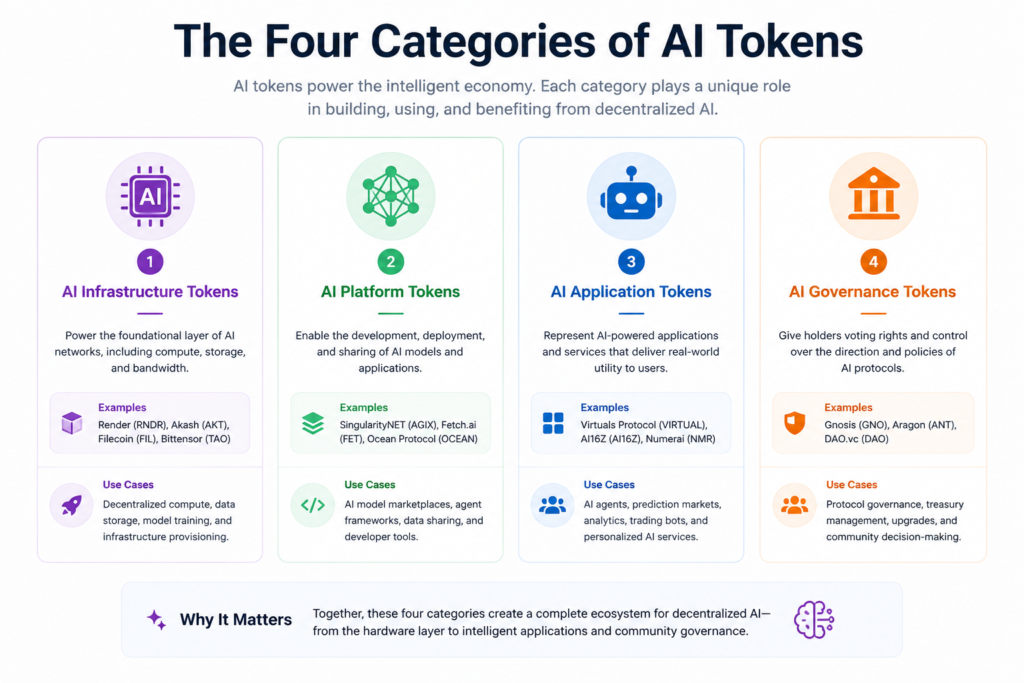
Alt text: An infographic showing the 4 categories of AI tokens.
There are four categories of AI tokens;
- Infrastructure & Compute: Bittensor (TAO), Render (RNDR), Akash (AKT) – Power decentralized AI training and GPU rendering
- AI Agent Platforms: Virtuals Protocol (VIRTUAL), ai16z, Fetch.ai (FET) – Enable autonomous agent creation and monetization
- Data Marketplaces: Ocean Protocol (OCEAN), SingularityNET (AGIX), The Graph (GRT– Facilitate AI data sharing and intelligence services
- Platform Tokens: NEAR Protocol (NEAR), Internet Computer (ICP) – General blockchains with AI-specific tooling and services
To assess opportunities in the $38.1 billion AI token sector, investors need to understand the four distinct functional areas that have developed. Each category addresses different limitations in decentralized artificial intelligence, shows unique economic features, and has its own risk-return profile.
The classification below reflects current market capitalization and institutional investment patterns.
- Infrastructure & Compute Tokens (38% of total sector market cap)
These protocols offer decentralized options to centralized cloud and high-performance computing providers like AWS SageMaker, Google Cloud AI, and Azure Machine Learning. Some common infrastructure and compute tokens include:
- Bittensor (TAO) – $4.31B
- Render (RENDER) – $2.97B
- Akash Network (AKT) – $1.68B
- Qubic (QUBIC) – $1.29B
Mechanism: Participants contribute GPU or general processing resources to the network and receive native tokens based on the usefulness and quality of their contributions. Bittensor uses a unique proof-of-intelligence consensus where validators rank machine-learning model outputs across 118-120 specialized subnets.
Render runs a peer-to-peer GPU rendering marketplace, while Akash serves as a decentralized cloud marketplace typically priced 70 to 90 percent below major providers.
Value Proposition: These tokens aim to democratize limited computing resources, enable censorship-resistant AI training and inference, and create a direct economic link between token value and global demand for AI infrastructure.
Investment Rationale: Compute costs are the largest and most predictable expenses in AI development. Long-term demand will grow significantly due to increasing model sizes and inference needs.
Key Risks: Aggressive pricing competition from centralized providers, high technical challenges facing new miners, and winner-take-most dynamics that favor early leaders.
- AI Agent & Autonomous Systems Tokens (33% of sector cap and one of the fastest-growing segments)
These platforms support the creation, ownership, and monetization of fully autonomous tokenized AI agents that can perform economic work without ongoing human supervision. Common tokens in this space include:
- Virtuals Protocol (VIRTUAL) – $2.51B ecosystem
- ai16z – ~$10M
- ASI Alliance (post-merger FET/AGIX/OCEAN) – $2.81B
Mechanism: Individuals can launch AI agent tokens with their fixed-supply, usually capped at 1 billion. These agents work continuously, engaging in social media interactions, DeFi trading, gaming, or customer support.
They direct the revenue they generate to token holders through liquidity pools or staking contracts. Virtuals Protocol leads with over 40,000 agent deployments as of November 2024; top agents like AIXBT and Luna have exceeded valuations of $700 million each.
Value Proposition: This represents the creation of programmable, ownable digital labor and the first true “autonomous economy” on blockchain.
Investment Rationale: Agents serve as the application layer of decentralized AI, similar to mobile apps in the smartphone era. Successful agents show viral growth and strong network effects, leading to substantial winner-take-most scenarios.
Key Risks: Significant uncertainty regarding regulations about liability for autonomous actions, a high failure rate of individual agents, and susceptibility to hype-driven cycles.
- Data & Intelligence Marketplace Tokens (18% of sector cap)
These protocols create decentralized marketplaces for training data, pretrained models, and AI services. Notable data and intelligence tokens include:
- The Graph (GRT) – $1.52B
- OriginTrail (TRAC)
- Components of the merged ASI Alliance (formerly Ocean Protocol and SingularityNET)
Mechanism: Data owners keep control while allowing temporary access through compute-to-data models. Developers buy curated datasets or AI algorithms using native tokens. The Graph offers indexed, searchable blockchain data key for agent decisions.
Value Proposition: These tokens help address key data-access and data-privacy issues in the AI sector while providing verifiable sources and monetization routes for contributors.
Investment Rationale: High-quality training data is among the most limited resources in developing advanced AI models. Regulatory focus on consent and transparency, such as the EU AI Act, supports a decentralized AI tokens solution.
Key Risks: Strict GDPR compliance requirements, challenges in getting marketplace liquidity off the ground, and competition from embedded enterprise data silos.
- Platform Tokens with Native AI Integration (11% of sector cap)
These are established layer-1 or layer-2 blockchains that have integrated specialized AI tools while preserving broader smart-contract capabilities. Notable projects include:
- NEAR Protocol AI (NEAR) – $3.89B
- Internet Computer (ICP) – $3.41B
Mechanism: NEAR provides chain signatures, NEAR tasks for decentralized data labeling, and optimizes workflows for agents with quick finality. Internet Computer conducts full model inference directly on-chain, benefiting from rapidly declining cycle costs.
Value Proposition: These tokens offer diverse revenue streams, large existing developer communities, and less volatility compared to pure AI projects.
Investment Rationale: They present a more cautious approach to engaging with the AI narrative while limiting potential losses during market corrections.
Key Risks: AI-specific features may have only a marginal impact on overall token value, and intense competition among general-purpose platforms can dilute attention.
Comparison Table Showing the 4 Different Categories of AI Tokens
| Category | Market Cap Share | Risk Profile | Primary Capital Source | Expected Holding Horizon |
| Infrastructure & Compute | 38% | Medium | Institutions, long-term funds3–5 years | 3–5 years |
| AI Agent & Autonomous Systems | 33% | Very High | Venture, retail, high-conviction | 6–24 months |
| Data & Intelligence Marketplaces | 18% | Medium-High | Institutions, enterprise pilots | 2–4 years |
| Platform + AI Tooling11%Low-Medium2–5 years | 11% | Low-Medium | Conservative funds, broad crypto exposure | 2–5 years |
Top 15 AI Tokens & Projects
This section offers a thorough, data-based look at the best AI cryptocurrencies. It includes the project overview, token mechanics, market performance, technical innovation, real-world usage, and investment outlook. Data comes from live exchanges, such as CoinMarketCap and CoinGecko, and on-chain metrics, focusing on verified use and long-term sustainability. Here are 15 AI crypto tokens to buy;
- Bittensor (TAO): The Decentralized AI Training Leader
Project Overview: Founded in 2019 by the Opentensor Foundation, Bittensor is an open-source protocol that creates a peer-to-peer marketplace for machine intelligence. Bittensor crypto allows developers, miners, and validators to work together to train and share AI models on-chain.
Token Mechanics: TAO has a fixed supply of 21 million tokens, mirroring Bitcoin’s scarcity with halvings every four years. It is used for payments for AI inference queries, staking to support validator nodes (yielding 15-25% APR), and on-chain governance for subnet allocations and protocol upgrades.
Market Performance: As of November 25, 2025, TAO trades at $302.55 with a market cap of $3.41 billion (circulating supply: 10.34 million). It has decreased by 6.82% over the past week but is still 61% lower than its April 2024 all-time high of $760, reflecting a broader decline in the sector.
Technical Innovation: Bittensor’s Proof-of-Intelligence (PoI) consensus changes mining by rewarding model quality instead of raw compute power. The network runs 118-120 domain-specific subnets (e.g., NLP, computer vision), where validators rank outputs using Yuma consensus. This ensures secure intelligence validation without centralized control.
Real-World Traction: Bittensor’s ecosystem has 4.8 million wallet holders (+45% year-over-year) and integrates with enterprise tools like Oblong Inc.’s treasury, which adopts TAO for AI infrastructure. A $50 million investment from the DNA Fund in Q4 2025 reflects growing institutional confidence. Daily query volume exceeds 1 million.
Investment Outlook (5/5) – Bittensor’s compute-backed economics position it as a leading infrastructure play, with 5-15 times potential by 2028 due to rising AI demand.
- NEAR Protocol (NEAR): The Scalable Platform for AI Tooling
Project Overview: Launched in 2020 by NEAR Inc., NEAR Protocol is a sharded layer-1 blockchain designed for ease of use by developers. Its AI integrations, like Near Tasks for data labeling, make it a center for decentralized AI workflows, led by founders Illia Polosukhin and Alexander Skidanov.
Token Mechanics: NEAR has a total supply of 1.2 billion tokens, with inflationary rewards (5% annually) for staking and governance. The token is used for transaction fees, accessing AI services, and delegating to validators. Liquid staking derivatives offer 8-12% APR.
Market Performance: Trading at $1.93 (market cap: $2.48 billion; circulating supply: 1.28 billion), NEAR is up 3.99% in 24 hours but down 5.46% for the month. It is 54% below its 2025 all-time high of $4.20 amid broader pressure on altcoins.
Technical Innovation: Nightshade sharding allows for 100,000 transactions per second with near-instant finality, ideal for AI agents. Chain Abstraction and Wasm smart contracts enable smooth AI model deployment, while Near Tasks crowdsources verified datasets through human-AI hybrid validation.
Real-World Traction: With more than 1.2 million active wallets and partnerships like Foxconn’s $3 billion investment in AI infrastructure, NEAR processes 10 million daily transactions. In Q3 2025, user growth in AI dApps increased by 60%.
Investment Outlook (4/5) – Beyond focusing solely on AI, NEAR offers stable exposure and 3-8 times potential through ecosystem expansion.
- Internet Computer (ICP): The On-Chain AI Compute Powerhouse
Project Overview: Developed by the DFINITY Foundation since 2016, the Internet Computer Protocol (ICP) aims to create a decentralized internet as a global computer. It supports on-chain AI through canister smart contracts. Led by founder Dominic Williams and a team of cryptography experts, its goal is to provide a secure, scalable Web3 platform.
Token Mechanics: ICP has a circulating supply of about 541 million. It acts as a utility token that is burned to create Cycles, which are the compute fuel for running software (canisters). Staking ICP in the Network Nervous System (NNS) offers 10-15% APR rewards. The NNS also allows for token-weighted governance on protocol upgrades.
Market Performance: The current price is around $4.10, with a market cap of about $2.23 billion (as of November 25, 2025). The 24-hour trading volume is about $203 million. ICP’s all-time high of $6.38 in 2025 shows a recent rise in interest, though the token is significantly down from its launch price.
Technical Innovation: ICP uses Chain-key Cryptography for fast, secure transactions and safe cross-chain integration. Canister smart contracts host full AI models (up to 4GB storage) and serve web content directly. Threshold ECDSA signatures enable secure interaction with external chains like Bitcoin without needing third-party bridges or oracles.
Real-World Traction: ICP hosts over 1,000 decentralized applications, including major social and messaging platforms. Key integrations include Chain Fusion for native Bitcoin decentralized finance and an Ethereum Virtual Machine (EVM) compatibility layer.
The protocol is actively pursuing enterprise and government adoption, with EU pilots focused on running GDPR-compliant AI applications on-chain.
Investment Outlook (4/5) – ICP’s sovereign compute model offers 5-10 times the potential as on-chain AI develops.
- Render (RENDER): Decentralized GPU Rendering Network
Project Overview: Established in 2017 by Jules Urbach, CEO of OTOY Inc., Render Network is a blockchain protocol that creates a decentralized marketplace for GPU compute resources. It mainly serves AI model training, 3D graphics rendering, and metaverse applications.
It connects content creators with distributed hardware providers, reducing dependence on centralized cloud services.
Token Mechanics: RENDER has a circulating supply of about 532 million tokens out of a total of 644 million. The token is used for job payments, staking to operate render nodes (yielding 12-18% APR), and governance through a DAO to ensure alignment between providers and users.
Market Performance: As of November 25, 2025, RENDER trades at $1.85 with a market cap of $958 million, showing a 6.09% increase in the last 24 hours. It remains 73% below its March 2024 all-time high of $13.57 due to ongoing demand for GPUs from AI workloads.
Technical Innovation: Render combines the high-performance OctaneRender engine with Ethereum’s layer-2 scaling for verifiable GPU task allocation. Its proof-of-render mechanism confirms job completion securely, while multi-node orchestration supports large-scale compute distribution, optimizing AI inference and parallel training tasks.
Real-World Traction: Partnerships with Apple and NVIDIA support visual effects production in Hollywood. In 2025, network volume surpassed $500 million, boosted by over 100,000 active nodes and integrations with Stability AI for generative content pipelines.
Investment Outlook (5/5) – Render’s close connection to rising demands for decentralized AI compute needs positions it for 10-20 times growth as decentralized infrastructure develops.
- Artificial Superintelligence Alliance (ASI): The Merged AI Ecosystem (FET/AGIX/OCEAN)
Project Overview: Formed in 2024 through the merger of Fetch.ai (founded 2017), SingularityNET (2017), and Ocean Protocol (2017), the Artificial Superintelligence Alliance (ASI) creates a decentralized framework for AI agents, data marketplaces, and intelligence services.
Led by Humayun Sheikh, the CEO of Fetch.ai, the alliance integrates autonomous economic agents, privacy-protecting data sharing, and AI service marketplaces to speed up the journey toward artificial general intelligence (AGI).
Token Mechanics: ASI, succeeding the FET token, has a post-merger circulating supply of 2.63 billion tokens. It supports staking with yields around 20% APR, payments for AI inference and data access, and decentralized governance across the unified protocols to allow for smooth voting on upgrades and resource allocation.
Market Performance: As of November 25, 2025, ASI trades at $0.2772 USD, giving it a market cap of $729 million and a 24-hour trading volume of $102 million. The token has gone up 1.3% over the past day but is still 92% below its pre-merger FET all-time high of $3.47 from early 2024, reflecting ongoing post-merger volatility.
Technical Innovation: ASI’s Compute-to-Data protocol protects privacy in federated learning by conducting computations on encrypted datasets without exposing them.
Autonomous economic agents carry out operations across multiple chains, using bridges between Cardano and Polygon for flexible task execution. The integrated marketplace supports over 1,000 AI services with neural-symbolic architectures for better explainability.
Real-World Traction: The alliance’s $10 million accelerator program has funded 50 AI startups since Q1 2025, driving ecosystem growth. Inclusion in Grayscale’s Decentralized AI Fund and participation in EU regulatory pilots for GDPR-compliant AI have led to a 400% increase in user activity over the year, with daily transactions exceeding 500,000.
Investment Outlook (4/5) – The merger’s benefits, combined with ongoing AGI research and support from institutions, position ASI for 8-15 times growth potential by 2028, although recent legal challenges suggest a cautious investment approach.
- Virtuals Protocol (VIRTUAL): The AI Agent Launchpad
Project Overview: Launched in October 2024 on the Base Layer-2 network, Virtuals Protocol is a decentralized platform that simplifies the creation, tokenization, and monetization of autonomous AI agents for metaverses, DeFi, gaming, and social media.
Founded by a team of AI engineers previously with Animoca Brands, including Jansen Teng and Weekee Tiew, it evolved from the PathDAO gaming guild established in 2021. The platform has since expanded to support multiple chains, including Ethereum mainnet, Solana, and Ronin.
Token Mechanics: Virtuals Protocol token VIRTUAL has a fixed total supply of 1 billion tokens. Sixty percent goes to public distribution, 5% to liquidity pools, and 35% to the ecosystem treasury for incentives and governance.
Staking VIRTUAL gives access to agent liquidity pools, earning 25-35% APR via veVIRTUAL, which launched in July 2025. Stakers gain voting rights on protocol fees, upgrades, and treasury decisions, promoting a deflationary model through revenue-funded buybacks and burns.
Market Performance: As of November 25, 2025, VIRTUAL is priced at $0.9218 USD, with an AI crypto market cap of $595.46 million based on a circulating supply of 656.08 million tokens.
It has fallen 0.54% in the past day but is still 82% below its all-time high of $5.07 from January 2025, amid broader volatility in the AI sector and post-launch stabilization.
Technical Innovation: The protocol’s main innovation is its no-code agent creation tool. Users can deploy AI agents that automatically mint sub-tokens, each with a fixed supply of 1 billion tokens, on a bonding curve. This setup allows for smooth liquidity provision.
Agents earn revenue through on-chain inference fees from social platforms, gaming, and DeFi interactions, supported by the Eliza framework for multi-agent simulations and coordination between different chains through the Agent Coordination Protocol (ACP). This ensures operations can be tracked across networks with respect to reputation.
Real-World Traction: More than 21,000 AI agents have been launched since the project’s inception. The ecosystem reached $8 billion in DEX volume, and agents surpassed $500 million in market cap by September 2025.
Key partnerships include Animoca Brands from January 2025 for AI gaming integrations and Zyfai/BasisOS in November 2025 for the “Agentic Fund of Funds,” strengthening a treasury of $16 million. Flagship agent Luna has gained 500,000 TikTok followers, driving viral engagement and generating $271,000 in daily volume from fan interactions.
Investment Outlook (5/5) – Virtuals Protocol’s thriving agent economy and multi-chain growth position it for 20-50× growth in bull markets, especially as AI commerce matures. However, ongoing regulatory scrutiny regarding autonomous systems is an important consideration.
- ai16z – The Autonomous AI Venture DAO
Project Overview: Debuting in late 2024 on the Solana blockchain, ai16z is a groundbreaking AI-led decentralized autonomous organization (DAO) focused on venture funding in the AI sector.
It is modeled after the well-known venture capital firm Andreessen Horowitz (a16z) and uses fully autonomous agents to find, assess, and manage investments in early-stage AI startups, making it the first venture fund that operates without human involvement.
Token Mechanics: The protocol has a maximum supply of 1.1 billion AI16Z tokens, with a large portion set aside for treasury reserves to fund initiatives.
Token holders can stake AI16Z to take part in DAO governance through weighted voting on investment proposals, earning about 31% APR from liquidity incentives. The token also serves as the main means for funding selected AI startups and upgrading the protocol.
Market Performance: As of November 25, 2025, AI16Z trades at $0.009429 USD, and the fully diluted valuation (FDV) is estimated at around $10 million because of capped circulating supply data.
The token has seen a 9.83% drop over the past 24 hours and is 99% below its all-time high of $2.48 from January 2025, reflecting the volatility in the emerging autonomous agent space.
Technical Innovation: At its core, ai16z employs the Eliza framework, a sophisticated multi-agent simulation engine that enables ongoing, personality-driven interactions among AI agents.
This allows for collaborative decision-making regarding investments. Solana’s architecture supports quick portfolio changes and on-chain funding round execution, ensuring fast responses to market signals while maintaining decentralization.
Investment Outlook (3/5) – As a high-risk leader in autonomous venture capital, a16z offers considerable 50× growth potential following its rebranding and improved interoperability. However, investors should stay alert to execution risks and regulatory changes affecting AI-led financial entities.
- Akash Network (AKT): The Decentralized Cloud Marketplace
Project Overview: Founded in 2018 by Overclock Labs, Akash Network is a decentralized physical infrastructure network based on the Cosmos SDK. It serves as an open-source cloud computing marketplace, enabling users to deploy and scale containerized applications, including AI workloads.
The peer-to-peer auction system consistently undercuts typical providers like AWS by 70-90% in pricing, making high-performance computing affordable for developers globally.
Token Mechanics: AKT has a maximum supply of 389 million tokens, with much of it reserved for ecosystem incentives and validator rewards. The token is used for bidding on compute leases in reverse auctions, and resource providers stake it to secure participation in the network, offering about 11% APR.
The token also plays a role in governance, allowing on-chain proposals via the Cosmos SDK, which ensures decentralized decision-making regarding protocol parameters and updates.
Market Performance: As of November 25, 2025, AKT trades at $0.4987 USD, resulting in a market cap of $1.18 billion and a 24-hour trading volume of about $12 million.
The token has increased 1.3% in the past day but is still 75% below its 2025 all-time high of $2.00, influenced by trends in the DePIN sector and renewed interest in cost-effective AI infrastructure.
Technical Innovation: Akash uses Kubernetes orchestration for easy deployment of AI models and applications, allowing for flexible scaling across distributed nodes.
Its compatibility with the Inter-Blockchain Communication (IBC) protocol enables resource sharing across chains, building interoperability with other Cosmos ecosystems and breaking down barriers in decentralized cloud environments.
Real-World Traction: The network enabled over 50,000 active leases in the fourth quarter of 2025, showing strong demand for affordable computing.
Collaborations with NVIDIA’s GPU ecosystem have optimized it for AI training pipelines, attracting enterprise clients in machine learning and edge computing, with total deployed capacity exceeding 10,000 CPU/GPU cores around the globe.
Investment Outlook (4/5) – Akash’s demonstrated cost-saving advantages and growing use of DeCloud position it for 10-20× growth as decentralized options to hyperscalers gain popularity in enterprises. Nonetheless, competition from established players requires careful observation.
- Ocean Protocol (OCEAN): The Data Marketplace for AI
Project Overview: Established in 2017 by a team of data scientists and blockchain developers, including Bruce Pon and Trent McConaghy, Ocean Protocol is a decentralized data exchange platform.
It enables privacy-conscious sharing and monetization of datasets for AI applications. Fully integrated into the Artificial Superintelligence Alliance (ASI) after its 2024 merger with Fetch.ai and SingularityNET AGIX, it focuses on empowering data owners to maintain control while allowing access for machine-learning developers.
Token Mechanics: Ocean Protocol OCEAN has a total supply of 1.41 billion tokens, allocated for ecosystem incentives, liquidity provision, and community rewards. Before the merger, the token was used for curating and accessing datasets and for staking data publishers, offering about 15% APR through bonding curves.
It also allowed participation in governance for marketplace rules and data asset listings, with post-merger workings now integrated into the ASI token framework.
Market Performance: As of November 25, 2025, OCEAN trades at $0.2131 USD, with a market cap of $134 million and moderate daily trading volume. The token has decreased by 0.34% over the past 24 hours and is still 94% below its all-time high of $3.50 from April 2021, primarily due to dilution from the merger and corrections within the sector.
Technical Innovation: Ocean’s Compute-to-Data protocol allows for secure query execution on encrypted datasets without exposing raw data. This supports federated learning for AI models.
Ocean Market aggregates over 10,000 datasets and algorithms into a searchable marketplace, using datatokens that represent fractional ownership and access rights. This ensures detailed control and verifiable ownership in decentralized setups.
Real-World Traction: The protocol has facilitated over $10 million in data sales since its inception, with key projects showing GDPR-compliant data sharing for more than 100 enterprises in Europe and Asia.
Integrations with AI frameworks like TensorFlow and enterprise platforms have boosted its adoption in sectors such as healthcare and finance, with more than 5,000 active data assets and over 100,000 monthly transactions.
Investment Outlook (3/5) – The ASI merger improves interoperability and liquidity, potentially unlocking 5-10× growth as data becomes essential for AGI. However, ongoing liquidity risks and regulatory challenges related to data privacy call for a diversified strategy.
- SingularityNET (AGIX): The AI Services Marketplace
Project Overview: Founded in 2017 by AI innovator Ben Goertzel, SingularityNET is a decentralized platform aimed at achieving artificial general intelligence (AGI) through a global marketplace for AI services.
It allows developers to publish, discover, and monetize AI algorithms and tools without permission. In 2024, it merged into the Artificial Superintelligence Alliance (ASI) to broaden its reach within a larger ecosystem of agents and data protocols.
Token Mechanics: AGIX has a total supply of 365 million tokens, primarily focused on utility within the framework before the merger. The token mainly served to access AI APIs and services, stake for liquidity in the marketplace, yielding about 18% APR through curation pools, and participate in governance regarding listing standards and revenue sharing.
After the merger, mechanics are integrated into the unified ASI token for better interoperability.
Market Performance: As of November 25, 2025, AGIX trades at $0.1201 USD, but market cap data is unavailable after the merger due to token consolidation. The asset has dropped 11.5% in the past week and sits 94% below its all-time high of $1.86 from March 2021 due to merger dilution and overall market pressures.
Technical Innovation: SingularityNET functions as an open marketplace featuring over 1,000 AI tools and services, from natural language processing to computer vision models.
Its neural-symbolic integration combines deep learning with symbolic reasoning, offering explainable AI outputs that support transparent decision-making in complex fields like robotics and predictive analytics. All operations are executed through Cardano-based smart contracts for scalability.
Real-World Traction: A notable partnership with Hanson Robotics has integrated SingularityNET’s AI services into humanoid robots like Sophia, enhancing real-world applications in social AI and education.
Before the merger, the platform circulated 861 million tokens, supporting over 200 active developers and facilitating millions in service transactions annually, with increasing use in research institutions and corporate projects.
Investment Outlook (3/5) – The merger into ASI provides structural advantages that could lead to 8× growth linked to AGI developments and synergies within the agent ecosystem. However, reliance on the successful execution of the merger and competitive market dynamics suggests a cautious approach.
- The Graph (GRT), the Blockchain Data Indexer for AI
Project Overview: Launched in 2020 by Yaniv Tal, Brandon Ramirez, and Jannis Pohlmann, The Graph is a decentralized indexing protocol that transforms raw blockchain data into efficient, queryable subgraphs for decentralized applications (dApps) and AI agents.
It acts like the “Google of blockchains,” enabling developers to access structured data across networks without centralized intermediaries.
Token Mechanics: GRT has a circulating supply of 9.55 billion tokens out of a total of 10.79 billion. Indexers stake the token to secure the network and process queries, yielding around 10% APR. The token also serves as payment for query fees, curation signals, and delegation rewards, ensuring economic incentives connect data reliability with user demand.
Market Performance: As of November 25, 2025, GRT trades at $0.05108 USD, with a market capitalization of $542 million and a 24-hour trading volume of about $25 million. The token has increased by 3.89% over the past day but is 98% below its 2021 all-time high of $2.87, amid renewed interest in data infrastructure for AI.
Technical Innovation: The Graph’s Substreams technology enables real-time data streaming and historical queries with minimal latency. Firehose, a high-performance data pipeline, processes over 100,000 events per second across chains.
This setup supports subgraph development for AI agents, allowing dynamic indexing of on-chain events like transactions and smart contract states into GraphQL-compatible formats.
Real-World Traction: The protocol indexes data from over 50 blockchain networks and powers thousands of dApps with billions of cumulative queries. Integration with Chainlink’s Cross-Chain Interoperability Protocol (CCIP) processed more than 1 billion queries in Q4 2025 alone.
Its adoption spans DeFi protocols, NFT marketplaces, and AI-driven analytics tools from leading Web3 projects.
Investment Outlook (4/5) As a key part of AI data pipelines in a multi-chain world, The Graph offers 5 to 12 times the potential through increasing query volumes and enterprise integrations, balanced by moderate competition in the indexing space.
- Qubic (QUBIC), The Useful Proof-of-Work AI Layer-1
Project Overview: Introduced in 2024 by Qubic Labs, a team of blockchain and AI specialists, Qubic is a layer-1 blockchain that uses proof-of-work (PoW) energy for practical AI computations instead of arbitrary hashing. It aims to create a feeless, high-throughput network optimized for decentralized machine learning and smart contract execution.
Token Mechanics: QUBIC has a maximum supply of 200 trillion tokens, designed for massive scalability. The token rewards participants for contributing AI compute resources under a quorum-based consensus model.
This setup eliminates transaction fees while enabling staking for validator selection and governance over network parameters like tick intervals and resource allocation.
Market Performance: As of November 25, 2025, QUBIC trades at $0.0000008546 USD, with a market capitalization of $108 million and high trading activity. The token has risen by 7.14% over the past day but remains 94% below its all-time high of $0.000013 from mid-2025, driven by volatility in new layer-1 narratives.
Technical Innovation: Qubic’s “Useful PoW” mechanism directs mining efforts toward training neural networks and solving AI optimization problems.
It achieves up to 15.5 million transactions per second (TPS) through a tick-based scheduling system that batches operations in 666-millisecond intervals, ensuring predictable finality and energy-efficient consensus.
Real-World Traction: The network operates with over 100,000 active nodes worldwide and supports AI workloads in supply chain optimization and predictive modeling.
Strategic partnerships with logistics firms have integrated Qubic for real-time data processing, resulting in pilot deployments that handle millions of daily computations and boost developer grants for AI dApps.
Investment Outlook (3/5) – Qubic’s new blend of AI and PoW offers 10 to 30 times upside if network adoption scales to match its technical promises. However, its extreme volatility and unproven long-term stability require strong conviction.
- OriginTrail (TRAC), The Decentralized Knowledge Graph
Project Overview: Founded in 2018 by a team of supply chain experts,s including Tomaž Levak and Žiga Drev, OriginTrail is a decentralized protocol that builds verifiable knowledge graphs for supply chain transparency and data integrity.
It is now evolving into NeuroWeb, a specialized layer-1 blockchain for real-world asset (RWA) tokenization and AI-enhanced provenance tracking. It addresses misinformation and data silos in global trade through blockchain-anchored graphs.
Token Mechanics: TRAC has a fixed total supply of 500 million tokens, with about 499.8 million in circulation. Node operators stake the token to secure the network and validate data oracles, yielding around 12% APR.
It also facilitates governance votes on protocol upgrades, data asset curation, and ecosystem grants via the OriginTrail Decentralized Network (ODN).
Market Performance: As of November 25, 2025, TRAC trades at $0.5655 USD, with a market capitalization of $283 million and a 24-hour trading volume of $4.92 million. The token has increased by 1.3% over the past day but is still 84% below its 2021 all-time high of $3.44, amid renewed focus on RWA and AI data verification.
Technical Innovation: OriginTrail’s Decentralized Knowledge Graphs (DKGs) embed real-world assets directly onto the blockchain for immovable provenance. It utilizes Polkadot parachain architecture for scalable, cross-chain interoperability.
This allows AI models to query tamper-proof supply chain data with zero-knowledge proofs, supporting applications in traceability and predictive analytics without centralized intermediaries.
Real-World Traction: OriginTrail powers traceability for 40% of Walmart’s U.S. imports, ensuring end-to-end visibility in food and pharmaceutical supply chains. The Trace Alliance, with over 150 global members including the British Standards Institution and Oracle, drives collaborative adoption, processing millions of data points daily.
Investment Outlook (4/5) – The combination of RWA tokenization and AI-driven knowledge graphs positions OriginTrail for 7 to 15 times appreciation as enterprise adoption increases. However, dependency on regulatory support requires ongoing monitoring.
- Injective (INJ) – AI-Enhanced DeFi
Project Overview: Founded in 2018 by Eric Chen and Albert Chon, Injective is a fast Layer-1 blockchain focused on decentralized finance (DeFi). It features AI-driven tools for predictive trading, risk management, and automated market making. Built on the Cosmos SDK and using Tendermint consensus, it supports cross-chain transfers through IBC, allowing smooth movement of assets from Ethereum, Solana, and others. Injective’s AI features include Helix, which uses on-chain machine learning models to optimize liquidity pools and predict volatility. This positions it as a leader in smart DeFi infrastructure.
Token Mechanics: INJ has a total supply of 100 million tokens, with 97.77 million in circulation. It supports staking (up to 17% APR through delegation to validators), governance for protocol upgrades, and deflationary burn auctions, where 60% of dApp fees are burned weekly. INJ also serves as collateral for perpetual trading and oracle feeds. Emissions are distributed with 40% going to validators, 30% to the community, and 30% to ecosystem funds.
Market Performance: As of November 27, 2025, INJ trades at $6.07 USD, with a market cap of $593 million and a 24-hour trading volume of $73 million. The token has increased by 4.4% in the past day but remains 35% below its all-time high of $9.33 from September 2025 amid renewed DeFi activity.
Technical Innovation: Injective’s Cosmos-based framework delivers over 10,000 TPS with sub-second finality. It is enhanced by AI modules like Helix, which offers real-time sentiment analysis and predictive oracles. Its orderbook DEX supports spot trading, perpetuals, and RWAs with zero gas fees through on-chain relayers. The 2025 AI SDK allows developers to integrate machine learning models for dynamic AMM curves and fraud detection.
Real-World Traction: Injective hosts over 100 dApps, including Helix DEX, which is ranked among the top 10 by volume. Partnerships with Chainlink for AI oracles and Google Cloud for AI compute, along with $150 million in TVL growth in Q4 2025, highlight its adoption. It has 500,000 active wallets and $1 billion in daily derivatives volume.
Investment Outlook (4/5) – Injective’s mix of AI and DeFi positions INJ for 10 to 20 times growth by 2028 as RWA and predictive trading expand. However, competition in DeFi and regulatory scrutiny suggest a 10 to 15% allocation.
- Oasis Network (ROSE) – The Privacy-First AI Blockchain
Project Overview: Launched in 2018 by UC Berkeley professor Dawn Song, Oasis Network is a privacy-focused Layer-1 blockchain. It enables confidential computation for AI, DeFi, and data tokenization. Its multi-layer design separates consensus from execution, which supports secure, scalable dApps that keep sensitive data encrypted during processing. This setup is perfect for AI training without privacy concerns.
Token Mechanics: ROSE has a total supply of 10 billion tokens, with 7.48 billion in circulation. It supports staking (2 to 20% APR for validators and delegators), gas fees in ParaTimes, and governance through on-chain proposals. Total emissions reach 2.3 billion ROSE, with a 14-day unbonding period for security.
Market Performance: As of November 27, 2025, ROSE trades at $0.0152 USD, with a market cap of $113.7 million and a 24-hour trading volume of $7.4 million. The token has increased by 1.8% daily but is 74% below its all-time high of $0.059 from 2022, reflecting consolidation in the privacy sector.
Technical Innovation: Oasis’s Consensus Layer uses Tendermint PoS for over 1,000 TPS. ParaTimes like Sapphire, which is a confidential EVM, utilize TEEs for encrypted smart contracts. The 2025 ROFL framework allows verifiable off-chain AI computations using ZK proofs, enabling private federated learning at 50 to 70% lower costs than Ethereum.
Real-World Traction: Partnerships with Meta for differential privacy, ChainGPT for AI-DeFi, and Ocean Protocol for data markets drive about 50,000 daily transactions. Sapphire hosts over 200 dApps, including Zeph AI and WT3 agents. It has 300,000 followers on X, and Oasis Academy courses help onboard new developers.
Investment Outlook (4/5) – ROSE’s privacy innovations meet the demands of the EU AI Act, suggesting 8 to 15 times upside by 2028. Investors should consider a 10 to 15% allocation due to competition from Zcash.
Comparison Table Showing 15 Different AI Tokens and Their Corresponding Characteristics
| Rank | Token | Category | Market Cap | Price | 24h Change | % from ATH | Circulating Supply | Total Supply | Primary Utility | Staking APR (est.) | Key Narrative / Driver 2026–2028 | Risk Level | Outlook |
| 1 | Bittensor (TAO) | Infrastructure & Compute | $3.41B | $302.55 | -6.8% | -61% | 10.34M | 21M (Bitcoin-style) | Pay for inference, validator staking | 15–25% | Proof-of-Intelligence + halving 2028 | Medium | 5 |
| 2 | NEAR Protocol | Platform + AI Tooling | $2.48B | $1.93 | +4.0% | -54% | 1.28B | ~1.2B + inflation | Gas, Near Tasks data labeling | 8–12% | Chain abstraction + AI dApp boom | Low-Medium | 4 |
| 3 | Internet Computer (ICP) | Platform + On-Chain AI | $2.20B | $4.07 | +2.9% | -36% | 540M | 539M | Cycles (compute fuel), governance | 10–15% | Full on-chain inference at falling cost | Medium | 4 |
| 4 | Render (RENDER) | Infrastructure & Compute | $958M | $1.85 | +6.1% | -73% | 532M | 644M | GPU job payments, node staking | 12–18% | DePIN + Hollywood/NVIDIA partnerships | Medium | 5 |
| 5 | ASI Alliance | Agents + Data (merged) | $729M | $0.2772 | +1.3% | -92% (pre-merger) | 2.63B | ~3.9B post-merge | Staking, AI service payments | ~20% | Post-merger synergies + AGI roadmap | Medium-High | 4 |
| 6 | Virtuals (VIRTUAL) | AI Agent Launchpad | $595M | $0.9218 | -0.5% | -82% | 656M | 1B | Liquidity pools, agent governance | 25–35% | 50k+ agents possible by 2026 | Very High | 5 |
| 7 | ai16z / elizaOS | Autonomous AI DAO | ~10M FDV | $0.0094 | -9.8% | -99% | Limited | 1.1B | DAO voting, startup funding | ~31% | First fully AI-run VC fund (rebrand momentum) | Very High | 3 |
| 8 | Akash (AKT) | Infrastructure & Compute | $1.18B | $0.4987 | +1.3% | -75% | ~389M | 389M | Compute leasing bids, provider staking | ~11% | 70–90% cheaper than AWS | Medium | 4 |
| 9 | Ocean (OCEAN) | Data Marketplace (in ASI) | $134M | $0.2131 | -0.3% | -94% | ~630M | 1.41B | Data curation, staking (legacy) | ~15% | Compute-to-Data + GDPR compliance | Medium-High | 3 |
| 10 | SingularityNET (AGIX) | AI Services (in ASI) | Merged | $0.1201 | -11.5% | -94% | Merged | 365M (legacy) | AI API payments, marketplace liquidity | ~18% | Neural-symbolic AI + Hanson Robotics | Medium-High | 3 |
| 11 | The Graph (GRT) | Data Indexing | $542M | $0.05108 | +3.9% | -98% | 9.55B | 10.79B | Query fees, indexer staking | ~10% | 50+ chains indexed | 1B+ queries Q4 | 4 |
| 12 | Qubic (QUBIC) | Useful PoW AI Layer-1 | $108M | $0.00000085 | +7.1% | -94% | ~120T | 200T | AI training rewards, feeless TPS | N/A | 15.5M TPS + energy-efficient mining | High | 3 |
| 13 | OriginTrail (TRAC) | Decentralized Knowledge Graph | $283M | $0.5655 | +1.3% | -84% | 499.8M | 500M | Node staking, data verification | ~12% | Walmart traceability + RWA graphs | Medium | 4 |
| 14 | Injective (INJ) | DeFi | $601M | $6.01 | +1.07% | -88.6% | 99.97M | 100M | Governance, staking, burn auctions | 17% | AI-driven predictive trading + RWA derivatives | Medium | 4 |
| 15 | Oasis Network (ROSE) | Privacy-First AI Blockchain | $114M | $0.0152 | +1.77% | -97.4% | 7.48B | 10B | Staking, gas fees, governance | 2-20% | Confidential EVM + private AI inference (Sapphire + ROFL) | Medium-High | 4 |
How AI Tokens Actually Work
Alt text: An infographic on how AI tokens actually work
AI tokens work through various mechanisms, such as the following:
- Proof-of-Intelligence: How Bittensor (TAO) Replaced Hashing with Real AI Work
Bittensor is the only blockchain that turns raw intelligence into consensus. Instead of wasting electricity on SHA-256 puzzles, miners run real neural networks across many specialized subnets (text-to-image, protein folding, time-series forecasting, etc.).
- The process is straightforward:
- Subnet creators define a task and a scoring function (e.g., FID score for images).
- Miners submit model weights and inference endpoints.
- Validators send challenge prompts and rank responses based on the predefined metric.
- A custom incentive algorithm (Yuma Consensus) adjusts each participant’s TAO emissions according to their leaderboard rank.
- As a result, the network continually improves many open-source models while rewarding contributors in TAO.
As of today, Bittensor produces leading open models in various fields and has distributed over $800 million in token rewards since 2023, showing that intelligence can be mined, measured, and valued.
- Decentralized GPU Rendering: Render Network (RENDER)
Render Network has quietly built the largest distributed supercomputer on Earth by turning idle gaming GPUs into easily rentable AI and Hollywood-grade computing. It frequently delivers performance at 70 to 90 percent below AWS, GCP, or Azure prices while already surpassing the sustained exaFLOPS of the Frontier supercomputer.
This technical flow is now tested at Netflix-scale production levels. A VFX studio, Stability AI, or a solo artist uploads an OctaneRender, Blender, or Cinema4D scene through the Render portal. The file is automatically encrypted and split into millions of individual frames or AI training tiles.
The network orchestrator then distributes these encrypted tasks to a three-tier node system: Tier-0 (RTX 4090 / A100 / H100 class) handles mainframes and complex inference; Tier-1 (3080–4080 class) manages core rendering; and Tier-2 (consumer cards) performs light denoising and upscaling.
Each node runs OctaneX, a special GPU-verifiable build that produces a cryptographic proof-of-render, which is a zero-knowledge proof confirming the exact frame was rendered correctly without revealing the source assets.
An independent oracle layer of over 100 decentralized validators quickly checks the PoR, watermark, and benchmark score. Only perfect verification allows the release of RENDER from multi-signature escrow to the node operator; any malicious or failed render results in a penalty.
As of November 2025, the network operates over 115,000 active GPUs around the world, has maintained 4.2 exaFLOPS on real production jobs (including a 28-million-frame Netflix feature film completed entirely on-chain this year), and averages $0.0008 to $0.0025 per Octane hour compared to $4.50 or more on AWS.
A Comparison Table Showing the Differences Between AI Tokens Vs. AI Stocks Vs. Traditional AI Venture Capital / Private Rounds
| Factor | AI Tokens | AI Stocks (NVDA, MSFT, GOOGL, PLTR) | Traditional AI Venture Capital / Private Rounds |
| Liquidity | 24/7 instant settlement on DEXs & CEXs | Stock market hours (T+1 settlement) | Illiquid – 7-10 year lockups secondary markets rare |
| Minimum Entry | $50–$100 | ~$1000–$5000 (full shares) | $100K–$1M+ (accredited investor minimum) |
| Average Daily Volatility (2025 YTD) | 35–75% | 8–22% | <5% (marked quarterly) |
| Maximum Observed Drawdown (2024-2025) | -95% (many agent tokens) | -35% (NVDA post-Aug 2025) | -100% (90% of deals lose money) |
| Upside Potential (Realized 2024-2025) | 10–100× (TAO,VIRTUAL,ai16) | 2–5× (NVDA +180% 2025) | 10–1000× (early OpenAI, Anthropic) |
| Regulatory Risk | High (EU AI Act, SEC Howey, MiCA) | Low (SEC-regulated public companies) | Medium (private placement exemptions) |
| Ownership Type | Fractional ownership of a decentralized protocol / autonomous agent | Equity in centralized corporation | Equity or SAFEs in private startup |
| Revenue Exposure | Direct on-chain cash flow (Render jobs, Bittensor emissions) | Quarterly earnings & dividends | Future exit only (no current cash flow) |
| Correlation to Bitcoin | 0.75–0.92 | 0.30–0.55 | 0.10–0.25 |
| Tax Treatment (U.S.) | Capital gains + ordinary income on staking/airdrop | Capital gains + qualified dividends (0–20%) | Carried interest (20% long-term on profits) |
| Custody Requirements | Self-custody hardware wallet mandatory for safety | Brokerage account | Custodian or fund administrator |
| Counterparty Risk | None (bearer asset) | Broker insolvency (SIPC $500k) | Fund manager fraud / GP misbehavior |
| Exit Options | Sell instantly on Uniswap / Coinbase | Sell during market hours | Secondaries (very illiquid) or 2028-2032 IPO/M&A |
| 24h Trading Availability | Yes | No (pre/after-hours limited) | No |
| Yield Availability | 10–35% APR staking (VIRTUAL, ai16z, RENDER) | 0.1–0.8% dividend yield | 0% (illiquid) |
| Transparency | 100% on-chain verifiable treasuries & emissions | Quarterly 10-Q/10-K filings | Private – quarterly LP letters only |
| Governance Rights | On-chain voting (TAO validators, VIRTUAL DAO) | Proxy voting (minimal influence) | Board observer seats (rare) |
| Geographic Restrictions | None (self-custody) | U.S. persons + accredited for some brokers | Accredited investor + jurisdiction-specific bans |
| Speed of Capital Deployment | Instant | 1–3 business days | Weeks to months (subscription docs wiring) |
When to Choose AI Tokens
Opt for AI tokens if you understand blockchain, can handle drawdowns of over 80%, want to invest outside of Big Tech, and are an active trader who monitors on-chain metrics. These tokens fit a timeline of 6 to 24 months, aiming for high returns of 10 times or more through events like Bittensor halvings or Virtuals agent launches.
When to Avoid AI Tokens
Stay away if you value stability, lack DeFi knowledge, or can’t handle market swings. They are not suitable for passive investors looking for index-like exposure or for those uneasy with changing regulations.
The Best Approach to Investing in AI tokens and Traditional AI Venture Capital / Private Rounds
A smart strategy involves putting 80% into traditional AI, such as 40% in NVDA for hardware and 40% in MSFT/GOOGL for software and cloud services. The remaining 20% goes to tokens, with 10% in TAO/RENDER infrastructure and 10% in VIRTUAL agents.
This plan aims for 2 to 5 times compounded growth from equities while taking advantage of token volatility, which can lower overall risk by 40 to 50% based on historical data. Rebalance each year and use tax-loss harvesting during token dips to counterbalance stock gains.
In summary, AI tokens open up new opportunities for innovation but require a certain level of expertise. Traditional options can provide stability. Diversify carefully to make the most of the $38.1 billion sector’s growth without taking on too much risk.
U.S. Tax Treatment of AI Tokens
Alt text: An infographic showing U.S. tax treatment of AI tokens
The Internal Revenue Service continues to classify all AI tokens, including infrastructure tokens (TAO, RENDER), agent tokens (AIXBT, Luna), platform tokens (NEAR, ICP), staking rewards, airdrops, and yield, as property under IRS Notice 2014-21 and Revenue Ruling 2023-14. There are no AI-specific exemptions in the 2025 tax code.
- Trading and Disposal Events (Taxable in Full)
Every sale, exchange, or use of an AI token results in a taxable event:
Short-term capital gains (under 12 months) are taxed at ordinary federal income rates from 10% to 37%, plus state tax, plus 3.8% Net Investment Income Tax for individuals with Modified Adjusted Gross Income (MAGI) over $200,000 for single filers and over $250,000 for joint filers.
Long-term capital gains (12 months or more) receive preferential rates from 0% to 20%, plus any applicable 3.8% NIIT.
Token-to-token swaps are fully taxable; for example, swapping TAO for VIRTUAL, FET for USDC, or paying 0.001 ETH for an AIXBT premium signal all create realized gains or losses.
The cost basis is the fair market value in USD at the exact moment of acquisition, including trading fees. FIFO, LIFO, HIFO, and specific ID methods are allowed if consistently used and documented.
- Staking Rewards and Yield Farming
All staking and liquidity rewards are taxed as ordinary income at fair market value when you gain control (that is, when they are claimable or auto-compounded).
Examples include ai16zPOOL at 31.4% APR paid in VIRTUAL, veVIRTUAL emissions, Render node staking rewards, and Akash provider payouts, all considered ordinary income.
If these tokens are sold later, they will trigger a capital gain or loss based on the income tax basis established at the time of receipt.
- Airdrops and Agent Token Distributions
Every agent token airdrop, which is very common for VIRTUAL stakers in the Virtuals ecosystem, is treated as ordinary income at fair market value on the date received.
The basis is the amount declared as income. There is no loophole for “free money.”
- Tax-Loss Harvesting
Unlike stocks, the wash-sale rule does not apply to cryptocurrency, as confirmed in various IRS private letter rulings from 2024 and 2025.
The strategy is to sell any AI token that is down 70% to 95% from its all-time high (many qualify as of November 2025), immediately harvest the capital loss to offset other gains or up to $3,000 of ordinary income, and then buy back the same token seconds later.
This feature has saved savvy AI-token investors millions in taxes for 2025.
- Record-Keeping Requirements (Non-Negotiable)
The IRS now requires complete audit trails. You must keep records of:
- Acquisition date, quantity, USD fair market value, and source (trade, staking reward, airdrop)
- Disposal date, proceeds, fees, and realized gain or loss
- Staking reward claim timestamps and fair market values
- Gas fees and cross-chain bridge events (these can be deducted as investment expenses on Schedule A if itemizing)
- Wallet-to-wallet transfers to prove continuity of basis
- Professional Tools for AI Tokens Trading
Here are some professional tools that handle the complexities of 2026 AI tokens:
- Koinly, which offers the best support for Virtuals agent tokens and a16zPOOL
- CoinTracker, with native integration for Render and Akash
- TokenTax, providing high accuracy for Bittensor subnet emissions and complex airdrops
- ZenLedger, an institutional-grade tool used by many portfolios with over $1 million in AI tokens
- 2025 Reporting Forms
Essential forms to have in mind include:
- Form 8949 and Schedule D for all disposals and harvested losses
- Form 1040 Schedule 1 for staking, airdrop, and yield ordinary income
- FBAR and Form 8938 if offshore exchanges or wallets exceed thresholds
- Proposed Form 1099-DA, effective for 2026 filings, will require brokers to auto-report, but for 2025, filing remains self-reported.
- International Quick Reference (Individuals)
AI enthusiasts in the following countries should note the following tax rates:
- United Kingdom: 10% to 20% capital gains tax, £3,000 annual allowance for 2025-2026
- Germany: tax-free after 12 months
- Portugal NHR 2.0: 28% flat rate on crypto gains
- Singapore and the UAE generally have zero capital gains tax for individuals.
- Canada: 50% of gains taxed at the marginal rate (considered business income if trading is frequent)
Regulatory Space & Compliance for AI Tokens
Alt text: An infographic on regulatory space & compliance for AI tokens
AI token tax compliance is essential as failure to comply could cause AI crypto tokens tax implications, which can result in fines of up to 6% of global revenue under regulations like the EU AI Act or actions from the SEC. This section explores the EU AI Act’s effects on crypto integration, U.S. developments during the Trump administration, and the global mix, offering practical guidance for investors and projects.
EU AI Act & Crypto Convergence
The EU Artificial Intelligence Act (AI Act), which entered into force on August 1, 2024, with the GPAI obligations taking effect on August 2, 2025, and the high-risk system rules applying from August 2, 2026, is the first complete regulation on AI in the world. It categorizes systems by risk and imposes various obligations. For AI tokens, merging with blockchain brings extra attention.
Decentralized networks that train models using user data must now deal with traceability, accountability, and registration requirements. High-risk systems, such as those that enable autonomous financial decisions in DeFi or agent-based trading, face strict rules, including risk assessments and transparency reporting.
Key effects on AI tokens include:
- Data Governance: Training on user-contributed datasets requires explicit consent and alignment with GDPR; non-compliance could lead to halted projects like Ocean Protocol’s marketplaces, where compute-to-data protocols must ensure privacy.
- Transparency Obligations: Providers of general-purpose AI (GPAI) models, such as those powering Bittensor subnets, must share summaries of their training data and ensure copyright compliance, facing fines up to €35 million for violations.
- Liability Framework: Autonomous agents, such as those launching under Virtuals Protocol, require clear accountability; failures in on-chain decisions could lead to product recalls or bans.
The Act’s staged rollout includes bans on unacceptable risks starting in February 2025, the General-Purpose AI Code of Practice (GPAI) rules from August 2025, and high-risk systems by August 2026. This has led to a proposed delay for the “Digital Omnibus” until December 2027 for old systems, which relaxes immediate pressures but calls for faster regulatory compliance.
Projects with a presence in the EU, like NEAR Protocol and Internet Computer (ICP), are investing in voluntary GPAI Codes of Practice to ensure transparency and safety. On the other hand, anonymous agent token launches could face delisting or enforcement actions.
Compliant groups like those within the ASI Alliance, which merges Fetch.ai and Ocean, show proactive changes by integrating explainable AI and risk mitigation to stay in the market.
Also Read: Notice to Proceed
U.S. Regulatory Evolution
The second Trump administration has notably changed U.S. crypto policy to favor innovation. On July 18, 2025, the President signed the GENIUS Act, the first federal legislation on stablecoins, while pushing for broader frameworks. Chaired by David Sacks as Special Advisor for AI and Crypto, an interdepartmental working group now manages oversight, stressing consumer protection without hindering growth.
The SEC’s Crypto Task Force, established in January 2025, is focused on building innovation and protecting investors, reversing the earlier enforcement-heavy approach under Gary Gensler.
Key laws include:
- GENIUS Act (Guiding and Establishing National Innovation for U.S. Stablecoins Act): This creates a regulatory framework for stablecoin payments, requiring 1:1 asset backing (like USD or Treasuries) and state/federal licensing. This indirectly supports AI tokens by allowing smoother DeFi integration, with bank subsidiaries issuing stablecoins under FDIC oversight, which could lead to more tokenized AI services.
- FIT 21 (Financial Innovation and Technology for the 21st Century Act): Passed in June 2025, it clarifies SEC and CFTC roles, treating most AI infrastructure tokens (like TAO and RENDER) as commodities overseen by the CFTC, reducing risks of AI crypto coins and related securities.
- AI-Specific Measures: Senate proposals for AI governance, such as the AI Foundation Model Transparency Act, require disclosures for models found in SingularityNET, while Trump’s executive order on establishing a Strategic Bitcoin Reserve suggests indirect support for AI-crypto combinations.
SEC guidance is also key. AI tokens must pass the Howey Test (a SEC legal standard that determines what is deemed an investment contract) if they offer revenue shares without centralized control.
Agent tokens with profit expectations, like those in Virtuals revenue streams, may encounter scrutiny, while purely infrastructural tokens like Render likely qualify as commodities.
The administration’s pro-crypto stance, including the withdrawal of SAB 121 for bank custody, attracted $4.9 billion in venture capital, but the ongoing implementation of FIT 21 necessitates careful Howey Test evaluations.
Global Regulatory Patchwork
The global regulatory environment for AI tokens in 2026 favors innovation hubs while creating challenges in other areas.
Progressive regions include Switzerland, which has clear stablecoin and DLT guidelines that promote Zug’s “Crypto Valley”; Singapore, where the MAS’s Payment Services Act sets guidelines for stablecoin issuance and requires licensing for exchanges and custodians; and Dubai, which has a unified virtual asset framework and sandbox for AI-crypto projects.
These markets stress AML/KYC and technology standards, drawing 35% of global crypto activity.
Restrictive environments remain: China prohibits all crypto activities, including AI token mining and trading, while India imposes a 30% tax along with a 1% TDS amidst uncertainty, discouraging institutional investment.
Investors should assess project locations, focusing on Swiss or Singaporean entities, and keep an eye on DORA’s EU-wide IT resilience rules for cross-border AI systems. Projects prioritizing compliance, such as NEAR (aligned with EU regulations), stand to gain, while unclear launches may face delisting.
How to Get Started and Invest in AI Tokens
Here’s how beginners and advanced AI token enthusiasts can invest in AI tokens;
- Research fundamentals – Study project whitepapers, team credentials, and token utility
- Assess market position – Check market cap, trading volume, exchange listings
- Evaluate technology – Understand consensus mechanism, subnet architecture, or agent model
- Analyze tokenomics – Review supply schedule, staking rewards, inflationary model
- Diversify across categories – Combine infrastructure (TAO), agents (VIRTUAL), data (OCEAN)
- Monitor regulatory status – Track compliance with EU AI Act, SEC guidance
- Set risk limits – AI tokens are highly volatile; never invest more than 5-10% of your portfolio
Engaging with AI tokens requires a careful approach that combines education, technical setup, strategic allocation, and disciplined execution. The AI token market has grown to $38.1 billion, creating opportunities in decentralized computers, data marketplaces, and autonomous agents. This guide offers a step-by-step framework for everyone and focuses on risk management and long-term sustainability.
Step 1: Education and Research
Before investing, take time to research and understand the technical aspects and market forces behind AI tokens. Start with foundational materials that explain basic mechanisms such as;
- The Bittensor subnet guide provides a clear overview of proof-of-intelligence consensus, where participants earn rewards by contributing valuable machine-learning models across over 118 specialized subnets, setting it apart from traditional proof-of-work systems.
- The Virtuals Protocol whitepaper details how creators lock $VIRTUAL tokens to launch autonomous agents with a supply of 1 billion ERC-20 sub-tokens, encouraging revenue-sharing through inference fees.
- For an institutional viewpoint, look at the Grayscale Decentralized AI Fund thesis, which highlights how blockchain-based AI protocols can reduce centralization risks while predicting $15–25 billion in sector growth by 2026.
- Lastly, review the EU AI Act summary to understand regulatory effects, such as mandatory GDPR compliance for training data in decentralized networks, which could lead to fines of up to 6% of global revenue for those who don’t comply.
To keep updated, follow key influencers on X (formerly Twitter), where AI crypto researchers and founders share insights. For more analysis, listen to podcasts such as Bankless’s AI Agents series, which covers the potential of tokenized labor. Set aside 5–10 hours each week for these resources to build a well-informed viewpoint and steer clear of speculation.
Step 2: Set Up Infrastructure
Build a strong technical infrastructure to protect your assets and facilitate smooth transactions.
- Use hardware wallets for long-term investments: Ledger devices, like the Nano X, create private keys offline and support over 5,500 cryptocurrencies, including TAO and VIRTUAL, via Bluetooth and the Ledger Live app for firmware updates and transaction verification.
- The Trezor Model T offers similar security with a touchscreen interface and works with ERC-20 tokens on Ethereum and Base, ensuring a secure environment against remote attacks.
For daily transactions;
- Set up software wallets: MetaMask for Ethereum and Base networks by downloading the extension, creating a new wallet, and adding Base using Chain ID 8453 for low-fee agent interactions.
- Create a Phantom account for Solana-based tokens like ai16z, which can be installed as a browser extension with seed phrase backup and dApp browser integration.
Choose exchanges carefully;
- Tier-1 platforms like Coinbase, UEEx, and Kraken offer fiat on-ramps and list major AI tokens, such as TAO and NEAR, with FDIC-insured USD balances up to $250,000.
- Tier-2 options like Bitget and Gate.io provide broader access to agent tokens like VIRTUAL and FET, but require careful KYC checks and have withdrawal limits.
Track your portfolio using free tools from CoinGecko or CoinMarketCap, which update prices for over 10,000 assets and generate performance reports. The Delta app adds to this by aggregating data from various exchanges and offering tax previews.
For compliance, use Koinly or CoinTracker to automate transaction imports from over 800 sources, calculate cost basis using FIFO or LIFO methods, and produce IRS Form 8949-ready reports, ensuring accurate reporting of staking income and disposals.
Step 3: Initial Allocation
Customize allocations based on experience level, starting conservatively to manage volatility.
For beginners with $1,000–$5,000, use a simple 50/30/20 split: 50% in Bittensor (TAO) for stable infrastructure exposure, earning 15–25% staking yields; 30% in NEAR Protocol for diverse platform utility, with 1.2 million wallet holders; and 20% in Virtuals Protocol (VIRTUAL) for getting involved in the agent narrative.
This balanced growth strategy targets 3–5× returns over 12–24 months while limiting losses to 40–50%.
Intermediate investors with $5,000–$25,000 can adopt a 30/25/20/15/10 model: 30% in TAO for core computational support; 25% in NEAR for broad ecosystem exposure; 20% in Render (RENDER) to meet GPU demand; 15% in Fetch.ai (FET) for agent partnerships after the ASI merger; and 10% in Ocean Protocol (OCEAN) for data advantages.
This spread reduces risk from single assets and historically yields performance 2–3× higher than benchmarks with 30% less volatility.
For advanced portfolios ($25,000+), consider a structured 40/30/20/10 approach: 40% in core assets (20% TAO, 10% NEAR, 10% ICP) for stability; 30% in growth assets (10% RENDER, 10% FET, 10% OCEAN) that drive on-chain inference.
20% in speculative assets (10% VIRTUAL, 5% ai16z, 5% emerging agents) for greater potential; and 10% in stablecoins (USDC) for agile opportunities during market corrections of more than 20%. Rebalance these allocations every six months, including tax-loss harvesting to offset gains.
Step 4: Execution and Best Practices
Make purchases thoughtfully to improve your entry points. Use dollar-cost averaging (DCA) by investing fixed amounts regularly (for example, $200 into TAO) to reduce timing risks in volatile markets. Historical data shows that DCA outperforms lump-sum investments by 15–20% in AI tokens.
Stick to limit orders.
- Set buy limits 5–10% below current prices to take advantage of dips, avoiding market orders that can result in slippage during price surges.
- Accumulate assets when they are more than 20% below recent highs, as seen with TAO after halving phases.
- Avoid chasing after 50% daily increases driven by fear of missing out (FOMO).
Keep security in mind.
- Enable two-factor authentication (2FA) through authenticator apps (not SMS) on all platforms.
- Never share seed phrases, even under the guise of “support.”
- Transfer assets to hardware wallets after buying; test small transfers ($10–50) before larger ones; and confirm smart contract addresses from official documents (like Bittensor’s explorer). Set alerts on CoinGecko for 10% price changes and review wallet balances every quarter.
Read Also: Top Crypto Wallet Security Best Practices
FAQs: Frequently Asked Questions Answered
What is the difference between AI tokens and regular cryptocurrencies?
AI tokens are specific cryptocurrencies designed to support decentralized artificial intelligence ecosystems. These include model training, autonomous agent operations, data marketplaces, and distributed computing services. Their value comes from both speculative trading and real demand for AI services, which allows them to provide governance rights, resource access, and on-chain AI interactions.
Which AI token is best to buy in 2026?
There isn’t one AI token that is universally the best; your choice depends on your risk tolerance, goals, and AI token investment strategy. For conservative investors, Bittensor (TAO) is appealing as it offers staking returns of 15 to 25% APR and has support from Grayscale. For balanced exposure, consider NEAR Protocol (NEAR), valued at $2.48 billion.
Are AI tokens a good investment?
AI tokens can offer a strong, high-risk, high-reward investment as the field grows rapidly. The market grew from $2.7 billion in April 2023 to $38.1 billion by November 2025, which is a 1,400% annual growth rate. Studies suggest that agent-specific tokens alone could reach $15 to $25 billion by the end of 2026, fueled by institutional investments like Grayscale’s.
How do I buy AI tokens like Bittensor or Virtuals Protocol?
To buy AI tokens like Bittensor (TAO) or Virtuals Protocol (VIRTUAL), follow a straightforward process on regulated exchanges. First, create an account on platforms like Coinbase, Kraken, UEEx, or Binance, and complete the identity verification (KYC). Deposit money using bank transfer, ACH, or credit card.
Then, find the trading pair (e.g., TAO/USD or VIRTUAL/USDT) and place a limit order to buy at your target price. Avoid market orders during high volatility for better execution. For security, move your tokens to a hardware wallet like Ledger or Trezor right away and always check the exchange fees and see if they operate in your region.
How are AI tokens taxed?
AI tokens are considered property by the IRS and similar agencies. This means they incur capital gains tax when sold or traded, just like regular cryptocurrencies. For U.S. tax filings in 2025, short-term gains (for tokens held for under one year) are taxed at ordinary income rates of 10 to 37%.
Long-term holdings (over one year) qualify for lower rates ranging from 0 to 20%, plus a possible 3.8% net investment income tax. Staking rewards, such as a16z’s 31.4% APR, are taxed as ordinary income when received. The wash-sale rule does not apply, allowing for tax-loss harvesting and immediate repurchase.