Smart contracts are one of those technologies that sounds abstract until you understand what they actually replace: lawyers, notaries, banks, escrow agents, and the long human chains of manual verification that slow down almost every agreement we sign.
First described by computer scientist Nick Szabo in 1994 nearly three decades before the first Ethereum contract went live smart contracts have moved from theory to multi-billion dollar infrastructure in just a few years.
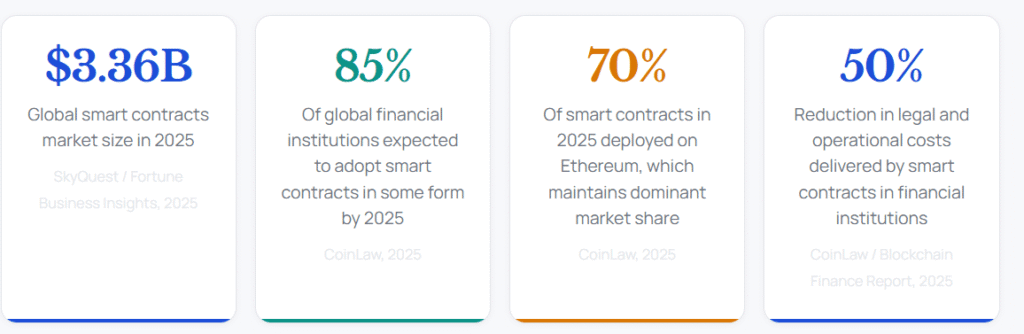
The global smart contracts market was valued at $3.36 billion in 2025 and is projected to reach $18.18 billion by 2033, growing at a 23.5% compound annual growth rate.
You might have been thinking or thought what actually powers a DeFi lending protocol, what made the NFT boom possible or how businesses could automate an international payment without writing money through correspondent banks-smart contract is the answer
This guide explains what they are, how they work, where they are already in use, and what their limitations are, so you can evaluate them with clear eyes.
Related Reads: Blockchain in health care: benefits and use cases, what is crypto mining and how does it work?
What Are Smart Contracts and Where Did They Come From?
A smart contract is a self-executing program stored on a blockchain that automatically enforces the terms of an agreement when predetermined conditions are met.
See it as: a vending machine encoded in software: you put the right input in, and the correct output comes out instantly, without anyone pressing a button on the other end.
The contract does not need a judge, a bank, or a compliance officer to check whether the rules were followed. The code does that.
The logic follows a simple if this, then that structure. If a buyer sends the agreed payment, then the property token is transferred to their wallet. If a flight is delayed beyond two hours, then the insurance payout is triggered automatically.
If a shipment is confirmed as delivered by a verified oracle, then the supplier invoice is settled.
The moment conditions are satisfied, execution happens and because it sits on a blockchain like Ethereum or Solana, that execution is transparent, immutable, and cannot be reversed by any single party.
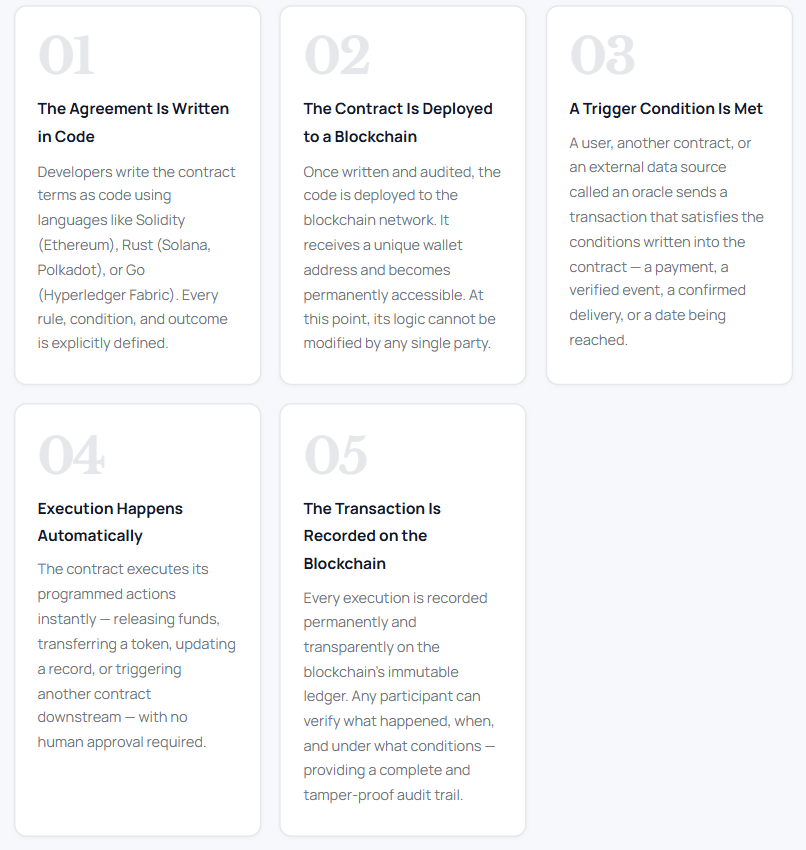
How Do Smart Contracts Actually Work Step by Step?
Knowing the mechanics removes most of the mystery. The process follows a consistent sequence regardless of which blockchain platform the contract runs on.
What Role Do Blockchain Oracles Play in Smart Contract Execution?
Blockchains themselves cannot access external data.
A smart contract on Ethereum has no native way to know whether a flight landed on time, whether a payment was received in a bank account, or what the current gold price is.
This is where blockchain oracles come in, they are data feeds that securely relay real-world information onto the chain, allowing contracts to react to events that happen outside the blockchain.
Chainlink is the dominant oracle network and currently secures over $24 billion in token value across more than 50 chains.
Without oracle infrastructure, smart contracts would be limited to on-chain interactions only powerful, but far less versatile.
Which Blockchain Platforms Support Smart Contracts
Ethereum invented the modern smart contract ecosystem, but it no longer operates alone. By 2025, a diverse range of platforms has emerged, each competing on different dimensions of speed, cost, developer tooling, and security.
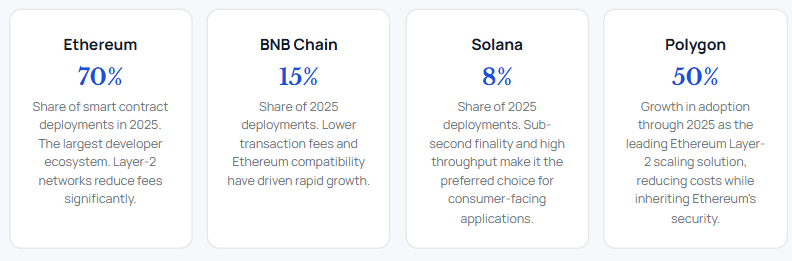
Enterprise settings often favour permissioned platforms like Hyperledger Fabric, which saw adoption grow by 20% in 2025, particularly in private finance where data confidentiality requirements make public blockchains unsuitable.
The key insight from 2025 is that smart contract infrastructure is no longer a single-chain story around 70% of new platforms are built with interoperability features to enable cross-chain collaboration.
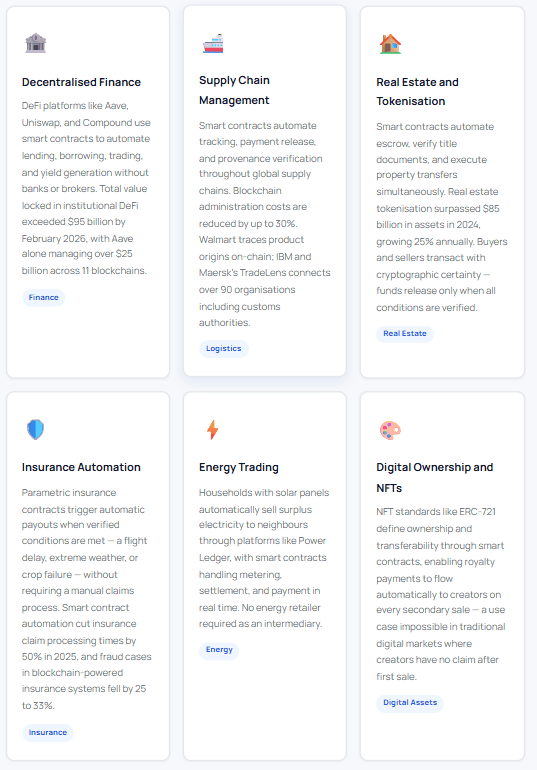
What Are the Real-World Use Cases for Smart Contracts
This is where smart contracts shift from interesting technology to genuinely transformative infrastructure.
The use cases have grown far beyond simple cryptocurrency transfers and now span financial services, logistics, healthcare, energy, and legal agreements.
How Are Smart Contracts Changing Cross-Border Payments?
This is one of the most practically impactful applications for businesses.
Smart contracts have reduced cross-border payment processing times by up to 80% from multiple business days to minutes by eliminating the correspondent banking chains that traditional SWIFT transfers rely on.
Blockchain-based contracts cut cross-border processing times by roughly 40% on average across all deployments, and financial institutions report a 62% improvement in scalability during high-demand periods when using blockchain-based systems.
For businesses accepting international payments through platforms like crypto payment gateways, this means real money saved on fees and time saved on settlement.
In late 2025, UniCredit demonstrated a tokenised structured note recorded on a public blockchain a concrete example of smart-contract-enabled financial issuance moving beyond pilot programmes into live production for institutional clients.
What Are the Risks and Limitations of Smart Contracts?
| Risk | What It Means in Practice | Severity | How to Mitigate |
| Code Vulnerabilities | Bugs in the contract code can be exploited by attackers. Once deployed, most contracts cannot be changed. Even small errors can result in permanent loss of funds. | High | Professional audits, formal verification, bug bounty programmes |
| Oracle Dependency | Contracts relying on external data are only as reliable as their oracle source. A manipulated or faulty oracle feed can cause incorrect execution. | Medium | Use decentralised oracle networks like Chainlink. Design fallback logic. |
| Immutability | The same feature that makes smart contracts tamper-resistant also makes them very hard to fix once deployed. A design flaw cannot simply be patched. | Medium | Upgradeable proxy patterns, staged deployments, thorough pre-launch testing |
| Regulatory Uncertainty | Legal recognition of smart contracts varies by jurisdiction. Enforceability in court is not guaranteed in all markets, particularly for complex agreements. | Medium | Pair code with traditional legal agreements. Seek jurisdiction-specific legal advice. |
| Network Fees and Congestion | High-traffic blockchains can experience elevated gas fees and slower confirmation times, making some use cases uneconomical during peak periods. | Lower | Use Layer-2 networks, batch transactions, design around fee-efficient patterns |
| Private Key Risk | If the wallet interacting with the contract is compromised through key loss or phishing, the attacker can execute transactions on the user’s behalf. | High | Hardware wallets, multi-signature authorisation, hardware security modules |
Key Benefits of Smart Contracts for Businesses?
- Save Money:
Smart contracts eliminate the need for intermediaries such as lawyers, escrow agents, brokers, and notaries. In financial services alone, they deliver up to 50% savings on legal and operational costs.
For supply chain deployments, businesses using smart contracts for end-to-end visibility reduce manual reconciliation costs by an average of 22%, and one US supply chain operator that implemented smart contracts cut operational costs by nearly 45% by eliminating paper-based processes entirely. - Improve Security and Reduce Fraud:
Because smart contracts execute automatically based on verified conditions rather than human approval, they remove the most common sources of fraud: manual document alteration, selective enforcement of terms, and corruption by intermediaries.
The blockchain ledger is immutable once a transaction is recorded, it cannot be changed by any party. Fraud cases in traditional finance environments integrated with blockchain fell by 12% in 2024.
Frequently Asked Questions
Can smart contracts be hacked?
Yes, but the risk has declined significantly.
What is the difference between a smart contract and a traditional contract?
A traditional contract is a legal document that describes terms and requires human beings — lawyers, courts, or enforcement bodies to verify compliance and execute outcomes.
A smart contract encodes those terms directly in code and executes automatically the moment conditions are met, with no possibility of selective enforcement or human error in the execution step.
Do I need to understand coding to use smart contracts as a business?
No. Most businesses interact with smart contracts indirectly through platforms and payment gateways that handle the technical layer.
Conclusion
As we wrap it up, moving from paperwork to digital logic isn’t just an upgrade, it is a complete overhaul of how we build trust.
By cutting out the middleman, smart contracts turn slow, complex agreements into instant, automated reality.
Take a look around. If you found this helpful, you’ll also like our guides on: Crypto volume analysis, factors behind the volatility of crypto market and many others on Ueex blog.