A crypto order book is a real-time digital ledger displayed on a cryptocurrency exchange that lists every active buy order (bid) and sell order (ask) for a specific trading pair, such as BTC/USDT.
When you tap Buy on a Bitcoin trade, an algorithm called a matching engine reads the live order book, finds a seller at the best available price, and executes the transaction in milliseconds.
Everything happening in that fraction of a second is driven by data that is visible to you right now on your trading screen if you know how to read it.
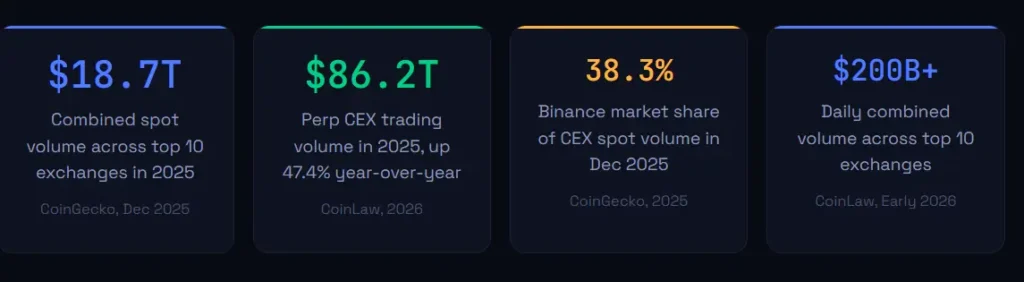
As at 2025, the top ten centralized crypto exchanges processed a combined $18.7 trillion in spot trading volume. Binance alone pushed $7.3 trillion through its matching engine.
Behind every one of those trades was an order book routing the interaction between buyer and seller. Knowing this mechanism is not optional for anyone serious about crypto trading, it is foundational.
Related Reads Top 5 Effective Crypto Technical Analysis Signals in 2026, Cryptocurrency Hedging Techniques
What Are the Key Components of a Crypto Order Book?
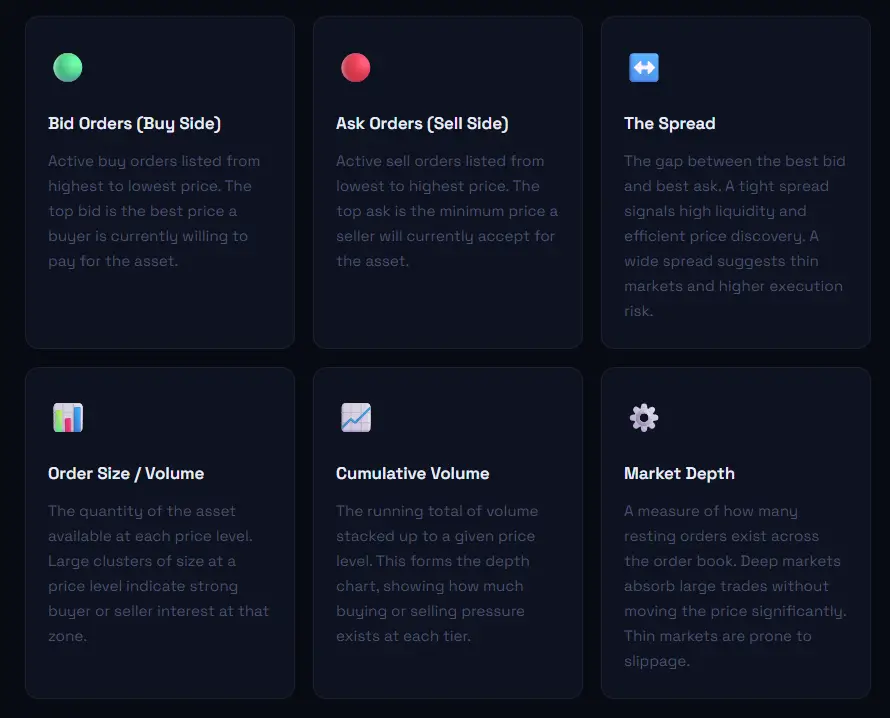
Before you can use an order book effectively, you need to know what each column and row is actually telling you. The layout varies slightly between exchanges, but the core components are universal.
What Does a Crypto Order Book Look Like in Practice?
Here is a simplified example of what a BTC/USDT order book might display on a major exchange. The ask side appears above the spread and the bid side below, though some platforms invert this layout.
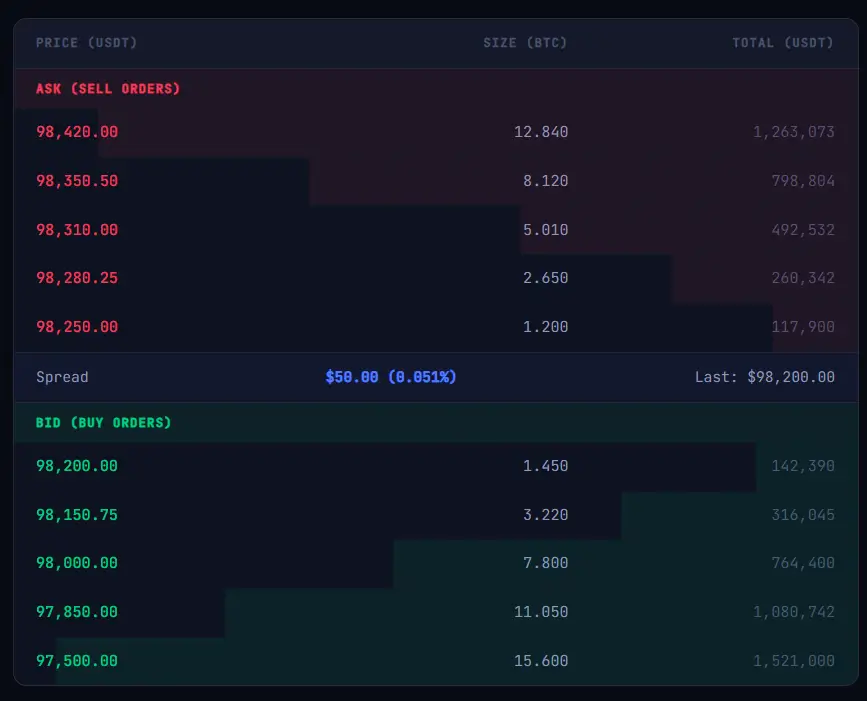
Notice the large cluster of buy orders stacking up at $97,500 and $97,850.
Traders interpret this kind of concentration as a potential support zone, a price level where significant demand may prevent further declines. Conversely, heavy sell-side clustering near $98,420 could act as short-term resistance.
What Is the Difference Between a Market Order and a Limit Order?
A market order executes immediately at the best available price in the order book. If you place a market buy for 5 BTC, the matching engine fills it against the cheapest available ask orders, first the ask at $98,250, then $98,280, then $98,310, and so on until your full order is satisfied.
If you are buying significant size in a thin market, each price level you exhaust pushes the execution price higher. This is called slippage, and it is one of the most expensive lessons traders learn.
A limit order, by contrast, rests in the order book at a price you specify. It only executes if the market price reaches your level.
A limit buy order placed at $97,500 simply joins the queue of bids at that price tier and waits. Limit orders add liquidity to the book. Market orders consume it.
This distinction is the basis of how exchanges classify makers (limit orders) and takers (market orders), and why maker fees are typically lower than taker fees on most platforms.
What Are Buy Walls and Sell Walls in the Order Book?
A buy wall is a very large bid order or cluster of bid orders at a specific price level, visible as an outsized block in the bid side of the order book.
It signals that a major participant often an institution or market maker is willing to absorb significant sell pressure at that price.
While buy walls can signal genuine support, sophisticated traders also watch for walls that disappear just before the price reaches them, a tactic called order spoofing, which regulators have increasingly targeted in 2025 under expanded market manipulation frameworks.
A sell wall is the mirror image: a large concentration of ask orders at a specific price that creates overhead resistance. When a sell wall is broken meaning market buy pressure absorbs all the supply at that level, it often triggers a rapid price move upward as the resistance clears.
How Do Different Types of Crypto Order Books Compare?
Not all order books are structured the same way. Different exchanges and trading environments use different models, each with distinct characteristics that affect liquidity, transparency, and execution quality.
| Type | Where Used | Liquidity Depth | Transparency | Best For |
| Standard L2 Order Book | Binance, Coinbase, UEEX | Deep | Full (aggregated by price) | Most retail and institutional traders |
| Level 3 (L3) Order Book | Coinbase, Bitso (native) | Deepest | Full (order-by-order) | HFT, algorithmic, and quant trading |
| Aggregated Order Book | Multi-exchange platforms | Cross-venue | Combined from multiple sources | Arbitrage detection, best execution |
| AMM (DEX) | Uniswap, Curve, Aerodrome | Pool-based | On-chain, transparent | DeFi users, long-tail tokens |
| Hybrid (CEX + AMM) | dYdX, Hyperliquid | Growing | Partial (off-chain matching) | Perp traders seeking decentralised execution |
It is worth noting that decentralised exchanges (DEXs) do not use traditional order books. Instead, they use Automated Market Maker (AMM) protocols, where prices are determined by a mathematical formula based on the ratio of assets in a liquidity pool.
DEX monthly volumes on platforms like Uniswap climbed to $86 billion in Q4 2025, but the order-book model remains dominant for large-cap liquid pairs on centralised exchanges.
Read Also: Quantitative Analysis of Cryptocurrency Markets
How Do You Read a Crypto Order Book as a Trader?
Reading an order book is a skill that takes practice, but the framework is straightforward.
Here is a step-by-step process for extracting meaningful information from the order book on any major exchange.
1. Identify the Best Bid and Best Ask
Start at the top of each side. The best bid is the highest price any buyer is currently willing to pay. The best ask is the lowest price any seller will accept.
The gap between them is the spread, and its width tells you immediately how liquid this market is. A spread below 0.05% on a major pair like BTC/USDT indicates excellent liquidity.
2. Scan for Large Volume Clusters
Scroll down the bid side and look for price levels where the order size is significantly larger than the surrounding levels.
These clusters often act as support zones because substantial buy interest needs to be absorbed before the price can fall through. Apply the same logic to the ask side for resistance identification.
3. Assess Market Depth Before Placing Large Orders
Before executing a substantial position, calculate how deep the book runs at your target price.
If you want to buy 10 BTC and the order book only shows 3 BTC available within a 0.1% price range, your market order will push through multiple price levels.
Splitting your order into smaller limit orders placed across multiple price levels is usually the better strategy.
4. Watch Order Flow in Real Time
The order book is not a static photograph, it is a live video. Watch how quickly large orders appear and disappear.
Sustained large bids that hold their ground even as the price approaches them suggest genuine demand. Orders that vanish before the price arrives warrant scepticism.
5. Cross-Reference With Trade History
Most exchanges display a trade tape alongside the order book, a chronological list of recently executed trades.
If you see large buy orders appearing in the book while the trade tape simultaneously shows large sells hitting bids, the two signals are telling contradictory stories.
Reconciling them helps you build a more accurate picture of true market sentiment.
“Whenever the price of cryptocurrency is rallying, people start spending a lot more,”
—Shapeshift’s founder Erik Voorhees
Which Exchanges Have the Deepest Order Book Liquidity
Liquidity is not evenly distributed across the crypto market, and where you trade matters enormously for execution quality.
A 2025 CoinGecko liquidity report analysing eight major exchanges found significant differences in depth even for major pairs like BTC/USDT and ETH/USDT.
Binance led BTC liquidity across all depth levels in 2025, holding approximately $8 million in depth on both bid and ask sides within a $100 price range of the market price.
Also Read: Top 8 Volume Indicators for Traders
For Ethereum, Bitget overtook Binance as the liquidity leader within the tightest price range, though Binance reasserted dominance at wider depths.
For XRP, liquidity was concentrated on Bitget, Binance, and Coinbase, which together controlled about 67% of the available market depth.
For traders executing large orders anything above $50,000 to $100,000 in notional value choosing an exchange with deeper market depth is not a preference but a financial necessity.
A thin order book means your market order eats through multiple price levels, producing an average execution price worse than the quoted price.
This cost is called price impact, and it is invisible to traders who do not study order book depth before trading.
Risks of Relying Solely on Order Book Data
While order book analysis can provide valuable insights, it’s important to recognize its limitations:
Fake Orders: Spoofing or wash trading can distort the true picture of market sentiment, leading traders to make decisions based on false data.
Read Also: How to Do On-Chain Analysis and Why It Gives You a Real Edge?
Flash Crashes: Rapid, unexpected price movements can cause a sudden influx of market orders, making it difficult to rely solely on the order book for decision-making.
Algorithmic Trading: High-frequency trading bots can execute trades faster than human traders, creating artificial movements in the order book that can mislead manual traders.
Note that the reliability of crypto order books varies depending on the platform or exchange you choose, as well as your specific trading strategy. It’s essential to recognize that while order books can offer valuable insights, crypto trading inherently involves risk.
However, order books are one tool among many to help guide trading decisions. To make well-informed choices, it’s recommended to complement the data from order books with other resources, such as technical analysis and market trends.
“The reliability of an order book is influenced by the reputation, liquidity, and security measures of the exchange hosting it. Always ensure you are using a trustworthy platform to mitigate risks.”
Conclusion
In the trading world, people love to say, The trend is your friend but if you really want the unfiltered truth, you have to look at the order book.
Most retail traders get stuck chasing lagging candles and old news, but the pros know better.
Read Also: Best Crypto Exchanges in Albania (2026)
They’re busy decoding the crypto order book to figure out exactly where the big institutions are putting their money.
At the end of the day, it’s about seeing where the real weight is leaning before the rest of the market catches on.