Cryptographic principles are the engine room of every cryptocurrency you have ever used, every wallet you have ever created, and every transaction ever recorded on a blockchain.
We’re stripping away the jargon to show you how crypto actually works. From the math behind hash functions to the privacy of zero-knowledge proofs, this guide breaks down exactly how your assets stay secure.
You’ll walk away finally feeling confident about the tech keeping your wallet safe.
Those numbers show just how much of the world’s financial infrastructure now rests on a foundation of cryptography.
Knowing cryptographic principles is no longer just for computer scientists.
It is essential knowledge for every investor, developer, and business owner who operates in the digital asset space.
What Are Cryptographic Principles and Why They Are Important in Crypto?
At its simplest, cryptography is the science of securing information using mathematical algorithms so that only intended parties can read, verify, or act on it.
In the context of blockchain and cryptocurrency, cryptographic principles solve three critical problems simultaneously: proving you own something without exposing a password, ensuring data cannot be tampered with after being written, and verifying identities without a central authority.
Before blockchain existed, trust in financial systems required banks, governments, and third-party intermediaries.
Cryptography replaced that centralized trust with mathematical certainty.
Bitcoin’s creator, Satoshi Nakamoto, combined existing cryptographic principles in a novel way in 2008 to create a system where peer-to-peer value transfer is possible without any institution standing in the middle.
How Do Cryptographic Hash Functions Keep the Blockchain Immutable?
A cryptographic hash function is perhaps the most fundamental building block of blockchain technology.
It takes any input, whether that is a single character or an entire library of text, and converts it into a fixed-length string of characters called a hash or digest.
The process is one-directional: you cannot reverse-engineer the original input from the hash.
What Makes a Hash Function Cryptographically Secure?
A secure hash function must satisfy three non-negotiable properties. First, it must be collision resistant, meaning it is computationally impossible to find two different inputs that produce the same hash.
Second, it must be preimage resistant, so you cannot work backwards from a hash to discover what input created it.
Third, it must exhibit avalanche behavior: changing even one character in the input produces a completely different hash output.
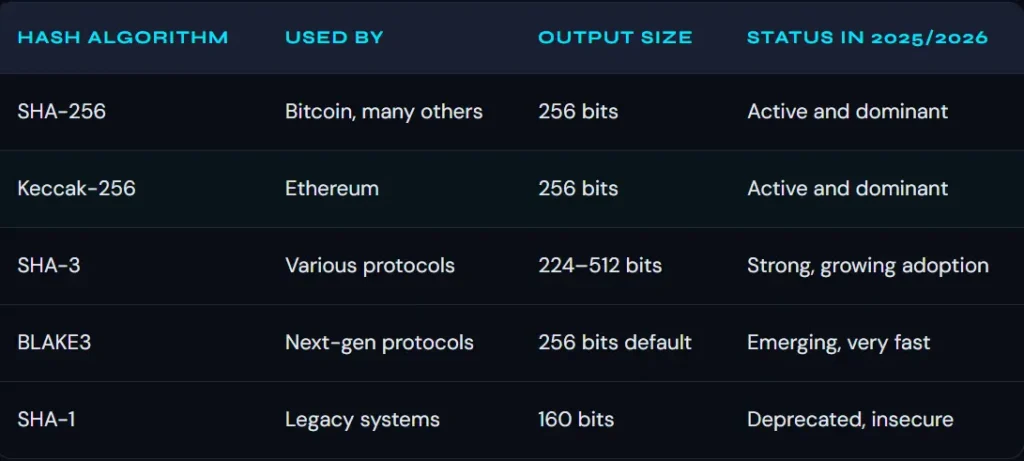
Bitcoin uses SHA-256 (Secure Hash Algorithm 256-bit), standardized by the US National Institute of Standards and Technology (NIST) in 2001.
Every Bitcoin block header is hashed using SHA-256 twice, a technique called double-SHA-256, adding an extra layer of security. Ethereum uses the Keccak-256 algorithm, a variant of the SHA-3 family.
Why Does This Make Blockchain Tamper-Proof?
Each block in a blockchain contains the hash of the previous block.
This creates a cryptographic chain. If someone tries to alter even one transaction in a past block, the hash of that block changes completely, which invalidates every block that came after it.
Rewriting a blockchain block means recomputing the proof of work for that block and every subsequent block, a task that would require more computational power than the entire honest network combined.
This is why the Bitcoin blockchain, now over 700GB in size, remains an essentially immutable ledger.
What Is Public-Key Cryptography and How Does It Secure Your Crypto Wallet?
Public-key cryptography, also called asymmetric cryptography, is the mechanism that allows you to receive cryptocurrency from strangers without trusting them and to send cryptocurrency without revealing your secret credentials. It is the reason your crypto wallet works the way it does.
How Does the Public and Private Key System Work?
The system generates a mathematically linked pair of keys. Your private key is a randomly generated secret number, typically a 256-bit integer in Bitcoin and Ethereum.
It must never be shared with anyone. From that private key, a corresponding public key is derived through a mathematical process called elliptic curve multiplication.
The relationship is one-way: knowing the public key does not allow anyone to compute the private key.
Your public key is then processed through hash functions to produce your wallet address, the string of characters you share with others to receive funds.
See your wallet address like a bank account number (safe to share) and your private key like your PIN (never share under any circumstances).
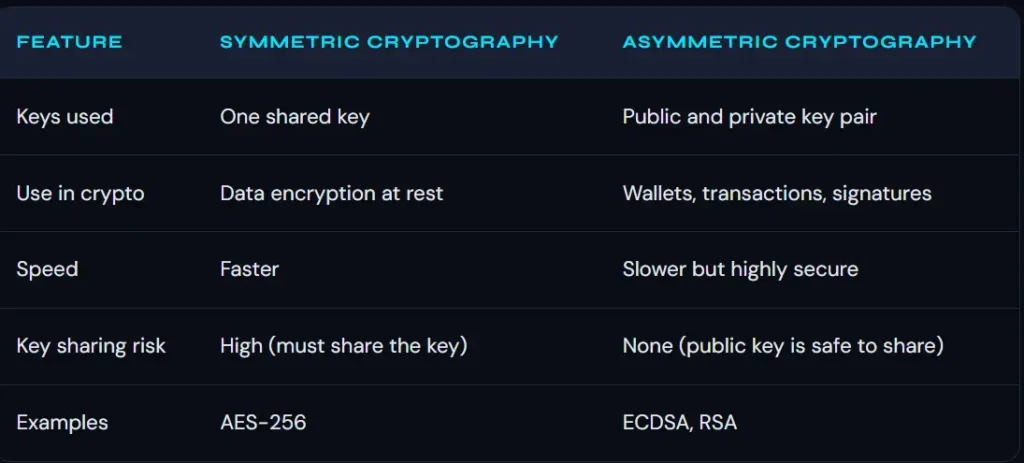
What Is the Difference Between Symmetric and Asymmetric Cryptography?
What Is Elliptic Curve Cryptography and Why Does Crypto Use It?
Bitcoin and Ethereum both use Elliptic Curve Cryptography (ECC), specifically a curve called secp256k1.
ECC provides the same level of security as older algorithms like RSA but with dramatically smaller key sizes.
A 256-bit ECC key offers roughly equivalent security to a 3,072-bit RSA key. Smaller keys mean faster operations, lower bandwidth usage, and more efficient block processing.
For a global blockchain network processing millions of transactions daily, that efficiency matters enormously.
The security of ECC is grounded in the Elliptic Curve Discrete Logarithm Problem (ECDLP): given a point on an elliptic curve, it is computationally infeasible to determine the scalar that produced it.
No classical computer in 2025 or 2026 can solve this in any practical timeframe.
Join UEEx
Experience the World’s Leading Digital Wealth Management Platform
What Are Digital Signatures and How Do They Authorize Crypto Transactions?
When you send cryptocurrency from your wallet, you are not physically doing anything. You are creating a digital signature, a cryptographic proof that you authorized the transfer.
This is how the blockchain network knows a transaction is legitimate without you needing to reveal your private key.
By doing this, they prevent fraud and maintain the integrity of the blockchain. Think of it like having a group of friends double-checking each other’s work to make sure everything is correct.
How Does the ECDSA Signing Process Work?
Bitcoin and Ethereum rely on ECDSA (Elliptic Curve Digital Signature Algorithm) to authorize transactions. Here is the flow in plain terms.
First, your wallet software creates a hash of the transaction data, including the recipient address, amount, and fee.
Second, your private key and a randomly generated number are used to produce a unique signature from that hash.
Third, the signature is broadcast alongside the transaction to the network.
Finally, any node on the network can use your public key to verify that the signature is valid without ever knowing your private key.
A digital signature is bound to both the specific transaction data and your private key.
If a malicious actor tries to alter the transaction amount or recipient address, the signature immediately becomes invalid. This is the cryptographic principle of data integrity in action.
What Are Merkle Trees and How Do They Enable Efficient Transaction Verification?
A Merkle tree is a data structure that organizes all transactions in a block into a binary tree of hashes. Each leaf node is the hash of a transaction.
Each parent node is the hash of its two children. At the very top sits the Merkle root, a single hash that represents every transaction in the block.
The Merkle root is stored in the block header. This structure allows Simplified Payment Verification (SPV), enabling a wallet or lightweight node to verify that a specific transaction is included in a block without downloading the entire blockchain.
Instead of verifying thousands of transactions, a node only needs a small Merkle proof, a path of hashes from the transaction to the root.
On Ethereum, which processed a record 2.88 million transactions in a single day in January 2026, this efficiency is essential.
How Do Zero-Knowledge Proofs Take Cryptographic Privacy to the Next Level?
Zero-knowledge proofs (ZKPs) represent one of the most exciting applications of advanced cryptographic principles in the crypto space.
A ZKP allows one party (the prover) to mathematically demonstrate to another party (the verifier) that they know specific information, without revealing the information itself.
What Real-World Problems Do Zero-Knowledge Proofs Solve?
In traditional finance, proving you have enough funds for a loan requires revealing your entire financial history.
With zero-knowledge proofs, you can prove you meet a threshold without disclosing the exact amount. In blockchain, ZKPs are being used to build privacy-preserving transactions, scalable rollups, and trustless identity verification systems.
Projects like Zcash use zk-SNARKs (Zero-Knowledge Succinct Non-Interactive Arguments of Knowledge) to enable fully private transactions.
Ethereum’s Layer 2 ecosystem uses zk-Rollups to batch thousands of transactions off-chain and submit a single cryptographic proof on-chain, dramatically reducing costs and increasing throughput.
How Do Cryptographic Principles Protect Smart Contracts on Ethereum?
Smart contracts are self-executing programs stored on the blockchain. They automate agreements between parties without intermediaries.
Ethereum’s smart contracts use cryptographic principles in multiple layers simultaneously to protect both the code and the users interacting with it.
What Security Mechanisms Do Smart Contracts Use?
Every smart contract interaction is signed with ECDSA, tying the action to a specific wallet.
The bytecode of a deployed contract is hashed and stored on-chain, so any attempt to alter the contract code changes its hash and can be detected immediately.
Access control within contracts often relies on cryptographic checks, such as verifying that the calling address matches a stored owner address.
Modern DeFi protocols also incorporate multi-signature (multisig) schemes, requiring multiple private keys to authorize high-value operations, reducing single points of failure.
Join UEEx
Experience the World’s Leading Digital Wealth Management Platform
How Do The Principles Apply to Real-World Crypto Use Cases?
Abstract mathematics becomes tangible when you see cryptographic principles applied across real-world scenarios. Here are some of the most significant applications that touch everyday crypto users.
1. Crypto Wallets and Key Management
Every crypto wallet is fundamentally a key management system.
The wallet software generates and stores your private key, derives your public key and address, and signs transactions on your behalf.
Knowing how your crypto wallet works is the foundation of responsible asset management.
2. Decentralized Finance and DeFi Protocols
DeFi protocols like lending platforms, decentralized exchanges (DEXs), and yield farms operate entirely on cryptographic smart contracts.
When you provide liquidity or take a loan, cryptographic principles enforce every rule of the agreement without human intervention or counterparty risk.
3. Cross-Chain Bridges and Interoperability
Secure cross-chain bridges use cryptographic attestations and threshold signature schemes to lock assets on one chain and mint equivalent tokens on another.
Knowing the cryptographic assumptions behind a bridge is essential for assessing its security profile before bridging significant value.
4. NFTs and Digital Ownership
Non-fungible tokens derive their ownership guarantees from the same public-key cryptography used in cryptocurrency.
An NFT is owned by whoever controls the private key of the wallet holding it. Transferring an NFT is a cryptographically signed transaction, just like any other blockchain operation.
What Are the Most Important Security Practices Built on Cryptographic Principles?
Never Share Your Private Key or Seed Phrase
Use Hardware Wallets for Cold Storage
Verify Addresses Cryptographically Before Sending
Prefer Multi-Signature Schemes for Business Wallets
Putting Cryptographic Principles to Work: What This Means for You
Cryptographic principles are not abstract academic concepts. They are the living infrastructure of an industry worth hundreds of billions of dollars.
Every Bitcoin transaction, every Ethereum smart contract, every DeFi protocol, and every NFT you have ever interacted with owes its security to the elegant mathematics of hash functions, elliptic curves, and digital signatures.
In 2026, as the blockchain market expands past $47 billion and adoption reaches more than half a billion users globally, the importance of understanding these foundations only grows.
Frequently Asked Questions
What is the difference between a public key and a wallet address
Your public key is derived from your private key via elliptic curve mathematics.
Your wallet address is derived from your public key by applying one or more hash functions to it. The extra hashing step adds a layer of security
How does SHA-256 make Bitcoin secure?
SHA-256 hashes block headers, links blocks together in a tamper-evident chain, and powers the Proof of Work mining puzzle.
Conclusion
Knowing these core principles, you are not just watching the market you’re understanding the very DNA of financial freedom.
The tech might be complex, but the result is simple: your assets are yours, and the math has your back.
Adekusibe Ogunmokun is a content strategist, web developer and SEO specialist. He has varying experience in self-publishing, blogging, ghostwriting, and content marketing for solopreneurs. You can find him talking about storytelling, design and marketing strategies. Otherwise, he will probably be watching the latest exciting series.
Disclaimer: This article is intended solely for informational purposes and should not be considered trading or investment advice. Nothing herein should be construed as financial, legal, or tax advice. Trading or investing in cryptocurrencies carries a considerable risk of financial loss. Always conduct due diligence before making any trading or investment decisions.
Trade with proof of Reserves
UEEx publish monthly audits and third party verification on every listed market.