Anyone searching for 10 must-know crypto investment tips deserves more than a generic list recycled from 2025.
Bitcoin surged past $126,000 in 2025 before retracing. The total crypto market cap briefly touched $4.4 trillion, a new record before closing the year at $3 trillion.
Stablecoins hit a new all-time high market cap of $311 billion. Institutional investors poured at least $49.7 billion into digital asset treasury strategies.
And yet, 2025 was also the year when the old four-year halving cycle broke down, macro forces dominated price action, and individual investors who chased momentum without a plan suffered avoidable losses.
The first step in your investment journey should always be education. Cryptocurrency and blockchain technology are revolutionary but complex, so taking the time to learn the basics can make a significant difference. Ensure to get a solid understanding of what blockchain is and how it works.
Learn about different cryptocurrencies, while Bitcoin might be the most well-known, thousands of cryptocurrencies exist, each with unique features and uses.
Explore beyond the headlines to understand the diversity of the crypto world.
In addition, look for resources from established financial news sites, educational platforms, and reputable crypto communities. Join forums, attend webinars, and connect with experienced investors to hear different perspectives.
Remember, the more you know, the better equipped you’ll be to make informed decisions. Investing time in your crypto education will pay dividends in your investment journey.
Foundation
02. Only Ever Invest What You Can Genuinely Afford to Lose
This is not a disclaimer, it is the most important rule in digital asset investing. Bitcoin fell over 6% across 2025 as a whole year while Gold rose over 62% in the same period.
The market can move violently against you at any time, and unlike a bank deposit, there is no insurance scheme protecting your crypto holdings.
As a beginner, it’s advisable to start small. Invest an amount you can afford to lose without it affecting your financial stability.
This approach not only minimizes your risk but also allows you to learn and understand the market dynamics without the stress of potentially losing a significant amount of money.
Financial professionals consistently recommend treating crypto as a high-risk, high-reward slice of a broader portfolio, typically 1 to 10% of your total investable assets.
Starting within that range means a major market correction hurts your portfolio without devastating your finances. Exceeding it means a bad month becomes a personal crisis.
Strategy
03. Use Dollar-Cost Averaging to Remove Timing Risk
Dollar-cost averaging (DCA) means investing a fixed amount at regular intervals regardless of price — for example, putting £100 into Bitcoin every week.
When the price is high, your money buys fewer coins. When it is low, it buys more.
Over time, this smooths out your average purchase price and eliminates the psychological pressure of trying to predict the market’s next move.
DCA is particularly powerful in crypto, where 20% daily swings are entirely normal.
Investors who set up automatic weekly purchases during 2023 and held through 2025 built positions at prices well below the peak, giving them meaningful returns even after the late-2025 correction.
The strategy requires no special skill only consistency and patience.
04. Do Your Own Research (DYOR)
With the plethora of cryptocurrencies available, it’s crucial to conduct thorough research before deciding to invest in a particular cryptocurrency.
Doing your own research involves understanding the project behind the cryptocurrency, its use case, the team behind it, and its market potential.
Here’s a checklist of what to look for when researching a cryptocurrency:
Project: What problem does the project aim to solve? Is there a need for this project in the market?
Team: Who are the people behind the project? Do they have a track record of success in the crypto or tech industry?
Use Case: Does the cryptocurrency have a real-world use case? Is it being used or adopted by businesses or consumers?
Tokenomics: How is the cryptocurrency structured? Is there a maximum supply? How are new coins created and distributed?
Community: Is there an active community supporting the project? A strong community can be a good indicator of a project’s legitimacy and potential for growth.
Whitepaper: The whitepaper is the project’s blueprint. It should provide detailed information about the project’s concept, implementation, and technical aspects.
Strategy
05. Diversify Intelligently — Quality Over Quantity
Diversification in crypto does not mean holding 50 different tokens.
It means spreading your capital across high-quality assets in different categories: the store-of-value layer (Bitcoin), the smart-contract layer (Ethereum), high-performance Layer-1 alternatives (Solana), and a liquidity buffer of stablecoins.
Institutional portfolios in 2025 allocated around 60 to 70% to Bitcoin and Ethereum combined, 20 to 30% to large-cap altcoins and DeFi tokens, and 5 to 10% to stablecoins.
Avoid the temptation to chase coins trending on social media.
True diversification provides meaningful exposure to the ecosystem’s growth while limiting the damage when any single asset collapses and some altcoins do collapse entirely.
Protection
06. Never Invest Based on Social Media Hype or Influencer Calls
This is where the majority of avoidable losses happen. Meme coins, politically themed tokens, and influencer-promoted projects tend to spike rapidly on social media attention and crash just as fast when the attention moves on.
In 2025, politically themed crypto tokens despite massive media coverage were held by approximately 1% of crypto owners, proof that hype does not translate to sustainable value.
A credible investment has a real use case, an identifiable and experienced development team, genuine transaction volume, and a growing community of actual users not just followers.
Before putting money into any new asset, ask yourself whether you can explain clearly what problem it solves and why people will use it in three years.
Strategy
07. Review and Rebalance Your Portfolio on a Regular Schedule
Crypto portfolios drift significantly from their original allocations during strong market moves.
An asset that started at 10% of your portfolio can become 40% after a major rally, concentrating your risk in ways you never intended.
Setting a quarterly rebalancing schedule, selling portions of your outperformers and buying more of your underallocated positions keeps your risk profile consistent and forces you to take profits mechanically rather than emotionally.
Dynamic rebalancing strategies have been shown to outperform static portfolio strategies in crypto, improving both return stability and volatility control.
You do not need to trade daily to manage a crypto portfolio well; you need to check in deliberately and systematically.
Advanced
08. Learn to Read On-Chain Data to Understand What the Market Is Actually Doing
On-chain data, information pulled directly from the blockchain gives you a view of the market that price charts alone cannot provide.
Key metrics include the number of long-term holders (69% of Bitcoin’s supply was held by long-term holders in 2025, signalling strong conviction), exchange inflows and outflows (coins moving to exchanges signal selling pressure), and network transaction volume (a proxy for real-world utility).
Free tools such as Glassnode, CryptoQuant, and Dune Analytics make this data accessible without technical expertise.
When on-chain data shows long-term holders accumulating while prices are depressed, it is often an early signal of a market recovery.
Price charts show you what happened; on-chain data helps you understand why.
Foundation
09. Transact and Receive Payments Through Regulated, Reliable Platforms
Whether you are an individual or a business, where and how you transact matters enormously.
Regulated platforms offer consumer protection, transparent fee structures, clear legal standing, and the security infrastructure needed to operate at scale.
For businesses looking to accept cryptocurrency payments which offer lower fees, faster settlement, and no chargeback risk compared to traditional card processing using a purpose-built crypto payment gateway like UPay provides all these protections in one place.
Protection
10. Understand Taxes
In many countries, cryptocurrencies are considered taxable assets. This means that you may need to pay taxes on any profits you make from your cryptocurrency investments.
The exact tax rules can vary greatly by country. Some countries treat cryptocurrencies like property, while others treat them as currency. Some even consider cryptocurrencies as legal tender.
In the UK, HMRC treats crypto as a capital asset, every disposal, including swapping one token for another, spending crypto, or gifting it, is a taxable event that may trigger Capital Gains Tax.
In the US, the IRS treats crypto as property, with similar implications. Holding an asset for more than 12 months before disposal typically qualifies for lower long-term capital gains rates in both jurisdictions.
Using tools such as Koinly or CoinLedger to automatically track every transaction makes reporting significantly less painful.
Join UEEx
Experience the World’s Leading Digital Wealth Management Platform
Patience is a virtue, especially in the volatile world of cryptocurrency investing. The market is known for its rapid fluctuations, which can be both a source of opportunity and a test of endurance.
Having realistic expectations and a patient mindset is key to navigating this dynamic environment successfully.
Cryptocurrency has the potential for high returns, but it’s important to remember that these outcomes often take time. Short-term market movements can be unpredictable and influenced by various factors, including regulatory news, market sentiment, and technological advancements.
Instead of seeking quick wins, focus on the long-term potential of your investments.
This approach requires understanding the projects you’ve invested in and believing in their value proposition and growth over time.
It’s also crucial to set realistic goals based on your risk tolerance and investment strategy. Not every investment will yield massive returns, and losses are a natural part of the investment process.
By acknowledging this and sticking to your investment plan, you can maintain a level head through market ups and downs.
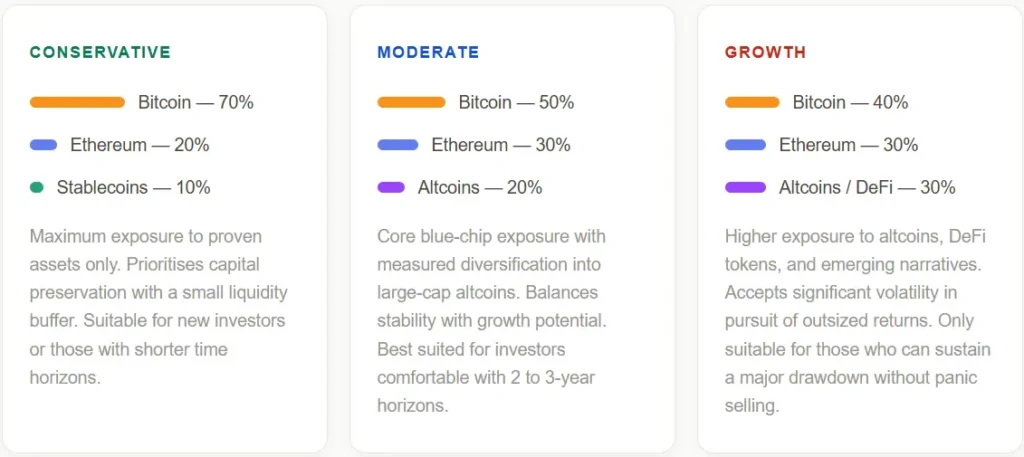
What Portfolio Allocation Model Should You Use for Crypto
There is no universally correct allocation, but the following three frameworks offer structured starting points based on your risk tolerance and investment horizon.
All three are actively used by institutional and sophisticated retail investors
What Are the Biggest Crypto Investment Mistakes to Avoid
Mistake
Why It Is Costly
What to Do Instead
Trying to time the market
Even professional fund managers consistently fail to call crypto tops and bottoms.
Most who try end up buying high and selling low under emotional pressure.
Use dollar-cost averaging and commit to a regular investment schedule regardless of price.
Investing borrowed money
Leverage amplifies losses as much as gains. A 50% drawdown wipes out a leveraged position entirely, leaving debt behind with nothing to show for it.
Only invest capital you own outright and can afford to have locked up for 2 to 3 years.
Leaving holdings on exchanges long-term
Exchange hacks, insolvencies, and withdrawal freezes have cost users billions. Bybit lost $1.46 billion in a single 2025 breach.
Move long-term savings to a self-custody hardware wallet you control.
Chasing meme coins and hype projects
These assets are designed to transfer wealth from late buyers to early insiders and influencers.
The vast majority go to zero within 12 months.
Allocate to assets with demonstrated utility, real transaction volume, and strong developer activity.
Ignoring tax obligations
Many investors do not realise that swapping one crypto for another is a taxable disposal.
HMRC and the IRS both audit crypto portfolios using blockchain analytics.
Use automated crypto tax software from day one and maintain complete records of every transaction.
Panic selling during drawdowns
The investors who sold Bitcoin during the 2022 bear market at $15,000 missed the rally to $126,000 in 2025. Short-term pain often precedes long-term recovery in established assets.
The investors who sold Bitcoin during the 2022 bear market at $15,000 missed the rally to $126,000 in 2025. Short-term pain often precedes long-term recovery in established assets.
Join UEEx
Experience the World’s Leading Digital Wealth Management Platform
How much should a beginner invest in cryptocurrency?
Financial professionals consistently recommend starting with 1 to 5% of your total investable portfolio. This gives you meaningful exposure to the asset class without concentrating risk beyond what most people can emotionally and financially sustain.
Is Bitcoin still worth investing?
Bitcoin remains the largest, most liquid, and most institutionally held digital asset, with approximately 69% of its supply held by long-term holders as of 2025, signalling strong conviction among experienced investors.
Conclusion
Look, if you’re content with your portfolio being a playground for institutional smart money that poured $49.7 billion into the space last year, then keep ignoring these 11 must-know crypto investment tips.
With close to 5 years of experience, Oluwatosin has honed his skills as an SEO content writer, editor, and content marketing manager. He has written articles, conducted extensive research, and managed projects for clients in the Tech, Finance, Web3, Real Estate, E-commerce, Education, and Health industries. His expertise extends to content optimization, content re-purposing, keyword research, competitor analysis and web content management.
Disclaimer: This article is intended solely for informational purposes and should not be considered trading or investment advice. Nothing herein should be construed as financial, legal, or tax advice. Trading or investing in cryptocurrencies carries a considerable risk of financial loss. Always conduct due diligence before making any trading or investment decisions.
Trade with proof of Reserves
UEEx publish monthly audits and third party verification on every listed market.