Bitcoin halving is one of the most anticipated events in the entire cryptocurrency calendar, a pre-programmed moment when the reward miners earn for adding new blocks to the blockchain is cut in half, permanently tightening Bitcoin’s supply
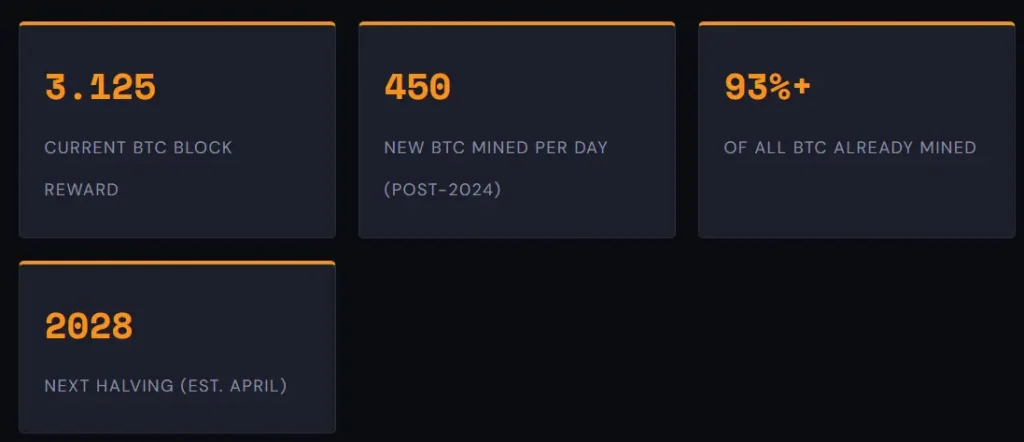
The most recent halving happened on April 19, 2024, and the next one is already on the horizon for April 2028.
If you want to understand why Bitcoin is called digital gold, the halving mechanism is where that story begins.
Related Reads: How to read stock market charts? Best strategies to protect yourself against crypto scams.
Key Takeaways:
- Bitcoin Halving and How It Works
- How Does the Bitcoin Mining Reward System Actually Work?
- The Complete History of Every Bitcoin Halving Event
- What Should Investors Expect From the Next Bitcoin Halving in 2028?
- The Significance of Bitcoin Halving
What Exactly Is Bitcoin Halving and How Does It Work?
At its core, Bitcoin is governed by a strict set of rules baked directly into its open-source code — and the halving is one of the most important of those rules.
Roughly every four years, or more precisely every 210,000 blocks mined, the reward granted to Bitcoin miners for validating transactions is automatically slashed by 50%.
When Bitcoin launched in January 2009, miners received 50 BTC for every block they added to the blockchain.
That seems generous, but Satoshi Nakamoto, Bitcoin’s pseudonymous creator, built this decreasing supply schedule deliberately, mimicking the scarcity of finite commodities like gold.
The total supply of Bitcoin will never exceed 21 million coins, and the halving is the mechanism that enforces that promise.
How Does the Bitcoin Mining Reward System Actually Work?
Miners compete to solve complex cryptographic puzzles using powerful hardware.
The first miner to solve the puzzle earns the right to add the next block of transactions to the Bitcoin blockchain and collects the block reward, a fixed number of newly created BTC, plus any transaction fees attached to that block.
This is known as proof-of-work (PoW) consensus. The halving reduces the newly created BTC component by 50%, making the new supply progressively scarcer over time.
Recommended reading: Bitcoin Halving Chart 2024: Key Highlight and Insights
What Is the Complete History of Every Bitcoin Halving Event?
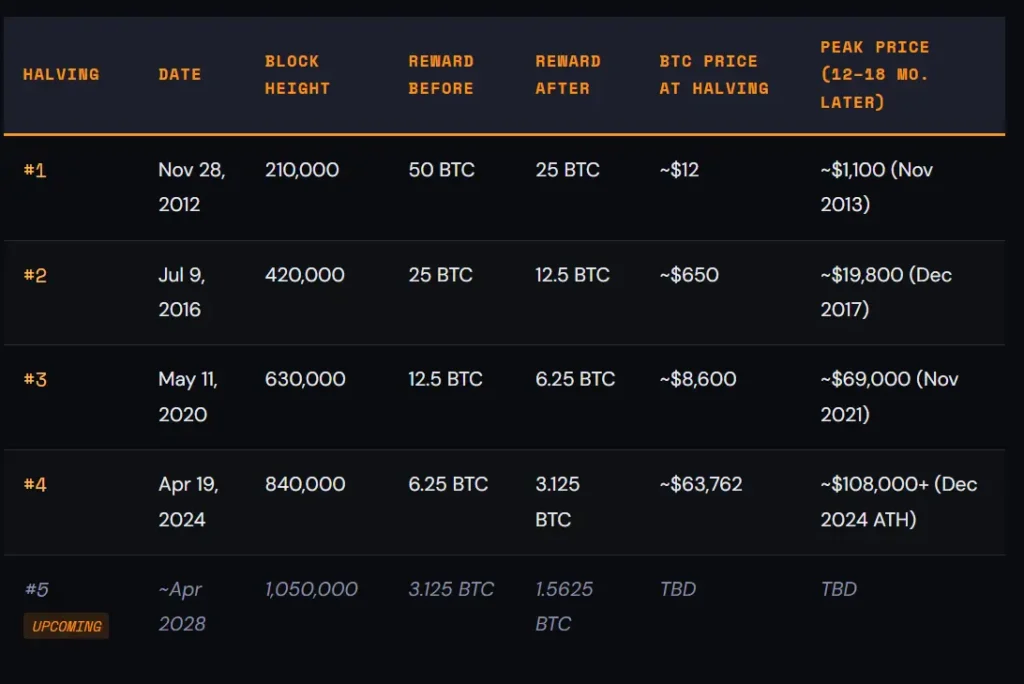
Four Bitcoin halvings have taken place since the genesis block was mined in January 2009. Each one has reshaped miner economics, market sentiment, and historically Bitcoin’s long-term price trajectory.
What Happened After the First Halving in 2012?
The 2012 halving is often called the proof of concept halving. Bitcoin was trading at just $12 when block 210,000 was mined by SlushPool. Many early adopters barely noticed.
But within a year, the price had surged past $1,100, a gain of over 9,000%.
The crypto market was tiny and illiquid then, so enormous percentage swings were common, but the directional principle was established: reduce supply, and prices can climb dramatically.
What Happened After the 2016 Halving?
The second halving at block 420,000 in July 2016 was more widely anticipated. Bitcoin was already a recognized asset, and exchanges like Coinbase, Bitstamp, and Kraken were operational.
The immediate post-halving reaction was muted, but the bull run that followed was not.
By December 2017, Bitcoin had reached nearly $20,000, a gain of over 2,100% from the halving price. This cycle cemented the halving as a major market-moving event in the public consciousness.
The immediate post-halving reaction was muted, but the bull run that followed was not.
By December 2017, Bitcoin had reached nearly $20,000, a gain of over 2,100% from the halving price. This cycle cemented the halving as a major market-moving event in the public consciousness.
What Happened After the 2020 Halving?
The third halving in May 2020 took place against the backdrop of a global pandemic.
Bitcoin initially dipped before recovering, and then spent the remainder of 2020 and 2021 in one of the most powerful bull runs in crypto history.
By November 2021, Bitcoin hit an all-time high of approximately $69,000 over 700% above the halving price of around $8,600.
This cycle introduced significant institutional participation, with companies like MicroStrategy and Tesla adding Bitcoin to their balance sheets.
What Actually Happened With the 2024 Bitcoin Halving?
The fourth halving occurred on April 19, 2024, at block height 840,000.
It was the most-watched halving in Bitcoin’s history, partly because of a major structural difference in the market: the approval of spot Bitcoin ETFs in the United States just months earlier in January 2024.
Bitcoin was trading at approximately $63,762 on the halving day.
The immediate price reaction was relatively calm compared to past cycles, which some analysts attributed to the fact that institutional investors had already been pricing in the event for months. However, the broader cycle was anything but quiet.
What Should Investors Expect From the Next Bitcoin Halving in 2028?
The fifth Bitcoin halving is projected to occur around April 2028 at block height 1,050,000. When it arrives, the block reward will drop from 3.125 BTC to just 1.5625 BTC per block.
By that point, less than 5% of the total Bitcoin supply will remain to be mined, and over 98% of all Bitcoin will have already been created.
Several structural shifts will define the 2028 cycle differently from anything that came before.
Bitcoin ETFs, which did not exist in the 2020 cycle, will have been operating for four full years by 2028, potentially with far deeper AUM and more sophisticated institutional participation.
Government-level discussions around Bitcoin strategic reserves, with proposals already active in the United States as of 2025, could introduce sovereign-level demand that dwarfs anything the market has previously processed.
And Bitcoin’s growing status as a recognized alternative asset class means the next halving will take place in a very different macro environment than any previous one.
Why Does Bitcoin Halving Create Scarcity and Why Does That Matter?
programmatic scarcity. Unlike fiat currencies, which central banks can print in unlimited quantities, Bitcoin’s total supply is mathematically capped at 21 million coins.
As of 2025, over 93% of all Bitcoin has already been mined, leaving fewer than 1.5 million BTC left to be created, and it will take until approximately 2140 to mine those remaining coins due to the halving schedule.
Each halving reduces the annual inflation rate of Bitcoin. After the 2024 halving, Bitcoin’s annual supply inflation dropped below 1%, lower than gold’s estimated annual supply growth rate of 1.5–2%.
Does Bitcoin Halving Always Lead to a Price Increase?
This is the question every investor asks, and the honest answer requires nuance. Historically, every Bitcoin halving has been followed by a significant price rally within 12 to 18 months.
The correlation is clear across all four halving events.
However, correlation is not causation, and the magnitude of post-halving gains has declined with each cycle as Bitcoin’s market capitalization grows larger and harder to move.
Academic research published in 2025 using synthetic control methodology found that the 2024 halving positively affected Bitcoin’s price, with the estimated halving impact accounting for roughly one-fifth of Bitcoin’s total price growth over the 17-month study period.
This suggests the halving itself is a meaningful but not singularly dominant apst driver.
The Significance of Bitcoin Halving
There are several reasons why Bitcoin halvings are considered by many to be good for Bitcoin’s ecosystem and market value.
However, some might not see it as such a good thing. Let’s look at some effects Bitcoin halving may have:
1. Inflation Control
Bitcoin halving plays a crucial role in managing inflation within the Bitcoin ecosystem.
By cutting the rate at which new bitcoins are introduced, halving ensures that the total supply grows at a predictable and decreasing pace.
This mechanism prevents excessive inflation, which could devalue the currency due to an oversupply of new coins. Unlike fiat currencies, where central banks can print money at will, Bitcoin’s controlled supply model is a key element of its value proposition as “digital gold.”
For instance, the 2020 halving event lowered Bitcoin’s annual inflation rate from approximately 3.6% to 1.8%, marking a significant step in its deflationary design.
Likewise, following the April 2024 Bitcoin halving, the digital asset inflation rate dropped to 0.84%, substantially lower than the current US inflation rate of 3.4%, and the annual inflation rate of gold, which ranges between 1% and 3%.
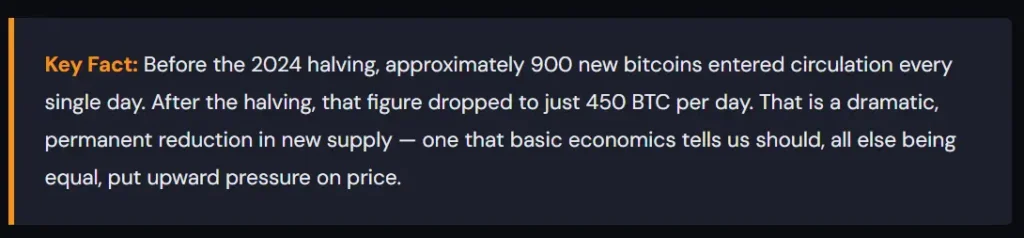
The halving reduced the block reward from 6.25 BTC to 3.125 BTC, decreasing Bitcoin’s issuance rate.
With approximately 450 BTC mined daily, this halving tightens market supply and could potentially increase Bitcoin’s value over time.
2. Long-Term Economic Sustainability
Halving events also contribute to Bitcoin’s long-term economic sustainability.
The system is designed to gradually transition from a high-inflation phase, where miners rely heavily on block rewards, to a low-inflation phase where transaction fees sustain network security.
This gradual reduction in the rate of new Bitcoin creation ensures that the network remains economically viable even as the total supply approaches its cap of 21 million bitcoins, expected to be fully mined by around 2140.
3. Increases Value
Each Bitcoin halving reduces the block reward miners receive by 50%, which directly increases Bitcoin’s scarcity.
As fewer bitcoins are introduced into circulation over time, this scarcity effect strengthens Bitcoin’s perception as a store of value.
This artificial scarcity is a key factor in its valuation, echoing the supply and demand principles that drive the value of precious metals.
For example, after the 2020 halving, the reduced issuance rate contributed to a significant price surge in late 2020 and early 2021, as investors recognized the increased scarcity and perceived value.
The 2024 halving is expected to further enhance Bitcoin’s scarcity, potentially driving its value higher as fewer new bitcoins are mined.
4. Market Sentiment
Bitcoin halving events are highly anticipated within the crypto community and often generate significant market sentiment.
Investors and traders closely watch these events because they have historically been followed by substantial increases in Bitcoin’s price.
The anticipation of reduced supply can lead to speculative investments and contribute to price volatility both before and after the halving.
This psychological impact is a unique aspect of Bitcoin’s market dynamics, influencing both short-term trading and long-term holding strategies.
5. Network Security and Miner Incentives
While the reduction in block rewards might initially seem detrimental to miners’ revenue, it ultimately encourages more efficient mining operations and technological advancements.
As block rewards decrease, miners are incentivized to innovate and find more cost-effective solutions, which can enhance the overall security of the Bitcoin network.
Additionally, transaction fees, which will increasingly constitute a larger percentage of miners’ revenue, help align miners’ interests with those of network users, maintaining a balance between supply and security.
Recommended reading: Bitcoin Technical Analysis: A Comprehensive Guide
Is it advisable to buy Bitcoin During a Halving?
Many investors place high expectations on Bitcoin halvings, as historically, prices have tended to rise following these events.
However, these upward trends have typically unfolded gradually, taking months or even years to materialize, and there is no guarantee that Bitcoin will follow the same pattern in the future.
Whether you choose to invest in Bitcoin before, during, or after a halving should depend on the market conditions at the time, your personal outlook, and your risk tolerance.
For example, the most recent halving was distinct in that Spot Bitcoin ETFs were approved by the U.S. Securities and Exchange Commission (SEC) just a few months prior to the event.
This led investors and speculators to flock to these new exchange-traded funds (ETFs), with some even reallocating capital from previously popular Bitcoin ETF Trusts.
However, one month after the halving, the market experienced another shift, resulting in a price drop.
At the beginning of May, the ETFs saw significant outflows, which were followed by comparable inflows later in the month as market optimism shifted towards Ether ETFs and Bitcoin’s price began to climb.
Given these unpredictable market dynamics, it seems that, at least for now, predicting what the market will do remains a challenge and investors can only make educated guesses.
Recommended reading: Different Types of Crypto Mining Methods
Conclusion
The bitcoin halving isn’t just a technical update; it’s a psychological ticking clock for everyone holding fiat currency.
You can either ignore the cycle and hope the rules of supply and demand don’t apply this time, or you can recognize that scarcity is the only thing that separates digital gold from digital clutter.