Crypto scams took more money from people last year than ever before. According to Chainalysis, illicit crypto addresses received at least $154 billion in 2025, and the FBI says Americans alone lost more than $11.4 billion to crypto fraud.
The hardest part isn’t the technology; it’s that scammers now use AI voices, fake video calls, and months of patient conversation to earn your trust before they ever ask for a dollar.
Do your research isn’t bad advice, but it’s too vague to help you when a scammer already knows exactly what to say to you.
This guide breaks down every major type of crypto scam active in 2026, with the warning signs for each one. By the end, you’ll have a simple system (we call it SHIELD) that you can run through before sending crypto to anyone, for any reason.
Read Also: Quick tips on how to convert crypto to cash.
Why Crypto Scams Are Getting Worse in 2026
According to Chainalysis, illicit crypto addresses received tens of billions of dollars in recent years, with scam revenues continuing to scale rapidly as automation tools proliferate.
Coupled with the rise of AI, Chainalysis found that scams using AI tools generated 4.5 times more revenue per operation than scams without them and reported that impersonation scams grew by roughly 1,400% year-over-year.
Crypto is attractive to scammers for a simple reason: once you send it, it’s gone. There’s no bank to call, no chargeback, and no undo button.
Meanwhile, older adults remain the biggest target by dollar amount. The FBI’s Internet Crime Complaint Center (IC3) reported that elder fraud accounts for a major portion of total losses, with Americans over 60 losing billions annually to investment and romance-related crypto schemes.
Scammers exploit the same handful of emotions every time: greed, fear, urgency, and loneliness. The technology changes every year. The psychology behind it almost never does.
That’s the real story behind the statistics. The tools are new but the tricks are old.
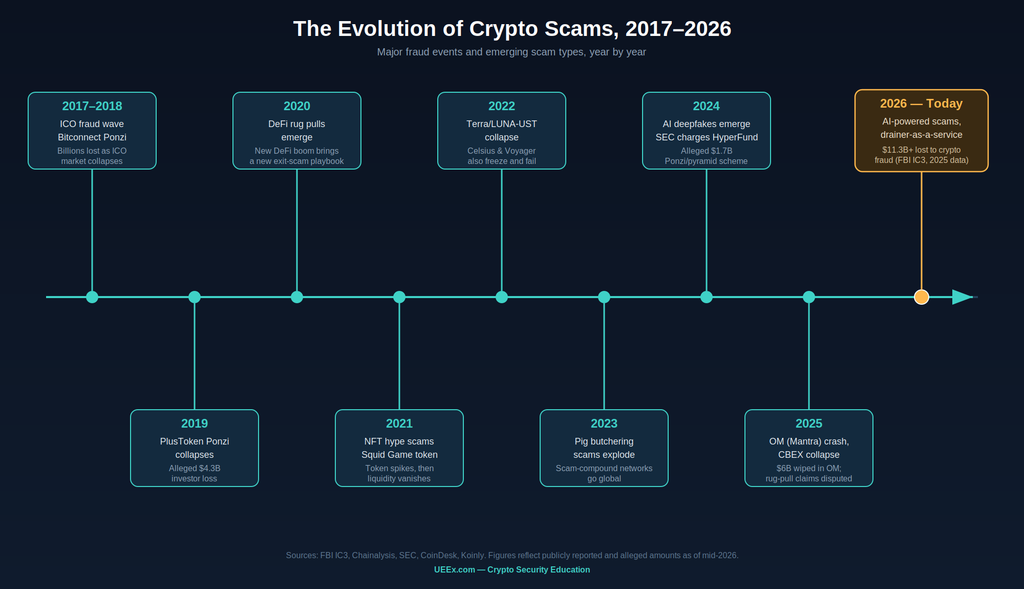
A Quick History of Crypto Fraud
- 2017–2020: Fake token sales (ICOs) and old-fashioned Ponzi schemes, like Bitconnect and OneCoin, promised huge guaranteed returns and collapsed.
- 2021–2022: DeFi rug pulls and NFT scams exploded alongside the crypto bull market.
- 2023–2025: Pig butchering scams, run out of forced-labor compounds in Southeast Asia, became the single biggest source of losses.
- 2026: AI deepfakes, wallet-draining tools sold as ready-made kits, and crypto ATM fraud are now the fastest-growing threats.
The Psychology Scammers Use Against You
Before we get into the different scam types, it helps to understand why smart, careful people still fall for them.
Scammers use a handful of pressure tactics over and over:
- Urgency: You get pressured with a message like This offer ends in 24 hours.
- Authority: Pretending to be the IRS, your bank, or a well-known exchange’s support team.
- Social proof: Fake reviews, fake testimonials, and bots in Telegram groups all agreeing the platform is legit.
- Loneliness and connection: Long, patient relationship-building before any money is mentioned.
- Greed and FOMO: The fear that everyone else is getting rich except you.
Once you can name these tactics, they lose most of their power. That’s the whole point of this guide.
Read Also: Digital Cash: The Race to Replace Physical Money (2026)
The Main Types of Crypto Scams You Need to Know
1. Investment and Financial Scams
| Scam | Key Red Flags | Protection |
| Pig Butchering | Early crypto talk from online/dating contacts; pressure to use WhatsApp. | Never send crypto to online-only contacts; demand live video. |
| Ponzi Schemes | Guaranteed returns; bonuses for recruiting new people. | Walk away if they can’t simply explain where profits come from. |
| HYIPs | Unrealistic daily/weekly returns (e.g., 1-2% daily); heavy private chat promotion. | Check website age (WHOIS); avoid platforms promising impossible yields. |
| Fake ICOs | Copied whitepapers; unconfirmed celebrity backers. | Verify partnerships on official channels; check whitepapers for originality. |
| Pump-and-Dump | Sudden hype without real news; token supply hoarded by a few wallets. | Use blockchain explorers to check token holder distribution. |
| DeFi Rug Pulls | Unverified audits; unlocked liquidity; easy to buy but impossible to sell. | Verify smart contracts; ensure liquidity is locked before buying. |
2. Social Engineering & Phishing
| Scam | Key Red Flags | Protection |
| Phishing | Misspelled URLs; urgent demands; requests for your seed phrase. | Bookmark official sites; verify sender domains; never share seed phrases. |
| Fake Support | Unsolicited DMs offering help; requests for screen shares or keys. | Use official help forms only; ignore unsolicited support messages. |
| Impersonation | “Giveaways” asking you to send crypto first; slightly altered usernames. | Check verification badges/account age; never pay to receive a giveaway. |
| AI Deepfakes | Lip-sync issues; urgent financial requests via video or audio call. | Set up a private family/coworker code word; verify via a second channel. |
| Job Scams | Upfront fees for training/equipment; chat-only interviews. | Never pay to get hired; research the employer independently. |
| Romance Scams | Sudden requests for emergency funds; consistent excuses to avoid video calls. | Reverse image search profile photos; beware of inconsistent life details. |
3. Platform & Technology Scams
| Scam | Key Red Flags | Protection |
| Fake Exchanges | Unregistered platforms; withdrawal fees; overly consistent gains. | Test with small withdrawals first; check financial regulator advisories. |
| Fake Wallet Apps | Few reviews for “major” brands; unexpected seed phrase prompts. | Download only from official App/Play stores; double-check developer names. |
| Malicious Extensions | Broad permissions requested; wallet addresses change when pasted. | Check permissions carefully; verify addresses character-by-character. |
| Crypto Drainers | Unexpected tokens prompting external site visits; broad transaction permissions. | Review transaction details before signing; regularly revoke unused approvals. |
| Compromised Code | (Devs) Urgent registry lock emails; typosquatted packages. | Verify package authors; use official registries; avoid email login links. |
4. Specialized & Emerging Scams
| Scam | Key Red Flags | Protection |
| Crypto ATMs | Urgent calls from “government/banks” instructing ATM deposits. | Hang up and call official numbers; real agencies never use crypto ATMs. |
| Ransomware | Locked/encrypted files demanding crypto payment to unlock. | Keep offline backups; update software regularly; do not pay the ransom. |
| Address Poisoning | Tiny unexpected transactions; look-alike addresses in your history. | Verify the full address before sending; use a saved address book instead of copying history. |
Read also: Beyond the Hype: Why Is Bitcoin So Expensive?
Tools You Can Use to Verify Before You Invest
- Blockchain explorers: Etherscan and BscScan let you check whether a smart contract’s code is verified and see its actual functions.
- Regulator databases: FinCEN’s Money Services Business registry and the CFTC’s advisory pages list warnings about unregistered platforms.
- Audit firms: Reputable smart contract auditors like CertiK, Trail of Bits, and OpenZeppelin publish audit reports you can search for directly.
- Approval management: Revoke.cash lets you see and cancel token approvals you no longer need.
- Community due diligence: Search Reddit and independent forums for a project’s name alongside the word “scam” before you invest.
The SHIELD Framework: A Simple System for Checking Any Crypto Opportunity
Instead of memorizing every crypto scam type above, use this framework before any decision involving a new project, platform, or person.
Think of it as a checklist. One failed step means proceeding with caution. Two or more failed steps mean walk away.
S – Scrutinize the Source: Look up the team. Are they real people with a genuine, verifiable work history, or stock photos and vague first names? Check how old the website and social accounts are; scam sites are often only a few months old.
H – Heed the Hype: Be suspicious of aggressive marketing, countdown timers, and “limited spots.” No legitimate investment needs to pressure you into acting within 24 hours.
I – Investigate Independently: Don’t take the project’s word for anything. Check independent sources: audit firms, blockchain explorers, community discussion on Reddit, and a simple Google search for “[project name] scam.”
E – Examine the Economics: Ask a basic question: if there were no new investors tomorrow, how would this project actually make money? If the honest answer is “it wouldn’t,” that’s a Ponzi structure, not an investment.
L – Limit Your Exposure: Never invest more than you can afford to lose completely. Test new platforms with a small amount first. Keep the bulk of your holdings in a separate, secure wallet.
D – Demand Transparency: Real projects are open about their team, their code, and their audits. If a team is cagey, evasive, or refuses to answer direct questions, that’s your answer.
Conclusion
An old maritime warning says, “A false lighthouse destroys more ships than any storm.”
That is precisely how crypto scams work. They don’t batter down your defenses; they guide you onto the rocks using manufactured trust, pixel-perfect AI deepfakes, and artificial urgency.
Defending your assets doesn’t require outsmarting every new line of malicious code. It requires a single, stubborn habit: forcing a pause.
Verify every address through official channels, treat unsolicited messages as toxic, and keep your seed phrase completely offline.
On an immutable ledger where transactions cannot be reversed, healthy suspicion isn’t paranoia your ultimate security protocol.