A honeypot crypto scam is a fraudulent scheme built around a manipulated smart contract that allows investors to buy a token but prevents them from ever selling it or withdrawing their funds. The contract appears legitimate – often with real liquidity, active trading, and a polished project presence – but contains hidden logic that permanently locks buyer assets while permitting the scammer to drain the pool at will. These scams exploit the open, permissionless nature of DeFi to trap investors who cannot distinguish a rigged contract from a genuine one without technical examination. As of 2026, an estimated $17 billion was stolen through crypto scams and fraud – a record – with DeFi honeypot contracts accounting for a significant share of volume, particularly among retail investors who rarely inspect contract code before transacting.
What Is a Honeypot Crypto Scam?
Source: Freepik
The term “honeypot” comes from cybersecurity, where it describes a decoy system designed to lure attackers. In crypto, the concept is inverted: the scammer builds the trap, and ordinary investors are the ones drawn in. The token or project looks attractive – a compelling narrative, a sharp price pump driven by coordinated buying, and aggressive promotion across social media. But the smart contract at the center of it has been written specifically to ensure that buyers cannot exit.
Honeypots are primarily deployed on Ethereum and BNB Smart Chain because both support permissionless token creation at low cost. Anyone can write and deploy a smart contract on these chains without oversight or review – exactly the environment honeypot operators exploit. In 2026, impersonation-based crypto scams grew by 1,400% year over year, showing how rapidly these schemes are scaling alongside broader market growth.
How Does a Honeypot Scam Work?
Source: Napkin
The mechanics follow a consistent pattern across projects, even when the surface details change.
The scammer writes a smart contract with a hidden restriction. The most basic version uses a blacklist: as soon as a wallet buys the token, it is added to a list that the sell function checks. Any wallet on that blacklist is blocked from executing a sale. The buyer cannot see this because the blacklist is populated dynamically after purchase, not before.
Other technical methods include:
- Balance manipulation: The contract secretly alters the token balance shown to buyers, making it appear they hold more tokens than they can actually move.
- Transfer restrictions: The contract permits transfers only to specific addresses controlled by the scammer, blocking all sales to external buyers.
- Hidden fee logic: Sell transactions trigger fees of 100% or near-100%, making exit economically impossible even if technically permitted.
- Ownership traps: The contract owner retains exclusive rights to unlock trading – a function they never exercise for ordinary buyers.
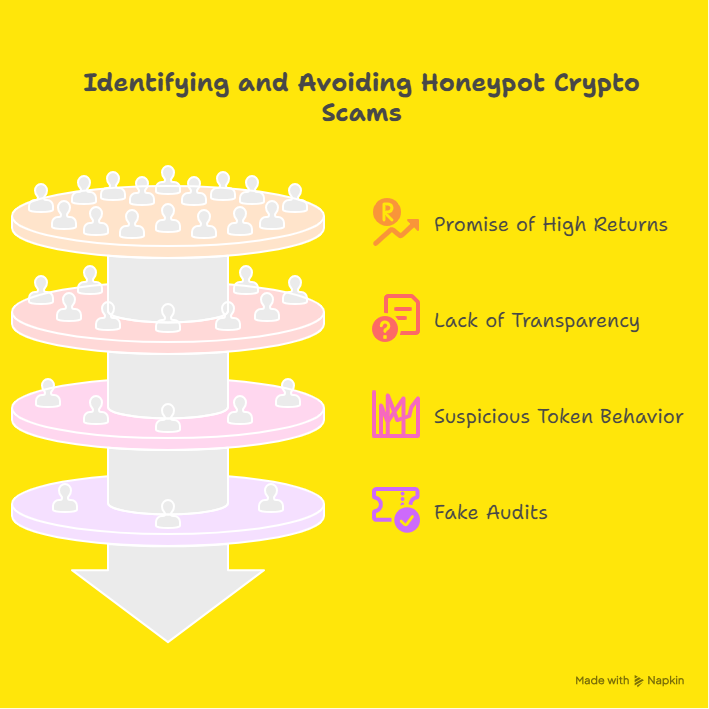
After deploying the contract, the operator markets the token aggressively using paid influencers, fake Telegram communities, fabricated audit reports, and coordinated buy pressure to create the appearance of a legitimate market. Once enough retail capital is locked in, the operator executes a liquidity drain – withdrawing all underlying funds from the pool. The token price collapses to zero, and victims cannot sell.
What Are Real-World Examples of Honeypot Scams?
| Project | Year | Mechanism | Estimated Loss |
| Squid Game Token | 2021 | Contract blocked selling for most holders; operators drained liquidity at peak price | ~$3.3 million |
| AnubisDAO | 2021 | Liquidity pool drained within hours of launch via a compromised deployer wallet | ~$60 million |
| PoodleCoin | 2021 | Ownership restrictions prevented token sales after purchase | Undisclosed |
| Multi-scam campaign (Telegram) | February 2024 | Single actor ran at least nine separate honeypot schemes via paid Telegram promotion | ~$3.2 million |
| Mass deployment campaign | 2024 | One threat actor deployed 979 honeypot contracts in a two-month window | Multiple smaller losses totalling significant volume |
Volume compensates for smaller per-contract losses when operating at scale. At 979 contracts over two months, even modest per-contract gains accumulate into substantial totals – and the operator bears minimal technical overhead once the contract template is established.
What Red Flags Identify a Honeypot Before You Buy?
Source: Freepik
Most honeypots display recognisable warning signs for anyone who knows where to look. The difficulty is that new investors rarely look in the right places when excitement runs high.
Price behaviour is often the first indicator. Honeypot tokens typically show sharp, rapid price increases with almost no sell pressure – because the sell function is disabled or effectively blocked. Normal tokens show two-way price movement as buyers and sellers interact. A token that shows only green candles in a short window, with no meaningful pullbacks, warrants serious scrutiny.
Additional red flags to check before buying any new token:
- Anonymous or unverifiable team with no public LinkedIn, GitHub, or conference presence
- No independent smart contract audit from a recognised firm, or a fabricated audit certificate
- Vague or plagiarised whitepaper with no technical implementation detail
- Liquidity pool too small or too new to sustain the claimed trading volume
- Token not listed on any reputable centralised exchange
- Significant buy tax / sell tax asymmetry (e.g., 1% to buy, 25%+ to sell)
- No sell orders visible in the DEX transaction history – only buys
- Community entirely composed of new accounts with no posting history
- Promises of guaranteed returns or “risk-free” investment
How Do You Check a Smart Contract for Honeypot Code?
Direct contract inspection before you buy is the most reliable protection. This does not require developer skills – several free tools make the check accessible to any user.
Honeypot.io simulates both buy and sell transactions against a contract address and returns a clear pass or fail result within seconds. Enter the token contract address for Ethereum or BNB Smart Chain, and the tool tells you immediately whether the sell function is blocked.
TokenSniffer runs an automated safety check and assigns a risk score based on factors it detects, including honeypot patterns, copy-paste code from known scams, and excessive owner privileges. As of 2026, TokenSniffer has flagged nearly 300,000 scam tokens across over 2.2 million analysed contracts.
DEXTools integrates a built-in Honeypot Checker alongside its charting interface. When browsing a trading pair, you can sort transaction history to see whether any sell orders exist at all – a token showing only buy-side transactions is a strong honeypot signal.
GoPlus Security offers a Honeypot Checker API used by multiple wallets and trading platforms for real-time on-chain analysis. Featured by CoinGecko in 2024, GoPlus checks honeypot risk, rug-pull probability, and contract owner privileges in a single call.
Etherscan and BscScan let you read verified contract source code directly. Key checks: Is the contract verified? If not, the source code is hidden – itself a red flag. Does the contract include an owner function that can disable trading or change fees? Is there a blacklist mapping in the transfer logic?
Running these checks takes under five minutes and is more informative than any marketing material the project publishes.
How Do Scammers Promote Honeypot Tokens?
Promotion is as important as the technical trap. A well-built honeypot still fails if nobody buys the token. Scammers have developed a consistent playbook for driving purchase volume.
Paid influencer promotion is common and effective. Crypto influencers with large YouTube, Twitter, or TikTok followings are paid to endorse tokens – sometimes with disclosure, often without. The association with a recognisable name creates false credibility among followers who assume the influencer has vetted the project.
Fabricated audit reports have grown more sophisticated. Operators copy the branding of reputable security firms like CertiK or Hacken and produce fake certificates claiming the contract has been reviewed and cleared. Without checking the audit firm’s own website directly, the report can appear legitimate.
Telegram and Discord manipulation uses fake accounts to fill community channels with enthusiastic buyer testimonials, fabricated profit screenshots, and artificially high member counts. This social proof convinces newcomers that the project is already succeeding – when in reality the activity is coordinated by the operator.
How Does a Honeypot Differ From a Rug Pull?
Both are exit scams, but they operate through different mechanisms.
| Feature | Honeypot | Rug Pull |
| Exit mechanism | Smart contract blocks buyer from selling | Team dumps tokens or withdraws liquidity |
| Technical trap | Yes – embedded in contract code from deployment | No – the exploit is economic, not structural |
| Detection tool | Honeypot.is, TokenSniffer, DEXTools checker | Token distribution analysis, LP lock verification |
| Timing of loss | Buyers are trapped immediately on purchase | Team exits at a chosen moment post-hype |
| Can you sell? | No – contract prevents it | Yes, but by the time you try, the price has collapsed |
A rug pull typically involves a legitimate-looking project where the team holds large token allocations or liquidity. They hype the project, wait for price appreciation, then sell their holdings or drain the liquidity pool in a single transaction. Technically, any holder could sell – the scam is in the distribution and timing, not in the contract mechanics. A honeypot specifically uses code to prevent buyer exits from the start. The technical barrier is the defining characteristic.
What Should You Do If You Suspect You Are in a Honeypot?
If you have bought a token and cannot sell it, move quickly:
- Try selling a very small amount first to confirm whether the restriction is complete or only partial.
- Check the contract on Honeypot or Etherscan to identify the mechanism blocking your exit.
- Report the contract address to the blockchain’s security community – BSCScan and Etherscan both have token flagging tools that warn future users.
- Document everything: transaction hashes, the contract address, any communications with project accounts, and screenshots of the project’s social media presence.
- File a report with relevant authorities. In the US, the FBI’s Internet Crime Complaint Center (IC3) accepts crypto fraud reports. Europol and equivalent agencies in other jurisdictions do as well. While fund recovery is rarely possible, reports contribute to ongoing investigations and help build cases against serial operators.
Do not invest additional funds trying to average down, and do not wait for the contract owner to “open selling.” In a genuine honeypot, that never happens. Accept the loss, cut exposure, and move on.
Frequently Asked Questions About Honeypot Crypto Scams
What makes a crypto token a honeypot?
A token is a honeypot when its smart contract is coded to allow purchases but block sales or withdrawals for ordinary buyers. The restriction is embedded in the contract’s transfer or sell logic and is invisible to buyers who do not read the code directly. The token may look and trade like any other asset right up until you try to exit – at which point the restriction becomes apparent.
Can honeypot contracts be found on major blockchains like Ethereum?
Yes. Honeypot contracts are most common on Ethereum and BNB Smart Chain because both support permissionless token creation with low costs and no prior review requirement. One documented case from 2024 showed a single threat actor deploying 979 honeypot contracts across these networks within a two-month window, demonstrating how rapidly they can be produced at scale by a single operator.
Is it possible to recover funds lost to a honeypot scam?
Recovery is extremely rare. Once funds are trapped in a honeypot contract and the operator drains the liquidity pool, the money is effectively gone. Blockchain transactions are irreversible by design. Blockchain analytics firms like Chainalysis assist law enforcement in tracing stolen funds, and a small number of high-profile cases have resulted in partial recovery – but these are the exception. Prevention through pre-purchase contract checks is the only reliable protection.
How long do honeypot scams typically run before collapsing?
Most honeypots collapse within days to weeks of launch. The operator’s goal is to accumulate as much buy-side capital as possible before draining the pool, so there is no incentive to sustain the illusion long-term. Some more elaborate schemes run for months, using fake partnership announcements and roadmap updates to maintain buying pressure, but the underlying contract mechanics remain the same throughout.
Does using a hardware wallet protect you from honeypot scams?
A hardware wallet protects your private keys but does not protect you from the economic consequences of buying into a fraudulent token. If you authorise a transaction to purchase a honeypot token, the hardware wallet signs that transaction just as it would any other. The protection against honeypots comes from researching and verifying the contract before you buy – not from the custody device you use to sign transactions.
Are honeypot scams illegal?
Yes, in most jurisdictions. Deploying a smart contract specifically designed to defraud investors constitutes fraud, and in many countries, wire fraud as well. The pseudonymous nature of blockchain makes attribution and prosecution difficult, but law enforcement agencies, including the FBI and Europol, have successfully prosecuted crypto fraud cases. The global, decentralised nature of DeFi means many operators remain beyond reach, which is why prevention matters more than expecting enforcement.
Practical Tips to Avoid Honeypot Crypto Scams
- Run every new token through Honeypot.is before buying.The tool simulates a sell transaction and returns a clear pass/fail result in seconds. It takes less time than reading any whitepaper and is more informative than any marketing material.
- Check DEXTools transaction history for sell orders. If you can only see buy transactions and zero sells from other wallets, stop. That pattern is a strong honeypot signal regardless of what the project claims.
- Verify the contract on Etherscan or BscScan.Unverified contracts hide their source code. Any project that has not verified its contract on a public explorer should be treated as high-risk by default.
- Compare buy tax and sell tax explicitly. A buy tax of 1% with a sell tax of 25% or higher is a clear signal that exiting will be costly or impossible. Check tax parameters in the contract or via TokenSniffer before committing funds.
- Confirm whether the liquidity pool is locked. Tools like Team.Finance and Unicrypt show whether LP tokens are locked for a defined period. Unlocked liquidity can be withdrawn by the deployer at any moment – that is the core mechanism behind both rug pulls and many honeypot exits.
- Search the contract address on Twitter and Reddit before buying. Scam contracts often have prior reports from earlier victims, particularly when the operator has reused wallet addresses across multiple projects.
- Treat influencer promotion as a flag to investigate further, not a buy signal. Paid promotion disclosures are inconsistent, and many influencers promote tokens for fees without reviewing the underlying contract at all.
- For significant positions, use established exchanges. Platforms like UEEx, Binance, and Coinbase vet listed tokens. New tokens appearing only on DEXs, with no centralised listing, have passed no third-party review process.