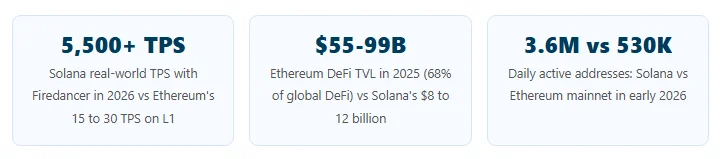
Ethereum leads on institutional capital depth ($55 to 99 billion in DeFi TVL, 68% global share), developer count (31,869 active developers), and regulatory maturity (spot ETFs, $35B+ in institutional reserves). Solana leads on transaction speed (5,500+ TPS with Firedancer), fees ($0.00025 per transaction), daily active users (3.6M vs Ethereum’s 530K), and DEX volume (41% global market share in Q1 2026). The verdict: neither is universally superior. Each wins where it was designed to compete.
Key Takeaways
- Solana processes 3,000 to 5,500 real-world TPS with the Firedancer client deployed in early 2026, versus Ethereum mainnet’s 15 to 30 TPS. Stress tests on Solana have exceeded 107,000 TPS. Ethereum’s L2s narrow the gap significantly but add complexity.
- Ethereum leads DeFi TVL at approximately $55 to 99 billion (68% of global DeFi) versus Solana’s $8 to 12 billion. Solana leads daily active addresses (3.6M vs 530K) and Q1 2026 DEX volume ($284.5 billion, 41% global market share).
- Solana’s average transaction fee is $0.00025. Ethereum mainnet fees range from $0.50 to $3.00, spiking to $15 to $30 for complex DeFi. Ethereum’s Pectra upgrade reduced L2 fees 40% to $0.10 to $0.50, a meaningful improvement but still orders of magnitude above Solana.
- Ethereum’s developer ecosystem is larger (31,869 vs 17,708 active developers), but Solana led all blockchains in new developer additions in 2024 with 7,625 new developers, an 83% year-over-year increase.
- Ethereum’s institutional footprint is much larger: spot ETFs holding $35 billion in ETH, $12 billion in on-chain real-world assets, and institutional builders including BlackRock, Franklin Templeton, and JPMorgan primarily using Ethereum. Solana ETFs launched in Q3 2025 and attracted $1.02 billion in net inflows despite a late start.
- Solana achieved 99.9%+ uptime throughout 2024 and 2025, recovering from a history of major outages in 2021 to 2023. Ethereum has operated since 2015 without a single L1 outage, a nine-year institutional trust advantage.
Read Also: Proof of Stake Consensus Mechanism Explained
Overview: How Ethereum and Solana Differ in Design Philosophy
Ethereum and Solana represent two distinct visions for what a general-purpose blockchain should be. Ethereum, launched in 2015 by Vitalik Buterin and others, prioritises decentralisation and security above all else, accepting scalability limitations at the base layer and addressing them through a layered scaling strategy using Layer-2 rollups. Solana, launched in March 2020 by Anatoly Yakovenko, was engineered from the start for maximum throughput and minimum cost at the base layer, accepting some trade-offs in decentralisation to achieve its performance targets.
By 2026, both approaches have produced substantial, thriving ecosystems with different strengths. Rather than a zero-sum contest, the data increasingly suggests that Ethereum and Solana have evolved into complementary platforms serving different user profiles: Ethereum anchors institutional capital and long-tail DeFi with its security and ecosystem depth; Solana dominates retail trading volume, consumer applications, and high-frequency on-chain activity with its speed and cost economics.
How Do Speed and Fees Compare in 2026?
Transaction Speed
Solana’s Firedancer validator client, deployed on mainnet in early 2026, pushed real-world throughput to 5,500+ TPS with 400-millisecond block times and approximately 2.5-second finality. Stress tests on Solana mainnet exceeded 107,540 TPS in August 2025, a showcase of theoretical capacity rather than daily reality. Typical effective throughput is 3,000 to 5,000 TPS. Governance passed SIMD-0266 in early 2026, expected to boost transaction efficiency by up to 19 times further, with a full Firedancer mainnet rollout targeting 1,000,000 TPS by late 2026.
Ethereum mainnet processes 15 to 30 TPS on its base layer. However, when Ethereum’s Layer-2 ecosystem is included, the picture changes materially. Base, an Ethereum L2 built on the OP Stack, frequently processes more daily transactions than Ethereum L1 alone. Celo ranks as the number one Ethereum L2 by daily active users. When all L2 activity is counted together, Ethereum’s effective throughput surpassed Solana’s in 2025 by aggregate count, though the experience is fragmented across dozens of separate environments rather than delivered on a single unified chain.
Transaction Fees
The fee gap between Solana and Ethereum is the starkest quantitative difference between the two chains. Solana’s average transaction cost is $0.00025 and stays below $0.01 even under congestion. Ethereum mainnet fees range from $0.50 to $3.00 for simple transfers and spike to $15 to $30 for complex DeFi operations during peak demand. Ethereum’s Pectra upgrade (2025 to 2026) reduced L2 fees approximately 40% to $0.10 to $0.50 per transaction. This is meaningful progress, but still hundreds to thousands of times more expensive than Solana mainnet for comparable operations.
“For NFT minting, micro-payments, or retail DeFi trading, Solana’s fee advantage compounds directly into net returns. For deploying large DeFi liquidity positions or building regulated financial products, Ethereum’s ecosystem depth and regulatory maturity remain the deciding factor.”Spoted Crypto / Phemex 2026 Solana vs Ethereum Analysis
Read Also: Ultimate Guide to Understanding DeFi
How Do Their Consensus Mechanisms Differ?
Ethereum: Proof of Stake
Ethereum transitioned from Proof of Work to Proof of Stake in September 2022 (The Merge), dramatically reducing its energy consumption. Under Proof of Stake, validators stake at least 32 ETH as collateral to participate in block validation. If they act dishonestly, their staked ETH is slashed as a penalty. Ethereum has over 900,000 validators, making it the most decentralised Proof of Stake network by validator count. This decentralisation is a key security advantage: coordinating an attack requires controlling or corrupting a very large number of geographically distributed validators simultaneously.
Solana: Proof of History plus Proof of Stake
Solana uses a hybrid consensus mechanism combining Proof of History (PoH) with Proof of Stake (PoS). Proof of History is a cryptographic clock that creates a historical record proving events occurred at a specific time, allowing validators to process transactions without needing to communicate timing with each other. This reduces coordination overhead dramatically and enables Solana’s high throughput. The PoS layer secures the network and validates transactions using approximately 1,500 active validators, compared to Ethereum’s 900,000-plus. Solana’s smaller validator count provides higher performance but represents a meaningful decentralisation trade-off relative to Ethereum. The Solana Foundation’s 2026 quantum readiness plan confirms it will use Falcon, a NIST-standardised lattice-based signature scheme, for quantum-resistant signature migration.
How Do Their DeFi Ecosystems Compare?
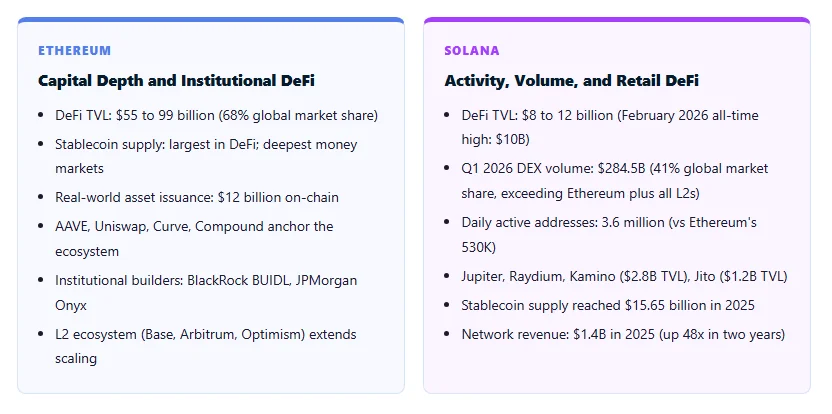
The distinction between TVL and trading volume is critical to understanding the Solana vs Ethereum DeFi debate. Ethereum’s $55 to 99 billion TVL reflects the volume of capital passively deposited in protocols, a measure of capital trust and long-term deployment. Solana’s $284 billion Q1 2026 DEX volume reflects the velocity of capital actively trading, a measure of day-to-day user activity. Ethereum is where large capital is parked and secured; Solana is where transactions are being executed at scale.
Solana’s DeFi TVL itself is growing rapidly. The Solana DeFi TVL reached an all-time high of 80 million SOL (approximately $10 billion) in February 2026, with protocols like Kamino ($2.8 billion), Jupiter Lend ($1.65 billion), and Jito ($1.2 billion) anchoring the ecosystem. Jupiter Lend launched in August 2025 and reached $500 million TVL within 24 hours with zero bad debt through its beta period, demonstrating the speed and quality of Solana’s emerging lending infrastructure.
Which Has the Stronger Developer Ecosystem?
Ethereum leads in total developer count according to the Electric Capital 2025 Developer Report: approximately 31,869 active developers versus Solana’s 17,708, a 1.8x advantage. Ethereum hosts 4,000+ deployed decentralised applications with over $50 billion in TVL. Over 88 million smart contracts have been deployed on Ethereum, reflecting a mature and deeply established builder ecosystem.
However, the trend data favours Solana. Solana led all blockchains in new developer joiners in 2024, adding 7,625 new developers, an 83% year-over-year increase. Solana’s developer count grew 42% year-over-year in 2025, overtaking BNB Chain and approaching parity with Ethereum on a relative growth basis. Ethereum attracted 16,181 new developers in 2025, and Solana added 11,500.
Solana’s developer tooling uses Rust as its primary smart contract language, which has a steeper learning curve than Ethereum’s Solidity but is increasingly popular among developers building performance-critical applications. Ethereum’s tooling ecosystem (Hardhat, Foundry, Truffle, OpenZeppelin) is more mature and extensively documented, lowering the barrier for new developers. Solana’s Solana Agent Skills, pre-built tools for AI coding integration released in early 2026, represent an emerging advantage in attracting developers building AI-adjacent blockchain applications.
Which Is More Established for Institutional Use?
Ethereum’s institutional footprint is significantly larger and more deeply embedded in traditional financial infrastructure. Spot Ethereum ETFs hold more than $35 billion in ETH. On-chain real-world asset issuance on Ethereum exceeded $12 billion in 2025. BlackRock’s BUIDL tokenized Treasury fund, Franklin Templeton’s BENJI, and JPMorgan’s Onyx blockchain platform all primarily use Ethereum infrastructure. When institutional builders including BlackRock, Franklin Templeton, and JPMorgan assess where to deploy regulated financial products at scale, Ethereum’s regulatory maturity and ecosystem depth are the deciding factors.
Solana entered the institutional market later. Solana spot ETFs launched in Q3 2025, attracting $1.02 billion in net inflows despite launching months after Bitcoin and Ethereum ETFs. Charles Schwab began offering spot ETH trading to retail clients in April 2026, broadening institutional access to Ethereum. Solana’s institutional narrative continues to build: its role as the primary chain for high-frequency DeFi activity, its dominance of the stablecoin transaction layer ($650 billion in stablecoin volume in February 2026 alone), and the expansion of its DePIN ecosystem attract a growing cohort of institutional participants interested in high-throughput use cases rather than capital storage.
Ethereum has operated continuously since 2015 without a single L1 outage, a nine-year institutional trust record that Solana cannot yet match. Solana experienced multiple major outages between 2021 and 2023, which created lasting reputational concerns among risk-averse institutional capital allocators. Solana’s 99.9%+ uptime throughout 2024 and 2025 is rebuilding this trust, but the gap remains meaningful for capital that prioritises reliability above all other factors.
Read Also: What Is Proof of Work? A Beginner’s Guide
How Do Their NFT Ecosystems Compare?
Both Ethereum and Solana have significant NFT ecosystems with different characteristics. Ethereum’s NFT market is characterised by high-value blue-chip collections: CryptoPunks, Bored Ape Yacht Club, Art Blocks, and similar collections that trade at significant price points on OpenSea, Blur, and X2Y2. Ethereum’s security and permanence record make it the preferred choice for collectors storing significant value in digital assets long-term.
Solana’s NFT ecosystem is characterised by volume and accessibility. Q1 2025 NFT trading volume on Solana surpassed $1.2 billion, driven by new gaming and collectible markets. Solana’s NFT transaction volume is 3 times higher than Polygon’s and approaches Ethereum’s weekly volumes according to CoinLaw data. The near-zero minting cost on Solana enabled the innovation of compressed NFTs (cNFTs), which allow millions of NFTs to be minted at a tiny fraction of the cost possible on Ethereum. This opened NFT creation to gaming studios, loyalty programmes, and consumer applications that would be economically impractical on Ethereum mainnet. Top Solana NFT collections include Mad Lads, DeGods, and Claynosaurz, traded on Magic Eden and Tensor. Solana’s $2 billion NFT market continues to grow rapidly, driven by low-cost minting and the expanding gaming and consumer app ecosystem.
Which Blockchain Is More Secure?
Both chains have strong security foundations but with different characteristics and historical track records.
Ethereum’s Security Advantages
Ethereum’s 900,000-plus validator network is the most decentralised Proof of Stake network in existence. The sheer number and geographic distribution of validators makes coordinating an attack extraordinarily expensive and logistically challenging. Ethereum has operated without a single L1 outage since 2015, a nine-year track record that is unmatched in the smart contract platform category. Its smart contract ecosystem has been battle-tested by more value over a longer period than any other platform, and its security research community is the largest in the blockchain industry. Ethereum’s post-quantum security hub (pq.ethereum.org) launched in 2026 to coordinate quantum-resistance research and development.
Solana’s Security Position
Solana operates with approximately 1,500 active validators, a much smaller set than Ethereum, which increases performance but reduces decentralisation and the cost of a hypothetical coordinated attack. The Solana Foundation’s quantum readiness plan, confirmed in early 2026, specifies the use of Falcon (a NIST-standardised lattice-based signature scheme) for migration, positioning Solana proactively on post-quantum security. Solana’s smart contract ecosystem, written in Rust, is younger than Ethereum’s and has had a shorter period of adversarial scrutiny, though its Rust-based security model is generally considered robust. The 2021 to 2023 network outages were caused by software bugs and congestion issues rather than security exploits, and have largely been resolved through engineering improvements.
Smart contract risk note: Neither chain’s security guarantee extends to the smart contracts deployed on them. Individual protocols on both Ethereum and Solana have suffered significant exploits. The Ethereum L2 cross-chain bridge infrastructure has been a recurring source of exploits. On Solana, DeFi protocols have also experienced smart contract vulnerabilities. Security due diligence on any specific protocol is separate from the chain-level security evaluation.
When Should You Choose Solana vs Ethereum?
| Metric | Ethereum (ETH) | Solana (SOL) |
|---|---|---|
| Real-world TPS | 15 to 30 (L1); effective total higher via L2s | 3,000 to 5,500 (Firedancer, 2026) |
| Average fee | $0.50 to $3 (L1); $0.10 to $0.50 (L2 post-Pectra) | $0.00025 (below $0.01 even under congestion) |
| DeFi TVL | $55 to 99 billion (68% global DeFi share) | $8 to 12 billion (all-time high $10B Feb 2026) |
| DEX volume (Q1 2026) | $7.62B weekly (Ethereum L1) | $11.49B weekly; $284.5B Q1 total (41% global DEX share) |
| Daily active addresses | 530,000 (mainnet) | 3.6 million (6.8x more than Ethereum) |
| Active developers | 31,869 (1.8x Solana; 16,181 new in 2025) | 17,708 (led all chains in 2024 new joiners: +7,625) |
| Validator count | 900,000+ (most decentralised PoS chain) | ~1,500 (40+ countries; higher performance trade-off) |
| Institutional ETFs/assets | $35B+ in ETFs; $12B+ in RWAs on-chain | $1.02B in ETF inflows since Q3 2025 launch |
| Network uptime record | No L1 outage since 2015 (9+ years) | 99.9%+ uptime 2024 to 2025; prior outages 2021 to 2023 |
| Smart contract language | Solidity (mature, extensive tooling) | Rust (steep learning curve; high performance) |
When Should You Choose Solana?
- You are executing retail DeFi trades, minting NFTs, building on-chain games, or sending micro-payments where $0.00025 fees and 5,500 TPS are directly beneficial to your economics
- You are building applications requiring high-frequency, cost-sensitive on-chain interactions that would be uneconomical on Ethereum at any layer
- You are building DePIN (Decentralised Physical Infrastructure Networks), AI-agent applications, or consumer-facing crypto apps where user experience requires near-instant confirmation and negligible fees
- You want exposure to a rapidly growing ecosystem with strong developer momentum and improving institutional credibility
When Should You Choose Ethereum?
- You are deploying large DeFi liquidity positions where the depth of Ethereum’s money markets and the security of its nine-year operational track record are non-negotiable
- You are building regulated financial products, tokenizing real-world assets, or integrating with institutional infrastructure where Ethereum’s regulatory maturity is essential
- You are a developer wanting access to the largest existing developer community, the most mature tooling, and the deepest ecosystem of audited protocols to build on
- You want exposure to the most institutionally integrated blockchain platform, with the deepest liquidity, longest security track record, and most established regulatory relationships
Read Also: How to Diversify Your Cryptocurrency Portfolio
Frequently Asked Questions
Is Solana faster than Ethereum?
Yes, significantly. Solana processes 3,000 to 5,500 real-world TPS with the Firedancer client deployed in early 2026, versus Ethereum mainnet’s 15 to 30 TPS. Solana’s block time is approximately 400 milliseconds with 2.5-second finality. Ethereum’s L2 solutions narrow the gap: Base, Arbitrum, and Optimism collectively process more daily transactions than Ethereum L1 and charge under $0.50 per transaction after the Pectra upgrade. However, Solana mainnet remains faster and cheaper than any individual Ethereum L2.
Which has lower fees, Solana or Ethereum?
Solana is significantly cheaper. The average Solana transaction costs $0.00025 and stays below $0.01 even under congestion. Ethereum mainnet charges $0.50 to $3.00 for simple transfers, spiking to $15 to $30 for complex DeFi operations during peak demand. Ethereum’s Pectra upgrade reduced L2 fees approximately 40% to $0.10 to $0.50 per transaction, a meaningful improvement but still orders of magnitude above Solana mainnet. For micro-payments, NFT minting, and retail DeFi, Solana’s fee advantage is decisive.
Which has more DeFi activity, Solana or Ethereum?
It depends on the metric. Ethereum dominates total value locked at approximately $55 to 99 billion versus Solana’s $8 to 12 billion, representing 68% of global DeFi TVL. However, Solana dominates on-chain activity: 3.6 million daily active addresses versus Ethereum’s 530,000, and in Q1 2026 Solana’s spot DEX volume reached $284.5 billion, a 41% global market share exceeding Ethereum plus all its L2s combined. Solana wins on volume and users; Ethereum wins on capital depth and institutional liquidity.
Which blockchain is better for developers, Solana or Ethereum?
Ethereum leads in total developer count with approximately 31,869 active developers versus Solana’s 17,708. Ethereum attracted 16,181 new developers in 2025. However, Solana led all blockchains in new developer joiners in 2024 with 7,625 additions, an 83% year-over-year increase. Ethereum’s larger existing ecosystem provides more tooling and documentation. Solana attracts builders who prioritise high throughput and low cost, particularly in gaming, DePIN, and high-frequency retail DeFi applications.
Should I invest in Solana or Ethereum?
This is not investment advice. The key distinction is risk and use profile. Ethereum ($247 billion market cap as of early 2026) offers relative stability, deeper institutional integration through spot ETFs, and the largest DeFi ecosystem. Solana ($50 billion market cap) offers higher growth potential, stronger on-chain activity metrics, and faster user adoption. Both declined in 2025 (ETH approximately -15%, SOL approximately -32%). Most diversified crypto portfolios hold both. The right allocation depends entirely on personal risk tolerance, investment horizon, and conviction in each network’s long-term thesis.