Definition
A gas fee is the cost required to perform a transaction or execute a smart contract on the Ethereum blockchain and other EVM-compatible networks. Gas fees serve as the primary mechanism for compensating validators (formerly miners, prior to Ethereum’s transition to Proof of Stake) for the computational resources they expend to process and validate transactions on the network. Every operation on the Ethereum Virtual Machine (EVM) – from a simple ETH transfer to a complex multi-step DeFi interaction – requires a specific amount of gas, and users must pay for that gas in the network’s native cryptocurrency, typically Ether (ETH).
Gas fees are not fixed; they fluctuate dynamically based on network demand and congestion. When the network is heavily used – for instance, during a popular NFT mint, a DeFi yield farming event, or a period of extreme market volatility – gas fees can spike dramatically, sometimes making small transactions economically impractical. Conversely, during periods of low activity, gas fees can drop to fractions of a cent. This dynamic pricing model is central to how Ethereum allocates its finite computational capacity among competing users. After the implementation of EIP-1559 in August 2021, Ethereum’s fee model was restructured into a base fee (which is algorithmically determined and burned) and a priority fee or tip (which goes to the validator), fundamentally changing how gas fees are calculated and distributed.
The concept of gas fees extends well beyond Ethereum. Nearly every smart contract platform – including BNB Smart Chain, Polygon, Avalanche, Arbitrum, Optimism, and many others – employs a similar gas or transaction fee mechanism. These fees are essential to network security because they impose a real economic cost on every computation, preventing spam attacks and ensuring that validators are incentivized to maintain the network. Understanding gas fees is critical for anyone interacting with blockchain networks, as they directly affect the cost-effectiveness of transactions, the profitability of DeFi strategies, and the overall user experience of decentralized applications.
Origin & History
- 2013: Vitalik Buterin publishes the Ethereum whitepaper, introducing the concept of “gas” as a unit of computational effort needed for operations on a Turing-complete blockchain, distinguishing Ethereum from Bitcoin’s simpler transaction model.
- 2014: Gavin Wood publishes the Ethereum Yellow Paper, formally defining the gas mechanism, gas costs for each EVM opcode, and the relationship between gas, gas price, and transaction fees.
- July 30, 2015: Ethereum mainnet launches (Frontier release). Gas fees become operational for the first time. Early gas prices are extremely low, often below 1 Gwei, due to minimal network usage.
- 2016: The DAO hack in June 2016 highlights gas mechanics; complex contract interactions and the subsequent hard fork draw attention to how gas costs affect smart contract execution and security.
- 2017: The CryptoKitties craze in December 2017 causes the first major gas fee crisis, clogging the Ethereum network and driving gas prices to unprecedented levels. Average gas prices spike above 40 Gwei, introducing mainstream users to the concept of gas wars.
- 2018-2019: During the crypto bear market, gas fees drop to very low levels (often 1-5 Gwei). Developers begin serious research into scaling solutions to prevent future congestion crises.
- 2020 (DeFi Summer): The explosion of DeFi protocols like Uniswap, Compound, and Aave causes sustained gas fee spikes. Average gas prices regularly exceed 100-200 Gwei, with some transactions requiring $50-$100+ in fees. The concept of “gas wars” – users outbidding each other for transaction priority – becomes widely understood.
- August 5, 2021: EIP-1559 is implemented as part of the London hard fork, fundamentally restructuring Ethereum’s fee market. The update introduces a base fee that adjusts algorithmically based on block utilization and is burned (removed from circulation), plus an optional priority fee (tip) paid directly to validators. This makes gas fees more predictable and introduces ETH as a deflationary asset.
- 2021-2022: NFT mania drives gas fees to extreme levels. High-profile NFT mints such as Bored Ape Yacht Club, Otherside land, and various free mints cause gas wars where users pay hundreds or even thousands of dollars in gas for a single transaction. The Otherside mint in April 2022 burns over $150 million in ETH gas fees in a single event.
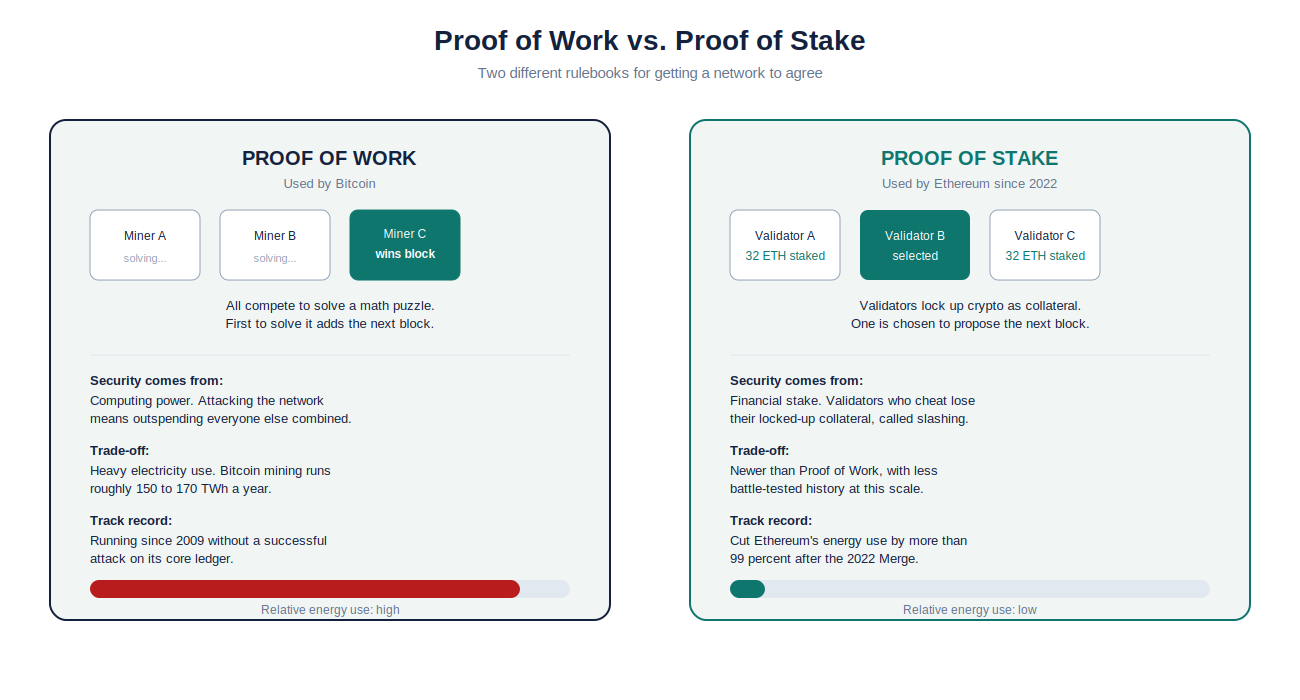
- September 15, 2022: The Merge transitions Ethereum from Proof of Work to Proof of Stake. While the Merge does not directly reduce gas fees, it sets the stage for future scalability improvements and changes the economic model for validators receiving priority fees.
- March 2023 (Shapella Upgrade): Enables staking withdrawals on Ethereum. The upgrade causes temporary gas fee spikes as validators rush to manage their staked ETH.
- March 13, 2024: The Dencun upgrade introduces EIP-4844 (proto-danksharding) with “blob” transactions, dramatically reducing gas fees on Layer 2 rollups like Arbitrum, Optimism, and Base by 90-99%. This marks a watershed moment for Ethereum’s rollup-centric scaling roadmap.
- 2024-2026: Layer 2 adoption accelerates rapidly post-Dencun. Gas fees on L2s drop to sub-cent levels, while Ethereum mainnet gas fees stabilize at lower levels due to activity migrating to L2s.
In Simple Terms
- The Highway Toll Analogy: Think of gas fees like tolls on a highway. Every car (transaction) that wants to use the road (blockchain) must pay a toll. During rush hour (high network congestion), the tolls go up because more cars are competing for limited road space. During off-peak hours, tolls are much cheaper. Just like you can choose to drive during less busy times to save money, you can time your blockchain transactions for lower gas fees.
- The Auction House Analogy: Imagine an auction house where there is limited space in each auction session (block). Every bidder (user) must offer a fee to get their item (transaction) included. If the auction house is popular and many people want to participate, you need to bid higher to secure a spot. EIP-1559 changed this from a pure auction to a system more like a posted price with an optional tip – the house sets a base entry fee, and you can add a tip to get served faster.
- The Electricity Bill Analogy: Gas fees are like your electricity bill for using blockchain computing power. Simple tasks like turning on a light (sending ETH) use a small amount of electricity and cost little. Complex tasks like running a factory (executing a complicated smart contract with many steps) use much more electricity and cost proportionally more. The price per unit of electricity also varies depending on overall demand on the grid.
- The Shipping Cost Analogy: Sending a blockchain transaction is like shipping a package. The gas fee is your shipping cost, which depends on two factors: the size and weight of your package (the complexity of the transaction, measured in gas units) and the current shipping rate (the gas price per unit, measured in Gwei). A heavier package during a holiday shipping rush will cost much more than a small letter sent on a quiet Tuesday.
- The Restaurant Kitchen Analogy: Validators are like chefs in a busy restaurant kitchen. They can only prepare so many orders (transactions) at once. Gas fees are like tips that determine which orders get prepared first. During a dinner rush, you might need to tip more generously to get your meal faster. EIP-1559 made it so the restaurant also charges a standard cover fee (base fee) on top of the optional tip.
Key Technical Features
Gas Units and Gas Price
Every operation executed by the Ethereum Virtual Machine has a predetermined gas cost assigned to it. A simple ETH transfer requires exactly 21,000 gas units. More complex operations – such as token approvals (around 45,000 gas), ERC-20 token transfers (around 65,000 gas), or Uniswap swaps (around 150,000-300,000 gas) – require proportionally more gas. The total transaction fee is calculated as: Total Fee = Gas Units Used x Gas Price (in Gwei). One Gwei equals 0.000000001 ETH (10^-9 ETH). So if a simple transfer uses 21,000 gas at a gas price of 30 Gwei, the fee is 21,000 x 30 = 630,000 Gwei = 0.00063 ETH.
EIP-1559 Fee Structure
Since the London hard fork in August 2021, Ethereum uses a dual-component fee structure. The base fee is determined algorithmically by the protocol based on how full the previous block was. If the previous block was more than 50% full, the base fee increases (up to 12.5% per block); if less than 50% full, it decreases. This base fee is entirely burned – removed from ETH’s circulating supply forever. The priority fee (or tip) is an optional amount set by the user that goes directly to the validator as an incentive to include the transaction. The max fee is the maximum total amount per gas unit the user is willing to pay. The actual fee paid is: min(max fee, base fee + priority fee). Any difference between the max fee and the actual fee paid is refunded to the user.
Gas Estimation and Optimization
Wallets like MetaMask automatically estimate gas fees based on current network conditions, typically offering slow, average, and fast options. Developers can optimize gas consumption by writing efficient smart contract code – using appropriate data types, minimizing storage operations (SSTORE is one of the most expensive opcodes at 20,000 gas for new storage), using events instead of storage for non-critical data, and batching operations. Tools like gas profilers, Foundry’s gas reports, and Tenderly’s simulation features help developers identify and reduce gas costs in their contracts.
Layer 2 Gas Fee Reduction
Layer 2 scaling solutions dramatically reduce gas fees by executing transactions off the main Ethereum chain and only posting compressed summaries (calldata or blobs) to Layer 1. Optimistic rollups (Arbitrum, Optimism, Base) and ZK-rollups (zkSync, StarkNet, Scroll) can reduce transaction costs by 10-100x compared to Ethereum mainnet. After EIP-4844 (proto-danksharding) in March 2024, L2 fees dropped even further – often to less than $0.01 per transaction – because rollups can now use dedicated “blob space” instead of expensive calldata for posting transaction data to Ethereum.
Advantages & Disadvantages
| Advantages | Disadvantages |
| Prevents spam and denial-of-service attacks by imposing real economic cost on every computation | Can make small transactions economically unviable during periods of high network congestion |
| Incentivizes validators to process transactions and secure the network honestly | Creates significant barriers to entry for new users and those in developing economies |
| EIP-1559 base fee burn creates deflationary pressure on ETH supply, potentially increasing its value | Unpredictable fee spikes cause poor user experience and failed transactions when gas limits are set too low |
| Dynamic pricing efficiently allocates scarce block space to highest-value transactions | Gas wars during popular events (NFT mints, token launches) can result in users paying hundreds of dollars in fees |
| Encourages developers to write efficient, optimized smart contract code to minimize user costs | Complex DeFi strategies involving multiple transactions can accumulate prohibitively high total gas costs |
| Layer 2 solutions now offer near-zero gas fees while inheriting Ethereum’s security guarantees | New users often find the gas fee concept confusing, especially when they need ETH to move other tokens |
| Gas fees fund the economic security model that makes Ethereum one of the most secure networks | MEV extraction by validators and searchers can effectively increase the hidden cost users pay beyond the visible gas fee |
Risk Management
Managing gas fees is essential for anyone regularly transacting on blockchain networks. Users should monitor gas prices using tools like Etherscan Gas Tracker, GasNow, or Blocknative’s Gas Estimator before initiating transactions. Timing transactions during off-peak hours – typically weekends and late night/early morning UTC – can yield significantly lower fees. Setting an appropriate gas limit is critical: too low and the transaction will fail (consuming the gas without completing), too high and you overpay. For high-value DeFi operations, simulating transactions first using Tenderly or similar tools can prevent costly failures. Users should also consider using Layer 2 networks for routine transactions and only using Ethereum mainnet when necessary (for large settlements, bridging, or interacting with contracts only available on L1). Developers should conduct gas optimization audits on their smart contracts and consider implementing gas-efficient patterns such as EIP-2929 access lists, batch operations, and proxy patterns to minimize end-user costs.
Cultural Relevance
Gas fees have become one of the most discussed and debated topics in the entire cryptocurrency ecosystem. The phrase “gas is too high” became a ubiquitous complaint during the DeFi and NFT booms of 2020-2022, symbolizing Ethereum’s scalability challenges and spurring the growth of competing Layer 1 blockchains like Solana, Avalanche, and BNB Smart Chain that marketed themselves as low-fee alternatives. Gas fee frustration was a primary catalyst for the rapid development and adoption of Layer 2 scaling solutions. The burning of the base fee under EIP-1559 created the popular “ultrasound money” narrative, with community members tracking ETH burn rates in real time and celebrating periods when more ETH was burned in fees than issued as staking rewards. Gas fees also influenced NFT culture – the “gas war” became a shared experience that bonded and frustrated the NFT community in equal measure. The exorbitant gas fees during peak congestion periods became a symbol of exclusivity but also of inequality, as wealthy users could afford priority access while smaller participants were priced out. The ongoing effort to reduce gas fees through L2s and protocol upgrades remains one of the defining narratives of Ethereum’s development roadmap.
Real-World Examples
- Otherside NFT Mint (April 2022): Yuga Labs’ Otherside virtual land sale caused one of the worst gas crises in Ethereum history. Users collectively burned over $150 million in ETH gas fees in a matter of hours, with individual transactions costing $5,000-$14,000 in gas alone. Many transactions failed, wasting the gas fee without completing the purchase. This event accelerated the push for off-chain and L2 minting solutions.
- DeFi Summer (2020): During the DeFi boom, average gas prices on Ethereum regularly exceeded 200-500 Gwei. A simple Uniswap swap could cost $50-$200 in gas fees, effectively excluding users with smaller portfolios from participating in yield farming and token trading. This period drove the creation of gas-efficient protocols and the rise of alternative L1s.
- EIP-1559 Impact (August 2021 onward): After EIP-1559 was implemented, Ethereum burned over 3.5 million ETH in its first two years (worth billions of dollars). During peak usage periods, the burn rate exceeded new ETH issuance, making ETH net deflationary. This mechanism fundamentally changed ETH’s economic model and value proposition.
- Post-Dencun L2 Fees (March 2024 onward): After the Dencun upgrade introduced blob transactions, gas fees on major L2s like Arbitrum and Optimism dropped by 90-99%. Transactions that previously cost $0.20-$1.00 on L2s now cost less than $0.01, making blockchain transactions accessible to a vastly wider audience and enabling use cases like micropayments and social applications.
Comparison Table
| Feature | Ethereum L1 Gas Fee | Bitcoin Transaction Fee | Solana Transaction Fee | Arbitrum (L2) Gas Fee |
| Fee Currency | ETH (Gwei) | BTC (satoshis/vbyte) | SOL (lamports) | ETH (Gwei, much lower) |
| Typical Cost (2026) | $0.50-$10 | $0.50-$5 | $0.001-$0.01 | $0.01-$0.10 |
| Fee Model | EIP-1559 (base + tip) | Simple auction | Fixed low fee | EIP-1559 + L1 data cost |
| Fee Burn | Yes (base fee burned) | No | Partial (50% burned) | Yes (L2 base fee burned) |
| Congestion Impact | High – fees spike 10-100x | Moderate – fees spike 5-20x | Low – fees remain stable | Low – fees spike modestly |
| Smart Contract Cost | High ($5-$500+) | N/A (limited scripting) | Very low ($0.01-$0.10) | Low ($0.05-$2) |
| Fee Predictability | Moderate (EIP-1559 helps) | Low (pure auction) | High (very stable) | Moderate |
Related Terms
- Gas Limit: The maximum amount of gas a user is willing to spend on a transaction.
- Gas Price (Gwei): The price per unit of gas, measured in Gwei (billionths of ETH).
- EIP-1559: The Ethereum Improvement Proposal that restructured the fee market with base fee burning and priority tips.
- Base Fee: The algorithmically determined minimum gas price per unit that is burned after EIP-1559.
- Priority Fee (Tip): The optional fee paid to validators to incentivize faster transaction inclusion.
- Layer 2: Scaling solutions built on top of Ethereum that significantly reduce gas fees.
- Gwei: A denomination of ETH equal to 10^-9 ETH, commonly used to express gas prices.
- EVM (Ethereum Virtual Machine): The computation engine that executes smart contracts and determines gas costs for each operation.
- Proto-Danksharding (EIP-4844): An upgrade introducing blob transactions to reduce L2 data costs on Ethereum.
- MEV (Maximal Extractable Value): Additional value extracted by validators through transaction ordering, which effectively acts as a hidden fee for users.
FAQ
Q1: Why do I have to pay gas fees even when my transaction fails?
A1: Gas fees compensate validators for the computational work they perform to process your transaction. When a transaction fails – for example, because the smart contract reverted due to slippage, insufficient allowance, or a condition not being met – the validator has still expended computational resources attempting to execute it. The gas consumed up to the point of failure is not refunded. This is why setting an appropriate gas limit and simulating transactions beforehand is important. The only gas that is refunded is the unused portion if the transaction uses less gas than the gas limit you specified.
Q2: How can I reduce the gas fees I pay on Ethereum?
A2: There are several strategies to minimize gas fees. First, time your transactions during off-peak hours – typically weekends and early morning UTC – when network congestion is lower. Second, use Layer 2 networks like Arbitrum, Optimism, Base, or zkSync for routine transactions, as fees are 90-99% cheaper than mainnet. Third, set a reasonable max fee and priority fee rather than accepting the wallet’s default “fast” setting if you do not need immediate confirmation. Fourth, batch multiple operations into a single transaction when possible. Fifth, use gas-efficient protocols and DEX aggregators that optimize for lower gas consumption.
Q3: What happened to gas fees after EIP-1559?
A3: EIP-1559, implemented in August 2021, fundamentally changed Ethereum’s fee structure. Before EIP-1559, users submitted blind bids (gas prices) in a first-price auction, leading to overpayment and unpredictability. After EIP-1559, the protocol calculates a base fee algorithmically based on network demand, making fees more predictable. The base fee is burned (permanently removed from ETH supply), creating deflationary pressure. Users can also add an optional priority fee (tip) for faster inclusion. While EIP-1559 did not reduce average gas costs, it made fees more predictable, reduced overpayment, and introduced ETH burning that has removed millions of ETH from circulation.
Q4: Why are gas fees on Layer 2s so much cheaper than Ethereum mainnet?
A4: Layer 2 rollups process transactions off-chain in batches and only post compressed summaries to Ethereum mainnet. This means the expensive L1 computation and storage costs are shared among hundreds or thousands of L2 transactions rather than borne by each transaction individually. After the Dencun upgrade (March 2024) introduced EIP-4844 blob transactions, L2s gained access to a dedicated, much cheaper data availability layer on Ethereum, reducing their data posting costs by 90-99%. The L2 itself charges a small execution fee, but since L2 computation is not constrained by Ethereum’s gas limit, these fees remain extremely low.
Q5: Are gas fees the same on all blockchains?
A5: No, gas fees vary enormously across different blockchains. Ethereum mainnet has historically had the highest fees due to its heavy usage and limited throughput. Blockchains like Solana, Avalanche, and BNB Smart Chain have much lower fees – often fractions of a cent – because they use different consensus mechanisms, have higher throughput, or have less network congestion. Ethereum Layer 2s offer a middle ground: near-zero fees while inheriting Ethereum’s security guarantees. Each blockchain has its own fee token (ETH for Ethereum, SOL for Solana, etc.) and its own fee calculation mechanism.
Sources
- Ethereum Foundation – Gas and Fees: https://ethereum.org/en/developers/docs/gas/
- EIP-1559 Specification: https://eips.ethereum.org/EIPS/eip-1559
- EIP-4844 Specification: https://eips.ethereum.org/EIPS/eip-4844
- Etherscan Gas Tracker: https://etherscan.io/gastracker
- Blocknative Gas Estimator: https://www.blocknative.com/gas-estimator
- Ultrasound Money – ETH Burn Tracker: https://ultrasound.money/
UEEx.com | Cryptocurrency Exchange Glossary | (c) 2026