A rug pull is a crypto scam where developers build a seemingly legitimate project, attract investor funds, then drain the liquidity or disappear – leaving token holders with assets worth nothing. The term comes from the phrase “pulling the rug out from under someone.” As of Q1 2026, rug pulls remain the most prevalent form of crypto fraud: 2026 saw total rug pull losses approach $6 billion, with the Mantra (OM) collapse alone accounting for $5.52 billion. Knowing how to spot one before it happens is among the most practical skills any crypto participant can build.
What Is a Rug Pull in Crypto?
Rug pulls follow a recognizable pattern even when surface details vary. Scammers create a new token or NFT project – often with polished branding, a whitepaper, and active social media accounts. They list the token on a decentralized exchange (DEX) like Uniswap or PancakeSwap, seed a liquidity pool to make trading possible, then push aggressive marketing to drive demand. As retail buyers purchase in and the price rises, the developers quietly prepare to exit.
When they execute, they either drain the liquidity pool (taking the ETH or BNB deposited by buyers), dump their own large token holdings into the market, or trigger hidden functions in the smart contract that grant access to user funds. The token price collapses to near zero within minutes. Social media accounts disappear. The project website goes offline. Investors are left holding worthless tokens with no recourse.
As of 2026, the average time between a project’s launch and its rug pull has dropped to just 12 days, down from 21 days in 2023. Scammers have grown more efficient, and the window for detection keeps narrowing.
What Are the Different Types of Rug Pulls?
How Do Hard Rug Pulls Work?
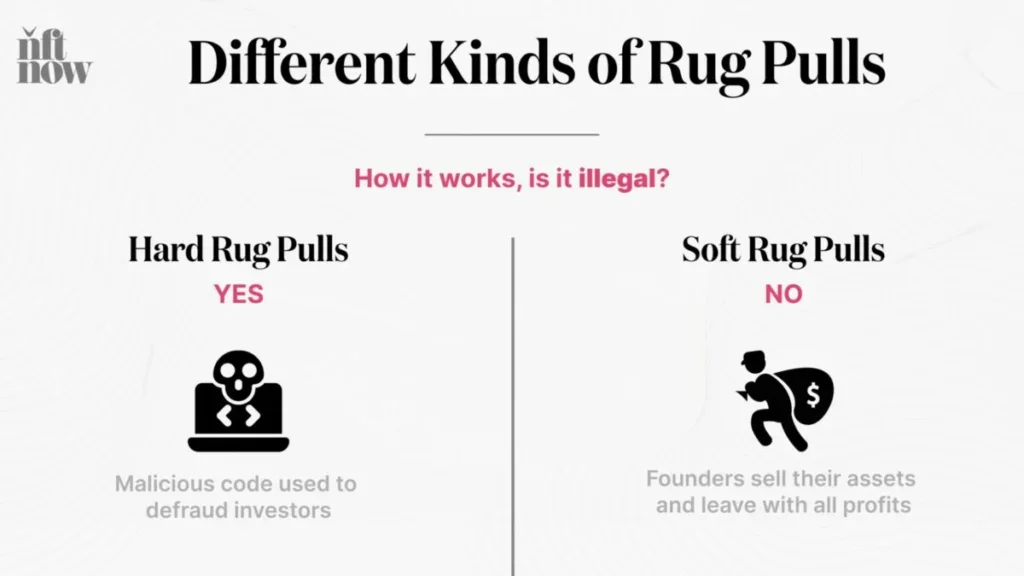
Hard rug pulls are sudden and complete. The three most common forms are liquidity draining, honeypot traps, and flash loan attacks.
In a liquidity drain, developers remove all paired assets (ETH, BNB, USDC) from the pool in a single transaction, leaving the token with no tradeable value. In a honeypot trap, the smart contract is coded so anyone can buy the token but only the developer can sell – investors discover only after purchase that their holdings are permanently locked. Flash loan attacks use uncollateralized loans to inflate a token’s price before the exit executes, drawing in more buyers just before the collapse.
How Do Soft Rug Pulls Work?
Soft rug pulls are slower and harder to identify in real time. Instead of a single dramatic exit, the team gradually abandons the project – stopping development, reducing communication, and slowly selling token holdings over weeks or months. Pump-and-dump schemes follow this pattern: the team holds large token allocations, manufactures hype to drive the price up, sells into the momentum, and exits when the price can no longer be maintained.
As of 2026, soft rug pulls increased by 35% year-over-year, outpacing hard rug pulls in frequency. The slower timeline makes them easier to disguise as legitimate projects that simply “failed” rather than deliberate fraud.
Recommended reading: Top 5 Effective Crypto Technical Analysis Signals
What Are the Biggest Rug Pulls in Crypto History?
| Project | Year | Type | Estimated Loss | Key Detail |
| Mantra (OM) | 2026 | Coordinated dump | $5.52 billion | 17 wallets moved 43.6M tokens; 94% price crash in hours |
| MetaYield Farm | 2026 | Exit scam | $290 million | DeFi yield protocol vanished after raising funds |
| AnubisDAO | 2021 | Liquidity drain | $60 million | Funds drained just 20 hours after launch |
| Squid Game Token | 2021 | Honeypot + dump | ~$3.4 million | Price rose from $0.01 to $2,861 before collapse |
| Luna Yield (LUNY) | 2021 | Exit scam | $6.7 million | Funds sent to Tornado Cash 3 days after IDO |
| Furucombo | 2021 | Smart contract exploit | $14 million | Fake Aave contract granted unauthorized access |
The 2026 Mantra (OM) collapse stands as the largest single rug pull on record. Seventeen coordinated wallets moved 43.6 million OM tokens worth $227 million to exchanges in a compressed window, triggering a cascade that wiped $5.52 billion in combined investor value. Unlike crude overnight scams, this was a months-long operation that had accumulated institutional-looking credibility before the exit – illustrating how sophisticated coordinated rug pulls have become.
What Are the Warning Signs of a Rug Pull?
Why Does an Anonymous Team Increase Risk?
Legitimate projects publish verifiable information about their founders, developers, and advisors. When a team operates entirely under pseudonyms – no LinkedIn profiles, no prior on-chain history, no public appearances – the accountability barrier that deters fraud is absent. Scammers operating anonymously face essentially zero legal consequence when they vanish. This does not mean every anonymous team is fraudulent, but it shifts the risk profile significantly and should trigger additional scrutiny on every other indicator.
What Does an Unlocked Liquidity Pool Signal?
When developers can withdraw liquidity from a pool at any time, they have the ability to execute a hard rug pull instantly. Legitimate projects typically lock their liquidity – committing it to a smart contract for a set period (often six months to two years) to demonstrate they are not planning to exit. Before investing in any new project, verify whether liquidity is locked, for how long, and through which platform. Unicrypt and Team.Finance provide liquidity lock verification on major chains and are free to use.
How Do Token Distribution Patterns Reveal Fraud Risk?
If the development team holds a disproportionate share of total token supply – anything above 20% is worth examining, and figures above 50% are a serious warning sign – they hold the power to crash the market by selling. On-chain analysis tools show wallet distribution before you invest. When a handful of wallets control most of the supply, price manipulation is simple and exit is straightforward. As of 2026, the majority of confirmed rug pull projects showed highly concentrated token distribution detectable before the collapse.
What Should You Look for in Smart Contract Audits?
An unaudited smart contract is an open invitation for hidden malicious functions. Honeypot traps, developer-only sell functions, and backdoor minting capabilities are written directly into contract code – invisible to a non-technical investor reading marketing materials. Third-party audits from CertiK, Hacken, or Trail of Bits are not guarantees of safety, but their absence is a reliable warning sign. As of 2026, the majority of confirmed rug pull projects had no independent smart contract audit at all.
Recommended reading: Trust and Transparency in the Crypto Community
How Does a Rug Pull Compare to Other Crypto Scams?
| Scam Type | Mechanism | Speed | 2026 Share of Crypto Fraud | Primary Venue |
| Rug Pull | Developer drains funds and exits | Minutes to months | 68% of crypto scam losses | DEXs, DeFi protocols |
| Ponzi Scheme | Returns paid from new investor capital | Months to years | ~22% | CeFi platforms, investment clubs |
| Flash Loan Attack | Exploits price oracles with uncollateralized loans | Single transaction | 18% of rug pulls involve this vector | DeFi lending protocols |
| Phishing | Fake sites or wallets steal private keys | Immediate | Significant but under-reported | Email, social media, fake apps |
Which Blockchains See the Most Rug Pulls?
As of 2026, Ethereum leads with 104 recorded rug pull incidents, followed by BNB Chain with 71, Arbitrum with 16, and Solana and Optimism with 6 each. Ethereum’s dominance reflects its status as the primary DEX ecosystem – Uniswap and its derivatives host enormous liquidity, making it the most attractive venue for fraudulent token launches. BNB Chain’s lower gas fees have historically made it cheaper for scammers to deploy multiple fraudulent contracts quickly and at scale.
Across all chains in 2026, 70% of rug pull victims were retail investors who had committed less than $10,000 to the project. The average loss per incident rose sharply to approximately $510,000, driven by the scale of the Mantra collapse. Stripped of that outlier, average losses per incident across the broader rug pull market remain in the low hundreds of thousands – still devastating for the retail investors who make up the bulk of victims.
Also Read: Misconceptions About Crypto: Cryptocurrency is a Fancy Ponzi Scheme
What Should You Do If You Are the Victim of a Rug Pull?
Act quickly and methodically. First, document everything before evidence disappears: take screenshots of the project’s website, social media accounts, your transaction history, and any team communications. Export your wallet’s transaction log from Etherscan or the relevant block explorer and save it securely offline. Do not send additional funds to the project – a common follow-on scam targets victims with fake “recovery services” that steal further money.
Report the incident to the relevant authorities. In the United States, file reports with the SEC (sec.gov), the CFTC (cftc.gov), and the FTC (reportfraud.ftc.gov). For significant losses, contact the FBI’s Internet Crime Complaint Center at ic3.gov. In the UK, report to Action Fraud. In the EU, contact your national financial regulator. Recovery through official channels is rare, but reports contribute to investigations that have resulted in prosecutions – the Squid Game Token case led to identifications and legal action against several participants.
Find other victims. Telegram groups, Reddit threads, and Discord servers specific to the collapsed project often form within hours of a rug pull. Coordinated victim groups can pool transaction evidence, engage lawyers, and raise the visibility of the case with regulators. Collective action is substantially more effective than individual complaints.
Practical Steps to Protect Yourself From Rug Pulls
Verify the team before committing any capital. Search every named team member on LinkedIn, Twitter, and GitHub. Look for a track record of prior blockchain work. If a team’s names appear only in connection with this single project, treat that as a meaningful risk signal. A team that has built and shipped before has reputational and legal exposure to protect; a team with no history does not.
Confirm liquidity lock status on every new project. Use Unicrypt or Team.Finance to verify that liquidity is locked and check the duration. Liquidity locked for less than six months provides minimal protection; one to two years is the standard for projects serious about longevity. No lock at all means the team can drain funds at any moment with no technical barrier.
Read the smart contract audit report itself, not just the badge. Scammers increasingly commission superficial audits from obscure firms to add legitimacy. Look for audits from CertiK, Hacken, Trail of Bits, or OpenZeppelin. Then open the actual report and verify that identified issues were addressed – an audit that found critical vulnerabilities marked as “acknowledged but unresolved” offers no protection.
Run on-chain analysis before investing anything significant. Etherscan’s token holder distribution shows ownership concentration. Wallet creation dates reveal whether addresses were set up specifically for this project. DEXTools exposes real trading volume versus bot-generated wash trading. These checks take under ten minutes and consistently surface the red flags that marketing materials hide.
Size positions to match the actual risk level. New, unaudited projects on DEXs carry fraud risk that established assets simply do not. If you choose to participate in early-stage token launches, size those positions so that losing 100% would not materially harm your overall portfolio. Speculative DeFi participation deserves to be treated as genuinely speculative – because statistically, it is.
Apply extra scrutiny to influencer-promoted tokens. Social media promotion is the primary marketing channel for rug pull projects. Influencers are often paid to promote tokens they have not researched and may hold large bags they plan to sell into their audience’s buying activity. When the primary evidence that a project is worth investing in is a YouTube video or a tweet from a crypto personality, that is a warning sign worth taking seriously.
Also Read: The Risks of Double Spending in Cryptocurrency: What You Need to Know
Frequently Asked Questions About Rug Pulls
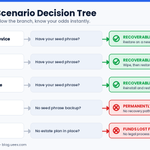
Can you recover money lost in a rug pull?
Recovery is possible but rare. Blockchain transactions are irreversible at the protocol level, so funds sent to scammers cannot be recalled directly. Law enforcement has successfully frozen and returned funds in high-profile cases where scammers were identified – typically when they tried to cash out through regulated exchanges with KYC requirements. On-chain forensics firms like Chainalysis and TRM Labs have traced rug pull proceeds in several cases, leading to arrests. The majority of smaller incidents result in permanent loss.
Are rug pulls illegal?
Yes, in most jurisdictions. Deliberately deceiving investors for financial gain meets the legal definition of fraud in the United States, EU, UK, and most developed legal systems. Depending on project structure, securities fraud charges may also apply. Enforcement is difficult when teams are anonymous and route funds through mixers like Tornado Cash to obscure their trail. Legal outcomes improve significantly when scammers are careless with their on-chain footprint or attempt to cash out through KYC-required platforms.
What is the difference between a rug pull and a legitimate project failure?
Intent is the distinguishing factor. Many crypto projects fail legitimately – that is a normal feature of a high-risk, speculative market. A project that runs out of funding, loses key developers, or fails to achieve product-market fit is not a rug pull. A rug pull involves deliberate deception from the outset: the team never intended to build anything of value, the whitepaper existed to attract investment, and the exit was planned before launch. On-chain analysis typically reveals pre-positioned wallets, unusual token distribution, and coordinated sell activity that distinguishes intentional fraud from genuine failure.
How do scammers avoid being caught after a rug pull?
Most use a combination of anonymity and fund obfuscation. They operate under pseudonyms, use freshly created wallets with no prior history, and route stolen funds through mixers like Tornado Cash or cross-chain bridges to break the on-chain trail. Many cash out through peer-to-peer exchanges or over-the-counter desks without identity verification requirements. Scammers who get caught typically make identifiable mistakes: using a centralized exchange tied to a real identity, reusing wallets across projects, or accessing funds from a trackable IP address.
Which free tools can I use to check if a project might be a rug pull?
Several free tools are worth using together. Token Sniffer (tokensniffer.com) scans smart contracts for known malicious patterns. RugDoc (rugdoc.io) provides risk ratings for DeFi projects. Honeypot.is tests whether a token can actually be sold after purchase. DEXTools and Etherscan let you examine wallet distributions and transaction histories directly. No tool provides certainty, but running two or three checks before committing capital significantly reduces exposure to obvious fraud patterns.
Why are DEXs more vulnerable to rug pulls than centralized exchanges?
Centralized exchanges require projects to pass listing reviews, submit team information, and often undergo due diligence before trading begins. DEXs have no listing gatekeepers – anyone can deploy a token and create a liquidity pool within minutes. This openness enables legitimate innovation but removes the friction that slows fraudulent projects. As of 2026, the vast majority of rug pulls occur on DEXs, with Ethereum-based Uniswap pools and BNB Chain-based PancakeSwap pools the most commonly targeted venues.