Liquid staking is a decentralized finance mechanism that allows cryptocurrency holders to stake their tokens to secure a proof-of-stake (PoS) blockchain network while simultaneously receiving a liquid derivative token – known as a Liquid Staking Token (LST) – that represents their staked position plus accruing rewards. This derivative token can be freely traded, transferred, used as collateral in DeFi lending protocols, or deployed in yield farming strategies, effectively eliminating the traditional trade-off between earning staking rewards and maintaining asset liquidity.
In traditional staking, token holders lock their assets in a validator or staking contract for a fixed period, during which the tokens are illiquid – they cannot be sold, transferred, or used in other protocols. This creates an opportunity cost: while stakers earn rewards (typically 3-8% APY depending on the network), they forgo the ability to deploy those assets in potentially higher-yielding DeFi strategies. Liquid staking solves this fundamental tension by issuing a receipt token that tracks the value of the staked asset plus accumulated rewards, allowing holders to participate in staking and DeFi simultaneously.
Lido Finance has been the largest liquid staking protocol by total value locked since shortly after its 2020 launch, issuing stETH (staked ETH). Its share of all staked ETH has fluctuated over time – it peaked at roughly 30-33% around 2023 and has since compressed into the low-to-mid 20% range as institutional and exchange-based staking providers have expanded their share. Other major providers include Rocket Pool (issuing rETH), Coinbase (issuing cbETH), Frax Finance (issuing frxETH/sfrxETH), and Jito (issuing JitoSOL for Solana staking). Together, these protocols have made liquid staking one of the largest DeFi categories by TVL.
Liquid staking tokens follow two primary models: rebasing tokens (like Lido’s stETH), where the token balance in a holder’s wallet automatically increases daily to reflect earned rewards, and reward-bearing tokens (like Rocket Pool’s rETH), where the token’s exchange rate against the underlying asset appreciates over time while the token balance remains constant. Both models achieve the same economic outcome – staking rewards accrual – but through different mechanisms that have distinct implications for tax reporting, DeFi composability, and user experience.
The emergence of liquid staking has also catalyzed the development of restaking, pioneered by EigenLayer, where liquid staking tokens themselves can be staked again to secure additional networks and protocols, compounding yield while extending the security guarantees of Ethereum’s validator set to a broader ecosystem of services.
Origin & History
2020: The concept of liquid staking began crystallizing as Ethereum 2.0’s Beacon Chain launched in December 2020, introducing ETH staking with a minimum requirement of 32 ETH and no withdrawal timeline. The locked nature of staked ETH – with withdrawals not scheduled until the Shanghai upgrade years later – created intense demand for a liquid alternative. Lido Finance launched in December 2020, enabling users to stake any amount of ETH and receive stETH in return.
2021: Lido’s stETH rapidly gained adoption, becoming one of the most widely held DeFi tokens. The Curve Finance stETH/ETH pool became one of the largest liquidity pools in DeFi, enabling stETH holders to exit their staked position by trading rather than waiting for on-chain withdrawals. Rocket Pool launched its mainnet in November 2021, introducing a decentralized alternative to Lido with permissionless node operators and a minimum of 16 ETH (later reduced to 8 ETH) to run a minipool validator. Total ETH staked through liquid staking protocols grew rapidly through the year, with Lido’s TVL alone reaching roughly $15 billion at its late-2021 peak.
2022: The Terra/Luna collapse in May 2022 temporarily destabilized stETH’s peg to ETH, as distressed sellers (notably Three Arrows Capital and Celsius) removed large amounts of liquidity from the Curve stETH/ETH pool and sold stETH on secondary markets. The stETH/ETH exchange rate dropped to roughly 0.93-0.95 at its worst point, causing panic but ultimately recovering as it was not an algorithmic peg but rather a market-priced derivative of genuinely staked ETH. This stress test demonstrated both the risks and resilience of liquid staking tokens. Coinbase launched cbETH, and Frax Finance introduced frxETH, further diversifying the liquid staking market.
2023: Ethereum’s Shanghai/Capella upgrade in April 2023 finally enabled staked ETH withdrawals, a watershed moment for liquid staking. Paradoxically, rather than reducing demand for liquid staking (since native staking became more flexible), the upgrade increased confidence in LSTs by removing the risk of indefinite lock-up. Jito launched JitoSOL on Solana, bringing liquid staking to a major PoS ecosystem outside Ethereum with the added feature of MEV (Maximal Extractable Value) reward sharing.
2023-2024: EigenLayer introduced the concept of restaking, allowing stETH and other LSTs to be deposited into EigenLayer contracts to secure additional Actively Validated Services (AVSs). This created a new yield layer on top of liquid staking, with LST holders earning both Ethereum staking rewards and additional restaking rewards. Liquid Restaking Tokens (LRTs) like eETH (from ether.fi), ezETH (from Renzo), and pufETH (from Puffer Finance) emerged as a new asset class.
2024-2026: Liquid staking matured into a major staking method for Ethereum. Regulatory scrutiny around whether LSTs constitute securities continued, though the SEC has since indicated that certain liquid staking models may not constitute securities transactions. Lido’s market share compressed from its earlier peak as institutional custodians, exchanges (Binance), and large holders (such as BitMine and Grayscale) expanded their own staking activity. Multi-chain liquid staking expanded significantly, with protocols launching on Cosmos (Stride), Celestia, Sui, and other PoS networks. By mid-2026, total staked ETH across the network approached roughly a third of circulating supply.
In Simple Terms
Imagine putting money into a savings account that normally locks your funds for a year. Now imagine the bank gives you a special certificate worth the exact same amount as your deposit, plus it automatically gains interest. You can spend, sell, or use that certificate as collateral for a loan – all while your original deposit continues earning interest in the savings account. That certificate is essentially what a liquid staking token is.
Think of it like renting out your apartment on a long-term lease. Normally, once you lease it out, you cannot sell the apartment easily. But with liquid staking, you receive a tradable token that represents your ownership of the leased apartment plus the rental income flowing in. You can sell this token to someone else, and they will receive the apartment and future rent – while you get immediate cash without breaking the lease.
Picture a concert where your ticket (your staked ETH) grants you a share of the venue’s profits every night. Traditionally, you would have to sit in your assigned seat all season to collect your share. Liquid staking gives you a transferable VIP pass (stETH) that entitles whoever holds it to those nightly profits. You can sell the pass, lend it to a friend, or use it as collateral at a pawn shop – and whoever holds it still earns those nightly rewards.
It is like a factory worker who invests their paycheck into company bonds (staking) but receives a receipt that acts like cash anywhere in town (LST). The bonds keep earning interest for whoever holds the receipt, and the receipt can be deposited in other banks, used to buy groceries, or traded with neighbors. The worker gets the best of both worlds – bond interest and spending money.
Important: Liquid staking tokens are not risk-free. They carry smart contract risk (a bug in Lido’s contracts could affect all stETH holders), slashing risk (if the underlying validators misbehave, the staked ETH can be penalized), and depeg risk (during market stress, LSTs can trade at a discount to their underlying asset). Additionally, liquid staking has historically raised concerns about validator power concentration, since a single protocol controlling a very large share of staked ETH could affect Ethereum’s decentralization and censorship resistance. Users should diversify across multiple LST providers and understand that the “liquid” in liquid staking does not mean “riskless.”
Join UEEx
Experience the World’s Leading Digital Wealth Management Platform
Liquid staking protocols operate pooled staking contracts where user deposits are aggregated and distributed across multiple professional node operators
Each depositor receives LSTs proportional to their contribution, regardless of the 32 ETH minimum required to run a solo validator
The protocol selects, monitors, and rotates node operators to maintain performance and minimize slashing risk
Insurance funds or slashing coverage mechanisms protect depositors against validator penalties
Rebasing vs. Reward-Bearing Token Models
Rebasing tokens (stETH): The token balance in a user’s wallet increases daily to reflect staking rewards. If you hold 10 stETH today, you might hold 10.003 stETH tomorrow. The exchange rate against ETH stays close to 1:1.
Reward-bearing tokens (rETH, cbETH): The token balance stays constant, but the exchange rate against ETH increases over time. 1 rETH might be worth 1.05 ETH today and 1.10 ETH in a year.
Rebasing tokens are simpler to understand but can cause complications in some DeFi protocols that do not handle changing balances natively
Reward-bearing tokens are more DeFi-compatible but require users to understand that 1 LST does not equal 1 underlying token
How Liquid Staking Works (Lido stETH Example)
A user deposits ETH into Lido’s staking smart contract through the Lido dApp or directly on-chain
Lido mints an equivalent amount of stETH and sends it to the user’s wallet (1 ETH deposited = 1 stETH received)
The deposited ETH is distributed by the Lido DAO to a curated and permissionless set of node operators (several hundred as of 2026, spanning professional operators and home stakers)
Node operators run Ethereum validators with the deposited ETH, earning consensus rewards and execution layer tips/MEV
Regularly, the Lido oracle reports total rewards earned by all validators to the stETH smart contract
The stETH contract rebases – increasing all holders’ balances proportionally to reflect the new rewards (minus Lido’s protocol fee, which has been adjusted over time by DAO governance)
The user can hold stETH for ongoing yield, swap it for ETH on Curve/Uniswap, use it as collateral on Aave/MakerDAO, or deposit it into EigenLayer for restaking
Withdrawal Mechanisms
Primary withdrawal: Users burn LSTs to receive underlying staked assets through the protocol’s withdrawal queue, which processes validator exits on the beacon chain. Under normal conditions this can take anywhere from about a day to several weeks depending on the size of the exit queue, which has grown substantially at times in 2025-2026 as staking volumes increased.
Secondary market exit: Users can instantly swap LSTs for the underlying asset on DEXs like Curve, Uniswap, or Balancer, though at a potentially small discount during high-demand periods
The Shanghai/Capella upgrade enabled reliable primary withdrawals for Ethereum LSTs, improving LST peg stability and reducing reliance on secondary market liquidity
Restaking Integration (EigenLayer)
Liquid staking tokens can be deposited into EigenLayer smart contracts to provide “restaked” security for Actively Validated Services (AVSs)
Restakers earn additional yield from AVS protocols on top of their base Ethereum staking rewards
Liquid Restaking Tokens (LRTs) like eETH, ezETH, and pufETH wrap the restaked position, maintaining liquidity even at the restaking layer
This creates a yield stack: base ETH staking rewards + restaking rewards + potential DeFi yields on LRTs, though restaking yields have compressed over time as the category matured
Advantages & Disadvantages
Advantages
Disadvantages
Capital Efficiency: Users earn staking rewards while simultaneously deploying the same capital in DeFi lending, borrowing, and yield farming – effectively earning multiple yields on a single asset
Smart Contract Risk: All staked assets flow through complex smart contracts that, if exploited, could result in catastrophic loss of funds for a large number of users simultaneously
No Minimum Stake: Protocols like Lido allow staking any amount of ETH, removing the 32 ETH barrier to solo staking and democratizing access to staking rewards
Centralization Concerns: A single liquid staking protocol controlling a large share of staked ETH concentrates validator power and has historically raised concerns about Ethereum’s censorship resistance and decentralization, though this concentration has eased somewhat as the market has diversified
Instant Liquidity: LST holders can exit their staked position immediately by trading on secondary markets, rather than waiting for validator exit queues that can take days or weeks
Depeg Risk: During market stress (as seen in the 2022 stETH depeg), LSTs can trade at significant discounts to their underlying asset, causing mark-to-market losses for holders and liquidations for those using LSTs as collateral
DeFi Composability: LSTs are standard ERC-20 tokens that integrate smoothly with DeFi protocols – usable as collateral on Aave, tradeable on Uniswap, depositable in yield optimizers
Slashing Exposure: If validators operated by the liquid staking protocol are penalized for downtime or misbehavior, LST holders can share the slashing loss proportionally
Professional Validator Management: Liquid staking protocols curate and monitor node operators, reducing the technical burden and slashing risk compared to solo staking
Regulatory Uncertainty: Regulators in various jurisdictions have examined whether LSTs constitute unregistered securities, which could still affect protocol operations depending on jurisdiction
Restaking Yield Stacking: LSTs can be restaked through EigenLayer and similar protocols, earning additional yield layers while extending Ethereum’s security to new networks and services
Compounding Systemic Risk: The layering of yields (staking + restaking + DeFi) creates interconnected risk – a failure at any layer could cascade through the entire stack
Network Security Enhancement: Liquid staking increases the total amount of ETH staked on the network by removing the liquidity penalty, strengthening Ethereum’s overall economic security
Oracle Dependency: Rebasing tokens like stETH rely on oracle systems to report validator rewards accurately; oracle manipulation or failure could cause incorrect reward distribution
Tax Efficiency (Reward-Bearing Model): Tokens like rETH that appreciate in value rather than rebasing may offer tax advantages in some jurisdictions, as they potentially defer taxable events until the token is sold
Fee Extraction: Liquid staking protocols charge a percentage of staking rewards as fees, which vary by provider, reducing net yields compared to solo staking where validators keep all rewards
Liquid staking protocols hold billions of dollars in smart contracts that are high-value targets for attackers
Mitigation: major protocols like Lido undergo multiple independent audits (by firms such as Sigma Prime, Quantstamp, and Trail of Bits), maintain bug bounty programs, and implement time-locked upgrade mechanisms
Users should diversify across multiple LST providers (stETH, rETH, cbETH) rather than concentrating in a single protocol
Validator Slashing Risk
If validators operated by the liquid staking protocol commit attributable faults (double signing, extended downtime), the staked ETH is partially slashed by the Ethereum protocol
Mitigation: Lido’s operator set requires vetted operators with track records; Rocket Pool requires each node operator to post collateral that absorbs slashing losses before affecting rETH holders
Slashing insurance products from protocols like Nexus Mutual provide additional protection layers
Depeg and Liquidity Risk
During market panics, forced selling of LSTs can push their price below the value of the underlying staked assets
Mitigation: the availability of primary withdrawals (post-Shanghai) creates a natural floor for LST prices, as arbitrageurs can buy discounted LSTs and redeem them 1:1 for the underlying ETH, though this depends on withdrawal queue length
Users borrowing against LST collateral should maintain conservative loan-to-value ratios to withstand temporary depeg events
Centralization and Governance Risk
A liquid staking protocol controlling a very large share of staked ETH could theoretically influence consensus outcomes or enable censorship
Mitigation: Lido’s governance has implemented mechanisms such as Dual Governance to reduce counterparty risk from contentious governance decisions; the broader market has also diversified as institutional and exchange-based staking has grown
The Ethereum community has continued discussing protocol-level safeguards against excessive liquid staking concentration
Regulatory and Compliance Risk
Regulatory classification of LSTs has evolved and remains an active area of discussion across jurisdictions
Mitigation: decentralized protocols like Lido and Rocket Pool operate without centralized intermediaries, potentially reducing regulatory surface area compared to centralized offerings like cbETH
Users in uncertain regulatory environments should consult tax and legal professionals regarding LST holdings and reward accrual
Cultural Relevance
Liquid staking has fundamentally reshaped the DeFi market and Ethereum’s economic model. Before liquid staking, the crypto community viewed staking as a passive, set-and-forget activity – lock your tokens, earn rewards, and wait. Lido’s stETH shattered this model by turning staked ETH into one of the most versatile collateral assets in DeFi, spawning an entire category of financial strategies collectively known as “LST-fi.”
The phrase “why would you hold plain ETH?” became a common refrain in DeFi circles by 2023, reflecting a growing view that holding unstaked ETH was leaving money on the table. In this view, stETH became something like a “risk-free rate” for the Ethereum economy – a baseline yield that other DeFi strategies are often measured against, loosely analogous to how U.S. Treasury yields function as a benchmark in traditional finance.
The 2022 stETH depeg during the Three Arrows Capital and Celsius collapse became one of crypto’s most studied market events. It demonstrated that liquid staking tokens, while backed by real staked assets, are still subject to market forces, sentiment, and liquidity conditions. The community learned that “liquid” does not mean “perfectly pegged,” and the event spurred improvements in withdrawal mechanisms, insurance products, and risk disclosures.
The emergence of restaking through EigenLayer in 2023-2024 further amplified liquid staking’s cultural significance, as it created a recursive yield opportunity that captured the imagination of yield-hungry DeFi participants. The concept of “points farming” – depositing LSTs into restaking protocols ahead of token launches – became a dominant narrative for a period, with billions of dollars flowing into LRT protocols. Critics warned of “yield inception” risks, where layers of stacked yields could create systemic fragility, while proponents argued that restaking extends Ethereum’s security model to an entire ecosystem of decentralized services.
The debate over Lido’s market share dominance also became a defining cultural flashpoint. Ethereum purists argued that a large single-protocol share of staked ETH threatened the network’s neutrality and censorship resistance, while Lido supporters countered that the protocol was more decentralized than centralized exchange staking (Coinbase, Kraken) and that the real threat was centralized providers, not decentralized protocols. This debate crystallized broader tensions within the Ethereum community about the trade-offs between DeFi innovation and network decentralization, and has cooled somewhat as Lido’s relative share has declined and institutional staking has diversified the field.
Real-World Examples
DeFi Leverage Strategy with stETH on Aave
Scenario: A DeFi power user deposits stETH into Aave V3 as collateral, borrows ETH against it, stakes the borrowed ETH through Lido to receive more stETH, and redeposits into Aave – creating a leveraged staking position.
Implementation: The user’s position earns staking rewards on the full leveraged stETH balance while paying borrowing costs on the borrowed ETH. If the staking yield exceeds the borrowing cost, the spread is amplified by leverage, producing a higher effective APY than simple staking.
Outcome: The strategy works as long as the stETH/ETH exchange rate remains stable and borrowing costs stay below staking yields. During the 2022 depeg, similar leveraged positions faced liquidation as stETH’s discount widened, demonstrating both the opportunity and risk of LST-based leverage strategies.
Rocket Pool Permissionless Node Operation
Scenario: An independent Ethereum enthusiast with 8 ETH wants to run a validator without relying on a centralized operator curation process. They join Rocket Pool as a node operator, depositing 8 ETH alongside ETH from the Rocket Pool deposit pool to create a full-sized validator minipool.
Implementation: The node operator runs Ethereum validator software on their own hardware, earning a commission on the pool’s contribution plus the full reward on their own ETH, compared to passive rETH holders who earn the base staking rate minus fees. They also earn RPL token rewards for posting RPL collateral.
Outcome: Rocket Pool provides a permissionless, decentralized alternative to curated-operator protocols where anyone can become a node operator with a fraction of the 32 ETH normally required, contributing to Ethereum’s decentralization while earning enhanced yields. rETH holders benefit from a diversified, community-operated validator set.
Institutional Treasury Management with cbETH
Scenario: A crypto-native company with a large ETH treasury wants to earn staking yield while maintaining the ability to meet operational expenses in ETH. They convert a portion of their treasury to Coinbase cbETH through their institutional Coinbase Prime account.
Implementation: The company holds cbETH earning Coinbase’s staking yield after Coinbase’s fee. cbETH can be redeemed for ETH through Coinbase or traded on secondary markets when the company needs liquidity for operational expenses. A remaining portion stays as liquid ETH for immediate needs.
Outcome: The company earns staking yield on its treasury while maintaining operational liquidity. cbETH’s regulatory clarity, issued by a publicly traded, regulated entity, satisfies many institutional compliance requirements, even though the net yield is typically lower than decentralized alternatives due to Coinbase’s fee structure.
Solana Liquid Staking with JitoSOL MEV Rewards
Scenario: A Solana DeFi user stakes SOL through Jito to receive JitoSOL, which includes both standard Solana staking rewards and a share of MEV (Maximal Extractable Value) tips collected by Jito’s validator client.
Implementation: Jito’s modified validator client captures MEV tips from transaction ordering and distributes them to JitoSOL holders, providing additional yield on top of Solana’s base staking yield. Users can deposit JitoSOL into other Solana DeFi protocols for further yield.
Outcome: Users earn a combination of staking rewards and MEV tips, generally outperforming plain SOL staking. JitoSOL’s success demonstrated that MEV redistribution to stakers – rather than exclusive capture by validators – is a powerful differentiator in the liquid staking market, and it sparked similar MEV-sharing initiatives across other ecosystems.
Comparison Table
Feature
Lido (stETH)
Rocket Pool (rETH)
Coinbase (cbETH)
Frax (sfrxETH)
Jito (JitoSOL)
Token Model
Rebasing (balance increases daily)
Reward-bearing (exchange rate appreciates)
Reward-bearing
Reward-bearing (sfrxETH vault)
Reward-bearing
Network
Ethereum
Ethereum
Ethereum
Ethereum
Solana
Node Operators
Curated and permissionless (several hundred operators)
Permissionless (anyone meeting the minimum ETH requirement)
Coinbase-operated
Curated set
Jito-selected validators
Decentralization
Medium (DAO-governed, mixed operator set)
High (permissionless operators)
Low (centralized entity)
Medium (DAO-governed)
Medium (Jito-selected)
MEV Rewards
Included via MEV-Boost
Included via MEV-Boost
Included
Included via MEV-Boost
Included + Jito MEV tips
DeFi Integration
Deepest (Aave, Curve, MakerDAO, EigenLayer)
Strong (Aave, Uniswap, EigenLayer)
Moderate (Coinbase ecosystem, some DeFi)
Growing (Frax ecosystem, Curve)
Strong (Solana DeFi: Marinade, Raydium)
Note: TVL and market share figures for liquid staking protocols change frequently; check a live source like DefiLlama for current numbers before using them in published content.
Related Terms
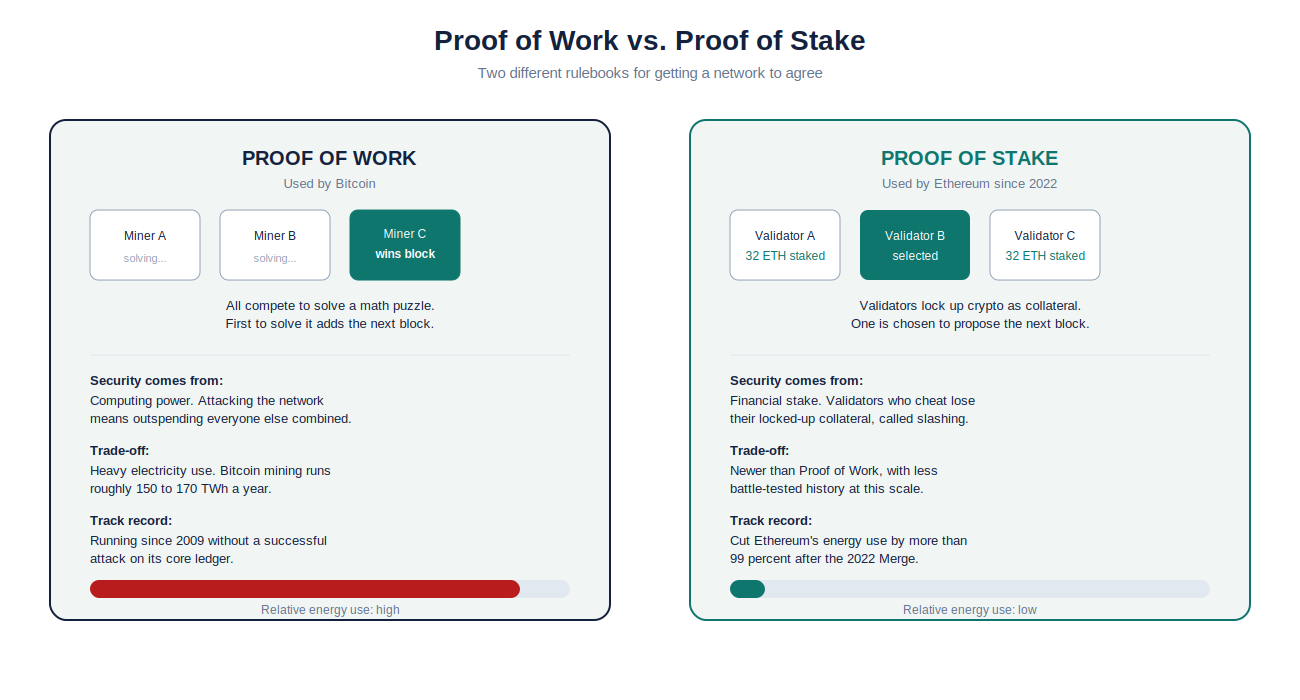
Proof of Stake (PoS) – A consensus mechanism where validators lock cryptocurrency as collateral to secure the network and earn rewards, which liquid staking makes accessible without sacrificing liquidity.
Restaking – The practice of taking already-staked assets (or LSTs) and staking them again on additional protocols like EigenLayer to earn supplementary yield while extending security guarantees. See Restaking
EigenLayer – A middleware protocol on Ethereum that enables restaking of ETH and LSTs to secure Actively Validated Services (AVSs), creating additional yield layers on top of base staking rewards.
Lido Finance – The largest liquid staking protocol by TVL, issuing stETH on Ethereum and operating across multiple PoS networks.
Rocket Pool – A decentralized liquid staking protocol that issues rETH and uniquely allows permissionless node operation with a low ETH minimum, promoting Ethereum validator decentralization.
Staking Derivative – A tokenized representation of a staked position that can be traded or used in DeFi, of which liquid staking tokens are the most prominent example.
Validator – A node that participates in block production and attestation on a PoS blockchain, operated by liquid staking protocols on behalf of LST depositors.
Slashing – A penalty mechanism in PoS networks that destroys a portion of a validator’s staked assets for misbehavior, representing a key risk factor for liquid staking token holders.
MEV (Maximal Extractable Value) – The profit validators can extract by reordering, inserting, or censoring transactions within blocks, which liquid staking protocols increasingly share with LST holders through MEV-Boost and similar systems.
DeFi Composability – The ability of DeFi protocols to interoperate like building blocks, which LSTs leverage by serving as collateral, trading pairs, and yield sources across multiple protocols simultaneously.
Yield Farming – The practice of deploying crypto assets across DeFi protocols to maximize returns, which liquid staking tokens supercharge by offering baseline staking yield plus DeFi yield opportunities.
Shanghai/Capella Upgrade – The Ethereum network upgrade in April 2023 that enabled staked ETH withdrawals for the first time, fundamentally improving the peg stability and risk profile of all Ethereum liquid staking tokens.
FAQ
Q: What is the difference between liquid staking and regular staking? A: Regular staking requires locking your tokens in a validator or staking contract, making them illiquid until you unstake (which can take days or weeks). Liquid staking gives you a derivative token (like stETH or rETH) that represents your staked position and earns rewards, while remaining freely tradeable and usable in DeFi. You get staking rewards without sacrificing the ability to use or sell your assets.
Q: Is stETH the same as ETH? A: No. stETH is a derivative token that represents staked ETH plus accumulated rewards. While it is designed to track ETH’s value closely, it is not ETH itself. stETH can trade at a slight premium or discount to ETH on secondary markets depending on supply and demand. Since the Shanghai upgrade, stETH can be redeemed for ETH through Lido’s withdrawal process, though the wait time varies with the size of the exit queue, providing a natural peg mechanism.
Q: How do liquid staking protocols make money? A: Liquid staking protocols charge a percentage fee on staking rewards, which varies by provider and has changed over time through governance decisions. This fee is typically split between node operators and the protocol’s treasury or DAO, and reduces net yield to LST holders compared to the gross staking yield.
Q: Can I lose money with liquid staking? A: Yes, through several mechanisms: (1) Smart contract exploit – if the LST protocol’s contracts are hacked, staked assets could be drained; (2) Validator slashing – if the protocol’s validators are penalized, losses can be distributed to LST holders; (3) Depeg – during market stress, you might be forced to sell your LST at a discount; (4) Regulatory action – governments could restrict or ban liquid staking services; (5) Market risk – the underlying staked asset (ETH, SOL) can still decline in value.
Q: Which liquid staking token is best? A: There is no single best LST – the choice depends on priorities. Lido’s stETH offers deep DeFi integration and liquidity. Rocket Pool’s rETH is generally considered the most decentralized option. Coinbase’s cbETH is often preferred by institutions needing regulatory clarity. Frax’s sfrxETH has at times offered a higher yield. Jito’s JitoSOL is a leading option for Solana stakers. Many experienced users diversify across multiple LSTs to reduce protocol-specific risk.
Q: What is restaking and how does it relate to liquid staking? A: Restaking, pioneered by EigenLayer, allows liquid staking tokens to be staked a second time to secure additional protocols and services. For example, a user can deposit stETH into EigenLayer to earn both Ethereum staking rewards and EigenLayer restaking rewards. Liquid Restaking Tokens (LRTs) like eETH from ether.fi add yet another layer of liquidity on top of the restaked position.
Q: Does liquid staking affect Ethereum’s decentralization? A: This is one of the most debated topics in the Ethereum community. Lido’s share of staked ETH peaked at roughly 30-33% around 2023, close to thresholds where concentration concerns become more acute, and has since compressed into the low-to-mid 20% range as institutional and exchange-based staking has grown. Critics have argued this level of concentration threatens Ethereum’s neutrality. Defenders note that Lido is a decentralized protocol with a large and growing set of independent node operators, making it more decentralized than centralized exchange staking. The debate has spurred governance-level safety mechanisms and continued community advocacy for diversified staking across multiple providers.