Bitcoin miners now burn through more electricity every year than some entire countries. Meanwhile, Ethereum validators do the same job on the power of a few thousand laptops. That gap is not a rounding error. It is the entire debate around Proof of Stake vs Proof of Work in 2026.
Every blockchain needs a way to agree on what is true. No bank, no boss, no central server to call the shots. That job falls to a consensus mechanism, and the two biggest ones in crypto are Proof of Work (PoW) and Proof of Stake (PoS).
This isn’t just a technical argument for developers. It shapes how much a coin costs to run, how fast it moves money, how green it looks to regulators, and how safe your funds really are. By the end of this guide, you’ll know exactly how each system works, what it costs, and which one fits what you’re trying to do with crypto.
Key Takeaways
- Proof of Work uses computing power and electricity to secure the network, while Proof of Stake uses locked-up crypto as collateral instead.
- PoW has the longer track record and the strongest brute-force security. PoS is faster, cheaper to run, and far more energy efficient.
- Neither model eliminates price volatility. The real difference shows up in energy cost, transaction speed, and regulatory treatment.
- There’s no universal “better” option. The right choice depends on whether you prioritize proven security or speed and sustainability.
What Is a Consensus Mechanism and Why Does It Matter?
Source: ai-generated
A consensus mechanism is the rulebook a blockchain uses to agree on which transactions are real. Think of it as a group of strangers trying to keep one shared notebook accurate, without a teacher checking their work.
If you want to understand the bigger picture first, our guide on what is blockchain technology breaks down the basics before you dive into consensus rules.
The Double Spend Problem, Explained Simply
Digital money is just data, and data can be copied. So what stops someone from spending the same coin twice, once in New York and once in Tokyo, a second later?
This is called the double spend problem. Traditional banks solve it with a central ledger they control. Bitcoin solved it in 2009 without a bank at all by making everyone on the network agree on one shared history of transactions in order and permanently.
“A purely peer-to-peer version of electronic cash would allow online payments to be sent directly from one party to another without going through a financial institution,”
The Byzantine Generals’ Problem
Picture several army generals surrounding a city. They can only communicate by messenger, and some of those messengers might be traitors sending fake orders. The generals still need to agree on one plan: attack together or retreat together.
A blockchain has the same issue. Thousands of computers around the world, some of them possibly dishonest, need to agree on one version of events without a leader in the room. Proof of Work and Proof of Stake are two different answers to that same puzzle.
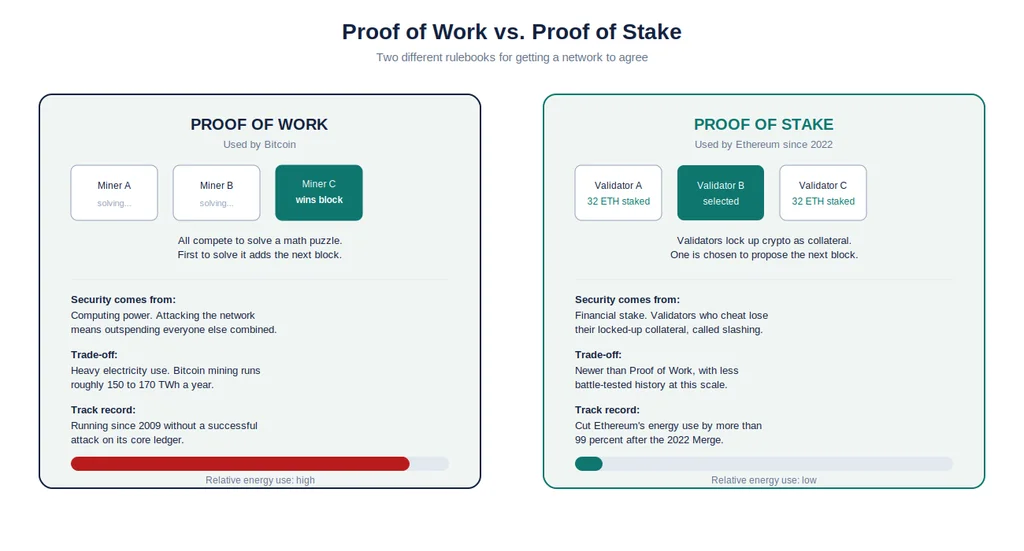
Quick answer: Proof of Work makes computers compete by solving math puzzles, and the winner adds the next block. Proof of Stake picks a validator based on how much crypto they’ve locked up as collateral. Both stop cheaters, just in very different ways.
Proof of Work (PoW) Deep Dive
Source: ai-generated
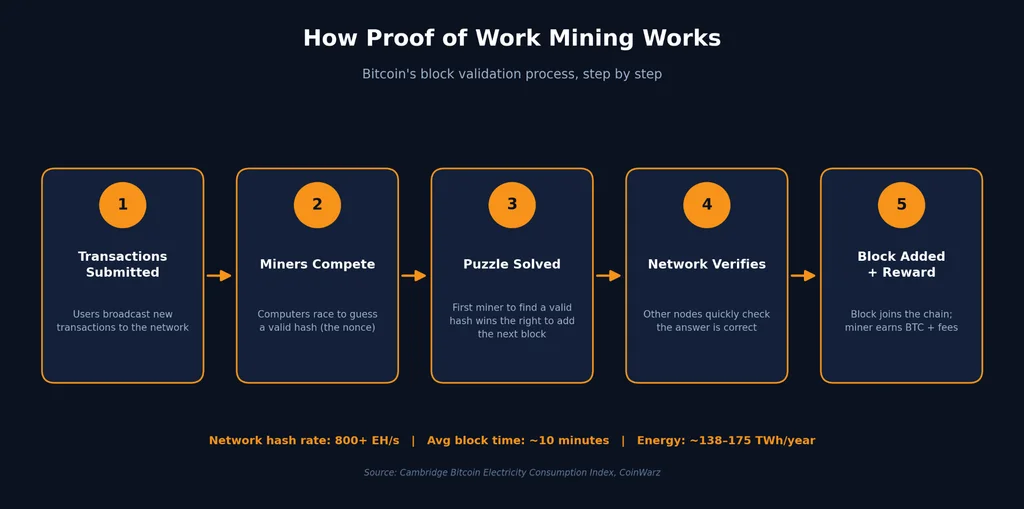
Proof of Work (PoW) is the consensus mechanism that secures many of the world’s largest cryptocurrencies. It relies on miners competing to solve complex cryptographic puzzles, making it extremely difficult for bad actors to alter blockchain records.
While PoW has been criticized for its energy use, which is estimated around 190 TWh, depending on the methodology used by researchers such as the Cambridge Bitcoin Electricity Consumption Index, it remains the most battle-tested consensus model for decentralized networks.
How Proof of Work Functions
PoW follows a straightforward process:
- Transactions are broadcast: Users submit transactions to the blockchain network.
- Miners verify transactions: Mining nodes collect valid transactions into a candidate block.
- Hash puzzle competition: Miners repeatedly generate hashes by changing a nonce (a random number used once) until one produces a hash below the network’s difficulty target.
- Block validation: The first miner to find a valid hash broadcasts the block to the network.
- Consensus: Other nodes verify the block before adding it permanently to the blockchain.
- Rewards: The successful miner receives the block reward plus transaction fees.
Hash Rate, Difficulty, and Block Rewards
Three components keep PoW networks secure:
- Hash rate: Measures the total computing power securing the blockchain. A higher hash rate makes attacks significantly more expensive. In 2026, Bitcoin’s network hash rate has consistently exceeded 800 EH/s and at times topped 1,000 EH/s (one zettahash). EH/s stands for Exahashes per second, which measures quintillions of mathematical guesses.
- Difficulty adjustment: To keep the network stable, Bitcoin automatically adjusts mining difficulty (making the puzzles harder or easier) every 2,016 blocks (about every two weeks) to maintain an average block time of 10 minutes.
- Block rewards: Miners earn newly created coins and transaction fees for successfully validating blocks. Following Bitcoin’s 2024 halving, the block reward remains 3.125 BTC until the next halving event.
Cryptocurrencies That Use Proof of Work
Several major cryptocurrencies continue to rely on PoW:
- Bitcoin (BTC): The largest and most secure PoW blockchain.
- Litecoin (LTC): Uses the Scrypt algorithm for faster block generation.
- Bitcoin Cash (BCH): A Bitcoin fork focused on faster, lower-cost payments.
- Dogecoin (DOGE): Uses merged mining with Litecoin, allowing miners to secure both networks simultaneously.
Mining in Practice
Mining has evolved from home computers to highly specialized operations.
ASIC miners
Modern PoW mining depends on application-specific integrated circuits (ASICs), purpose-built machines that deliver vastly higher performance and energy efficiency than CPUs or GPUs for hashing Bitcoin’s algorithm as fast as possible. A single competitive ASIC rig can cost anywhere from $3,000 to well over $20,000, and serious mining operations run thousands of them at once.
Mining pools
Because finding a block independently is increasingly difficult, most miners join mining pools. Participants combine computing power and share rewards based on their contribution, creating more predictable income.
Profitability factors: Mining profitability depends on several variables, including:
- Cryptocurrency price
- Network hash rate and mining difficulty
- Electricity costs
- ASIC efficiency
- Mining pool fees
- Transaction fee revenue
This is why it’s called “work.” You are literally burning electricity to prove you did the computation. As network difficulty rises, miners must continually upgrade hardware and secure low-cost electricity to remain competitive.
Pros of Proof of Work
- Battle-tested security. Bitcoin has run for over 15 years without a successful attack on its core protocol.
- Real-world cost creates real decentralization. You can’t fake spending electricity. That physical cost is itself a security feature.
- Proven resistance to attack. Taking over the Bitcoin network would require more hardware and electricity than most governments could quietly acquire.
Cons of Proof of Work
- Massive energy consumption. Bitcoin alone uses more electricity annually than most mid-sized countries.
- A heavy carbon footprint, since a large share of that electricity still comes from fossil fuels in some mining regions.
- Slow transaction speed, with new blocks landing roughly every 10 minutes.
- High cost to enter, plus a steady stream of e-waste as older mining hardware gets replaced.
Proof of Stake (PoS) Deep Dive
Source: ai-generated
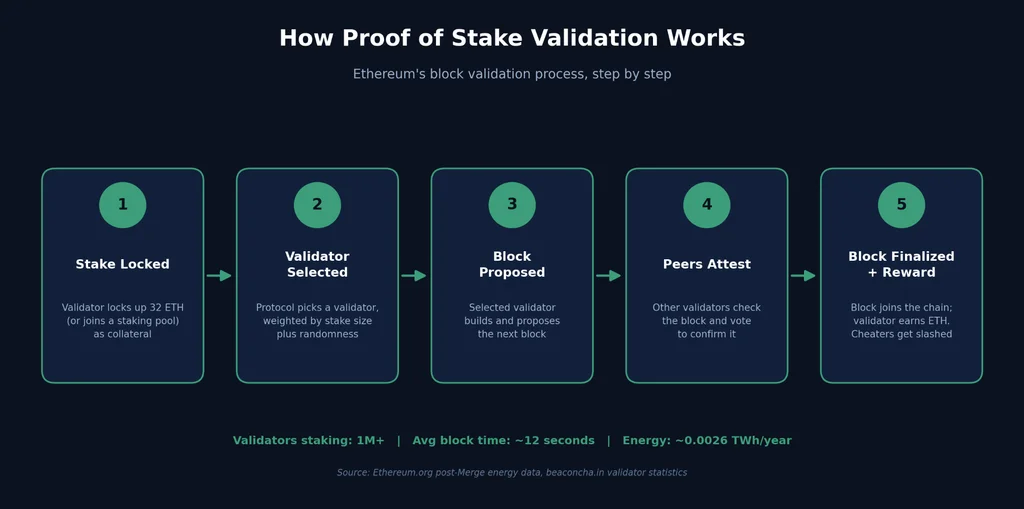
Proof of Stake (PoS) is a blockchain consensus mechanism that replaces energy-intensive mining with staking. Instead of competing with computing power, participants lock up cryptocurrency as collateral to help validate transactions and secure the network.
In return, they earn staking rewards. Ethereum adopted PoS in 2022 through The Merge, reducing its energy consumption by over 99% while improving scalability and security.
How Proof of Stake Works
PoS relies on validators rather than miners. Here’s how the process works:
1. Validator Selection
Users lock (stake) their coins to become eligible validators. The network then selects validators, typically at random, with stake size influencing the odds to propose and verify new blocks.
2. Staking Process
Validators deposit tokens into the network as collateral. On Ethereum, running an independent validator requires 32 ETH, although smaller holders can join staking pools.
3. Rewards
Staking yields differ significantly by network and validator participation rates. For instance, Ethereum staking yields hover between 3% and 4% APR, while newer high-throughput networks can offer higher nominal yields balanced by different token inflation models.
4. Slashing
Validators who act maliciously or repeatedly fail to meet network responsibilities can lose a portion of their staked assets. This economic penalty discourages fraud and strengthens network security.
Types of Proof of Stake
Several blockchain networks use different versions of PoS to balance decentralization, scalability, and governance.
- Pure Proof of Stake (PPoS): Validators are randomly selected based on their stake. This model, used by networks like Algorand, prioritizes fairness and energy efficiency.
- Delegated Proof of Stake (DPoS): Token holders vote for a limited number of delegates who validate transactions on their behalf. This approach offers faster transaction speeds but introduces more governance centralization.
- Nominated Proof of Stake (NPoS): Used by Polkadot, NPoS allows token holders to nominate trustworthy validators. Both validators and nominators share rewards and may also share penalties if validators behave dishonestly.
- Liquid Proof of Stake (LPoS): Token holders can delegate their stake without locking their assets permanently, giving them greater flexibility while still earning staking rewards.
Major Cryptocurrencies Using PoS
Several of today’s largest blockchain networks rely on Proof of Stake or PoS-based consensus models.
- Ethereum (ETH): Secures its massive decentralized app ecosystem via Proof of Stake, optimized by recent upgrades like Pectra to maximize validator efficiency.
- Cardano (ADA): Uses the Ouroboros PoS protocol, allowing users to delegate ADA to staking pools without surrendering custody of their tokens.
- Solana (SOL): Combines Proof of Stake with Proof of History (PoH) to deliver high transaction throughput and low fees.
- Polkadot (DOT): Uses Nominated Proof of Stake (NPoS), enabling nominators to support validators while earning a portion of staking rewards.
Staking in Practice
Staking allows investors to earn passive income while helping secure a blockchain network.
Requirements
To run a solo Ethereum validator, you need 32 ETH locked in the deposit contract, dedicated validator software, and reliable internet connectivity running around the clock. Ethereum’s 2025 Pectra upgrade raised the maximum a single validator can hold to 2,048 ETH, letting institutions consolidate thousands of small validators into far fewer large ones
You don’t need 32 ETH to participate, though. Investors with smaller holdings can participate through staking pools or liquid staking platforms that let you stake any amount and still earn a share of rewards. Ready to start earning? Our UEEx Ethereum Staking Guide walks through the process from start to finish.
Rewards
Staking yields differ by network and validator performance. Rewards are typically paid in the blockchain’s native token and fluctuate based on network activity and the total amount staked.
Responsibilities
Validators must remain online, validate transactions accurately, and follow protocol rules. Downtime or malicious actions can reduce rewards or trigger slashing penalties, making reliable operation essential.
“The Merge represents a change to the consensus mechanism, not the execution layer, meaning the way transactions are processed and finalized on Ethereum won’t change,”
Pros of Proof of Stake
- A massive cut in energy use: Ethereum’s move to PoS cut its energy footprint by about 99.95 percent.
- Very low environmental impact compared to mining-based networks.
- Much faster transactions, with new blocks roughly every 12 seconds.
- Lower barriers to entry and better scalability for future growth.
Cons of Proof of Stake
- A shorter track record: Ethereum’s full switch only happened in 2022, so it hasn’t been stress tested for as long as Bitcoin’s model.
- Wealth concentration concerns: Larger stakers earn larger rewards, which can, in theory, let big holders grow their share over time.
- More complex to build and audit, since the slashing rules and validator logic add layers that pure mining doesn’t have.
Proof of Work vs Proof of Stake: Direct Comparison
Here’s how the two models stack up side by side, using current 2026 figures.
| Feature | Proof of Work (Bitcoin) | Proof of Stake (Ethereum) |
| Who validates blocks | Miners | Validators |
| Selection method | Computational race (hashing) | Stake-weighted random selection |
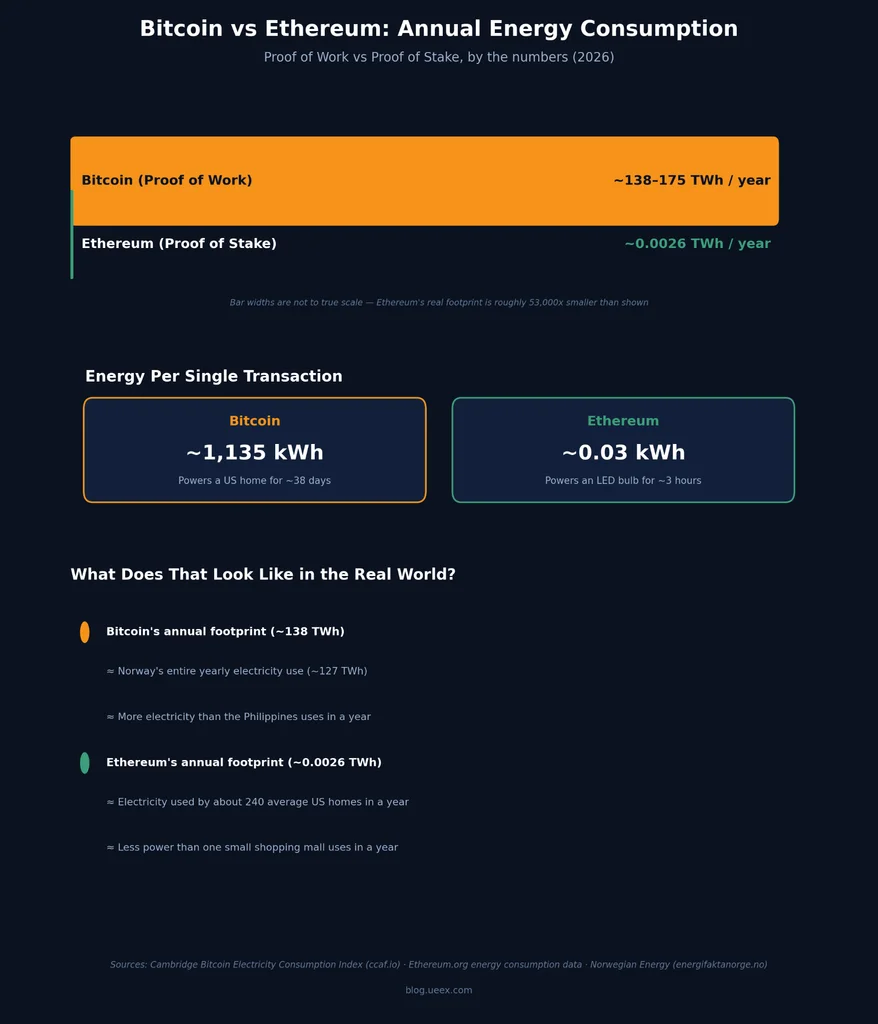
| Annual energy use | Roughly around 190 TWh per year | About 0.0026 TWh per year |
| Energy per transaction | Around 1,135 kWh | Around 0.03 kWh |
| Average block time | About 10 minutes | About 12 seconds |
| Entry cost | High: $3,000 to $20,000+ in mining hardware | Lower: 32 ETH to solo stake, or any amount through a pool |
| Environmental impact | Significant carbon footprint | Minimal carbon footprint |
| First launched | Bitcoin, 2009 | Peercoin, 2012 |
Energy figures are drawn from the Cambridge Bitcoin Electricity Consumption Index and Ethereum Foundation post-Merge estimates.
The Ethereum Merge: A Real-World Case Study
If you want proof that Proof of Stake can work at scale, look no further than Ethereum’s own history.
Ethereum launched in 2015, running on Proof of Work, just like Bitcoin. Miners secured the network for seven years while developers quietly built and tested a Proof of Stake alternative called the Beacon Chain, running in parallel since 2020.
On September 15, 2022, Ethereum executed what’s known as The Merge. The original PoW execution layer was joined with the PoS Beacon Chain, and mining on Ethereum stopped completely in a single, carefully planned event with no downtime.
The results were immediate and measurable. Ethereum’s energy use dropped by around 99.95 percent, falling from roughly 84,000 watt hours per transaction down to around 35 watt hours.
It eliminated the need for energy-intensive mining and instead enabled the network to be secured using staked ETH. It was a truly exciting step in realizing the Ethereum vision: more scalability, security, and sustainability.
“Ethereum’s energy consumption decreased by 99.95% after the Merge, a truly landmark achievement for the ecosystem,”
As of 2026, staking participation has kept climbing. Roughly a third of all ETH in existence is now staked, spread across more than a million active validators securing the network around the clock. The Merge is now the reference case every other PoW chain gets compared against when someone asks whether switching models is even possible.
Environmental Impact: The Numbers That Matter
Source: ai-generated
This is where the two models really pull apart.
Bitcoin’s electricity use is now estimated at around 190 TWh per year by the Cambridge Bitcoin Electricity Consumption Index. For context, 190 TWh is roughly comparable to the annual electricity consumption of Norway or Argentina and represents a significant portion of global electricity production.
To its credit, the Bitcoin mining industry has cleaned up its energy mix. Cambridge estimates around 52 percent of Bitcoin’s electricity now comes from sustainable sources, combining renewables and nuclear power.
Proof-of-stake networks tell a very different story. Ethereum’s total annual energy use post-Merge is estimated at roughly 0.0026 TWh, producing well under 1,000 tons of CO₂ per year, a rounding error next to Bitcoin’s footprint.
This gap hasn’t gone unnoticed by regulators or investors. ESG-focused funds increasingly favor PoS assets, and environmental campaigns like “Change the Code, Not the Climate” have specifically pushed Bitcoin to consider a PoS switch, something the Bitcoin community has firmly rejected in favor of preserving its existing security model.
Which Is Better: PoW or PoS?
The better choice depends on what you value most. Neither consensus mechanism is universally superior; each is designed with different priorities and trade-offs.
Choose Proof of Work (PoW) if you prioritize:
- Battle-tested security backed by Bitcoin’s long operating history.
- Strong decentralization, where network security is secured through computational work rather than staked capital.
- Long-term value preservation over maximum transaction throughput.
Choose Proof of Stake (PoS) if you prioritize:
- Energy efficiency with dramatically lower power consumption than PoW.
- Faster transaction finality and improved scalability for high-volume applications.
- Lower operating costs, making it easier to participate as a validator without specialized mining hardware.
Ultimately, PoW excels in security and resilience, while PoS offers better efficiency and scalability. The right choice depends on whether your priority is maximizing security or optimizing speed, sustainability, and network growth
Also Read: Layer 1 vs Layer 2 Scalability Solutions 2026: The Complete Guide
PoW vs. PoS: What It Means for Crypto Investors
For investors, Proof of Work (PoW) and Proof of Stake (PoS) differ more in network design than in return potential. Neither consensus model protects you from price swings.
Both PoW and PoS cryptocurrencies can experience sharp price swings, meaning market sentiment, adoption, and macroeconomic conditions typically have a greater impact on price than the consensus mechanism itself.
Regulation is where the distinction becomes more significant. In many jurisdictions, Proof of Work assets like Bitcoin are primarily viewed as commodities due to their physical mining cost. Conversely, regulators have historically scrutinized Proof of Stake networks as potential securities, although U.S. guidance issued in 2025 clarified that routine protocol staking on its own is not a securities transaction. PoS networks consume far less energy than PoW blockchains, making them more attractive to institutional investors and ESG-focused funds as environmental scrutiny around crypto continues to grow.
Rather than choosing one over the other, investors can reduce risk by diversifying across both. PoW assets such as Bitcoin offer proven security and scarcity, while PoS projects like Ethereum, Cardano, and Solana provide staking rewards and energy-efficient networks with growing real-world adoption.
Platforms like UEEx support both PoW and PoS assets, allowing investors to build a diversified portfolio without being limited to a single blockchain ecosystem.
Frequently Asked Questions
What is the main difference between PoW and PoS?
Proof of Work secures a blockchain through computational competition, where miners solve math puzzles using electricity and hardware. Proof of stake secures a blockchain through financial commitment, where validators lock up crypto as collateral and get penalized for dishonest behavior.
Is PoS more secure than PoW?
Not necessarily more secure, just secure in a different way. Proof of Work has a longer real-world track record, having protected Bitcoin since 2009 without a successful attack. Proof of Stake is newer at scale, with Ethereum’s full switch happening in 2022, but it has held up well so far and uses financial penalties instead of energy costs to deter attacks.
Why did Ethereum switch from PoW to PoS?
Ethereum switched mainly to cut its environmental footprint and improve long-term scalability. The move, known as “The Merge,” happened on September 15, 2022, and cut Ethereum’s energy use by about 99.95 percent almost overnight.
Does Bitcoin plan to switch to Proof of Stake?
No, the Bitcoin community has consistently rejected proposals to move away from Proof of Work, viewing the energy cost as a core part of its security model rather than a flaw to fix.
The 2026 Verdict: Which Model Actually Wins?
Ultimately, neither model secures a flawless victory because they solve for entirely different priorities. Proof of Work remains the undisputed king for raw, unforgeable asset security, anchoring Bitcoin as digital gold. Conversely, Proof of Stake wins the crown for utility, decentralized application scale, and regulatory friendliness by scrubbing the environmental overhead completely out of the equation.