Every week, someone loses money to a slow transaction or a gas fee that costs more than the trade itself. It still happens in 2026, just less often than it used to.
For instance, Ethereum’s base layer processes somewhere around 15 to 30 transactions per second. Visa, on a busy shopping day, can clear tens of thousands per second. That gap is the reason “Layer 1 vs Layer 2” has become one of the most searched questions in crypto.
This guide breaks down what Layer 1 and Layer 2 actually mean, how each one tries to solve blockchain’s speed problem, and which one fits your use case, whether you’re trading, building, or just trying to understand where your gas fees are going.
Key Takeaways
Layer 1 is the base blockchain. Layer 2 is a network built on top of it that handles transactions faster and cheaper, then settles back to Layer 1 for security.
No blockchain has solved the decentralization-security-scalability trilemma completely. Every scaling method trades one for another.
Ethereum scales mainly through Layer 2 rollups. Solana scales by optimizing its own base layer directly.
Optimistic rollups (Arbitrum, Base, Optimism) offer cheap, EVM-compatible scaling but require a roughly week-long withdrawal window to Ethereum mainnet.
ZK-rollups (zkSync, Starknet, Polygon zkEVM) offer faster finality and stronger mathematical security guarantees but are still growing their ecosystems.
The realistic future is a multi-chain world where different networks specialize in what they do best.
Vitalik Buterin, one of Ethereum’s co-founders, described this problem with something now called the blockchain trilemma. The idea is simple: a blockchain can be strongly decentralized, genuinely secure, and highly scalable, but pushing hard on any two usually pulls the third one down.
Here’s why, in plain terms:
More decentralization means more independent computers (nodes) checking every transaction. More checking takes more time. Speed drops.
More security means stricter rules for validating each transaction. Stricter rules cost more computing power. Speed drops again.
More scalability, if you get it by shrinking the number of validators or letting one operator order transactions, quietly chips away at decentralization.
This is the entire reason Layer 2 networks exist. Instead of forcing Ethereum’s base layer to somehow do everything at once, developers built separate networks on top of it that handle the heavy lifting, then check back in with Ethereum for the final word on security.
“No blockchain has fully solved the trilemma as of 2026. Layer 1 and Layer 2 scaling are the two main strategies for getting as close as possible without giving up what makes a blockchain trustworthy in the first place.”
What Is Layer 1? The Base Layer Explained
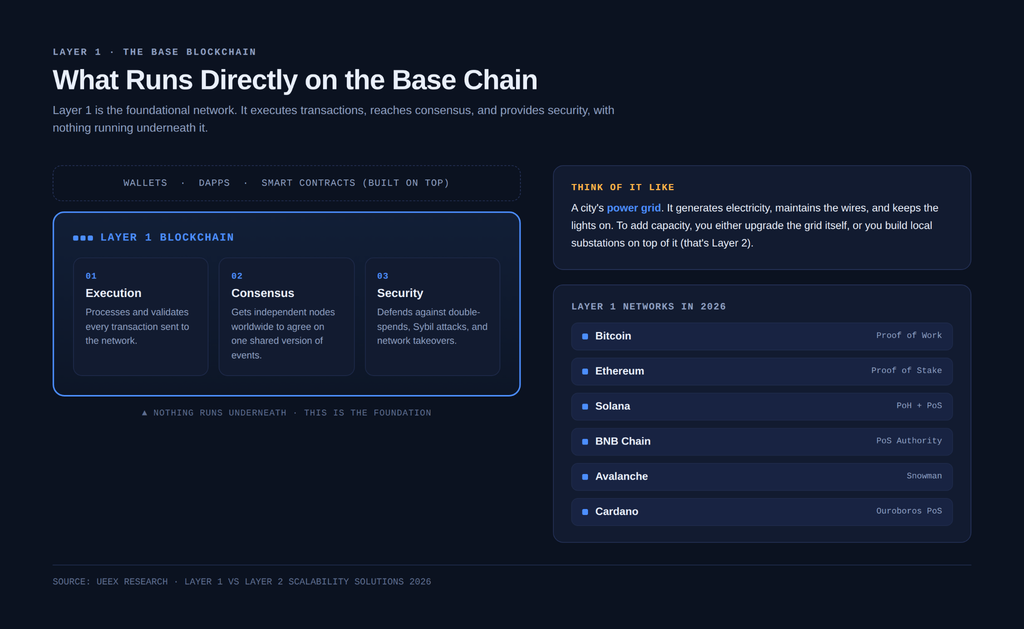
Layer 1 is the underlying blockchain itself. It’s the foundational network that processes transactions, reaches agreement (consensus) on what happened, and secures everything on top of it. Bitcoin, Ethereum, Solana, BNB Chain, Cardano, and Avalanche are all Layer 1 blockchains.
Every Layer 1 handles three jobs:
Executing transactions: actually running and confirming what people send, swap, mint, or stake.
Reaching consensus: getting thousands of independent computers around the world to agree on the same version of events.
Providing security: defending against attacks like double-spending or a single actor taking over the network.
Think of Layer 1 like a city’s power grid. It generates the electricity, keeps the wires running, and makes sure the lights stay on. If you need more capacity, you have two choices: upgrade the grid itself or build local substations that draw from it and distribute power more efficiently to individual neighborhoods. The grid is Layer 1, while the substations are Layer 2.
How Layer 1 Chains Try to Scale Themselves
1. Upgrading the Consensus Mechanism
Ethereum’s biggest shift came with the September 2022 Merge, replacing energy-intensive Proof of Work with Proof of Stake. Validators now stake ETH instead of mining, cutting network energy use by roughly 99.95%, per the Ethereum Foundation. Speed wasn’t the goal, though Ethereum L1 still processes just 15–30 TPS, serving instead as the foundation for later scaling upgrades.
Solana chose a different path, combining Proof of Stake with Proof of History, a timestamping method that lets validators agree on transaction order without constant cross-communication.
This design supports 1,000–4,000 real TPS today (excluding vote traffic). In August 2025, a stress test using lightweight “no-op” calls briefly hit 107,000 TPS, impressive, though trackers like Solscan and Chainspect note real user activity remains far lower.
Solana’s next major upgrade, Alpenglow, was approved by validators with 98% support and aims to cut finality from 12.8 seconds to around 150 milliseconds using new Votor and Rotor protocols, with mainnet activation possible as early as late Q3 2026.
BNB Chain takes a different tradeoff, using Proof of Staked Authority, a small, fast validator set, to hit roughly 2,000 TPS, sacrificing some decentralization for throughput.
2. Sharding: Splitting the Work Into Pieces
Sharding was originally designed to improve blockchain scalability by splitting the network into parallel “shards” that process transactions simultaneously, much like multiple kitchens serving customers at once.
Ethereum has since shifted its strategy, focusing on danksharding, which provides inexpensive data storage for Layer 2 networks rather than sharding transaction execution. The first major step came with the Dencun upgrade (EIP-4844) in March 2024, introducing “blobs” that reduced Layer 2 data costs by over 90%.
The Pectra upgrade in May 2025 enhanced staking flexibility and smart wallet functionality, while Fusaka in December 2025 added PeerDAS, enabling efficient verification of large data volumes and increasing blob capacity.
Looking ahead, the planned Glamsterdam upgrade targets shorter slot times and further scaling into 2027, while longer-term statelessness research aims to shrink node storage requirements and make Ethereum validation more accessible.
“Ethereum has pivoted toward a rollup-centric roadmap, where Layer 2 networks handle most of the transaction volume while Layer 1 focuses on providing data availability and rock-solid security underneath them.”
3. Bigger Blocks, Faster Blocks
Two blunt but effective levers: fit more transactions into each block, or produce blocks more often.
For example, in order to increase throughput toward about 50 TPS and more, Bitcoin Cash, a fork of the Bitcoin blockchain, raised its block size from 1MB to 8MB. Later updates raised the cap to 32MB. The trade-off is that bigger blocks take longer to download and verify, which quietly pushes out smaller node operators who can’t keep up, nudging the network toward centralization.
On block speed: Solana produces blocks roughly every 400 milliseconds, Ethereum every 12 seconds, and Bitcoin every 10 minutes. Solana keeps tuning this further. In July 2026, it rolled out a roughly 20% increase to per-block compute capacity, part of a steady stream of tweaks aimed at squeezing more throughput out of the existing design, proof that L1 optimization never really stops, even for a chain built for speed from day one.
4. Making the Data Itself Lighter
Ethereum’s planned Verkle trees would replace the current data structure with one that produces far smaller “proofs,” the cryptographic receipts a node needs to confirm state without storing everything.
Paired with state expiry, where old, rarely used data quietly ages out of the active set, the goal is to make running a full validator cheap enough that ordinary people keep doing it. That matters because decentralization depends on there being lots of independent validators, not just a few well-funded data centers.
A Comparison Table of The Layer 1 Space in 2026
Chain
Approx. TPS
Consensus
Notable Strength
Notable Trade-off
Ethereum (ETH)
15–30 (L1)
Proof of Stake
Largest developer ecosystem, deepest institutional trust
L1 alone is still slow; relies on L2s for scale
Solana (SOL)
1,000–4,000 real-world
Proof of History + PoS
Fast, cheap, strong consumer and trading apps
Smaller validator set; past network outages (2021–2023)
BNB Chain (BNB)
2,000
Proof of Staked Authority
Low fees, huge retail user base via Binance
Small validator set means more centralization
Avalanche (AVAX)
4,500
Snowman consensus
Customizable subnets for specific use cases
Smaller DeFi ecosystem than Ethereum or Solana
Cardano (ADA)
Low, deliberately conservative
Ouroboros PoS
Peer-reviewed research approach
Slower feature rollout, smaller DeFi footprint
Numbers like these shift week to week. For live figures, DeFiLlama and L2Beat are the two trackers worth bookmarking.
Bottom line on Layer 1 scaling: Ethereum bet on staying secure and decentralized at the base layer while pushing volume onto Layer 2s. Solana bet on making one fast chain that doesn’t need a second layer at all. Both approaches are working for different audiences.
What Is Layer 2? Building on Top of the Foundation
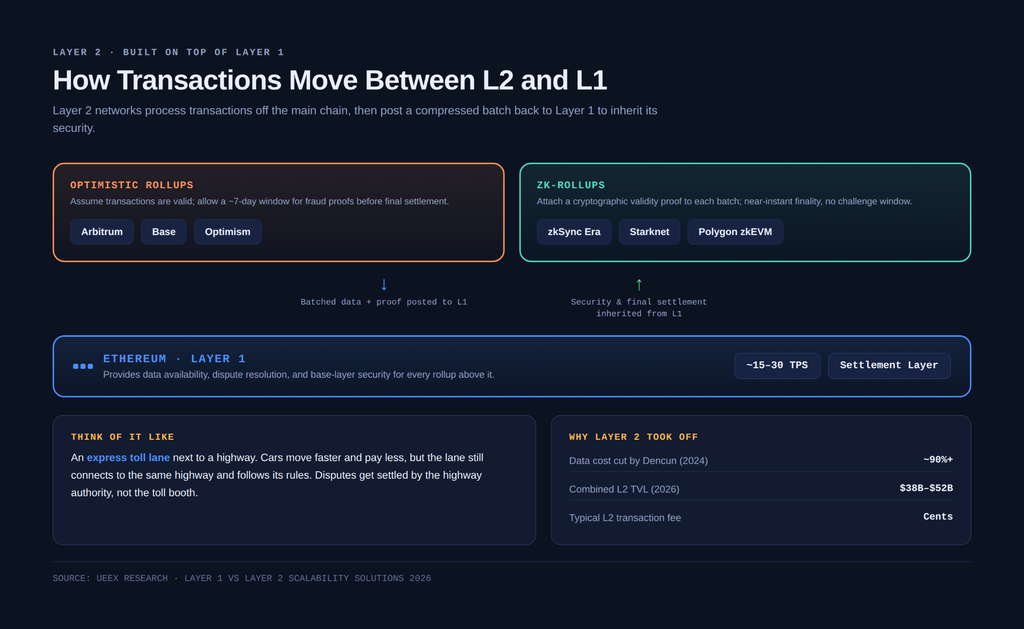
Layer 2 is a separate network built on top of a Layer 1 blockchain that processes transactions off the main chain, then reports a summary back to Layer 1 for final security.
Instead of forcing every single transaction through Ethereum’s narrow lane, an L2 batches thousands of them together and submits one compact proof back to the base chain.
The clever part is that Layer 2s don’t have to sacrifice Ethereum’s security to get this speed. If an L2 operator tries to submit fraudulent data, the system is built so anyone can catch and challenge it directly on Ethereum. That dispute mechanism is what lets an L2 inherit most of Ethereum’s security while running its own show off to the side.
Think of Layer 2 as an express toll lane next to a highway. Cars move faster and pay less, but the lane still connects to the same highway and follows its underlying rules. If there’s ever a dispute, it gets settled by the highway authority, not the toll booth operator.
Layer 2s exploded in relevance after Ethereum’s Dencun upgrade in March 2024 made posting data to L1 roughly 90% cheaper. Combined TVL across all Ethereum Layer 2 networks has hovered between roughly $38 billion and $52 billion through 2025 and 2026, according to L2Beat, depending on market conditions.
Types of Layer 2 Solutions
Here are the different types of Layer 2 solutions and examples
Optimistic Rollups
Optimistic rollups scale Ethereum by assuming transactions are valid unless challenged within a fraud-proof window, usually seven days. A sequencer batches transactions and submits compressed data to Ethereum, where they become final if no fraud is detected.
They are easier to build and fully compatible with Ethereum tools, but the main drawback is the seven-day withdrawal period when moving funds back to Ethereum without a fast bridge.
Examples:
Arbitrum One is currently the largest Ethereum L2 by total value locked, generally holding somewhere around 40% of all L2 TVL. It’s home to major DeFi protocols like Uniswap, Aave, and GMX, and it uses a Rust and C++-friendly environment called Stylus alongside standard Solidity contracts.
Base, built by Coinbase on Optimism’s OP Stack, has grown into one of the largest consumer-facing L2s, driven heavily by Coinbase’s wallet and fiat on-ramp integrations. It typically ranks second in TVL, not far behind Arbitrum, and leads most L2s in daily active addresses.
Optimism (OP Mainnet) pioneered the “Superchain” idea, a shared framework that lets multiple L2s, including Base, interoperate more easily as a connected family of chains rather than as isolated islands.
Zero-Knowledge Rollups (ZK-Rollups)
ZK-rollups eliminate the long withdrawal delays common with optimistic rollups by using cryptographic proofs (SNARKs or STARKs) to verify every transaction batch before it reaches Ethereum. This enables near-instant finality while providing strong mathematical security guarantees.
Although they offer faster settlement and enhanced security, ZK-rollups are more complex to build, requiring significant computing power, and many ecosystems are still smaller than leading optimistic rollups in liquidity and adoption.
Examples:
zkSync Era uses zkSNARKs and supports both Solidity and Vyper, with native account abstraction built in for a smoother wallet experience.
Starknet uses zkSTARKs, which don’t require a “trusted setup” and are considered resistant to future quantum computing attacks. It runs on its own language, Cairo, rather than standard Solidity, which narrows the pool of developers who can build on it immediately but gives the network more flexibility under the hood.
Polygon zkEVM targets full compatibility with Ethereum’s existing tooling, aiming to make migrating an existing Ethereum app as close to copy-paste as possible.
Other Layer 2 and Layer 2-Adjacent Designs
State channels, like the Bitcoin Lightning Network, let two parties transact off-chain as many times as they want and only touch the base chain to open and close the channel. Great for micropayments, but both sides need to stay online and lock up capital upfront.
Sidechains, such as Polygon PoS, run their own independent consensus and connect back to Ethereum through a bridge. They’re flexible and fast but don’t inherit Ethereum’s full security the way a rollup does.
Plasma was an earlier fraud-proof design that mostly gave way to modern rollups, though some of its ideas still show up in specialized use cases.
Validium works like a ZK-rollup but stores transaction data off-chain instead of on Ethereum, making it even cheaper at the cost of a slightly weaker data availability guarantee. It’s popular for privacy-sensitive or enterprise applications.
Below is a comparison table of Layer 1 and Layer 2 networks
Category
Ethereum L1
Solana L1
Optimistic Rollup (e.g., Arbitrum)
ZK-Rollup (e.g., zkSync)
Transaction speed
15–30 TPS
1,000–4,000 TPS real-world
Up to tens of thousands TPS
Up to tens of thousands TPS
Finality
12-second blocks, minutes to full finality
Seconds today, targeting 150ms with Alpenglow
Instant soft finality; 7 days to withdraw to L1
Instant soft finality; roughly an hour to L1
Typical transaction cost
Often well under $1 today; spiked past $50 during past congestion
Fractions of a cent
Cents
Cents, often lower than optimistic rollups
Security model
Hundreds of thousands of PoS validators
Roughly 1,000+ PoS/PoH validators
Inherits L1 security via fraud proofs
Inherits L1 security via validity proofs
Decentralization
Very high
Moderate; growing with Firedancer client
Currently centralized sequencers, roadmaps in progress
Currently centralized provers, roadmaps in progress
Developer experience
Solidity, mature tooling
Rust, mature but distinct tooling
Solidity, near drop-in compatibility
Mixed: some EVM-equivalent, some custom (Cairo)
Ecosystem maturity
Largest in crypto
Large and fast-growing
Maturing, strong DeFi liquidity
Earlier stage, smaller liquidity
Fees on Ethereum have fallen sharply since Dencun, Pectra, and Fusaka. Academic tracking published on arXiv shows median mainnet transaction fees dropping from roughly $3.79 in early 2024 to about $0.01 in early 2026, though fees still spike during periods of heavy demand.
Real-World Examples: How This Plays Out in Practice
DEX trading
DeFi trading and lending hinge on transaction cost versus trade size. Ethereum L1 remains the choice for high-value swaps and large lending positions ($50,000+), where security outweighs gas costs.
For everyday trading, Layer 2s like Arbitrum cut fees to roughly $0.01–$0.30 per transaction, while Solana keeps costs between $0.0001 and $0.01, making it the default for high-frequency traders and platforms like Jupiter, which routes most of Solana’s DEX volume.
NFTs
Blue-chip collections tend to stay on Ethereum mainnet, where prestige and deep liquidity matter more than mint cost.
Mid-tier generative art and PFP projects have increasingly moved to Base and Arbitrum, where mint costs run a few dollars instead of hundreds. Gaming NFTs lean toward Solana, where “compressed” NFTs can be minted for a fraction of a cent, making it realistic to mint millions of in-game items.
Gaming
Ethereum’s 12-second block time is a nonstarter for real-time gameplay. Solana’s sub-second blocks and near-zero fees make it a natural fit, which is part of why projects like Star Atlas and Aurory built there.
On the Ethereum side, purpose-built chains like Arbitrum Nova and gaming-focused L2s aim to bring similar performance while staying inside the Ethereum ecosystem.
Payments
Solana’s roughly sub-cent fees and multi-second finality have attracted real institutional interest, including integrations explored by Visa and Stripe, since a fraction-of-a-cent transfer that settles in seconds is a genuinely different product than a traditional wire transfer that takes days.
Every scaling choice trades something for something else. A few honest points worth knowing before you build or trade on any of these networks:
Security
Ethereum L1 remains the gold standard, with around one million active validators across 80+ countries and roughly 39 million staked ETH securing the network as of 2026, though gas costs stay high.
Solana trades some battle-testing for speed: its validator set spans 37 countries with a Nakamoto coefficient around 19, but active validators have fallen roughly 68% since 2023, from about 2,500 to near 800, raising centralization concerns even as Firedancer improves client diversity.
Among L2s, Optimistic Rollups (Arbitrum, Optimism) inherit Ethereum’s security via fraud proofs but rely on centralized sequencers; ZK-Rollups offer cryptographic finality with no fraud-window delay, though prover centralization remains a bottleneck.
Decentralization
Ethereum’s validator base is the most geographically distributed in crypto, aided by a 32 ETH minimum stake and consumer-grade hardware. Solana’s higher hardware bar concentrates nodes among fewer, better-resourced operators.
Most L2 sequencers today are single-operator, though decentralized sequencer roadmaps are live across major networks. As Bitcoin’s mining pool concentration shows, perfect decentralization is unrealistic; the real question is sufficient decentralization for the use case.
User Experience
Solana wins on simplicity: one chain, one wallet, and low fees. Meanwhile, Ethereum L2s still suffer fragmented liquidity, $8–20 bridging costs, and multi-day withdrawal delays on Optimistic Rollups.
That said, UX is converging: Base’s Coinbase integration, Pectra’s EIP-7702 account abstraction, and native smart-contract wallets on zkSync are closing the gap. Chain-abstraction tooling is emerging that could soon make the L1-vs-L2 decision invisible to end users entirely.
Bottom line: In 2026, you can optimize for security, speed, or cost, but rarely all three, though ZK-Rollups are closest to breaking that trade-off.
“Perfect decentralization is a myth; even Bitcoin has mining pool concentration to worry about. The real 2026 question isn’t which chain is ‘most decentralized’ in the abstract. It’s whether a given chain is sufficiently decentralized for what you’re actually using it for.”
When to Use Layer 1 vs Layer 2
This section helps you decide on how to choose the right network
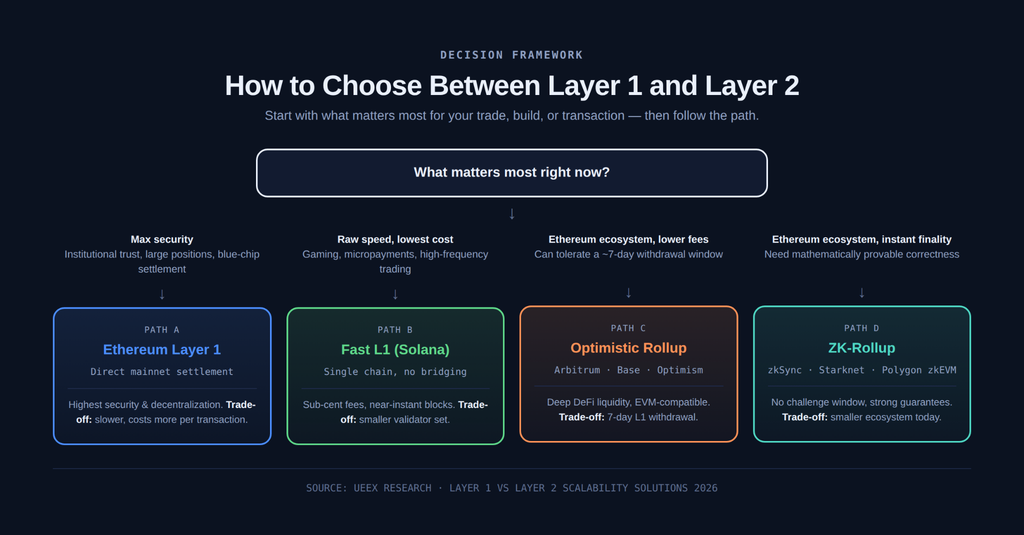
Choose Ethereum Layer 1 When:
Maximum security matters more than cost (large custody positions, institutional settlement)
You need to interact with the full breadth of Ethereum’s composable DeFi ecosystem directly
You’re trading blue-chip, high-value NFTs where provenance and prestige matter
Choose Solana Layer 1 When:
Speed and rock-bottom fees are the priority (high-frequency trading, gaming, micropayments)
Your app needs to process many actions happening at once
You’re building for price-sensitive users in emerging markets
What is the main difference between Layer 1 and Layer 2 blockchains?
Layer 1 blockchains, such as Ethereum, Solana, and Bitcoin, operate independently with their own security and consensus. Layer 2 networks build on Layer 1, delivering faster, cheaper transactions while inheriting the base chain’s security.
Is Layer 2 safer than Layer 1?
Layer 2 networks are designed to be almost as secure as Layer 1 while offering much lower fees. They inherit Layer 1 security but still rely on largely centralized sequencers in 2026, though decentralization plans are underway.
Do I need to bridge assets to use a Layer 2 network?
Yes, you can transfer funds from Ethereum to Layer 2 networks like Arbitrum, Base, or zkSync using an official or third-party bridge. You’ll pay a small Ethereum gas fee, while transfer times vary from minutes to up to seven days, depending on the Layer 2 network.
Will Layer 2 networks eventually replace Layer 1?
No, Layer 2 networks cannot replace Layer 1 because they rely on it for security and final transaction settlement. Instead, they scale Layer 1, handling most everyday transactions while the base layer provides security and finality.
Disclaimer: This article is intended solely for informational purposes and should not be considered trading or investment advice. Nothing herein should be construed as financial, legal, or tax advice. Trading or investing in cryptocurrencies carries a considerable risk of financial loss. Always conduct due diligence before making any trading or investment decisions.
Trade with proof of Reserves
UEEx publish monthly audits and third party verification on every listed market.