
Blockchain technology has transformed the way digital transactions are recorded by offering a system that is secure, transparent, and resistant to tampering. At the heart of this innovation is blockchain hashing.
This cryptographic process converts data into a unique fixed-length code, allowing networks to verify information, detect alterations, and maintain the integrity of every block. Without hashing, cryptocurrencies like Bitcoin and Ethereum could not operate securely.
The importance of hashing came into the spotlight after researchers presented findings at EUROCRYPT 2024 showing they had successfully attacked a reduced 31-round version of SHA-256, the cryptographic hash function that underpins Bitcoin.
While the announcement sparked concerns about Bitcoin’s security, the reality was far less alarming. Bitcoin relies on the full 64-round SHA-256 algorithm, leaving a significant gap between the research breakthrough and any practical attack.
So, how secure is blockchain hashing today, and why does it remain the backbone of modern blockchain networks? Let’s explore.
Key Takeaways
- Hashing turns any data into a fixed-size code that can’t be reversed and changes completely if even one character in the input changes.
- Bitcoin uses SHA-256, Ethereum uses Keccak-256, and newer tools increasingly use Blake3 for speed.
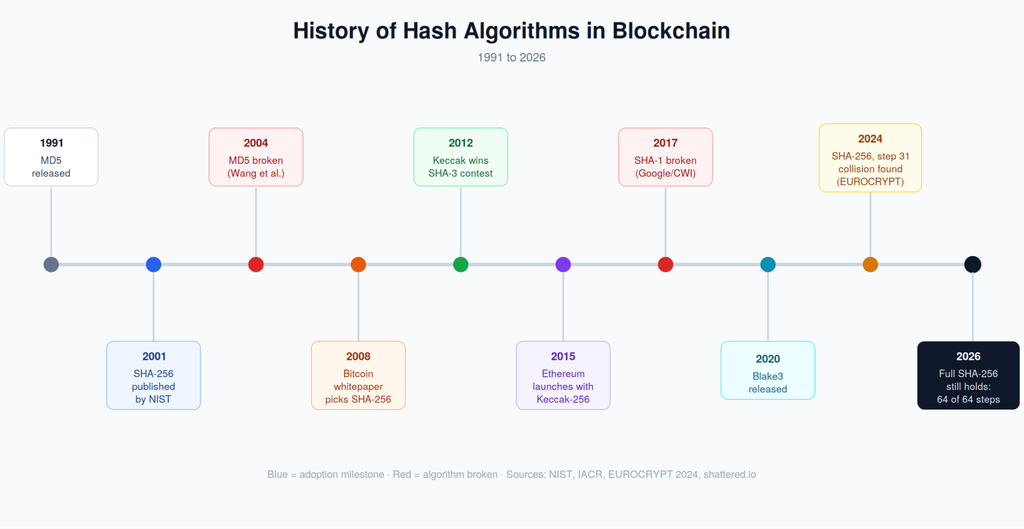
- The 2024 EUROCRYPT collision attack broke 31 of SHA-256’s 64 steps. That’s real progress for researchers, not a real threat to Bitcoin.
- Merkle trees let blockchains prove a single transaction is valid without downloading the entire chain.
Historical Evolution of Blockchain Hashing
Source: AI-generated
Hashing existed long before blockchain technology and was originally developed to verify data integrity and strengthen digital security. Early cryptographic hash functions such as MD5 and SHA-1 became widely used in the 1990s, but advances in computing eventually exposed weaknesses that made them vulnerable to collision attacks.
These limitations led to the adoption of stronger algorithms, including SHA-256, part of the SHA-2 family introduced in 2001, which remains one of the most trusted hashing standards today.
Blockchain hashing entered the spotlight with the launch of Bitcoin in 2009. Satoshi Nakamoto selected SHA-256 to secure transactions, link blocks together, and power Bitcoin’s Proof-of-Work consensus mechanism.
Its one-way design and resistance to tampering make it ideal for preserving blockchain integrity, as even a tiny change in input produces a completely different hash.
Since Bitcoin’s debut, hashing has become a foundational component of blockchain technology, supporting everything from transaction verification and mining to smart contracts and decentralized applications across modern blockchain networks.
What Is Hashing in Blockchain?
Source: ai-generated
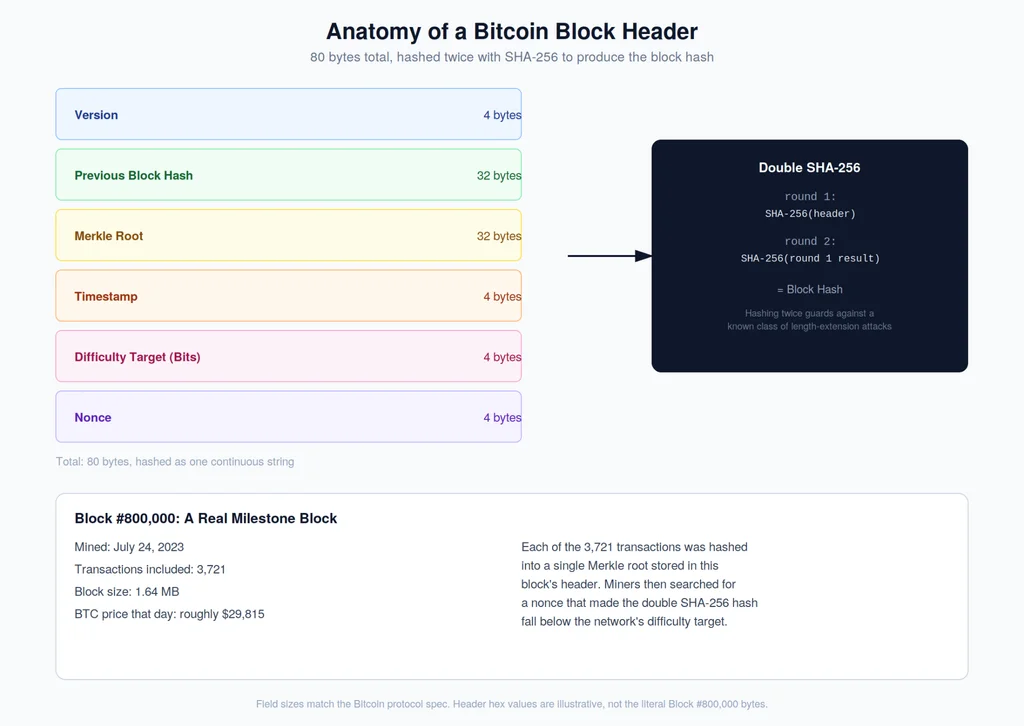
Hashing in blockchain is the process of running data, a transaction, a block, a file, or anything through a math function that spits out a unique fixed-length code called a hash. That chain of hashes is where the word “blockchain” actually comes from.
This plays a key role in generating and verifying digital signatures. Change even one letter in the input, and the hash comes out completely different. Because every block contains the hash of the previous block, even a minor change to stored data produces a completely different hash, instantly exposing any attempt to tamper with the blockchain.
To successfully alter a block, an attacker would have to recalculate the hashes for that block and every subsequent block while also outpacing the network’s consensus mechanism, a task that is computationally impractical on well-secured blockchains.
As a result, hashing helps preserve the integrity, transparency, and trustworthiness of blockchain networks. This immutability is what makes blockchain technology so reliable and tamper-proof.
That’s the whole idea. Everything else in this article is just explaining why that simple trick turned out to be so powerful. Every block in Bitcoin, Ethereum, and pretty much every other blockchain carries a hash of its own data plus the hash of the block before it.
Uses of Hash Functions in Blockchain
Hash functions are a core component of blockchain technology, helping secure data, verify transactions, and maintain the integrity of decentralized networks. Here are their primary applications:
Merkle Trees
Blockchains use Merkle trees to organize transaction data efficiently. Individual transactions are hashed and combined until a single Merkle root is produced, which is stored in the block header. Any change to a transaction alters the root hash, making tampering easy to detect while enabling fast transaction verification.
Consensus Mechanisms
Hash functions also power blockchain consensus mechanisms such as Proof of Work (PoW). In Bitcoin, miners repeatedly hash block headers until they find a hash below the network’s target difficulty, ensuring blocks are validated fairly and securely.
Digital Signatures
Digital signatures rely on cryptographic hash functions to verify transaction authenticity and data integrity. Instead of signing an entire transaction, users sign its hash, allowing others to confirm ownership and detect any unauthorized changes without exposing private keys.
Data Storage and Retrieval
Hashing also improves data storage and retrieval by assigning every block and transaction a unique digital fingerprint. This allows blockchain networks to locate, verify, and retrieve information quickly while preserving the integrity of records across decentralized systems.
Properties of a Secure Cryptographic Hash Function
A cryptographic hash function is only effective if it meets several essential security and performance requirements.
- Collision Resistance: It should be computationally infeasible to find two different inputs that produce the same hash value. In other words, finding two messages (m₁ and m₂) where hash(k, m₁) = hash(k, m₂) should be practically impossible. This prevents attackers from substituting one piece of data for another without detection.
- Preimage Resistance: Given only a hash value, it should be virtually impossible to determine the original input that generated it. This one-way property ensures sensitive information cannot be recovered from its hash.
- Second Preimage Resistance: Even if an attacker knows the original message, they should not be able to find a different message that produces the same hash. This protects against attempts to replace legitimate data with a malicious alternative.
- Large Output Space: A secure hash function should generate a sufficiently large range of possible outputs (such as 256 bits). The enormous number of possible hash values makes brute-force collision attacks computationally impractical.
- Deterministic Output: A hash function must always produce the same hash for the same input. Regardless of when or where the function is executed, identical data should always result in an identical hash value.
- Avalanche Effect: A tiny change in the input, even changing a single bit, should produce a completely different hash output. This property prevents attackers from identifying relationships between similar inputs and their corresponding hashes.
- Puzzle Friendliness (Unpredictability): A secure hash function should make it impossible to predict any part of the output or infer missing portions of the input from partial information. Even if an attacker knows most of the input, they should not be able to determine the remaining data or predict the resulting hash.
- Fixed-Length Output: Regardless of whether the input is a single character or an entire database, the hash function always produces an output of the same length. For example, SHA-256 consistently generates a 256-bit (32-byte) hash for every input, making storage and verification efficient.
How Do Hash Functions Actually Work?
Source: ai-generated
Think of a hash function like a paper shredder that always makes the exact same-sized pile of confetti, no matter how big or small the paper you feed it is.
Feed it a single word or an entire novel, and you get back confetti of the exact same size either way. And here’s the trick: no two different pieces of paper should ever produce the same pile of confetti, and you should never be able to glue the confetti back into the original page.
That’s a hash function in plain terms. In technical terms, a good cryptographic hash function needs four properties:
- Deterministic: The same input always produces the same output. Every time, forever.
- Fast to compute: Your computer should be able to hash something almost instantly.
- One-way: You can turn data into a hash easily. Turning a hash back into the original data should be practically impossible.
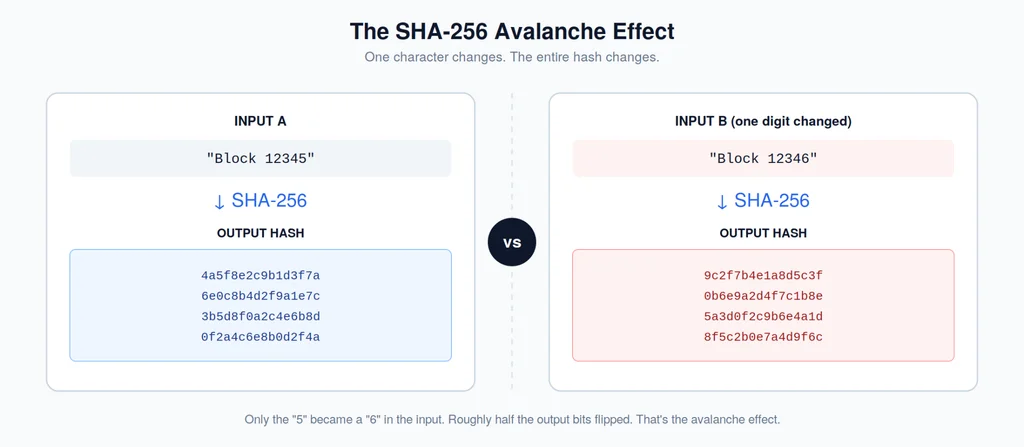
- Sensitive to change: Flip a single bit in the input, and the output should look totally different. This is called the avalanche effect.
The Avalanche Effect, In Plain English
Here’s a real example using SHA-256. Try hashing these two inputs:
Input: “I owe you 10 dollars”
Output: 3367642f44f82b0c063b69805aefa6af49dcf20e338e0d91dc546174dbae0173
Input: “I owe you 10 Dollars”
Output: 7922c6ed072fb8330e12b386d9c98c94786236c1bc3b9adbfa16105442c3e5cc
One capital letter changed. The hash isn’t a little different. It’s completely, unrecognizably different. That’s the avalanche effect at work, and it’s exactly why you can’t guess or reverse-engineer a hash by nudging inputs closer and closer to a target.
A single flipped bit should change roughly half of the output bits. If it doesn’t, the hash function has a design flaw.
Hashing in Code: Python, JavaScript, and Solidity
Reading about hashing only gets you so far. Here’s what it actually looks like when you write it.
Python
import hashlib
def hash_data(data: str) -> str:
return hashlib.sha256(data.encode(‘utf-8’)).hexdigest()
print(hash_data(“Hello, blockchain”))
# Output: a fixed 64-character hex string, every time
JavaScript (Node.js)
const crypto = require(‘crypto’);
function hashData(data) {
return crypto.createHash(‘sha256’).update(data).digest(‘hex’);
}
console.log(hashData(“Hello, blockchain”));
// Same 64-character output as the Python version above
Solidity (Ethereum Smart Contracts)
// SPDX-License-Identifier: MIT
pragma solidity ^0.8.20;
contract HashExample {
function hashData(string memory data) public pure returns (bytes32) {
return keccak256(abi.encodePacked(data));
}
}
Notice Solidity uses keccak256, not SHA-256. Ethereum picked a different algorithm than Bitcoin, and that choice matters more than most tutorials explain. Let’s get into why.
SHA-256 vs Keccak-256 vs Blake3: Which One Actually Wins?
Every blockchain has to pick a hash function, and the choice shapes speed, gas costs, and long-term security. Here’s how the three big options stack up.
| Feature | SHA-256 | Keccak-256 (SHA-3 family) | Blake3 |
| Used by | Bitcoin, Bitcoin Cash | Ethereum, BNB Chain | Newer chains, file integrity tools |
| Output size | 256 bits | 256 bits | 256 bits (adjustable) |
| Design | Merkle-Damgård | Sponge construction | Merkle tree based |
| Speed on CPU | Moderate | Moderate | Very fast, uses parallel processing |
| Hardware acceleration | Yes, dedicated ASIC chips exist | Limited ASIC support | Software-optimized, SIMD friendly |
| Known weaknesses | 31-step theoretical collision (2024) | None practical as of 2026 | None practical as of 2026 |
| Best for | Proof-of-work mining at scale | Smart contracts, EVM chains | High-throughput apps, file hashing |
SHA-256 got a massive head start because Bitcoin picked it in 2009. Miners built specialized hardware called ASICs around it, and that hardware is now one of Bitcoin’s biggest security advantages.
The Bitcoin network’s combined mining power has hovered around 1,000 exahashes per second (roughly 1 zettahash) through 2026, meaning attacking it means out-hashing that entire wall of dedicated equipment, not just breaking math.
Keccak-256 won the NIST SHA-3 competition in 2012, but Ethereum actually uses the pre-standardization version of Keccak, not the final NIST SHA-3 spec. That’s a small but real difference developers sometimes trip over when moving between chains.
Blake3, released in 2020, is the newest of the three. It’s built for speed rather than legacy compatibility, and it can hash data far faster than SHA-256 on modern CPUs because it splits work across multiple cores. It hasn’t seen widespread blockchain adoption yet, but tools like IPFS and several newer layer-1 chains use it for internal data integrity checks.
Note: Speed isn’t the same thing as security. Blake3 is faster, but SHA-256 has survived 17 years of attention from the best cryptanalysts on earth. That track record is worth something Blake3 hasn’t earned yet.
Merkle Trees: How Bitcoin Checks Millions of Transactions Without Rechecking Everything
Source: ai-generated
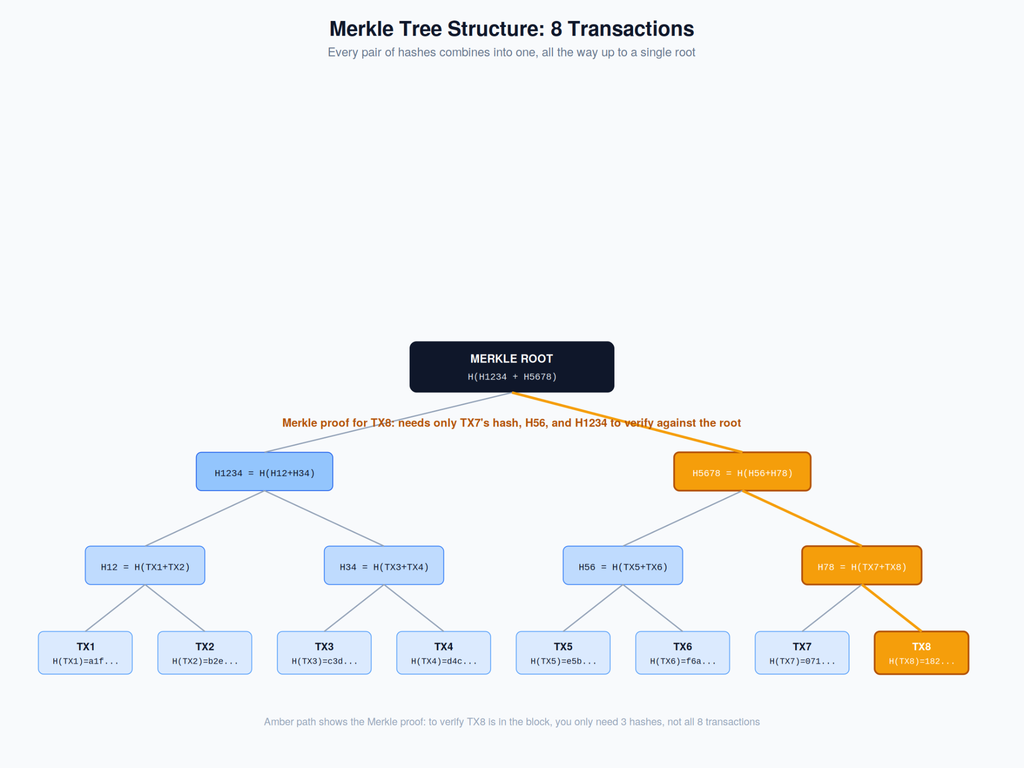
Here’s a problem; a single Bitcoin block can hold thousands of transactions. If you wanted to prove one transaction is really in that block, would you have to download and check every other transaction too?
No, that’s exactly what Merkle trees solve. A Merkle tree hashes pairs of transactions together, then hashes those results together, then keeps pairing and hashing until only one hash is left at the top. That final hash is called the Merkle root, and it gets stored in the block header.
For example:
Transactions: TX1 TX2 TX3 TX4
\ / \ /
Hash pairs: H(1,2) H(3,4)
\ /
Hash again: Merkle Root
If someone wants to prove TX2 is part of the block, they don’t need all four transactions. They just need TX2, the hash of TX1, and the hash of H(3,4). That’s called a Merkle proof, and it lets a lightweight wallet on your phone verify a transaction happened without downloading the entire blockchain, which by 2026 is well over 600 gigabytes for Bitcoin alone.
This is also what makes tampering so hard to hide. Change one transaction, and its hash changes. That also changes the pair hash above it, the Merkle root, and the block header hash and breaks the link to the next block. One small change echoes all the way up and out.
Security Analysis: What the 2024-2025 Collision Research Actually Means
Back to that EUROCRYPT announcement. Here’s what actually happened, in order.
Researchers Yingxin Li, Fukang Liu, and Gaoli Wang found a theoretical collision attack against 31 out of 64 steps of SHA-256, published at EUROCRYPT 2024. A related follow-up paper then turned that into a practical collision, meaning they actually produced two different inputs with the same 31-step hash in about 1.2 hours using 64 computer threads.
That sounds alarming until you know two things; first, this was the first improvement on 31-step SHA-256 collisions since EUROCRYPT 2013, more than a decade earlier. Progress on breaking SHA-256 moves at a crawl, not a sprint.
Second, and this is the part that matters most, Bitcoin’s SHA-256 runs the full 64 steps. The researchers themselves stated plainly that their attack is nowhere near threatening the security of full SHA-256, since it only reaches about half the total steps.
Nearly half of full SHA-256 can now be practically cracked. That sounds bigger than it is. Reaching step 31 after a decade of stalled progress still leaves 33 steps of runway before Bitcoin’s actual hash function is in any danger.
For context on why steps matter: SHA-256 processes your data through 64 rounds of mixing and scrambling. Each extra step you can attack roughly doubles the computing power the next step requires. Going from step 31 to step 64 isn’t twice as hard. It’s astronomically harder.
What you should actually do with this information:
- Don’t panic; no production blockchain is at risk from this research today.
- Do keep an eye on academic progress. If researchers reach step 40 or 45 within the next few years, that’s the point to start paying closer attention.
- If you’re building something today, don’t design around SHA-256 collapsing. Instead, design around it eventually needing a graceful upgrade path, which is a very different and much calmer engineering problem.
Quantum Computers and the Future of Hashing
Quantum computing headlines love to imply blockchains are doomed. The real picture is more boring, in a good way. Quantum computers threaten two very different things in cryptography, and it’s worth separating them clearly:
- Public-key cryptography (the signatures that prove you own your coins) is genuinely at risk. Shor’s algorithm can theoretically break the elliptic curve math behind Bitcoin and Ethereum wallet signatures.
- Hash functions (what this entire article is about) are far more resistant. The best quantum attack against hashing, Grover’s algorithm, only gives a square-root speedup, not a full break.
In practice, that means a 256-bit hash function like SHA-256 or Keccak-256 would still offer roughly 128 bits of quantum-era security, which is still considered strong for decades to come. The bigger quantum risk to blockchain sits in wallet signatures, not in the hashing that secures blocks.
The National Institute of Standards and Technology (NIST) finalized its first three post-quantum cryptography standards in August 2024: FIPS 203, 204, and 205. Notably, one of them, FIPS 205 (SLH-DSA), is a hash-based signature scheme built specifically because hash functions are considered one of the most quantum-resistant tools cryptographers have.
If you’re building for the long term, here’s the realistic migration path:
- Keep using SHA-256, Keccak-256, or SHA-3 for hashing. They’re not the weak link.
- Watch how NIST’s ML-DSA and SLH-DSA signature standards get adopted across major chains over the next few years.
- If you’re storing anything meant to stay verifiable for 20+ years, favor hash algorithms with larger output sizes (SHA-512 over SHA-256, for example) since Grover’s algorithm needs roughly triple the output length to hold the same security level against a quantum attacker.
Common Hashing Errors and How to Fix Them
If you’ve written any code that touches blockchain hashing, you’ve probably hit one of these.
“Hash mismatch” when verifying data: This almost always means whitespace, encoding, or byte order snuck in somewhere. Hashing “Hello” and “Hello “ (with a trailing space) gives two totally different results. Always trim and normalize your input the same way on both ends before hashing.
Different hash results between Python and JavaScript for the “same” input: Check your string encoding. Python’s hashlib defaults can behave differently from JavaScript’s Buffer handling if you’re not explicit about UTF-8 encoding on both sides.
Solidity’s keccak256 is giving unexpected results compared to online SHA-3 calculators: This confuses a lot of developers. Ethereum’s keccak256 is not the same as the final NIST SHA-3 standard.
They’re close cousins, not identical twins, because Ethereum was built before NIST finalized SHA-3’s padding rules. Use Solidity’s own keccak256 for anything Ethereum-related, never an external SHA-3 tool.
Merkle proof verification failing: Double-check the order you’re concatenating hashes in. Most Merkle tree bugs come from hashing (A + B) when the tree actually expects (B + A). Order matters completely in hashing, even though it feels like it shouldn’t.
Slow hashing performance in a loop: If you’re hashing thousands of records one at a time in a script, batch the work or move to a faster algorithm like Blake3 for non-consensus-critical tasks. Don’t force SHA-256 everywhere just because it’s the famous one.
Industries Benefiting from Blockchain Hashing
Blockchain hashing has become a critical security layer across multiple industries, ensuring that data remains tamper-proof, verifiable, and trustworthy:
Finance
Cryptocurrencies such as Bitcoin and Ethereum depend on hashing to validate transactions, secure wallets, and maintain blockchain integrity. Financial institutions also use blockchain to improve payment processing and reduce fraud.
Healthcare
Hospitals and healthcare providers rely on hashing to protect electronic medical records, verify data authenticity, and enable secure information sharing without compromising patient privacy.
The global blockchain technology in the healthcare market was valued at $11.33 billion in 2024. This rapid growth is fueled by increasing demand for secure patient data management, interoperability, and transparent healthcare systems. Leading players in the market include Akiri, BurstIQ, PokitDok, and Guardtime.
Supply Chain
Manufacturers and retailers use blockchain hashing to track products from origin to delivery. This creates transparent audit trails, verifies product authenticity, and helps combat counterfeiting and supply chain fraud. For instance, watch brand Breitling provides digital passports for all of its watches.
Government
Public agencies are exploring hashing for secure digital identity systems, electronic voting, and tamper-resistant document management, improving transparency and public trust.
One prominent example of government blockchain is Estonia’s e-governance system, where blockchain is used to secure its citizens’ data and facilitate services like digital identification, online voting, and e-taxation.
Media and Entertainment
Blockchain hashing protects intellectual property by verifying ownership, securing digital rights, and reducing piracy of creative content. For example, Audius, a decentralized music-streaming service ensuring fair revenue distribution.
Frequently Asked Questions
What is hashing in blockchain?
Hashing in blockchain is the process of converting data of any size into a fixed-length code, called a hash, using a mathematical function. It’s used to link blocks together, verify transactions, and detect any tampering instantly.
Is SHA-256 still safe to use in 2026?
Yes, the 2024 collision research broke 31 of SHA-256’s 64 total steps, which the researchers themselves confirmed is far from threatening the full algorithm. SHA-256 remains safe for blockchain use today.
What’s the difference between hashing and encryption?
Encryption is reversible if you have the right key. Hashing is one-way by design. You’re never meant to get the original data back from a hash, which is exactly why it’s used to prove data hasn’t changed.
What is a Merkle tree used for in blockchain?
A Merkle tree combines all transaction hashes in a block into a single hash called the Merkle root. It lets anyone verify a specific transaction is part of a block without downloading every other transaction in that block.