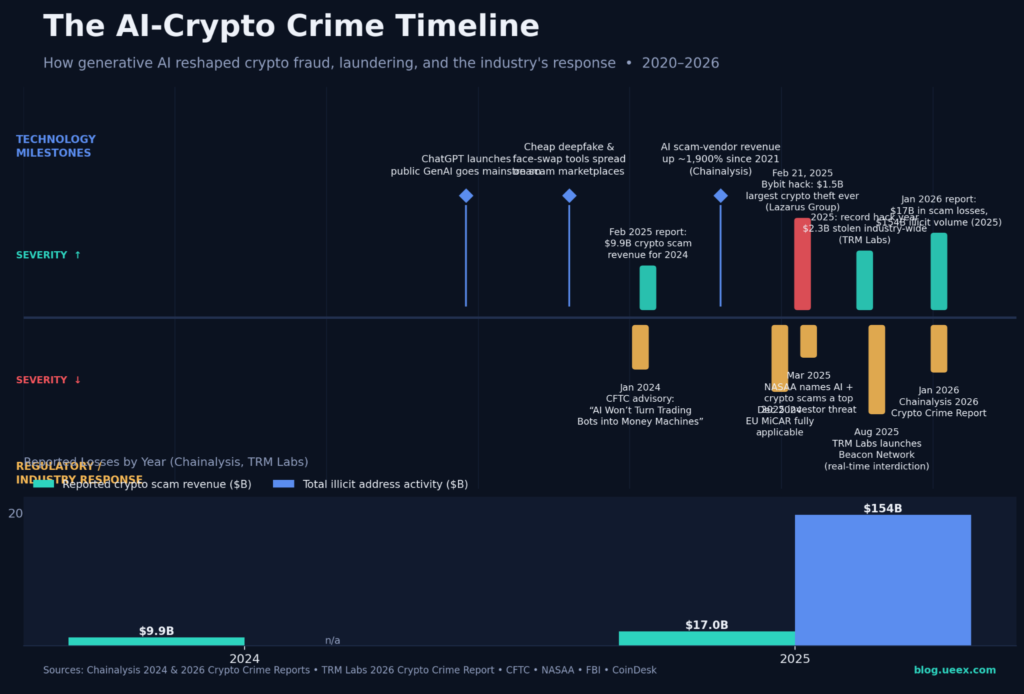
The February 21, 2025, Bybit hack, in which North Korea’s Lazarus Group stole about $1.5 billion in Ethereum, exposed the growing intersection of AI and crypto crime. While the attack relied on social engineering rather than AI itself, the aftermath revealed how cybercriminals increasingly use AI to create convincing fake identities, phishing campaigns, and fraudulent job applications to accelerate attacks.
According to TRM Labs, about $158 billion flowed to illicit crypto addresses in 2025, with the true figure likely much higher due to underreporting. This highlights a troubling paradox: AI is strengthening crypto through better fraud detection, compliance, and trading tools, yet it is equally empowering scammers with sophisticated deception techniques such as voice cloning, deepfakes, and automated phishing.
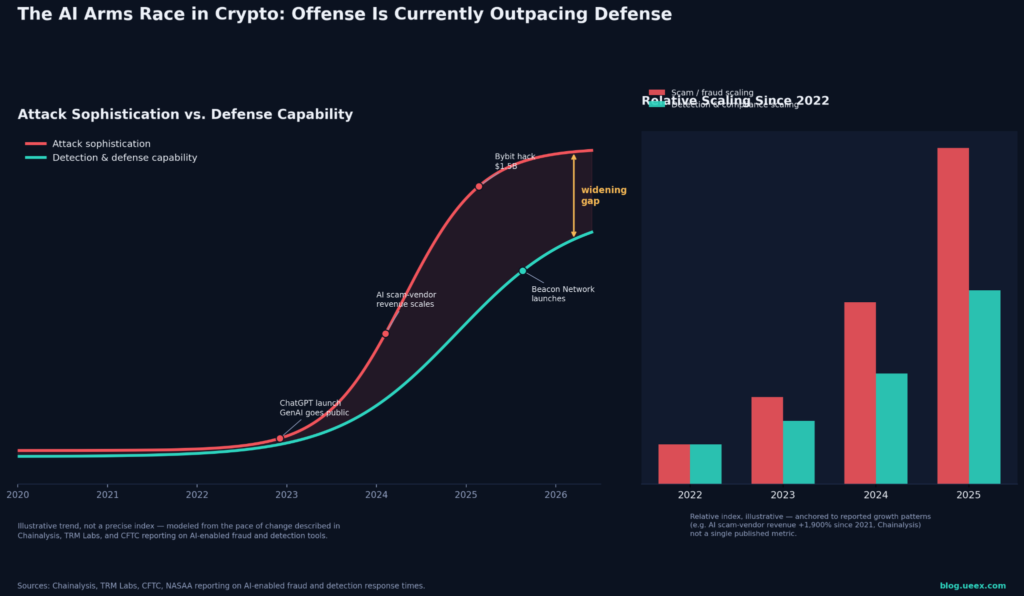
As both defenders and attackers adopt the same technology, the battle is intensifying, with criminals often staying one step ahead of the industry’s security measures. This article walks through where AI is actually hurting crypto users today, what the industry is doing about it, and what you can do to protect yourself.
Join UEEx
Experience the World’s Leading Digital Wealth Management Platform
AI has industrialized crypto scams. Chainalysis found scams linked to AI vendors generate 4.5 times more revenue per operation than scams without AI ties.
Money laundering moves faster and hides better thanks to AI-optimized mixing, chain-hopping, and wallet networks.
Deepfakes and voice cloning are cheap and convincing. Some AI “face-changing” services sell for as little as $200.
Regulators are catching up, not keeping up. The CFTC, SEC, and NASAA have all issued fresh warnings, but enforcement still lags the technology.
Personal vigilance still matters most. Exchange tools like UEEx’s security help, but no system replaces a healthy dose of suspicion.
The AI-Crypto Paradox: A Tool for Both Sides
How AI Is Supposed to Help Crypto
Used the right way, AI genuinely strengthens the crypto ecosystem. Exchanges use machine learning to flag unusual withdrawal patterns in real time, long before a human analyst would notice. Compliance teams use it to sort through mountains of transaction data for anti-money laundering (AML) checks, a job that used to take weeks and now takes minutes.
Industry surveys suggest that in 2026, roughly 98% of leaders report that their teams are already integrating AI into day-to-day workflows. Trading firms use AI models to manage risk and rebalance portfolios. Blockchain forensics companies like Chainalysis and TRM Labs use AI-assisted pattern recognition to trace stolen funds across thousands of wallets, something that would be nearly impossible by hand.
None of that is hype. It’s real, working technology. The problem is that criminals have access to the exact same category of tools and fewer rules to follow while using them.
The Reality: How AI Actually Threatens Crypto Users
Here’s where the picture gets darker. According to Chainalysis’s 2026 Crypto Crime Report, illicit addresses received at least $154 billion in 2025, a 162% jump from the year before. Crypto scams alone accounted for roughly $17 billion in losses, the highest figure ever recorded. Impersonation scams, the kind that lean heavily on AI-generated content, grew more than 1,400% year over year.
The average amount a single scam victim lost also jumped, from $782 in 2024 to $2,764 in 2025, a 253% increase. That’s not because scammers found richer victims. It’s because AI lets them run more convincing, higher-touch scams at a fraction of the old cost.
Six patterns show up again and again when you look at where AI is doing the most damage in crypto:
AI-powered scams and social engineering
Trading bot manipulation and market abuse
Privacy invasion and data weaponization
Money laundering and criminal infrastructure
Regulatory evasion and compliance bypass
Quiet centralization of power in a “decentralized” industry
Let’s go through each one.
AI-Powered Scams: Where Most of the Money Is Being Lost
Below are types of AI-powered scams
Pig Butchering: The Scam That Refuses to Slow Down
Pig butchering scams rely on building trust before convincing victims to invest in fake cryptocurrency opportunities. The name comes from the idea of fattening up a victim before the slaughter. Scammers often initiate contact through dating apps, WhatsApp, or seemingly harmless wrong-number texts, spending weeks cultivating relationships before introducing fraudulent investments.
AI has made these scams far more scalable, allowing a single operator to manage dozens of realistic conversations simultaneously across multiple languages. According to recent crypto crime reports, investment scams, including pig butchering, account for the majority of crypto fraud losses, representing 62% of fraud inflows in 2025.
Much of this activity has been linked to organized scam compounds in Southeast Asia and online marketplaces such as Huione Guarantee, where criminals can purchase AI-powered fraud tools and other infrastructure, making these sophisticated scams increasingly widespread and difficult to detect.
As Elad Fouks, head of fraud products at Chainalysis, put it:
“GenAI is amplifying scams, the leading threat to financial institutions, by enabling high-fidelity, low-cost, and highly scalable fraud that exploits human vulnerabilities. It facilitates the creation of synthetic and fake identities, allowing fraudsters to impersonate real users and bypass identity verification controls.”
That’s not a hypothetical risk. Chainalysis found that revenue for AI service vendors on scam marketplaces grew by roughly 1,900% between 2021 and 2024, and one vendor advertised an AI “face-changing service” for about $200 in crypto.
It’s worth noting that falling for one of these scams is not a sign of being naive. These operations are run like businesses, with scripts, psychological playbooks, and now AI tools that adapt in real time to what a victim says. Smart, careful people get caught in them every day.
Deepfake videos and voice clones have evolved into a major financial threat, particularly in cryptocurrency scams. Fraudsters increasingly use AI-generated content to impersonate trusted public figures, convincing victims to invest in fake schemes.
A notable example is the misuse of deepfake videos featuring Bank of Italy Governor Fabio Panetta to promote fraudulent investments. Voice cloning is especially dangerous, as convincing replicas can be created from just a few seconds of publicly available audio.
Over the past three years, financial institutions have reported a 2,000% surge in deepfake-related fraud attempts, while many UK adults have unknowingly been targeted by voice-cloning scams. Although detection tools are improving, they continue to lag behind rapidly advancing deepfake technology, making these AI-driven scams an increasingly serious challenge.
Fake AI Trading Bots
Scammers often lure victims with social media ads promoting AI trading bots that promise guaranteed returns. After joining WhatsApp or Telegram groups, victims see fake profits and may even make small withdrawals to build trust. Eventually, their accounts are frozen, and fraudsters demand extra fees through a fake “loan provider” to unlock the funds, resulting in financial losses
The United States Commodity Futures Trading Commission (CFTC) has warned about exactly this pattern. Its customer advisory is blunt about it:
“Fraudsters are exploiting public interest in artificial intelligence (AI) to tout automated trading algorithms, trade signal strategies, and crypto-asset trading schemes that promise unreasonably high or guaranteed returns. Don’t believe the scammers. AI technology can’t predict the future or sudden market changes.”
The CFTC exposed Mirror Trading International as a fraudulent AI trading scheme that defrauded over 23,000 investors of $1.7 billion. Operated by Cornelius Johannes Steynberg, the Ponzi scheme lured victims with Bitcoin investments starting at $100, promising unrealistic 10% monthly returns.
Warning signs of a fake AI trading bot:
Guaranteed or “risk-free” returns, especially anything above normal market rates
Pressure to invest quickly or refer friends for bonuses
A vague, “proprietary” AI system nobody can explain in plain terms
Difficulty withdrawing funds, followed by requests for more money to “unlock” them
Synthetic Identities and AI-Personalized Phishing
AI is making crypto fraud more sophisticated by helping criminals bypass exchange security and create highly convincing scams. Through synthetic identity fraud, attackers combine stolen personal data with AI-generated faces and documents to fool KYC verification systems.
AI also enhances phishing attacks by producing natural, error-free messages tailored with information gathered from social media. Scammers can impersonate support staff or moderators on platforms like Discord and Telegram, making it easier to trick victims into revealing login credentials or seed phrases.
As these AI-driven threats become more advanced, users can strengthen their wallet security practices. Our Top Crypto Wallet Security Best Practices guide is a good place to start and remain vigilant against increasingly realistic social engineering attacks.
Trading Bot Manipulation and Market Abuse
Legitimate algorithmic trading has existed in crypto for years. The problem is the growing gap between what’s disclosed and what’s actually happening inside these “black box” systems.
Front-running: Some bots watch pending transactions in the public mempool, spot a large trade about to go through, and pay higher gas fees to jump ahead of it, profiting from the price move the original trade was about to cause.
Spoofing and wash trading: AI can generate large volumes of fake buy or sell orders to create the illusion of demand, then cancel them once real traders react. This is illegal in regulated markets but harder to police on decentralized exchanges with no central operator to enforce rules.
Pump-and-dump coordination: Networks of bot accounts on social media can manufacture hype around a low-liquidity token, drawing in retail buyers right before insiders sell into the rally.
Sentiment manipulation: AI tools can scan Twitter, Reddit, and Discord in real time, gauge crowd mood, and time trades or manufactured news around known psychological triggers, like round-number price levels, to provoke panic selling or euphoric buying.
Algorithmic trading already dominates traditional markets and is increasingly shaping crypto. Moreover, institutional firms benefit from faster data, larger capital, and superior AI, leaving retail traders at a structural disadvantage that even smarter trading bots cannot fully overcome.
If you do use a bot, treat it the way you’d treat handing someone else the keys to your account:
Never grant withdrawal permissions to a third-party bot, only trading permissions
Use IP whitelisting where the exchange supports it
Set a hard cap on position size (many experienced traders cap any single automated trade at 1-2% of total portfolio)
Always set a stop-loss, and never assume the bot will manage risk better than you would manually
Join UEEx
Experience the World’s Leading Digital Wealth Management Platform
Privacy Invasion: The Quiet Casualty of AI-Powered Crypto
Blockchain transactions are inherently transparent, but AI has made it far easier to analyze and trace them. Advanced analytics can cluster wallet addresses, reveal spending patterns, and link supposedly anonymous wallets to real identities.
While this helps combat financial crime, it also raises serious privacy concerns by exposing ordinary users’ transaction histories. The risk is amplified by data breaches, as stolen KYC information can be combined with AI to create highly convincing, personalized crypto scams.
Meanwhile, privacy-focused cryptocurrencies such as Monero face growing challenges, with AI-powered statistical analysis weakening anonymity and increasing regulatory pressure leading some exchanges to delist them.
Practical steps that actually help here:
Keep the bulk of your holdings in cold storage, disconnected from any exchange account
Use separate wallets for different purposes so activity can’t easily be linked together
Limit how much KYC data you hand over to platforms that don’t strictly require it
Review your account security regularly rather than assuming “set and forget” is safe
AI is transforming crypto laundering by helping criminals automate peel chains, generate disposable wallets, and route funds across multiple blockchains to evade detection.
According to TRM Labs and Chainalysis, these increasingly sophisticated networks are faster and harder to trace, with Chinese-language laundering networks processing an estimated $16.1 billion in 2025.
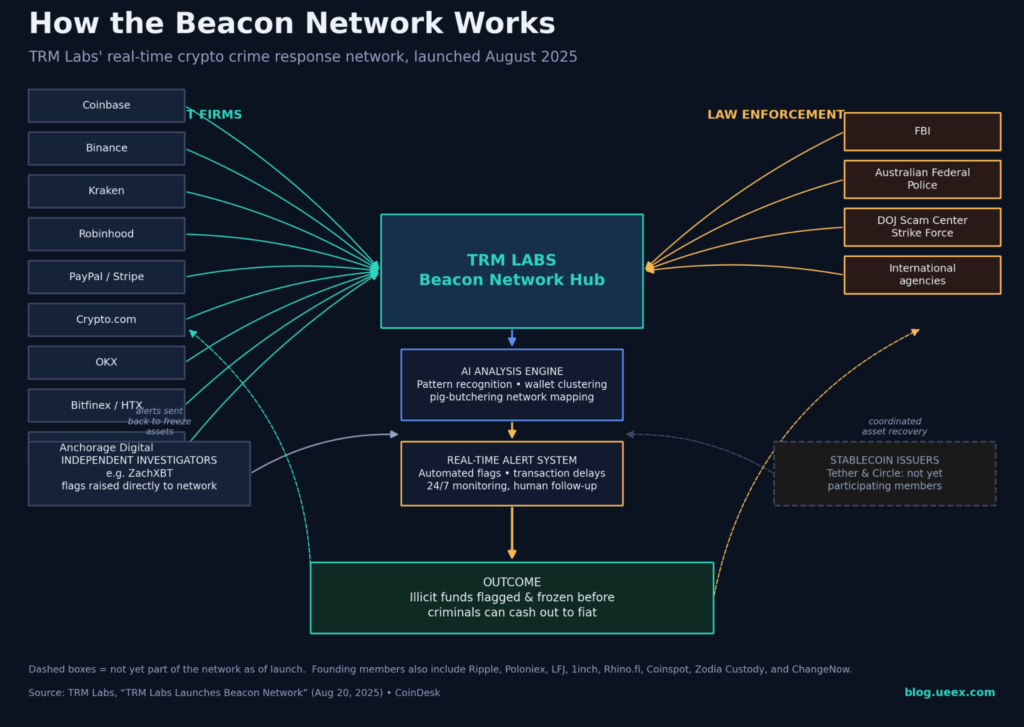
To combat this threat, the crypto industry launched the Beacon Network in August 2025. Led by TRM Labs, Beacon links major exchanges, including Coinbase, Binance, Kraken, Robinhood, and PayPal, with law enforcement through a real-time alert system that helps identify and freeze stolen funds before they can be cashed out.
Ari Redbord, TRM Labs’ global head of policy, explained the urgency behind it:
“We need this ecosystem to be locked down, and we need it to be locked down in real time.”
As long as North Korean state hackers can steal over a billion dollars and launder a meaningful chunk of it within 48 hours, the industry needs a faster response than traditional, relationship-by-relationship information sharing allowed.
Coinbase’s global head of anti-money laundering, Valerie-Leila Jaber, described what makes Beacon different:
“There’s no program like Beacon Network. It’s a true early-warning system that helps us identify and freeze illicit assets so law enforcement can recover them.”
However, it’s not a complete fix. Notably, stablecoin issuers Tether and Circle were not part of the initial network, which matters given that stablecoins accounted for roughly 84% of illicit crypto volume in 2025 per Chainalysis.
And a large share of exchanges globally still fall short of the Financial Action Task Force’s (FATF) Travel Rule requirements for sharing sender and receiver information on transactions.
Artificial intelligence is becoming a powerful tool for criminals seeking to bypass KYC and AML controls. AI can generate synthetic identities, forge convincing documents, create deepfake videos, and clone voices to evade identity verification, creating an ongoing arms race between cybercriminals and compliance teams.
Regulatory weaknesses compound the problem, with only 51 of 149 jurisdictions largely compliant with the FATF crypto standards as of 2026, leaving significant gaps for abuse. AI also enables regulatory arbitrage by helping bad actors identify favorable jurisdictions, establish shell entities, and rapidly restructure operations to evade sanctions, as seen in the Garantex-to-Grinex rebranding.
Meanwhile, decentralized finance (DeFi) introduces further compliance challenges through anonymous protocols, complex smart contracts, governance manipulation, flash-loan attacks, and limited KYC requirements, making illicit activity harder to detect and regulate.
Regulation Is Racing to Catch Up
Regulators are responding with new frameworks, but technology continues to evolve faster than policy. The SEC launched its Crypto Task Force in January 2025 to develop clearer crypto rules, and the CLARITY Act, which passed the House in 2025 and is still under Senate negotiation as of August 2026, aims to build on that.
Meanwhile, the EU has fully rolled out the Markets in Crypto-Asset Regulation (MiCA), significantly tightening oversight across member states. The challenge remains finding the right balance between innovation and consumer protection, decentralization and accountability, privacy and transparency, and technological progress and effective regulation.
Fighting Back: AI Defence Against AI Attack
As AI-powered crypto crime becomes more sophisticated, the industry’s response is evolving just as quickly. Exchanges, blockchain analytics firms, regulators, and users are increasingly deploying AI to detect suspicious behavior before funds disappear.
Detection Technologies
Modern blockchain forensics combines real-time transaction monitoring, behavioral analytics, and network mapping to trace illicit funds across multiple blockchains.
Companies such as TRM Labs use AI to identify laundering patterns, criminal clusters, and cross-chain activity, helping law enforcement disrupt darknet markets, ransomware operations, and fraud networks. Meanwhile, deepfake detection tools analyze facial, voice, and video inconsistencies, although synthetic media continues to evolve faster than detection systems.
Industry and Regulatory Response
Collaboration has become a critical defense. TRM Labs’ Beacon Network enables exchanges, payment firms, and law enforcement to share real-time threat intelligence, while independent investigators such as ZachXBT contribute blockchain intelligence that speeds up fraud investigations.
Exchanges are also strengthening AI-driven KYC, biometric liveness checks, transaction monitoring, and withdrawal controls. Globally, regulators continue to enforce FATF standards, mandatory suspicious activity reporting, and cross-border intelligence sharing through the Egmont Group.
Technology alone cannot eliminate risk. Users should store assets in hardware or multi-signature wallets, whitelist withdrawal addresses, enable time-locked transactions where available, diversify holdings across reputable platforms, and perform regular security reviews.
However, the biggest weakness remains education. Many victims still struggle to recognize AI-generated scams, making clear security guidance and community awareness just as important as technical defenses.
How to Protect Yourself: A Practical Framework
You don’t need fifteen separate systems running in your head. A handful of habits cover most of the risk.
Before you trust anyone or anything with your money:
Verify independently. Don’t rely on a link or contact info someone sends you. Look up the company or person through official channels yourself.
Treat unsolicited contact as a red flag, especially anything that starts on a dating app, social media DM, or wrong-number text and drifts toward investing.
Be suspicious of guaranteed returns, secret “proprietary” systems, and pressure to act fast.
Never share your seed phrase or private keys with anyone, for any reason, ever.
Before you use any trading bot:
Check whether it’s registered with a real regulator (CFTC registration is checkable in the US).
Look for independent audits and a genuine, verifiable track record, not screenshots.
Restrict API keys to trading only, never withdrawals.
For your day-to-day security:
Keep the bulk of your funds in cold storage, and use a hot wallet only for what you’re actively using.
Use a password manager and hardware-based two-factor authentication, not SMS codes.
Verify urgent requests, especially ones involving money, through a separate channel. A quick video call or a callback to a known number stops most voice-cloning and deepfake scams cold.
If you think you’ve already been scammed:
Stop sending money immediately, and save every message, screenshot, and transaction ID.
Contact your bank or payment provider if any traditional payment method was involved.
Contact the exchange you used directly. Fast reporting gives networks like Beacon a better shot at freezing funds before they’re cashed out.
What Comes Next
The next few years will likely bring AI-generated smart contracts with hidden malicious logic buried in code most people can’t read, autonomous AI agents capable of running entire scam operations with minimal human input, and deepfakes good enough that “watch a video to verify” stops being reliable advice.
On the defense side, expect more zero-knowledge tools that protect privacy without sacrificing accountability and slowly tightening international coordination on AML enforcement.
Which side moves faster, offense or defense, is genuinely an open question. It depends on how much money and attention the industry puts into defense compared to how much criminals put into offense, and right now that fight is closer than most people assume.
Join UEEx
Experience the World’s Leading Digital Wealth Management Platform
AI in crypto really is a double-edged sword, and the dark side isn’t some future risk. It’s already responsible for tens of billions of dollars in losses every year, and it’s still growing.
At the same time, the legitimate side of this industry is maturing too, with better detection tools, faster coordination between exchanges, and regulators finally catching up on some fronts.
None of that replaces basic vigilance. The single best defense against AI-powered crypto crime is still the oldest one: slow down, verify independently, and be skeptical of anything that sounds too easy.
Explore UEEx’s trading and security tools to see how a security-first exchange approaches this fight, and treat this article as a starting point, not a finish line.
FAQs
How can I tell if someone is using AI to scam me in crypto?
Watch for multiple warning signs: unsolicited investment approaches, unusually flawless messages, subtle video or voice glitches, and pressure to invest quickly. If someone refuses simple verification, such as an unscripted video call or a callback to a verified number, consider it a major red flag.
Are AI trading bots safe to use?
While some AI trading bots are legitimate and transparent, many promising guaranteed high returns are scams. Verify regulatory registration, independent audits, and never grant bots withdrawal permissions before investing.
What should I do immediately if I suspect I’ve been targeted by an AI crypto scam?
Stop sending funds immediately. Save all evidence, including messages, screenshots, wallet addresses, and transaction IDs. Contact your bank if applicable, report the scam to the FBI’s IC3 and the CFTC or SEC, and notify your crypto exchange to flag the receiving wallet.
Can deepfakes really impersonate anyone now?
AI-generated video and voice deepfakes can now be created from brief recordings using inexpensive, widely available tools. As detection struggles to keep pace, independent, out-of-band verification is more reliable than trusting appearances or audio alone
Disclaimer: This content is for educational purposes only and isn’t financial or legal advice. AI-related threats in crypto are real and evolving quickly. Statistics and cases cited here reflect publicly available reporting as of August 2026, but this space changes fast. Always do your own research, verify claims through multiple sources, and consult a qualified professional before making significant financial decisions. UEEx makes no guarantees about the effectiveness of any security measure described here and isn’t liable for losses related to AI-driven crypto threats.
Disclaimer: This article is intended solely for informational purposes and should not be considered trading or investment advice. Nothing herein should be construed as financial, legal, or tax advice. Trading or investing in cryptocurrencies carries a considerable risk of financial loss. Always conduct due diligence before making any trading or investment decisions.
Trade with proof of Reserves
UEEx publish monthly audits and third party verification on every listed market.