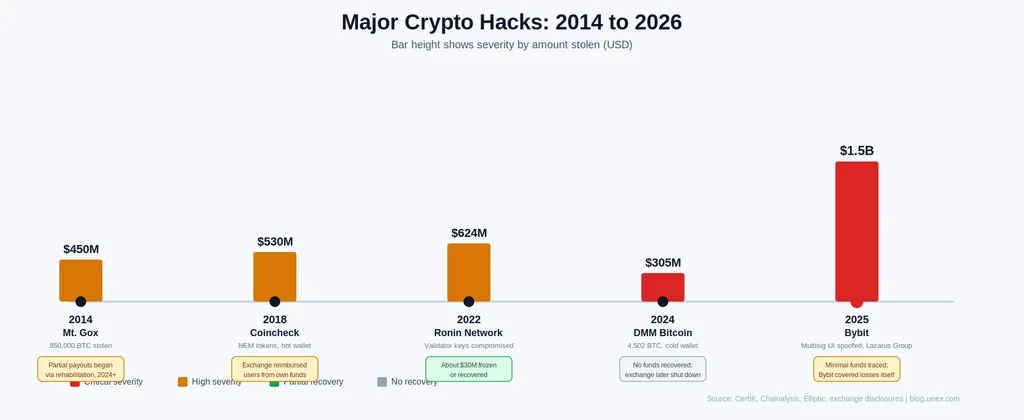
Crypto hackers stole $1.3 billion across 344 incidents in the first half of 2026 alone, per CertiK’s Hack3d report, already rivaling last year’s full-year losses. The playbook hasn’t changed much since February 2025, when North Korean hackers drained $1.5 billion from Bybit in under two hours, spreading funds across 50 wallets.
Individuals aren’t spared either; one Bitcoin holder lost 783 BTC ($91 million) in 2025 to scammers posing as hardware wallet support. Here’s the paradox: Bitcoin’s blockchain has never been hacked in 16 years, yet billions vanish annually. The weak point isn’t the chain; it’s wallets, exchanges, and users.
With roughly 560 to 740 million crypto wallet holders worldwide, that attack surface keeps growing. And unlike a bank, there’s no Federal Deposit Insurance Corporation (FDIC), no fraud line, and no undo button. This guide breaks down 12+ wallet hacking methods (2018–2026) with real cases and step-by-step defenses.
Join UEEx
Experience the World’s Leading Digital Wealth Management Platform
Use hardware wallets for any assets you cannot afford to lose, and reserve hot wallets strictly for small daily transactions.
Your seed phrase must never touch an internet-connected device. Avoid photos, cloud storage, and digital note-taking apps. Paper or metal, kept somewhere safe.
Phishing and social engineering, not code bugs, cause most losses today. Treat every unexpected message about your wallet as a scam until proven otherwise.
Layer your defenses. One password is not security. Combine a hardware wallet, an authenticator app, and good habits.
Can Crypto Wallets Actually Be Hacked? The Direct Answer: Yes, crypto wallets can be hacked, mainly through phishing, malware, stolen private keys, and social engineering rather than through breaking the blockchain itself. According to CertiK’s Hack3d H1 2026 report, the industry lost roughly $1.3 billion across 344 incidents in the first six months of 2026, and wallet compromise alone accounted for over $444 million of that. The technology behind Bitcoin and Ethereum has never been broken. The wallets, exchanges, and people using them are where the money actually gets stolen.
That distinction matters, and it’s the whole story of crypto security.
Blockchain Security Versus Wallet Security
Bitcoin’s network has run without a successful hack for over 16 years. Breaking its cryptography by brute force would take longer than the universe has existed. Ethereum has a similar track record. So when you hear about a “crypto hack,” the blockchain itself rarely had anything to do with it.
A wallet is simply the tool that holds your private key, which is the piece of information that proves you own your crypto and lets you spend it. Steal the key, and you control the funds, no matter how secure the underlying blockchain is. This is why people in the crypto world repeat the phrase “not your keys, not your coins.” It’s not a slogan but a description of how the entire system actually works.
“The underlying security environment has not improved. In several meaningful respects, it has deteriorated,” CertiK wrote in its H1 2026 Hack3d report, after finding that just two operational security failures accounted for nearly 44% of that half’s total losses.
The Real Scale of the Problem in 2026
While underlying blockchain networks like Bitcoin and Ethereum remain cryptographically secure, user-facing endpoints, such as software wallets, centralized exchanges, and human operators, remain vulnerable. Phishing and private key compromises account for the vast majority of financial losses in the industry, far outweighing direct protocol exploits.
Remove these mega-incidents, and the underlying trend actually got worse compared to the same period a year earlier, once you also strip out the record-setting Bybit theft from February 2025.
Here’s where the money went, by attack type, in H1 2026:
Attack Type
Amount Stolen
Incidents
Wallet compromise
$444.5 million
33
Phishing
$366.3 million
63
Code vulnerabilities
$151.6 million
204
Notice something? Code vulnerabilities caused the most incidents by far, but wallet compromise and phishing, both of which target people rather than software, caused far more financial damage per incident. That gap is the whole point of this guide.
Why Wallets Get Hacked
Security researchers who study these incidents consistently point to the same breakdown:
User error and social engineering cause the large majority of individual losses. This includes phishing, leaked seed phrases, and scams that trick people into handing over access
Software bugs in wallet code, browser extensions, or mobile apps cause a smaller but still meaningful share
Advanced technical attacks, like supply chain tampering or physical device hacking, are rare and usually require the attacker to already have your device in hand.
Types of Crypto Wallets and How Vulnerable Each One Is
Not all wallets carry the same risk. Picking the right type for your situation is probably the single biggest security decision you’ll make.
Hot Wallets (Software Wallets)
Hot wallets live on your phone, computer, or browser. Think MetaMask, Trust Wallet, Exodus, Coinbase Wallet, or Phantom. They store your keys on the device itself, but that device is connected to the internet, which is exactly what makes them convenient and exactly what makes them a target.
Risk level: High. These wallets face constant attempts through phishing sites, fake browser extensions, malware, and fraudulent apps.
Good for: daily spending, small balances, and interacting with apps where you need to sign transactions often.
Join UEEx
Experience the World’s Leading Digital Wealth Management Platform
A hardware wallet, like a Ledger or Trezor device, keeps your private key on a small offline chip that never touches the internet. To spend funds, you physically approve the transaction on the device itself.
Risk level: Low. The main threats here involve someone physically stealing the device, buying a tampered device from an unofficial seller, or losing your backup with no way to recover funds. Remote hackers sitting behind a screen generally can’t touch a properly used hardware wallet. Read our full breakdown of the best offline crypto wallet for safe storage if you’re shopping for one.
Good for: savings you don’t touch often, and any amount that would genuinely hurt to lose.
Custodial Wallets (Exchange-Held Wallets)
While convenient for trading, your funds depend entirely on the platform’s internal security, making centralized exchanges high-value targets for hackers.
Risk level: Depends entirely on the exchange. This is exactly what makes exchanges such attractive targets. A single breach can expose funds belonging to millions of users at once. See our comparison of the best crypto exchange to start with in 2026 for a deeper look.
Multi-Signature and MPC Wallets
These wallets split control across multiple keys or multiple parties, so no single stolen key is enough to move funds. Gnosis Safe, Fireblocks, and Zengo are common examples.
Risk level: Very low, provided the setup is configured correctly. This is increasingly the standard for businesses, DAOs, and serious individual holders, especially since CertiK’s 2026 data shows attackers now targeting exactly this kind of infrastructure with more sophistication than in past years.
Comparison Table
Wallet Type
Hack Risk
Convenience
Best For
Cost
Examples
Hot Wallet (Software)
High
Very High
Daily transactions and storing small amounts of crypto
Free
MetaMask, Trust Wallet
Cold Wallet (Hardware)
Low
Medium
Long-term storage and securing large crypto holdings
$49–$400
Ledger, Trezor
Custodial (Exchange)
Medium–High
High
Active trading, fiat on/off ramps, and beginners
Free (plus trading/withdrawal fees)
Coinbase, Binance
Multi-Signature / MPC Wallet
Very Low
Low–Medium
Enterprises, DAOs, institutional custody, and shared treasury management
Varies by provider
Gnosis Safe, Fireblocks
The Ways Crypto Wallets Actually Get Hacked
Here’s the part that matters most: the actual methods attackers use. Almost every case falls into one of the categories below.
1. Phishing
Phishing means tricking you into typing your seed phrase or private key into a site or form that looks legitimate but isn’t. Attackers build near-perfect copies of wallet websites, buy search ads that outrank the real site, or send emails claiming your wallet needs urgent verification.
CertiK found phishing caused $366 million in losses in H1 2026 across 63 incidents, making it the second costliest attack category of the half. What’s changed is the shape of the problem. Fewer, larger campaigns are now doing the damage that used to take hundreds of small ones.
How to protect yourself:
Bookmark wallet sites directly. Never search for them
Check the URL letter by letter before typing anything sensitive
Never enter your seed phrase anywhere online, period, no matter how official the request looks
Turn on any built-in scam detection your wallet offers
2. Leaked Private Keys and Seed Phrases
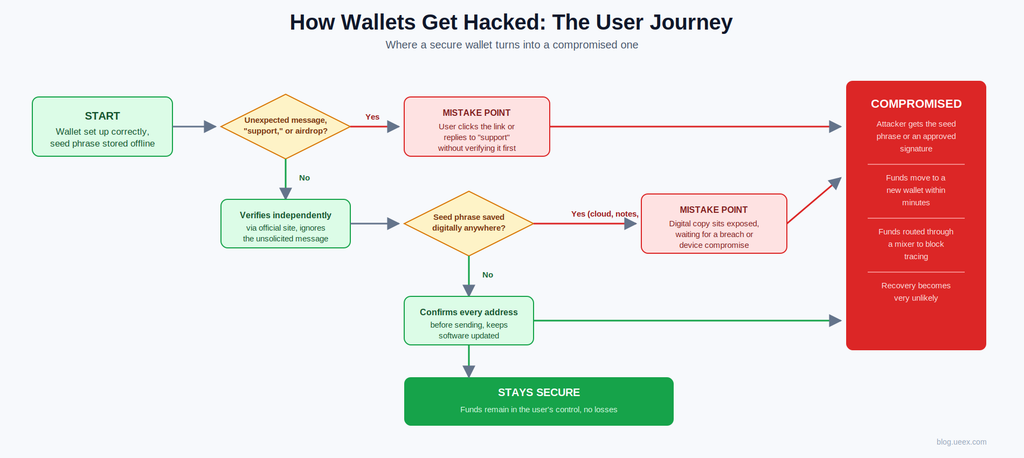
Your seed phrase is the master key to everything in your wallet. If it ends up somewhere digital, a cloud note, an email, a screenshot, or a password manager, it can eventually be found.
In January 2024, Ripple co-founder Chris Larsen lost over 200 million XRP (valued at over $110 million). Investigators pointed to compromised private keys as the entry point.
How to protect yourself:
Never store a seed phrase digitally in any form, not even in an encrypted note
Write it on paper, or better, a fireproof metal backup plate, and store it somewhere physical and secure
Keep a second copy in a separate location, like a safe deposit box
Consider a passphrase (sometimes called the “25th word”) for an extra layer that isn’t written down anywhere
3. Social Engineering and Fake Customer Support
Social engineering scams involve attackers impersonating customer support on platforms like Discord, Telegram, or even by phone to trick victims into revealing sensitive wallet information.
In August 2025, a Bitcoin holder lost 783 BTC (worth about $91 million) after scammers posing as exchange and hardware wallet support obtained wallet credentials and quickly laundered the funds.
The key takeaway is simple: legitimate wallet providers and exchanges will never ask for your seed phrase, private key, or full account credentials.
How to protect yourself:
Treat unsolicited contact about your wallet as suspicious by default
Verify support channels by going directly to the official website, not through a link someone sent you
Never act quickly because of pressure or urgency. Scammers rely on you not stopping to think.
4. Malware and Clipboard Hijackers
Some malware records everything you type, capturing seed phrases instantly, while clipboard hijackers replace copied wallet addresses with an attacker’s address without your knowledge.
The 2023 Atomic Wallet breach highlights the devastating impact of such attacks: around $100+ million was stolen from multiple users in a single weekend, suggesting a large-scale compromise rather than isolated user errors, according to blockchain security firms Elliptic and Chainalysis.
Join UEEx
Experience the World’s Leading Digital Wealth Management Platform
Always check the first and last few characters of any address before confirming a transaction
Keep antivirus software updated and avoid pirated software or shady downloads
Only install wallet apps and browser extensions from official app stores
Consider a device used only for crypto, kept clean of everything else
5. Exchange Hacks
Exchanges hold enormous amounts of crypto in centralized systems, which makes them the highest-value targets in the entire industry. When they get hit, the numbers are staggering.
The largest crypto theft occurred on February 21, 2025, when North Korea’s Lazarus Group stole about $1.5 billion from Bybit. Rather than exploiting blockchain security, the attackers compromised a developer’s device linked to Bybit’s multisig wallet system, injecting malicious code that disguised a fraudulent transaction as legitimate.
After human approval, 401,000 ETH was transferred to attacker-controlled wallets and quickly dispersed across dozens of addresses, highlighting the risks of compromised infrastructure rather than blockchain flaws.
“Bybit is solvent; even if this hack loss is not recovered, all of clients’ assets are 1-to-1 backed; we can cover the loss,” CEO Ben Zhou posted publicly within hours of the theft being confirmed, as the exchange processed over 350,000 withdrawal requests the following day.
How to protect yourself:
Don’t leave large balances sitting on any exchange long-term
Withdraw to self-custody once you’re done trading
Turn on every available security feature: two-factor authentication through an app (not SMS), withdrawal address whitelisting, and anti-phishing codes
6. Software Bugs in Wallet Code
Even well-known, well-funded wallet providers occasionally ship code with real security flaws. In 2022, thousands of users of the Solana-based Slope wallet lost funds after it came to light that the app had been sending users’ seed phrases to its own analytics servers in plain text, where they sat exposed. It’s a reminder that even backend decisions you’ll never see can create catastrophic vulnerabilities.
How to protect yourself:
Favor open-source wallets that independent security researchers can actually inspect
Update your wallet software as soon as patches are released
Don’t put all your funds in one wallet provider
7. Unlimited Token Approvals in DeFi
Every time you connect your wallet to a DeFi app or NFT marketplace, you’re often asked to approve that app to spend your tokens, sometimes with no limit at all. That approval doesn’t expire on its own.
If the app is later hacked or turns out to be a scam from the start, it can drain every token you approved without asking you again. A common trick involves sending “free” NFTs to wallets. Clicking to claim the prize actually signs a hidden approval that hands the scammer access to your tokens.
How to protect yourself:
Periodically revoke old approvals using a tool like Revoke. Cash or Etherscan’s token approval checker
Never interact with unexpected NFTs or tokens that show up unannounced
Set specific spending limits when a dApp allows it, instead of accepting unlimited
8. Public WiFi and Network Attacks
Public networks at coffee shops and airports are easy places for an attacker to sit between you and the internet, watching or redirecting your traffic. This can lead to fake versions of legitimate wallet sites being served to you without any obvious sign anything is wrong.
How to protect yourself:
Never access a wallet over public WiFi
Use a VPN on any network you don’t personally control
Double-check for HTTPS and a valid certificate before entering anything sensitive
9. SIM Swapping
If an attacker convinces your mobile carrier to transfer your phone number to their SIM card, they can intercept any SMS-based two-factor codes meant for you. From there, they can reset passwords and walk into accounts that rely on your phone number as proof of identity.
How to protect yourself:
Never use SMS as your two-factor method for anything crypto-related
Switch to an authenticator app like Google Authenticator or Authy or, better yet, a physical security key
Ask your carrier about adding a PIN or extra verification step to your account
10. Physical Attacks on Hardware Wallets
Hardware wallets are the gold standard for security, but physical possession changes the equation. Sophisticated attackers with specialized equipment have demonstrated techniques like voltage glitching, which manipulates a device’s power supply at precisely timed moments to try to extract data from its chip.
These attacks require the device in hand, real technical skill, and hours of work, so they’re rare, but device manufacturers do periodically patch against them.
How to protect yourself:
Buy hardware wallets only directly from the manufacturer, never from third-party marketplaces
Check for signs of tampering when the device arrives
Update firmware as soon as it’s released
Use the passphrase feature, since even a fully extracted seed phrase is useless without it
11. Cross-Chain Bridge Exploits
Bridges let you move assets between blockchains, and they typically hold huge reserves to back the wrapped tokens they issue. That concentration of funds has made bridges one of the most exploited categories in crypto history, from the $624 million Ronin Network hack in 2022 to the $320 million Wormhole exploit the same year.
How to protect yourself:
Only use well-established, independently audited bridges
Move funds off a bridge as soon as the transfer completes. Don’t leave assets parked there
Bridge only what you’re comfortable putting at some risk
The Wallet Security Paradox: Why Human Error Dominates
If there’s one theme running through every case in this guide, it’s that the technology holds up, while people are the target. CertiK’s own H1 2026 analysis makes this explicit, noting that the two biggest incidents of the half exploited operational security and infrastructure trust, not smart contract bugs, and that wallet compromise has become the single costliest category of attack in the industry.
That’s actually good news in a strange way. Blockchain security is largely out of your hands and already extremely solid. Your own habits, on the other hand, are entirely within your control.
Your Wallet Security Action Plan
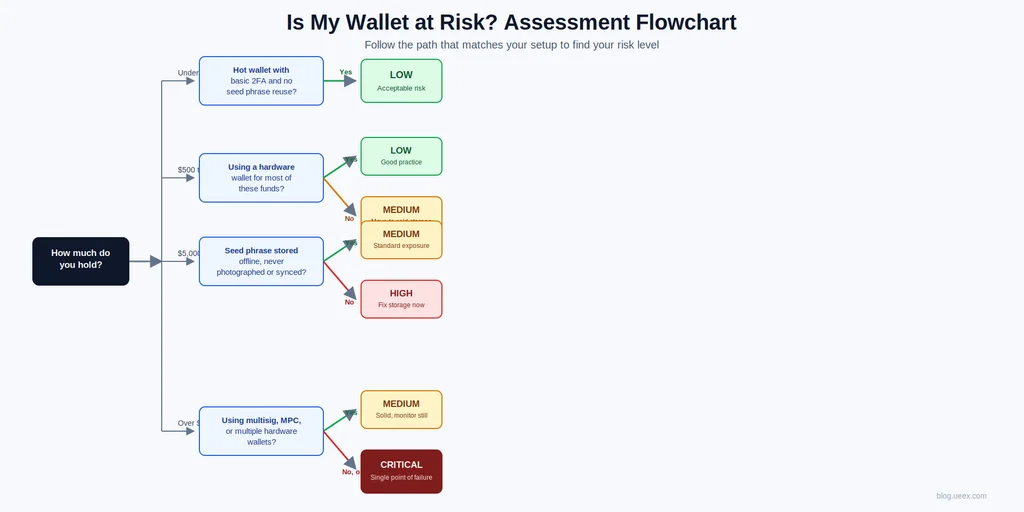
Here’s how to put all of this together, based on what you’re actually holding:
Holdings
Recommended Setup
Small, everyday spending money
A reputable hot wallet, kept lean
Meaningful savings ($1,000+)
A hardware wallet as your primary storage
Serious wealth
Multiple hardware wallets, or a multisig setup
Seed phrase rules, non-negotiable:
Never digital. Not a photo, not a note, not a cloud file, not a password manager
Write it on paper or metal, and store at least two copies in separate physical locations
Never share it with anyone, no matter who they claim to be
Daily habits that matter:
Use an authenticator app for two-factor authentication, never SMS
Bookmark wallet and exchange sites instead of searching for them
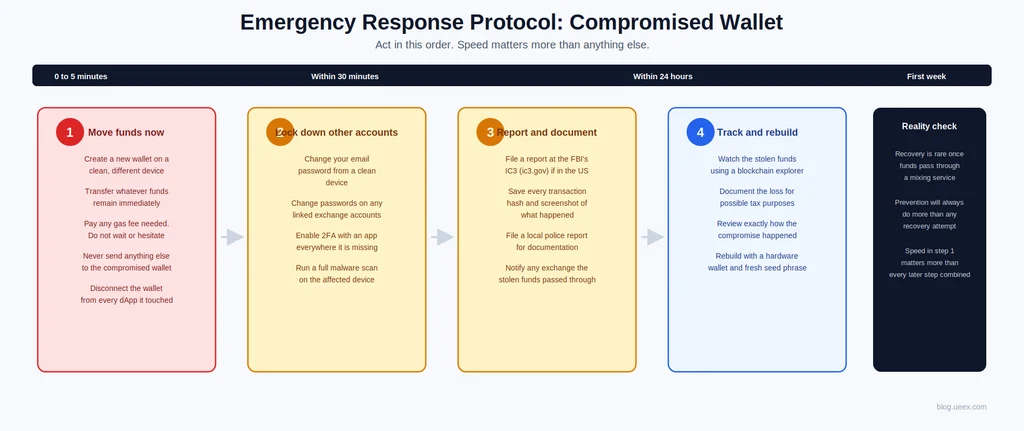
If you suspect your wallet has been compromised, speed matters more than anything else.
Move remaining funds immediately. Create a fresh wallet on a different, clean device and transfer whatever is left, right away.
Don’t send anything else to the compromised wallet, even to try to “test” it.
Disconnect the wallet from every dApp it was ever linked to
Change passwords on your email and any exchange accounts, since attackers who got this far may have more access than you realize
Report it. File a report with the FBI’s Internet Crime Complaint Center at ic3.gov if you’re in the US, and consider a local police report for documentation purposes
Track the funds using a blockchain explorer, and contact any exchange the stolen funds moved through, since some can freeze deposits if notified quickly
Realistically, recovery is rare once funds move through a mixing service. Prevention will always do more for you than any recovery effort after the fact.
The following table outlines the probability of recovering funds based on the specific nature of the exploit:
Attack Type
Recovery Likelihood
Reasoning
Exchange hack
Medium (20–60%)
Exchanges may freeze withdrawals, trace stolen funds, or compensate affected users, depending on their policies and reserves.
Phishing / Social engineering
Very Low (2–5%)
Attackers typically move stolen assets through mixers or multiple wallets immediately, making recovery extremely difficult.
Malware / Keylogger
Very Low (1–3%)
Stolen private keys allow attackers to transfer funds quickly and anonymously, often using mixing services to obscure the trail.
Bridge exploit
Low (5–15%)
Some bridge exploits are carried out by white-hat hackers or resolved through negotiations, leading to partial fund recovery.
Smart contract exploit
Low–Medium (10–30%)
If the protocol is responsible for the vulnerability, it may reimburse users through treasury funds, insurance, or governance proposals.
Hardware wallet physical theft
Medium (30–50%)
Recovery chances improve if the theft is reported quickly and the attacker cannot unlock the device or access the recovery phrase.
Advanced Crypto Wallet Security: Multisig, MPC, and Quantum Resistance
As crypto holdings grow, single-key wallets become a liability. Here’s how multi-signature wallets, MPC technology, and quantum-resistant designs are raising the security bar.
Multi-Signature (Multisig) Wallets
Multisig wallets require several private keys to approve a transaction, removing any single point of failure. A typical setup uses an M-of-N scheme (e.g., 2-of-3 or 3-of-5), where keys are held across different people or devices, and a threshold number must sign before funds move.
Personal setups using separate devices or backup signers
Popular platforms: Gnosis Safe (the most widely used option across Ethereum and EVM chains), Casa (consumer-friendly with strong UX), and Unchained Capital (multisig paired with financial services).
Trade-offs: more complex setup, higher gas fees from multiple signatures, coordination overhead, and the risk of losing keys below the required threshold.
Multi-Party Computation (MPC) Wallets
MPC splits a private key into cryptographic “shares” distributed among the user, a provider, and trusted contacts, never reconstructing the full key. Transactions are signed collaboratively once a threshold of shares (e.g., 2-of-3) participates.
Why MPC often beats multisig: no on-chain multisig transaction (lower fees), a normal wallet appearance to the blockchain, flexible threshold changes, and support for social recovery.
Leading providers: Zengo (2-of-2 with biometric recovery), Fireblocks (institutional custody), and Qredo (decentralized custody with governance). Many industry experts expect MPC and account abstraction to eventually replace seed phrases altogether.
The Quantum Computing Threat
Sufficiently powerful quantum computers could theoretically break the elliptic curve cryptography securing Bitcoin and Ethereum keys, though most experts place that risk 10-20 years out.
Key 2025–2026 developments:
Trezor’s Safe 7, released late 2025, became the first hardware wallet with quantum-ready firmware verification (SLH-DSA-128)
Ethereum researchers are actively evaluating quantum-resistant signature schemes
What users should do: this isn’t urgent for the next 5-10 years. Keep wallet firmware updated to receive quantum-resistant upgrades as they roll out, and watch quantum-resistant chains like QRL for longer-term diversification.
The Future of Wallet Security
Crypto wallet security is shifting fast from seed-phrase anxiety toward passkeys, AI threat detection, and regulatory guardrails. Here’s what’s changing and what it means for you.
Emerging Tech Cutting Hack Risk
Account abstraction (ERC-4337)
This is the biggest shift. It replaces seed phrases with passkeys, biometrics, and social recovery and lets users set programmable rules like daily spending caps or multi-sig approval for large transfers.
Live since March 2023, the standard now powers over 40 million smart accounts and 100+ million transactions across Ethereum and L2s like Base, Arbitrum, and Optimism, and May 2025’s Pectra upgrade (EIP-7702) extended these features to regular wallets too.
Zero-knowledge proofs
This cryptographic technology enables users to prove wallet ownership or fund sufficiency without exposing addresses, breaking the trail between transactions and reducing whale-targeting. ZKSync and StarkNet are leading implementations.
AI-powered threat detection
AI-driven tools now flag phishing sites and suspicious transactions before you sign. MetaMask’s Blockaid integration and similar ML tools scan for malicious contracts in real time.
Hardware wallets are evolving too: EAL6+ secure element chips (a tamper-resistant hardware component certified under the Common Criteria standard) are becoming standard, biometric unlocking is common, and quantum-resistant cryptography is in development.
Regulation Is Catching Up
The EU’s MiCA framework fully applies as of July 1, 2026, requiring exchanges and custodial wallet providers to be licensed, disclose security practices, and maintain proof-of-reserves. Self-custody wallets remain outside its scope. In the US, a federal crypto framework called the CLARITY Act remains under discussion.
Net effect: fewer unregulated wallet providers, stronger consumer recourse, and more institutional confidence, though tighter rules can trade off some decentralization for mainstream safety.
What to Expect by 2030
Seed phrases fade out for new users; social recovery becomes default
Biometric, quantum-resistant hardware wallets go mainstream
AI catches the majority of phishing attempts before damage occurs
Insurance coverage for wallets matures and becomes affordable
So, can crypto wallets be hacked? Yes, they absolutely can, and 2026’s numbers prove it’s still happening at scale. But almost none of it comes from someone breaking Bitcoin’s math.
It comes from a fake email, a seed phrase saved in the wrong place, or a stranger on Discord pretending to be support. Once you understand that the target is you, not the blockchain, the whole picture becomes a lot less mysterious and a lot more manageable.
Use a hardware wallet for anything that matters, keep your seed phrase offline and split across safe locations, and treat every unexpected request for your credentials as a scam. Do those three things consistently, and you’ve already avoided the cause of most crypto thefts in 2026.
Frequently Asked Questions
Can someone hack my crypto wallet with just my public address?
No, a public address only reveals your blockchain balance and transaction history. It cannot access your funds; only your private key or seed phrase can authorize transactions.
What’s the difference between custodial and non-custodial wallets in terms of security?
A custodial wallet lets a company manage your private keys, while a non-custodial wallet gives you full control and full responsibility for your funds’ security.
Are hardware wallets 100% safe, or can they be hacked too?
No crypto wallet is completely hack-proof, but hardware wallets offer the highest security. Their offline private keys block remote attacks, while theft and tampered devices remain the main avoidable risks.
Can I use the same seed phrase for multiple wallets?
While multiple wallets can share the same seed phrase, it’s safer to use separate seed phrases for different wallets. This reduces risk by isolating everyday funds from long-term holdings if one wallet is compromised.
Disclaimer: This content is for educational purposes only, not financial advice. Crypto investments involve risks, including hacks, scams, and user error. No security measure is foolproof. Always do your own research, verify information through official sources, stay updated on emerging threats, and never invest more than you can afford to lose.
Disclaimer: This article is intended solely for informational purposes and should not be considered trading or investment advice. Nothing herein should be construed as financial, legal, or tax advice. Trading or investing in cryptocurrencies carries a considerable risk of financial loss. Always conduct due diligence before making any trading or investment decisions.
Trade with proof of Reserves
UEEx publish monthly audits and third party verification on every listed market.