Before You Start Bitcoin has been the best-performing major asset class in 8 out of 11 years from 2014 to 2024, averaging a 54% annualised return (BlackRock). In 2025, long-term HODLing delivered 52.8% annual returns, outperforming active trading strategies. But Bitcoin reached a peak of $126,200 in October 2025 before correcting 36% within weeks. Every method in this guide carries real financial risk. Only invest what you can genuinely afford to lose.
Key Takeaways
Long-term HODLing outperformed active trading in 2025, delivering 52.8% annual returns versus inconsistent short-term trading results (CoinLaw). Most active retail traders underperform a simple buy-and-hold strategy over any meaningful time horizon.
Bitcoin reached an all-time high of $126,200 in October 2025. Public companies worldwide hold approximately 1.02 million BTC, about 4.8% of total supply, confirming that long-term institutional holding has become the dominant strategy.
Dollar-cost averaging (DCA) is the most widely recommended beginner strategy. Regular fixed investments reduce timing risk, remove emotional decision-making, and allow buying during corrections without requiring precise market timing.
Bitcoin mining in 2025 requires ASIC hardware at $3,000 to $15,000+ per unit and electricity below approximately $0.07 per kWh to be profitable. Mining pool participation grew 17% in 2025. Solo mining is effectively impractical for individual beginners.
Bitcoin lending is a passive income option, but the collapse of BlockFi, Celsius, and Genesis demonstrates counterparty risk is real. Use only reputable, financially transparent platforms and treat lending as higher risk than direct holding.
Bitcoin faucets that pay satoshis for small tasks require no investment but produce very small returns. They are a learning tool, not a meaningful income source.
What Are the Main Ways to Make Money with Bitcoin?
Bitcoin has been one of the top-performing assets in recent years, outpacing traditional investments like stocks and bonds. But how do you, as a beginner, participate in this opportunity safely and effectively? Understanding the range of strategies available, and their very different risk levels, is the essential starting point.
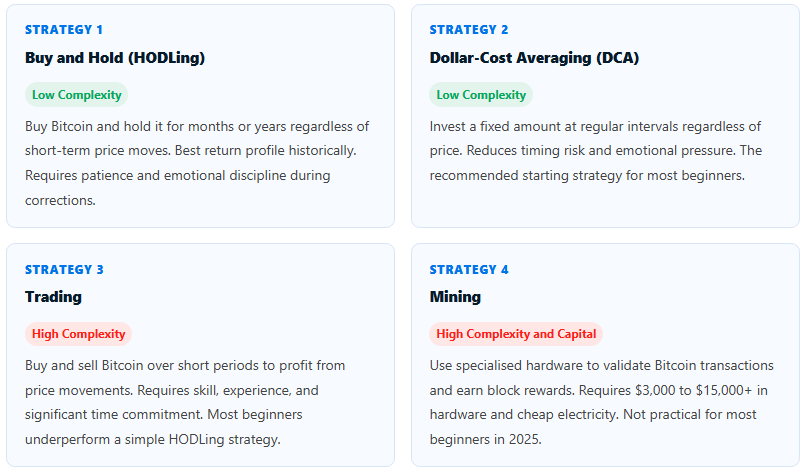
How Does Buy and Hold (HODLing) Work?
One of the most straightforward and historically most effective ways to make money with Bitcoin is buying and holding for the long term. In the Bitcoin community, this is called “HODLing,” a term born from a famous 2013 forum post misspelling of “hold” that became a mantra: Hold On for Dear Life.
What Makes HODLing So Effective?
Long-term HODLing outperformed active trading in 2025, delivering 52.8% annual returns versus inconsistent short-term results according to CoinLaw research. The reason is rooted in Bitcoin’s long-term supply and demand dynamics: a fixed supply of 21 million coins, with approximately 93% already mined and an estimated 17 to 20% permanently lost, combined with growing adoption produces a structural upward price bias over multi-year periods. Public companies worldwide now hold approximately 1.02 million BTC, about 4.8% of total supply. About 73% of crypto holders planned to hold or add to their investments throughout 2025, preferring a long-term view.
“Bitcoin’s price reached near $109,000 in early 2025, but pullbacks significantly penalised frequent traders. HODLers who remained invested historically regain losses during market recoveries, whereas active traders often miss the rebounds.”CoinLaw Crypto HODLing Statistics, March 2026
What Are the Steps to Start HODLing Bitcoin?
Choose a reputable, regulated exchange. Buy Bitcoin through a well-established exchange with strong security practices and regulatory compliance. Verify the exchange URL directly rather than clicking links from emails or social media.
Decide on your position size. Only invest money you can genuinely afford to hold through a 50 to 80% drawdown without being forced to sell. Most financial professionals suggest 1 to 5% of total investable assets for those new to Bitcoin.
Move significant holdings to self-custody. For amounts beyond what you actively trade, transfer to a hardware wallet (Ledger, Trezor) that you fully control. Not your keys, not your coins.
Secure your seed phrase offline. Write down your wallet’s seed phrase on paper and store it in a secure physical location. Never photograph it or store it digitally.
Ignore short-term price movements. Bitcoin experienced a 36% correction from its October 2025 all-time high within weeks. Every previous cycle has included corrections of 50% or more. The strategy only works if you hold through volatility.
What Is the Tax Consideration for Long-Term Holding?
In the United States, holding Bitcoin for more than one year before selling qualifies the gain for long-term capital gains tax rates of 0%, 15%, or 20% depending on income, compared to ordinary income tax rates of up to 37% for short-term gains. This tax advantage makes long-term HODLing structurally more attractive than active trading for many investors, and is one reason why family offices report that over 80% of their crypto exposure is held for more than 18 months.
Dollar-cost averaging (DCA) is an investment strategy where you invest a fixed amount of money at regular intervals, regardless of Bitcoin’s current price. If you invest $100 every week, you buy more Bitcoin when prices are low and less when prices are high, automatically averaging your cost basis over time.
Why Is DCA Particularly Suited to Bitcoin?
Bitcoin’s price volatility makes lump-sum timing extremely difficult even for experienced investors. DCA removes the psychological pressure of trying to identify the “perfect” entry point, which is practically impossible to predict consistently. By spreading purchases across many intervals, you smooth out the impact of any single price peak or trough. The strategy also promotes consistent investing discipline: a regular $100 weekly commitment builds a meaningful Bitcoin position over a year regardless of what the market is doing in any given week. For those who cannot commit large lump sums, DCA makes Bitcoin investing accessible from whatever level of capital is available.
What Are the Realistic Returns from a DCA Strategy?
Historical DCA backtests on Bitcoin consistently produce strong returns for investors who maintained their strategy through full market cycles. An investor who DCA’d $100 per week into Bitcoin from January 2020 through December 2025 would have invested approximately $31,200 and accumulated a position worth substantially more at December 2025 prices, depending on exact timing, due to Bitcoin’s overall price appreciation over that period. Past performance does not guarantee future results, and DCA does not protect against prolonged bear markets where prices decline for extended periods. It reduces timing risk, but does not eliminate investment risk.
Join UEEx
Experience the World’s Leading Digital Wealth Management Platform
Bitcoin trading involves buying and selling Bitcoin over shorter periods to profit from price changes. Unlike HODLing, trading requires regular market monitoring, an understanding of price dynamics, and significant emotional discipline. Most studies find that the majority of active retail traders underperform a simple buy-and-hold strategy over any time period longer than a few months.
What Are the Main Types of Bitcoin Trading?
Day Trading
Day traders buy and sell Bitcoin within the same day, attempting to profit from intraday price movements. They make multiple trades throughout the day, closely monitoring charts and market news. Experienced day traders may earn 1% to 3% of their capital per day, but this requires significant skill, timing, and a solid strategy built through extensive practice. As a beginner, losses while learning to manage trades effectively are common and should be factored in as a cost of education. Bitcoin traded above $100,000 for much of 2025, meaning even small percentage moves represent meaningful absolute dollar values per position.
Swing Trading
Swing trading involves holding Bitcoin for days to weeks until its price reaches a target level. Unlike day trading, swing traders focus on medium-term trends rather than daily price changes. Swing traders with good market analysis might target monthly returns of 10% to 30% during trending markets, though this depends heavily on correctly identifying direction and managing positions when the market moves against them. Risk is moderate relative to day trading but significantly higher than simply holding.
Scalping
Scalping is a high-frequency trading style targeting very small profits per trade, typically 0.1% to 0.5%, executed many times per day. Scalpers aim for 1% to 2% daily returns from accumulated small gains. It requires constant monitoring, fast decision-making, access to low-latency trading infrastructure, and the ability to stay disciplined under high cognitive load. This approach is entirely unsuitable for beginners and should only be considered after developing substantial trading experience through less intensive methods.
Regardless of trading style, the basic principle is to identify situations where buying or selling Bitcoin has an asymmetric risk-to-reward profile: the potential gain meaningfully outweighs the risk of loss. This requires understanding support and resistance levels, momentum indicators, volume analysis, and how news events typically affect Bitcoin’s price. Nathalie Llanto, Manager at Shopthemer, cautions against the common mistakes of selling during price drops from panic or chasing trendy coins, which often fail to deliver on their promises. She recommends sticking to well-known cryptocurrencies like Bitcoin that have stood the test of time and doing thorough research before entering any trade.
Trading risk warning: On October 10, 2025, a single Bitcoin flash crash wiped $19 billion in leveraged long positions in one day. Leveraged trading amplifies both gains and losses. Beginners using leverage can lose their entire position within hours on a normal intraday price swing. If you trade, start with small positions and no leverage until you understand how the market behaves across multiple market conditions.
Style
Holding Period
Target Return
Skill Required
Best For
HODLing
Months to years
52.8% annual (2025)
Low
All investors; especially beginners with conviction in Bitcoin’s long-term value
Swing Trading
Days to weeks
10 to 30% per month (experienced)
Medium
Investors with some market knowledge who can monitor positions regularly
Day Trading
Intraday only
1 to 3% per day (experienced)
High
Experienced traders with technical analysis skills and full-time availability
Scalping
Seconds to minutes
0.1 to 0.5% per trade, 1 to 2% daily
Very High
Advanced traders only; requires specialised infrastructure and extreme discipline
How Does Bitcoin Mining Work in 2025?
Bitcoin mining is the process of solving complex cryptographic puzzles to validate transactions on the Bitcoin blockchain. Miners who solve a block first earn the block reward, currently 3.125 BTC per block following the April 2024 halving, plus transaction fees from included transactions. In 2025, Bitcoin miners collectively earned $11.2 billion in total revenue. But mining has become highly competitive and capital-intensive: it is no longer viable for most individual beginners without significant resources.
What Hardware Do You Need to Mine Bitcoin?
Bitcoin mining requires Application-Specific Integrated Circuit (ASIC) miners, purpose-built hardware designed specifically for Bitcoin’s SHA-256 hashing algorithm. The leading ASIC models in 2025 achieve efficiency levels of 12 to 17 joules per terahash (J/TH). Top models from Bitmain’s Antminer S21 series and MicroBT’s Whatsminer M60S range from $3,000 to $15,000 per unit. In addition to hardware costs, you need to account for power supply units, cooling systems, network infrastructure, and either home space or data centre hosting fees.
What Electricity Cost Is Required to Be Profitable?
Electricity is the primary operating cost and the critical variable in profitability calculations. The break-even electricity cost for top-tier 2025 ASIC hardware is approximately $0.05 to $0.07 per kilowatt-hour. At the Bitcoin network’s current difficulty and block reward, operations paying above $0.07 per kWh face tight or negative margins. The US leads global mining at 37.8% of hash rate, driven by access to relatively cheap power in Texas and other energy-rich states. Over 52% of Bitcoin mining now uses non-fossil fuel energy sources as miners co-locate with cheap renewable generation.
Why Should Beginners Join a Mining Pool?
Mining Bitcoin as a solo miner with any amount of hardware available to individuals is effectively impractical: the probability of finding a block alone is astronomically low relative to the massive competing network. Mining pool participation grew 17% in 2025 as individual miners pooled their computing power. Foundry USA mines approximately 30% of all Bitcoin blocks. Other major pools include AntPool, F2Pool, and Braiins Pool. In a pool, your machine contributes its hash rate to the collective effort, and rewards are shared proportionally when the pool finds a block. Common payout models include Pay-Per-Share (PPS) and Full Pay-Per-Share (FPPS). See our guide on crypto mining pools for a complete breakdown.
Join UEEx
Experience the World’s Leading Digital Wealth Management Platform
How Can You Earn Passive Income by Lending Bitcoin?
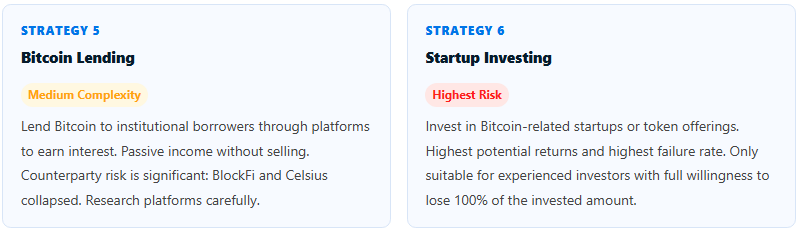
While Bitcoin does not support traditional staking like Ethereum or other Proof of Stake blockchains, you can still earn passive income by lending your Bitcoin to institutional borrowers through platforms that pay interest in return. This allows your Bitcoin to generate returns without requiring you to sell it or actively manage it.
How Does Bitcoin Lending Work?
Bitcoin lending platforms work by connecting Bitcoin holders who want to earn interest with institutional borrowers who need Bitcoin liquidity for trading, hedging, or other purposes. You deposit your Bitcoin into the platform, which then manages the lending arrangements and pays you a regular interest rate. Rates vary by platform and market conditions but have historically ranged from 1% to 8% APY for Bitcoin. The platform handles borrower management, collateral requirements, and loan administration.
Critical counterparty risk warning: Three major Bitcoin lending platforms collapsed between 2022 and 2023: BlockFi, Celsius Network, and Genesis Global. Customers lost access to billions of dollars in deposits. The original article’s mention of BlockFi and Celsius as recommended platforms is no longer accurate. Both are now bankrupt. Before using any Bitcoin lending platform, independently verify its financial health, proof of reserves, regulatory registration, and user fund protections. Treat Bitcoin lending as materially higher risk than direct self-custody holding.
What Should You Look for in a Bitcoin Lending Platform?
Proof of reserves: The platform should regularly publish independently audited proof that its total assets exceed its liabilities. If a platform cannot demonstrate this, do not deposit.
Regulatory registration: Platforms operating in regulated jurisdictions with clear licensing have meaningfully lower risk of sudden collapse than offshore unregulated operators.
Withdrawal conditions: Check that withdrawals are available without unusual conditions. Platforms that require fees, unlock periods, or other hurdles to access your funds should be treated with extreme caution.
Track record: Platforms with multi-year operating histories that have maintained payouts through the 2022 bear market are more credible than newer or untested services.
Bitcoin faucets are websites or apps that reward users with very small amounts of Bitcoin (measured in satoshis, where 1 satoshi equals 0.00000001 Bitcoin) for completing simple tasks such as solving captchas, watching advertisements, or visiting specific websites. They require no financial investment and are accessible to complete beginners.
What Can You Realistically Earn from Bitcoin Faucets?
Earnings from Bitcoin faucets are genuinely very small. A typical captcha task might pay 10 to 50 satoshis. At Bitcoin’s April 2026 price range, 10,000 satoshis equals approximately $8 to $9. Reaching withdrawal minimums of 10,000 to 50,000 satoshis through faucet tasks alone could require many hours of work for what amounts to a few dollars. Bitcoin faucets are best understood as a learning and familiarisation tool for complete beginners who want to interact with Bitcoin wallets and transactions without financial risk, not as a meaningful income source. Popular faucet platforms include FreeBitco.in and Cointiply, though the landscape changes regularly as platforms launch and close.
How Does Investing in Bitcoin Startups Work?
Investing in Bitcoin-related startups or blockchain projects is another avenue for potential gains, with significantly higher risk than direct Bitcoin investment. Early investors in successful Bitcoin infrastructure companies, exchanges, or applications have generated extraordinary returns. But the failure rate for early-stage startups is extremely high: most early-stage venture investments lose money.
What Types of Bitcoin Startups Are Most Common?
Bitcoin-related startup opportunities fall into several categories: Bitcoin payment applications and merchant tools; cryptocurrency exchanges and brokerages; blockchain infrastructure and developer tools; custody and security services; and Bitcoin financial products including ETFs and lending platforms. Some projects offer token-based funding through Initial Coin Offerings (ICOs) or newer structures like Initial DEX Offerings (IDOs), though the 2017 ICO boom demonstrated that the majority of these token offerings go to near zero. Platforms including AngelList and CoinList provide structured access to early-stage crypto and Bitcoin startup investments.
Beginner’s note on startup investing: Bitcoin startup investing is suitable only for investors who understand that they could lose 100% of their investment, have already established a long-term Bitcoin holding position, and are investing amounts they can comfortably lose without affecting their financial stability. It is generally not an appropriate first step for Bitcoin beginners.
Method
Risk Level
Capital Required
Time Required
Beginner Suitable?
HODLing / DCA
Medium (market risk)
Any amount from $10+
Minimal ongoing
Yes
Swing Trading
High
$500+ recommended
Several hours per week
With caution
Day Trading
Very High
$1,000+ recommended
Full-time
Not recommended
Mining
High (hardware + electricity)
$3,000 to $15,000+ hardware
Setup intensive; ongoing management
Not recommended
Bitcoin Lending
Medium to High (counterparty)
Platform minimum (varies)
Minimal once set up
With research
Bitcoin Faucets
Near zero financial risk
Zero (time only)
Hours for small amounts
Yes (learning tool)
Startup Investing
Very High (venture risk)
$1,000+ minimum typically
Research intensive
Not recommended
How Do You Safely Store and Manage Your Bitcoin?
Making money with Bitcoin is only half the challenge. Keeping it secure is equally important. The collapse of FTX in November 2022, which trapped approximately $8 billion of customer funds, and the February 2025 Bybit hack, which saw $1.46 billion stolen from the exchange, are reminders that custody risk is real.
Use a hardware wallet for significant holdings. A hardware wallet like Ledger or Trezor stores your private key on a device that never connects to the internet when signing transactions. This makes remote hacking practically impossible. For long-term holdings, hardware wallets are the security standard.
Understand hot vs cold wallets. A hot wallet (software on a phone or computer connected to the internet) is convenient for day-to-day use and active trading funds but is more vulnerable to attack. A cold wallet (hardware wallet, paper wallet, or air-gapped computer) is more secure for long-term holdings you do not need frequent access to.
Never store large amounts on exchanges indefinitely. Exchanges are not banks. They are not FDIC-insured. If an exchange is hacked or goes bankrupt, there is no guarantee of recovery. Only keep on exchanges the funds you actively need for trading.
Back up your seed phrase securely offline. Your seed phrase (12 to 24 words) can recover your entire wallet if your device is lost or damaged. Write it down on paper, store copies in multiple secure physical locations (a home safe and a bank safe deposit box for example), and never store it digitally or photograph it.
Enable strong two-factor authentication. Use an authenticator app (Authy, Google Authenticator) rather than SMS-based 2FA, which is vulnerable to SIM-swapping. Apply this to every exchange and email account associated with your Bitcoin activity.
Yes. Beginners can make money with Bitcoin through buying and holding, dollar-cost averaging, participating through Bitcoin ETFs, lending Bitcoin for passive interest, or earning small amounts through faucets. Long-term HODLing outperformed active trading in 2025, delivering 52.8% annual returns. Beginners are generally best served by starting with small, regular DCA investments rather than attempting to time the market or trade actively before developing experience and understanding of how Bitcoin behaves across different market conditions.
What is the easiest way for beginners to earn Bitcoin?
The easiest entry points are buying Bitcoin through a regulated exchange and holding it long term, or using a Bitcoin ETF through a standard brokerage account. Dollar-cost averaging, investing a fixed amount regularly regardless of price, removes the pressure of timing the market and has historically produced strong returns. Bitcoin faucets require no investment and pay small amounts of satoshis for simple tasks, making them a useful learning tool even though the earnings are minimal.
How much should a beginner invest in Bitcoin?
Beginners should invest only amounts they are genuinely comfortable losing entirely. Most financial advisors who cover crypto suggest 1 to 5% of total investable assets. A common beginner approach is $50 to $100 per month through dollar-cost averaging, increasing as familiarity grows. Bitcoin should complement a broader diversified portfolio rather than replace it. Never invest money needed for essential expenses or an emergency fund.
Is Bitcoin trading profitable for beginners?
Bitcoin trading is difficult and frequently unprofitable for beginners. Most studies find that the majority of active retail traders underperform a simple buy-and-hold strategy over any time period longer than a few months. In 2025, long-term HODLing delivered 52.8% annual returns versus inconsistent short-term trading results. Day trading and scalping require significant technical knowledge, emotional discipline, and experience. Beginners are strongly advised to start with long-term investing before attempting active trading strategies.
What are the safest and most beginner-friendly ways to make money with Bitcoin?
The safest beginner-friendly approaches are: (1) Dollar-cost averaging into Bitcoin through a reputable regulated exchange or Bitcoin ETF over a long time horizon. (2) Holding Bitcoin in a secure self-custody hardware wallet for the long term. (3) Bitcoin lending through reputable, transparent platforms after thorough due diligence. (4) Bitcoin faucets for learning without financial investment. The riskiest approaches for beginners are leveraged trading, day trading without experience, and investing in speculative early-stage projects with limited due diligence.
Join UEEx
Experience the World’s Leading Digital Wealth Management Platform
Oluwadamilola Olaniyan is a certified content writer. As a content writer and marketer, she is passionate about creating content that engages and inspires audiences. She is also skilled in turning complex ideas into impactful and easy to read content.
Disclaimer: This article is intended solely for informational purposes and should not be considered trading or investment advice. Nothing herein should be construed as financial, legal, or tax advice. Trading or investing in cryptocurrencies carries a considerable risk of financial loss. Always conduct due diligence before making any trading or investment decisions.
Trade with proof of Reserves
UEEx publish monthly audits and third party verification on every listed market.