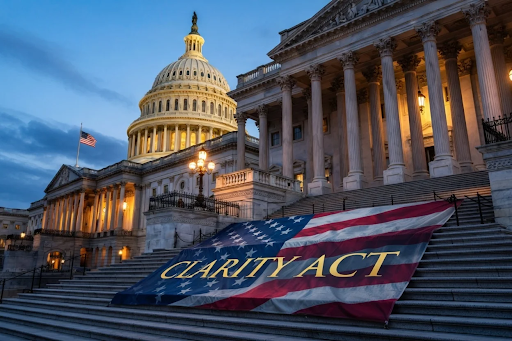
The U.S. Senate will not vote on the Clarity Act before its August recess, Senate Majority Leader John Thune confirmed, pushing one of the crypto industry’s biggest legislative priorities into September. Thune said Democrats were not prepared to support a vote before senators leave Washington and that the bill would be taken up when the chamber returns.
“The Dems are insistent on no Clarity vote,” Thune said. “I worked with sponsors of the bill. Senator Lummis was great, and we’re getting that queued up first thing when we come back.”
The Senate is scheduled to return in mid September, leaving lawmakers only a short legislative window before attention shifts increasingly toward the November midterm elections.
Key Takeaways
The Senate has postponed consideration of the Clarity Act until after its August recess.
Majority Leader John Thune said Democrats were unwilling to support a vote before the break.
The bill needs 60 votes to overcome a potential filibuster, meaning Republican leaders need Democratic support.
Ethics rules concerning President Donald Trump’s crypto interests remain a major point of disagreement.
Some Republican senators have also raised concerns about stablecoin rewards and the bill’s potential impact on banks.
The delay leaves lawmakers with only a few weeks in September to reach a compromise before the midterm election period dominates the legislative calendar.
Why the Clarity Act Missed the August Deadline
The Clarity Act is designed to establish a federal framework for digital assets and clarify the respective roles of the Securities and Exchange Commission and Commodity Futures Trading Commission. The bill had been expected to receive Senate consideration before the recess, but negotiations failed to produce enough support. The legislation needs 60 votes to overcome a filibuster, making bipartisan backing essential.
Democratic lawmakers have continued pushing for stronger ethics provisions addressing crypto ownership and activities by public officials. The issue has gained particular attention because of Trump’s extensive crypto interests and the launch of his $TRUMP memecoin. A bipartisan proposal from Senators Thom Tillis and Ruben Gallego has sought stronger restrictions on public officials’ digital asset interests. Negotiations over how such provisions would be enforced remain unresolved.
Republican support is also not guaranteed. Senators Josh Hawley and Jerry Moran have raised concerns about the bill’s treatment of banking interests, particularly provisions involving stablecoin rewards. That combination has left Republican leaders without a clear path to the 60 votes needed for a procedural advance.
September Becomes a Critical Window
The delay does not kill the legislation, but it significantly compresses the timetable for passage. The Senate is expected to return around September 14 and will have only a few weeks to work through the Clarity Act and other legislative priorities before the election season becomes more intense.
Prediction markets have also sharply reduced expectations for the bill’s passage this year. Recent market estimates put the probability at roughly 14%, down considerably from earlier levels. Still, Thune has indicated that Republican leaders intend to make the bill an early priority when senators return.
The delay could give negotiators additional time to address the outstanding ethics, banking and enforcement concerns. It could also give Democrats more leverage to demand changes before agreeing to advance the measure.
Crypto Industry Reacts to the Delay
The crypto industry has pushed strongly for Congress to establish a statutory market structure framework, arguing that regulatory uncertainty has made it harder for companies to operate and invest in the United States.
Crypto Council for Innovation CEO Ji Hun Kim described the postponement as disappointing but said the industry would continue working toward passage.
“Every day without such a framework pushes American users and builders offshore and leaves consumers at risk,” Kim said.
The Digital Chamber CEO Cody Carbone similarly said the fight was not over and that industry groups would continue working with lawmakers during the recess to find common ground. The delay also comes as federal regulators continue developing crypto rules independently. If Congress fails to pass the legislation, the SEC and CFTC could continue using existing authority to establish parts of the regulatory framework, potentially reducing some uncertainty but without the permanence of congressional legislation.
Conclusion
The Senate’s decision to postpone the Clarity Act vote until September represents a major setback for U.S. crypto legislation, particularly after lawmakers spent months preparing the bill for a pre-recess vote.
The legislation still has a path forward, but that path is becoming narrower. Republicans need Democratic votes while also addressing concerns from members of their own party over ethics provisions, stablecoin rewards and banking interests. When senators return in September, lawmakers will face a compressed window to resolve those disputes. Whether they can reach a bipartisan agreement before the midterm election cycle takes over could determine whether the Clarity Act becomes law in 2026 or remains unfinished legislation.
Disclaimer: This article is intended solely for informational purposes and should not be considered trading or investment advice. Nothing herein should be construed as financial, legal, or tax advice. Trading or investing in cryptocurrencies carries a considerable risk of financial loss. Always conduct due diligence before making any trading or investment decisions.
Trade with proof of Reserves
UEEx publish monthly audits and third party verification on every listed market.