A Decentralized Autonomous Organization (DAO) is a member-owned community that runs on a blockchain through smart contracts, making decisions by collective vote rather than through any central leader or executive team. Rules are written into code, executed automatically, and visible to every participant. Members acquire governance tokens – which grant voting rights – and use them to propose or reject changes to the organization. As of Q1 2026, more than 13,000 DAOs exist globally, with over 6,000 showing regular activity and collectively holding approximately $21.4 billion in liquid treasury assets.
Key Takeaways
- DAOs are digital organizations that operate on a blockchain, enabling decentralized decision-making, governance, and collective action without a central authority.
- They are run by smart contracts that automate decision-making processes based on predefined rules and voting outcomes.
- They are decentralized, autonomous, transparent, community-driven, and typically open-source.
- They are found in industries including DeFi, governance, art and collectibles, gaming, education, and healthcare.
- Over 13,000 DAOs now exist globally, with combined treasuries of approximately $24.5 billion as of 2025.
What Is a Decentralized Autonomous Organization (DAO)?
Picture a company where no CEO exists. Every decision – from how to spend funds to which projects to prioritize – goes to a vote. All votes are recorded on a public blockchain. Nobody can alter the results, and the code automatically carries out whatever the vote decides.
A concrete example helps. Suppose 10,000 people pool their money into a shared treasury to invest in early-stage crypto projects. No fund manager controls the money. Anyone who holds the fund’s governance token can submit an investment proposal. The group votes. If the proposal passes, the smart contract releases the funds automatically. If it fails, nothing moves. That is an investment DAO operating as designed.
The key distinction between a DAO and a traditional organization is where authority lives. In a company, authority flows from the board and executive team down to employees. In a DAO, authority flows from rules encoded in smart contracts, ratified by token-weighted votes from members. There is no human intermediary in the decision chain.
How Did DAOs Start – and What Was the First Big Test?
The idea has a clear origin point. In 2013 and 2014, Ethereum co-founder Vitalik Buterin outlined the concept in writings describing blockchain-based organizations governed entirely by code. The earliest vision was of a network that could hire staff, acquire resources, and operate businesses without human management layers.
The first real test came in 2016 with a project called simply “The DAO.” Built on Ethereum, it was an investor-directed venture fund. Members contributed Ether and received voting rights over which startup projects to fund. The DAO raised approximately $150 million worth of ETH in its token sale – one of the largest crowdfunding events in history at that point.
The experiment ended badly. A coding flaw allowed an attacker to drain roughly $70 million worth of Ether before anyone could stop it. Because blockchains are designed to be immutable, there was no easy way to reverse the theft. The Ethereum community ultimately performed a hard fork – essentially rewriting history to return the stolen funds. A faction that opposed this on principle refused to adopt the new chain, and their version became Ethereum Classic (ETC), which still exists today.
Despite that early collapse, the concept survived and evolved. By 2020, the explosion of decentralized finance (DeFi) brought DAOs back to prominence as governance mechanisms for lending protocols, exchanges, and liquidity pools. Projects like MakerDAO, Uniswap, and Compound used DAO structures to hand protocol control over to their communities.
How Does a DAO Actually Work?
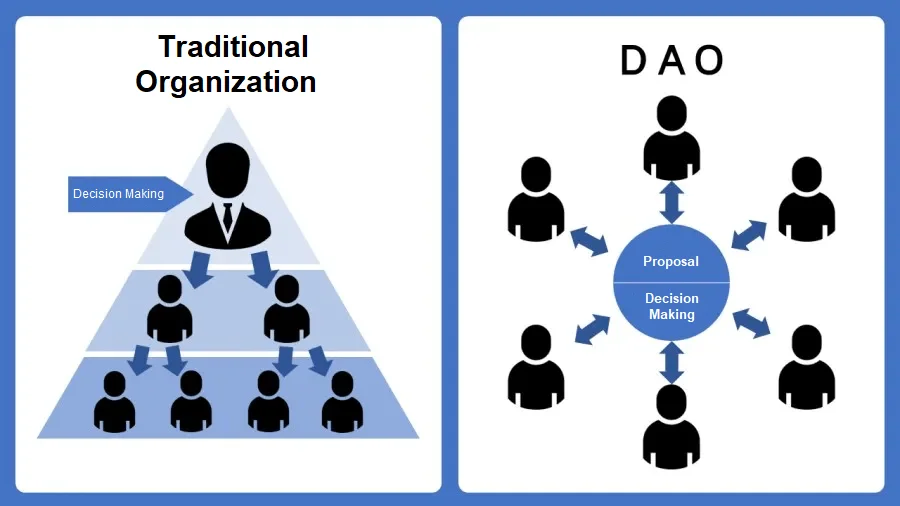
A DAO operates through three interconnected layers: smart contracts, governance tokens, and voting mechanisms.
Smart contracts are the foundation. They are self-executing programs stored on a blockchain that automatically carry out actions when specific conditions are met. A DAO’s rules – how proposals are submitted, how votes are counted, how funds are released – are all written into these contracts. Because the code runs on a decentralized network, no single party can modify or override it unilaterally.
Governance tokens give members their voice. When a DAO launches, its founders distribute tokens to early contributors, investors, or the public through token sales or airdrops. Holding tokens typically grants voting power proportional to the number held. This means larger stakeholders carry more influence – which critics note mirrors traditional shareholder structures more than pure democracy.
Voting mechanisms vary by DAO design. The most common approaches include simple majority votes, quadratic voting (which reduces the outsized influence of large holders by making each additional vote cost progressively more tokens), and delegated voting (where token holders assign their votes to representatives they trust).
When a member wants the DAO to do something – allocate funds, change a protocol parameter, hire a developer – they submit a formal proposal. Members debate it in community forums on Discord or Snapshot. After a set period, the vote opens, runs for a fixed window, and the result executes automatically via smart contract if the threshold is met.
Which Governance Model Is Right for a DAO?
Not all DAOs vote the same way. The choice of voting model shapes who actually holds power.
| Governance Model | How It Works | Best For | Main Weakness |
| Token-weighted voting | 1 token = 1 vote; large holders dominate | Protocol DAOs with concentrated stakeholders | Whale capture; top 10% hold 76.2% of voting power on average |
| Quadratic voting | Each additional vote costs exponentially more tokens | Grant DAOs, public goods funding | Sybil attacks (splitting votes across wallets) |
| Delegated voting | Token holders assign their votes to trusted delegates | Large DAOs with low participation | Delegate capture; delegates may drift from voter intent |
| Multi-sig governance | A small council of signers approves transactions | Early-stage DAOs needing speed | High centralization; few people hold all keys |
| Conviction voting | Votes accumulate weight over time the longer they are held | Continuous funding DAOs (e.g., Gardens) | Slow for time-sensitive decisions |
What Are the Different Types of DAOs?
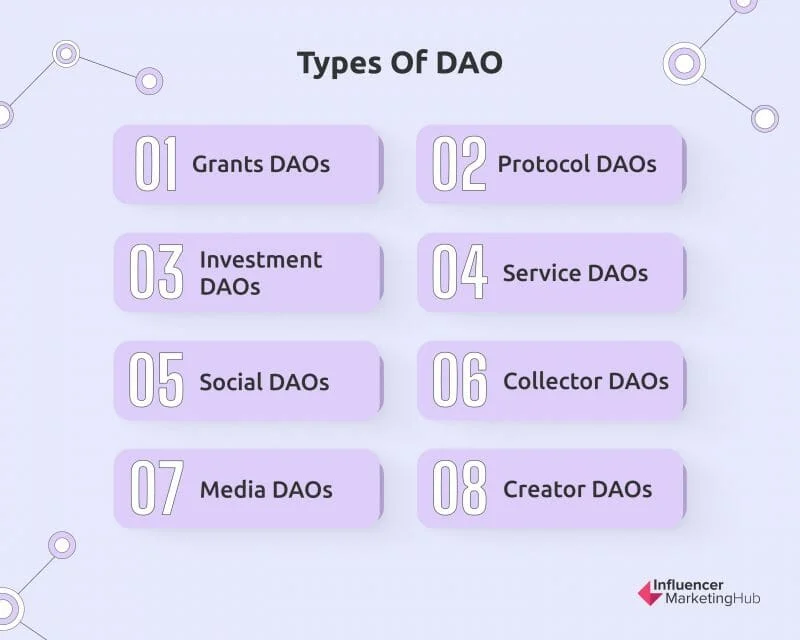
DAOs have expanded well beyond their DeFi origins. As of 2026, they appear across nearly every sector where collective ownership or governance makes sense.
| DAO Type | Primary Purpose | Notable Examples | Treasury / Scale (2026) |
| Protocol DAOs | Govern blockchain protocols and DeFi platforms | MakerDAO, Uniswap, Compound | Billions in protocol-managed assets |
| Investment DAOs | Pool capital for collective investment decisions | The LAO, MetaCartel Ventures | $1.4B+ across finance DAOs |
| Gaming DAOs | Manage in-game assets, guilds, and virtual economies | Yield Guild Games, Decentraland | ~$520M in digital assets |
| Social DAOs | Community networking and shared experiences | Friends with Benefits (FWB) | Membership-gated communities |
| Media DAOs | Collaborative content creation and distribution | Bankless, Mirror | 18% of all DAO count |
| Charity DAOs | Transparent philanthropic funding | GiveDirectly, Gitcoin | Community-funded grants |
| Science DAOs | Fund and coordinate research | Molecule, SciDAO | Early-stage, growing |
| Collector DAOs | Acquire and manage NFTs and digital art | PleasrDAO, Flamingo | Varies by collection value |
Protocol DAOs remain the largest by treasury size. The DAO development market overall is projected to grow from approximately $3.75 billion in 2026 to $25 billion by 2035, at a compound annual growth rate of around 20.9%.
What Are the Key Features That Define a DAO?
Not every blockchain project calling itself a DAO deserves the label. The defining characteristics that separate genuine DAOs from centralized platforms with governance tokens are specific and worth understanding.
- No central authority. Control is distributed among token holders. No single person or company can unilaterally override the rules or direct the treasury.
- Smart contract governance. Rules execute automatically without human intermediaries. A vote to release funds triggers the payment directly – no CFO approves the transfer.
- On-chain transparency. Every proposal, vote, and transaction is recorded publicly on the blockchain. Any member can audit the organization’s full history.
- Token-weighted participation. Governance tokens grant voting rights. Members acquire them by purchase, contribution, or airdrop – and can transfer or sell them.
- Open-source code. Most DAO smart contracts are publicly readable. Community members can review logic, flag vulnerabilities, and propose upgrades.
- Immutability within rules. Once governance decisions pass and are encoded, they cannot be reversed without another vote – protecting minority members from sudden unilateral changes.
How Do DAOs Compare to Traditional Companies?
| Dimension | Traditional Company | DAO |
| Decision-making | Board + executives; private deliberations | Public token votes; all records on-chain |
| Legal structure | Corporation, LLC, partnership | Often unregistered; Wyoming/Marshall Islands DAO LLCs exist |
| Ownership proof | Shares or equity | Governance tokens |
| Hiring | Standard employment contracts | Contributor grants voted by the DAO |
| Accountability | Regulatory filings, audits, boards | Smart contract code and community voting |
| Speed of decisions | Fast for small executive actions | Slow; proposals take days to weeks |
| Geographic reach | Incorporated in one jurisdiction | Globally accessible with an internet connection |
What Are the Real Benefits of Participating in a DAO?
The appeal of DAOs goes beyond ideology. They offer practical advantages over traditional organizational structures in specific contexts.
Global, borderless participation. Anyone with an internet connection and the relevant token can join. Geography, employment status, and institutional affiliation are irrelevant. This opens governance and economic participation to people who would be excluded from traditional investment funds or corporate governance entirely.
Transparent decision-making. Because votes are recorded on-chain, every member can see exactly who voted, which direction they voted, and what the outcome was. This removes the backroom dealing that characterizes many traditional organizational decisions.
Aligned incentives. Token holders have a direct financial stake in the DAO’s success. This aligns the interests of contributors, investors, and users in ways that traditional employment or shareholder structures rarely achieve for all parties simultaneously.
Reduced administrative overhead. Smart contracts automate payments, fund releases, and rule enforcement. There is no accounts payable department, no HR processing payroll, no legal team required to execute internal transfers.
Community ownership of products. When a DeFi protocol is governed by its users rather than its founders, the community has a direct say in fee structures, supported assets, and protocol upgrades. This changes the relationship between a product and its users fundamentally.
What Are the Biggest Risks and Limitations of DAOs?
The same features that make DAOs powerful also create real problems. As of 2026, several persistent challenges limit their effectiveness.
Voter apathy is severe. Voter participation in most DAOs averages around 17% of token holders, though leading DAOs like Aave and MakerDAO reach above 22% on critical votes. When most token holders do not vote, decisions effectively get made by a small, engaged minority. As of Q1 2026, the top 10% of token holders control 76.2% of all voting power across major governance systems – despite DAOs claiming decentralization.
Smart contract risk. The DAO hack of 2016 established the stakes clearly. Code that has not been thoroughly audited can be exploited. Once funds leave a smart contract through an exploit, recovery without a controversial hard fork is often impossible. The larger the treasury, the larger the target.
Regulatory ambiguity. Most jurisdictions have not clearly defined the legal status of DAOs. Members can face unexpected personal liability in some countries. DAOs struggle to sign contracts, open bank accounts, or hire employees through conventional means without legal wrappers – and the wrappers that exist (like Wyoming’s DAO LLC structure) create their own complications.
Concentration of governance power. Token distributions frequently concentrate voting power among early contributors and venture investors. A DAO that claims decentralization but has 60% of tokens held by five wallets is functionally centralized, regardless of the governance processes around it.
Slow decision-making. Reaching consensus among thousands of members takes time. In fast-moving market conditions, slow governance can mean missed opportunities or delayed responses to security incidents.
How Do You Join a DAO?
The process is more accessible than it might appear, though it varies by DAO.
- Research first. Find DAOs that match your interests – DeFi, art, gaming, social causes, scientific research. Review the DAO’s documentation, treasury, governance history, and community reputation. Tools like DeepDAO and Snapshot let you explore active DAOs and their governance records.
- Set up a compatible wallet. Most DAOs operate on Ethereum or EVM-compatible chains (Polygon, Arbitrum, Base). MetaMask is the most common starting point. Hardware wallets like Ledger add security for significant holdings.
- Acquire the governance token. Buy it on an exchange or DEX, earn it through contribution, or receive it via airdrop if eligible. Check the token’s contract address against official DAO sources to avoid scam tokens.
- Join community channels. Discord and Telegram are where most DAO discussion happens. Reading proposal discussions, governance calls, and community debates is essential before casting votes or submitting proposals.
- Participate actively. Vote on proposals, contribute expertise, or submit your own proposals. Many DAOs reward active contributors with additional tokens or grant funding.
How Do DAOs Make Money?
DAOs generate revenue through several mechanisms depending on their type and design.
- Protocol fees collected from users of DeFi platforms (trading fees, borrowing fees, liquidation penalties)
- Returns on treasury investments in other crypto assets or liquidity positions
- Grants and funding from ecosystem foundations for building on their chain
- NFT sales and royalties for collector or gaming DAOs
- Membership fees for social DAOs with exclusive access
- Service revenue for DAOs that provide consulting, development, or marketing services to other projects
How revenue gets distributed also varies. Some DAOs buy back and burn governance tokens to return value to holders. Others distribute yields directly to stakers. Many reinvest all revenue into the treasury for future governance votes to allocate.
FAQ: Decentralized Autonomous Organizations
Are DAOs legal?
Legal status varies by country. Most jurisdictions have no specific DAO legislation, leaving them in a gray area. Wyoming (USA) and the Marshall Islands have enacted DAO-specific legislation that grants legal entity status. Members in other jurisdictions may face personal liability for DAO actions. Before making significant DAO investments or contributions, consulting a legal professional familiar with your local regulations is strongly advisable.
What is a governance token and why does it matter?
A governance token is a blockchain-based asset that grants its holder voting rights within a DAO. The more tokens you hold, the more influence your vote carries on proposals. Governance tokens can also appreciate in value if the DAO grows, giving holders both a voice and a financial stake. They are typically transferable, meaning governance participation is open to anyone willing to acquire them on the open market.
Can a DAO be hacked?
Yes. Smart contract vulnerabilities are real and have caused substantial losses. The 2016 DAO hack resulted in $70 million in stolen Ether. Since then, multiple DeFi protocols governed by DAOs have suffered exploits. Reputable DAOs address this through multiple independent security audits before deploying contracts, bug bounty programs, and timelocked execution of governance decisions – giving the community time to detect malicious proposals before they take effect
Is a DAO the same as a cryptocurrency?
No, though they often issue tokens. A DAO is an organizational structure for collective governance. Cryptocurrencies are assets. Many DAOs have their own governance tokens that trade on exchanges, but the DAO itself is the organization and its smart contracts – not the token. Bitcoin has no DAO governance. Networks like Uniswap and MakerDAO use DAO governance structures alongside their native tokens.
Why is voter turnout so low in most DAOs?
Low participation reflects a combination of factors: many token holders buy governance tokens purely for speculation rather than governance interest; voting on complex protocol proposals requires significant technical understanding; gas fees on some chains make voting economically irrational for small holders; and many members simply do not feel their individual vote meaningfully changes outcomes. Some DAOs have adopted gasless voting via Snapshot and delegated voting systems specifically to address these barriers.
What happens to a DAO if its smart contract gets exploited?
Options are limited and often controversial. Without a governance-approved recovery mechanism already built in, the community must either accept the loss, attempt a hard fork of the underlying blockchain (as Ethereum did in 2016), or execute an emergency upgrade if the DAO’s governance contracts include an upgradeable proxy. This is why timelocks, multi-sig safeguards, and pre-approved emergency councils are increasingly standard in well-designed DAOs as of 2026.
Practical Tips for Getting Involved with DAOs Safely
- Start with established DAOs, not new ones.MakerDAO, Uniswap, and Compound have years of governance history, audited contracts, and active communities. New DAOs with large treasuries and no track record carry significantly higher risk of exploits or rug pulls.
- Read the DAO’s governance documentation before buying tokens. Understand how proposals are structured, what quorum thresholds are required for votes to pass, and who holds the largest token concentrations. A DAO where three wallets hold 70% of voting power is not meaningfully decentralized.
- Never invest more governance tokens than you are prepared to lose entirely. Smart contract risk is real, and even well-audited code can have undiscovered flaws. Treat governance token purchases with the same caution you would apply to any high-risk speculative asset.
- Verify governance token contract addresses from official sources. Scam tokens mimicking popular DAO governance tokens are common. Always cross-reference the contract address from the DAO’s official website or documentation – not from social media links or direct messages.
- Participate in discussions before voting. Governance forums (often on Discourse or Commonwealth) and Discord servers contain context that makes voting more informed. Many proposals with serious flaws are flagged by community members before the formal vote opens.
- Consider delegating if you lack time to engage deeply. Most DAO platforms let you delegate your voting power to a community member you trust. This keeps your tokens active in governance without requiring you to evaluate every proposal personally.
- Check whether the DAO has a legal wrapper. If you plan to receive income or make substantial contributions, understanding whether the DAO is structured as a Wyoming DAO LLC or another entity can affect your tax and liability exposure significantly.