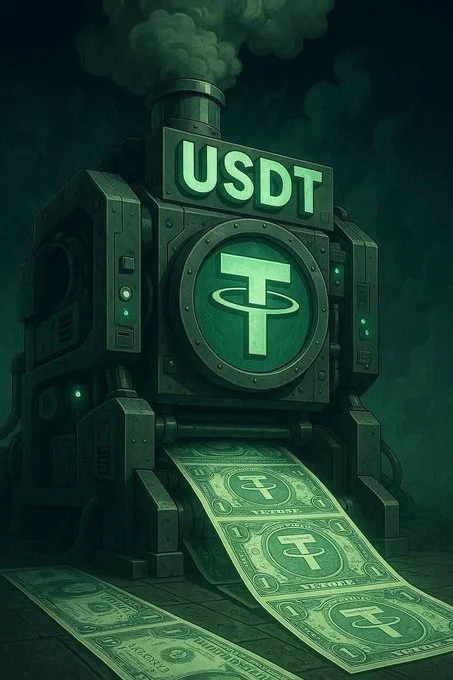
Tether has kicked off 2026 with a major move in the stablecoin market, minting 1 billion USDT on the Tron network on January 9. The issuance, confirmed by on-chain analytics platforms, marks the first large USDT mint of the year and is already drawing close attention from traders and market watchers.
Blockchain tracking account Onchain Lens was among the first to flag the transaction, stating in a post: “Tether has minted $1B $USDT on the #Tron Network. They minted for the first time in 2026.”
Shortly after, Arkham Intelligence corroborated the data, identifying the transfer as originating from Tether’s official multisig wallet and moving directly into its treasury wallet on Tron.
This structure is significant. Rather than flowing immediately into exchanges or DeFi protocols, the newly created USDT has been placed in Tether’s treasury as part of what the company calls an “authorized mint.”
According to Tether CEO Paolo Ardoino, the mint was carried out to replenish inventory, ensuring that liquidity is readily available when demand rises. In practice, this means the stablecoins are now on standby, ready to be deployed quickly to counterparties such as exchanges, market makers, and institutional clients.
Key Takeaways
- Tether minted 1 billion USDT on the Tron network on January 9, marking its first major stablecoin issuance of 2026.
- The newly created USDT was transferred from Tether’s multisig wallet to its treasury as an authorized mint, meaning it is reserved for future liquidity needs rather than immediate circulation.
- Tron remains Tether’s dominant network, hosting over 60% of total USDT supply and serving as the largest stablecoin settlement layer globally.
- Large USDT inventory mints often signal rising demand for trading liquidity and can precede periods of increased crypto market activity.
What the On-Chain Data Shows
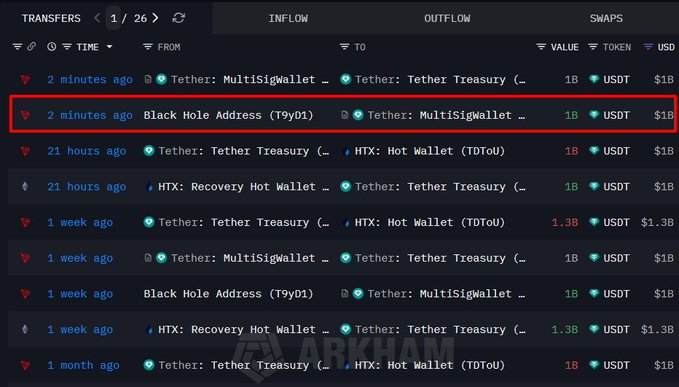
The transaction itself reflects a standard operational pattern Tether has used repeatedly in recent years. Funds were minted on-chain and transferred internally, signaling that the tokens are fully backed and approved but not yet circulating freely.
Large mints of this nature often precede periods of increased trading activity, as they allow Tether to respond almost instantly when demand for USDT spikes.
Historically, similar inventory mints in 2024 and 2025 appeared ahead of heightened activity across Bitcoin and major altcoins. While a mint does not guarantee a price rally, it often suggests that large players are preparing for heavier usage of stablecoin liquidity.
Why Tron Remains Tether’s Preferred Network
Tron continues to dominate as the primary issuance and settlement layer for USDT. More than 60% of all circulating USDT is currently hosted on the Tron blockchain, making it the most heavily used network for the stablecoin worldwide.
Traders and institutions alike favor Tron for its low transaction fees and fast confirmation times, which are critical for high-volume transfers.
USDT on Tron is widely used for crypto trading, cross-border payments, remittances, and decentralized finance activity.
In regions where traditional banking access is limited or expensive, Tron-based USDT has become a key rail for dollar-denominated transfers. Its efficiency has also made it attractive for arbitrage strategies and rapid capital movement between exchanges.
In 2025 alone, Tron processed more than $7 trillion in USDT transfers, underscoring its role as the largest stablecoin settlement network globally. The latest $1 billion mint further reinforces Tron’s position as the backbone of USDT activity.
Market Implications of a $1 Billion Mint
Large USDT mints tend to influence market sentiment, particularly when they occur during periods of rising interest in crypto assets. Traders typically use USDT as the base currency to enter positions in Bitcoin and altcoins.
As a result, an increase in available USDT supply is often interpreted as fresh dry powder waiting to be deployed.
That said, the current issuance remains parked in Tether’s treasury. It will only reach the open market when exchanges or liquidity providers request it. This distinction is crucial, as it means there is no immediate increase in circulating supply. Instead, the mint signals readiness rather than action.
Still, many market participants view such moves as an early indicator of growing demand. As trading volumes expand and sentiment improves, treasury-held USDT can move quickly into circulation, supporting both spot and derivatives activity.
Tether’s Continued Dominance
Despite ongoing debates around regulation and competition from newer stablecoins, USDT remains the clear leader in the sector.
With total supply now well above $150 billion, Tether accounts for more than 60% of the entire stablecoin market. Nearly every major centralized exchange relies on USDT pairs, and the token is deeply integrated across multiple blockchains.
For traders, USDT remains the default unit of account during periods of volatility. Rather than exiting entirely to fiat, many participants rotate into stablecoins, keeping capital on-chain and ready for redeployment. Because of this, changes in USDT supply are closely monitored as signals of shifting liquidity conditions.
What To Watch Next
The key question following this mint is not whether liquidity has been created, but when and where it will be deployed. Movement from Tether’s treasury to exchanges or DeFi platforms would indicate that demand has materialized. Such flows often coincide with rising trading volumes and increased market momentum.
For now, the January 9 mint stands as a strong opening signal for 2026. While prices may not react immediately, the expansion of USDT inventory on Tron suggests that Tether expects sustained on-chain activity in the months ahead. As liquidity begins to move, the broader crypto market is likely to respond.