If you’ve spent any time in the crypto industry, you’ve probably seen announcements like “1 billion tokens burned!” or “The next burn event is coming soon!” But what does that actually mean and why do so many projects do it?
Think of token burning like a limited-edition sneaker drop. Imagine a brand releases 10,000 pairs, then later destroys 2,000 of them so fewer remain in the market. Suddenly, the sneakers become rarer, and collectors may value them more. Token burning works in a similar way: projects permanently remove some tokens from circulation to make the remaining supply scarcer.
Today, token burning is used across the industry from major blockchains like Ethereum, which automatically burns part of every transaction fee, to exchange tokens like BNB that conduct scheduled burns, to meme coins where communities burn tokens just to show support.
It has become a common strategy for shaping a token’s economics, managing supply, and building confidence among holders.
Key Takeaways
- Token burning permanently reduces supply, sending tokens to a “null” address where they can never be used again.
- Burning can create scarcity and support value, but it only works if the token has real demand and utility.
- Transparency matters, all burn events should be verifiable on the blockchain to maintain trust with the community.
- Burns are not a substitute for strong fundamentals; projects must focus on adoption, use cases, and sustainable tokenomics.
“Burning alone cannot fix weak fundamentals; real adoption and utility are what give a token lasting value.”
What Is Token Burning?
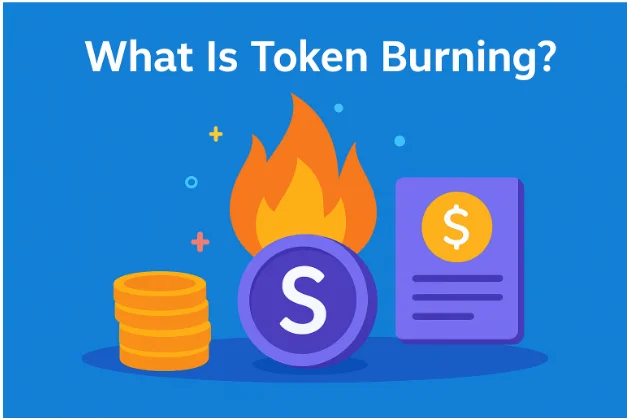
Token burning is the process of permanently removing cryptocurrency tokens from circulation. When a token is “burned,” it is intentionally sent to a special address where it can never be retrieved or used again.
This reduces the total supply of the token, which can influence scarcity and value depending on market demand.
Think of it like taking money and locking it inside a safe that no one on earth has a key to, you know it still exists, but it’s gone forever.
How Burning Differs from Normal Token Transfers
A normal token transfer simply moves cryptocurrency from one wallet to another. Both wallets still have owners, tokens can still be used, traded, or sent somewhere else.
But in token burning, the tokens are sent to a place from which they can never come back. The burned tokens cannot be spent, no one controls the destination wallet and the tokens are effectively destroyed.
The Burn Address (or “Null Address”) Mechanism
A burn address, also called a null address, dead wallet, or eater address is a special type of wallet on the blockchain that has no private key. This means no one (not even the project creators) can ever access the tokens stored inside it.
Once tokens enter this address, they are stuck there forever. That is why sending tokens to a burn address is considered “burning.”
What Makes a Burn Address Unique is that it is visible to everyone on the blockchain, it has a public wallet address like a normal wallet, but it does not have a private key, making it impossible to unlock and tokens sent there are gone permanently.
These addresses are widely known as irreversible “token graveyards.” Common examples of burn addresses include:
- 0x0000000000000000000000000000000000000000
- 0x000000000000000000000000000000000000dEaD
One important feature of token burning is that it is fully transparent:
- Every burn transaction is recorded on the blockchain.
- Anyone can open a blockchain explorer (like Etherscan or BscScan).
- You can see the exact number of tokens burned, when they were burned, and who burned them.
This transparency helps build trust, because the community can verify that the project actually burned the tokens and didn’t just claim they did.
“Some projects use token burning like a tool for trust, scarcity, and price stability, but it works best when paired with strong tokenomics.”
How Token Burning Works: Mechanisms & Methods

Token burning can happen in several ways. Some projects do it manually, some automate it, and others integrate burning directly into their blockchain’s rules. Below are the main methods and how they work.
Manual / One-Off Burns
Manual burns are the simplest type of token burning. These burns happen only when a team or community decides to burn tokens intentionally, not according to a fixed schedule.
- Project or Team Manually Sending Tokens to a Burn Address: In this method, the project team takes a specific number of tokens and sends them directly to the burn (null) address.
- Community-Driven Burns: Sometimes, community members themselves choose to burn their own tokens. This happens when holders want to support the token’s value or a community challenge or campaign encourages burning,
Scheduled or Automatic Burns
These burns happen on a regular or automated basis, without needing manual decisions each time.
Burns Tied to Specific Events
Some tokens burn automatically based on certain actions or events happening within the ecosystem. These triggers can include trading volume, transaction fees, and periodic schedules.
Protocol-Level Burns: In this method, burning is built directly into the smart contract. This means burning happens automatically, following rules in the code, without any human involvement.
“Buy-Back and Burn” Strategy
The buy-back and burn model works similarly to stock buybacks used by traditional companies.The project uses profits, revenues, or treasury funds to buy tokens from the open market.
Alternative / Consensus-Level Burning
Some blockchains use burning as part of their consensus mechanism, the method used to secure the network and validate transactions. This system is called Proof-of-Burn (PoB). Participants (miners or validators) must burn their own tokens to earn the right to mine or validate new blocks
How Token Burns Affect Price: The Data
To understand how token burning can affect price, it helps to start with basic economics. In any market, price is shaped by the balance between supply (how much of something exists) and demand (how many people want it).
If supply decreases while demand stays the same or increases, the remaining units usually become more valuable. This is the same principle behind rare collectibles or limited-edition products. When something becomes harder to get, people are often willing to pay more for it.
Token burning works directly on the supply side of this equation. When tokens are permanently removed from circulation, the total available supply goes down.
In simple terms: Supply decreases (S↓). If the number of people who want the token — the demand — stays the same or grows, then, in theory, price should rise (P↑). So the formula looks like this: S↓ + D→ = P↑.
If demand increases at the same time as supply drops, price pressure becomes even stronger.
However, this model is still theoretical. Crypto markets are influenced by many other factors: investor sentiment, market cycles, regulation, speculation, liquidity, and overall trust in the project.
A token burn doesn’t automatically mean price will rise, it simply creates the economic conditions where a price increase becomes more possible, assuming demand continues to exist.
Also Read: Crypto Margin Trading Made Simple: How to Trade with Leverage
Types of Token Burns: Complete Classification
Token burning isn’t just one single method. Over time, the crypto industry has developed several different burn models, each with its own purpose and structure. Below is a simple explanation of the main types you’ll see in real projects today.
Type 1: Transaction Fee Burns (Ethereum EIP-1559 Model)
In this model, part of every transaction fee is destroyed automatically. Ethereum introduced this system through EIP-1559. When users pay gas fees, a base portion of that fee is burned rather than going entirely to miners or validators.
This means the more the network is used, the more ETH is burned. It turns network activity into a steady, ongoing deflationary force. Instead of relying on manual or scheduled burns, the blockchain itself handles the process, making it predictable and transparent.
Type 2: Scheduled / Quarterly Burns (BNB Model)
Some projects plan burns ahead of time and announce them publicly. BNB (Binance Coin) is one of the best-known examples. The project historically carried out quarterly burns based on profits and token supply targets.
This model helps control long-term supply and signals commitment to token value management. Because the burns are expected and reported, holders can easily track progress and verify transactions on-chain.
Type 3: Community-Driven Burns (SHIB Model)
With community-driven burns, token holders voluntarily send tokens to a burn address. Shiba Inu (SHIB) is a major example, with dedicated burn portals and community initiatives that encourage participation.
These burns are often motivated by loyalty, hype, or a belief in long-term scarcity. They highlight the social and emotional side of crypto — the community plays an active role rather than the project team acting alone.
Type 4: Buyback-and-Burn (MakerDAO Model)
In this model, the project uses revenue or profits to buy tokens on the open market and then burn them. MakerDAO uses this approach with MKR tokens. It operates similarly to stock buybacks in traditional finance, where companies repurchase and cancel shares.
The burn not only reduces supply but also supports price by purchasing tokens from traders before destroying them.
Type 5: One-Time Strategic Burns (OKB August 2025 Model)
Some burns are not recurring. Instead, they are large, strategic, one-off events carried out for restructuring, tokenomics updates, or major roadmap changes. An example is the OKB burn event in August 2025.
These burns usually aim to reset supply, correct earlier token distribution issues, or align the project with new economic goals. Because they happen suddenly, they often create strong market attention.
Type 6: Stablecoin / Wrapped Token Burns (Operational Burns)
For stablecoins and wrapped tokens, burning is often part of normal operations rather than a value-boosting tactic. When users redeem a stablecoin for fiat or unwrap a token (like converting wrapped BTC back to BTC), the redeemed tokens are burned.
This keeps supply equal to reserves or backing assets. The goal here is accounting accuracy and stability, not speculation.
Why Projects Use Token Burning

Token burning is not just a technical action, it plays a major role in shaping a project’s tokenomics, investor confidence, and long-term value strategy. Different projects burn tokens for different reasons, but most motives fall into the key areas below.
Creating Scarcity and Supporting Value
One of the most common reasons for token burning is to create scarcity. When a project burns tokens, those tokens are permanently removed from the total supply.
With fewer tokens available on the market, scarcity increases and each remaining token becomes more valuable if demand stays the same or grows.
Managing Inflation or Oversupply
Some projects mint new tokens regularly, for rewards, staking, ecosystem development, or network security. Without proper supply control, this can lead to inflation, where too many tokens chase too little demand.
Burning removes extra tokens from circulation, it counterbalances ongoing minting, it keeps the market supply in check and ensures the token’s price is not diluted over time
This process helps maintain a healthy balance between supply and demand, making the token’s economy more stable and sustainable.
Building Investor/Holder Confidence & Tokenomics Credibility
Investors want reassurance that a project is committed to long-term growth, not just short-term hype. Token burning can send a powerful message.
Sometimes, when a project willingly destroys its own tokens, it shows that they are not planning to dump tokens on the market, they are committed to the project’s future success and they have structured tokenomics with clear thought and intention.
Price Stabilization & Market Psychology
Token burning doesn’t guarantee price increases, but it can influence how the market feels and reacts. If there is too much supply in circulation, the price may drop due to selling pressure. Burning helps by reducing oversupply, helps to stabilize the token price and creates more balanced market conditions.
Burns can have a strong psychological impact too. They often generate excitement or attention, show that the team is actively managing the token economy, encourage more users to buy or hold the token and create hype around big burn events (common in exchange tokens or meme tokens)
This kind of positive sentiment can attract new investors and bring new energy into the project’s community.
“Community-driven burns show support and engagement, but without real demand, even large burns may have limited effect on price.”
Criticisms, Risks and Limitations of Token Burning
While token burning is often presented as a positive tokenomics strategy, it is not a magic solution. Burning can help in some situations, but it also comes with limitations and risks that both projects and investors should understand.
Burn not equal to Guarantee of Price Increase
A common misunderstanding is that burning tokens will automatically increase the price. In reality, the effect of burning depends heavily on demand, utility, and how much people actually want to use or hold the token.
If a token has weak demand or minimal real-world use, reducing the supply may not make any difference. In some cases, even after large burns, the price can still fall because the core issue is not the supply but the demand.
Lack of Transparency / Poor Communication
Token burning can lose its purpose if a project does not communicate clearly about when, how, or why the burns are happening. Burns that occur randomly, without proper announcements, or that are not visible on-chain can make the community suspicious.
Investors want to verify burns using blockchain explorers, and if they cannot, trust in the project quickly weakens.
Tokenomics Imbalance: Burns Cannot Fix Weak Fundamental Utility
Burning tokens cannot solve deeper structural problems. If a token has no strong use-case, limited adoption, or an economic model that doesn’t make sense, reducing supply will not magically fix those issues. A token with poor fundamentals will remain weak even if billions of tokens are burned.
Regulatory, Ethical or Market-Manipulation Concerns
Token burns can sometimes be used in ways that raise ethical or regulatory questions. If a project uses burn events purely to create hype or manipulate market prices, it can mislead investors.
Announcing exaggerated or unclear burn plans, or timing burns to pump the price before insiders sell, can create serious trust and legal problems.
Real-World Examples & Case Studies
One of the best known real world examples of token burning comes from Ethereum. Since its “London” upgrade and the introduction of EIP-1559, Ethereum automatically burns a portion of transaction fees (the so-called “base fee”) every time someone sends a transaction.
That means each transaction permanently removes a small amount of ETH from circulation using a built-in protocol-level deflation mechanism.
Because Ethereum is widely used (for DeFi platforms, smart contracts, NFTs, and more), these burns add up quickly. As of 2025, billions of dollars worth of ETH have already been burned.
Another major example is Binance Coin (BNB), the native token of Binance. Binance carries out regular, periodic burns (usually quarterly), based on trading volume and ecosystem activity. Over time, these burns steadily shrink BNB’s circulating supply.
These protocol-level or scheduled burns show how token burning can be embedded as a structural element in a blockchain or project’s economics, not just a one off stunt.
Recent Burn Events & Trends
Token burning remains very active in 2025, and several projects have announced large burns or new burn mechanisms.
For example, one 2025 report lists recent major burns by exchange-based tokens including OKB (from exchange OKX), a stablecoin token burn, and a handful of other newer projects, showing that burn strategies continue to play a role in supply management.
Meanwhile, data from some smaller tokens shows that even modest burn events (relative to total supply) are being used periodically in 2024-2025 often framed as supply-control or deflationary measures.
Overall, 2024–2025 shows that token burning remains a widely used tactic, but one whose real-world impact depends heavily on the underlying project’s fundamentals, adoption, and transparency.
Best Practices for Projects Considering Token Burns
Token burning can be an amazing part of a project’s tokenomics, but only when it is handled responsibly. Poorly designed burns can damage trust, mislead investors, or create an unstable economic model. The following best practices help ensure a burn strategy actually supports the long-term health of a project.
Transparency & Clear Communication
Transparency is one of the most important principles when implementing any burn mechanism. Because burning affects supply, holders want to clearly understand how the process works and why it exists. Projects should:
- Clearly publish how and when tokens will be burned.
- Explain whether burns are manual, automated, or event-driven.
- Give the community advance notice when major burns are scheduled.
- Provide on-chain proof through verifiable burn addresses or transaction hashes.
- Maintain public documentation or dashboards showing total tokens burned over time.
Align Burns with Utility and Real UseCase Growth
Burning tokens should never be treated as the main reason for a project to exist. Burns can support a system, but they cannot replace genuine value creation.
A strong burn strategy works with utility, not instead of it. This means:
- Burns should make sense within the project’s ecosystem (fees, rewards, transactions, etc.).
- The token should still have clear use cases, payments, governance, staking, or access to features.
- The project should be actively developing products, partnerships, or real adoption.
- Burns should reflect genuine economic activity, not artificial hype.
Monitor Supply Demand Dynamics, Not Just Token Count
Reducing supply does not automatically increase value. A project must continually study how supply interacts with demand, users, and market conditions.
Key considerations include:
- Whether user demand for the token is growing or shrinking.
- Whether the network or platform is seeing increasing activity.
- How burns affect liquidity, trading volume, and market stability.
- Whether reducing supply too quickly might limit future incentives or ecosystem rewards.
Avoid Over-Reliance on Burns
Even when used correctly, token burning should not dominate a project’s tokenomics. Over-reliance can create unrealistic expectations or harm sustainability. Successful projects usually combine multiple economic levers:
- Staking rewards: encourage holding and network participation.
- Governance utility: allow holders to influence decisions.
- Ecosystem incentives: reward usage, development, or community contributions.
- Real-world or in-platform utility: encourage spending, not hoarding.
- Token sinks: functions that naturally use or remove tokens through network activity.
Also Read: How to Easily Identify Key Support and Resistance Levels
Conclusion
Token burning has become one of the most popular tools in modern crypto tokenomics, but it works best when used with purpose and transparency. At its core, burning reduces the supply of a token by permanently removing units from circulation.
This can help create scarcity, balance inflation, strengthen investor confidence, and support long-term value, but only when the underlying project already has real demand, strong utility, and a healthy ecosystem.
Burns alone cannot fix weak fundamentals. They cannot create value where none exists, and they do not guarantee price growth. Projects that rely too heavily on burns risk misleading their communities or masking deeper problems in adoption and economic design.
In the end, token burning should be seen as one part of a bigger picture, not a shortcut, but a thoughtful mechanism that works best when paired with genuine innovation, strong utility, and a committed community.
FAQs
What does “token burning” actually mean?
Token burning means permanently removing tokens from circulation so they can never be used again. This is usually done by sending them to a special “burn address” that has no private key, meaning no one can access or recover the tokens. Once burned, they are gone forever.
Does burning tokens always increase the price?
No. Burning reduces supply, but it does not automatically raise prices. For a burn to have a meaningful effect, the token must already have real demand, active users, and a clear purpose. Without strong fundamentals, even large burn events may not impact price at all.
Why do crypto projects choose to burn tokens?
Projects burn tokens to manage supply, reduce inflation, create scarcity, and build confidence among holders. Burns can also help stabilize the market or support long-term tokenomics. For some blockchains, burning is built directly into the protocol (like Ethereum’s fee burn after EIP-1559).
How can I verify that a token burn is real?
All legitimate burn events are visible on the blockchain. You can use a block explorer to view the transaction that sent tokens to the burn or “null” address. Real projects also publish burn reports, links to burn transactions, and transparent explanations of their burn schedule.
What are the risks of token burning?
The main risks include projects using burns to create hype, lack of transparency about burn events, and over-reliance on burns to make the token appear valuable. Burns cannot fix poor utility, weak adoption, or a broken token model. If used incorrectly, they can mislead investors.