WordPress database error: [You have an error in your SQL syntax; check the manual that corresponds to your MariaDB server version for the right syntax to use near '' at line 1]SELECT * FROM wp_mica_ecta WHERE cta_id =
WordPress database error: [You have an error in your SQL syntax; check the manual that corresponds to your MariaDB server version for the right syntax to use near '' at line 1]SELECT * FROM wp_mica_ecta WHERE cta_id =
WordPress database error: [You have an error in your SQL syntax; check the manual that corresponds to your MariaDB server version for the right syntax to use near '' at line 1]SELECT * FROM wp_mica_ecta WHERE cta_id =
WordPress database error: [You have an error in your SQL syntax; check the manual that corresponds to your MariaDB server version for the right syntax to use near '' at line 1]SELECT * FROM wp_mica_ecta WHERE cta_id =
WordPress database error: [You have an error in your SQL syntax; check the manual that corresponds to your MariaDB server version for the right syntax to use near '' at line 1]SELECT * FROM wp_mica_ecta WHERE cta_id =
Bitcoin operates without a bank, CEO, or central authority. Instead, a global network of miners secures the blockchain by verifying transactions, adding new blocks, and issuing new Bitcoin through a process known as mining.
Since the April 2024 halving, miners earn 3.125 BTC per block, making efficient ASIC mining hardware essential as competition continues to intensify. What began as a hobby on home computers has evolved into a multi-billion-dollar industry powered by large-scale mining operations.
In this guide, you’ll learn how Bitcoin mining works step by step, the hardware required, why miners join mining pools, whether mining is still profitable in 2026, and its environmental impact. If mining isn’t for you, you can still own Bitcoin by purchasing it directly on UEEx without investing in expensive equipment or managing electricity costs.
There's no Call To Action with the ID #0.Key Takeaways
- Bitcoin mining verifies transactions and creates new coins through Proof of Work.
- Miners currently earn 3.125 BTC per block, plus transaction fees, roughly every 10 minutes.
- ASICs are the only practical mining hardware today, costing $4,500 to $14,000 or more.
- Solo mining is nearly impossible at today’s network scale, which is why most miners join pools.
- Profitability comes down mainly to electricity cost, generally needing rates under $0.06/kWh
- Mining uses roughly 135 to 180 TWh of electricity a year, about 0.5 to 0.6% of global power use.
- The next halving arrives around 2028, cutting rewards again to 1.5625 BTC
What Is Bitcoin Mining?
Bitcoin mining is digital bookkeeping. Miners collect Bitcoin transactions, check that they’re real, and bundle them into a “block.” That block gets added to the blockchain, which is just a long, shared list of every transaction ever made.
Mining does two jobs at once:
- It keeps the network secure, because checking and confirming transactions this way makes cheating extremely expensive.
- It creates new Bitcoin, since the miner who adds a block gets a reward in fresh coins.
People often compare it to gold mining, and the comparison holds up well.
Mining is called “mining” because, like gold mining, it involves pulling a limited resource out of the ground through hard work. With Bitcoin, the “ground” is math, and the total supply is capped at 21 million coins. Roughly 20 million of those have already been mined as of 2026, according to data from Blockchain.com’s charts.
A few terms you’ll see throughout this guide:
- Blockchain: the shared ledger that stores every transaction
- Decentralization: no single company or government controls the network
- Transaction verification: the check miners perform before a transaction counts as final
- Mining rewards: the new coins plus the transaction fees a miner earns for adding a block
How Does Bitcoin Mining Work?
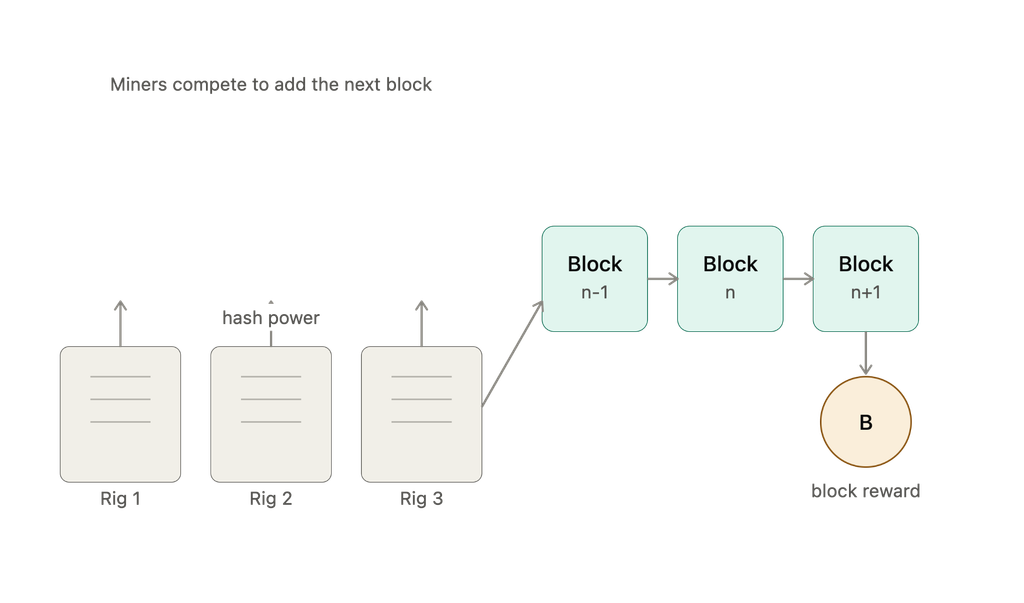
The Proof of Work Consensus Mechanism
Bitcoin uses a system called Proof of Work, or PoW. In plain terms, it means miners have to do real computational work before their block gets accepted. This matters because it stops people from spending the same Bitcoin twice, a problem known as double-spending.
To rewrite the blockchain, an attacker would need more computing power than the rest of the network combined. That would cost more than any theoretical gain, so it rarely happens.
Proof of Work is different from Proof of Stake, which some other cryptocurrencies use. Proof of Stake secures the network by having people lock up coins instead of burning electricity on computation.
Bitcoin sticks with PoW because the energy spent is, in a real sense, the security. Every watt spent mining makes attacking the network that much harder.
The Block Mining Process: Step by Step
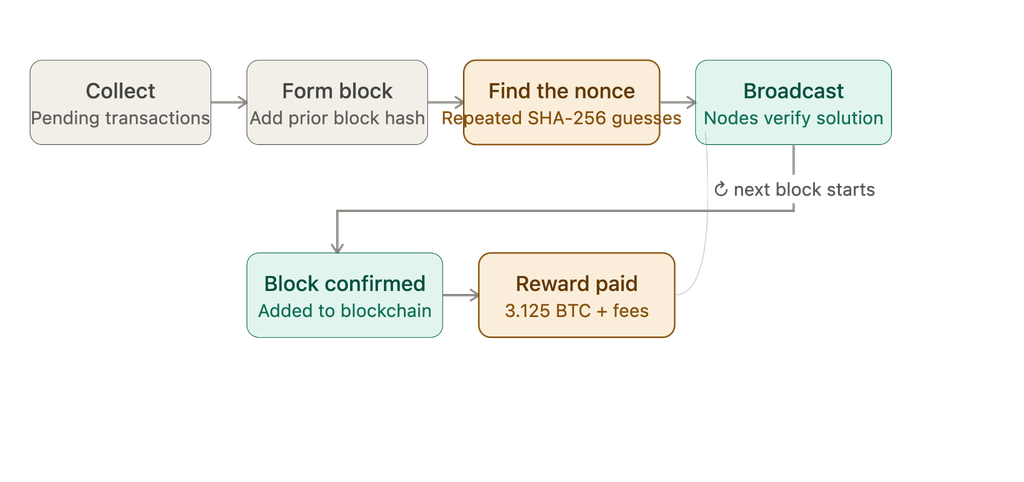
Step 1: Transaction collection
Unconfirmed transactions sit in a waiting area called the mempool. Miners pick transactions from here, usually giving priority to the ones offering higher fees.
Step 2: Block formation
Miners group these transactions into a candidate block. Each block also carries the hash of the previous block, which is what actually chains the blocks together, plus a timestamp and a few other technical details.
Step 3: The mining puzzle, or finding the nonce
This is the part people picture when they think of mining. Miners search for a number called a nonce (“number used once”). They run the block’s data plus the nonce through a hashing function called SHA-256, over and over, changing the nonce each time, hoping to land on a hash that starts with a certain number of zeros.
For example:
Target hash:
0000000000000000ffff0000000000000000000000000000000000000000
Valid block hash:
0000000000000000057e29f1b57c1a9d5b90a6b7f1b4f0c9e2b0a1d3e4f5c6d
The resulting hash has to be equal to or lower than the target. There’s no shortcut here. Miners simply guess billions of times per second until one guess works.
Step 4: Broadcasting the solution
Whichever miner finds a valid hash first shares it with the rest of the network. Other computers on the network, called nodes, quickly check that the answer is correct. Once confirmed, the block joins the blockchain for good.
Step 5: Reward distribution
The winning miner collects the block reward, currently 3.125 BTC, plus every transaction fee included in that block. Then the whole process starts again with a new block, roughly every 10 minutes.
There's no Call To Action with the ID #0.SHA-256 Hashing and Mining Difficulty
SHA-256 is a one-way cryptographic function. You can turn data into a hash easily, but you can’t work backward from a hash to figure out the original data. That one-way property is exactly what makes the mining puzzle fair.
To keep blocks arriving roughly every 10 minutes no matter how much mining power joins the network, Bitcoin adjusts its difficulty every 2,016 blocks, about every two weeks. More miners competing pushes difficulty up, while fewer miners pull it back down.
As of mid-July 2026, Bitcoin’s difficulty sits around 127 trillion after a run of adjustments through the year that moved it both up and down as miners came online and went offline in response to price swings, according to Hashrate Index.
Understanding Hash Rate
Hash rate is simply how many guesses a miner (or the whole network) can make per second. It’s measured in terahashes (TH/s), petahashes (PH/s), and exahashes (EH/s) per second.
A single modern ASIC might run at 200 to 500 TH/s. The entire Bitcoin network, combining every miner on Earth, was running at roughly 900 EH/s in July 2026. The higher your hash rate compared to the network total, the better your odds of mining a block, whether you’re one miner or one pool.
Bitcoin Mining Hardware: What You Need
Below are the things needed to have Bitcoin mining hardware.
Evolution of Mining Hardware
Mining hardware has gone through three real eras:
- 2009 to 2010: Regular computer processors (CPUs) could mine Bitcoin from a laptop
- 2010 to 2013: Graphics cards (GPUs) took over, offering far more power
- 2013 to today: Application-Specific Integrated Circuits (ASICs) replaced everything else
CPUs and GPUs simply can’t compete anymore. ASICs are built for one job only, running SHA-256 calculations as fast as physically possible, and nothing else comes close.
ASIC Miners: The Current Standard
An ASIC, or Application-Specific Integrated Circuit, is a chip designed and built to do exactly one thing. For Bitcoin mining, that means running SHA-256 hashes nonstop. The trade-off is that an ASIC has no other use. Once it’s outdated, it’s scrap.
Here’s a table of the leading ASIC miners as of mid-2026:
| Model | Manufacturer | Hash Rate | Power Draw | Efficiency (J/TH) | Approx. Price |
| Antminer S21 XP | Bitmain | 270 TH/s | 3,645W | 13.5 | $4,500-6,000 |
| Antminer S21 Pro | Bitmain | 234 TH/s | 3,510W | 15.0 | $5,800-6,500 |
| Antminer S21 XP Hydro | Bitmain | 473 TH/s | 5,676W | 12.0 | $9,000 |
| Whatsminer M66S Immersion | MicroBT | 298 TH/s | 5,513W | 18.5 | $14/TH |
| Antminer S23 Hydro | Bitmain | 580 TH/s | 5,510W | 9.5 | $13,500 |
Prices shift constantly with Bitcoin’s price and chip supply, so treat these as a general guide rather than a quote.
A few things to weigh before buying:
- Upfront cost typically runs from $4,500 to $14,000 or more per unit
- Machines usually stay competitive for only 2 to 3 years before newer, more efficient models push them out
- Cooling and noise are real issues. Air-cooled units can run past 75 decibels, loud enough that most people can’t have one in a living space
- Hydro and immersion-cooled models cost more upfront but run quieter and more efficiently
Additional Equipment Requirements
Beyond the ASIC itself, you’ll need:
- A Bitcoin wallet to receive and store your mining rewards
- Mining software that connects your hardware to a mining pool
- Serious electrical infrastructure, since these machines pull several kilowatts each, all day, every day
- A cooling setup, whether that’s airflow, immersion, or a hydro loop
- A stable, always-on internet connection
Nice to have but not required: monitoring dashboards, backup power, and noise dampening if you’re running equipment anywhere near where people live or sleep.
Mining Pools: Why Solo Mining Is Nearly Impossible
A mining pool is a group of miners who combine their hash rate and split whatever rewards they earn, based on how much each person contributed.
Solo mining today means competing against a network running at roughly 900 EH/s. A single home miner running one ASIC has such a tiny slice of that total power that finding a block alone could realistically take years, if it happens at all. Pools solve this by turning a rare, unpredictable jackpot into small, steady, frequent payouts.
The first mining pool, Slush Pool, launched back in November 2010. Today, a handful of large pools handle most of the network’s hash rate, which has raised some fair concerns about concentration, something we’ll come back to later in this guide.
How Mining Pools Work
Pools track each miner’s contribution through “shares,” which are partial proofs of work that show you’re actually contributing hash power, even if you haven’t found a full block yourself.
Payout methods vary by pool:
- PPS (Pay-Per-Share): A fixed, guaranteed payment for every share you submit
- FPPS (Full PPS): PPS plus a cut of transaction fees
- PPLNS (Pay-Per-Last-N-Shares): Rewards based on your recent contribution, with more variance but often lower fees
- Proportional: Your share of the actual block reward, based on your share of the work
Top Mining Pools in 2026
Based on hash rate data from mid-2026:
| Pool | Hashrate | Approx. Network Share | Payout Method | Blocks Mined |
| Foundry USA | 250.1 EH/s | 28.14% | FPPS | 278 |
| F2Pool | 154.7 EH/s | 17.41% | Unknown | 172 |
| AntPool | 152.9 EH/s | 17.21% | FPPS / PPLNS | 170 |
| ViaBTC | 90 EH/s | 10.12% | PPS+ | 100 |
| SpiderPool | 54.9 EH/s | 6.17% | FPPS | 61 |
Source: https://hashrateindex.com/hashrate/pools
If you’re picking a pool, weigh the following:
- Size and consistency of payouts
- Fee structure, typically 0% to 4%
- Minimum payout threshold
- Server location, since latency affects your share submission speed
- Reputation and how long they’ve been running
Is Bitcoin Mining Profitable in 2026?
This depends almost entirely on your electricity cost. Everything else- hardware efficiency and Bitcoin’s price- matters too, but cheap power is what separates a profitable operation from a losing one.
Right now, home mining is a tough sell in most parts of the world. Industrial-scale mining, especially in places with electricity under $0.06 per kilowatt-hour, can still turn a real profit.
There's no Call To Action with the ID #0.Who can mine profitably:
- Large operations with electricity under roughly $0.05 to $0.06 per kWh
- Facilities near hydro, wind, or other renewable power
- Operations big enough to negotiate bulk electricity rates
Who tends to struggle:
- Anyone paying standard residential electricity rates
- Regions with electricity above $0.08 per kWh
- Small setups running older, less efficient machines
Key Factors Affecting Mining Profitability
Here are some factors that affect mining profitability
Electricity Costs
This is usually 60 to 80% of a miner’s running costs. Compare a facility in Texas or Paraguay, often paying $0.03 to $0.07 per kWh thanks to hydro and wind power, against a home miner in Germany paying $0.30 or more. The difference decides whether mining makes any sense at all.
Bitcoin’s Price
Bitcoin has traded between roughly $58,000 and $65,000 through mid-2026, and every swing moves the math. A drop in price without a matching drop in difficulty can push marginal miners into the red overnight.
Mining Difficulty
Difficulty adjusts every two weeks based on how much total hash power is competing. More miners online pushes difficulty up and shrinks everyone’s individual share of the reward.
Hardware Cost and Efficiency
A new ASIC can run from $4,500 to $14,000 or more. Newer machines squeeze out more hashes per watt, which matters enormously over a year of nonstop operation.
The 2024 halving
The block reward dropped from 6.25 to 3.125 BTC in April 2024, cutting mining revenue in half overnight. The next halving isn’t expected until around 2028, so miners are operating on tighter margins in the meantime.
Transaction Fees
These add on top of the block reward but fluctuate depending on how busy the network is, making them far less predictable than the fixed reward.
Calculating Your Mining Profitability
A simplified version of the formula miners use:
Daily profit = (your hash rate ÷ network hash rate × block reward × BTC price) − (power draw × hours running × electricity cost)
Here’s a rough example using an Antminer S21 Pro (234 TH/s, 3,510 watts), a network hash rate around 900 EH/s, Bitcoin at $63,000, and electricity at $0.06/kWh:
- Estimated daily revenue: roughly $7 to $8
- Daily electricity cost: roughly $5
- Estimated daily profit: roughly $2 to $3
- Monthly profit: roughly $60 to $90
- Rough payback period on a $6,000 machine: five years or more at these economics, before accounting for pool fees, difficulty increases, or downtime, which is exactly why cheap power decides everything
These numbers move constantly. Difficulty rises, Bitcoin’s price swings, and hardware wears down, so treat any calculation as a starting estimate, not a guarantee. Tools like WhatToMine, CoinWarz, and NiceHash’s calculator can help you run your own numbers with current data.
Environmental Impact of Bitcoin Mining
Let’s find out what impact Bitcoin mining has on the environment
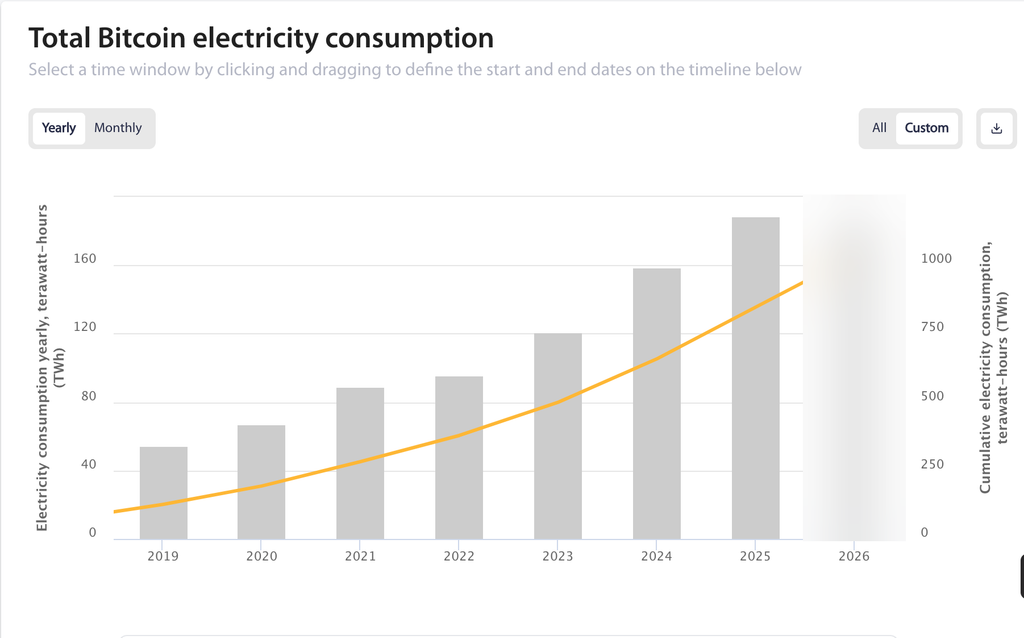
Source: https://ccaf.io/cbnsi/cbeci
Energy Consumption Concerns
Bitcoin mining uses a genuinely large amount of electricity. Current estimates from the Cambridge Bitcoin Electricity Consumption Index put annual estimated consumption at 135.35 terawatt-hours, in the same range as a mid-sized country like Poland.
That said, context matters. Global electricity generation runs past 29,000 TWh a year, so Bitcoin mining works out to roughly 0.5 to 0.6% of the world’s electricity use. Carbon output depends heavily on where mining happens and what powers it.
A facility running on hydropower produces a small fraction of the emissions of one running on coal. Since China’s 2021 mining ban pushed operations toward the US, Canada, and other regions with cleaner grids, the network’s average carbon footprint has likely improved, though it’s hard to measure precisely.
Sustainability Efforts and Green Mining
The industry has been shifting toward cleaner power, partly because renewable energy is often the cheapest option, and cheap power is what makes mining profitable in the first place.
Some real examples:
- Facilities built specifically near hydro, wind, and solar sites
- Miners that soak up excess or “stranded” energy that would otherwise go to waste
- Immersion cooling, which cuts energy use while extending hardware life
- A small but growing number of setups that capture landfill methane or recycle waste heat for other uses
Paraguay’s hydropower, Nordic hydro and geothermal power, and Texas’s wind and solar buildout are frequently cited as leading examples of where mining and clean energy overlap well.
The Debate: Climate Concern or Innovation Driver?
Critics argue mining burns enormous energy on financial speculation, competes with everyday electricity needs, and generates real electronic waste as hardware becomes obsolete every few years.
Meanwhile, supporters counter that mining actually funds new renewable projects that wouldn’t otherwise get built, makes use of power that would be wasted anyway, and keeps getting more efficient per unit of computing power delivered.
The honest answer sits somewhere in between. Impact varies enormously by location and energy source; the trend is moving toward sustainability, but the challenges are real, and regulatory scrutiny keeps growing around the world.
There's no Call To Action with the ID #0.Getting Started With Bitcoin Mining
If you want to know if Bitcoin mining is right for you, read on.
Mining might make sense if you:
- Have access to electricity under roughly $0.05 to $0.06 per kWh
- Can commit $10,000 or more in starting capital
- Are comfortable learning the technical side, or willing to hire someone who is
- Have space for loud, hot equipment that runs nonstop
- Are thinking in years, not months
Mining probably isn’t for you if you:
- Pay standard residential electricity rates above $0.08/kWh
- Have limited capital or want fast returns
- Live somewhere noise would be a problem
- Are hoping for easy, hands-off passive income
- Would rather avoid the environmental debate altogether
If any of that sounds like a lot of overhead for exposure to Bitcoin, buying it directly is the simpler route. Start trading Bitcoin on UEEX today instead of building out a mining operation from scratch.
Step by Step: How to Start Mining
- Run the numbers first: Use a mining calculator and be honest about electricity cost, hardware price, and how Bitcoin’s price or difficulty might change.
- Pick your hardware: Weigh cost against efficiency, and be cautious about buying used equipment without a warranty or condition history.
- Set up a Bitcoin wallet: A hardware wallet is worth it for anything beyond small amounts. Test with a small transaction before relying on it.
- Choose a mining pool: Compare size, fees, payout method, and server location.
- Install mining software, usually recommended directly by your pool, and connect it to your wallet address.
- Set up and monitor your hardware, watching temperature and performance closely in the first few days.
- Keep optimizing: Track electricity use, watch difficulty and price trends, and consider firmware updates as they roll out.
Mining Risks and Challenges
Below are the challenges tied to Bitcoin mining
Technical: This includes hardware failure, overheating, connectivity issues, and software bugs.
Financial: Bitcoin’s price swings, rising difficulty eating into returns, hardware becoming outdated faster than expected, and electricity prices climbing after you’ve already invested.
Operational: This includes noise above 75 decibels, heat that needs somewhere to go, physical space, and ongoing maintenance time.
Regulatory: Some countries, including China and Kuwait, have banned or restricted mining outright. Others are adding electricity surcharges, tax rules, or environmental permits that change the math.
Market: Competition from large industrial operations, pool concentration, and the next halving in 2028, which will cut rewards again.
Also Read: Mining Rig
The Future of Bitcoin Mining
A few clear trends are shaping where mining goes from here:
Industrial Mining Will Dominate
Bitcoin mining is becoming increasingly concentrated in the hands of large-scale operators. Rising network difficulty, higher electricity prices, and the cost of next-generation ASIC hardware are making it harder for home miners to compete. While hobbyist mining still exists, industrial mining farms continue to account for a growing share of the network’s hashrate.
ASIC Hardware Will Keep Getting Smarter
Mining hardware continues to become more energy efficient. The latest hydro-cooled ASIC miners now achieve less than 10 joules per terahash (J/TH), a milestone that seemed unattainable just a few years ago. These improvements help miners lower electricity costs and remain profitable despite increasing mining difficulty.
Renewable Energy Will Power More Mining
Low-cost electricity remains the industry’s biggest competitive advantage. As a result, miners are increasingly relocating to regions with abundant hydroelectric, wind, and solar power, allowing them to reduce operating costs while meeting growing sustainability expectations.
Regulation Will Continue to Expand
Governments are paying closer attention to crypto mining. Over the next few years, expect more jurisdictions to introduce energy reporting requirements, tax rules, environmental standards, and, in some cases, restrictions on mining operations as the industry matures.
Block Rewards Will Keep Shrinking
Bitcoin’s fixed monetary policy means mining rewards will continue to decline after every halving. Around 2028, the block subsidy will fall to 1.5625 BTC. Over time, miners will rely increasingly on transaction fees as new Bitcoin issuance declines, with the final Bitcoin expected to be mined around 2140.
Mining Will Follow Cheap Energy
Mining operations will continue shifting across the globe in search of the best economics. Countries offering affordable electricity, renewable energy, stable regulations, and supportive policies are likely to attract the next wave of mining investment.
Bitcoin Mining vs. Other Cryptocurrencies
Bitcoin mining stands apart from mining other coins in a few important ways: it uses the SHA-256 algorithm, it has the highest difficulty and competition of any proof-of-work coin, and ASICs are the only realistic option since regular GPUs stopped being competitive years ago.
If you’re curious about mining as a hobby rather than an industrial pursuit, a few GPU-mineable coins are more approachable:
- Ethereum Classic (ETC)
- Ravencoin (RVN)
- Ergo (ERG)
These have lower barriers to entry and let you use hardware you might already own. There are also other ASIC-mined coins, like Litecoin and Dogecoin (both using the Scrypt algorithm) and Bitcoin Cash (also SHA-256), which sit somewhere in between.
Bitcoin remains the choice for anyone prioritizing security, liquidity, and long-term staying power. Smaller coins can offer lower competition and a lower entry cost, but with far less certainty about where they’ll be in five or ten years.
Conclusion
Bitcoin mining is what keeps the entire network honest, secure, and running without anyone in charge. It’s grown from something you could do on a home computer into a serious industrial business built around cheap electricity, efficient ASICs, and mining pools.
There's no Call To Action with the ID #0.Whether mining makes sense for you comes down to a handful of practical questions: your electricity cost, your starting capital, and how much of the technical and physical setup you’re willing to take on. For a lot of people, the simpler path to owning Bitcoin is just buying it. Ready to invest in Bitcoin? Start trading on UEEX today.
Frequently Asked Questions
What is Bitcoin mining in simple terms?
Bitcoin mining is the process of using computers to check Bitcoin transactions and add them to the blockchain. Miners compete to solve a math puzzle, and whoever solves it first gets to add the next block and earn a reward in new Bitcoin.
How does Bitcoin mining work?
Miners collect pending transactions, bundle them into a block, and search for a specific number (a nonce) that produces a valid hash when combined with the block’s data. The first miner to find it broadcasts the answer; other computers on the network verify it, and the block gets permanently added to the blockchain.
How much does it cost to start Bitcoin mining?
A single ASIC miner typically costs between $4,500 and $14,000, depending on the model and its efficiency. On top of that, you’ll need electrical infrastructure, cooling, and a stable internet connection.
What happens when all 21 million Bitcoin are mined?
Miners will stop earning new coins as a block reward and will rely entirely on transaction fees instead. That’s expected to happen gradually as rewards keep halving, with the very last Bitcoin projected to be mined around the year 2140.