
A single Bitcoin costs more than most cars. It costs more than a year of rent in most cities. And it costs this much even though you can’t hold it, touch it, or hang it on a wall.
So why is Bitcoin so expensive? In short: Bitcoin’s price comes from a hard cap on supply (only 21 million will ever exist), a shrinking rate of new coins entering the market, and a wave of institutional money that arrived once spot Bitcoin ETFs launched in January 2024.
As of late July 2026, Bitcoin trades around $63,000 to $65,000 per coin, down sharply from its all-time high of $126,198 set on October 6, 2025, according to CoinMarketCap. That drop is part of the story too, and we’ll get into why it happened.
This guide breaks down exactly what drives Bitcoin’s price, using real data. You’ll get the scarcity math, the halving history, the institutional adoption numbers, and an honest look at where Bitcoin stands right now.
What Gives Bitcoin Value? The Fundamental Question
| Why is Bitcoin so expensive? Bitcoin’s price comes from three things working together: a hard-coded limit of 21 million coins, a supply schedule that slows down every four years through halvings, and demand from retail buyers, corporations, and institutions competing for a limited pool of coins. Add in the fact that Bitcoin can move across the world in minutes and can’t be frozen by any single government, and you get an asset that behaves like digital gold. As of July 2026, that combination puts the price at roughly $63,000 to $65,000 per coin, down from a peak above $126,000 in October 2025. |
That’s the short answer. Here’s the longer one:
The Intrinsic Value Debate
Unlike stocks, bonds, or rental properties, Bitcoin generates no cash flow, dividends, or interest. This has led critics like Warren Buffett to argue it has no intrinsic value.
However, gold also produces no income, yet it remains one of the world’s most valuable assets because people trust it as a long-term store of value.
Bitcoin follows a similar principle in digital form. Its value is driven not by income generation but by verified scarcity, decentralization, and growing confidence among individuals and institutions that it will retain purchasing power over time.
Key insight: Bitcoin isn’t valuable because it does something. It’s valuable because a limited number of people can own it, and more people want in every year.
That’s the same logic behind gold, rare art, and even limited-edition sneakers, just applied to a digital asset with a fixed supply.
Read Also: Top DeFi Protocols by Category: Banking Without the Bank.
Bitcoin’s Value Proposition, In Plain Terms
- No single owner: No bank, company, or government controls Bitcoin. It runs on a network of computers spread across the world.
- Real scarcity: Only 21 million coins will ever exist. That number is written into the code and can’t be changed without agreement from nearly the entire network.
- Strong security: Bitcoin’s core protocol has never been hacked in over 16 years of operation.
- Fast, cheap transfers: You can send a large sum of Bitcoin across the globe in about ten minutes for a few dollars in fees.
- Easy to divide: One Bitcoin splits into 100 million smaller units called satoshis, so you don’t need to buy a whole coin.
- Nothing to decay: It’s a digital record, so there’s no rust, no wear, no expiration date.
Why “Expensive” Doesn’t Mean “Overpriced”
Calling Bitcoin expensive because one coin costs $63,000 is a bit like calling Berkshire Hathaway stock expensive because one share costs over $600,000.
The price per unit doesn’t tell you much on its own. What matters is total market value.
Bitcoin’s entire market is worth around $1.2 to $1.3 trillion as of July 2026. That’s smaller than Apple, smaller than Microsoft, and far smaller than gold’s total market value.
You don’t need to buy a whole coin either. Most exchanges let you buy $10 or $50 worth of Bitcoin at a time.
The Core Drivers Behind Bitcoin’s Value
These are the factors driving Bitcoin’s value
1. Fixed Supply: The 21 Million Cap
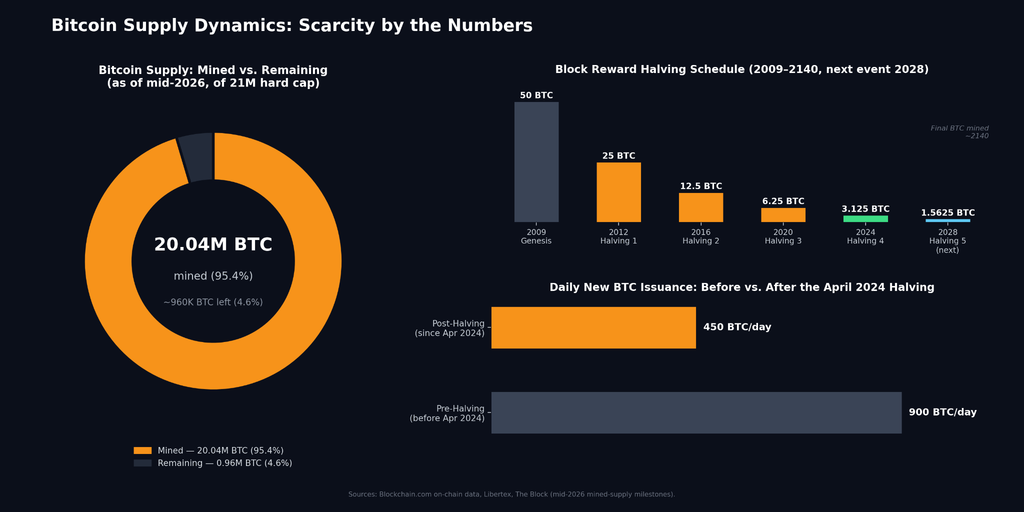
Alt text: Infographics explaining Bitcoin supply, displaying the mined and remaining numbers, including the block reward bar chart and daily new BTC issuance before and after the April 2024 halving, labeled Bitcoin supply dynamics: Scarcity by numbers
Bitcoin’s value is rooted in its fixed supply. Its code caps the total supply at 21 million coins, with over 20 million already mined by July 2026, leaving fewer than 1 million to be released gradually until around 2140.
Unlike fiat currencies such as the U.S. dollar, whose supply can be expanded by central banks, Bitcoin’s issuance is predetermined and enforced by a decentralized network of computers.
This predictable scarcity is a key reason Bitcoin is often compared to gold. While global gold supplies grow by about 1.5% annually through mining, Bitcoin’s annual supply growth has fallen below 1% and continues to decline after each halving.
This increasing scarcity strengthens Bitcoin’s appeal as a long-term store of value and helps explain why its value appreciates over extended cycles.
2. Halving Events: Supply Cuts On A Schedule
Every four years, or more precisely every 210,000 blocks, Bitcoin’s reward for mining a new block gets cut in half. Here’s the full timeline:
Bitcoin Halving History
| Halving # | Date | Block Height | Reward Before | Reward After |
| 1st | Nov 28, 2012 | 210,000 | 50 BTC | 25 BTC |
| 2nd | July 9, 2016 | 420,000 | 25 BTC | 12.5 BTC |
| 3rd | May 11, 2020 | 630,000 | 12.5 BTC | 6.25 BTC |
| 4th | April 20, 2024 | 840,000 | 6.25 BTC | 3.125 BTC |
Bitcoin’s latest halving reduced daily issuance from about 900 BTC to 450 BTC, effectively cutting new supply in half. Historically, when demand remains steady or increases while supply falls, prices tend to rise over time.
Every previous halving has been followed by a major bull run within 12–18 months.
The 2024 halving was unique because Bitcoin reached a new all-time high before the event, largely fueled by anticipation of spot ETF approvals. The next halving is expected in 2028, reducing block rewards to 1.5625 BTC.
3. Institutional Adoption And The ETF Era
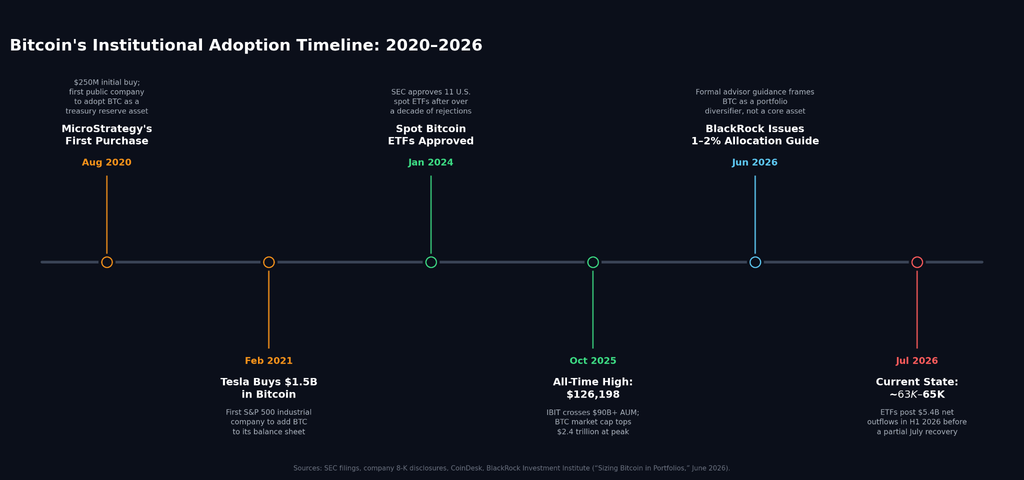
January 2024 marked a turning point for Bitcoin after the U.S. Securities and Exchange Commission (SEC) approved the first U.S. spot Bitcoin ETFs, allowing investors to gain Bitcoin exposure through traditional brokerage accounts without managing crypto wallets.
The launch sparked massive demand, with BlackRock’s IBIT becoming one of the fastest-growing ETFs, attracting about $60 billion in cumulative net inflows by mid-2026.
However, 2026 has been more challenging than many expected. During the first half of the year, U.S. spot Bitcoin ETFs recorded roughly $5.4 billion in net outflows, their weakest six-month period since launch, as Bitcoin’s price declined and investors shifted capital toward AI-related stocks.
June accounted for about $4.5 billion in outflows, although July saw a modest recovery with several weeks of net inflows. Despite this improvement, spot Bitcoin ETFs remained in negative territory for the year by late July 2026.
Key insight: ETFs didn’t create permanent, one-way demand for Bitcoin. They created a new, easier channel for money to flow in and out. That channel amplifies both rallies and pullbacks, which is exactly what played out between Bitcoin’s October 2025 peak and its 2026 slide.
Bitcoin ownership itself keeps broadening well beyond institutions. Somewhere between 560 million and 740 million people worldwide now hold some form of cryptocurrency, depending on the estimate, and about 30% of U.S. adults own crypto as of 2026, up from 27% in 2024, according to industry adoption surveys.
If you’re one of the people considering a first purchase, our Bitcoin vs Bitcoin ETF: Which One Should You Buy? guide walks through the basics.
4. Corporate Treasury Holdings
Michael Saylor’s company, MicroStrategy, started buying Bitcoin for its corporate treasury back in August 2020. By mid-2026, Strategy holds more than 840,000 BTC, worth tens of billions of dollars, making it the largest corporate holder of Bitcoin anywhere in the world.
Why do companies do this? A few reasons come up again and again:
- Hedging against currency erosion: Corporate cash sitting in a bank account loses value to inflation every year.
- A different kind of diversification: Holding an asset that isn’t tied to the dollar or the stock market.
- Signaling: Some companies want to be seen as forward-thinking or tech-savvy.
Strategy has pursued an aggressive Bitcoin accumulation strategy by taking on debt and issuing new shares to fund purchases.
While this approach amplified gains during bull markets, the 2026 price pullback has reduced the company’s paper profits, highlighting the risks of leveraged Bitcoin investing.
With an average purchase price of roughly $75,000 per BTC, Strategy remains highly exposed to volatility.
Meanwhile, BlackRock has adopted a more cautious stance. On June 23, 2026, the BlackRock Investment Institute advised financial advisors to limit Bitcoin exposure to just 1%–2% of a diversified portfolio.
The firm described it as a complementary diversifier with a risk profile comparable to holding a single Magnificent Seven stock.
That’s a notably conservative number from the firm running the largest Bitcoin ETF on the market.
5. The Digital Gold Store Of Value Narrative
Bitcoin gets compared to gold so often that “digital gold” has become its unofficial nickname. Here’s how the two actually stack up:
| Property | Gold | Bitcoin | Winner |
| Scarcity | Approximately 216,000 metric tons mined; 1–2% annual supply growth | Fixed supply of 21 million BTC; annual issuance falls after each halving | Bitcoin |
| Divisibility | Can be divided but impractical below small physical amounts | Divisible into 100 million satoshis (8 decimal places) | Bitcoin |
| Portability | Heavy, costly, and slow to transport internationally | Can transfer billions of dollars globally within minutes, 24/7 | Bitcoin |
| Durability | Does not corrode or degrade over time | Digital asset secured by a permanent blockchain ledger | Tie |
| Verifiability | Requires purity testing and authentication | Ownership and transactions are instantly verifiable on the blockchain | Bitcoin |
| Seizure Resistance | Physical gold can be confiscated or seized | Self-custodied Bitcoin can be protected with a private key or seed phrase | Bitcoin |
| Market Capitalization | About $23 trillion, according to World Gold Council figures after gold’s 2025 rally | About $1.27 trillion (varies with price), according to CoinMarketCap | Gold (currently) |
| Historical Track Record | Used as a store of value for over 5,000 years | Operating continuously since 2009 | Gold |
Gold retains one major advantage over Bitcoin: a centuries-long history of trust across civilizations, currencies, and economic crises. Bitcoin, while growing, has only a short track record.
Its reputation as an inflation hedge is also debated, as it fell over 60% during the 2022 inflation surge, behaving more like a risk asset.
Although Bitcoin has outperformed gold over five-year periods, it remains far more volatile and less reliable as a short-term safe haven.
6. Network Effects & First-Mover Advantage
Bitcoin, launched in 2009, remains the leading cryptocurrency thanks to its unmatched liquidity, largest developer community, and strongest brand recognition.
While newer blockchains may offer faster speeds or lower fees, none have matched Bitcoin’s security, decentralization, or the vast capital securing its network.
Competing projects, such as Bitcoin Cash, have failed to overtake its dominance, with Bitcoin Cash now worth only a fraction of Bitcoin’s value.
Bitcoin has also demonstrated remarkable resilience, surviving major events, including the Mt. Gox collapse, the 2018 market crash, the COVID-19 sell-off, and the FTX collapse without its protocol being compromised.
This consistent reliability reinforces investor confidence and strengthens Bitcoin’s appeal as a long-term digital asset.
Read Also: Quick tips on how to convert crypto to cash.
7. Macroeconomic Conditions
Bitcoin’s price is heavily influenced by macroeconomic factors such as interest rates, inflation, and the strength of the U.S. dollar, often moving alongside risk assets like technology stocks.
As of the Federal Reserve’s July 2026 meeting, interest rates remain at 3.50%–3.75%, though policymakers have adopted a more hawkish stance due to persistent inflation above the 2% target.
Higher rates typically reduce demand for riskier assets like Bitcoin by making safer investments, such as Treasury bonds, more attractive.
Despite these headwinds, blockchain technology continues to advance independently of Bitcoin’s price. In 2026, enterprise adoption has accelerated, with major institutions deploying blockchain in production.
Platforms such as JPMorgan’s Kinexys (formerly Onyx) process tokenized transactions daily, while Hyperledger Fabric remains a leading choice for permissioned enterprise blockchain networks, highlighting the technology’s growing real-world adoption.
8. Regulatory Clarity: How 2025–2026 Reshaped Crypto’s Legal Framework
The Trump Effect on Crypto Policy
President Trump’s January 2025 inauguration triggered the most crypto-friendly policy shift in U.S. history. Within weeks, his administration:
- Signed executive orders promoting U.S. leadership in digital assets
- Proposed a Strategic Bitcoin Reserve
- Barred the Federal Reserve from developing a CBDC
- Installed a crypto-friendly SEC chair, Paul Atkins
- Rescinded SAB 121, freeing banks to custody digital assets
Bitcoin rallied sharply in the following weeks as markets priced in the removal of a decade of regulatory friction that had kept institutions on the sidelines.
Landmark Legislation
- GENIUS Act (signed July 18, 2025): The first federal crypto law, requiring fully-reserved, dollar-backed stablecoins and giving banks and payment firms a clear compliance path.
- CLARITY Act: Passed the House in July 2025 and cleared the Senate Banking Committee in May 2026 but remains stalled amid disputes over enforcement jurisdiction and stablecoin yield rules, still short of the 60 votes needed for Senate passage.
- SEC generic listing standards (September 2025): Cut spot crypto ETF approval times from roughly 240 days to 60–75 days.
Together, these moves addressed the core hesitations, enforcement risk, fiduciary liability, and accounting treatment that had kept banks, pensions, and corporates on the sidelines.
A Global Race to Regulate
The EU’s MiCA framework has driven majority industry compliance across member states. Meanwhile, Hong Kong approved its first spot Solana ETF in October 2025.
In addition, multiple jurisdictions are now competing for institutional crypto capital rather than restricting it, pressuring the U.S. to keep pace.
Risks That Remain
- Inconsistent global tax treatment
- Ongoing securities-vs-commodity classification debates
- Unresolved custody standards
- Policy reversal risk under future administrations
Regulatory clarity has narrowed, not eliminated, crypto’s legal uncertainty.
9. Mining Costs Set A Rough Price Floor
Bitcoin mining costs vary significantly depending on your ASIC, electricity price, and network conditions. Since the 2024 halving cut block rewards from 6.25 to 3.125 BTC, only large-scale, efficient miners have survived, raising the network’s average production cost.
As of July 2026, the Bitcoin network hashrate is approaching 904 EH/s (exahashes per second, a metric unit used to measure the computing power of a crypto network like Bitcoin).
With electricity priced at $0.10/kWh, highly efficient ASICs such as the Bitmain Antminer S23 Hydro (Note: These specifications are illustrative projections), which cost around $13,000 to $14,000, can see a profit of $4.66 per day while mining 0.00028884 BTC daily at the power cost of $13.22 daily.
Whereas older Antminer S19-class miners, which cost roughly $200 to $500, may face a production loss of -$4.32 daily while mining 0.00014592 BTC/day at the power cost of $13.36 daily.
Ultimately, modern mining demands industrial facilities, megawatts of power, and $50M–$500M in capex, grounding Bitcoin’s value in real infrastructure, unlike zero-cost tokens.
Bitcoin vs. Other Assets
Here’s how Bitcoin actually stacks up against other assets.
Bitcoin vs. Tech Stocks: A Leveraged Trade
| Metric | Bitcoin | NASDAQ-100 |
| 5-Year Return | 87% (2021–2026) | 90-100% (cumulative, incl. dividends) |
| Long-Term CAGR | Historically 40%+ over a decade, though slowing | 10.3% annualized since 2000 |
| Annual Volatility | 65–75% | 20–25% |
| Correlation to Nasdaq | 0.3–0.6 average; spiked to a record 0.96 in April 2026 | – |
| Dividend Yield | 0% | 0.8% |
Sources: StatMuse, ChartRow, Intellectia
Bitcoin’s older reputation for explosive, multi-thousand-percent decade returns has cooled. Morgan Stanley’s long-term model now pegs realistic 10-year annualized returns at roughly 3–10%, not the 4-figure gains of the past, as the market matures and adoption slows.
What hasn’t changed is the risk profile. Bitcoin still behaves like a high-beta tech trade, amplifying, not hedging, equity moves. Its correlation with the Nasdaq has become increasingly asymmetric: it tends to track tech sell-offs closely while sometimes lagging rallies, a pattern that hit a record 0.96 correlation in April 2026 before easing again.
The takeaway: Bitcoin no longer offers the diversification it once did during periods of market stress, even though its long-run upside potential remains larger than equities.
Bitcoin vs. Real Estate: Growth vs. Income
Real estate wins on:
- Rental income (typically 4–8% yield)
- Tangible, utility-generating asset
- Lower volatility
- Tax advantages (depreciation, 1031 exchanges)
- Access to leverage via mortgages
Bitcoin wins on:
- Zero maintenance or holding costs
- Near-instant liquidity; sellable in seconds, anywhere
- No property taxes
- Global, borderless accessibility
- No tenant, vacancy, or geographic concentration risk
The right choice depends on what you need from the asset. Income-focused investors are better served by real estate’s steady cash flow.
Growth-focused investors with a higher risk tolerance may prefer Bitcoin’s appreciation potential. Most diversified portfolios hold both real estate for stability and yield and Bitcoin for asymmetric upside.
Bitcoin vs. Fiat Currency: Store of Value vs. Medium of Exchange
The case for Bitcoin as digital gold starts with the dollar’s long decline in purchasing power as the Federal Reserve itself estimates the dollar has lost the vast majority of its value since 1913.
Bitcoin’s pitch is a fixed, transparent alternative:
- Supply is capped by code, not policy; Bitcoin’s issuance grows only about 0.8% a year post-halving and continues shrinking
- Monetary policy is predictable and rule-based
- No central authority can debase it
- It works the same everywhere, with no borders
But that same design makes it a poor day-to-day currency. Daily price swings of 5–10% are common, which discourages its use for pricing goods or settling everyday transactions.
The dollar remains far better suited for spending; Bitcoin is better suited for saving.
Bottom Line: Bitcoin isn’t a replacement for stocks, real estate, or cash; it’s a different tool with its own risk-return profile: higher volatility and higher upside than equities, no income unlike real estate, and no practicality as everyday money unlike the dollar.
Where it fits in a portfolio depends entirely on whether you’re optimizing for growth, income, stability, or liquidity.
Read Also: Pre-Market Trading: Gap Strategies & What Actually Moves Markets.
Conclusively
Bitcoin’s long-term value drivers (scarcity, halving, institutional infrastructure) are real and haven’t gone away. But 2026 has been a genuine reset year, not a straight continuation of 2025’s rally, and anyone looking at Bitcoin today should weigh both stories, not just the bullish one.
Disclaimer: This article is for educational purposes only and isn’t financial advice. Bitcoin is highly volatile, and prices can and do fall 50% or more within months. Never invest money you can’t afford to lose. Past performance doesn’t guarantee future results, and this article’s figures reflect data available as of late July 2026, which will continue to change. Speak with a licensed financial advisor before making investment decisions. UEEx makes no guarantees about Bitcoin’s future performance.