WordPress database error: [You have an error in your SQL syntax; check the manual that corresponds to your MariaDB server version for the right syntax to use near '' at line 1]SELECT * FROM wp_mica_ecta WHERE cta_id =
WordPress database error: [You have an error in your SQL syntax; check the manual that corresponds to your MariaDB server version for the right syntax to use near '' at line 1]SELECT * FROM wp_mica_ecta WHERE cta_id =
AI cryptocurrency in 2026 sits at the intersection of two transformative technologies: artificial intelligence and blockchain. AI has evolved from a research field into everyday infrastructure, while crypto has developed into a global financial and technological ecosystem.
Their convergence addresses problems on both sides. AI needs vast computing power, reliable data, and efficient ways to pay for resources. Crypto can provide decentralized infrastructure, transparent incentives, and programmable payments.
At the same time, AI can make increasingly complex blockchain systems easier to use and automate tasks such as trading, governance, and transactions. The bigger debate is decentralization. AI development remains concentrated among powerful companies, while blockchain is designed to distribute control.
Researchers argue that decentralized AI could counter this concentration through open data, computing, governance, and verification. This guide explains what AI cryptocurrency is, how leading projects work, the risks involved, and what investors should consider before putting money into the sector.
Key Takeaways
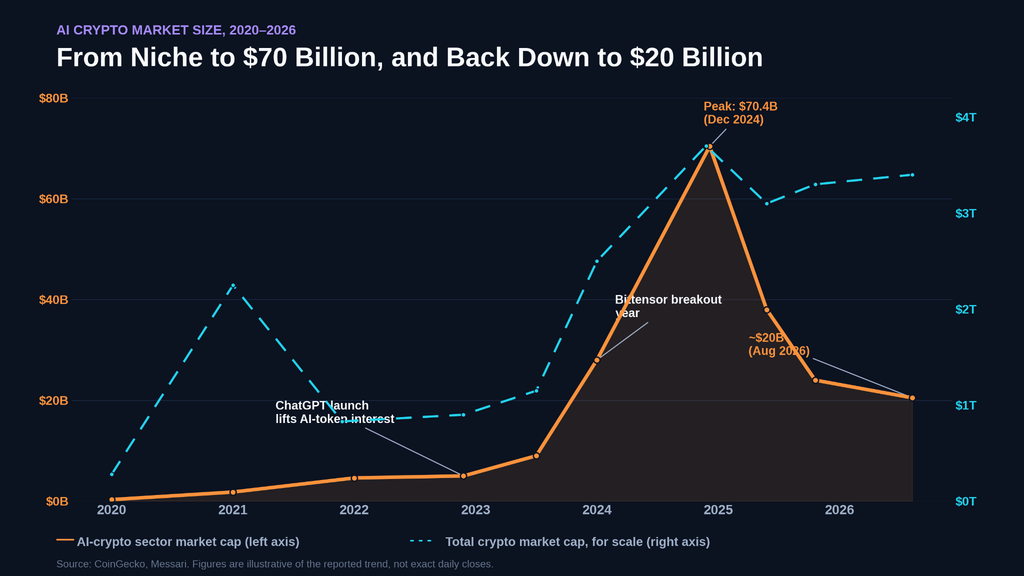
- The AI-crypto market is worth about $20 billion as of August 2026, down sharply from its December 2024 peak of $70.4 billion, according to CoinGecko. The hype has cooled, but real projects are still shipping.
- Three projects lead the space in different ways: Bittensor pays people to train AI models, Render Network rents out spare GPUs for AI work, and Fetch.ai (now part of the ASI Alliance) builds AI agents that can act on your behalf.
- Every AI token in this guide has lost 70% to 95% of its value from its all-time high. This is a young, volatile market. Treat every number here as a snapshot, not a promise.
- Verifying AI on a blockchain is still slow and expensive. The math that proves an AI model is telling the truth can cost 50 to 10,000 times more computing power than just running the model.
What Do People Mean by “AI Crypto” & How Does AI Crypto Actually Work?
There isn’t one single thing called “AI crypto.” It’s really a handful of different ideas that use both technologies together. AI and crypto intersect in three major ways: autonomous agents can transact on blockchains, decentralized networks can coordinate AI training, and cryptography can make AI outputs verifiable and private.
1. AI Agents Transacting on Blockchains
An AI agent becomes an on-chain actor when it combines a decision-making model with a blockchain wallet and transaction infrastructure.
How the process works
- Build the agent: Developers use Python, JavaScript, or agent frameworks to combine an AI/ML model with tools such as blockchain APIs and Web3 libraries.
- Give it controlled access: The agent receives a wallet or delegated signing authority. Developers can add spending limits, multisig approval, and transaction policies to reduce the risk of runaway actions.
- Monitor and decide: The agent reads prices, contract states, events, or external data, then evaluates predefined goals, for example identifying an arbitrage opportunity.
- Execute: It constructs, signs, and broadcasts a transaction, then interacts with smart contracts through functions such as swaps, staking, or transfers.
- Verify results: The agent monitors transaction receipts and contract events to confirm execution.
Fetch.ai’s DeltaV and Agentverse demonstrate this broader model by connecting users with AI agents and services that can handle tasks across areas such as travel, commerce, and data services.
Key challenges: oracle accuracy, gas costs, private-key security, transaction nonce management, and spending controls.
2. Training AI on Blockchain Networks
Blockchain can create economic incentives around decentralized AI rather than simply storing AI models on-chain.
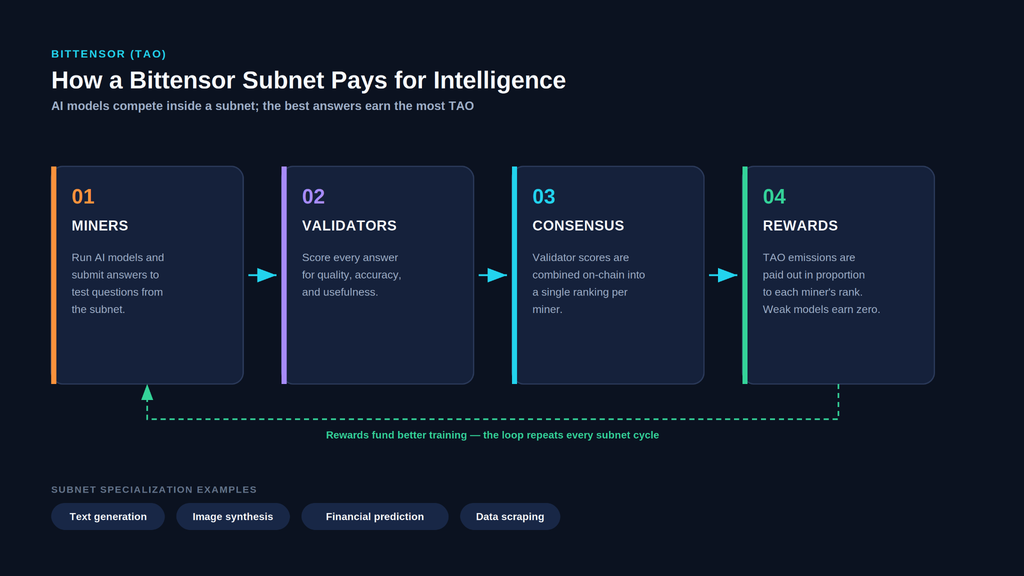
Bittensor documentation provides a useful example:
- Choose a subnet: Each subnet focuses on a particular AI or compute task.
- Run a miner: Miners provide models, computation, or other useful outputs.
- Evaluate performance: Validators test miners and assign weights based on their perceived quality.
- Earn rewards: Network emissions are distributed according to the protocol’s incentive mechanism.
- Improve continuously: Miners optimize their systems to achieve better evaluations and attract more rewards.
This creates a competitive feedback loop: better useful output → stronger validator scores → greater rewards → more resources for improvement. Bittensor’s research also focuses on preventing validators from simply copying other validators’ evaluations.
Privacy-preserving collaboration
MPC and related privacy-preserving techniques can also let multiple organizations train or evaluate models without exposing their raw datasets. Blockchain can provide the coordination and incentive layer by recording contributions and automating rewards.
3. Cryptographically Verifying AI
The biggest challenge is trust. If an AI system makes a high-stakes decision, users need more than a claim that the model produced the result.
zkML: proving AI inference
Zero-knowledge machine learning (zkML) attempts to prove that a specific computation was performed correctly without revealing sensitive model information or inputs.
A simplified workflow is: Input → Off-chain AI inference → ZK proof → On-chain verification → Accepted result
This can support applications such as verifiable AI oracles, DAO decision systems, and automated DeFi agents. Current research is progressing toward practical verification of increasingly complex models, although proving AI inference remains computationally demanding.
FHE: computing on encrypted data
Fully Homomorphic Encryption (FHE) takes a different approach: it allows AI systems to process encrypted inputs without first decrypting them. The user encrypts a query, the AI processes the ciphertext, and the user decrypts the resulting prediction.
FHE remains computationally expensive, but 2026 research is improving its practicality through better algorithms and hardware.
Defending AI agents
Crypto-based AI systems still need conventional security controls:
- Rate limits to prevent automated abuse.
- Transaction limits to contain financial losses.
- Cryptographic authentication for sensitive actions.
- Model and query monitoring to detect manipulation.
- Multiple models or verification layers for high-risk decisions.
Ultimately, AI-crypto infrastructure works best when AI provides the intelligence, blockchains provide coordination and settlement, and cryptography provides verifiability and privacy.
Ethereum co-founder Vitalik Buterin laid out this space in a widely read January 2024 essay. He grouped the ideas into AI as a player inside a system, AI as the interface people use to reach a system, AI as part of the rules that run a system, and AI as the goal a system is built to protect. He was blunt about which is easiest to build.
“This use case has existed for a long time, even with much simpler AIs than what we have today, but ultimately it is a very real AI + crypto intersection.”
That line was about trading bots, the simplest and most proven version of AI crypto. He was far more cautious about AI acting as a judge or referee inside a blockchain system, warning that a public, downloadable AI model can be studied and gamed by anyone with the time to try.
Why AI and Crypto Actually Need Each Other
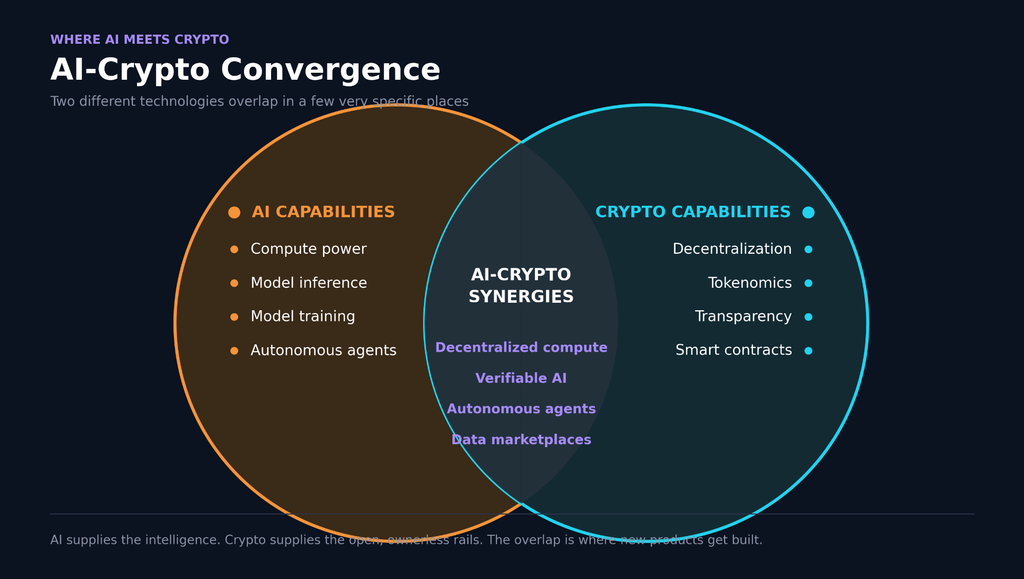
It helps to think of this as two lists of problems that happen to cancel each other out.
AI’s problems, crypto’s answers:
- AI training needs enormous compute power, and a handful of cloud giants control most of it. Decentralized GPU networks offer an alternative supply.
- AI models are trained on data scraped from the internet, often without paying the people who created it. Token rewards give data contributors a way to get paid.
- AI decision-making is a black box. Blockchains create a public, permanent record that can be checked later.
Crypto’s problems, AI’s answers:
- Crypto wallets and DeFi protocols are confusing for newcomers. AI assistants can explain a transaction in plain language before you sign it.
- Markets move faster than humans can watch them. AI already handles the bulk of arbitrage and liquidity work on decentralized exchanges.
- Scams and phishing sites are everywhere in crypto. AI-driven detection tools can flag a fake token or a malicious contract before a user loses money.
If you’re new to how blockchains actually work under the hood, our guide on What is Blockchain is a good place to start before diving deeper into this one.
There's no Call To Action with the ID #0.The Biggest Projects, and What They Actually Do
Numbers below reflect early-to-mid August 2026 data and change constantly. Always check a live source like CoinGecko or CoinMarketCap before making any decision.
Bittensor (TAO): Paying People to Train AI
Bittensor is one of the most ambitious decentralized AI networks, creating an open marketplace where independent participants provide machine intelligence, computing power, data, and other AI services.
Instead of relying on a single company to control AI infrastructure, Bittensor uses specialized subnets (a smaller, logical piece of a larger IP network) to coordinate different AI-related tasks and reward participants based on their contribution.
Key Metrics in 2026
- TAO price: Around $190–$193
- Market cap: Roughly $2 billion
- Maximum supply: 21 million TAO
- Active subnets: 128–129, up sharply from earlier network stages
- All-time high: About $768 in April 2024
How Bittensor Works
Each subnet targets a specific AI or computing problem, including inference, data, prediction, training, and decentralized compute. Yuma Consensus allows validators to evaluate subnet participants and determine rewards according to the network’s stake-weighted consensus rather than simply relying on a traditional proof-of-work or proof-of-stake model.
Recent 2026 upgrades have also changed subnet economics. The July 2026 V431 upgrade introduced conviction-based subnet ownership and tied emissions between subnets to moving-average prices.
Investment Case
Strengths
- Growing decentralized AI ecosystem
- Increasing specialization across subnets
- Fixed 21-million maximum TAO supply
- Strong developer and validator participation
Risks
- Complex subnet economics
- Highly volatile TAO and subnet tokens
- Decentralized AI can struggle with efficiency and consistency compared with centralized providers
Investment thesis: TAO offers exposure to the growing demand for decentralized AI infrastructure while betting on a more open alternative to centralized AI platforms.
Fetch.ai and the ASI Alliance: AI Agents With Wallets
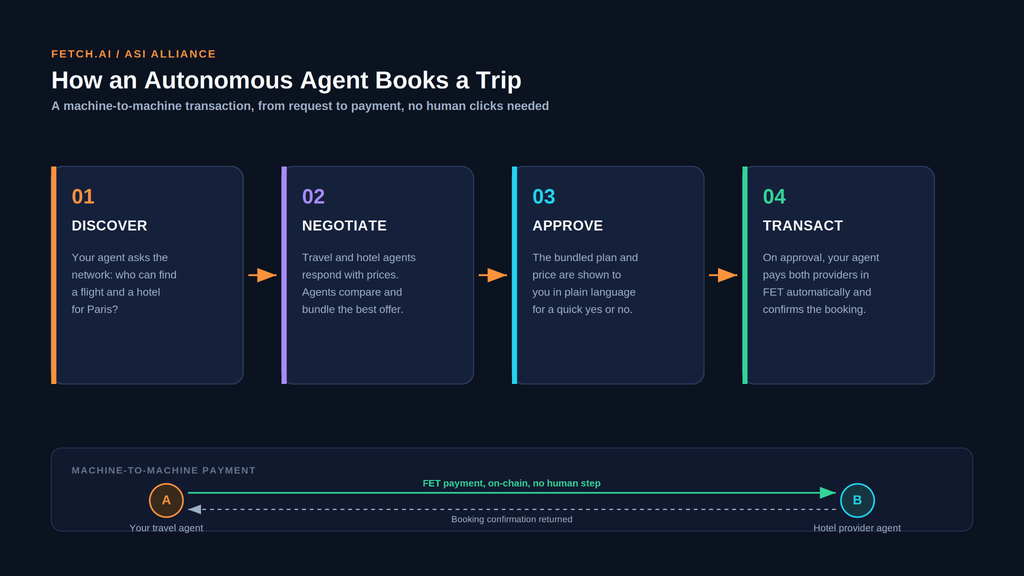
Fetch.ai is building infrastructure for an emerging agent economy, where autonomous AI agents can discover services, negotiate, coordinate tasks, and execute transactions with minimal human input. Its technology combines AI agents, blockchain-based identity and payments, and tools such as Agentverse and DeltaV.
ASI Alliance and 2026 Position
Fetch.ai, SingularityNET, and Ocean Protocol joined forces to create the Artificial Superintelligence Alliance (ASI), initially consolidating their tokens under the FET ticker. However, Ocean Protocol exited in October 2025 following governance disagreements, highlighting the challenges of large-scale crypto mergers.
CUDOS later joined the alliance. Despite the changes, Fetch.ai continues developing real-world AI infrastructure through Agentverse, which now has more than 2.7 million registered agents.
Fetch.ai has also pursued industrial applications through its Bosch collaboration. As of 2026, FET remains the actively traded token, with roughly 2.24 billion tokens circulating and a market capitalization of about $309 million.
Key highlights:
- AI agents: Autonomous programs can discover, negotiate, and transact for users or businesses.
- Real-world applications: DeltaV connects users with AI agents for services such as travel, mobility, and commerce.
- Enterprise adoption: Fetch.ai has worked with Bosch on industrial, mobility, IoT, and autonomous-device applications.
- Token utility: FET supports network transactions, agent services, and staking within the ecosystem.
Investment Thesis: The bull case for FET centers on the machine economy: a future where AI agents and connected devices independently find services, exchange data, and make payments. Its biggest challenges remain competition, execution risk, and proving that real-world agent activity can translate into sustained token demand.
Render Network (RENDER): Renting Out Spare Computer Chips
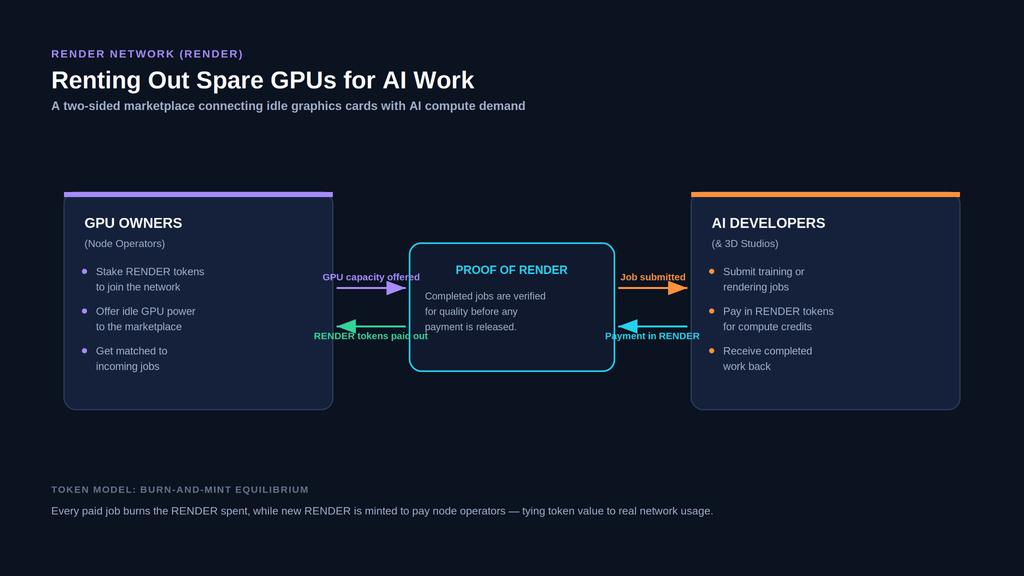
Render Network is a decentralized GPU marketplace that began with 3D rendering and is expanding into AI and machine-learning compute. Its current network has rendered 77 million+ frames, while its compute network supports AI inference, fine-tuning, training, and generative AI workloads.
RENDER operates on Solana, following its migration from Ethereum’s RNDR token. Its Burn-and-Mint Equilibrium (BME) model burns RENDER when users pay for compute, while emissions reward node operators for completed work. This replaces the outdated claim of a fixed 5% burn and 15–25% APY.
Key Features
- GPU marketplace: Node operators monetize idle GPU capacity, while developers access distributed compute without relying entirely on centralized cloud providers.
- AI expansion: Supports machine-learning training, inference, fine-tuning, and generative AI applications alongside traditional 3D rendering.
- 3D ecosystem: Integrates with tools including Maya, 3ds Max, Unity, Unreal Engine, and Octane X.
- Enterprise-grade hardware: The network is onboarding data-center providers with 25+ GPUs or H100-class hardware for higher-performance workloads.
Strengths: Growing AI compute use cases, established 3D network, decentralized GPU supply, and expanding hardware support.
Risks: Distributed compute can face latency, hardware quality, and reliability constraints, while competitors such as Akash, Golem, and io.net compete for decentralized GPU demand.
NEAR Protocol (NEAR): AI-Native Layer-1
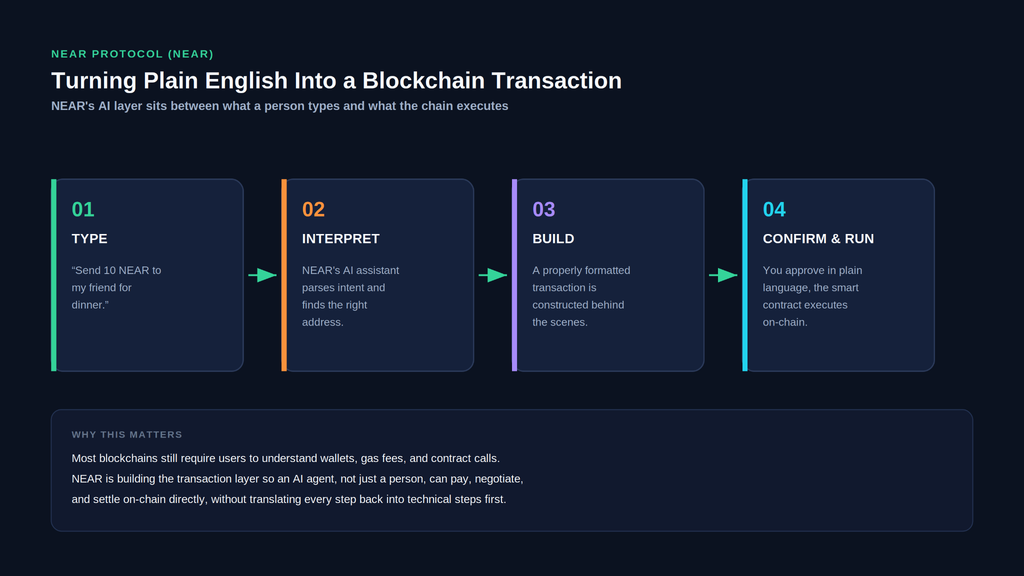
NEAR is a sharded Layer-1 blockchain evolving into infrastructure for AI agents and cross-chain transactions. As of August 2026, NEAR has a market cap of roughly $2.2B and about $99M in DeFi TVL, according to DefiLlama.
AI & Chain Abstraction
NEAR’s 2026 strategy centers on making AI agents capable of securely interacting with blockchain networks.
- Chain Signatures: Lets NEAR accounts and AI agents sign transactions across networks such as Bitcoin, Ethereum, and Solana.
- NEAR AI: Provides private, verifiable AI inference using Trusted Execution Environments (TEEs).
- NEAR Intents: Enables users and agents to execute cross-chain transactions without manually managing bridges, wallets, or gas.
- Developer tools: Supports Rust, JavaScript/TypeScript, Python, and Go, lowering the barrier to building Web3 applications.
Strengths
- 1M TPS scalability and 1.2-second finality.
- Strong developer tooling and low fees.
- Clear 2026 focus on AI agents and chain abstraction.
Risks
- Faces intense competition from other Layer-1s and AI-focused networks.
- AI-agent adoption remains an emerging use case.
- DeFi TVL remains modest relative to major Layer-1 competitors.
Internet Computer (ICP)
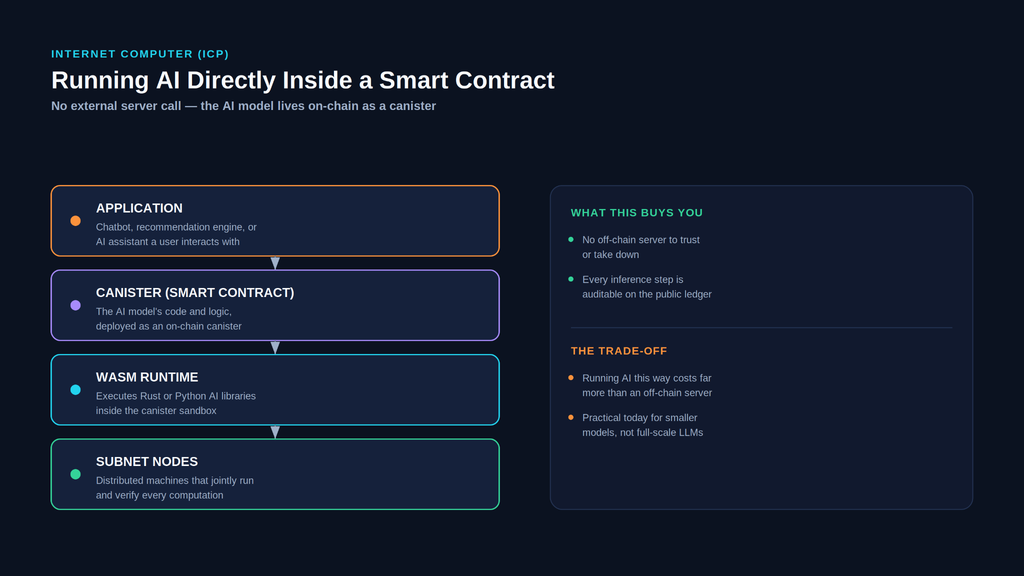
Internet Computer is a decentralized blockchain designed to host complete web applications, backend infrastructure, and increasingly, AI workloads directly on-chain. Its canisters combine WebAssembly code with persistent state, allowing applications to run without conventional cloud infrastructure
ICP’s key AI advantage is on-chain inference: developers can deploy AI models inside canisters and execute inference across the decentralized network.
- Supports decentralized AI assistants, recommendation systems, and AI agents.
- Canisters can store AI-related data and execute model logic on-chain.
- Experimental confidential-AI projects are also exploring GPU/TEE-based infrastructure and on-chain RAG.
- Large-scale model training remains impractical because of compute and cost constraints.
2026 Metrics
- Market cap: Approximately $1.2B in late July 2026, rather than the previously stated $3.5B.
- Runtime: WebAssembly-based canisters.
- Compute: Distributed across subnet nodes.
- Storage: About $5 per GiB annually on a standard 13-node subnet.
- Developer stack: Supports languages including Rust and Motoko, with expanding tooling for other environments.
Strengths
- Fully decentralized application and AI infrastructure.
- On-chain execution reduces dependence on centralized cloud providers.
- Suitable for verifiable AI and data-intensive applications.
Limitations
- AI inference can cost more than conventional off-chain alternatives.
- Training large models directly on-chain remains impractical.
- AI infrastructure is still developing compared with mature centralized GPU clouds.
World Network: Proving You’re Human

Source: world.org
Not every AI-crypto project builds AI models. World Network, co-founded by Sam Altman, tackles a growing problem: how can people prove they are human as AI-generated content and bots become harder to detect?
Its orb scans a user’s iris to create a privacy-preserving World ID, allowing them to verify their humanity online without revealing personal information. As of 2026, nearly 18 million people across 160 countries have completed Orb verification.
Adoption Meets Regulation
- Major integrations: Tinder, Zoom, and DocuSign now support World ID use cases.
- Regulatory scrutiny: The project continues to face investigations, restrictions, and privacy concerns across several countries over biometric data collection.
World shows how AI-era identity technology can gain meaningful adoption while facing significant regulatory risks.
Investment Guide: How to Evaluate AI-Crypto Projects
AI-crypto projects can offer significant upside, but many rely more on AI branding than genuine technology. Use this seven-factor framework to separate useful infrastructure from speculative hype.
1. Real Utility vs. Hype – 25%
Start with the product, not the token.
Look for:
- A live product with measurable users, transactions, or compute demands.
- AI that provides a genuine advantage rather than serving as marketing.
- Active developers, technical documentation, APIs, and open-source code.
- Partnerships that demonstrate actual adoption.
Red flags: vague AI claims, inactive repositories, anonymous teams, promises of AGI or a token launched long before the product.
Example: Bittensor has a functioning decentralized AI ecosystem, but its utility does not eliminate the token’s speculative risk.
2. Token Economics – 20%
Determine whether the token has sustainable demand.
- What is it actually used for: payments, staking, compute, or governance?
- Check circulating supply, inflation, unlock schedules, and insider allocations.
- Identify the mechanisms that create genuine token demand.
- Avoid high inflation without sufficient demand or sustainable rewards.
Render is a useful example: its RENDER token supports the network’s decentralized GPU economy, while its Burn-Mint Equilibrium links network usage to token economics.
3. Technical Feasibility – 15%
Read the technical documentation rather than relying on marketing.
Prioritize: proven cryptography, credible architecture, realistic scalability claims, published research, and demonstrated products. Be cautious of projects claiming to solve difficult computing problems without technical evidence.
4. Competitive Position – 15%
Compare the project with both crypto and traditional competitors. Ask:
- Why would users choose it over AWS, Google Cloud, or established decentralized networks?
- Does it offer lower costs, better accessibility, or meaningful decentralization?
- Does growing adoption create network effects?
A decentralized GPU network such as Render, for example, competes on distributed capacity and pay-as-you-use infrastructure.
5. Team & Governance – 10%
Assess the team’s technical track record, transparency, and incentives. Examine whether governance actually controls important decisions or merely exists for appearances.
6. Regulatory Risk – 8%
Regulatory treatment is project-specific. In the U.S., the Securities and Exchange Commission (SEC)’s March 2026 interpretation distinguishes categories such as digital commodities and digital tools from digital securities, while noting that an otherwise non-security crypto asset can still be involved in an investment contract.
In the EU, Markets in Crypto-Assets (MiCA) provides the core framework for crypto-assets and related services, with the European Commission reviewing the framework in 2026.
7. Community & Ecosystem – 7%
Check GitHub activity, developer participation, independent applications, integrations, grants, and technical discussions, not simply follower counts.
Investment Strategy
- Lower-risk approach: prioritize established networks and proven AI infrastructure, then keep a portion in stablecoins.
- Aggressive approach: combine established leaders with smaller infrastructure projects, but limit exposure to early-stage tokens.
Risk rules:
- Keep any single AI token below 10% of your portfolio.
- Reassess projects quarterly based on fundamentals, not price alone.
- Monitor token unlocks, development activity, adoption, and regulatory changes.
- Never confuse AI narratives with product-market fit.
If you decide a project clears your bar and you want to act on it, our guide on AI Tokens in Crypto walks through the mechanics on how to invest.
“Crypto’s decentralization can balance AI’s centralization; AI is opaque, and crypto brings transparency. AI needs data, and blockchains are good at storing and tracking data.”
That’s Vitalik Buterin’s own summary of why people keep reaching for this combination, quoted in Cointribune’s coverage of his essay. It’s a fair one-line case for the whole sector and also a fair warning that the case is still mostly theoretical outside a few working examples.
Challenges and Risks at the AI-Crypto Intersection
Below are some of the major challenges the technology still faces.
Technical Challenges
1. High Computational Costs
Running AI with cryptographic verification can be far more expensive than conventional cloud inference. Zero-knowledge proofs, multiparty computation (MPC), and fully homomorphic encryption (FHE) add significant processing and latency overhead, particularly for large AI models.
- Impact: Decentralized AI can be slower and more expensive than centralized alternatives.
- Best approach: Keep intensive computation off-chain and use blockchain for verification, settlement, or auditability.
- Outlook: zkML, optimized proving systems, and specialized hardware could reduce these costs over time.
2. Adversarial Attacks
Open AI models can be tested and manipulated by attackers who craft inputs designed to produce incorrect outputs. In crypto, this could undermine fraud detection, automated trading, identity verification, or content moderation.
Defenses include:
- Query limits and authentication
- Multiple-model or ensemble systems
- Cryptographic verification
- Immutable logging of important model activity
No defense completely eliminates adversarial manipulation, making security testing essential.
3. Data Poisoning and Quality
Decentralized AI allows many participants to contribute training data, creating opportunities for malicious or inaccurate inputs. Blockchain can establish data provenance, but it cannot independently prove that data is truthful.
Staking, reputation systems, validator voting, and anomaly detection can discourage manipulation, while cryptographic provenance techniques offer a longer-term solution.
Economic and Regulatory Risks
4. Unsustainable Tokenomics
AI tokens need genuine utility rather than relying on speculation. High emissions can create selling pressure, while weak demand for the underlying AI service can undermine long-term value. Projects must demonstrate why users need the token and whether decentralized infrastructure provides benefits that justify its cost.
Regulation also matters. Under the EU’s MiCA framework, crypto-asset issuers face transparency, disclosure, and authorization requirements depending on the asset and offering.
5. Centralization Behind the Decentralized Model
A network can be decentralized at the blockchain layer while remaining concentrated elsewhere. GPU supply, training datasets, development teams, validators, and token ownership can all become centralized.
The solution requires broader geographic distribution, transparent governance, diverse infrastructure providers, and incentives that encourage new participants.
Social and Environmental Risks
6. AI Bias and Governance
AI models can reproduce biases in their training data. Putting their outputs on an immutable ledger can make flawed decisions harder to correct. Model versioning, independent audits, and DAO-based governance can help, but communities still need clear processes for challenging and replacing biased models.
7. Environmental Impact
AI requires substantial computing resources, while proof-of-work blockchains can add significant energy demand. However, the environmental impact varies by architecture. Ethereum’s move to proof-of-stake reduced its energy consumption by roughly 99.95%, showing that blockchain consensus does not necessarily require energy-intensive mining.
Ultimately, decentralized AI must prove that its benefits, such as privacy, censorship resistance, verifiability, and open access, outweigh its additional technical and economic costs.
If you plan to hold any of these tokens yourself or manage a wallet for an AI agent, read through Cryptocurrency Security Best Practices first.
Future Outlook of AI and Crypto Intersection
By 2030, the strongest projects are likely to be those that combine useful AI infrastructure with transparent incentives, verifiable computation, and efficient on-chain payments.
Near Term (2026–2027): From Hype to Adoption
1. AI agents become a meaningful on-chain economy
AI agents are already moving beyond prototypes. Fetch.ai reports more than 2.7 million registered agents, while June 2026 data shows millions of agent-related transactions across emerging protocols.
Key growth areas include:
- Automated DeFi trading and portfolio management
- Machine-to-machine payments
- Supply-chain and logistics coordination
- IoT and data-market transactions
2. DeFi protocols integrate AI-native features
Major protocols such as Aave or Uniswap could increasingly use AI for risk monitoring, liquidity management, fraud detection, and portfolio automation. This would help move AI-crypto integration from niche experiments into mainstream DeFi.
3. AI-focused crypto investment products expand
The approval of additional crypto ETFs in 2026 shows that the regulatory environment is becoming more accommodating. The SEC has also issued clearer guidance on crypto-asset classifications. A dedicated basket of AI-related crypto assets remains possible, although regulatory and liquidity requirements could delay it.
Midterm (2027–2028): Decentralized AI Gets More Competitive
4. Decentralized AI models close the performance gap
Networks such as Bittensor could produce models competitive with leading centralized systems as distributed compute, incentives, and training coordination improve. However, current research still highlights challenges around reward concentration and network incentives.
5. Verifiable AI becomes economically practical
Advances in ZK proofs, specialized hardware, and cryptographic techniques should reduce the cost of verifying AI computations. Lower overhead could unlock applications such as trustworthy AI oracles, autonomous agents, and high-stakes decision systems.
6. AI agents gain a role in DAO governance
DAOs could allow AI agents to monitor proposals, manage treasuries, optimize strategies, and execute routine decisions while humans retain ultimate oversight. The technology is feasible; governance legitimacy and security will determine adoption.
Long Term (2029–2030): AI and Crypto Converge
7. Token incentives become a standard funding model for some AI projects
Decentralized networks could increasingly reward users for providing compute, data, models, and other resources. This would create an alternative to the capital-intensive centralized AI model.
8. AI crypto becomes a major crypto sector
If AI agents, decentralized compute, tokenized data, and autonomous finance achieve sustained adoption, AI-related crypto networks could capture a significantly larger share of the digital-asset market.
9. Traditional tech companies enter decentralized AI
Major technology firms may experiment with open AI models, decentralized compute, blockchain-based identity, or on-chain coordination, not necessarily because decentralization replaces centralized AI, but because hybrid models could improve transparency, interoperability, and access.
There's no Call To Action with the ID #0.Wildcards to Watch
Positive: Major breakthroughs in fully homomorphic encryption, scalable verifiable AI, or decentralized training could accelerate adoption dramatically.
Negative: A major AI-agent exploit, regulatory restrictions on AI tokens, or a decisive performance advantage for centralized AI could slow the sector considerably.
The next four years will likely determine whether AI-crypto becomes a durable technological sector or remains another speculative crypto narrative. The strongest signals to watch are real economic activity to agents transacting, AI services generating revenue, and decentralized networks delivering measurable performance.
Read Also: How to Choose the Best AI Crypto Trading Bot
Conclusion
AI cryptocurrency in 2026 is smaller and calmer than the hype cycle promised, and that’s actually a good sign.
The market has shed 70% of its peak value, and what’s left are projects doing real work: Bittensor paying for trained models, Render renting out GPUs, Fetch.ai’s agents booking and paying on their own.
None of it is finished. Verifying AI on a blockchain is still slow, “decentralized” often isn’t as decentralized as it claims, and every token here remains volatile.
However, the core idea holds up. AI needs open compute and honest incentives. Crypto needs to be easier to use and harder to scam.
Watch what these projects ship over the next few years, not what they promise, and you’ll know whether this convergence was worth the wait.
Frequently Asked Questions
What is the intersection of AI and crypto?
It’s the overlap between artificial intelligence and blockchain technology, where AI models are trained and paid for using crypto tokens, AI agents hold and spend cryptocurrency on their own, and cryptographic tools are used to verify that an AI’s output can be trusted.
Why do AI and blockchain need each other?
AI needs cheap, distributed computing power and fair ways to pay data contributors, both of which blockchains can provide. Crypto needs to be easier to use and safer from scams, both of which AI can help with.
How do AI agents use cryptocurrency?
An AI agent is given its own crypto wallet and a set of rules. It can then monitor blockchain activity, make decisions like buying, selling, or paying for a service, and complete the transaction on its own, without a human approving each step.
Can I make money trading AI crypto tokens?
It’s possible, but every major AI token has fallen 70% or more from its all-time high, and the sector overall is roughly 70% below its December 2024 peak. These are high-risk, high-volatility assets. Only invest money you can afford to lose, and do your own research beyond any single article, including this one.
Disclaimer: This article is for educational purposes only and is not financial, investment, legal, or tax advice. AI crypto tokens are highly speculative and volatile, and many of the projects described are still experimental. Always do your own research, verify information through official project sources, and speak with a qualified financial or legal advisor before investing. UEEx makes no guarantees about the performance of any project mentioned here and is not responsible for any losses.