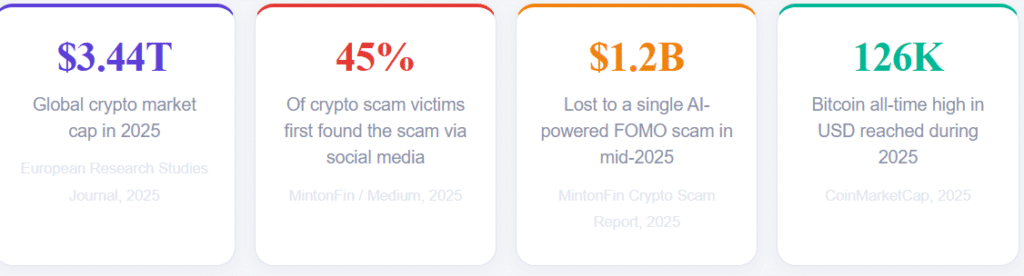
It is a well-documented psychological phenomenon that is actively exploited by market cycles, social media algorithms, and increasingly, by professional bad actors who manufacture urgency to separate investors from their money.
Knowing how to deal with FOMO in crypto may be the single most valuable skill you can develop as a digital asset investor
A 2025 study published in the European Research Studies Journal confirmed what experienced traders have long known: FOMO-driven decision-making in crypto markets leads investors to prioritise emotional reactions over rational analysis, buying at peaks and selling at troughs in a predictable, damaging pattern.
Crypto FOMO refers to the anxiety that arises when you see an asset surging and fear being permanently left behind if you do not act immediately.
It is a specific form of regret aversion, the human tendency to feel potential losses more acutely than equivalent gains amplified by the extreme price movements that make cryptocurrency markets unique.
The psychological mechanism is well understood. When Bitcoin surged from under $30,000 to over $126,000 in 2025, social media timelines filled with screenshots of gains, influencer endorsements, and breathless commentary about life-changing returns.
For anyone sitting on the sidelines, the discomfort of watching this play out became almost physically painful.
Join UEEx
Experience the World’s Leading Digital Wealth Management Platform
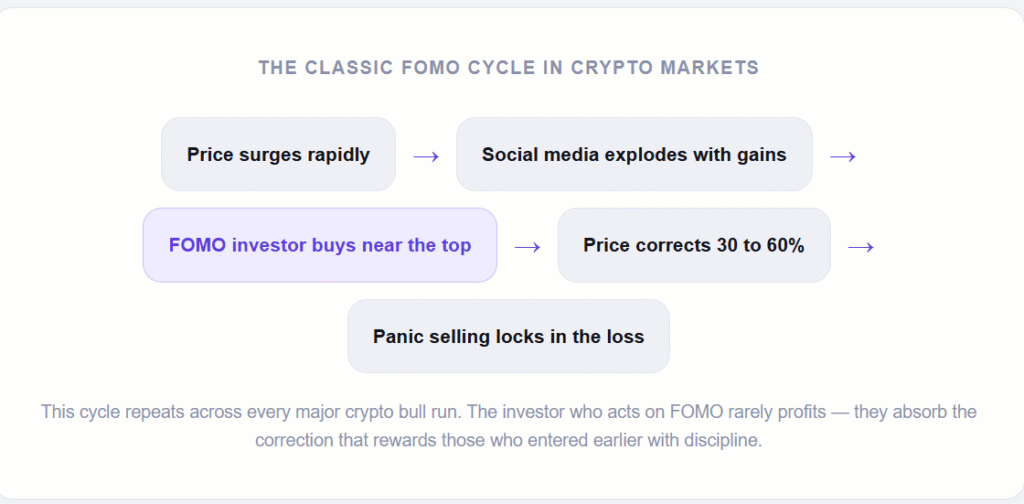
That discomfort is precisely what short-circuits rational analysis and triggers impulsive market entries almost always at or near the top.
What Makes Crypto Uniquely Vulnerable to FOMO Compared to Traditional Markets?
Traditional equity markets experience FOMO too, but several features of crypto amplify it dramatically. Markets run 24 hours a day, seven days a week, meaning there is no overnight break from the noise.
Price movements of 10%, 20%, or even 50% in a single day are historically documented.
Social media communities around specific coins from Bitcoin maximalists to Solana evangelists actively cultivate urgency and shared identity in ways that make sitting out feel like a social defection rather than a rational choice.
Research from the International Journal of Mental Health and Addiction found that FOMO in crypto is closely tied to social media usage, where rapid price fluctuations and the prevalence of unreliable information compel impulsive decisions without thorough research.
The same research confirmed that investors with lower financial literacy are significantly more susceptible and that impulsivity as a personality trait is a material risk factor for destructive FOMO behaviour.
How to Deal With FOMO in Crypto: 8 Strategies That Work
These strategies are not abstract motivational advice. Each is grounded in behavioural finance research and practical trading discipline.
Together, they form a system that replaces emotional reactivity with structured decision-making.
1. Write Your Investment Plan Before Markets Move
The single most effective defence against FOMO is a written investment plan created during a calm, uneventful market period not during a surge.
Your plan should define which assets you will hold, what percentage of your portfolio each represents, at what price levels you would consider adding more, and what conditions would prompt you to reduce your position.
When Bitcoin is up 30% in a week and your timeline is screaming at you to act, that pre-written plan becomes an anchor.
You are no longer making a new decision under emotional pressure, you are simply consulting a rational document your sober self already created.
2. Use Dollar-Cost Averaging to Remove Timing Pressure
Dollar-cost averaging (DCA) — investing a fixed amount at regular intervals regardless of price — is the most research-validated antidote to FOMO-driven timing decisions.
When you commit to buying £200 worth of Ethereum every two weeks no matter what the price is doing, you cannot buy at the top in any meaningful sense, because you are always buying incrementally.
You also cannot miss the entry point, because your system ensures you are always in the market. DCA transforms should I buy now? from an emotionally loaded question into a mechanical schedule.
The anxiety disappears because the decision has already been made.
Join UEEx
Experience the World’s Leading Digital Wealth Management Platform
3. Impose a Mandatory 48-Hour Waiting Rule on Impulse Trades
Before acting on any investment idea that arises from social media, a friend’s tip, or a news headline during a price surge, impose a mandatory 48-hour waiting period.
Write down your reasoning for the trade, set it aside, and revisit it after two days. In most cases, the emotional urgency will have faded and your analysis will look considerably less compelling in the cold light of two days later.
If it still looks like a good trade after 48 hours, it was probably worth making. If it looks embarrassing, you just avoided a FOMO-driven mistake.
This rule works because FOMO is a time-sensitive emotion, remove the urgency, and it largely dissolves.
4. Audit and Aggressively Curate Your Information Sources
If your primary exposure to crypto information is Twitter, TikTok, YouTube influencers, and Telegram groups, you are consuming content that is optimised for engagement which means it is optimised for emotional arousal, not rational analysis.
Social media platforms amplify content about gains, not losses. Influencers monetise attention, not accurate predictions.
Replace or heavily supplement these sources with on-chain analytics tools, protocol documentation, institutional research reports, and verified market data.
Studies consistently show that investors with higher financial literacy make significantly fewer impulsive decisions, even in volatile markets.
Join UEEx
Experience the World’s Leading Digital Wealth Management Platform
5. Keep a Trading Journal to Make Your Patterns Visible
A trading journal that records not just your trades but your emotional state, reasoning, and the information source that prompted each decision is one of the most powerful self-awareness tools available.
After three to six months of honest journaling, patterns become impossible to ignore.
You will see clearly which types of inputs, a particular influencer, a price alert notification, a late-night scroll consistently precede your worst decisions. What gets measured gets managed.
The 2025 psychology of crypto trading research confirms that journaling combined with mindfulness practices measurably reduces impulsive decision-making in active traders.
6. Understand That Crypto Cycles Repeat — You Rarely Miss Forever
One of FOMO’s most powerful cognitive distortions is the belief that the current opportunity is uniquely finite — that if you do not act right now, this specific window will close forever.
The historical record of Bitcoin and Ethereum tells a different story. Every major bull run has been followed by a significant correction that offered lower entry prices than the panic-induced top.
Bitcoin ran from under $30,000 to over $126,000 in 2025, then pulled back, giving patient investors who missed the run a second opportunity.
The asset that everyone made money on always has another cycle.
Patience is not missing out, it is positioning yourself for the next entry with discipline rather than desperation.
Join UEEx
Experience the World’s Leading Digital Wealth Management Platform
7. Set Hard Position Size Limits Before Any Market Conditions
FOMO does not just cause bad entry timing; it causes over-allocation.
Investors driven by fear of missing out often violate their own position-sizing rules, putting far more into a surging asset than their overall risk tolerance allows.
Set a hard maximum percentage of your total portfolio that can be allocated to any single asset and write it into your investment plan before you have any emotional stake in an asset’s price.
When you are tempted to go bigger on a position because a rally feels unstoppable, your pre-set rule acts as a circuit breaker.
Prop trading risk management strategies including strict position sizing are consistently cited in 2025 research as among the most effective structural defences against FOMO-driven losses.
8. Focus on Your Own Financial Goals Not Other People’s Gains
FOMO is fundamentally a social emotion. It is driven by comparison seeing what others appear to have gained and feeling the gap between their outcome and yours.
The most sustainable long-term mindset reframes the question entirely: rather than how do I get what they got, ask am I on track to reach my own specific financial goals?
If your goal is to grow a portfolio from £10,000 to £30,000 over five years, the fact that someone else tripled their money on a memecoin in a week is entirely irrelevant to your strategy.
Define your goals in concrete, personal terms. Measure yourself against your plan, not against other people’s highlight reels on social media.
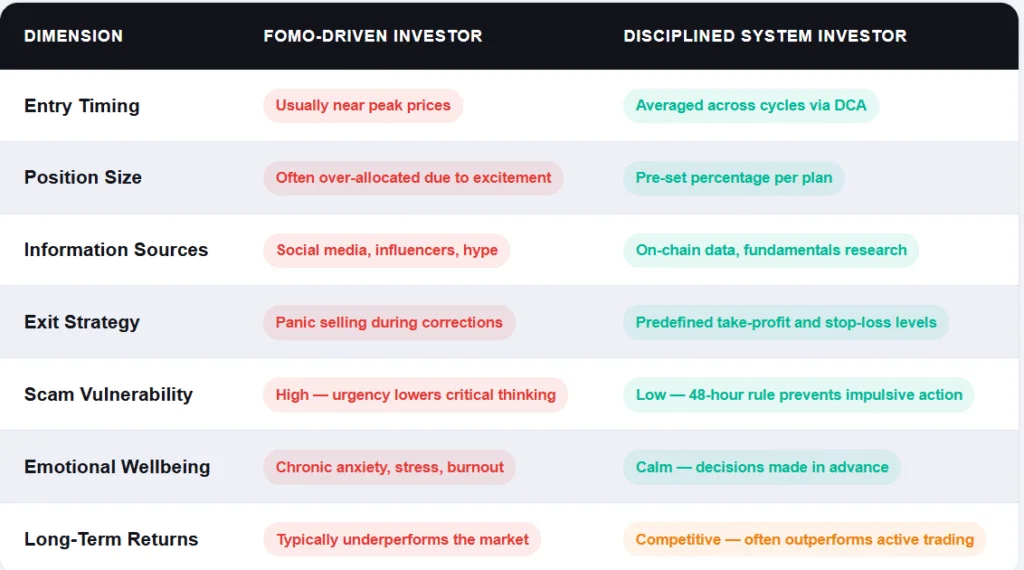
What Does Emotional Investing Actually Cost Versus a Disciplined Strategy?
The difference between FOMO-driven investing and systematic investing is not just psychological, it is quantifiable.
Join UEEx
Experience the World’s Leading Digital Wealth Management Platform
If you can’t explain a trade to a skeptic in two minutes using only logic, minus any mention of everyone else, you’re gambling, not investing.
Red Flags of Emotional Trading
Physical Agitation: Feeling wired or anxious while watching candles.
Deviation from the Script: Increasing your position because this rally feels different.
Obsessive Monitoring: Checking prices more than once an hour.
The Non-Buyer Sting: Feeling genuine distress when a coin you skipped keeps climbing.
Conclusion
As we conclude, FOMO in crypto isn’t just a feeling; it’s a business model for bad actors. If you’re trading on a viral screenshot, you aren’t an investor; you’re the exit liquidity paying for someone else’s beach house.
Disclaimer: This article is intended solely for informational purposes and should not be considered trading or investment advice. Nothing herein should be construed as financial, legal, or tax advice. Trading or investing in cryptocurrencies carries a considerable risk of financial loss. Always conduct due diligence before making any trading or investment decisions.
Trade with proof of Reserves
UEEx publish monthly audits and third party verification on every listed market.