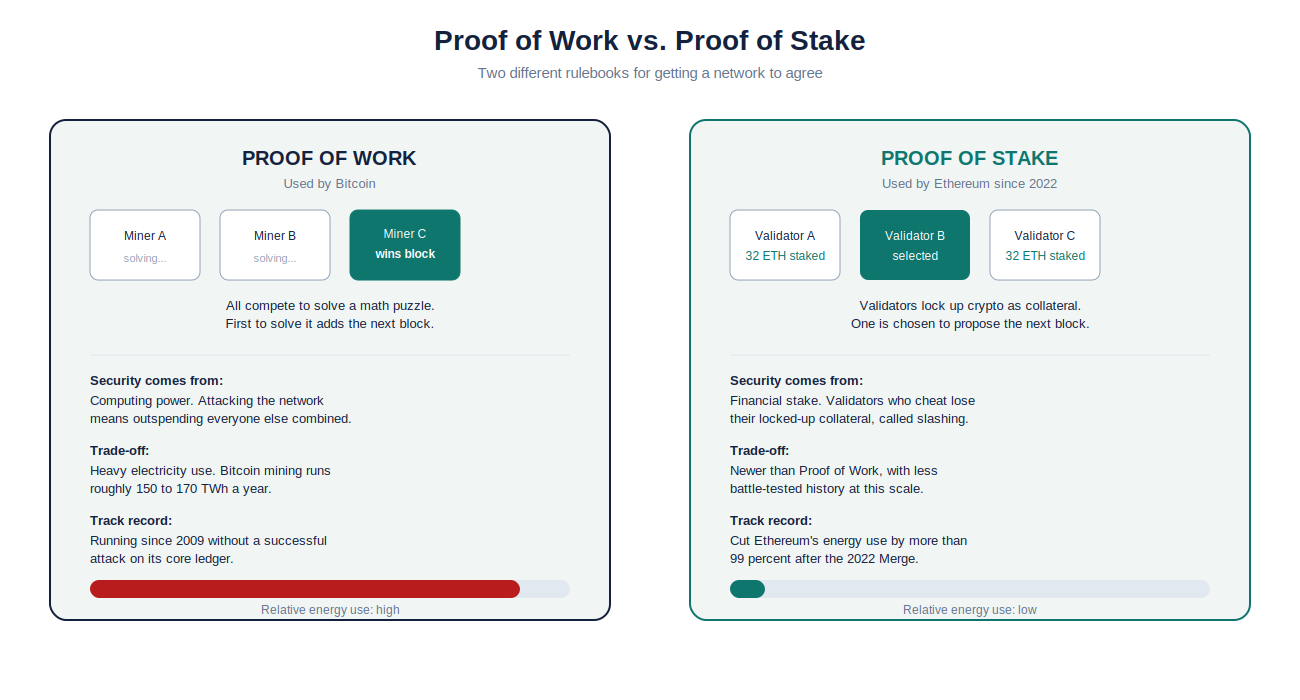
Consensus refers to the agreement among participants in a network on the validity of transactions and the state of the blockchain. It ensures that all copies of a distributed ledger remain consistent and secure.Different mechanisms achieve consensus. Proof of Work (PoW) involves miners solving complex mathematical problems to validate transactions and create new blocks. This method requires significant computational power and energy.Proof of Stake (PoS), on the other hand, allows validators to create new blocks based on the number of coins they hold and are willing to “stake” as collateral. This approach is more energy-efficient and can lead to faster transaction times.Other consensus mechanisms include Delegated Proof of Stake (DPoS), where trusted delegates are elected to validate transactions, and Byzantine Fault Tolerance (BFT), which helps the network withstand failures or malicious actors. Ultimately, the consensus mechanism chosen by a network plays a crucial role in its security, scalability, and efficiency. Effective consensus ensures that all participants agree on the transaction history, fostering trust and stability in the system.