WordPress database error: [You have an error in your SQL syntax; check the manual that corresponds to your MariaDB server version for the right syntax to use near '' at line 1]SELECT * FROM wp_mica_ecta WHERE cta_id =
WordPress database error: [You have an error in your SQL syntax; check the manual that corresponds to your MariaDB server version for the right syntax to use near '' at line 1]SELECT * FROM wp_mica_ecta WHERE cta_id =
WordPress database error: [You have an error in your SQL syntax; check the manual that corresponds to your MariaDB server version for the right syntax to use near '' at line 1]SELECT * FROM wp_mica_ecta WHERE cta_id =
WordPress database error: [You have an error in your SQL syntax; check the manual that corresponds to your MariaDB server version for the right syntax to use near '' at line 1]SELECT * FROM wp_mica_ecta WHERE cta_id =
Crypto in 2026 still comes down to one question every new buyer asks: is this token worth something because people use it, or is it worth something because people like it?
That question splits the market into two camps. Meme coins vs utility tokens is not just an internet debate. It decides how you research a coin, how long you should hold it, how much tax paperwork you’ll deal with, and how much of your money you can realistically afford to lose.
On one side, Dogecoin sits near a $10.9 billion market cap with no smart contracts, no revenue, and no roadmap, just a community that has stuck around for over a decade. On the other side, Chainlink quietly moves tens of trillions of dollars in transaction value through its oracle network and gets used by banks like JPMorgan and payment giants like Mastercard.
Both are real, and both can make or lose you money. But they work in completely different ways, and mixing them up is how most new investors get hurt.
This guide breaks down exactly what separates meme coins from utility tokens, walks through real 2025-2026 case studies, and gives you a practical framework for deciding where your money should actually go.
There's no Call To Action with the ID #0.Key Takeaways
- Meme coins run on attention, not usage. Their price moves with hype, celebrity mentions, and community size, not with any underlying product.
- Utility tokens run on demand for a service. Chainlink, Ethereum, and Aave earn real revenue from real usage, which gives their price a floor that meme coins don’t have.
- Don’t choose one or the other; diversify. A common approach is to keep the bulk of a crypto portfolio in established utility tokens, a small slice in meme coins as a high-risk bet, and some in stablecoins for flexibility.
- Regulation is starting to favor utility. In March 2026, the SEC and CFTC jointly classified 16 major cryptocurrencies, including Bitcoin, Ethereum, and Chainlink, as digital commodities, a status that removes some of the legal uncertainty that has scared off bigger investors for years.
What Are Meme Coins?
Meme coins are cryptocurrencies built around jokes, mascots, or cultural trends rather than functional products, with prices largely driven by community interest and hype. Dogecoin, launched in 2013 by Billy Markus and Jackson Palmer as a parody of crypto culture, pioneered the category.
Its community helped sustain the project through initiatives such as funding a Winter Olympics bobsled team and supporting water projects in Kenya. Shiba Inu followed in 2020, branding itself the “Dogecoin killer.”
From 2024, Solana-based Pump.fun further transformed the sector by making meme coin creation accessible to almost anyone. This evolution highlights how community engagement, cultural relevance, and ease of creation have become major forces shaping the meme coin market.
What Meme Coins Have in Common
- No built-in function: They can’t pay for gas fees, unlock a service, or plug into a smart contract the way Ethereum or Chainlink can. Their value is entirely sentiment.
- A community-first identity: Growth depends on Twitter/X, Reddit, Discord, and Telegram, not on developer documentation. “Diamond hands” culture rewards holding through crashes.
- Absurdly large supplies: Shiba Inu has a total supply in the hundreds of trillions, which is why it trades at a tiny fraction of a cent. Owning a million tokens feels exciting even though it costs less than a coffee.
- Anonymous creators, most of the time: Pump.fun’s own founder went by the pseudonym “Alon” for most of the platform’s history. Anonymity means there’s usually nobody to hold accountable if a project disappears.
- A dependence on virality: A single post from a high-profile figure can move a meme coin’s price by double digits within minutes.
Quick take: The same traits that make meme coins fun (huge supply, low price, no gatekeepers) are the traits that make them easy to abandon. There’s rarely a team with a reputation on the line.
Meme Coins Worth Knowing in 2026
| Coin | Approx. Market Cap (2026) | What Makes It Different |
| Dogecoin (DOGE) | $12.34B | The original. Accepted by thousands of merchants, but adoption hasn’t translated into real transaction volume. |
| Shiba Inu (SHIB) | $2.65B | Trying to bolt on utility through its Shibarium layer-2 network (more on this below). |
| Official Trump (TRUMP) | $369.23M | A celebrity-and-politics hybrid with heavy supply concentration. Covered in detail below. |
| Pepe | $1.17B | Pure internet-meme speculation with no attempt at added utility. |
| Bonk (BONK) | $203.46M | Distributed mostly through airdrops to the Solana community rather than a public sale. |
What Are Utility Tokens?
A utility token is a cryptocurrency built to do a specific job inside a blockchain network, such as paying transaction fees, accessing a service, or giving holders a vote in how a protocol is run. Its value is tied to how much people actually use that network, which means real usage and real revenue can support the price, not just hype.
Ethereum kicked off this category in 2015 by introducing smart contracts, self-executing pieces of code that other tokens and applications could be built on top of. The ERC-20 token standard that followed made it possible for thousands of projects to launch their own tokens on Ethereum’s infrastructure.
By the 2020 “DeFi Summer,” it was clear utility tokens could power an entire financial system running in parallel to traditional banks. Today, DeFi protocols collectively hold about $88 billion in Total Value Locked, according to DeFiLlama, a real-time measure of how much money is actually working inside these platforms.
What Utility Tokens Have in Common
- A functional job: ETH pays for Ethereum’s gas fees. LINK pays node operators for delivering real-world data to smart contracts. UNI gives holders a vote on Uniswap’s governance decisions.
- Revenue tied to usage: Chainlink has generated hundreds of millions of dollars from enterprise and DeFi customers who pay to use its oracle network, based on Token Terminal’s protocol revenue tracking. More usage generally means more demand for the token.
- Active development: Ethereum has upgraded its network multiple times since launch. Chainlink has rolled out its Cross-Chain Interoperability Protocol (CCIP) and an Automated Compliance Engine (ACE) aimed at institutional clients.
- Named, traceable teams: Chainlink co-founder Sergey Nazarov has a public professional history stretching back over a decade. That kind of accountability is rare in the meme coin world.
- Growing institutional interest: Standard Chartered has published price coverage on Chainlink, and Hong Kong’s monetary authority has endorsed Chainlink’s CCIP for tokenized asset settlement. Also, Ether-focused ETFs pulled in $12.6 billion in net inflows during 2025 alone, according to CoinShares data reported by Yahoo Finance, more than double the prior year.
Major Utility Token Categories
- Platform tokens: Ethereum, Solana, and Polkadot, which power smart contracts and dApps.
- DeFi tokens: Aave (lending), Uniswap (trading), Maker (the DAI stablecoin system).
- Oracle tokens: Chainlink and Band Protocol, which feed real-world data into blockchains. Chainlink’s documentation explains this “oracle problem” in detail.
- Infrastructure tokens: Filecoin and Arweave, which pay for decentralized data storage.
- Governance tokens: Compound and Curve, which let holders vote on protocol changes.
The Core Differences: Meme Coins vs Utility Tokens Side by Side
| Category | Meme Coins | Utility Tokens |
| Source of value | Hype, community size, celebrity attention | Actual usage, revenue, and network demand |
| Supply | Often unlimited or in the trillions | Usually capped, sometimes with burn mechanisms that reduce supply |
| Typical volatility | Can swing 50-200%+ in a single day | Established tokens usually swing 10-20% during market stress |
| Typical hold time | Days to weeks | Months to years |
| Team transparency | Frequently anonymous | Usually public, with track records |
| Regulatory standing | Mostly unclear, case-by-case | Increasingly recognized as commodities, not securities |
| Failure rate | Extremely high (see Pump.fun case study below) | Lower, but far from zero |
The biggest thing to understand: with a utility token, you can point to a number, transaction fees collected, active wallets, value secured and connect it to the price. With a meme coin, the only number that matters is how many people still want in tomorrow.
Quick take: Ask yourself one question before buying any token: “If everyone stopped talking about this tomorrow, would it still be used for something?” If the honest answer is no, you’re holding a meme coin, whatever the marketing calls it.
2025-2026 Case Studies: What Actually Happened
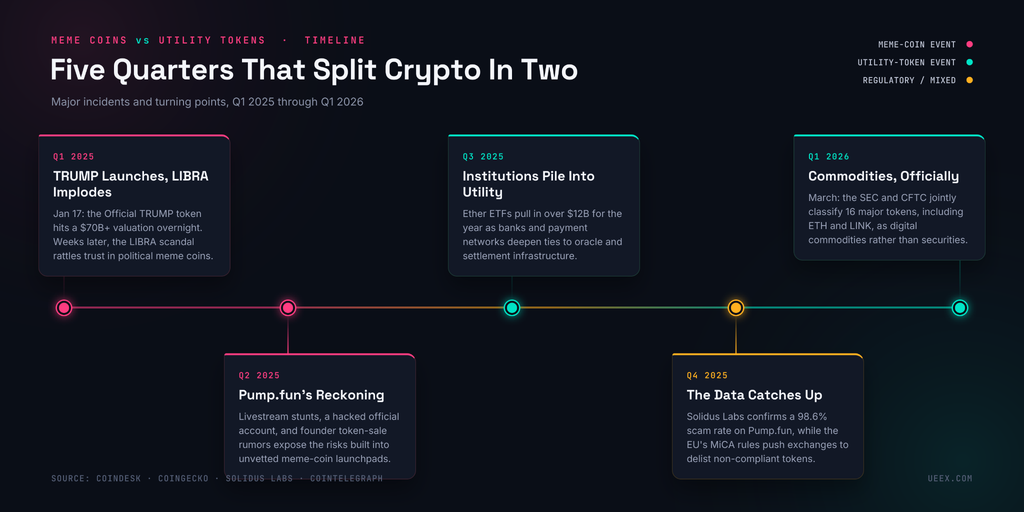
Numbers on a page are one thing. Watching real tokens live or die tells you a lot more.
Case Study 1: The Official Trump Token, a Lesson in Concentration Risk
On January 17, 2025, Donald Trump launched the Official TRUMP token on Solana shortly before his inauguration. The token surged rapidly, briefly reaching a fully diluted valuation above $70 billion.
However, its tokenomics raised concerns: only 20% of the 1 billion total supply was publicly released, while 80% remained controlled by entities linked to the Trump Organization under unlock schedules extending to 2028.
This concentration created significant supply risk, as large holders could potentially increase market pressure by selling. By mid-2026, TRUMP had fallen roughly 98% from its peak, trading near $1.65 with a market cap of about $370 million, according to DataWallet analysis.
Research also indicated that early large holders captured substantial profits while later retail investors suffered losses. The key lesson is supply structure: tokens controlled heavily by insiders carry significant risks, regardless of whether they are meme coins or utility-focused projects.
There's no Call To Action with the ID #0.Case Study 2: Pump.fun, the Meme Coin Factory
Launched in January 2024, Pump.fun made Solana-based meme coin creation accessible to anyone, issuing more than 7 million tokens by mid-2025. However, a May 2025 Solidus Labs report found that 98.6% of these tokens were scams or showed signs of pump-and-dump manipulation.
Only around 97,000 tokens maintained at least $1,000 in liquidity, while 93% of Raydium liquidity pools reportedly showed signs of “soft rug pulls,” where developers gradually withdraw liquidity.
Pump.fun has also faced controversies involving dangerous livestream stunts, a hacked official account promoting a scam token, and questions surrounding a founder-led token sale. Despite these issues, the platform became highly profitable by collecting trading fees. Its success highlights both the accessibility and risks of launching speculative tokens in the rapidly expanding Solana meme coin ecosystem.
Case Study 3: Dogecoin, the Exception That Proves the Rule
As of September 2026, Dogecoin has a market cap of about $13.8 billion, ranking just inside the top 12 cryptocurrencies despite its unlimited supply and lack of smart contract functionality. Its longevity stems from a dedicated community, Elon Musk’s influential endorsements, and growing merchant adoption.
In March 2026, the SEC and CFTC reportedly classified Dogecoin as a digital commodity alongside Bitcoin and Ethereum, reducing regulatory uncertainty. However, its underlying technology remains largely unchanged, and merchant adoption has yet to generate significant everyday transaction volume.
Dogecoin demonstrates how strong community support can sustain a cryptocurrency for more than a decade, but its success remains exceptional. Thousands of other meme coins have failed despite similar launches, highlighting how difficult long-term survival is in the highly competitive crypto market.
Case Study 4: Chainlink, What Institutional Adoption Actually Looks Like
Chainlink addresses crypto’s “oracle problem” by connecting blockchains to real-world data through a network of independent node operators, making it essential infrastructure for DeFi.
As of September 2026, LINK trades around $12.58 with a market cap near $9.4 billion, placing it among the top 16 cryptocurrencies. Unlike meme coins, Chainlink’s value is supported by real-world adoption, with organizations such as JPMorgan, Mastercard, Swift, and the Hong Kong Monetary Authority adopting or testing its technology.
The network has reportedly secured trillions of dollars in transaction value since launch. Standard Chartered also initiated coverage with a long-term price target tied to Chainlink’s role in tokenized asset settlement.
Despite significant volatility and declines from its 2021 peak, LINK’s long-term potential is linked to measurable network usage and growing demand for blockchain-based financial infrastructure.
Case Study 5: Shiba Inu, Can a Meme Coin Become a Utility Token?
Shiba Inu launched in 2020 as a Dogecoin-inspired meme coin with an enormous token supply. After Ethereum co-founder Vitalik Buterin burned most of the SHIB sent to him, the project began building utility through Shibarium, an Ethereum layer-2 network, ShibaSwap, and staking.
While SHIB has maintained a multibillion-dollar market cap through several bear markets, its ecosystem still faces challenges. Shibarium’s usage remains modest compared with established layer-2 networks such as Arbitrum and Optimism, while SHIB’s price continues to depend heavily on market sentiment rather than network activity.
Overall, Shiba Inu demonstrates how difficult it can be to transform a meme-driven community into an ecosystem supported by genuine, sustainable utility.
Investment Framework: Which Should You Choose?
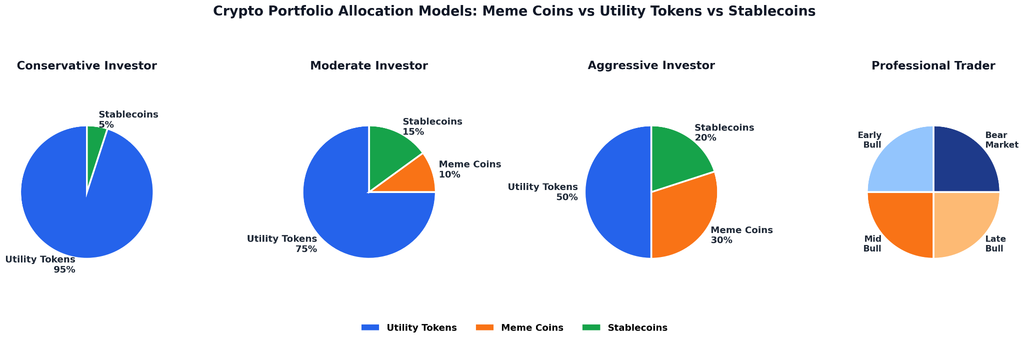
The allocations below are illustrative crypto-only allocations, not age-based financial advice. Even established crypto assets can experience substantial losses.
Investor Profile Matrix
Conservative Investor
- Suggested mix: 95% established utility tokens, 5% stablecoins, 0% speculative tokens.
- Focus on liquid, established assets such as Ethereum and selected infrastructure or DeFi tokens.
- Prioritize capital preservation and liquidity over chasing high-risk meme-coin gains.
Moderate Investor
- Suggested mix: 75% utility, 15% stablecoins, 10% meme/speculative tokens.
- Keep established utility assets as the core while using a smaller allocation for higher-growth opportunities.
- Rebalance when speculative positions become disproportionately large.
Aggressive Investor
- Suggested mix: 50% utility, 20% stablecoins, 30% meme/speculative tokens.
- Accept higher volatility in exchange for greater upside potential.
- Treat new meme launches as speculative positions, not core holdings. Research on Pump.fun highlights the difficulty of predicting which launches will successfully graduate to wider markets.
Professional Trader
- Use a dynamic allocation rather than fixed percentages.
- Increase speculative exposure when liquidity and momentum strengthen; reduce it when volatility, liquidity, or market breadth deteriorate.
- Use on-chain activity, trading volume, liquidity, and market structure to identify rotations.
Risk Assessment
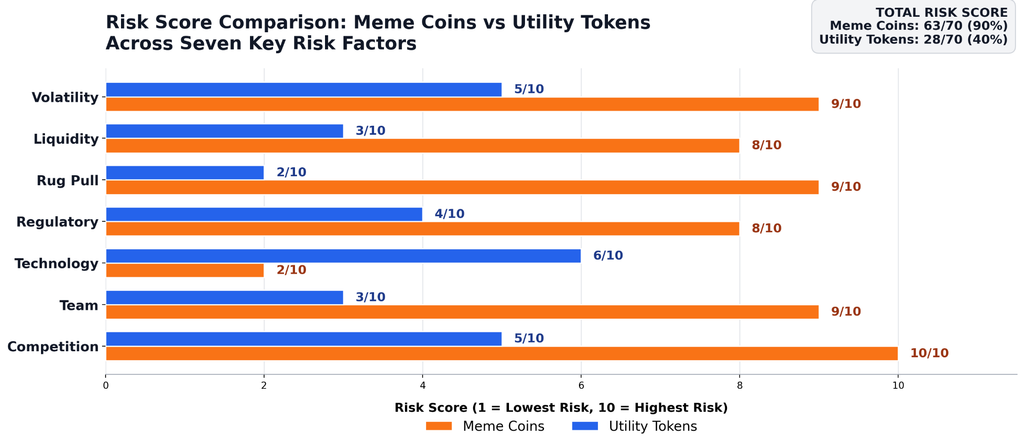
Meme coins generally carry higher volatility, liquidity, concentration, and fraud risks than established utility tokens. Research also finds that established assets such as ETH and SOL have deeper liquidity and greater resilience than many meme coins.
Instead of relying on a fixed “risk score,” assess each token for:
- Liquidity and trading depth
- Holder concentration
- Smart-contract and technology risk
- Team transparency
- Regulatory exposure
- Competitive position
- Evidence of real demand
Do not assume that every failed meme coin is a rug pull. However, the sector has documented abuse: a 2025 Solidus Labs analysis reported that 98.6% of tokens launched on Pump.fun were classified as rug pulls or pump-and-dump schemes.
Tax Considerations
Tax treatment varies by jurisdiction. In the U.S., the IRS digital-asset guidance treats crypto as property, and taxable events can include selling, swapping, spending, and certain staking activities.
For 2026:
- Brokers generally report digital-asset sales on Form 1099-DA.
- Keep detailed records of cost basis, transactions, transfers, and staking income.
- Do not assume the traditional 30-day wash-sale rule automatically applies to every cryptocurrency; current IRS rules specifically address digital assets treated as securities.
- Use tax software or a qualified professional when transaction volume becomes complex.
Rebalancing Strategy
- Early bull market: Favor utility while gradually increasing speculative exposure.
- Mid-cycle: Take partial profits from strong meme-coin rallies and move them into stablecoins or stronger fundamentals.
- Late bull market: Reduce speculative positions and increase liquidity.
- Bear market: Prioritize established projects, maintain larger stablecoin reserves, and accumulate selectively rather than chasing falling tokens.
The goal is simple: use utility tokens as the foundation, meme coins as controlled speculation, and stablecoins as dry powder.
There's no Call To Action with the ID #0.Red Flags & Warning Signs
Not every new token is a scam, but certain patterns should make you slow down before buying. Use on-chain data, contract analysis, and independent verification rather than relying on hype.
Meme Coin Red Flags
1. Anonymous or Unverifiable Team
- Very new social accounts with little genuine activity.
- No verifiable team history, previous projects, or professional profiles.
- Telegram/Discord communities dominated by bots, spam, or unanswered questions.
- Claims that the team will be “doxxed soon” rather than providing verifiable information.
2. Unrealistic Promises
- Guaranteed returns, “100x” claims, or promises that you cannot lose.
- Unverified claims about imminent listings on major exchanges.
- Heavy reliance on celebrity endorsements or influencer hype instead of evidence.
3. Concentrated Ownership
- A small number of wallets control a large share of circulating supply.
- Creator-linked wallets hold substantial amounts that could be dumped.
- Use Etherscan for EVM tokens and Solscan for Solana tokens to inspect holders and wallet activity. Solscan’s 2026 holder analytics also tracks top-10 concentration and whale exposure.
4. Dangerous Contract Controls
- Unlocked liquidity that allows developers to remove funds.
- High or hidden buy/sell taxes.
- Mint functions that allow additional tokens to be created.
- Blacklist, freeze, or other admin functions that can restrict selling.
Read Also: How Crypto Investment Affects You Psychologically
Utility Token Red Flags
1. No Working Product
- No functioning mainnet, testnet, demo, or usable application.
- Inactive GitHub repositories or development that cannot be independently verified.
- Outdated roadmaps that repeatedly postpone key milestones.
2. Weak or Forced Utility
Ask yourself:
- Does the product genuinely need a token?
- Could users use ETH, SOL, stablecoins, or fiat instead?
- Does holding the token provide meaningful access, governance, discounts, or economic value?
If the token mainly exists to raise money, treat it as a major warning sign.
3. Unverifiable Claims
- Alleged partnerships with major companies without confirmation.
- Team credentials that cannot be independently verified.
- No identifiable technical contributors despite ambitious technology claims.
4. Valuation Detached From Adoption
- Extremely high market capitalization with minimal users, revenue, or activity.
- Comparisons with established projects despite having little adoption.
- Aggressive claims about reaching multi-billion-dollar valuations within months.
How to Verify Before Buying
These are the steps to take before buying any assets
- Check holders: Review wallet concentration and creator-linked addresses.
- Inspect contracts: Look for mint, blacklist, freeze, ownership, and tax controls.
- Verify audits: An audit like Certik’s can help identify code vulnerabilities, but it does not guarantee a legitimate project or safe investment.
- Check liquidity: Determine who controls the liquidity and whether withdrawal rights are restricted.
- Measure real usage: Use DeFiLlama to examine TVL, fees, revenue, volume, and protocol activity.
- Verify development: Review GitHub activity, product releases, testnet updates, and technical documentation.
- Test the community: Look for genuine discussions and informed questions rather than repetitive hype.
Bottom line: If a token combines anonymous developers, concentrated ownership, weak liquidity, unverifiable claims, and unrealistic promises, the safest move is usually to walk away.
Tools Worth Using Before You Invest
For meme coins:
- DexScreener or DexTools for live price charts, liquidity depth, and buy/sell activity
- Token Sniffer for scanning smart contracts for hidden mint functions, blacklist capabilities, and honeypot traps
- A block explorer (Etherscan for Ethereum-based tokens, Solscan for Solana-based tokens) to check holder concentration directly
For utility tokens:
- DeFiLlama for Total Value Locked and protocol-level revenue data
- Token Terminal for comparing tokens on financial metrics like revenue and fully diluted valuation
- GitHub for checking whether a project’s code is actually being maintained
Common Myths & Misconceptions
Read these common misconceptions about both utility and meme coins.
Myth #1: “Meme Coins Are a Quick Way to Get Rich”
Reality: Most meme coins fail, and the odds of picking a lasting winner are extremely low. A 2026 study of more than 832,000 Pump.fun launches found that only about 0.2% graduated to the next stage of the platform.
The spectacular gains of coins such as Dogecoin create survivorship bias: investors notice the winners while ignoring thousands of tokens that collapse. Meme coins can deliver outsized returns, but they also carry an unusually high probability of permanent losses.
Myth #2: “Utility Tokens Are Boring and Won’t Pump”
Reality: Utility does not prevent price appreciation. Tokens such as ETH and LINK support active blockchain infrastructure, including staking, smart contract transactions, DeFi, and institutional tokenization.
Utility tokens can still experience sharp rallies and crashes. Their key advantage is that real network demand can provide a fundamental value driver beyond hype.
Myth #3: “Meme Coins Have No Value Because They Have No Utility”
Reality: Utility is not the only source of value. Community, culture, brand recognition, and liquidity can sustain a meme coin. Dogecoin demonstrates how a strong community can survive for years.
However, investors should not confuse established meme coins with the average newly launched token. Research continues to show that most new meme-token launches fail to gain meaningful traction.
Myth #4: “Utility Tokens Are Safe Investments”
Reality: Utility does not equal safety. ETH remains exposed to market volatility, while smart contracts, DeFi protocols, and staking systems can introduce technical and financial risks. Ethereum itself has experienced major drawdowns during previous bear markets. So, “less speculative than a meme coin” does not mean “safe.”
Myth #5: “You Must Choose Meme Coins or Utility Tokens”
Reality: You can hold both, but allocation should reflect your risk tolerance and investment goals.
A diversified crypto portfolio might include:
- Utility-focused assets: Core exposure to established networks and infrastructure.
- Meme coins: Smaller positions for higher-risk, asymmetric opportunities.
- Stablecoins: Liquidity for rebalancing or taking advantage of market opportunities.
There is no universal 80/10/10 formula. The better approach is to size speculative positions so that a total loss does not derail your broader portfolio.
Read Also: Crypto Regulatory Compliance Checklist: Complete 2026 Guide
Regulatory Picture 2026
Crypto regulation is moving toward clearer classifications, stronger consumer protections, and greater scrutiny of speculative tokens. The biggest divide is increasingly between assets with established utility and infrastructure and tokens driven primarily by speculation.
United States: Clearer Token Classifications
The SEC and CFTC made a major shift in March 2026 by introducing a five-part crypto taxonomy covering digital commodities, digital collectibles, digital tools, stablecoins, and digital securities.
Ether (ETH) is expressly classified as a digital commodity rather than a security, although the interpretation is not binding legislation and could still evolve. The guidance also addresses protocol staking and other crypto transactions.
- ETH: Classified as a digital commodity, providing greater regulatory clarity.
- Staking: The SEC’s 2026 interpretation provides clearer treatment for certain protocol-staking activities.
- Other assets: The framework also identifies assets, including Bitcoin, Solana, and XRP, as digital commodities.
- Institutional access: U.S. Ethereum products increasingly incorporate staking exposure, strengthening the connection between crypto infrastructure and regulated financial markets.
The development could create a clearer regulatory pathway for other established blockchain networks, although classification remains dependent on each asset’s characteristics.
Meme Coins and Platform Liability
Meme coins remain a regulatory challenge because their value can depend heavily on social-media attention rather than identifiable utility. The rise of platforms such as Pump.fun has also raised questions about whether platforms should bear responsibility for tokens created and promoted by third parties.
Political and celebrity-backed tokens add another layer of uncertainty. The TRUMP token, for example, has intensified questions about promotional practices, investor expectations, and potential conflicts when public figures are directly associated with token launches.
European Union: MiCA Enters Its Enforcement Phase
The EU’s Markets in Crypto-Assets (MiCA) framework applies broadly from December 30, 2024, while transitional arrangements for some existing crypto-asset service providers run through 2026.
MiCA requires issuers and service providers to meet defined disclosure, conduct, and consumer-protection requirements. ESMA’s 2026 register now tracks crypto-asset white papers, authorized service providers, and non-compliant entities.
- Utility tokens: Projects with clearly defined functions and transparent disclosures have a more straightforward compliance path.
- Meme coins: Projects lacking identifiable issuers, clear objectives, or adequate disclosures face greater regulatory and exchange-listing challenges.
- Exchanges: Greater compliance obligations may encourage platforms to remove assets that create regulatory uncertainty.
Asia-Pacific: Different Paths
Thailand continues to restrict exchanges from listing meme tokens, citing investor protection and market-manipulation concerns.
Hong Kong, meanwhile, is taking a more institutional approach. In 2026, the HKMA updated requirements covering virtual-asset dealing, custody, and portfolio management, while its stablecoin regime provides a regulated framework for digital-asset activity.
What It Means for Investors
The 2026 regulatory direction increasingly favors utility, transparency, and real-world use cases.
- Utility-focused tokens: Better positioned for institutional adoption and regulatory clarity.
- Meme coins: Face greater consumer-protection and disclosure risks.
- Hybrid projects: Tokens such as Shiba Inu may benefit if they can demonstrate sustainable utility beyond speculation.
- Stablecoins: Increasingly receive dedicated regulatory frameworks rather than being treated like ordinary utility or meme tokens.
- Global divergence: Investors must still account for significant differences between U.S., EU, and Asian markets.
Overall, 2026 is shifting crypto regulation from broad uncertainty toward clearer asset classifications and stricter standards for speculative projects
There's no Call To Action with the ID #0.Final Thoughts
Meme coins and utility tokens will keep pulling at new investors from opposite directions. One promises fast, thrilling gains built on nothing but attention. The other offers slower, steadier growth built on real usage and revenue.
Neither path is wrong, but pretending they’re the same thing is how people lose money. The real skill in meme coins vs utility tokens isn’t picking a winner. It’s knowing exactly what you’re holding, why its price moves the way it does, and how much of it you can afford to lose.
Build your foundation with researched utility tokens. Save a small, honest slice for meme coin bets. Then let the data, not the hype, guide every decision from here.
Frequently Asked Questions
What is the main difference between meme coins and utility tokens?
Meme coins get their value from community attention and hype, with no built-in function on a blockchain. Utility tokens get their value from an actual job they perform, like paying network fees or accessing a service, which ties their price to real usage and, often, real revenue.
Can I make money with meme coins?
Yes, some people have. Dogecoin’s 12-year run and the early days of tokens like Dogwifhat prove real gains are possible. But the odds are heavily stacked against you: independent analysis found that 98.6% of tokens launched on the Pump.fun platform were scams or collapsed into worthless pump-and-dump schemes. Only invest money you can fully afford to lose.
Are utility tokens safer than meme coins?
They’re generally lower risk, since their price is connected to measurable usage and revenue rather than pure sentiment. But “lower risk” doesn’t mean “safe.” Even Ethereum has dropped around 80% during past bear markets, and smart contract bugs have drained DeFi protocols before. All cryptocurrency remains a high-risk asset class.
Should beginners start with meme coins or utility tokens?
Most financial educators recommend beginners build their crypto knowledge and portfolio around established utility tokens first, since their price behavior is more connected to real-world factors you can research and understand. Meme coins can be added later, in small amounts, once you’re comfortable with how fast and unpredictably they move.
Check our guide to cryptocurrency trading strategies for a beginner-friendly starting point, or explore live pricing on the UEEx trading platform to see how both categories move in real time.
Disclaimer: This content is for educational purposes only and is not financial advice. Both meme coins and utility tokens carry a real risk of total capital loss. Only invest money you can afford to lose completely. UEEx.com provides educational content and is not liable for investment losses.