WordPress database error: [You have an error in your SQL syntax; check the manual that corresponds to your MariaDB server version for the right syntax to use near '' at line 1]SELECT * FROM wp_mica_ecta WHERE cta_id =
WordPress database error: [You have an error in your SQL syntax; check the manual that corresponds to your MariaDB server version for the right syntax to use near '' at line 1]SELECT * FROM wp_mica_ecta WHERE cta_id =
WordPress database error: [You have an error in your SQL syntax; check the manual that corresponds to your MariaDB server version for the right syntax to use near '' at line 1]SELECT * FROM wp_mica_ecta WHERE cta_id =
WordPress database error: [You have an error in your SQL syntax; check the manual that corresponds to your MariaDB server version for the right syntax to use near '' at line 1]SELECT * FROM wp_mica_ecta WHERE cta_id =
WordPress database error: [You have an error in your SQL syntax; check the manual that corresponds to your MariaDB server version for the right syntax to use near '' at line 1]SELECT * FROM wp_mica_ecta WHERE cta_id =
In 2025, crypto exchanges alone paid more than $927 million in anti-money laundering penalties in the United States, out of over $1.1 billion in total AML enforcement across the financial sector, according to the Institute for Financial Integrity.
The single biggest hit came from OKX, which pleaded guilty to running an unlicensed money-transmitting business and paid more than $504 million. Binance had already paid $4.3 billion two years earlier for similar failures.
That’s the backdrop crypto businesses are operating in today. 2025 and 2026 brought three of the biggest regulatory shifts the industry has ever seen. The EU’s Markets in Crypto-Assets (MiCA) framework became fully binding.
Also, the EU’s Digital Operational Resilience Act (DORA) rules put cybersecurity and IT resilience under direct regulatory watch. And in the US, the GENIUS Act created the country’s first-ever federal law for stablecoins, complete with criminal penalties for bad actors.
There's no Call To Action with the ID #0.If you run a crypto business or you’re planning to launch one, this guide walks through exactly what a proper crypto regulatory compliance checklist looks like in 2026: what to register, what to build, what to document, and roughly what it costs. We’ll also look at real enforcement cases so you can see what happens when firms skip these steps.
Read Also: Regulatory Frameworks for Cryptocurrencies Market
Key Takeaways
- Compliance opens doors. It’s what gets you banking access, exchange listings, and institutional investors. Treat it as a growth requirement, not a cost center.
- Start with the basics, then scale. Every crypto business needs KYC, AML, and business registration from day one. Add jurisdiction-specific licenses as you grow.
- Where you operate changes everything. The US can require licenses in more than 40 states one by one. The EU lets you apply once and operate across all 27 member states.
- Software isn’t optional anymore. Manual compliance checks don’t hold up once you’re processing real volume. You need identity verification tools, blockchain monitoring, and Travel Rule software.
- Hire someone to own it. A part-time or unofficial compliance role doesn’t survive an audit. Bring in a real compliance officer early.
What Is Crypto Regulatory Compliance?
| Crypto regulatory compliance means following the laws that govern how crypto businesses operate. That includes verifying who your customers are (KYC), watching for money laundering (AML), registering for the right licenses, sharing transaction data under the Travel Rule, and meeting country-specific rules like MiCA in the EU or the GENIUS Act in the US. |
Getting this right protects your business from fines that can reach into the hundreds of millions of dollars. It also keeps your bank accounts open, keeps your tokens listed on major exchanges, and makes your company fundable.
As of 2026, real compliance means registration, ongoing monitoring, regular reporting, and security controls, all running at the same time, often across several countries at once.
“Regulators are no longer treating crypto as a gray area. They’re applying the same playbook they use on banks, and the fines prove it.”
Why This Actually Matters to Your Business
The fines are no longer theoretical
MiCA violations can cost up to €5 million or a percentage of annual turnover depending on the breach. DORA violations can reach 2% of a firm’s total worldwide annual turnover. In the US, Securities and Exchange Commission (SEC) and Commodity Futures Trading Commission (CFTC) fines have no fixed ceiling.
Banks will drop you
Firms without a documented compliance program routinely get rejected or cut off by banking partners. This is one of the most common reasons crypto startups fail: not because the business idea was bad, but because they couldn’t keep a bank account.
Exchanges won’t list you
Coinbase, Kraken, and other major platforms now run compliance reviews before listing new tokens or partnering with new firms. Weak compliance history is a fast way to get rejected.
Institutions won’t touch you
Pension funds, hedge funds, and family offices have compliance requirements of their own. They can’t invest in or partner with a crypto firm that doesn’t meet baseline standards.
Executives can now go to prison
The GENIUS Act introduced criminal penalties for issuers who mislead the public about their stablecoins, for example, falsely claiming a token is government-backed or federally insured. That liability lands on individual executives, not just the company.
What Non-Compliance Actually Costs
Here’s what happened to firms that didn’t take this seriously:
| Company | What Happened | Penalty |
| Binance | Pleaded guilty to Bank Secrecy Act violations, unlicensed money transmission, and sanctions violations (Nov 2023) | $4.3 billion, plus CEO resignation and a five-year compliance monitor |
| OKX | Pleaded guilty to operating an unlicensed money transmitting business (Feb 2025) | $504 million, plus a compliance monitor through 2027 |
| Coinbase Europe | Fined by the Central Bank of Ireland for AML and transaction monitoring failures (Nov 2025) | €21.5 million |
“Growth at all costs isn’t a strategy anymore. It’s the fastest way to end up in a DOJ press release.”
The Three-Tier Compliance Framework
Before you go into individual rules, it helps to see the overall shape of crypto compliance. It generally breaks into three layers.
Tier 1: The Basics Every Crypto Business Needs
No matter where you operate or what you offer, you need:
- A KYC/AML program: Verify customer identity with government ID and proof of address. Identify beneficial owners who hold more than 25% of a business customer. Apply extra scrutiny to high-risk customers like politically exposed persons. Monitor accounts on an ongoing basis and file suspicious activity reports when something looks wrong.
- Proper business registration: Form a legal entity, get your tax IDs, and register with the right regulator (an MSB in the US, a CASP in the EU, a VASP elsewhere).
- Travel Rule compliance: Collect and share sender and recipient information for qualifying transfers and use a secure system to send that data to the receiving platform.
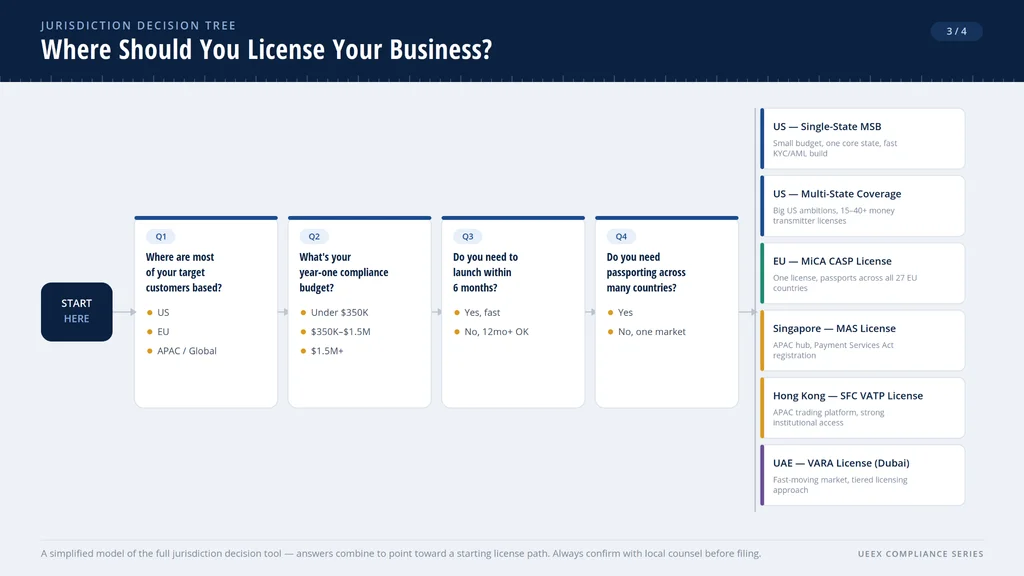
Tier 2: Rules That Depend on Where You Operate
United States
- FinCEN registration as a money services business
- State money transmitter licenses, often required in 40+ states individually
- SEC registration if you deal in security tokens
- CFTC registration if you offer derivatives or commodity-linked products
- GENIUS Act licensing for stablecoin issuers
European Union
- MiCA authorization as a Crypto-Asset Service Provider
- White paper filings for significant token launches
- Full reserve backing for stablecoins (asset-referenced and e-money tokens)
- DORA compliance for IT risk management and incident reporting
- Travel Rule compliance under the EU’s Transfer of Funds Regulation
Asia-Pacific and the Middle East
- Singapore: licensing through the Monetary Authority of Singapore under the Payment Services Act
- Hong Kong: licensing through the Securities and Futures Commission for virtual asset trading platforms
- Japan: registration with the Financial Services Agency
- UAE (Dubai): licensing through the Virtual Assets Regulatory Authority (VARA)
Tier 3: Rules Specific to What You Actually Do
- Exchanges need market surveillance systems, segregated customer funds, and controls against manipulation.
- Custodians need qualified custody arrangements, insurance, strong key management, and regular proof-of-reserves audits.
- Stablecoin issuers need full reserve backing, monthly attestations, and clear redemption processes.
- DeFi protocols need smart contract audits and clarity on whether their level of control triggers VASP-style obligations. For a deeper look at protocol-level risk, see our crypto risk management guide.
Step-by-Step Crypto Compliance Checklist
This is the core of the guide. Work through these four phases in order.
Phase 1: Assessment and Planning
Step 1: Figure out what you actually are
Are you an exchange, a custodian, an issuer, or a DeFi protocol? In the US, this decides whether the SEC or CFTC has jurisdiction over you (regulators apply the Howey Test to figure out if a token is a security). Meanwhile, in the EU, it determines which CASP service category you fall under.
Step 2: Map every jurisdiction that touches your business
Where are you incorporated? Where do your customers live? Where are your founders and key staff based? Each of these can trigger separate obligations. Build a simple table listing US federal rules, US state rules, EU rules, and any Asia-Pacific rules that apply to you.
Step 3: Run a gap analysis
Write down what you’ve already completed, what’s in progress, and what’s missing entirely. Rank the gaps by deadline pressure and enforcement risk, then estimate cost and time for each one.
There's no Call To Action with the ID #0.Phase 2: Core Compliance Implementation
Business Registration and Licensing
US Firms: If your business qualifies as a money services business (MSB), register with the Financial Crimes Enforcement Network (FinCEN) using FinCEN Form 107 within 180 days of establishment. Federal MSB registration is free, but you may incur legal and compliance costs.
You’ll also need state money transmitter licenses where required, with each state imposing its own application, bonding, capital, and compliance requirements. Nationwide licensing can therefore become costly and take months or longer to complete.
EU Firms: Under MiCA, crypto-asset service providers (CASPs) generally need authorization from the regulator in their home EU member state. Minimum capital requirements range from €50,000 to €150,000, depending on the services offered, while prudential safeguards must also account for 25% of fixed overheads.
Applicants need strong governance, business, risk, recovery, AML/CFT, and operational plans. Once authorized, a CASP can generally provide its approved services across the EU through MiCA’s passporting framework, making the region more centralized than the U.S. state-by-state licensing model.
Building a Real KYC/AML Program
Pick a KYC provider (Sumsub, Onfido, Jumio, and Chainalysis are common choices) and set up identity checks:
- Individuals: government ID, a selfie match, and proof of address
- Businesses: incorporation documents and identification for any owner holding more than 25%
Sort customers into risk tiers. Low-risk customers might just need standard checks. High-risk customers, like politically exposed persons or anyone moving very large sums, need enhanced due diligence: proof of where their money came from, tighter transaction monitoring, and more frequent reviews.
Build your suspicious activity report process before you need it. Know what triggers a report (structuring transactions to dodge thresholds, money that moves in and immediately back out, and patterns that don’t match a customer’s profile), know who has authority to file, and never tip off the customer that a report was filed.
“The firms that get hit hardest aren’t the ones with no compliance program. They’re the ones with a compliance program that only exists on paper.”
Travel Rule Compliance
Choose a Travel Rule provider such as Notabene or Sygna and integrate it with your transaction system. Configure thresholds based on the jurisdictions you serve: The Financial Action Task Force (FATF) allows a de minimis threshold of up to USD/EUR 1,000, while local rules may impose stricter requirements.
Collect the originator’s name, address, and account identifier during deposits and withdrawals, and verify that the receiving platform is a regulated or registered VASP before transferring funds. Budget roughly $10,000–$50,000 for implementation, plus $500–$5,000 per month for ongoing costs.
Phase 3: Jurisdiction-Specific Requirements
MiCA Checklist (European Union)
For Crypto-Asset Service Providers:
- Submit your application to your home country’s national regulator
- Show you have the required minimum capital
- Provide a business plan covering your customers, services, tech setup, and finances
- Document your governance structure and internal controls
- Provide a wind-down plan
- Show your AML and KYC program meets the standard
- Keep client assets separate from company assets
- Carry professional indemnity insurance
- Pass the “fit and proper” check for your leadership team
For stablecoin issuers:
- Back your token 100% with qualifying reserve assets
- Publish a white paper covering reserve makeup and redemption rights
- Get monthly reserve attestations from an independent auditor
- Let holders redeem at par value at any time
- Use a custodian with segregated accounts
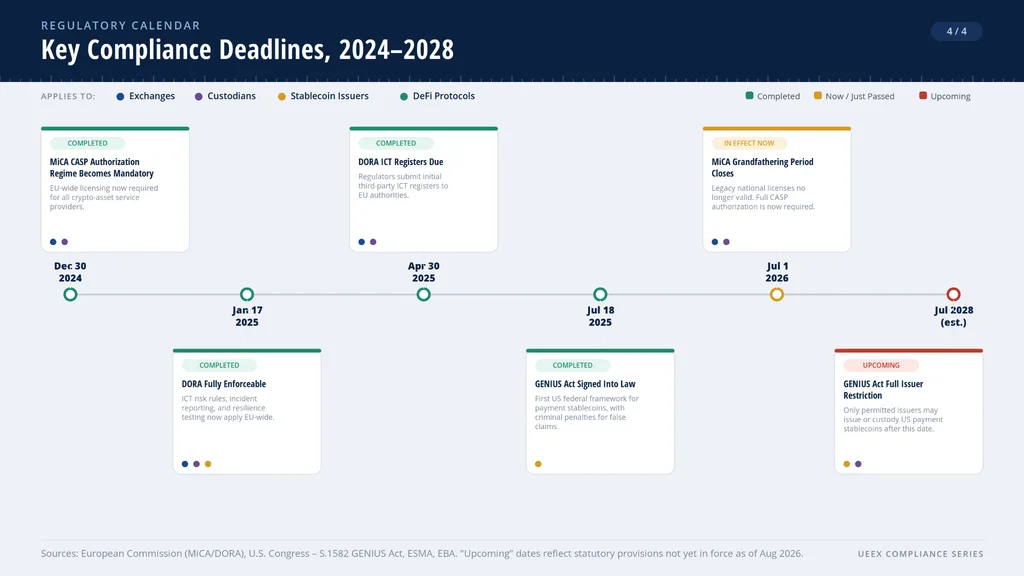
Note that MiCA’s full CASP authorization regime became mandatory on December 30, 2024, and the transitional grandfathering window that let existing providers keep operating without a license closed on July 1, 2026.
If you’re serving EU customers now, you need an actual CASP license, not a legacy registration.
There's no Call To Action with the ID #0.GENIUS Act Checklist (US Stablecoins)
The GENIUS Act, signed into law on July 18, 2025, is the first federal US law built specifically for payment stablecoins. It sets up two paths:
- If your stablecoin’s market cap stays under $10 billion, you can pursue a state-level license
- If it grows past $10 billion, you need a federal license from the OCC, the Federal Reserve, or the NCUA
- Back your token 100% with eligible reserves only: US dollar deposits, short-term Treasuries (90 days or less), qualifying repos, or approved money market funds
- Keep reserves in a bankruptcy-remote structure, separate from your core business
- Publish monthly reports on reserve composition
- Offer redemption to every holder
- Make sure stablecoin holders get priority if the issuer goes bankrupt
- Build KYC/AML and OFAC sanctions screening into your operations from day one
One detail worth flagging: the Act bars issuers from paying interest or yield directly to stablecoin holders, which reshapes how many product teams were planning to design their tokens.
DORA Checklist (EU Financial Entities, Including Crypto Firms)
DORA has been enforceable since January 17, 2025, and it applies to crypto firms operating in the EU, not just traditional banks.
- Put your board formally in charge of IT risk oversight
- Build a complete inventory of your tech systems, software, and data
- Run risk assessments at least once a year
- Put real protections in place: access controls, encryption, network segmentation
- Set up detection tools like intrusion monitoring and centralized logging
- Write incident response and disaster recovery plans
- Report major incidents fast: an initial alert within hours, a detailed follow-up within 72 hours, and a final report within a month
- Run regular vulnerability scans and penetration tests
- Keep a full register of every third-party tech vendor you rely on, with contracts that include audit rights and exit terms
DORA penalties can reach up to 2% of a firm’s total worldwide annual turnover, with individual fines against senior managers of up to €1 million. For the security side of this, our crypto security best practices guide goes deeper into the technical controls regulators expect to see.
Phase 4: Running Compliance Day-to-Day
Transaction Monitoring and Sanctions Screening
Connect a blockchain analytics tool (Chainalysis, Elliptic, and TRM Labs are the main players) to flag mixing services, high-risk exchanges, sanctioned wallet addresses, and dark web activity.
Screen every customer and transaction against the Office of Foreign Assets Control (OFAC) sanctions list, EU and UN sanctions lists, and country-specific restrictions, both at onboarding and continuously afterward.
Watch for the classic red flags: transactions structured just under reporting thresholds, funds that arrive and leave almost instantly, suspiciously round amounts, or activity that doesn’t match a customer’s profile, like a student account suddenly moving six figures.
Record Keeping
Keep customer records for at least five years after an account closes. Keep transaction records for five years from the transaction date. Store everything with encryption, strict access controls, and regular backups. When a regulator comes knocking, you need to produce these records fast.
Building the Compliance Team
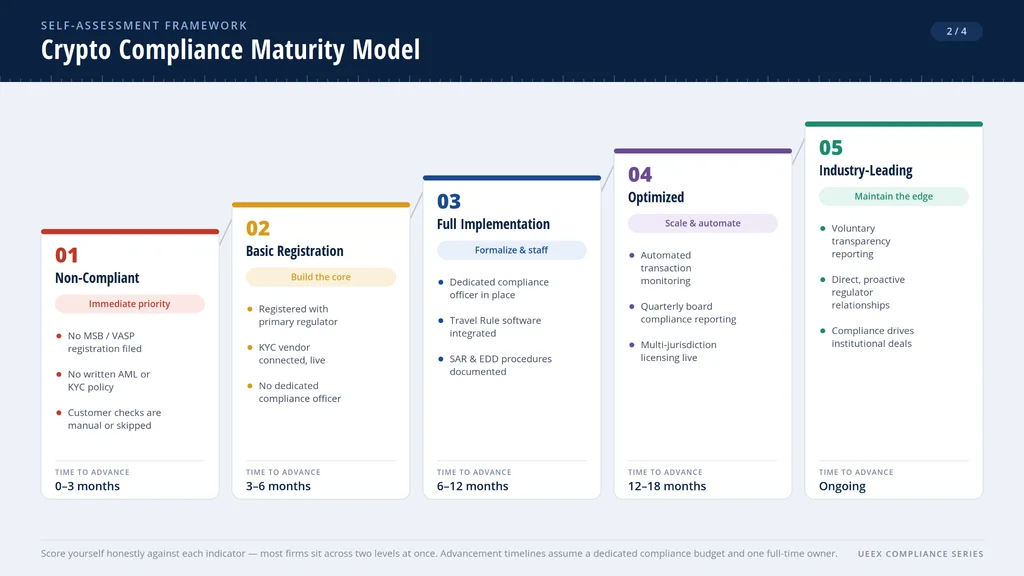
A chief compliance officer isn’t optional once you’re operating at any real scale. Look for someone with several years of financial services compliance experience, ideally with crypto-specific exposure, and give them real authority: the ability to freeze transactions or close accounts when something looks wrong and a direct line to the board.
Staffing scales with size. A small startup might get by with one or two compliance staff, often supplemented by outside consultants. However, a mid-size firm typically needs a team of three to eight, while larger, high-volume platforms often run compliance teams of dozens.
Training
Every new hire needs onboarding training on your compliance policies. Everyone needs a refresher at least once a year, with extra depth for customer-facing and senior roles. Cover the basics: how to spot red flags, how sanctions screening works, how the Travel Rule applies to your daily job, and how to protect customer data. Track completion and test understanding; don’t just send a slide deck and hope people read it.
What This Actually Costs
Compliance budgets swing wildly based on two things: how many jurisdictions you touch, and how many US states you need licenses in. Below is a breakdown by company size, then a look at where the money actually goes.
Early-Stage Firms (Under $5 Million in Annual Revenue)
Initial setup typically runs $150,000 to $350,000, with ongoing annual costs of $200,000 to $500,000.
At this stage, most firms operate in one or two jurisdictions and keep the team small, often just one compliance hire supported by outside consultants. Here’s roughly how the initial setup budget breaks down:
- FinCEN MSB registration and legal review: $5,000 to $15,000
- State money transmitter licenses (a handful of states, not all 50): $30,000 to $150,000, including surety bonds
- KYC/AML software setup: $10,000 to $40,000
- Travel Rule software setup: $10,000 to $50,000
- Legal fees for policy drafting and entity structuring: $40,000 to $80,000
- First-year compliance officer salary (often part-time or fractional): $60,000 to $120,000
Cost-saving tip: Many early-stage firms start in a single, well-established jurisdiction (a specific EU country under MiCA, or a handful of crypto-friendly US states) rather than trying to cover every market on day one. This cuts the license bill dramatically and still lets you build a track record before expanding.
Mid-Market Firms ($5 Million to $50 Million in Annual Revenue)
Initial setup runs $350,000 to $1.5 million, with annual costs of $500,000 to $2.5 million.
At this size, most firms are operating in multiple US states or have gone through full MiCA authorization, and the team has grown past a single compliance hire. A typical breakdown:
- State money transmitter licenses (broader coverage, 15 to 30+ states): $150,000 to $600,000
- MiCA CASP authorization, if applicable: €200,000 to €800,000
- Blockchain analytics and sanctions screening tools: $25,000 to $150,000 a year
- Compliance team of 3 to 8 people: $400,000 to $1.2 million a year in salaries
- Outside legal counsel on retainer: $60,000 to $200,000 a year
- Compliance and cyber insurance premiums: $30,000 to $100,000 a year
- Independent audits and reserve attestations (for stablecoin issuers): $50,000 to $200,000 a year
Cost-saving tip: This is the stage where firms often overspend on redundant tools, running two KYC vendors or two blockchain analytics platforms because of an acquisition or a rushed vendor choice. A consolidation review once a year can save six figures without cutting coverage.
Enterprise Firms (Over $50 Million in Annual Revenue)
Initial setup can exceed $1.5 million, sometimes reaching $10 million or more, with annual costs from $2.5 million upward.
At this scale, firms are usually licensed across most US states, hold a MiCA license, and often carry licenses in Singapore, Hong Kong, or the UAE too. Costs concentrate in three areas:
- Full multi-jurisdiction licensing (all major US states plus MiCA plus at least one APAC license): $2 million to $5 million combined, plus ongoing renewal fees
- A compliance team of 10 to 50+ people, often including dedicated Travel Rule, sanctions, and licensing specialists: $2 million to $8 million a year in salaries
- Enterprise-grade blockchain analytics, case management, and monitoring platforms: $500,000 to $2 million a year
- Independent compliance monitors, when required as part of a settlement: several million dollars a year, on top of everything else
Cost-saving tip: At this scale, the biggest lever isn’t cutting spend; it’s avoiding an enforcement action in the first place. A $2 million-a-year compliance program is far cheaper than a $500 million settlement plus a court-ordered monitor, which is exactly what happened to both OKX and Binance.
Quick Comparison Table
| Company Size | Initial Setup | Annual Ongoing Cost | Typical Team Size |
| Early-stage (under $5M revenue) | $150,000 to $350,000 | $200,000 to $500,000 | 1 to 2 people |
| Mid-market ($5M to $50M revenue) | $350,000 to $1.5 million | $500,000 to $2.5 million | 3 to 8 people |
| Enterprise (over $50M revenue) | $1.5 million to $10 million+ | $2.5 million upward | 10 to 50+ people |
Hidden Costs Firms Often Miss
A few expenses regularly catch founders off guard because they don’t show up in the initial license fee:
- Annual renewals: Most licenses aren’t one-time purchases. State money transmitter licenses, MiCA authorization, and VASP registrations all need renewal, usually every year, with their own paperwork and fees.
- Surety bond costs that scale with volume: Some states tie bond requirements to transaction volume, so your bond costs can climb as your business grows, not just at launch.
- Audit and attestation fees: If you issue a stablecoin or hold customer funds, independent monthly or quarterly attestations aren’t optional, and the cost adds up over a year.
- Software price increases: KYC and blockchain analytics vendors often price per verification or per transaction, so costs scale with growth in ways that are easy to underestimate in early projections.
- Legal fees for regulatory changes: Rules like MiCA and DORA get updated through technical standards and delegated acts even after the main law takes effect. Budget for ongoing legal review, not just a one-time reading of the law.
These ranges vary a lot depending on how many jurisdictions you’re in and how many state licenses you need. A firm that only operates in one EU country under a single CASP license will spend far less than one chasing 40+ US state licenses at once.
Recent Enforcement Cases Worth Learning From
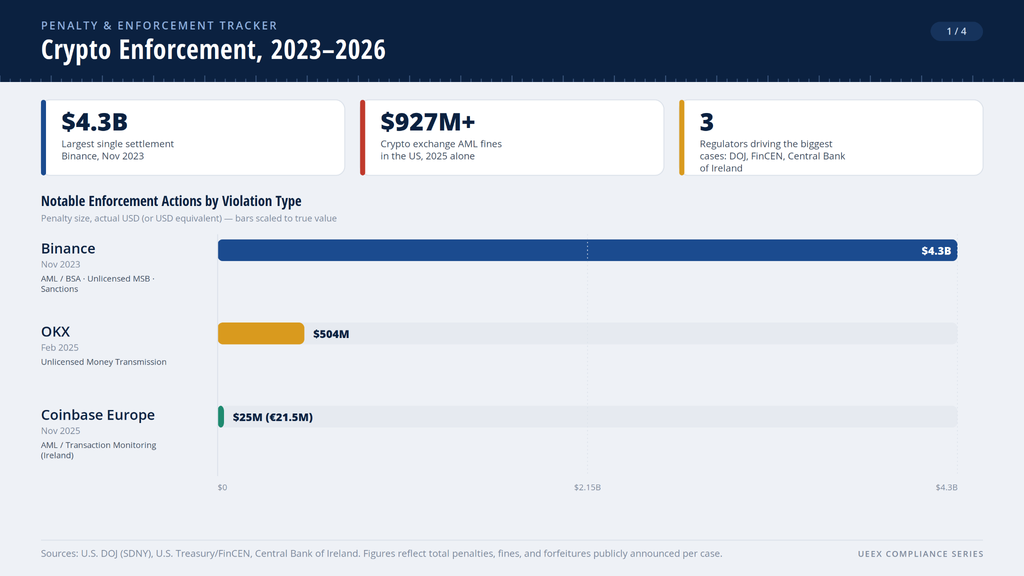
Below are some enforcement cases you should learn from
OKX (February 2025)
OKX pleaded guilty in a New York federal court to operating an unlicensed money-transmitting business. Despite its policy banning U.S. customers, OKX knowingly allowed Americans to access and trade on the platform, including through VPNs, for years.
The DOJ said the exchange facilitated more than $5 billion in suspicious transactions and agreed to pay over $504 million, which is about $84.4 million in fines and $420.3 million in forfeiture. OKX must also retain an external compliance consultant through February 2027.
The lesson is clear: a compliance policy means little if you do not enforce it. Ignoring known violations can turn a written rule into evidence that the company knew the risks and failed to act.
Binance (November 2023)
In November 2023, Binance pleaded guilty to violating the Bank Secrecy Act, operating an unlicensed money-transmitting business, and violating U.S. sanctions laws. The exchange agreed to pay $4.3 billion in penalties and forfeiture, while founder Changpeng Zhao pleaded guilty to AML violations and stepped down as CEO.
Binance also accepted an independent compliance monitor and agreed to strengthen its compliance controls. The DOJ described the resolution as one of the largest corporate penalties it had ever obtained in a criminal case.
Coinbase Europe (November 2025)
The Central Bank of Ireland fined Coinbase Europe €21.46 million for AML and transaction-monitoring failures between 2021 and 2025. More than 30 million transactions worth over €176 billion were improperly monitored.
Confirmed by the High Court in January 2026, the case marked the Central Bank’s first enforcement action against a crypto firm, underscoring that major exchanges face the same strict compliance expectations as traditional financial institutions.
Common Pitfalls and How to Avoid Them
Avoid these common mistakes by planning early, budgeting realistically, and treating compliance as a core business function.
There's no Call To Action with the ID #0.1. Underestimating the Timeline
Licensing rarely happens overnight. US money transmitter licensing can involve multiple state applications, while MiCA authorization requires extensive documentation covering governance, capital, risk management, AML controls, ICT security, and client-asset segregation.
Avoid delays by:
- Starting the licensing process well before launch.
- Building time for regulator questions and requests for additional documents.
- Confirming each jurisdiction’s requirements before submitting applications.
For MiCA, the regulatory process has become particularly time-sensitive: the EU transitional period ended on July 1, 2026, meaning unauthorized CASPs generally must stop providing crypto-asset services to EU clients.
2. Underbudgeting Compliance Costs
The application fee is only part of the cost. Businesses may also face legal and consulting fees, surety bonds, regulatory renewals, compliance software, audits, cybersecurity controls, and ongoing reporting expenses.
Build a realistic budget that includes:
- Licensing and renewal fees
- Legal and regulatory consulting
- Compliance and monitoring software
- Audit, cybersecurity, and insurance costs
- A 20–30% contingency reserve for unexpected expenses
3. Treating Compliance as a Side Job: What AI and Crypto Mean for Work, Money, and Privacy
Compliance should not become an afterthought as the business grows. Regulators expect firms to maintain effective governance, risk controls, AML procedures, and appropriately qualified management. MiCA applications, for example, require detailed information on governance, internal controls, risk management, and management competence.
Instead:
- Assign clear ownership of compliance.
- Appoint qualified compliance leadership as regulatory obligations grow.
- Scale the compliance team alongside transaction volume, customers, and jurisdictions.
4. Maintaining Weak Documentation
A strong compliance program is only useful if you can prove how it operates. Regulators expect documented policies, procedures, controls, and decision-making processes.
Maintain:
- Written AML/KYC and risk-management policies
- Compliance reviews and approval records
- Training and monitoring logs
- Clear audit trails
- Documented decisions, exceptions, and their rationale
Good documentation makes regulatory examinations easier and helps demonstrate that compliance controls operate consistently, not just on paper.
If you’re weighing where to list, trade, or hold assets, our guide on how to choose the best crypto exchanges covers what to check before you commit.
There's no Call To Action with the ID #0.Conclusion
Crypto regulatory compliance in 2026 isn’t a box to check once and forget. It’s an ongoing practice that shifts every time MiCA, DORA, or the GENIUS Act gets a new technical standard or delegated act.
As a result, the firms that treat compliance as core infrastructure, not an afterthought, are the ones still standing while others pay nine-figure settlements or lose their financial institution access overnight.
Start with the basics: register properly, build real KYC and AML controls, and get your Travel Rule setup working before volume forces your hand. Then layer in the jurisdiction-specific rules that apply to you.
Use the checklist above as your working document, revisit it quarterly, and bring in expert legal counsel before you file anything that carries personal liability.
Frequently Asked Questions
How much does crypto compliance cost?
Costs vary by size and jurisdiction, but a small crypto business should expect $150,000 to $350,000 for initial setup and $200,000 to $500,000 a year to maintain it. Larger firms operating across multiple countries or many US states can spend several million dollars a year.
Do I need a license to start a crypto exchange?
Yes, in almost every major market. In the US, you’ll generally need FinCEN registration plus state money transmitter licenses. In the EU, you’ll need CASP authorization under MiCA. Operating without the right license can lead to criminal charges, as seen in the OKX and Binance cases.
What is the Travel Rule, and do I need to follow it?
The Travel Rule requires crypto platforms to collect and share sender and recipient information on transfers above a certain amount. If you operate as an exchange, custodian, or any other business that moves crypto on behalf of customers, it applies to you. The threshold is $1,000 under the FATF standard, $3,000 in the US, and effectively zero in the EU.
How long does it take to become fully compliant?
For a single-jurisdiction license, plan for 6 to 12 months. For a business spanning the US, EU, and Asia-Pacific, full compliance can take 18 months to 2 years, since licenses often can’t be pursued in parallel and each one has its own review timeline.
Disclaimer: This article is for educational purposes only and isn’t legal, compliance, or financial advice. Crypto regulations vary by jurisdiction and change often. Always talk to a qualified lawyer and compliance professional about your specific business before making decisions. UEEX makes no guarantees about the completeness of the information above. Failing to comply with applicable laws can lead to criminal charges, major fines, license loss, and reputational harm. Do your own research and get professional advice before acting.