Friday night, 11 PM. Some guy in a Discord server deploys a meme coin called $GOATHOUSE, does absolutely nothing after that, and quietly pockets 0.3% every time someone else trades it.
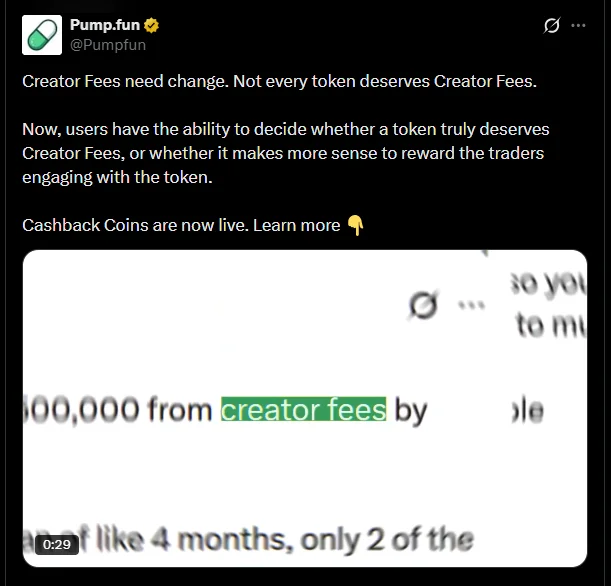
That arrangement just ended. Pump.fun Introduces Cashback Coins, a permanent, on-chain option that reroutes that entire creator cut straight to the traders doing the actual work.
Key Takeaways
Cashback Coins let token creators permanently choose to redirect fees to traders and holders instead of keeping them.
The choice between Trader Cashback and Creator Fees is locked on-chain and cannot be changed after launch.
Cashback Coins apply only to new tokens and do not support community takeover (CTO) mechanisms.
Trader rewards encourage higher trading activity but do not strengthen liquidity or long-term token stability.
The update aims to address criticism of low-effort launches and align incentives with market participation rather than deployer entitlement.
What Are Pump.fun Cashback Coins?
Pump.fun Cashback Coins are a token launch option that permanently redirects 100% of the standard 0.3% creator trading fee to traders and holders instead of the token deployer.
Introduced on February 17, 2026, the feature gives creators a binary choice at launch: keep the traditional Creator Fee structure, or select Trader Cashback which routes all fee revenue to the people trading the token.
Once selected, the decision is locked on-chain forever and cannot be reversed.
Cashback Coins also do not support community takeovers (CTOs), which are a governance mechanism that traditionally allows users to assume control of a token’s fee distribution after launch.
Traditionally on Pump.fun, token deployers automatically receive a share of trading fees—a 0.3% creator cut every time their token changes hands.
This fee model was positioned as a way for builders to fund community growth, development, and long‑term engagement. But as memecoin speculation ballooned over the past year, that logic has come under intense scrutiny.
Under the Cashback Coins mechanism, creators must choose one of two irreversible fee structures before launching:
Creator Fees: the familiar model, where deployers retain the fee revenue.
Trader Cashback: a system where 100% of what would have been creator fees is redistributed to traders and token holders instead.
Once a choice is locked in on‑chain, it cannot be changed. Unlike traditional creator‑fee tokens, tokens launched as Cashback Coins also cannot undergo community takeovers (CTOs), a governance path that typically lets users assume control of fee distribution.
This lock applies in both directions, Creator Fee coins are equally permanent in their structure. A token launched under the traditional Creator Fee model also cannot later be converted to Cashback.
The binary choice is a one-time, irreversible decision regardless of which path a creator selects.
This binary decision is now a standard part of the creation flow on both the Pump.fun website and mobile app. Participants who opt for Trader Cashback can claim their earned rewards through a dedicated rewards section.
The cashback isn’t split equally among all holders.
Distribution is weighted by trading activity, higher-volume traders earn proportionally more from the fee pool than passive holders.
This creates a self-reinforcing dynamic: more trading generates more cashback, which incentivizes more trading, which increases the token’s visibility and volume.
DEXTools has described this as a potential positive flywheel effect, though it’s worth noting that the same dynamic can accelerate a token’s decline just as quickly if volume fades, the rewards dry up alongside the activity that generated them.
Can a Creator Switch From Cashback Coins to Creator Fees Later?
No — the choice is permanent and cannot be changed after launch.
Once a token is deployed on Pump.fun with either the Cashback or Creator Fee model selected, that structure is locked on-chain.
This applies in both directions: a Cashback Coin cannot be converted to a Creator Fee token, and a Creator Fee token cannot be retroactively changed to Cashback.
The feature applies only to newly launched tokens existing tokens already live on Pump.fun are not affected by the update and remain on whatever fee structure they launched with.
Why the Change?
Pump.fun’s announcement framed the update as a response to growing criticism that creator fees too often benefited deployers who added little beyond deploying a contract.
Many memecoin projects gain traction strictly through trading momentum and social hype, without active teams, roadmaps, or real utility.
Redirecting fee revenue to traders is meant to address this perceived imbalance by letting market activity dictate who earns.
Reports show that Pump.fun’s fee revenue has slumped sharply year‑over‑year. In January 2026, the platform brought in roughly $31.8 million in fees—down about 75% from January 2025.
The trajectory since hasn’t improved. February 2026 revenue was tracking at approximately $15.6 million at the time of this announcement putting the platform on pace to fall below January’s already reduced figure.
The combined pressure of declining fee revenue and an increasingly skeptical community appears to have accelerated the timeline for this structural change.
This drop in revenue comes amid broader memecoin market contraction and a record level of project failures across the crypto ecosystem.
By making trader rewards an explicit, on‑chain option, Pump.fun appears to be aligning incentives more closely with market engagement rather than creator entitlement.
In its own words, not every token deserves creator fees, and now the market itself decides which tokens should carry that burden.
The announcement immediately reverberated across crypto markets.
Trading activity for Pump.fun’s native token PUMP jumped sharply, spot volume surpassed $110 million in a 24‑hour period, a roughly 56% increase from the prior day.
Open interest in futures markets also ticked up, reflecting renewed trader interest.
Despite this surge in activity, the broader memecoin market of which Pump.fun is a bellwether—remains challenged.
The scale of that failure rate is the backdrop against which Pump.fun’s announcement lands: an ecosystem where the overwhelming majority of launched tokens collapse, yet deployers were still collecting fees regardless of outcome.
The market didn’t wait for analysis. Within 24 hours of Pump.fun’s announcement, it was as if traders had been standing outside a store that just flipped its sign from “Closed” to “Now paying you to shop here.
PUMP spot volume crossed $110 million up 56% from the prior day and futures open interest climbed alongside it. The crowd showed up immediately. Whether they stay is a different story.
What It Means for Developers and Traders
For creators, choosing the Cashback model is a gamble.
Forgoing creator fees means giving up a potential revenue stream that historically supported project teams and builders.
But it also sends a clear signal: the token’s success will depend heavily on trading engagement rather than back‑end development narratives.
On the other hand, traders participating in Cashback Coins can accrue direct rewards from the fee pool, effectively functioning like a rebate system.
This can encourage high turnover and speculative volume, especially in short‑lived memecoin markets.
However, because these redistributed fees exit the token economy and do not add to liquidity or project treasuries, they do not inherently improve long‑term token durability.
Does Cashback Coins Help a Token’s Long-Term Value?
Not directly, cashback rewards increase trading activity but do not improve a token’s underlying fundamentals or liquidity depth.
The redistributed fees go to traders as rebates and exit the token economy entirely, they don’t flow into liquidity pools, project treasuries, or development funds.
This means a Cashback Coin can generate strong short-term volume (and therefore more cashback rewards), while still having no meaningful foundation once speculative interest fades.
Experts quoted in coverage of the update have noted the change does not address the deeper structural issues of volatility, liquidity, or systemic resilience that make most memecoins unsustainable long-term.
Broader Implications
Pump.fun’s new model creates a structural fork in how memecoins can be launched:
Project‑Driven Tokens, where creator fees support development and community management;
Market‑Driven Tokens, where trader rewards incentivize engagement and volume.
The former may appeal to builders seeking sustainability, while the latter targets speculative traders chasing short bursts of profit.
Over time, this segmentation could help the market self‑organize around clearer expectations.
But experts caution the change does not address the deeper issues of liquidity depth, volatility, or systemic resilience which remain core challenges for memecoin ecosystems.
Conclusion
The Scoreboard Has Changed But the Game Hasn’t
Think of it like a bar that’s been giving the bartender a cut of every tip even on nights when the bartender clocks out early and leaves the regulars to pour their own drinks.
Cashback Coins is the bar finally saying: if you’re not here running things, the tip jar goes to the people actually sitting at the counter.
That’s the shift Pump.fun is making. Whether it produces better tokens or just better-compensated traders in a collapsing market is the question the next six months will answer.
The mechanics are sound. The incentive alignment is real. But in a space where 11.6 million projects failed in a single year, changing who gets the fee doesn’t change the odds on the token itself.
Akindele T. Francis is a versatile content writer with extensive experience spanning various sectors. Specializing in blog posts, website content, service pages, compelling sales copy, etc., Akindele has collaborated with numerous agencies to deliver engaging and effective written material. With a keen eye for detail and a passion for crafting impactful narratives, Akindele consistently exceeds client expectations, driving results and enhancing brand messaging across diverse platforms.
Disclaimer: This article is intended solely for informational purposes and should not be considered trading or investment advice. Nothing herein should be construed as financial, legal, or tax advice. Trading or investing in cryptocurrencies carries a considerable risk of financial loss. Always conduct due diligence before making any trading or investment decisions.
Trade with proof of Reserves
UEEx publish monthly audits and third party verification on every listed market.