Quick Definition:Blockchain in education is the application of distributed ledger technology to securely store, verify, and manage academic records, credentials, and financial transactions within educational systems. It replaces easily forged paper certificates with tamper-proof digital credentials, automates administrative processes through smart contracts, enables cross-border tuition payments, and gives students permanent, portable ownership of their learning achievements.
Imagine learning from the best universities in the world from the comfort of your home, and getting paid as you do. Sounds like a dream, but blockchain technology is making this increasingly real, transforming the way we learn by making education more accessible, secure, and rewarding.
The global blockchain in EdTech market was valued at approximately $2.1 billion in 2024 and is projected to reach $30.3 billion by 2034, growing at a compound annual growth rate of 30.4 percent. Blockchain-based credential verification has grown 40 percent over the last three years, and investments in blockchain education technology have risen 50 percent annually. The education sector is changing fast, and institutions that move early stand to gain a substantial competitive advantage.
Key Takeaways
Blockchain technology is an open-source, distributed digital ledger that records transactions and data across a network of computers in a secure and transparent manner.
It is the underlying technology behind cryptocurrencies, but its applications extend into healthcare, supply chain, finance, and education.
A popular use case in education is the keeping and management of student records, and the creation of tamper-proof digital transcripts and credentials.
The global blockchain in EdTech market is projected to grow from $2.1 billion in 2024 to $30.3 billion by 2034 at a 30.4 percent CAGR.
Blockchain-based credential verification can reduce academic fraud by up to 75 percent and cut verification time by up to 80 percent.
Key challenges include high implementation costs, scalability concerns, regulatory uncertainty, and the need for cross-institutional standardization.
How Big Is the Blockchain in Education Market in 2025?
The blockchain in education sector has moved well past the experimental stage. Here is a snapshot of where the market stands today:
Metric
Figure
Context
Blockchain in EdTech market size (2024)
$2.1 billion
North America leads with 40.4% market share, driven by early adoption and R&D investment. US alone accounts for $0.72 billion.
Projected market size (2034)
$30.3 billion
Growing at a CAGR of 30.4% from 2025 to 2034, driven by demand for secure credential systems and decentralized learning.
Credential verification adoption growth
+40%
Growth over the last three years as institutions adopt blockchain to issue tamper-proof digital diplomas and transcripts.
Annual investment growth
+50%
Annual growth in VC and institutional investment in blockchain education startups focused on credentials and administrative efficiency.
Fraud reduction potential
Up to 75%
Estimated reduction in credential fraud from blockchain adoption, per the Council for Higher Education Accreditation (CHEA).
Verification time reduction
Up to 80%
Reduction in time required for credential verification using blockchain systems, per IBM research, generating cost savings for institutions and employers alike.
Despite this strong growth trajectory, blockchain in education is still in a relatively early phase. Only a fraction of the world’s institutions have adopted it at scale. Research published via ResearchGate confirms that the technology has major potential to transform educational systems from pre-school to university level, particularly in credential verification, record management, and cross-border academic recognition.
What Is Blockchain in Education and Why Does It Matter?
In 2009, the first blockchain, the Bitcoin blockchain, was launched by Satoshi Nakamoto. Several years later, what seemed an uncertain innovation spiraled into a massive revolution across multiple industries. Today, blockchain has changed traditional systems in finance, supply chain management, and healthcare by providing decentralized, secure, and transparent ways to store, transact, and track records without the possibility of unauthorized alteration.
The education sector is now experiencing this same transformation. The global education industry was worth approximately $5 trillion in 2020 and is projected to reach $10 trillion by 2030 according to HolonIQ, growing at a 4.5 percent CAGR and representing over 6 percent of Gross World Product. Yet despite this scale, it faces persistent challenges that blockchain directly addresses.
Chief among these challenges is the inability to efficiently track, verify, and transfer student academic records, achievements, and credentials. Traditional paper-based systems are easily forged, slow to verify, and difficult to share across borders. An employer trying to verify a job applicant’s degree from a foreign university can face days or weeks of manual back-and-forth. Blockchain eliminates this entirely by creating an immutable, publicly verifiable record that any authorized party can check instantly.
“Blockchain-based credential systems can reduce the time required for verification by up to 80%, translating into meaningful cost savings for educational institutions and employers, and faster outcomes for students and graduates.” – Source: IBM Research
Join UEEx
Experience the World’s Leading Digital Wealth Management Platform
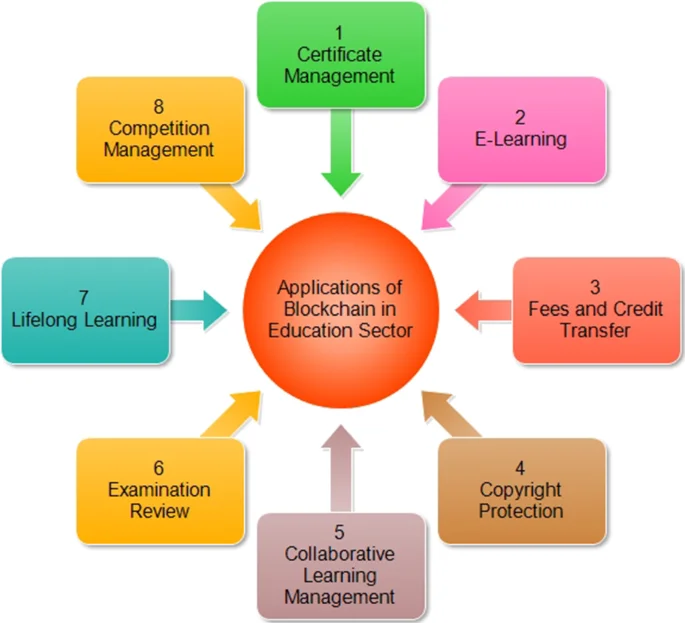
All over the world, blockchain technology is mostly associated with cryptocurrencies. However, this technology has many benefits beyond digital currency. Today, prominent institutions like Imperial College London and MIT have begun exploring the potential of blockchain in education. Here are the five primary ways blockchain is already being applied.
Record Keeping and Management
A popular use case of blockchain in education is in the keeping and management of student records. The number of student records grows every academic session, making verification overwhelming and time-consuming, with significant paperwork and case-by-case checking required.
Blockchain helps eliminate much of the stress associated with this process by streamlining verification. Graduates can share credentials with employers confidently, and employers can verify those credentials on the spot, reducing time and resources spent on background checks. In September 2025, Dr. APJ Abdul Kalam Technical University (AKTU) in India awarded approximately 50,000 degrees via blockchain at its convocation, demonstrating how large-scale blockchain credentialing is now operational reality, not just theory.
Courses and Assignments
With the rise of e-learning platforms, blockchain-powered automated learning platforms streamline educational processes using smart contracts.
What are smart contracts? Smart contracts are self-executing contracts with the terms of the agreement written directly into lines of code. They allow for the automation of various processes, such as the transfer of assets or the execution of specific actions, when certain conditions are met.
These contracts execute tasks such as the grading of assignments, tracking a student’s progress through a course, awarding certification upon completion, and creating individualized learning pathways based on each student’s performance. By automating administrative tasks, educators can focus on what matters most: teaching and mentoring. Adaptive learning systems create a customized learning environment for each student, adjusting content delivery to meet their unique needs and abilities.
Tuition Payments
Various sectors have adopted cryptocurrency payment into their systems, and the educational sector is no exception. With blockchain, tuition payments become error-free through the elimination of intermediaries, reducing transaction fees, processing times, and the overall backlog that comes with traditional payment infrastructure.
Lucerne University in Switzerland accepts Bitcoin for tuition payments. The University of Nicosia was one of the first universities in the world to accept Bitcoin. DeFi applications are also enabling new scholarship and financial aid models, where funds are automatically disbursed to eligible students via smart contracts when academic conditions are met.
Transcripts
A transcript is a detailed, official document recording a student’s academic history: courses taken, grades earned, credits awarded, certifications, diplomas, and academic honors. The creation of tamper-proof and secure digital transcripts is a major benefit of blockchain in education. This replaces the need for traditional paper-based transcripts, which can be easily lost, damaged, or falsified.
Over half of hiring managers now make academic credential verification a key step in their process. Blockchain-based transcripts allow that verification to happen instantly, without contacting the issuing institution, and with full confidence that the record has not been altered since issuance.
Intellectual Property and Digital Rights Protection
Blockchain enables educational content creators, researchers, and institutions to register and protect their intellectual property on an immutable ledger. Course materials, research papers, and learning resources can be timestamped and attributed on-chain, reducing unauthorized use and making royalty distribution transparent and automated. This is especially valuable as online education scales globally and jurisdictional boundaries around intellectual property become more complex.
What Are the Challenges of Blockchain in Education?
Although blockchain in education carries enormous potential, several real barriers to adoption remain:
Scalability, Cost and Funding: Blockchain networks can be expensive to implement and maintain. For institutions handling thousands of students and records, scaling blockchain infrastructure requires significant investment in hardware, software development, and ongoing maintenance. Many smaller institutions, especially in developing regions, lack the budget or technical capacity to deploy these systems effectively.
Regulatory Uncertainty: The lack of clear regulations and standards hinders adoption, as educators and administrators are unsure how to comply with existing data protection and privacy laws alongside emerging blockchain frameworks. Different jurisdictions have different requirements, adding complexity for institutions operating internationally.
Interoperability: Different blockchain platforms and systems are not automatically compatible. This remains a limiting factor in the blockchain industry, restricting data sharing and collaboration between institutions, departments, and countries. A student whose university uses Hyperledger may find their credentials cannot be directly read by an employer using an Ethereum-based system.
User Adoption and Training: Many educators, administrators, and students need substantial training to use blockchain-based systems effectively. This training investment is significant and requires ongoing support, particularly as platforms evolve.
Standardization of Credentials: Blockchain-based credentials require cross-institutional and cross-national standardization to ensure recognition and acceptance. Without common standards, a blockchain diploma from one country may not be recognized by institutions or employers in another.
Governance and Decision-Making: Blockchain-based systems require clear governance structures covering who controls the network, who can make changes, and how disputes are resolved. This is particularly complex in consortium blockchain models involving multiple institutions.
What Are the Leading Blockchain Learning Platforms?
Blockchain-based learning platforms are digital institutions that use distributed ledger technology to create decentralized, secure, and transparent ecosystems for learning. They stand out from traditional e-learning platforms by being decentralized (no single entity controls the platform), heavily secured through advanced cryptography, and transparent with all transactions and data publicly verifiable.
1. Learning Machine
Founded by Chris Jagers and Brian Kelly in 2016, Learning Machine uses blockchain to issue and verify credentials. It allows individuals to control their own learning records and credentials. The platform is in partnership with MIT, Harvard, and other leading institutions.
2. Open edX
Founded by Harvard and MIT in 2012 and updated with blockchain integration in 2019, Open edX is a decentralized learning platform using blockchain for secure and transparent credentialing. It offers courses from top institutions worldwide, including Harvard, MIT, and Microsoft, and has over 30 million learners globally.
3. Sony Global Education
Founded by Sony Corporation in 2017, this is a blockchain-based platform for secure and transparent learning records. It enables students to control their own data and learning journey, and is in partnership with various Japanese institutions and their government.
4. Udacity
Founded in 2011 and updated with blockchain integration in 2020, Udacity offers nanodegrees and micro-credentials using blockchain for secure and transparent credentialing. It has partnerships with Google, Amazon, and Meta. In May 2024, Udacity revamped its blockchain developer program to include comprehensive practical learning covering blockchain architecture, private blockchain creation, security, and decentralized application development on Ethereum.
5. Education Blockchain Consortium (EBC)
Founded in 2018 by a group of institutions and industry leaders, EBC connects learners, educators, and employers through secure and transparent credentialing, skill verification, and career development. Users include MIT, Stanford, IBM, and Microsoft.
6. Open Source University (OSU)
An online platform offering free and open-source educational resources, courses, and degree programs, OSU was founded in 2007 by Peer-to-Peer University (P2PU), a non-profit dedicated to open and accessible education. OSU has partnered with various institutions to offer recognized credits and certifications, though it is not itself an accredited university.
7. BlockLearn and CertChain (2025 Launches)
In January 2025, Webmob launched BlockLearn, a decentralized learning management system built on blockchain that facilitates secure sharing of educational content and student data across institutions while maintaining privacy. In February 2025, ValueLabs unveiled CertChain, a blockchain platform for issuing and verifying professional certifications across the entire credential lifecycle.
What Does the Future of Blockchain in Education Look Like?
The future of blockchain in education is promising, with the potential to transform virtually every aspect of how learning is structured, delivered, and recognized. As the technology continues to evolve, here are the most significant developments expected:
Widespread institutional adoption: As costs fall and standards emerge, blockchain solutions will become standard infrastructure across educational institutions, leading to greater efficiency in administrative processes, credentialing, and learning pathways.
Interoperability standards: The establishment of standardized protocols, such as the W3C Verifiable Credentials standard and Blockcerts framework, will enable seamless data sharing and credential transfer between institutions across borders.
AI integration: Combining blockchain with artificial intelligence will enhance personalized learning, automate grading and feedback, and optimize educational resource distribution. For every VC dollar invested in crypto companies in 2025, 40 cents went to companies also building AI products, signaling the convergence of these technologies in edtech as well.
DeFi applications for education funding: Expansion of blockchain-based financial aid, scholarships, and tuition payment systems will enable secure, transparent, and community-driven funding models, making quality education more accessible globally.
Digital credentialing becoming mainstream: Blockchain-based credentials and skills badges will achieve broad employer recognition, enabling learners to showcase verifiable achievements and enabling instant, trustworthy verification at every hiring decision.
Lifelong learning records: Blockchain-based systems will support continuous skill acquisition and verification throughout a career, enabling workers to upskill and reskill with a portable, permanent, and verifiable record of every course, certification, and achievement.
Equitable global access: Decentralized education platforms and tokenized learning incentives will expand access to quality education in underserved regions, where traditional institutional infrastructure is limited or unreliable.
Virtual and augmented reality integration: Blockchain will secure and manage immersive learning experiences, ensuring intellectual property protection, secure content sharing, and transparent tracking of user interactions in VR and AR educational environments.
“The traditional education system is broken, but blockchain technology is fixing it, one block at a time. The sector will experience more transformation with secure, transparent, and tamper-proof records for academic achievements and credentials, making it more credible, efficient, and student-centric.” – UEEx Research Summary, 2026
Frequently Asked Questions
What is blockchain in education?
Blockchain in education refers to the use of distributed ledger technology to securely store, manage, and verify academic records, credentials, and transactions within the education sector. It allows institutions to issue tamper-proof digital diplomas, automate administrative processes through smart contracts, enable secure tuition payments, and give students permanent, portable ownership of their academic achievements.
How big is the blockchain in education market in 2025?
The global blockchain in EdTech market was valued at approximately $2.1 billion in 2024 and is projected to reach $30.3 billion by 2034, growing at a CAGR of 30.4 percent. North America leads adoption with a 40 percent market share. Blockchain-based credential verification has grown 40 percent over the last three years, and investments in blockchain for education have grown 50 percent annually.
How does blockchain prevent academic credential fraud?
Blockchain prevents academic credential fraud by storing credentials as cryptographically secured, immutable records on a decentralized ledger. Once a degree or certificate is recorded, it cannot be altered, forged, or deleted. Any tampering immediately breaks the cryptographic verification. According to the Council for Higher Education Accreditation, blockchain could reduce credential fraud by up to 75 percent. IBM research found it reduces verification time by up to 80 percent.
Which universities are using blockchain for credentials in 2025?
Several institutions have implemented blockchain-based credentialing. MIT Media Lab and Georgia Institute of Technology issue tamper-proof digital certificates. McMaster University issues globally portable blockchain credentials. In September 2025, Dr. APJ Abdul Kalam Technical University (AKTU) in India awarded approximately 50,000 degrees via blockchain. The University of Nicosia issues blockchain certificates for graduates. Lucerne University in Switzerland accepts Bitcoin for tuition payments.
What are the main challenges of implementing blockchain in education?
The key challenges are: high implementation costs requiring significant investment in infrastructure and skilled personnel; scalability concerns as blockchain systems slow with large data volumes; regulatory uncertainty with no universal credential standards; interoperability issues between different blockchain platforms and institutions; extensive training requirements for educators and students; and the need for cross-national standardization so credentials are recognized globally.
What are blockchain learning platforms and how do they work?
Blockchain learning platforms are decentralized educational environments built on distributed ledger technology. They let students access courses, earn verifiable credentials, and in some cases receive cryptocurrency rewards for learning. Smart contracts automate grading, track course progress, and issue certifications when conditions are met. Examples include Open edX, Udacity, and Learning Machine, which partner with institutions like MIT, Harvard, and Google.
How does blockchain enable tuition payments?
Blockchain enables tuition payments by removing intermediaries, reducing processing fees, eliminating payment errors, and speeding up cross-border transactions significantly. Smart contracts can automate scholarship disbursements and financial aid when academic conditions are met. Institutions like Lucerne University and the University of Nicosia already accept cryptocurrency for tuition, and DeFi applications are enabling new decentralized scholarship and funding models.
Join UEEx
Experience the World’s Leading Digital Wealth Management Platform
Hi, I am preciousRuby. I am a content marketer and writer with a passion to help startups and small business achieve their marketing goals through organic marketing. When I’m not working, you’ll find me sleeping or just watching movies.
Disclaimer: This article is intended solely for informational purposes and should not be considered trading or investment advice. Nothing herein should be construed as financial, legal, or tax advice. Trading or investing in cryptocurrencies carries a considerable risk of financial loss. Always conduct due diligence before making any trading or investment decisions.
Trade with proof of Reserves
UEEx publish monthly audits and third party verification on every listed market.