Quick Definition: A crypto rug pull is a scam where developers create a fraudulent token or DeFi project, artificially inflate its price through social media hype and influencer promotion, attract investor funds, then suddenly drain the liquidity pool or dump their holdings and disappear. The token price collapses to near zero and investors are left with worthless assets. Rug pulls are now the single most common crime in crypto, with over 300,000 scam tokens created and approximately 2 million investors defrauded to date.
With the creation of cryptocurrencies came lucrative financial opportunities, but so did a new class of organized theft. Rug pulls have evolved from crude DeFi scams into sophisticated, AI-assisted operations targeting everyone from seasoned traders to celebrity fans with no prior crypto experience.
Rug pull losses surged to approximately $6 billion in 2025, a 6,500 percent increase from 2024, driven largely by the suspected Mantra (OM) token collapse. In 2024, over 350 rug pulls were documented globally, a 15 percent rise from 2023, with Binance Smart Chain hosting approximately 71 percent of all cases. Understanding exactly how these scams operate is your most effective defense.
Recommended reading: Top 5 Effective Crypto Technical Analysis Signals
Key Takeaways
- Rug pulls occur when DeFi project developers or founders suddenly withdraw all funds, leaving investors with worthless tokens.
- Rug pull losses reached approximately $6 billion in 2025, a 6,500 percent surge largely driven by the Mantra (OM) collapse.
- Scammers exploit greed, FOMO, social proof, and knowledge gaps to lure unsuspecting investors.
- Binance Smart Chain hosted roughly 71 percent of all rug pull scams in 2024 due to its low fees and minimal vetting.
- Soft rug pulls rose 35 percent in 2024 and are increasingly hard to detect, often unfolding over months.
- Investors can protect themselves by verifying smart contract audits, checking liquidity lock status, analyzing wallet concentration, and being skeptical of unrealistic return promises.
How Big Is the Rug Pull Problem in 2024 and 2025?
The rug pull problem has grown dramatically in both scale and sophistication. A handful of statistics show just how serious the threat has become:
| Metric | Figure | What It Means |
|---|---|---|
| Total rug pull losses in 2025 | ~$6 billion | A 6,500% surge year over year, driven almost entirely by the suspected Mantra (OM) collapse in April 2025. |
| Total rug pull losses in 2024 | $3.4 billion | Over 350 documented rug pull incidents globally, a 15% rise from 2023, with an average victim loss of $9,800. |
| Scam tokens created to date | 300,000+ | Roughly 2 million investors defrauded — more victims than the combined collapses of FTX, Celsius, and Voyager. |
| Share of all crypto scams that are rug pulls | 68% | As of Q1 2025, rug pulls dominate the crypto scam landscape, ahead of Ponzi schemes (22%) and all other fraud types. |
| Rug pulls hosted on Binance Smart Chain (2024) | 71% | BSC’s low transaction fees and minimal token vetting make it the preferred launchpad for scam tokens. PancakeSwap alone hosted 60% of rug pull tokens. |
| Stolen funds ever recovered | ~6% | 95% of rug pull losses are permanent. Funds are typically laundered through mixers and cross-chain bridges within minutes of the scam executing. |
| Average time for a rug pull to unfold (2025) | 12 days | Down from 21 days in 2023, meaning scammers are executing faster. 38% of hard rug pulls occur within just 7 days of token launch. |
| Soft rug pull growth rate (2024) | +35% | Soft rugs now account for 45% of all rug pull cases and caused approximately $1.2 billion in losses in a single year, with an average duration of 8 months before collapse. |
In early 2025, the number of rug pull incidents actually fell, with only 7 documented cases compared to 21 in the same period of 2024. However, the financial impact skyrocketed because each individual scam was far larger and more sophisticated. The Mantra (OM) collapse alone accounted for 92 percent of all rug pull losses in 2025. This pattern reveals an important shift: scammers are moving from high-volume, low-value attacks toward fewer, more elaborate operations targeting bigger pools of capital.
“Rug pulls are now the most common crime in crypto. Over 300,000 scam tokens have been created, defrauding roughly 2 million investors. This exceeds the combined number of victims from the collapses of FTX, Celsius, and Voyager.”
– Source: Solidus Labs Rug Pull Report, 2025
What Exactly Is a Rug Pull and How Does It Originate?
The phrase “rug pull” comes from the notion of pulling the rug out from under someone’s feet, which describes exactly what happens to investors. Scammers typically create a new cryptocurrency token or NFT project, generate artificial excitement around it, attract real investor capital into a liquidity pool, and then suddenly remove all of that liquidity and vanish.
To lure investors, scammers list their token on decentralized exchanges (DEXs) like Uniswap or PancakeSwap, pair it with popular cryptocurrencies like Ethereum or Solana, and promote it aggressively through social media, paid influencer campaigns, and fabricated partnerships. Once a critical mass of investors has bought in, the developers execute the theft.
Most rug pull projects share common features: false promises of 100x or higher returns, temporary social media hype with no substance behind it, injected liquidity to create an illusion of legitimacy, paid influencer or key opinion leader promotions, and manipulated token valuations to deceive investors. In the end, victims are left with worthless tokens and no recourse.
A rug pull can happen within minutes or unfold over months. This is precisely the distinction between hard rug pulls and soft rug pulls, covered in the Types section below.
What Psychological Tactics Do Rug Pull Scammers Use?
The crypto space is a breeding ground for get-rich-quick dreams, and the promise of overnight fortunes can cloud even sophisticated investors. Scammers know this and systematically exploit it.
Recommended reading: Trust and Transparency in the Crypto Community
- Greed: The primary psychological lever. Scammers promise outsized returns, such as 100x gains, that bypass rational analysis and trigger instinctive desire.
- Fear of Missing Out (FOMO): They create a sense of urgency through countdown timers, “whitelist only” presales, and staged social media excitement, making investors feel they must act immediately or miss their chance.
- Social proof: Scammers use paid influencers, fake testimonials, fabricated trading volume, and bot-driven social media activity to create the illusion that everyone else is already profiting.
- Lack of knowledge: Many investors, especially those new to crypto, do not know how to verify smart contracts, check wallet concentration, or identify warning signs. Scammers deliberately target newcomers and celebrity fan bases for this reason.
- Manufactured trust: Scammers pose as trusted authorities, announce fake partnerships with well-known companies, or pay celebrities to lend credibility to the project.
In 2025, scammers increasingly deployed AI-generated content and emotional manipulation tactics including romance-based “pig butchering” schemes alongside traditional rug pulls, according to the North American Securities Administrators Association (NASAA), which identified crypto scams as the top threat to retail investors that year.
How Does a Rug Pull Unfold Step by Step?
- Token Creation Scammers create a new cryptocurrency token or NFT project, complete with a convincing name, logo, website, and in many cases a fabricated whitepaper. The average time from token creation to rug pull execution is now just 12 days, down from 21 days in 2023, as scammers have become more efficient.
- Promotion and Hype Generation They promote the token through social media, paid crypto influencers, Telegram and Discord communities, and sometimes mainstream press. They make promises of high returns, guaranteed profits, or access to something revolutionary. Social media drives approximately 80 percent of rug pull traffic, with Telegram and Discord as the dominant platforms.
- Listing on a DEX They list the token on a decentralized exchange such as Uniswap, PancakeSwap, or Raydium (on Solana), where it can be traded by anyone without a vetting process. PancakeSwap on BSC was the launchpad for approximately 60 percent of rug pull tokens in 2024.
- Liquidity Pool Creation They create a liquidity pool, often injecting initial funds themselves to appear legitimate. The liquidity pool is what investors will ultimately lose when the rug is pulled.
- Price Pumping Scammers artificially inflate the token’s price by buying it themselves, coordinating wash trades, or deploying bots to simulate organic demand. This manufactured price rise attracts retail investors who see the green candles and pile in.
- The Rug Pull Once enough investor funds are in the pool, scammers drain all the liquidity, causing the token price to collapse to near zero within minutes. They immediately deactivate social media accounts, block investors, and in some cases flee the country. 95 percent of stolen funds are unrecoverable due to blockchain anonymity.
“Due diligence is your best defense. Always research the team, review the project’s code, and check for locked liquidity before investing in any crypto project.”
– Security Best Practice, DeFi Community Standard
What Are the Different Types of Rug Pulls?
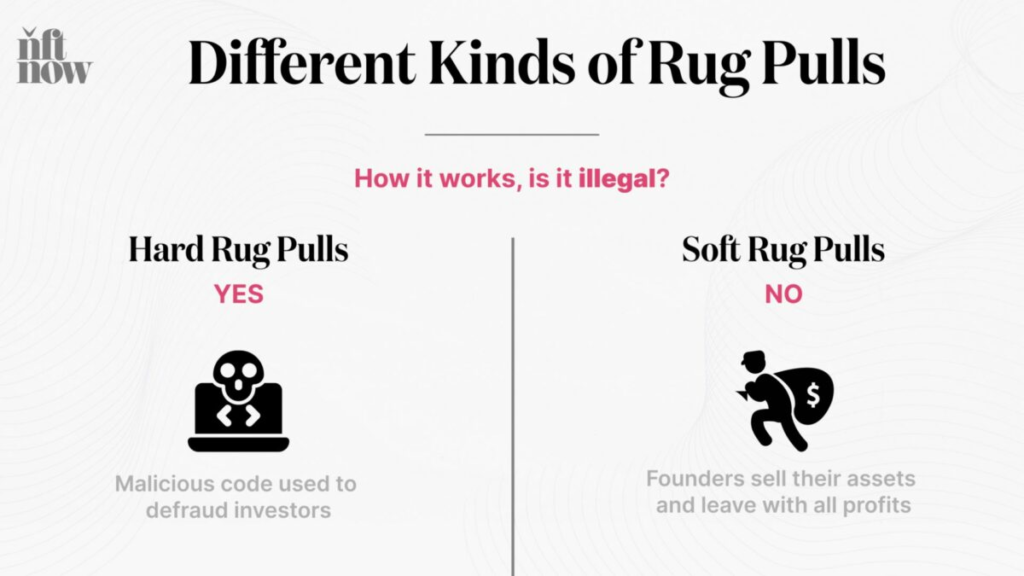
Rug pulls fall into two primary categories: hard rug pulls, which happen quickly through programmatic exploitation, and soft rug pulls, which unfold gradually. Hard rug pulls made up 55 percent of cases in 2024 while soft rug pulls accounted for the remaining 45 percent, though soft rugs rose 35 percent year over year.
Hard Rug Pull Types
Hard Rug
1. Liquidity Draining
Scammers create a token, list it on a DEX, and encourage investors to buy. Once enough liquidity is pooled, they withdraw all funds within a single transaction, leaving investors with tokens they cannot sell.
Example: A scammer creates “SunnyCoin” on Ethereum and lists it on Uniswap. After heavy promotion drives up the price, they sell off their large pre-allocated share, then drain all ETH from the liquidity pool. SunnyCoin holders are left with tokens worth a fraction of a cent.
Hard Rug
2. Flash Loan Attacks
Flash loans are uncollateralized DeFi loans that must be taken out and repaid within a single blockchain transaction. Scammers use them to borrow massive liquidity, manipulate token prices in one transaction, dump tokens at the inflated price, and repay the loan, all before anyone can react.
Example: A scammer borrows 100,000 DAI via a flash loan to buy “PumpToken,” driving the price from $0.10 to $1.00. They immediately sell the tokens, causing the price to drop to $0.01. Investors who bought at the top lose 99 percent of their capital.
Hard Rug
3. Honeypot Traps
Scammers deploy a smart contract that appears to be a legitimate token sale but contains hidden code that prevents investors from ever selling their tokens. Investors can buy freely but cannot exit. The honeypot mechanism is detectable by auditors reviewing the contract on Etherscan but is regularly missed by non-technical investors.
Example: “GrooveToken” promises a 100 percent return on investment. Investors send ETH to participate, but the contract is coded to drain incoming funds while making exits impossible. No returns are ever generated; the funds go directly to the scammer.
Soft Rug Pull Types
Soft Rug
1. Pump and Dump
Scammers artificially inflate a token’s price through coordinated buying and social media campaigns, then gradually sell their holdings over weeks or months while the price slowly erodes. The average soft rug pull lasts approximately 8 months before the full collapse, compared to under 24 hours for hard rugs.
Example: A group creates a Telegram channel promoting “MountainToken,” collectively buy it from $0.01 to $1.00, then sell their positions over several weeks as the price falls back to $0.001. Investors who bought near the peak lose 99 percent.
Soft Rug
2. Fake Listings and Partnership Announcements
Scammers create a convincing token listing on a DEX, complete with fake documentation, and then announce fabricated partnerships with well-known companies to boost the token price. After achieving their target price, they disappear with the funds over a period of time, maintaining the illusion of activity until they choose to exit.
Example: “HappyCoin” lists on PancakeSwap and announces a fake Microsoft partnership. The token price rises as investors buy into the credibility. Over weeks, the team gradually withdraws liquidity and stops responding on social media.
What Are the Warning Signs of a Rug Pull?
| Warning Sign | Why It Matters | How to Check |
|---|---|---|
| Anonymous or unverifiable team | No accountability if they disappear. Most major rug pulls have anonymous founders. | Search team members on LinkedIn, GitHub, and past project history. Reverse-image-search profile photos. |
| No independent smart contract audit | Unaudited code may contain hidden mint functions, transfer locks, or backdoors. | Check CertiK, Hacken, or PeckShield audit databases before investing. |
| Unlocked or short-lock liquidity | Developers who can access the liquidity pool at any time can drain it instantly. | Use GeckoTerminal, DEXScreener, or Unicrypt to verify liquidity lock duration. |
| High wallet concentration | If the top 10 wallets hold 50 percent or more of the supply, insider dumping is a major risk. | Check Etherscan or BscScan “Holders” tab. Token Sniffer flags concentration automatically. |
| Promises of guaranteed or 100x returns | No legitimate project can guarantee outsized returns. This is always a scam signal. | Trust your skepticism. No investment guarantees returns. |
| Sudden heavy social media promotion | Coordinated artificial hype through bots and paid influencers precedes most rug pulls. | Check whether accounts promoting the project are newly created or have histories of paid promotions. |
| Celebrity or influencer endorsement | The $HAWK token (December 2024) and Squid Game token both used celebrity tie-ins before collapsing over 90 percent. | Verify that the endorsed project has a real audit, locked liquidity, and distributed token supply. |
| No public GitHub or open-source code | Legitimate projects publish their code. Secrecy about technical implementation is a major red flag. | Search for the project name on GitHub. Absence of a repository is a warning sign. |
| Renounced contract ownership without a lock | Renouncing ownership without locking liquidity first is meaningless as a safety guarantee. | Verify both conditions are met, not just one. |
How Do You Protect Yourself from a Rug Pull Scam?
- Research thoroughly: Read the whitepaper, understand the technology, and evaluate real-world use cases independently. Verify team members’ professional backgrounds through primary sources, not just the project website.
- Verify smart contracts: Use tools like Etherscan, BscScan, or Token Sniffer to inspect the contract code and confirm it has been audited by a reputable firm. Look specifically for mint functions, transfer restrictions, and ownership centralization.
- Check liquidity lock status: Use GeckoTerminal, DEXScreener, or Unicrypt to confirm the liquidity pool is locked and for how long. Unlocked liquidity is the single most common mechanism used in hard rug pulls.
- Analyze token distribution: If the top 10 wallets hold more than 30 to 50 percent of the supply, the insider dump risk is too high. This pattern was visible in the $HAWK token, where 96 percent of supply was held by interconnected wallets.
- Be skeptical of high yields: Unrealistically high returns are always a warning sign in any asset class. Projects promising 1,000 percent APY or 100x token gains without a credible business model are overwhelmingly likely to be scams.
- Monitor project activity: Check GitHub commit history, social media, and community forums for consistent, substantive updates. Legitimate projects build in public.
- Only invest what you can afford to lose entirely: Set a budget and stick to it. The average victim loss in rug pull scams was approximately $9,800 in 2024.
- Diversify your portfolio: Spread exposure across multiple projects and asset classes. Concentration in a single high-risk token amplifies the damage of any single rug pull.
- Use secure, self-custodied wallets: Store long-term holdings in reputable hardware wallets like Ledger or Trezor. Keep only what you need for active trading on exchange accounts.
- Be patient and resist FOMO: The pressure to invest immediately is manufactured by scammers. Legitimate projects do not disappear if you take 48 hours to conduct due diligence.
“The allure of quick profits in DeFi can blind investors to rug pull red flags. Promises of guaranteed returns and anonymous teams are warning signs, not features.”
– DeFi Security Best Practice
What Should You Do Immediately After Being Rug Pulled?
- Stay Calm Panic leads to poor decisions, such as trying to recover losses immediately by investing in another high-risk project. Take time to assess the situation clearly before acting.
- Document Everything Collect all evidence: transaction IDs, wallet addresses, screenshots of project communications, social media posts, and any contact you had with the team. This documentation is essential for legal action and official reports.
- Report the Incident In the US, report to the SEC (sec.gov/tcr), FTC (reportfraud.ftc.gov), and the FBI’s Internet Crime Complaint Center (ic3.gov). Regulatory enforcement actions against crypto fraud increased 48 percent globally in 2024 compared to the prior year.
- Find Other Victims Search Twitter, Reddit, and Telegram for others affected by the same scam. Coordinating with other victims can help build a stronger legal case. The $HAWK token victims successfully coordinated a class-action lawsuit through this approach.
- Consult Legal Experts Contact lawyers experienced in cryptocurrency fraud. In cases involving clear securities violations or wire fraud, criminal prosecution is possible. Ryan Felton’s 2018 exit scams resulted in convictions on 12 counts of wire fraud, 10 counts of money laundering, and 2 counts of securities fraud.
- Learn and Adapt Analyze what red flags you may have missed. Rug pull victims who document their experience and share it publicly help protect other investors and contribute to the growing body of on-chain scam detection research.
Note: Recovering from a rug pull is extremely difficult. Only about 6 percent of stolen crypto funds are ever recovered through legal actions or technical exploits. Swift documentation and reporting improve your chances, but expectations should be set realistically.
Recommended reading: Cryptocurrency Hardware Security Modules (HSMs) Explained
What Are the Most Notable Rug Pull Scams in History?
These cases illustrate the evolving tactics scammers use and the specific warning signs that, in hindsight, were visible before each collapse.
1. Mantra (OM) Network Collapse (2025)
~$5.52 Billion Lost
The largest suspected rug pull in crypto history. In April 2025, seventeen wallets moved 43.6 million OM tokens worth approximately $227 million to exchanges in a short timeframe, triggering a 94 percent price crash. The collapse affected thousands of investors and accounted for 92 percent of all rug pull losses in early 2025. On-chain data showed concerning wallet distribution, unverified smart contracts, no public GitHub repository, and inorganic trading activity — all visible red flags before the collapse. A full investigation remains ongoing.
2. HAWK Token (December 2024)
~$430M in Market Cap Wiped
Launched by viral internet personality Hailey Welch and promoted through her “Talk Tuah” podcast, the $HAWK memecoin on Solana surged to a $490 million market cap within 15 minutes of launch before crashing over 93 percent within hours. On-chain data revealed that 96 percent of the supply was held by a cluster of interconnected insider wallets, with only 3 to 4 percent available to the public. A class-action lawsuit was filed in New York; insiders pocketed approximately $3 million from the collapse. Welch denied personal wrongdoing and claimed she was only a paid promoter.
3. Safuu Protocol Collapse (2024)
$50 Million Lost
Investors lost $50 million after liquidity was suddenly removed from the Safuu protocol in 2024. The project had marketed itself as a high-yield rebase token promising auto-staking rewards. Warning signs included unsustainable APY claims and a token distribution model concentrated among founding wallets.
4. Froggy (FROGGY) Coin (Early 2024)
Nearly 100% Token Value Lost
Exploiting the “community-driven meme coin” trend, FROGGY used a humorous brand identity to attract investors into its liquidity pool. Once sufficient capital was pooled, the developers drained it instantly. The token crashed 99.95 percent from its peak. This case illustrated how easily meme culture can be weaponized to bypass skepticism.
5. Squid Game Token (October 2021)
~$3.38 Million Lost
Inspired by the Netflix series, this token rose from $0.01 to $2,861 before the developer drained the liquidity pool. A honeypot mechanism prevented investors from selling. The project leveraged mainstream media coverage of the show to manufacture credibility with no audits, anonymous team, and no real utility.
6. AnubisDAO (October 2021)
$60 Million Lost
Promising a decentralized lending protocol backed by a basket of assets, AnubisDAO raised approximately $60 million in wrapped Ethereum in under 20 hours. The project had no whitepaper, no website, and no verified team — only a Dogecoin-inspired logo and heavy social media noise. The funds disappeared within hours of the raise closing.
7. Thodex Exchange (2021)
Over $2 Billion Lost
One of the largest centralized exit scams ever executed. The Turkish exchange CEO halted all withdrawals and fled the country with investor funds, affecting approximately 391,000 users. This case demonstrates that rug pulls are not limited to DeFi: centralized platforms with opaque ownership structures carry the same fundamental risk.
Recommended reading: The Rise of Decentralized Finance (DeFi)
Frequently Asked Questions
What is a rug pull in cryptocurrency?
A rug pull is a scam where developers create a fraudulent token or DeFi project, attract investor funds through artificial hype and influencer promotion, then suddenly drain the liquidity pool or dump their holdings and disappear. The token price collapses to near zero and investors are left with worthless assets and no recourse.
How much money have rug pulls stolen in total?
Rug pull losses reached approximately $6 billion in 2025, a 6,500 percent surge compared to 2024, largely driven by the suspected Mantra (OM) collapse which alone accounted for roughly $5.52 billion. In 2024, rug pulls caused an estimated $3.4 billion in losses globally. Over 300,000 scam tokens have been created to date, defrauding roughly 2 million investors — more than the combined collapses of FTX, Celsius, and Voyager.
What is the difference between a hard rug pull and a soft rug pull?
A hard rug pull uses malicious smart contract code to trap or drain investor funds, typically within 24 hours of launch. A soft rug pull, also called a slow rug, involves a gradual exit over weeks or months as the team slowly drains liquidity or dumps tokens while maintaining an appearance of activity. Soft rug pulls rose 35 percent in 2024 and are harder to detect because the price decline is gradual rather than sudden.
What are the main warning signs of a rug pull?
Key red flags include: anonymous or unverifiable team members, no independent smart contract audit, unlocked or unverified liquidity, promises of guaranteed returns or 100x gains, sudden heavy social media promotion without any real utility, a small group of wallets holding the majority of the token supply, no public GitHub repository, and celebrity or influencer endorsements without transparent tokenomics disclosures.
How can I check if a crypto project is a rug pull before investing?
Use these tools before investing: Token Sniffer or DEXScreener to check token contract flags and holder concentration, Etherscan or BscScan to review the smart contract and liquidity lock status, GeckoTerminal to verify whether liquidity is locked and for how long, and CertiK or Hacken audit databases to confirm an independent security firm has reviewed the code. Also check whether the top 10 wallets hold a suspicious percentage of the total supply.
What should I do immediately after being rug pulled?
Act quickly: stay calm to avoid making further impulsive decisions, document all evidence including transaction IDs and any communications with the project team, report the incident to the SEC, FTC, and FBI in the US, find other victims to coordinate legal action (class-action lawsuits have succeeded in some cases), and consult a lawyer with cryptocurrency fraud experience. Note that only about 6 percent of stolen crypto funds are ever recovered.
Are celebrity-endorsed meme coins safe to invest in?
No. Celebrity and influencer endorsements are a warning sign, not a safety signal. The $HAWK token launched with Hailey Welch’s backing in December 2024 surged to a $490 million market cap before crashing over 93 percent within hours after insiders dumped their holdings. A class-action lawsuit was filed shortly after. Always verify the project’s tokenomics, liquidity lock status, and smart contract audit regardless of who is promoting it.