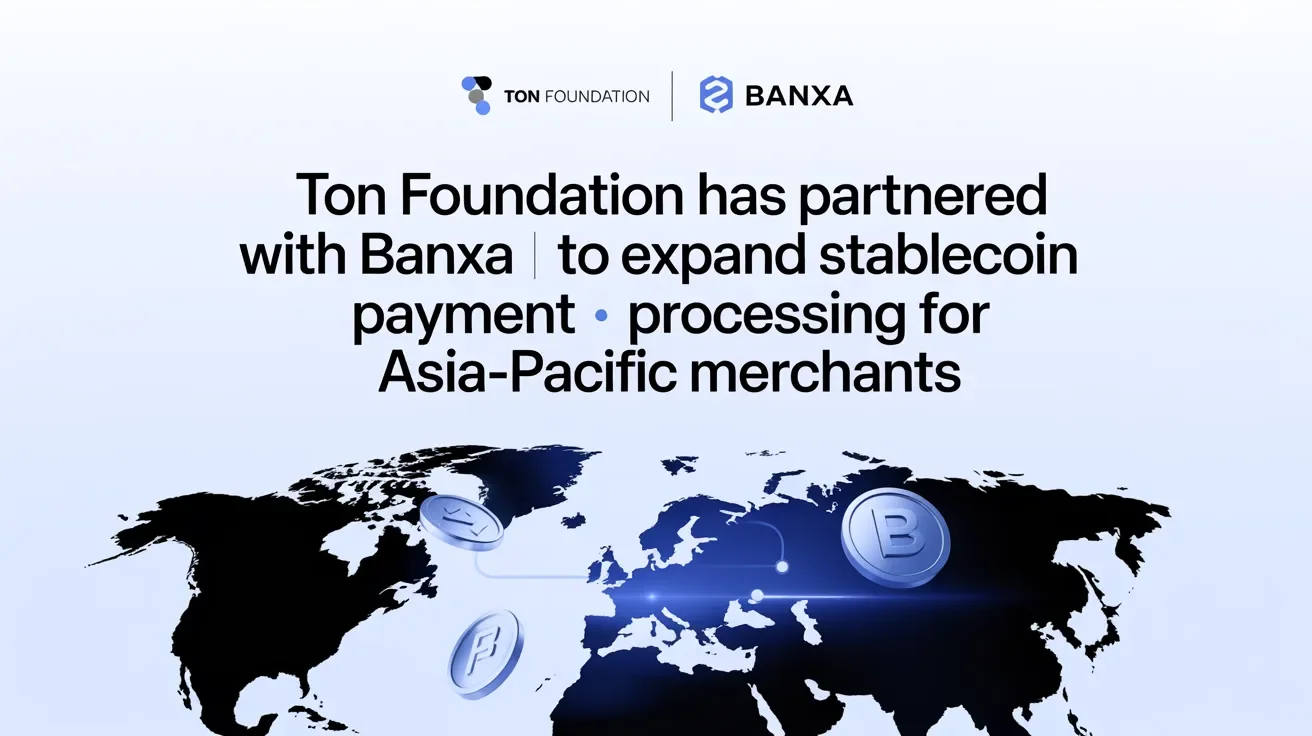
The TON Foundation has announced a strategic partnership with Banxa to roll out regulated stablecoin payment infrastructure for small and medium-sized enterprises (SMEs) across the Asia-Pacific (APAC) region.
The collaboration is designed to position TON as a practical settlement layer for real-world business payments, extending beyond consumer crypto use cases into enterprise-grade financial operations.
The initiative integrates Banxa’s licensed fiat on- and off-ramp network with the TON blockchain, enabling businesses to conduct B2B settlements, cross-border transfers, and consumer-to-merchant (C2B) transactions using stablecoins such as USDT and USDC.
Key Takeaways
- TON Foundation and Banxa are deploying regulated stablecoin payment infrastructure to support SMEs across the Asia-Pacific region.
- The integration connects Banxa’s licensed fiat on- and off-ramps with the TON blockchain to enable faster B2B, C2B, and cross-border settlements.
- The initiative emphasizes AML and KYC compliance to ensure secure and legally aligned digital payment operations in key APAC markets.
- Lower transaction costs and near-instant settlement times could provide SMEs with a competitive alternative to traditional bank-based international transfers.
Bringing Stablecoins Into Everyday Business Workflows
Under the agreement, Banxa will provide compliant payment infrastructure across key APAC jurisdictions, including Singapore, Hong Kong, and Australia. The company handles conversions between local fiat currencies and digital assets, ensuring adherence to AML and KYC requirements.
For SMEs, the process is straightforward. A business can convert local currency into stablecoins through Banxa’s gateway, settle invoices on-chain via TON within seconds, and allow recipients to either hold the digital dollars or convert them back into local currency. The model significantly reduces reliance on traditional correspondent banking networks.
The timing is notable. The global stablecoin market capitalization surpassed $150 billion in late 2025, reflecting growing demand for blockchain-based settlement tools.
In APAC, cross-border e-commerce is projected to exceed $2 trillion by 2030, according to industry estimates. SMEs account for a large share of that activity, yet many still face slow and costly international payment rails.
Traditional bank wires can take between two to five business days to settle, often costing 3–5% plus fixed fees. By contrast, blockchain-based transfers settle in seconds, with projected costs under 1% depending on corridor and liquidity conditions.
The TON blockchain’s high throughput — capable of processing thousands of transactions per second — supports this scale.
From Consumer Crypto to Enterprise Infrastructure

TON’s peer-to-peer infrastructure has already seen significant adoption in parts of Asia through Telegram-linked applications. This partnership expands its reach into structured business environments.
The announcement follows the recent launch of TON Pay, signaling a broader strategy to transform TON into a dedicated payments network for commercial use rather than primarily app-based activity.
Industry observers view the move as a shift from speculative crypto narratives to practical financial infrastructure.
The APAC region hosts more than 70 million SMEs, many of which encounter high foreign exchange costs, opaque fees, and liquidity delays when dealing with international suppliers. A stablecoin network offers price stability while preserving the speed advantages of blockchain settlement.
Regulatory Structure at the Core of the Rollout
Compliance remains central to the framework. Banxa, a subsidiary of OSL Group, operates under multiple regulatory licenses, including Money Services Business (MSB) registrations and digital asset exchange authorizations in jurisdictions such as Australia, the European Union, and the United Kingdom, with ongoing expansion in Asia.
By anchoring fiat endpoints within licensed infrastructure, the partnership aims to reduce regulatory friction that has slowed other crypto payment initiatives. On-chain transparency also provides an immutable transaction record, which can assist with auditing and reporting requirements.
Operational Model and Market Impact
The proposed system functions as a closed-loop payment corridor:
- SMEs convert fiat to stablecoins via Banxa.
- Payments are transmitted over the TON blockchain.
- Recipients either retain stablecoins or redeem them for local currency.
- Transactions occur 24/7, without banking-hour restrictions.
This structure reduces dependency on intermediaries and correspondent banking chains that typically add cost and delay.
However, adoption will depend on execution. Seamless user experience, sufficient liquidity across supported corridors, and continued regulatory clarity will determine how quickly merchants integrate the system. Education also remains essential, particularly for businesses unfamiliar with digital asset custody and wallet management.
Competition is another factor. Traditional financial institutions and payment providers may respond by lowering fees or accelerating settlement speeds to maintain market share.
Still, the cost differential is significant enough to attract attention. For SMEs operating on thin margins, even a 2–3% reduction in transaction costs can materially improve profitability.
A Broader Push for Web3 Commerce in APAC
The partnership underscores a growing focus on Asia-Pacific as a primary growth market for blockchain-based financial infrastructure. Digital payments are projected to account for more than 50% of total transactions in the region by 2028, reflecting rapid mobile and e-commerce adoption.
By targeting SMEs rather than retail traders, TON and Banxa are aligning with sectors that drive regional economic output. If successful, the network could onboard thousands of merchants, embedding stablecoins into daily trade flows rather than isolated crypto transactions.
The collaboration signals a clear strategic direction: positioning TON not merely as a blockchain for decentralized applications, but as a settlement layer for real business payments. Whether it achieves scale will depend on merchant adoption, corridor liquidity, and regulatory developments in key APAC markets.
For now, the announcement marks one of the more concrete attempts to bridge regulated fiat gateways with high-throughput blockchain infrastructure for mainstream commercial use.