Imagine you buy Bitcoin at $40,000 and set a $1,000 trailing stop. If the price rises to $42,500, your trailing stop moves up to $41,500.
If the market suddenly drops from $42,500 to $41,500, your trailing stop triggers and protects a good portion of your gains. A trailing stop order is an automated tool that moves with the market to help protect profits.
Because traders have different goals, some want fast exit, others want precise control, trailing stops come in several types. Each one behaves differently when triggered, especially during volatile or fast-moving markets. Understanding these variations helps you choose the right one for your strategy.
Join UEEx
Experience the World’s Leading Digital Wealth Management Platform
A trailing stop order automatically moves with the market to protect profits as the price moves in your favor.
Emotional trading fear, greed, hesitation, panic is one of the biggest reasons traders fail.
Trailing stops come in several forms, each designed to help traders protect profits or enter trades automatically as the market moves.
Trailing stops work even better when they are combined with other order types.
What Is a Trailing Stop Order?
A trailing stop order is a type of stop order designed to automatically adjust itself as the market price moves in your favor. Unlike a traditional stop loss order that stays fixed at one price level, a trailing stop “trails” the current market price by a set amount. This trailing mechanism allows traders to lock in profits while still giving the trade room to grow.
A trailing stop order helps you secure more profit as the market moves in your favor. After it’s activated, the stop level automatically moves up (or down) with the price. When the price eventually pulls back by the percentage you set, the order triggers and closes the trade, locking in your gains.
A trailing stop adjusts itself automatically as the market moves in your favor. It follows the price upward for a buy trade or downward for a sell trade, but it never moves backward. Once the price pulls away from its peak by the percentage you set, the system places the order.
For example, if you set an 8% trailing stop on a sell position, it will keep shifting upward as the market climbs. When the price drops by 8% from its highest point, the order is triggered.
“A trailing stop order moves with the market, helping traders protect profits without needing to constantly monitor price changes.”
Key Components
Trailing Amount: The most important element of a trailing stop is the distance between the current market price and the stop level. This can be a percentage, a fixed amount or a pip/point value (common in forex)
Stop Price: The price level at which the trailing stop converts into a market or limit order when hit.
Direction (Buy or Sell): Whether the stop trails below the price (for long positions) or above it (for short positions).
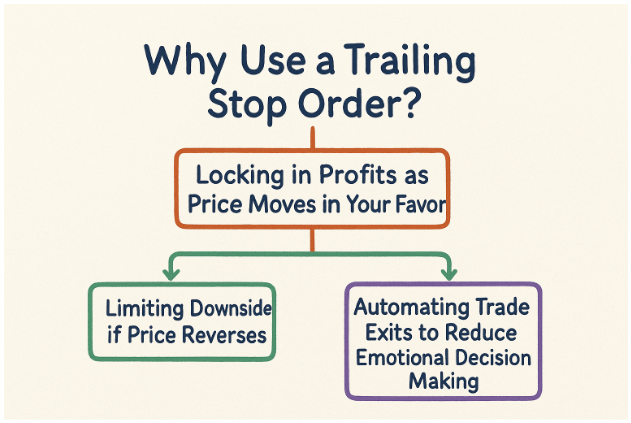
Trailing stop orders are widely used by traders because they combine risk management, profit protection, and automation into a single tool. They allow positions to grow while still providing downside protection, making them suitable for both new and experienced traders. Below is a full breakdown of why trailing stops are valuable.
Locking in Profits as Price Moves in Your Favor
One of the biggest advantages of a trailing stop is its ability to secure profits automatically. As the market price rises (for long trades) or falls (for short trades), the trailing stop moves with it, maintaining a fixed distance. This means that you don’t need to manually adjust your stop-loss.
Every new high in the trade becomes a new level of locked-in profit.
You can ride strong trends while ensuring gains do not evaporate.
Essentially, trailing stops help you stay in winning trades longer without sacrificing profit protection.
Limiting Downside if Price Reverses
Trailing stops also act as a dynamic safety net. If the price reverses by the trailing distance you set, the order triggers and exits your trade, protecting you from deeper losses. This is especially important in volatile markets where sharp reversals are common. The trailing stop ensures:
Controlled risk
Clear maximum loss parameters
Automatic exit without needing constant monitoring
In other words, it limits the downside while keeping the upside open.
Automating Trade Exits to Reduce Emotional Decision Making
Emotional trading fear, greed, hesitation, panic is one of the biggest reasons traders fail. Trailing stops remove much of the psychological pressure by making exit decisions automatic. Benefits include:
No second-guessing your stop-loss adjustment
No emotional attachment to “waiting for a bounce”
No panic-selling during pullbacks
Objectivity in fast-moving markets
By placing a trailing stop, you create a mechanical discipline system that protects your capital and profits without relying on emotional judgment.
Trailing stops come in different l forms, each designed to help traders protect profits or enter trades automatically as the market moves. The main difference between them is how they behave when the stop level is reached and how strictly they control execution price.
Below are the two core types of trailing stop orders you will encounter across most trading platforms.
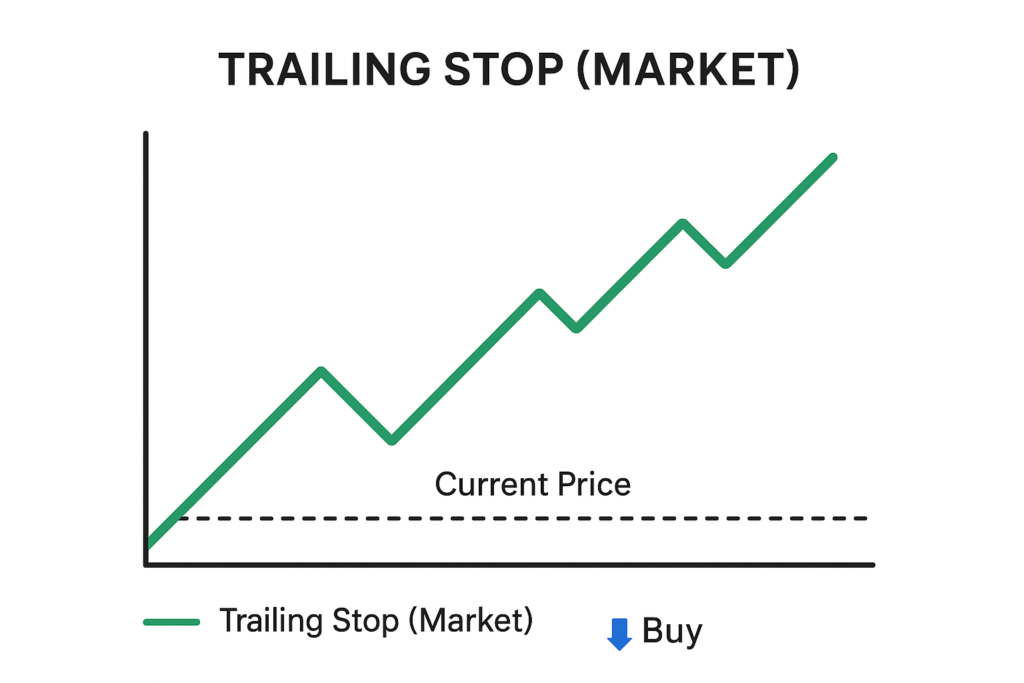
Trailing Stop (Market) Order
A trailing stop market order is the simplest and most commonly used type of trailing stop. Once the market price reaches the stop level, the system immediately sends a market order to exit (or enter) the trade.
How it Works
You set a trailing distance (for example, 2%, 20 pips, or $1 below the highest price).
As the market moves in your favor, the trailing stop adjusts.
When price reverses by the trailing amount, the order triggers and executes at the current market price.
Key Benefits
Execution is guaranteed: Once triggered, the order will be filled, even in fast-moving conditions.
Ideal for volatile markets where exiting quickly is more important than getting an exact price.
Works well in highly liquid assets like major forex pairs, large-cap stocks, and BTC/ETH.
Potential Downsides
Because it executes at market price, the actual fill may differ from the stop level.
This difference is known as slippage.
Simple Example
You bought a stock at $50 and set a $2 trailing stop. The price climbs to $60 → the trailing stop moves to $58. If the price falls to $58, a market order is sent and may fill at $57.98, $58.05, or whatever the market offers at that moment.
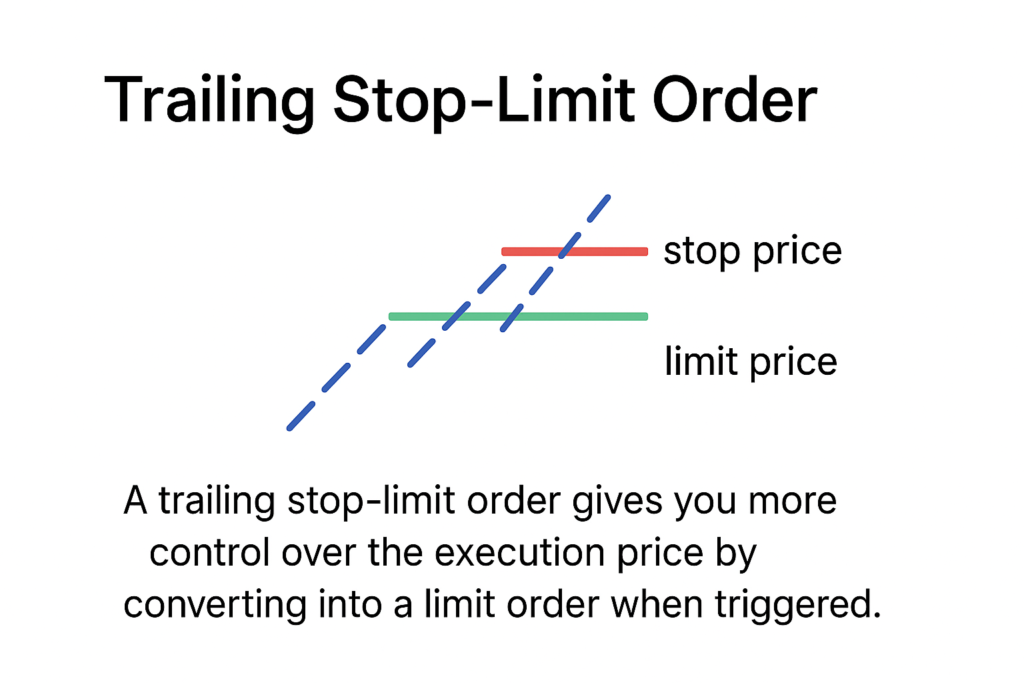
Trailing Stop-Limit Order
A trailing stop-limit order gives you more control over the execution price by converting into a limit order when triggered.
How it Works
You must set: A trailing distance (e.g., 3%, 30 pips)
A limit offset, how far from the stop you are willing to accept a fill
When the stop is hit, instead of sending a market order, the platform sends a limit order at the specified limit price.
Key Benefits
You control the minimum price (for a sell) or maximum price (for a buy) you’re willing to accept.
Protects you from large slippage, which is useful in low-liquidity markets, overnight gaps, Crypto assets prone to sudden spikes.
Potential Downsides
The order may not fill if price gaps past your limit.
This leaves you exposed to further losses (for sells) or missed entries (for buys).
Simple Example
You own an asset trading at $100 and set a $5 trailing stop and a $1 limit offset. If the price falls from $110 to $105, the stop triggers and sends a limit order at $104. If the market drops too fast, say to $102, your order will not fill, because $104 is no longer available. This type prioritizes price control over guaranteed execution.
Trailing stops can be used for both entering and exiting positions. The direction of the trailing stop changes depending on the type of trade.
“Trailing stops allow your winning trades to grow while setting an automatic exit when the market starts to reverse.”
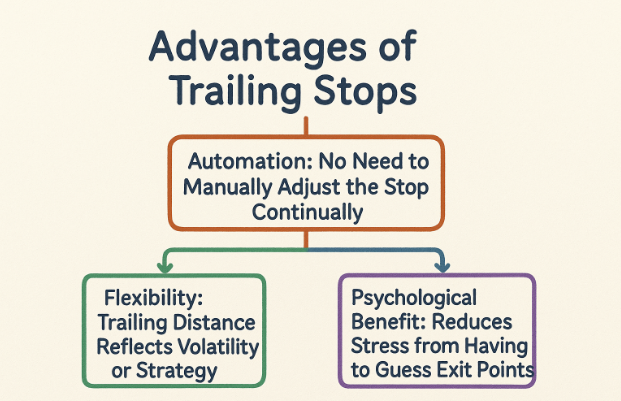
Advantages of Trailing Stops Order
Trailing stops offer you a smart way to protect profits while still giving the market room to grow. Instead of locking in gains too early, they adjust automatically as price moves in your favor. This makes them a flexible risk-management tool for both beginners and experienced traders.
Automation: No Need to Manually Adjust the Stop Continually
Trailing stops update themselves automatically as the trade becomes profitable. This prevents you from constantly watching the chart, missing an opportunity to tighten your stop and making errors from adjusting stops too late
Once set, the trailing mechanism works in real-time, even while you’re offline (depending on platform/broker). This makes trailing stops ideal for traders who cannot constantly monitor the market.
Flexibility: Trailing Distance Reflects Volatility or Strategy
Trailing stops can be fully customized to match your trading approach or the market’s nature:
Small trailing distance for tight, quick profits
Larger distance for trending or volatile markets
ATR-based distances to match volatility
Percentage-based distances for higher-priced assets
This adaptability allows traders to build trailing stops around momentum, volatility, swing structures, or trend following strategies.
Adaptability Across Different Asset Classes: Stocks, Forex, Crypto, etc.
Trailing stops work effectively across multiple markets. Because the concept is universal, traders can apply trailing stops across different environments and timeframes.
Psychological Benefit: Reduces Stress from Having to Guess Exit Points
Exit timing is one of the hardest parts of trading. Trailing stops solve this by moving the exit point automatically, which helps you removes guesswork, reduces anxiety over “when to close”, helps avoid closing too early and keeps you from holding losing trades due to hope
“Unlike fixed stop-loss orders, trailing stops adjust dynamically, giving trades room to breathe during strong trends.”
Limitations & Risks of Trailing Stop order
While trailing stops are powerful, they are not perfect. Traders must understand their limitations to use them effectively.
Whipsaw Risk: Rapid Reversals Triggering the Stop Too Early
Markets can behave erratically, especially during news events or low liquidity periods. A trailing stop set too tightly can get triggered by small fluctuations or “market noise,” causing premature exits even if the trend later resumes.
Market Gaps and Slippage
Trailing stops do not guarantee the price at which your exit will occur. If the market gaps or moves too quickly, a trailing stop market order may fill significantly worse than expected or a trailing stop-limit may not fill at all if price jumps past the limit level.
Poor Effectiveness in Non-Trending / Choppy Markets
Trailing stops work best in clear, directional trends. In sideways or choppy markets, price movement lacks direction, frequent reversals trigger the stop prematurely, the stop never has room to “trail” properly.
Many small losses may add up and this makes trailing stops less suitable for strategies that operate in consolidations or ranges.
Setting a trailing stop order is not complicated, but it does require understanding how far the stop should trail behind price, how your trading platform executes it, and the habits that help you use it effectively. A trailing stop works best when it is set intentionally rather than randomly.
Determining the Trailing Distance
The first step in using a trailing stop is choosing how far behind the current price your stop should follow. This distance determines how much room you give the market to move before your stop loss adjusts.
Fixed amount vs percentage method
Some traders choose a fixed trailing distance. This could be a specific number of pips for forex, points for indices, dollars for stocks, or a percentage of the market price.
A fixed trailing distance is simple and predictable. For example, if you are trading EUR/USD and choose a 30-pip trailing stop, the stop will remain 30 pips below price as long as the market moves upward. If price falls by 30 pips from its highest point, the trade closes.
Others prefer a percentage method. Instead of a fixed number, the stop trails by a chosen percentage of the asset’s price. This is more dynamic and naturally adjusts to higher or lower market prices.
Using volatility-based metrics to set trailing step
A more advanced method is using volatility-based metrics such as the Average True Range (ATR). ATR helps measure how much an asset typically moves. If the ATR is high, using a small trailing distance may cause the trade to close too quickly. Many traders set trailing stops at one or two times the ATR so the stop is wide enough to survive normal market noise.
Using technical analysis:
Technical analysis can also help you set an effective trailing distance. Support and resistance zones show where price frequently stalls or reverses. Placing your trailing stop beyond these levels gives your trade room to breathe.
Moving averages, such as the 20-period or 50-period MA, can act as dynamic support and resistance. Some traders trail their stops just below these lines so the trade remains open as long as the trend stays intact.
Platform Considerations
Every trading platform handles trailing stops slightly differently, so understanding your platform’s settings can help prevent mistakes.
On platforms like MetaTrader (MT4/MT5), you can attach a trailing stop directly to an open trade. You simply select the trade, choose “Trailing Stop,” and set the distance. The platform will then update the stop automatically as long as your device is connected. Some broker apps also allow cloud-based trailing stops, meaning the stop continues updating even if your device is offline.
Initial “stop price” or “activation” field
Most platforms also require you to set the initial stop price or activation price. This is the price level that your trailing stop starts from. For example, if you buy an asset at $100 and set a $5 trailing stop, the activation level might be $95. When price begins moving upward, the platform automatically pulls the stop upward as well.
Trigger method vs last price
Some platforms let you choose the trigger method: bid price, ask price, or last traded price. This matters because execution depends on which price hits your stop level first. For example, if your stop is triggered using the bid price on a buy trade, spreads can cause the stop to activate earlier than expected. Understanding how your broker handles these triggers prevents surprises.
Limit offset in trailing stop-limit orders
If you are using a trailing stop-limit order, you will also see a field for the limit offset. This defines how far the limit price can be from the stop price. A wider limit offset increases the chance that your order fills, especially in fast markets. A narrow offset gives you more control over price but increases the risk of the order not being filled at all.
Best Practices
Before using trailing stops with real money, it is wise to practice with a demo account. Each asset behaves differently, and testing allows you to see how trailing stops react to volatility, spreads, and sudden price changes.
Avoid setting trailing stops too tight in highly volatile markets
It’s also important not to set trailing stops too tight, especially in volatile markets. Tight stops often trigger prematurely because normal price fluctuations hit your stop repeatedly. Wider trailing distances allow trades to breathe and capture larger moves.
Combine trailing stops with other orders
Trailing stops work even better when they are combined with other order types. For example, you can set an initial fixed stop-loss to protect yourself at the beginning of the trade, and then add a trailing stop once the trade is in profit. Some traders also combine trailing stops with take-profit orders to lock in gains while still having a predefined target.
Regularly review and adjust as trade changes
Even though trailing stops adjust automatically, it is useful to review them periodically. Market conditions change, and a trailing distance that worked earlier in the day may not suit a new trend or increased volatility. At the same time, avoid adjusting your stop too frequently. Over-managing a trailing stop can interfere with the natural flow of the market and reduce the benefit of automation.
“Using a trailing stop order helps traders remove emotion from decisions by automating both protection and profit-locking.”
Strategies & Use Cases in Trailing Stop order
Trailing stop orders are flexible tools that can be used in many trading strategies. They help traders protect profits, manage risk, and stay aligned with market movement without constantly watching the charts. Below are the most common and effective ways trailing stops are used in real trading situations.
Trend-Following Strategies
Trailing stops are especially powerful in trend-following systems because they allow traders to stay in winning trades for as long as the trend lasts. When the market is moving strongly in one direction, the trailing stop keeps shifting along with the trend. This allows you to capture large moves instead of exiting too early.
Some traders use momentum-based trailing stops, where the stop stays a set percentage below the current price in an uptrend or above the price in a downtrend. For example, keeping the stop 3–5% away from the market helps ensure that minor pullbacks do not close the trade prematurely while still securing gains if the trend reverses sharply.
Technical indicators can also act as guides for trailing stops. Many trend traders use the Parabolic SAR, which rises or falls with the trend and provides suggested exit points. By placing the trailing stop just beyond the Parabolic SAR dots, traders ensure that the stop adapts naturally to changes in momentum. Other traders simply trail their stop below moving averages such as the 20- or 50-period MA, letting the trend itself dictate when the exit happens.
Volatility-Based Trailing Stops
Markets do not move with the same intensity every day. Some periods are calm, while others are highly volatile. Volatility-based trailing stops adapt to these changing conditions more effectively than fixed trailing distances.
A popular method is using the Average True Range (ATR) to decide how wide the trailing stop should be. ATR measures how much the price typically moves within a given period. When volatility is high, the trailing stop is set farther away to avoid getting triggered too early. When volatility is low, the stop can be set tighter because price movements are smaller.
Some traders use dynamic adjustments, widening or narrowing their trailing distance as market conditions shift. For example, a trader may start with a wide trailing stop during a fast, unpredictable move and then tighten it once the market stabilizes. This approach keeps the trade safer while still allowing enough room for natural fluctuations.
Combination with Other Order Types
Trailing stops are often combined with other types of orders to create more controlled and balanced trading strategies. One common setup is using both a fixed stop-loss and a trailing stop at the same time. The fixed stop protects the trader at the start of the trade, while the trailing stop takes over once the price begins moving in the right direction. This is often called a bracket order, because it places a boundary above and below the entry point.
In swing trading, trailing stops are useful for capturing multi-day or multi-week price moves. They give the trade room to develop while automatically tightening as momentum builds. In day trading, trailing stops can also work well, but they must be set carefully because intraday price movements can be choppy and trigger stops too early.
For long-term investing, trailing stops can be helpful but may not always fit the investor’s strategy. Long-term positions often ride through large temporary pullbacks that trailing stops would interpret as trend reversals. If the goal is to hold an asset for years despite market dips, a trailing stop may close the position too soon. However, some long-term investors still use wide trailing stops to secure major gains during strong upward periods without selling during small corrections.
“The real advantage of a trailing stop order is simple: it lets the market decide how much profit you keep, not your emotions.”
Tips for Traders Using Trailing Stop Order
Using trailing stops effectively requires planning, testing, and ongoing adjustment. Although they can help protect profits and manage risk, they work best when applied with the right strategy and expectations. The following tips will help traders get the most from trailing stop orders.
Start by Backtesting or Using a Demo Account
Before risking real capital, it’s important to experiment with trailing stops in a controlled environment. Backtesting allows you to see how different trailing distances would have performed on past market data.
This helps you avoid guesswork and gives insight into which settings match your trading style. Demo or paper trading is equally useful because you can observe how your trailing stop behaves in real time without financial risk.
Use Volatility Indicators Instead of Random Distances
Many traders make the mistake of choosing trailing distances based on arbitrary numbers, such as a fixed number of pips or points. A better approach is to base your trailing stop on actual market behavior. Tools like the Average True Range (ATR) provide a realistic measure of volatility.
When ATR is high, the market is moving more aggressively and needs a wider trailing stop; when ATR is low, a tighter stop is more appropriate. This makes your exit strategy more adaptive and reduces the chance of being stopped out prematurely.
Set Realistic Expectations
A trailing stop’s job is to protect gains not to deliver the perfect exit every time. It will rarely catch the exact top or bottom of a move. Instead, it locks in profits at reasonable levels while still letting the trend run. Knowing this helps manage expectations and keeps you from feeling frustrated when the market rallies again after your trailing stop is triggered. The goal is consistent protection, not perfection.
Combine Trailing Stops with Sound Risk Management
Trailing stops work best when paired with strong risk-management practices. This includes proper position sizing, a clear understanding of maximum acceptable loss per trade, and a disciplined approach to trade entries. A trailing stop cannot fix poor risk management; instead, it enhances a solid strategy by helping secure profits as the trade moves in your favor.
Review and Adjust Your Rules Over Time
Markets are constantly moving, and what works in one environment may not work in another. Trends may become weaker, volatility may increase, or your strategy may shift.
For this reason, it’s important to revisit your trailing stop rules regularly. Adjusting your trailing distance, volatility filters, or overall strategy ensures that your approach stays aligned with current conditions and remains effective over the long term.
Trailing stop orders are one of the most versatile tools available to traders, offering a balance between protecting profits and giving trades room to grow. By automatically adjusting with price movement, they remove much of the emotional pressure that comes with deciding when to exit a position. Whether you are trading stocks, forex, crypto, or commodities, trailing stops help you stay aligned with trends, manage risk more effectively, and avoid the common mistake of closing winning trades too early.
However, like any tool, they work best when used thoughtfully. Choosing the right trailing distance, accounting for volatility, and regularly refining your strategy are key to making trailing stops truly effective. They should be viewed as part of a broader risk-management framework not a guarantee of perfect exits, but a smart way to lock in gains while still staying open to larger market moves.
By understanding how trailing stops function and applying them with discipline, traders can add structure, consistency, and confidence to their trading decisions. Whether you’re a beginner learning the basics or an experienced trader optimizing your strategy, trailing stops can play a valuable role in building a more resilient and profitable trading approach.
Join UEEx
Experience the World’s Leading Digital Wealth Management Platform
A trailing stop order is an exit tool that automatically adjusts with the market price. It moves in the direction of the trade—upward for buy positions and downward for sell positions—and triggers a sell or buy order when the market reverses by the amount or percentage you set.
How is a trailing stop different from a regular stop-loss?
A regular stop-loss stays fixed at one price level, while a trailing stop moves with the market as it goes in your favor. This allows you to secure more profits during strong trends without constantly adjusting your stop-loss manually.
What trailing distance should I use?
There is no universal setting; the ideal distance depends on the asset, timeframe, and volatility. Many traders use volatility indicators like the ATR to determine an appropriate distance instead of relying on random fixed numbers.
Can trailing stops guarantee the best exit price?
No. Trailing stops protect profits but cannot guarantee perfect exits. They trigger when the price retraces by the chosen amount, which means you may miss part of the final peak. Their purpose is consistency and risk control not perfection.
Do trailing stops work in all market conditions?
Trailing stops work best in strong, trending markets. In choppy or sideways markets, they may trigger too often because of frequent small price swings. Adjusting the trailing distance or using volatility-based methods can help reduce this problem.
Are trailing stops useful for long-term investing?
They can be, but it depends on your strategy. Long-term investors who want to avoid selling during normal market dips may find trailing stops too sensitive. However, wider trailing stops can help lock in gains during extended bull runs without responding to short-term fluctuations.
Hello, welcome to my Profile. I am a passionate content writer, copywriter and fiction writer. I have a zeal to always deliver engaging and high quality content. I’ve perfected the art of blending imaginative thoughts with relatable themes crafting stories that captivates and connects with various audiences.
Disclaimer: This article is intended solely for informational purposes and should not be considered trading or investment advice. Nothing herein should be construed as financial, legal, or tax advice. Trading or investing in cryptocurrencies carries a considerable risk of financial loss. Always conduct due diligence before making any trading or investment decisions.
Trade with proof of Reserves
UEEx publish monthly audits and third party verification on every listed market.