Most traders don’t lose money because the market is too hard. They lose because they keep making the same mistakes without ever noticing. A 2025 survey of 1,005 retail crypto traders found that 84% of new traders lose money within their first year.
A crypto trading journal fixes that. It turns your trade history into a learning system, one that tells you exactly where you’re going wrong and what’s actually working. If you’ve ever closed a bad trade and thought, “Why did I do that again?” This guide is for you.
Key Takeaways
- You need two layers: the factual trade data and the contextual/emotional notes.
- Google Sheets works fine as a starting point. Apps like TraderSync add automation for active traders.
- Daily, weekly, and monthly reviews turn your journal from a log into a learning system.
- Never skip logging a loss. Losses are your most valuable data points.
What Is a Crypto Trading Journal?
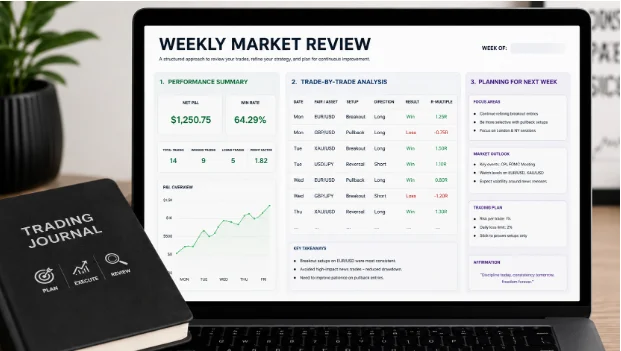
A crypto trading journal is a written log of every trade you make. It records what you bought, why you bought it, when you got in, when you got out, how much you risked, and what happened.
Think of it like a doctor’s chart. A doctor doesn’t just treat you and forget. They write everything down, such as symptoms, diagnosis, treatment, and outcome. Over time, patterns emerge. The same is true for trading.
In 2025 alone, over $154 billion in forced liquidations hit crypto futures markets. That’s not just about a bad market but a discipline problem at scale. While a trading journal doesn’t guarantee profits, it gives you something most losing traders never have: an honest record of their own behavior.
It’s not about tracking your wins. It’s about understanding why you win and why you lose, so you can do more of the former and cut out the latter.
Why Use a Crypto Trading Journal?
A crypto trading journal can be one of the most valuable tools for improving your performance as a trader.
Identifying Patterns: For starters, it helps you identify patterns in your trading activity. By reviewing past trades, you can see which strategies consistently deliver results and which mistakes keep holding you back. This insight makes it easier to refine your approach and make smarter decisions over time.
Discipline: A trading journal also promotes discipline. When you document every trade, you create a sense of accountability that discourages impulsive, emotion-driven decisions and encourages you to stick to your trading plan.
Improving Strategy: A journal allows you to evaluate and improve your strategy using real performance data. You can analyze your risk-reward ratios, optimize entry and exit points, and adjust your tactics based on what actually works rather than assumptions.
Emotional Awareness: Crypto markets are heavily driven by sentiment, with social media platforms like X (formerly Twitter) often shaping investor behavior. A well-maintained trading journal helps traders track the emotions behind their decisions, whether it’s buying because of FOMO (Fear of Missing Out) or selling in response to FUD (Fear, Uncertainty, and Doubt).
By tracking how you feel before and after each trade, you can identify emotional triggers, reduce reactive behavior, and make more consistent, rational trading decisions.
What to Include in Your Crypto Trading Journal
Most traders who try journaling quit because they don’t know what to write. Here’s exactly what to record with every trade.
Core Trade Data
This is the factual layer. No guessing, just the numbers.
- Date and time of the trade
- Asset traded (e.g., BTC/USDT, ETH/USDC)
- Trade type: spot, futures, long, or short
- Entry price and exit price
- Position size: how much you put in
- Stop-loss level and take-profit target
- Fees paid, including exchange fees, funding rates, gas fees
- Profit or loss in both dollar amount and percentage
Example: You bought 0.5 ETH at $1,800 on a breakout setup. You set a stop at $1,700 and a target at $2,000. ETH hit $1,980 and you exited manually. You made $90 but paid $10 in fees. Net: $80. That’s one clean journal entry with no narrative needed yet.
The Context and Emotion Layer
This is where most journals stop being useful. Numbers alone won’t tell you why you deviated from your plan at 2am or why you held a losing trade hoping it would bounce back.
Add these to every entry:
- Reason for the trade: What setup triggered it? (e.g., support bounce, breakout retest, trend continuation)
- Market conditions: Such as, how is the market trending or ranging? What was Bitcoin doing?
- Your emotional state: This includes anxious, confident, bored, or frustrated.
- Did you follow your plan? Yes or no. If no, why not?
- What you would do differently
This second layer is where the real learning happens.
How to Set Up Your Crypto Trading Journal
You don’t need expensive software to start. You need something you’ll actually use every day.
Option 1: Google Sheets or Excel (Free)
This is the best starting point for most traders. Create a spreadsheet with a column for each data point listed above. Add a separate tab for weekly and monthly reviews.
Pros: Free, fully customizable, easy to add formulas for win rate and average profit/loss.
Cons: Takes time to set up. No automatic trade imports.
A basic layout looks like this:
| Date | Asset | Entry | Exit | Size | P&L | Setup | Followed Plan? | Notes |
| June 10 | BTC | $67,200 | $69,100 | $500 | +$14.18 | Breakout | Yes | Clean entry |
Option 2: Dedicated Journal Apps
If you trade frequently and want automatic trade imports, apps like TraderSync, Trademetria, and Edgewonk sync directly with exchanges like Binance, Bybit, Coinbase, and Kraken. They generate charts, win rate breakdowns, and performance reports automatically.
Best for: Active traders who want analytics without manual data entry.
Worth noting: Even with an app, you still need to write your own notes. The emotional layer can’t be automated.
Top 8 Digital Crypto Journal
Below is a list of top 8 crypto journals to help improve your trading:
TraderSync
Source: tradersync.com
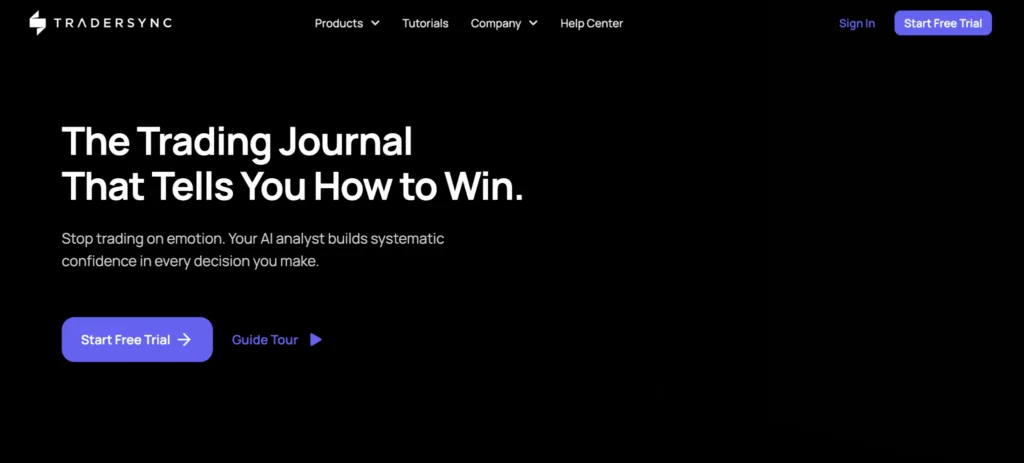
TraderSync stands out as one of the best crypto journal platforms because it goes far beyond simple trade logging. It combines powerful analytics, an AI coach called “Cypher,” which delivers personalized insights on your strategies, and a realistic market replay simulator that lets you backtest crypto trades with historical data.
Pricing is tiered and starts at $22.46/m (pro), $37.46/m (premium), and $59.96/m (elite), with a 7-day free trial. With smooth syncing across 700+ brokers, customizable performance reports, and built-in risk management tools, it gives crypto traders everything they need to spot patterns, stay disciplined, and consistently improve, all in one place.
Trademetria

Source: trademetria.com
Trademetria has earned its reputation as one of the best crypto journal platforms by doing what most tools can’t: turning raw trade data into real, actionable insights. Trusted by over 80,000 traders since 2016, it supports crypto exchanges like Binance, Coinbase, and Bitmex alongside dozens of other markets.
Prices range from the free plan to the basic ($14.10/month) and pro plan ($20.80/month). The platform offers deep performance analytics, AI-powered trade coaching, risk management tools, and a built-in trading simulator to test strategies without risking capital. It’s data-driven, highly customizable, and genuinely built for traders who want to grow.
Edgewonk
Source: edgewonk.com
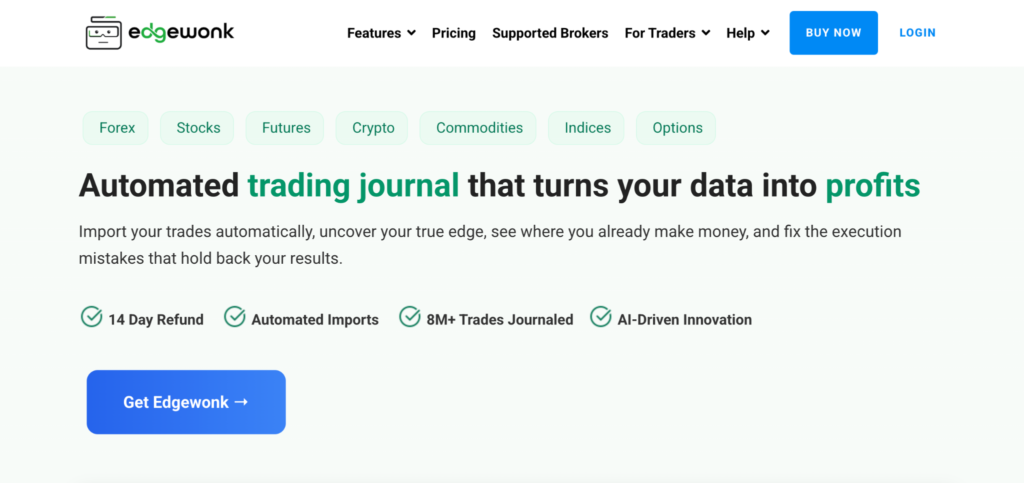
Edgewonk stands out as one of the best crypto trading journal platforms because it goes far beyond simple trade logging. It automatically imports your trades in seconds, then uses over 50 analytics reports and an AI-driven Edge Finder to show you exactly where your profits come from and what’s quietly draining them.
The Psychology Lab connects your emotions and habits directly to your performance data, making discipline measurable. With over a decade of trust, 8 million trades journaled, and support for 200+ brokers, it’s a tool built for traders who are serious about improving.
Pricing starts at $16.50 / month, and if you’re not fully satisfied, you’ll get a 100% refund of your purchase within 14 days.
TradesViz
Source: tradesviz.com
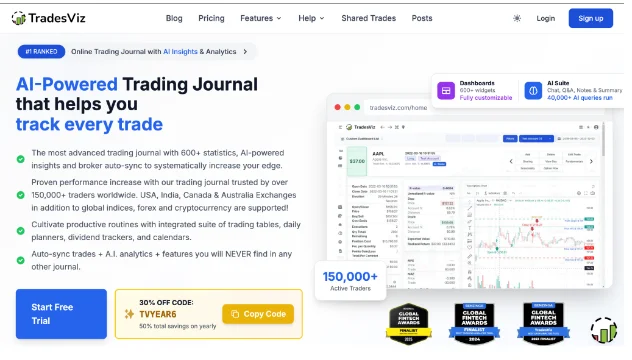
TradesViz is one of the best crypto trading journals for active traders who want deep performance analysis and automated trade tracking. It supports major exchanges such as Binance, Kraken, and OKX through API integrations, making it easy to sync and analyze crypto trades.
The platform offers multi-currency support, commission and fee tracking, advanced security through exchange API connections, and more than 600 analytics metrics to uncover trading patterns.
Pricing ranges from a free plan, a pro plan ($13/month), and a premium plan ($20/month). While it is a journaling and analytics platform rather than a regulated exchange, its detailed reporting, AI-powered insights, and affordable plans make it ideal for serious crypto traders, portfolio managers, and data-driven investors.
TraderVue

Source: tradervue.com
Tradervue is a powerful trading journal that helps crypto and multi-asset traders analyze performance through detailed reporting, automated trade imports, and advanced charting tools.
While it is not a crypto-native platform, it supports trade tracking through broker integrations and offers over 100 analytics reports to identify strengths and weaknesses. Pricing starts at $29.95/month for Silver and $49.95/month for Gold.
The platform integrates with 80+ brokers, supports stocks, options, futures, and forex, and includes broker sync, commission tracking, and TradingView-powered charts. Tradervue is best suited for active traders seeking deep performance analytics, strategy optimization, and disciplined trade journaling.
TradeZella

Source: tradezella.com
TradeZella is a powerful AI-driven trading journal designed to help traders build consistency by automatically importing trades from 500+ brokers and analyzing performance in real time.
The platform offers advanced analytics, trade replay, strategy tagging, and risk tracking, all within one platform, eliminating manual spreadsheets. It doesn’t execute trades or act as a broker, and there are no hidden trading fees, only subscription access (Essential at $29/month for beginners and Premium at $49/month for advanced traders).
TradeZella integrates with platforms like MetaTrader, Interactive Brokers, and others, supporting multiple currencies and instruments. Built with strong data security where users own their data, it’s best for active crypto, forex, and options traders focused on performance improvement and discipline.
Stonk Journal
Source: stonkjournal.com
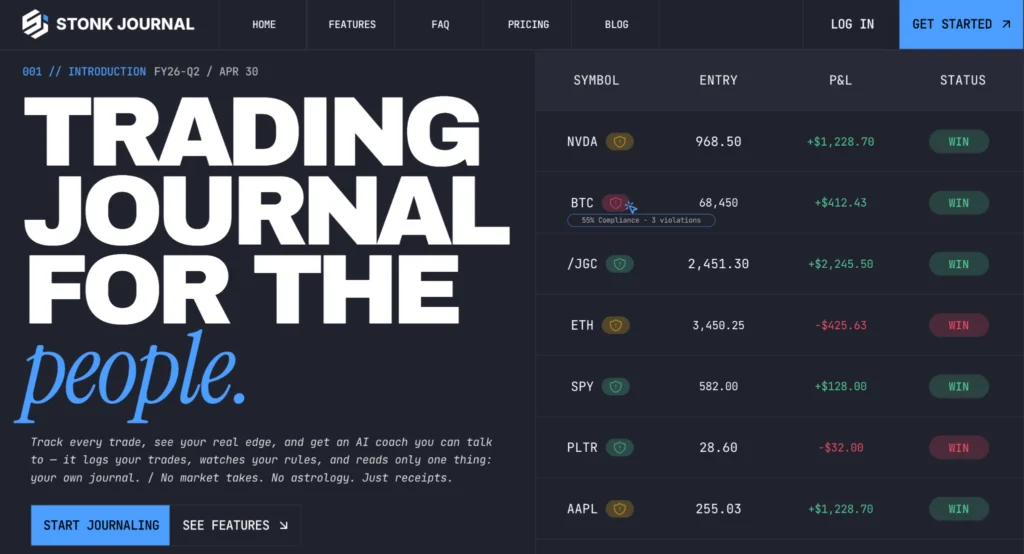
Stonk Journal is an ideal crypto trading journal because it is free, ad-free, and built for fast, manual trade logging with strong analytics. It supports multiple assets, including crypto, offers multi-currency tracking, risk rules, and performance metrics like P&L, win rate, and equity curves.
There are no fees for core use, with a $10/month Pro tier for AI coaching and CSV imports. It works as a secure, privacy-focused PWA with no data selling, making it best for active traders who want simple tracking, deep performance insights, and cross-exchange portfolio organization without complexity.
Myfxbook
Source: myfxbook.com
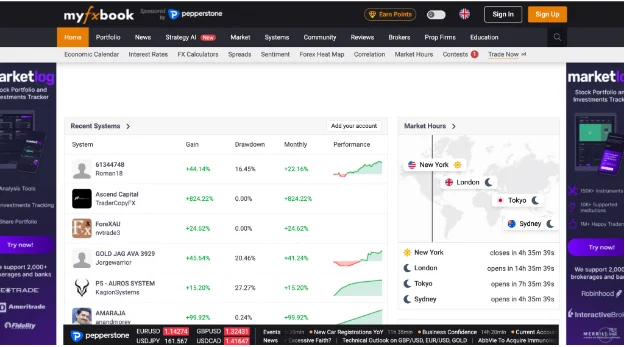
Myfxbook is an automated portfolio tracking and analysis platform designed mainly for forex traders, but it also supports crypto accounts through compatible brokers and exchanges like MetaTrader and Binance.
Instead of offering a standalone crypto journaling app, the platform tracks trades via API connections or manual logging through its community tools. The platform is free, with optional premium features for advanced analytics and an ad-free experience.
It uses secure read-only encrypted connections, supports multiple currencies, and is ideal for traders who want automated trade journaling, performance analysis, and portfolio monitoring rather than brokerage services.
Option 3: Paper Notebook
This is old-school, but it works. Writing by hand slows you down, and that’s actually good. It forces you to think through every trade before logging it. Some traders use a hybrid of paper notes during the session and a spreadsheet at the end of the day.
How to Review Your Crypto Trading Journal
Keeping the journal is step one. Reviewing it is where you actually improve.
Daily review (5 minutes): After each session, read back your entries. Did anything surprise you? Were your notes honest?
Weekly review (20–30 minutes): Calculate your win rate, average win vs. average loss, and your biggest mistakes for the week. Look for patterns; are you losing more on certain setups? At certain times of day?
Monthly review (1 hour): Go deeper. Pull your top 5 winning trades and top 5 losing trades. What do they have in common? Which setups have positive expectancy and which are costing you money?
Example: After a monthly review, a trader notices they lose money on 80% of trades placed after 10pm. They add a rule: no trading after 10pm. That one insight found only because they journaled saves them hundreds of dollars going forward.
Also Read: Best Offline Crypto Wallets: Ranked by the People Who Built Their Security Around One
Tips for Making Journaling a Consistent Habit
Building a journaling habit takes commitment, but the long-term benefits make the effort worthwhile. The key is to make the process as simple and sustainable as possible.
Automate
Whenever possible, automate parts of your workflow. Integrating tools such as TradingView and Google Sheets can help you capture and organize trade data automatically, reducing the time and effort required to maintain your journal. The easier the process becomes, the more likely you are to stick with it.
Incorporate Into Your Trading Routine
You should also make journaling a non-negotiable part of your trading routine. Whether you prefer to record your thoughts before a trading session, after it ends, or both, consistency is what matters most. Treat journaling as an essential step in your trading process rather than an optional task.
Start Simple and Focus on Consistency
When getting started, keep things simple. You don’t need lengthy entries or complex analyses. Even a few notes about your trade setup, emotions, and outcomes can provide valuable insights over time. Focus on showing up consistently rather than creating the perfect journal.
Use Insights to Optimize Your Strategy
Most importantly, use the information you collect to improve your performance. Review your journal regularly to identify patterns, strengths, and recurring mistakes.
Let objective data guide your decisions and strategy adjustments instead of relying on emotions or assumptions. Over time, these insights can help you become a more disciplined and profitable trader.
Common Journaling Mistakes to Avoid
Even traders who keep a journal often sabotage it. Here’s what to watch for.
Only logging winning trades: This defeats the purpose of keeping a journal. Your losses often teach you more than your wins, so record every trade, not just the successful ones.
Being too vague: Writing, “I entered because it looked good,” doesn’t provide any real insight. Be specific. What signals did you notice? What convinced you to take the trade?
Ignoring your emotions: If you felt nervous, impatient, or overly confident when entering a trade, make a note of it. Over time, you’ll spot patterns and discover which emotional states lead to poor decisions. That awareness can significantly improve your trading discipline.
Reviewing your journal too infrequently: A trading journal only works if you use it consistently. Reading it once a month is like paying for a gym membership and never showing up. Aim to review your entries at least once a week.
Rewriting history: Document your reasoning before placing the trade and leave it unchanged afterward. Don’t go back and justify a winning trade that was really based on luck. Honest records lead to meaningful lessons.
Also Read: Beyond the Hype: The Dark Side of AI in Crypto Nobody’s Talking About in 2026
Conclusion
A crypto trading journal won’t predict the market. However, it’s one of the few tools that forces you to look at your own behavior honestly. Most traders lose not because the market is against them but because they never study themselves.
Start with a simple spreadsheet, log every trade, and review it weekly. The patterns will show up, and so will the improvements. Your journal is the closest thing to a proven edge that requires no capital to build.
Frequently Asked Questions
What is a crypto trading journal?
A crypto trading journal is a log where you record every trade you make. Each entry includes the asset, entry price, exit price, position size, fees, profit or loss, your reason for the trade, and notes on your emotional state and plan adherence. It helps you spot patterns, fix mistakes, and trade more consistently over time.
Why do I need a crypto trading journal?
Most traders repeat the same mistakes because they never track them. A journal gives you a factual, honest record of your behavior. Over time, you can see exactly which setups work, which don’t, and what emotional states lead to bad decisions. It’s one of the highest-impact habits in trading, and it costs nothing to start.
What should I include in my crypto trading journal?
Include the date, asset traded, trade type (spot or futures), entry and exit price, position size, stop-loss and take-profit levels, fees, profit or loss, your reason for entering the trade, market conditions, emotional state, whether you followed your plan, and what you’d do differently next time.
How often should I review my trading journal?
Review your journal daily (5 minutes after each session), weekly (30 minutes to calculate win rate and find patterns), and monthly (1 hour to do a deep analysis of your best and worst trades). The reviews matter more than the logging itself.
Can a trading journal make me a profitable trader?
Not on its own. A journal is a feedback tool, not a strategy. But it helps you identify what’s working and what’s not faster than any other method. Traders who review their journals consistently make fewer repeated mistakes and adjust their approach based on real data, not guesses.