Trading psychology often influences trading success more than strategy. While many traders understand technical analysis, emotions such as fear, greed, and FOMO often lead to poor decisions, including exiting profitable trades too early, holding losing positions too long, or making impulsive entries.
Mark Douglas, author of “Trading in the Zone,” emphasized that consistently successful traders think in probabilities rather than seeking certainty. Even experienced traders face emotional challenges, as Ross Cameron’s costly impulsive trading episode illustrates.
This guide explores the psychology behind trading, the emotions that undermine performance, Mark Douglas’s probability-based mindset, and practical techniques to build discipline, improve decision-making, and achieve more consistent results across equity, forex, and crypto markets.
Join UEEx
Experience the World’s Leading Digital Wealth Management Platform
Success in trading is driven more by psychology than strategy. Data on retail day trading indicates that between 70% and 90% of participants lose capital over the long term, even when utilizing strategies that appear reliable during testing.
Fear, greed, FOMO, revenge trading, overconfidence, hope, and analysis paralysis are the seven emotional patterns that wreck accounts. Each one has a specific fix.
Mark Douglas’s core idea still holds up: the market doesn’t need to be predicted. It needs to be traded with a plan you don’t abandon under pressure.
Maintaining small position sizes (1% to 2% risk per trade) remains the most effective strategy for preserving emotional stability.
A trading journal, a written plan, and a recovery protocol for bad days matter more than any indicator.
What Is Trading Psychology?
Trading psychology is the emotional and mental mindset that influences trading decisions, including fear, greed, hope, regret, and cognitive biases. Many experts believe psychology has a greater impact on trading success than technical skills. Mastering it means staying disciplined and consistently following your strategy, regardless of recent wins or losses.
Trading psychology decides more of your results than your strategy does. You can spend months building and backtesting a setup and still watch your account shrink, not because the setup is wrong, but because of what happens in your head the moment real money is on the line.
“The consistent winners think differently from everyone else.”
That’s Mark Douglas, the trader and coach whose 2000 book Trading in the Zone effectively created the field of trading psychology. His point wasn’t that winning traders are smarter. It’s that they’ve trained themselves to execute a plan under pressure, something most traders never fully do.
Ross Cameron, founder of Warrior Trading, described a version of this on his own blog after a session where a loss he was managing carefully ballooned from $12,000 to $16,000 simply because he kept trading through it. Looking back, he was blunt about why:
To prevent a repeat episode, he established a hard circuit breaker: “I’m drawing the line at $5,000.” This became the non-negotiable rule built into his account afterward: once he’s down $5,000 in a day, trading stops, no exceptions without calling his broker directly. It’s a small, concrete example of a bigger truth.
Even traders with years of experience can get pulled into a spiral when a loss hits a nerve. The fix isn’t willpower in the moment but creating a rule set in advance, before the moment arrives.
Why Psychology Outweighs Strategy
Two traders can use the same profitable strategy yet achieve opposite outcomes because of psychology. While Trader A follows the plan consistently, Trader B lets emotions dictate decisions, cutting winners early, holding losing trades too long, and increasing position sizes after winning streaks. Over 100 trades, Trader A remains profitable, while Trader B loses money despite having the same edge.
As trading psychologist Dr. Brett Steenbarger, author of The Daily Trading Coach and longtime mentor to professional traders, has argued across his books, the ability to manage your own emotional state is a more reliable predictor of trading success than raw analytical skill or technical knowledge.
Research supports this pattern. A long-term study by finance professors Brad Barber and Terrance Odean on the Taiwan Stock Exchange found that only about 1% of active day traders consistently outperformed the market after costs.
Similarly, broker and regulator data show that 70–90% of retail traders lose money over time, with poor trading behavior, not a lack of knowledge, being the primary reason for underperformance.
A Short History of Trading Psychology
For decades, trading education focused almost entirely on charts, indicators, and fundamentals, with the assumption that better analysis meant better results. That started to shift when Mark Douglas published The Disciplined Trader in 1990, one of the first books to argue that psychology, not analysis, was the real bottleneck for most traders.
His follow-up, Trading in the Zone, released in 2000, became close to required reading in trading circles and pushed the idea of “thinking in probabilities” into the mainstream. Around the same time, behavioral economists like Daniel Kahneman and Amos Tversky were building the academic case for the same idea from a different angle; that work eventually earned Kahneman a Nobel Prize for showing how predictably irrational people are with money.
Today, trading psychology coaching is its own small industry, and most serious brokers and prop trading firms build risk controls specifically designed to protect traders from their own worst instincts.
The Four Stages of Trading Psychology
Most traders move through a rough sequence as they mature:
Unconscious incompetence: You don’t yet realize your emotions are sabotaging your trades. You blame the strategy, the market, or bad luck.
Conscious incompetence: You notice the pattern (you keep cutting winners short, you keep revenge trading), but you don’t yet have tools to stop it.
Conscious competence: You can manage your emotions, but it takes real effort and constant self-checking.
Unconscious competence: Discipline becomes close to automatic. This is where experienced, consistently profitable traders operate.
Getting from stage one to stage four is really what this whole guide is about.
The Neuroscience Behind Emotional Trading
Trading psychology is deeply rooted in biology, not personal weakness. When you see losses, your brain’s amygdala reacts as if facing a physical threat, often overriding the prefrontal cortex responsible for rational decision-making.
This stress response triggers cortisol, which can impair judgment for 20–45 minutes after a losing trade. Research from the American Psychological Association shows that stress disrupts clear thinking, while the National Institute of Mental Health notes that anxiety narrows focus and encourages impulsive decisions, common during losing streaks.
Winning trades also affect the brain by releasing dopamine, the same reward chemical linked to gambling. This can make profitable streaks feel addictive, leading traders to chase the emotional high of winning rather than following a disciplined trading strategy. Understanding these biological responses is essential for maintaining emotional control and making more consistent trading decisions.
Daniel Kahneman and Amos Tversky’s research on loss aversion, part of the prospect theory work that later earned Kahneman a Nobel Prize in economics, found something specific and measurable:
“Losses are felt about 2 to 2.5 times more intensely than equivalent gains.”
That single finding explains a lot of trading behavior on its own: why cutting a loss feels so much harder than it should, and why traders will fight to avoid a small loss while gladly booking a small win.
A few other mental shortcuts, documented across behavioral finance research, including work published in outlets like the Journal of Behavioral Finance, show up constantly in trading:
Recency bias: Your last few trades color your confidence going into the next one, even though each trade is a separate, independent event.
Anchoring: The first price you saw becomes a mental reference point that’s hard to let go of, even after the market has clearly moved on.
Gambler’s fallacy: After several losses in a row, it’s tempting to feel “due” for a win, which often leads to oversized position sizes at exactly the wrong time.
The Emotional Trading Cycle
Most losing trades that turn into disasters follow a familiar arc: optimism on entry, excitement as it moves your way, euphoria near the top, a flicker of anxiety when it turns, denial as losses build, fear as they accelerate, and finally either panic-selling at the bottom or, worse, doubling down out of desperation.
Recognizing this cycle while it’s happening, not just in hindsight, is most of what separates a manageable loss from an account-wrecking one.
Mark Douglas’s Framework for Trading Psychology
Mark Douglas started trading in 1978, lost nearly everything within his first year, and spent the rest of his career studying why. He began coaching traders in 1982 and later founded Trading Behavior Dynamics, working with floor traders, fund managers, and retail traders alike.
His central argument, laid out in The Disciplined Trader (1990) and Trading in the Zone (2000), was that the fix for inconsistent trading lives in the trader’s mind, not in a better indicator. More on his work is available at markdouglas.com.
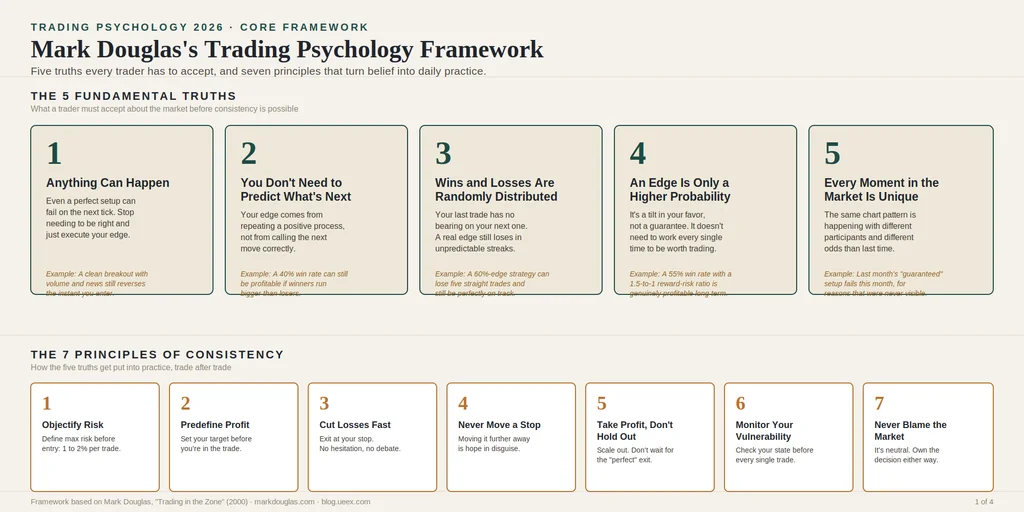
Douglas built his approach around this set of ideas:
1. Anything can happen: No matter how good your analysis is, the market can do anything on the next tick. Accepting this fully means you stop needing to be right and start focusing on executing your edge.
2. You don’t need to know what happens next to make money: Your edge comes from repeating a positive-expectancy process, not from predicting any single trade correctly. A strategy that wins 40 percent of the time can still be very profitable if the winners are big enough.
3. Wins and losses are randomly distributed, even with a real edge: Five losses in a row doesn’t mean a win is due. Five wins in a row doesn’t mean a loss is coming. Your edge plays out over a large number of trades, not in a predictable sequence.
4. An edge is only a higher probability, not a guarantee: A 55 percent win rate with good reward-to-risk is a real edge and a genuinely profitable one, even though it’s wrong nearly half the time.
5. Every moment in the market is unique: A setup that looks identical to one that worked last month is still happening with different participants, different context, and different odds. Pattern recognition is useful, but overconfidence in a “sure thing” is not.
The Principles Behind Consistent Trading
Douglas distilled his approach into a short list of operating beliefs that consistent traders hold, in one form or another:
Objectively identify your edge before you enter.
Predefine the risk on every single trade.
Accept that risk completely and be willing to let the trade go.
Act on your edge without hesitation once your conditions are met.
Take profits as the market makes them available, rather than holding out for more.
Continually watch for your own vulnerability to mistakes, especially when tired, stressed, or overconfident.
Never blame the market. It’s neutral and doesn’t know you exist.
None of this is mystical. It reads almost like a checklist for a mechanical trading system, which is the point. The goal is to make good decisions a habit rather than something you have to will yourself into every morning.
Join UEEx
Experience the World’s Leading Digital Wealth Management Platform
These are the seven emotional patterns responsible for most of the damage in trading accounts:
Fear: causes hesitation, early exits, or avoiding valid setups altogether
Greed: leads to oversized positions, ignored stop-losses, and holding winners too long
FOMO (fear of missing out): triggers impulsive entries and chasing prices after a big move
Revenge trading: an emotional reaction to a loss that leads to reckless, oversized trades
Overconfidence: post-win euphoria that drives excessive risk-taking
Hope: holding a losing position while waiting for an unrealistic reversal
Analysis paralysis: overthinking that causes missed entries or late, poorly-priced ones
Fear: The Paralysis Emotion
Fear shows up as fear of losing, fear of missing out, and fear of being wrong. The COVID-19 crash is a clean example: the S&P 500 fell 34% in 23 trading days between February 19 and March 23, 2020, with the VIX spiking to an all-time closing high of 82.69.
Traders without a plan often froze, then sold near the bottom out of panic. Those with predefined exit rules acted without the spiral, and the index fully recovered by August 2020.
How to manage fear:
Predefine your entry, stop-loss, and target before you’re in the trade
Use actual stop-loss orders so you’re not making a decision mid-trade
Risk only 1% to 2% of your account per trade so a loss doesn’t feel catastrophic
Reframe small losses as the cost of doing business, not as failures
Greed: The Amplification Emotion
Greed shows up as refusing to take-profit because you want more. During the January 2021 GameStop short squeeze, the stock ran from under $20 to an intraday high of $483 on January 28.
Traders who took profit in the $100 to $200 range walked away with major gains. Meanwhile, traders holding out for “$1,000” watched the stock close that same day at $193.60, well off the peak, and fall much further afterward.
How to manage greed:
Set your take-profit level before entering and don’t move it after you’re in
Scale out: take partial take-profit at a set target and let the rest run with a trailing stop
Track wins of any size in your journal, not just the huge ones, to train yourself to value consistency
FOMO: The Impulse Emotion
FOMO is fear and greed combined, and social media makes it worse. For instance, Bitcoin’s run to nearly $69,000 in November 2021 pulled in a wave of first-time buyers right at the top.
It spent the following year falling, eventually bottoming near $15,500 in November 2022, a decline of more than 75%. Traders who bought because everyone else seemed to be making easy money were, in many cases, buying the exact top of the cycle.
How to manage FOMO:
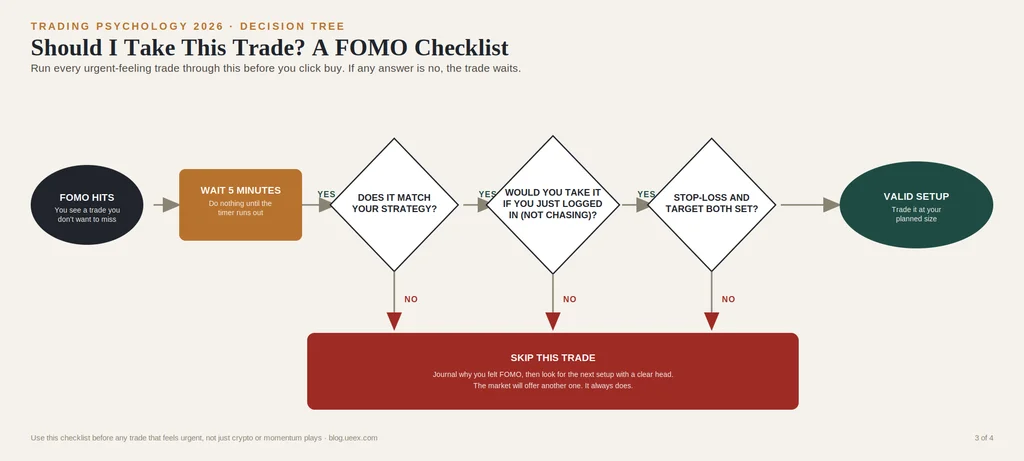
Ask: Does this trade actually match my strategy, or am I just chasing a feeling?
Mute trading-related social media and chat rooms during market hours
Remind yourself that the market produces new setups constantly. You are not missing your only chance.
Revenge Trading: The Destructive Cycle
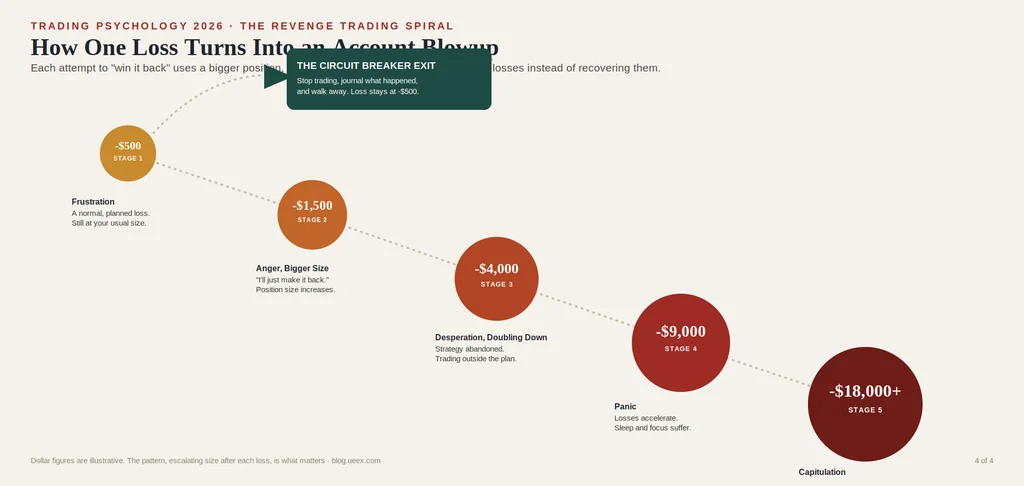
Revenge trading happens after a loss. This is the pattern behind Ross Cameron’s $12,000-to-$16,000 loss, described above. It’s arguably the most dangerous of the seven because each attempt to “get even” tends to make the underlying loss worse. That kind of pre-committed rule, set before the emotional moment hits, is the real defense against revenge trading.
How to recover from a revenge trading urge:
Close the platform immediately and physically step away
Do something physical: a walk, a workout, even just splashing cold water on your face
Write down what happened while it’s fresh, without minimizing it
Don’t trade again that same day; no exceptions
Overconfidence: The Winner’s Trap
Overconfidence tends to follow a winning streak, when dopamine and ego combine to make traders feel they have figured out the market rather than recognizing favorable conditions or ordinary variance.
The 2021 bull market pulled in traders who attributed easy gains to skill; many gave those gains back, and more, once 2022 turned bearish.
How to manage overconfidence:
Track whether your wins are happening because of your process or because the broader market is doing the work for you
Force a review after any streak of three or more winning trades
Keep your position sizing fixed regardless of a recent hot streak
Keep a reminder of your worst loss somewhere visible. It’s a good ego check.
Hope: The Dangerous Optimism
Hope is what keeps a trader in a losing position past the stop-loss, waiting for a reversal that may never come.
The “diamond hands” culture around AMC Entertainment in 2021, when the stock ran from around $2 to an all-time high of $72.62 (over $700 on a post-split adjusted basis), encouraged holders to never sell regardless of price. Many who bought near the top and held through the following year watched most of that value disappear.
How to manage hope:
Treat your stop-loss as non-negotiable the moment you set it
Add a time-based rule: if a trade isn’t working within a set window, exit regardless of the price
Before entering, decide the exact loss you’re willing to accept, and honor it if it happens
Analysis Paralysis: The Overthinking Trap
This one hits more experienced, research-driven traders. Too many indicators, too many news feeds, and a need for a “perfect” setup can freeze you long enough to miss the trade entirely or force you into a much worse entry price after the move has already happened.
How to manage analysis paralysis:
Limit yourself to two or three key decision inputs, not ten
Write your entry criteria down in advance. If they’re met, act.
Accept that you’ll never have perfect information. A reasonable edge acted on beats a perfect setup you missed.
Treat every skipped trade as a data point worth reviewing later, not a mistake to dwell on
Trader Personality Types and How to Work With Yours
Not every trader struggles with the same emotion, and understanding your natural tendency helps you build the right guardrails.
1. The Analyst
This type of personality is usually driven by logic.
Strengths: Deep research, disciplined risk management, meticulous documentation. Weaknesses: Analysis paralysis, missed entries, discomfort with gut calls.
Fixes:
Set a 10-second entry timer to force action
Reframe edge as probability, not certainty
Reward good execution over just winning trades
Allocate 5% of capital to intuition-building trades
2. The Intuitive
The intuitive trades on feel and pattern recognition, which works until it turns into impulsiveness.
Strengths: Fast decisions, sharp pattern recognition, comfort with uncertainty. Weaknesses: Impulsivity, weak risk control, rule-breaking.
Fixes:
Require a written plan before every trade
Automate stop-losses to remove discretion
Trade smaller size for flexibility without blowing up the account
Separate a “learning account” from the core account
3. The Aggressive
The aggressive trader handles risk and volatility well but tends toward overleveraging and revenge trading.
Trading success depends less on strategy and more on managing the emotions that sabotage it. Here are six proven tools to build discipline and consistency.
1. Keep a Trading Journal: Your journal is a mirror for your psychology. Track your emotional state (1–10) before, during, and after each trade, plus whether you followed your plan. Over time, patterns emerge; for example, cutting winners early on high-stress days but holding losers on Fridays hoping for a rebound. Once you spot the pattern, you can build a rule around it.
2. Build a Pre-Trade Routine: Like elite athletes, traders benefit from consistent rituals. A simple 30-minute morning routine, reviewing your journal, checking the economic calendar, doing breathing exercises, and stating your intentions primes the rational brain before the market opens.
3. Use the 4-7-8 Breathing Technique: inhale for 4 counts, hold for 7, and exhale for 8. Research shows this pattern activates the parasympathetic nervous system via the vagus nerve, lowering heart rate and blood pressure. Use it before entries, after losses, or when FOMO strikes.
4. Visualize Emotional Challenges: Mentally rehearse a trade going against you and calmly execute your stop. The brain doesn’t fully separate imagined from real experience, so this trains discipline before real money is on the line.
5. Rate Your Emotional State: Before every trade, score yourself 1–10. Only trade in the 4–6 “optimal zone.” Above 7, take a 15-minute break and reassess.
6. Master Position Sizing: The 1% rule; never risking more than 1% of your account per trade is the professional standard for balancing growth and survival. At 1% risk per trade, a ten-trade losing streak results in a ~9.5% drawdown, compared to a ~65% drawdown when risking 10% per trade.
Note that mastering these six tools won’t eliminate emotion from trading, but it will stop emotion from driving your decisions.
Recovery Protocols: What to Do After Emotional Trading Mistakes
Ross Cameron points to two main failure patterns: trading without a defined edge and abandoning a good strategy under emotional pressure. The four protocols below give you a structured way to reset after each.
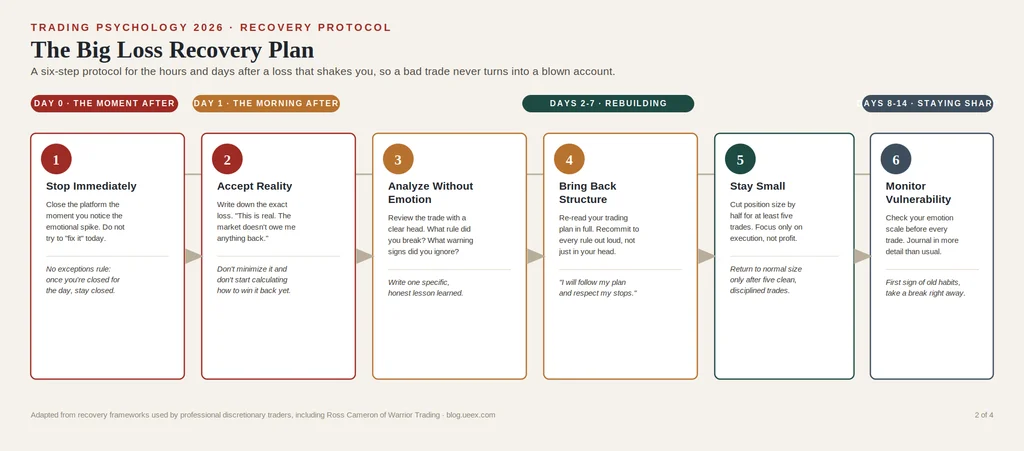
1. Big Loss Recovery Plan (BLRP):
Day 0: Stop trading immediately; no “recovery” attempts. Journal the loss factually, stating what happened with no excuses.
Day 1: Review the trade with a clear head. Identify the rule you broke and the warning signs you ignored. Re-read your trading plan and recommit to it aloud.
Days 2–7: Cut position size 50% for at least 5 trades. Prioritize clean execution over profit.
Days 8–14: Track your emotional state before every trade. At the first sign of emotional decision-making, stop and take a break.
2. Post-Win Overconfidence Prevention: After a 3%+ account gain, step away from screens for 15 minutes before your next move. Journal the win as one data point in a large sample, not proof of skill. The next day, hold or reduce position size, and review a week later whether discipline slipped.
3. Revenge Trading Intervention: Recognize the urge, close all positions (including winners), and set a mandatory 30-minute break. Use the time for a walk or cold water on your face to calm your nervous system. Don’t resume the same day, and trade the minimum size for your next 3 trades. Also keep a personal trigger list; common ones include back-to-back losses, a loss exceeding a set dollar amount, or Friday afternoons.
4. FOMO Management: Set a 5-minute timer before chasing any move. Afterward, run a quick checklist: Does this fit my strategy? Do I have a stop-loss and take-profit? Am I chasing or planning? If you can’t answer clearly, skip the trade. Traders using this filter report cutting FOMO trades by roughly 80%.
Trading Psychology in Algorithm-Dominated Markets
A large share of equity trading volume today runs through algorithms, and that changes the psychological playing field. Algorithms don’t feel fear, greed, or FOMO. They execute the same way every time, which is exactly the discipline human traders are trying to build.
That consistency cuts both ways. Automated systems can also be built to exploit predictable retail behavior, like the clustering of stop-loss orders just below obvious support levels or the rapid price moves that tend to trigger FOMO buying right before a reversal.
None of this means retail traders can’t compete. However, it does mean the emotional discipline covered throughout this guide matters more now, not less, since the traders on the other side of your trade increasingly have no emotions to exploit in return.
Trading psychology isn’t a soft add-on to a solid strategy. For most traders, it’s the actual deciding factor. The financial industry spends heavily on charting tools and indicators, but the research keeps pointing back to the same conclusion: the gap between traders who succeed and traders who don’t lies mostly in behavior, not analysis.
You can’t switch off fear, greed, or hope because they’re built in. What you can do is notice them early and have a plan ready before they show up. That’s really the whole game. The traders who last aren’t the ones who never feel these emotions but the ones who’ve built a system that keeps working even when they do.
Frequently Asked Questions
What is trading psychology?
Trading psychology refers to the emotions and mental habits influencing trading decisions. Mastering fear, greed, and discipline often matters more than strategy or market knowledge for consistent profitability.
Why do most traders lose money?
Long-term studies show that 70–90% of active traders lose money, largely because emotions override discipline. Common mistakes include abandoning trading plans, holding losing positions too long, taking profits too early, and letting fear or greed dictate decisions.
How do I stop emotional trading?
Predefine every trade with clear entry, stop-loss, target, and position size. Keep a trading journal, risk only 1–2% per trade, and create a recovery plan for losing streaks to reduce emotional decisions and improve long-term trading discipline.
How long does it take to master trading psychology?
There’s no set timeline, but disciplined traders typically develop emotional control over months or years. Recognize your emotional patterns and manage them consistently until discipline becomes second nature. Maintaining a written trading plan and journaling regularly can significantly accelerate this improvement.
Disclaimer: This article is for educational purposes only and isn’t financial advice. Trading carries a real risk of loss and isn’t right for everyone. Do your own research, never risk money you can’t afford to lose, and talk to a licensed financial advisor before making trading decisions. UEEx.com makes no promises about trading profitability and isn’t responsible for trading losses.
Disclaimer: This article is intended solely for informational purposes and should not be considered trading or investment advice. Nothing herein should be construed as financial, legal, or tax advice. Trading or investing in cryptocurrencies carries a considerable risk of financial loss. Always conduct due diligence before making any trading or investment decisions.
Trade with proof of Reserves
UEEx publish monthly audits and third party verification on every listed market.