You just joined your first crypto Discord server. Someone types: “GM ser, ready to ape into this gem? LFG! WAGMI, fam. 💎🙌”
You have no idea what any of that means. That’s normal. Cryptocurrency slang is its own language, and it changes fast. Some words came from drunk typos. Others came from gaming, hip hop, or Wall Street. A few were built specifically to warn you about scams.
This guide breaks down the cryptocurrency slang terms you’ll actually run into in 2026, what they mean, where they came from, and how to use them without sounding like you’re trying too hard. We’ll also cover the words that should make you stop and think twice, because in crypto, not knowing the slang can cost you real money.
Key Takeaways
- Learn the basics first: HODL, FOMO, FUD, DYOR, and ATH cover most everyday conversations.
- The same word can mean different things in different communities. “Ape” among DeFi traders is not the same as “ape” in a meme coin Telegram group.
- Slang tells you what a community values. HODL signals conviction. WAGMI signals support. Degen signals a high appetite for risk.
- Scam-related terms like rug pull and honeypot exist because people lost money learning them the hard way. Know them before you need them.
- Crypto language moves fast. What’s trending in 2026 (jeet, trenches, CT) may sound dated by 2028. Stay flexible.
Why Crypto Slang Actually Matters
Crypto slang is not just for decoration; it carries real information. When someone warns you about a “rug pull,” they’re telling you a project might steal your money.
When a community says “WAGMI,” they’re telling you to hold steady through a rough patch. When your feed fills up with “FUD,” someone wants you to panic sell, and it might be working exactly as planned.
Missing this vocabulary means missing warnings, missing context, and sometimes missing money. Those are the real stakes behind learning cryptocurrency slang, not just fitting in on Crypto Twitter.
The Core Cryptocurrency Slang Everyone Should Learn First
Before you touch platform-specific slang or 2026 trends, start with these five terms. They show up in nearly every conversation about crypto.
Essential Trading & Market Terms
HODL (Hold On for Dear Life)
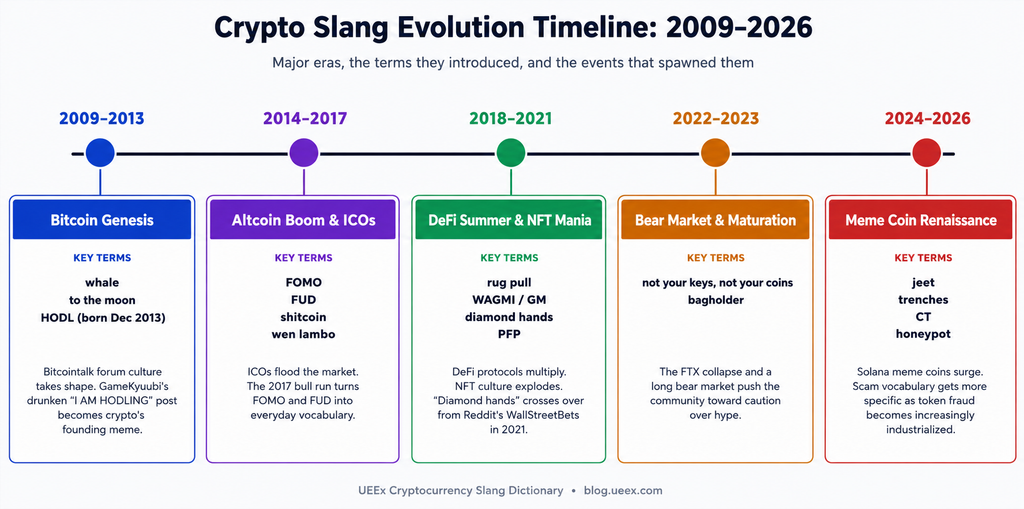
HODL started as a typo. On December 18, 2013, a Bitcointalk forum user named GameKyuubi posted a message titled “I AM HODLING” while Bitcoin’s price was falling hard from a recent high. He’d been drinking, misspelled “holding” twice, and gave up trying to fix it. He wrote that he was a bad trader and planned to hold his coins no matter what happened next.
The typo spread within hours. Today HODL means “hold on for dear life” or holding your crypto through price swings instead of panic selling.
Example: “Bitcoin dropped 20% this week, but I’m HODLing until 2030.”
Related terms: diamond hands (holding with strong conviction) and paper hands (selling at the first sign of trouble).
“The evolution from HODL to diamond hands shows how crypto absorbs outside memes and makes them its own. Every bear market adds a new word to the vocabulary of holding on.”
FOMO (Fear of Missing Out)
Borrowed from general internet slang, FOMO in crypto describes the anxious, impulsive buying that happens when a price is shooting up and you don’t want to be left out.
Example: “I FOMO’d into that coin right at the top, and I’m down 60% now.”
The fix is boring but effective: set a plan before you buy, use dollar cost averaging, and ignore green candles that are trying to rush you.
FUD (Fear, Uncertainty, Doubt)
FUD is negative information, real or fake, spread to shake confidence in a project or the market as a whole. The term came from 1970s tech marketing and got picked up by crypto around 2017.
Not all FUD is fake. Some of it is a legitimate warning. The trick is checking the source and figuring out who benefits if you believe it.
Example: “That article calling the project dead is mostly FUD; the writer is shorting the token.”
DYOR (Do Your Own Research)
“DYOR” means verify things yourself instead of trusting a stranger’s hot tip. In practice, that means:
- Reading the whitepaper
- Checking whether the team is public and verifiable
- Looking for a completed smart contract audit
- Understanding how the tokens are distributed
- Watching for red flags like anonymous founders or guaranteed returns
Example: “This project looks solid, but DYOR, don’t take my word for it.”
Note: People sometimes use DYOR to dodge responsibility after giving bad advice. Treat it as a starting point, not a shield.
ATH and ATL (All-Time High / All-Time Low)
ATH is the highest price an asset has ever reached, while ATL is the lowest. Bitcoin has set several new all-time highs over the past two years as institutional demand grew, which is a good moment to track ATH and ATL trends on UEEx charts before deciding when to buy or sell.
Example: “Bitcoin hit a new ATH in late 2025.”
Keep in mind that new highs tend to trigger FOMO, while new lows tend to trigger fear, which is often the wrong reaction.
Price Movement & Sentiment Terms
To the Moon / Mooning
“To the moon” describes a fast, sharp price increase. It comes from the same space-race optimism that gave crypto its early “we’re going to space” energy back in 2013 and 2014.
Example: “Wen moon?” is a common (half-joking) way of asking when a price will finally take off.
Bullish and Bearish
These come straight from traditional finance. Bulls attack by thrusting their horns upward, so “bullish” means expecting prices to rise. Bears swipe downward, so “bearish” means expecting prices to fall.
Example: “I’m bullish on Ethereum going into next year.”
Rekt
Short for “wrecked,” this gaming term crossed over into crypto to describe a major financial loss, usually from bad leverage, a scam, or buying at the top.
Example: “I got rekt on that 20x leverage trade and lost 80% in a day.”
Pump and Dump
This is a coordinated scheme where a group quietly buys a low-value token, hypes it up to attract new buyers, then sells everything once the price spikes, leaving latecomers holding a crashing asset. It’s illegal in regulated securities markets and extremely common with low-cap tokens that have thin trading volume.
Warning signs: private Telegram “pump groups,” promises of guaranteed gains, and tokens with almost no real trading history.
Buy the Dip (BTD / BTFD)
A trading strategy that encourages buying an asset after a temporary price drop in anticipation of a rebound. The logic is that fear creates opportunity. Popular during bull markets but can be risky if prices continue falling in a bear market. BTFD (“Buy the F***ing Dip”) is the more aggressive, meme-driven version.
Example: “Bitcoin dropped to $60K, might be time to BTD.”
This works best in a market that’s generally trending up. In a prolonged downturn, buying every dip can mean buying every step down.
Risk, Loss, and Warning Slang
Bagholder
This is originally a traditional finance slang, adapted by the crypto community. It refers to someone left holding an asset that’s lost most or all of its value, often out of hope of recovery rather than logic.
Example: “I’m a bagholder on a handful of dead tokens from an old ICO.”
Avoid becoming one by using stop losses, taking losses when needed, and avoiding emotional averaging down.
Rug Pull
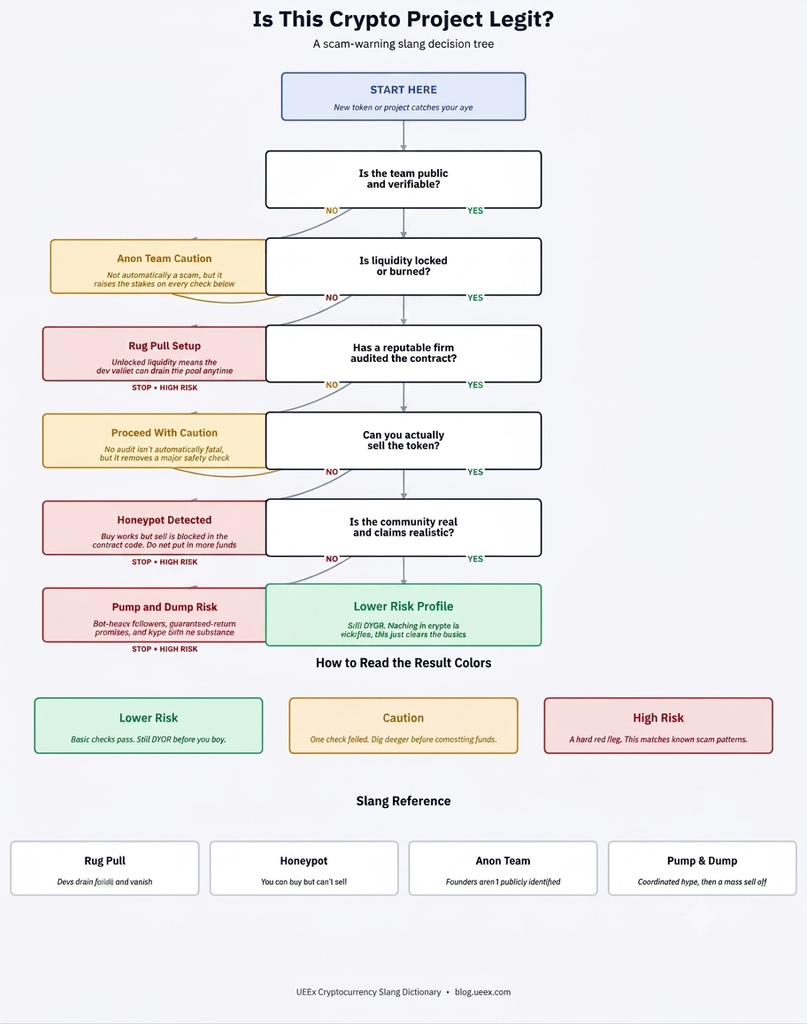
A rug pull is when developers drain a project’s funds and disappear, leaving investors with a worthless token. This can happen fast (pulling liquidity in one transaction) or slowly (the team quietly selling their holdings over weeks).
Nearly $6 billion was lost to rug pulls across the Web3 ecosystem in 2025, according to a report by crypto analytics firm DappRadar.
The most famous case is still the Squid Game token from November 2021, which surged past $2,800 before its developers drained the liquidity pool and the price collapsed to zero within minutes.
How to reduce risk: check whether liquidity is locked, whether the team is public, and whether the contract has actually been audited by a real firm, not just claimed to be.
“A rug pull almost always leaves the same fingerprints beforehand: an anonymous team, unlocked liquidity, and a community that’s mostly bots. If you slow down and check those three things, you avoid most of them.”
Honeypot
A honeypot is a token you can buy but can never sell, because the contract code blocks sell transactions. It’s one of the more mechanical scams to detect, since token scanner tools can usually flag it before you buy.
Exit Scam
Similar to a rug pull, but usually describes an entire platform or exchange shutting down and disappearing with user funds, rather than a single token project. OneCoin and PlusToken are well-documented historical examples.
Community Culture and Social Slang
Below are slang mainly used within a social team
Greeting & Community Building Terms
GM (Good Morning)
It was popularized on crypto Twitter and NFT communities around 2021. More than a greeting, GM signals optimism, community, and a shared belief in Web3’s future. It’s commonly used on X, Discord, and Telegram regardless of time zone, making it a symbol of belonging rather than the time of day.
The counterpart is GN (Good Night). In 2026, some Web3 communities even reward consistent GM participation through engagement campaigns and on-chain incentives.
Also Read: Layer 2 Blockchain: The Complete Guide to Blockchain Scaling Solutions
WAGMI (We’re All Gonna Make It)
Popularized by the bodybuilding community through the late Zyzz before becoming a crypto rallying cry during the 2020–2021 bull market. It is a phrase expressing collective optimism, resilience, and the belief that the community will succeed together.
Example: “The market’s down, but WAGMI, fam.”
Why it matters: WAGMI boosts morale during market downturns and reinforces community spirit. Its opposite, NGMI (“Not Gonna Make It”), is commonly used to criticize poor investment decisions or weak conviction.
LFG (Let’s F***ing Go)
An expression of excitement, confidence, or rallying support. It is commonly used to build hype before token launches, major announcements, price rallies, exchange listings, or key community milestones.
Real Usage: “New token launches in 10 minutes. LFG!”
Personality Types & Trader Archetypes
Every crypto community has its recognizable characters. Here’s how to spot them by their vocabulary.
Diamond Hands 💎🙌
Popularized by Reddit’s WallStreetBets during the 2021 GameStop short squeeze before becoming a crypto staple. It means holding onto an asset through sharp price swings instead of panic selling, driven by long-term conviction rather than short-term fear.
Example: “Bitcoin is down 40%, but I’m keeping my diamond hands.”
Why it matters: Diamond hands symbolize resilience and belief in an asset’s long-term potential. The opposite is Paper Hands.
Paper Hands 📄🙌
This means selling an asset quickly when prices fall or market fear sets in, often to avoid further losses. Paper hands are usually driven by fear, uncertainty, and doubt (FUD) rather than conviction.
Example: “He had paper hands and sold right before the rally.”
Not always bad: Exiting a weak project or cutting losses can be a disciplined risk-management decision. Knowing when to hold, and when to sell, is often more important than the label.
Whale
A whale is an individual or entity holding a huge amount of a cryptocurrency, large enough to move the market with a single trade, making them closely watched by traders.
The term comes from casino slang for high-rolling gamblers. Well-known crypto whales include Michael Saylor’s Strategy (formerly MicroStrategy) and El Salvador.
Example: “A whale just moved 50,000 BTC, watch for price action.”
Degen
Short for “degenerate,” used almost as a badge of honor in crypto circles. A degen trades high-risk, speculative assets like meme coins with minimal research, chasing big multiples and accepting they’ll get rekt often.
Example: “Full degen mode tonight, just aped into a brand-new token with zero research.”
OG (Original Gangster)
A crypto OG is someone who got into the market early, typically during Bitcoin’s early years or the rise of Ethereum, and stayed committed through multiple bull and bear cycles. The term, borrowed from hip-hop culture, is a badge of respect for veteran investors and builders.
Example: “She’s an OG; she bought Bitcoin when it traded below $100.” Bitcoin and Ethereum are widely regarded as the original OG crypto projects.
Normie and No-Coiner
A normie is someone outside the crypto community, while a no-coiner specifically refers to someone who owns no cryptocurrency and often believes digital assets will fail. The term usually carries a skeptical or dismissive tone, although some crypto enthusiasts use it playfully when encouraging newcomers to explore the space.
Example: “My normie friends still think Bitcoin is just a fad.”
Shrimp
A small retail investor with modest holdings. It’s not an insult, just an acknowledgment that everyone starts small.
Example: “I’m just a shrimp, but I’m stacking sats consistently every week.”
Chad
Started as an internet meme culture. “Chad” refers to someone viewed as exceptionally confident, successful, or dominant. In crypto, it’s often used for traders who boast about huge wins or make bold, high-conviction trades. Depending on the context, it can be either a compliment or playful mockery.
Real usage: “Look at this Chad bragging about his 100x trade.”
2026 Emerging Slang
Every market cycle adds new words. Here’s what’s actually circulating in crypto communities in 2026.
Jeet
“Jeet” describes someone who panic-sells too early, often at a small profit or a modest loss, right before a token takes off. It’s become one of the most common insults in Solana meme coin communities, where patience (or the lack of it) can mean the difference between a small gain and a huge one.
Example: “Stop being a jeet, this project still has room to run.”
Trenches
“The trenches” refers to the world of risky, early-stage, low-cap tokens, usually found in Telegram groups and Discord servers dedicated to brand-new projects. It’s a high-casualty environment. Most projects that launch here either go nowhere or rug pull entirely.
Example: “Spent all night in the trenches looking for the next gem.”
CT (Crypto Twitter)
CT refers to the crypto community on X, which functions as the industry’s main information hub, rumor mill, and sentiment tracker. Usually driven by influencers with thousands of followers shaping narratives, it has its own subcultures, including Bitcoin maximalists, DeFi traders, NFT collectors, and meme coin degens, all arguing in the same replies.
Real Usage: “CT is going crazy over this new Ethereum proposal.”
Alpha
“Alpha” means valuable, early, non-public information, borrowed from the investing term for returns that beat the market average. In practice, most “alpha” shared in private groups is either already public or simply wrong, so treat it with the same skepticism as any other tip.
Real Usage: “I got alpha on a new project launching next week.”
Ser
A misspelling of “sir” that evolved into a popular crypto meme. It is an ironic or affectionate way to address someone in crypto communities, especially on X, Discord, and Telegram.
Common phrases include “Wen moon, ser?” and “Thank you for the alpha, ser.” Despite its humorous roots, it’s now a widely recognized part of Web3 slang.
IYKYK (If You Know, You Know)
A way of referencing inside knowledge that only community insiders will fully understand, often used to build a sense of exclusivity around a project or announcement.
Real Usage: “Accumulating more before the announcement… IYKYK 👀”
SAFU (Funds Are Safe)
SAFU means “funds are safe,” used both sincerely and sarcastically. It started as a typo meme in 2018, after Binance CEO Changpeng Zhao tweeted “Funds are safe” during a maintenance outage, and a YouTube creator turned it into a parody video called “Funds Are Safu.”
Binance leaned into the joke and later named its actual $1 billion emergency insurance reserve the Secure Asset Fund for Users, or SAFU.
Example: “Don’t worry, your funds are SAFU,” said half-seriously whenever an exchange has a hiccup.
Also Read: Crypto Trading Journal: How to Build One That Actually Improves Your Trading
Trading & Investment Slang
Below are slang words mainly used for trading
Leverage & Advanced Trading Terms
Ape / Aping In
To “ape” means buying a token impulsively with little or no research, usually driven by FOMO. Traders often “ape in” hoping for quick gains, but the strategy carries high risk and more often leads to losses than profits. Occasionally, early apes catch explosive rallies, making the term a staple of degen trading culture.
10x, 100x, 1000x
This is crypto shorthand for return multiples. A 10x means a 10-fold return, while 100x and 1000x refer to far rarer gains that typically require investing in very early-stage, low-market-cap projects. Chasing these outsized returns often encourages excessive risk-taking.
Stack Sats
This represents a long-term Bitcoin strategy of steadily accumulating satoshis (sats), the smallest unit of Bitcoin (0.00000001 BTC). Rather than timing the market, Bitcoin supporters regularly “stack sats,” often through recurring purchases, with the goal of building wealth over time.
DCA (Dollar-Cost Averaging)
This means investing a fixed amount at regular intervals regardless of price. DCA reduces the impact of market volatility by buying more when prices are low and less when prices are high, making it one of the most popular long-term crypto investing strategies.
Real Usage: “I DCA $100 into BTC every Monday”
Gas / Gas Fees / Gas Wars
Gas fees are transaction costs paid to process activity on Ethereum and other smart contract blockchains. While “gas wars” still occur during periods of heavy demand, Ethereum upgrades and Layer 2 networks have dramatically reduced average transaction costs in 2026.
PVP vs. PPP
PVP (Player vs. Player) refers to competing against other traders in zero-sum markets, while PPP (Player vs. Protocol) focuses on earning rewards directly from DeFi protocols through staking, lending, or liquidity provision. In 2026, many investors view PPP as a more sustainable way to generate on-chain yields than active trading.
DeFi & Protocol-Specific Slang
Yield Farming
Yield farming is the process of earning rewards by depositing crypto into DeFi protocols, usually by providing liquidity or lending assets. Returns come from trading fees, token incentives, or borrowing interest. Established stablecoin pools on protocols like Curve typically offer more sustainable yields than high-incentive farms.
Real usage: “I’m yield farming USDC on Curve and earning 6% APY.”
Key risks: Impermanent loss, smart contract exploits, token inflation, and rug pulls.
APY vs. APR: APY includes compounding; APR does not.
Liquidity
Liquidity measures how easily you can buy or sell an asset without significantly affecting its price. High-liquidity markets have deep order books and low slippage, while low-liquidity markets experience sharp price swings even on relatively small trades.
Real usage: “This token has poor liquidity; I lost 5% on a $100 swap.”
High liquidity: Tight spreads, minimal slippage.
Low liquidity: Large price impact on small orders.
Slippage
Slippage is the difference between the price you expect and the price your trade actually executes at. It usually occurs during periods of low liquidity, high volatility, or when placing large orders.
Real usage: “Set your slippage tolerance to 1% before swapping.”
Risk: Higher slippage means receiving fewer tokens, or paying more, than expected.
Impermanent Loss
Impermanent loss is the reduction in value liquidity providers experience when the prices of assets in a liquidity pool move apart. It commonly affects volatile trading pairs and is only realized when you withdraw your funds.
Real usage: “I earned 20% in fees but lost 30% to impermanent loss.”
When it happens: While providing liquidity to pools with diverging asset prices.
Meme Coin & Speculation Slang
Shitcoin
A shitcoin is a cryptocurrency with little or no real utility, often launched to capitalize on hype. These projects typically feature anonymous teams, copied code, weak tokenomics, and pump-and-dump schemes.
Example: “Most of the tokens launched this week are just shitcoins.”
Despite the label, some projects, most notably Dogecoin, have grown into major cryptocurrencies despite starting as jokes.
Gem
A gem is an undervalued cryptocurrency believed to have strong upside potential. While many so-called gems never deliver, genuine ones usually have a working product, a transparent team, an active community, solid tokenomics, and a clear use case.
Example: “I found a hidden gem with a $500K market cap and a live product.”
Moon / Moonshot
To “moon” means a cryptocurrency’s price rises dramatically, while a “moonshot” refers to a token with the potential for outsized returns, often 100x or more.
Example: “This project could be a moonshot.”
The phrase “Wen Moon?” is crypto slang for asking, usually jokingly, when a token’s price will surge. Most moonshot predictions never materialize.
Lambo / Wen Lambo
“Wen Lambo?” became popular during the 2017 crypto bull run, when early Bitcoin and Ethereum investors celebrated their wealth by buying Lamborghini sports cars. Today, it jokingly asks when an investment will generate life-changing profits.
Example: “Wen Lambo?”
In 2026, the phrase is mostly used ironically as the market has become more mature.
Flippening
The Flippening originally referred to the possibility of Ethereum overtaking Bitcoin in market capitalization. The term emerged in 2017 as Ethereum’s ecosystem expanded rapidly. Although Ethereum has surpassed Bitcoin in metrics such as transaction activity and active addresses, it has not overtaken Bitcoin by market cap as of 2026.
Also Read: Beyond the Hype: The Dark Side of AI in Crypto Nobody’s Talking About in 2026
Platform & Ecosystem-Specific Slang
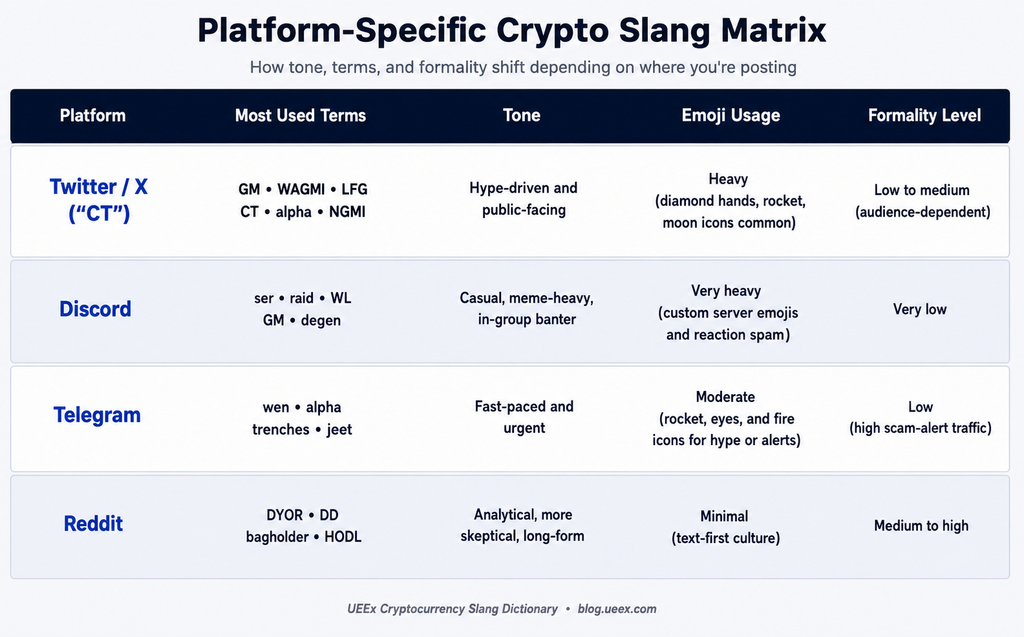
Let’s explore platform-specific slang
Discord & Telegram Terminology
WL (Whitelist)
A whitelist (WL) is a list of pre-approved wallet addresses or users granted early access to a token sale, NFT mint, or exclusive blockchain event. Projects use it to reward early supporters, manage demand, and reduce bot activity.
Real usage: “I need to get on the WL, the mint starts in two days.”
How to get WL: Stay active in the community, complete quests, join contests, refer friends, or win giveaways.
Raid
A raid is a coordinated effort where a crypto community floods another project’s or influencer’s social media posts with likes, comments, reposts, and engagement to boost visibility and attract new users. While common in Web3 marketing, successful raids focus on genuine interaction rather than spam.
Real usage: “We’re raiding XYZ’s X post; like, comment, and repost!”
Shill
To shill is to aggressively promote a crypto or NFT project, often because the promoter has a financial interest in its success. The term usually carries a negative connotation, implying exaggerated claims or undisclosed incentives rather than objective analysis.
Real usage: “Stop shilling your bags; you clearly want to sell at a higher price.”
Shiller: A person who promotes a project primarily for personal gain.
Twitter (X) Crypto Culture
Thread 🧵
This is a series of connected posts on X that breaks down a complex topic, shares research, or tells a story in an easy-to-follow format.
Real usage: “Great alpha thread on that new DeFi protocol.”
Why it matters: Threads are one of Crypto Twitter’s main educational formats. Well-researched threads often shape narratives, attract followers, and spread valuable insights across the community.
Cabal
This represents a supposed insider circle accused of coordinating token pumps, influencing narratives, or receiving privileged information before the public.
Real usage: “The cabal knew about the exchange listing before everyone else.”
Tone: Often used jokingly or conspiratorially. While coordinated groups do exist in crypto, the term is frequently thrown around without evidence.
Ratio
When a reply or quote post receives more likes, reposts, or engagement than the original post, usually because the audience disagrees with the original opinion.
Real usage: “That take was so bad you got ratio’d.”
Example: A trader posts a bullish prediction, and the top reply exposing flaws earns significantly more engagement.
Hopium
This represents a blend of hope and opium. It is the unrealistic optimism about a coin or market despite weak fundamentals or bearish signals.
Real usage: “You’re still expecting a new ATH? That’s pure hopium.”
Related: Copium combines cope and opium. It describes the excuses people make to justify losses or failed predictions after reality sets in.
NFT Community Slang
PFP (Profile Picture)
This is an NFT used as a social media avatar to showcase identity, community, or status.
Real usage: “Nice PFP, is that a BAYC?”
Why it matters: Owning a blue-chip PFP often signals early adoption and credibility in Web3, though prices have cooled since the 2021 boom.
Popular collections: Bored Ape Yacht Club, CryptoPunks, Azuki.
Floor / Floor Price
This is the lowest asking price for an NFT in a collection.
Real usage: “The BAYC floor is around 8.5 ETH.”
Why it matters: Floor price is the quickest way to gauge a collection’s market value and demand, although it changes constantly as NFTs are bought and listed.
Sweep the Floor
This means buying multiple NFTs listed at the collection’s floor price in a short period.
Real usage: “A whale just swept the floor and grabbed 20 NFTs.”
Impact: Floor sweeps reduce the available supply, often pushing the floor price higher and creating bullish momentum that attracts additional buyers.
Mint
This represents creating a new NFT on the blockchain or purchasing one directly from its initial release.
Real usage: “I’m minting five NFTs from the new drop tonight.”
Cost: Minting usually requires paying the project’s mint price plus blockchain network (gas) fees.
Reveal
This is the moment a newly minted NFT displays its final artwork and traits instead of a placeholder image.
Real usage: “Reveal is tomorrow; I hope I get a rare trait.”
Why it matters: Delayed reveals add excitement and randomness to generative NFT collections, making the reveal event one of the most anticipated stages after a mint.
Warning Signs & Scam-Related Slang
Check out these warning signs crypto slang below
Red Flag Terminology
Sniper Bot
A sniper bot is an automated program that buys newly launched tokens within milliseconds of liquidity going live, often before manual traders can react.
Impact: Retail investors often enter at higher prices after bots have already accumulated the cheapest tokens.
Real Usage: “Sniper bots grabbed 50% of the token supply within seconds of launch.”
Defense: Many projects deploy anti-sniper mechanisms such as trading delays, wallet limits, or protected launch features to reduce bot dominance.
Wash Trading
Wash trading is the practice of buying and selling the same asset between the same or coordinated accounts to create fake trading volume without any real change in ownership.
Real Usage: “That token’s volume looks fake; it’s likely wash trading.”
Purpose: To make a token or exchange appear more active and liquid than it really is.
Red Flag: High reported trading volume despite very few unique traders or genuine market activity.
Caution Terms
DEGEN at Your Own Risk
This is a warning that an investment is extremely speculative and could result in a total loss.
Real Usage: “This meme coin looks promising, but degen at your own risk.”
Context: Commonly used before discussing highly volatile meme coins, low-cap tokens, or leveraged trades. It reminds investors that potential rewards often come with equally significant downside.
Not Financial Advice (NFA)
This is a disclaimer stating that shared opinions are not personalized investment advice.
Real Usage: Most crypto influencers end posts with “NFA” or “DYOR. NFA.”
Reality: While it doesn’t eliminate legal responsibility, it signals that readers should make independent decisions.
Doxxed
This represents a project whose founders have publicly revealed and verified their identities.
Real Usage: “The team is fully doxxed with LinkedIn profiles and public interviews.”
Importance: Public identities increase accountability and often improve investor confidence, especially for presales. However, being doxxed is not a guarantee of legitimacy, as projects with known founders have still failed or executed rug pulls.
Anon Team
This represents a project run by anonymous or pseudonymous developers.
Real Usage: “The team is anonymous, so size your position accordingly.”
Risk Assessment: Anon founders generally increase investment risk because accountability is limited. That said, anonymity alone doesn’t make a project fraudulent, as Bitcoin itself was created by the pseudonymous Satoshi Nakamoto.
Common Crypto Slang Mistakes to Avoid
Avoid these mistakes and use your slang the right way
- Wrong: “I’m HODLing my stocks.” Right: HODL is crypto-specific slang, not a general investing term.
- Wrong: Calling any small gain “mooning.” Right: Mooning implies a fast, substantial price jump, not a 2% bump.
- Wrong: “This project has good alpha.” Right: Alpha refers to the information itself, not the project’s quality.
- Wrong: Using heavy meme slang in professional settings. Right: Save “wen lambo” and “ser” for casual community spaces, and stick to plain terms like DCA, market cap, and ATH in formal conversations.
Some terms also carry baggage worth knowing. “Jeet” has origins some people find genuinely offensive, and plenty of community members avoid it for that reason. Context and audience matter more than following the crowd.
The Human Element Behind the Slang
Every one of these words started as a real reaction from a real person. HODL came from genuine panic and a stubborn decision to hold anyway. WAGMI came from a community trying to support each other through a brutal downturn.
Even “Wen Lambo” is really just hope for a better financial future, dressed up as a joke. Learning cryptocurrency slang isn’t about memorizing a glossary but understanding the people behind the words and the ups and downs that shaped them.
Whether you’re a cautious long-term investor or a full degen chasing the next 100x, the language is one of the few things that connects everyone in this space.
GM and WAGMI.
FAQs
Is crypto slang unprofessional or immature?
Not really. Terms like DCA, ATH, and DYOR are used in professional analysis and journalism. Meme-heavy terms like “wen lambo” or “ser” are better suited for casual community spaces like Discord and Telegram rather than formal reports or client conversations.
Can using the wrong crypto slang hurt my credibility?
It can, especially in professional or investor-facing settings. Using casual meme slang in a serious pitch, or misusing a term entirely (like calling any small price bump “mooning”), can expose you as a newbie.
Should I use crypto slang when explaining crypto to non-crypto people?
Generally, no. Stick to plain language for beginners and save the slang for community spaces where people already share the same context. Overloading a newcomer with HODL, degen, and jeet in one sentence creates confusion, not connection.