Crypto markets never sleep, but traders do. AI crypto trading bots help bridge that gap by monitoring markets and executing strategies around the clock without the fatigue or emotion that can affect manual trading.
The global crypto trading bot market is estimated at $54.08 billion in 2026 and projected to reach $200.14 billion by 2035, highlighting the rapid growth of automated trading. But growth does not equal trust. Recent surveys show traders are increasingly open to AI, while many still want control over their funds and trading decisions.
We reviewed 11 leading AI crypto trading bots, comparing their features, pricing, setup, security, and overall usability. Whether you’re new to automated trading or looking to switch platforms, this guide helps you find the right bot.
There's no Call To Action with the ID #0.Key Takeaways
- AI bots trade around the clock, but no bot can guarantee profits. Every platform below carries real risk.
- 3Commas is the best all-rounder, Pionex is the best free option, and Cryptohopper has the deepest AI-driven strategy tools.
- Security matters more than strategy. Never give a bot withdrawal permissions on your exchange API key.
- Start small. Most experienced traders test a bot with 1-5% of their portfolio before scaling up.
What Are AI Crypto Trading Bots?
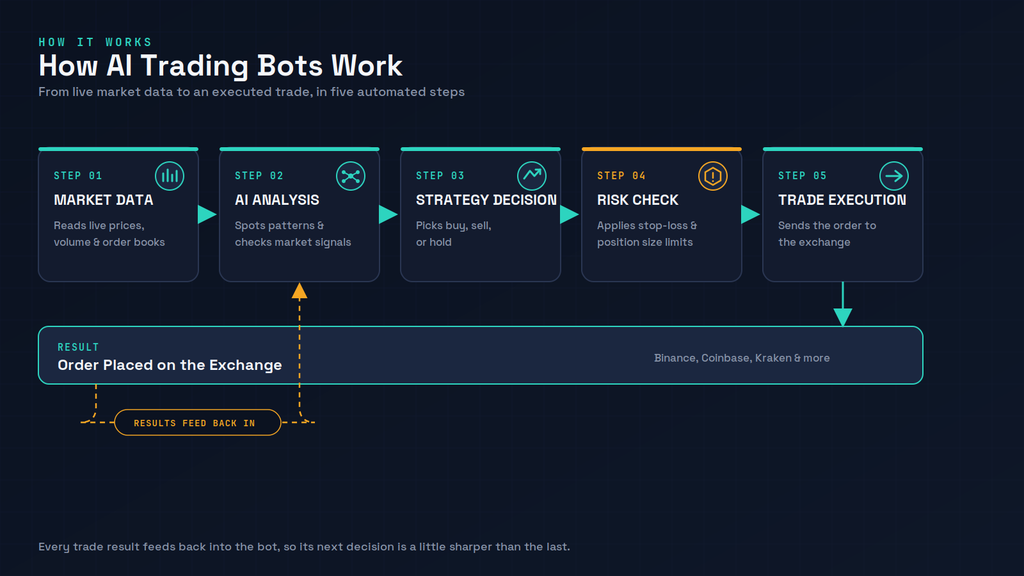
| An AI crypto trading bot is automated software that uses artificial intelligence and machine learning to analyze cryptocurrency markets and execute trades 24/7. Unlike basic bots with fixed rules, AI bots adapt to changing market conditions, learning from historical data and real-time signals to adjust their strategy. They connect to your exchange through an API key to place buy and sell orders automatically, based on rules you set or logic the bot generates itself. |
Think of a crypto trading bot as a thermostat for your portfolio. You set rules, such as “buy when the price falls 2%,” and the bot monitors the market and executes trades automatically.
Early bots relied on simple if-then rules, while today’s AI-powered systems can analyze market data, detect patterns, and adapt signals to changing conditions. However, AI does not guarantee profits; strategy, testing, and risk controls still determine performance.
How AI Bots Differ From Basic Algorithmic Bots
A basic algorithmic bot follows a fixed script. If you tell it to buy Bitcoin every time the price drops 5%, it will do exactly that, forever, no matter what else is happening in the market.
An AI bot looks at more than just price. It can factor in trading volume, momentum, and sometimes news sentiment, then adjust its own parameters over time. It is less like a vending machine and more like an assistant that gets a little sharper the longer it works for you.
Read Also: All You Need To Know About AI Trading Signals
Core Components of a Trading Bot
Every bot, AI-powered or not, is built from three basic parts:
- Data analysis: pulling in price feeds, order books, and sometimes social sentiment
- Strategy execution: deciding when to buy, sell, or hold based on that data
- Risk management: setting stop-losses, position sizes, and limits so one bad trade does not wipe out your account
Types of AI Trading Bots and Strategies
AI trading bots automate predefined strategies, but their effectiveness depends heavily on market conditions. The main types include:
1. Grid Trading Bots
Grid bots place automated buy and sell orders within a defined price range, aiming to profit from repeated market swings.
- Best for: Sideways or range-bound markets
- Strategy: Buy low and sell high within a set range
- Risk: Can underperform when prices break into a strong trend
2. DCA Bots
Dollar-cost averaging (DCA) bots make purchases at scheduled intervals or predefined price levels, reducing the need to time individual entries.
- Best for: Long-term accumulation
- Strategy: Build a position gradually
- Risk: Continues accumulating during prolonged declines, increasing exposure
3. Arbitrage Bots
Arbitrage bots identify price differences for the same asset across exchanges or trading venues and attempt to capture the spread.
- Best for: Fragmented markets with temporary price discrepancies
- Strategy: Buy on one venue and sell on another
- Risk: Fees, slippage, liquidity and execution speed can eliminate the spread
4. Market-Making Bots
Market-making bots continuously place buy and sell orders to capture the bid-ask spread while providing liquidity.
- Best for: Highly liquid markets
- Strategy: Profit from repeated bid-ask spreads
- Risk: Requires advanced risk management and can suffer during sharp price moves
5. Trend-Following Bots
These bots use indicators such as moving averages, breakouts, or momentum signals to identify directional moves and exit when the trend weakens or reverses.
- Best for: Strong bullish or bearish trends
- Strategy: Follow market momentum
- Risk: Frequent false signals in choppy markets
6. Portfolio Rebalancing Bots
Rebalancing bots automatically restore a portfolio to predetermined asset allocations when market movements push them away from their targets.
- Best for: Long-term diversified portfolios
- Strategy: Sell overweight assets and buy underweight assets
- Benefit: Reduces manual portfolio management
7. Signal-Based Bots
Signal bots execute trades based on external indicators, TradingView alerts, technical signals, or third-party strategies.
- Best for: Traders with established signal systems
- Strategy: Automatically execute predefined buy and sell signals
- Risk: Performance depends on the quality, timing and reliability of the signal source
8. Custom Strategy Bots
Custom bots let experienced traders build their own trading logic using indicators, entry and exit rules, position sizing, and risk controls.
- Best for: Advanced traders and developers
- Strategy: Fully customizable
- Requirement: Technical knowledge, testing and ongoing monitoring
Choosing the Right Trading Bot
No single strategy works across every market. Choose a bot based on the prevailing conditions:
| Market Condition | Best Bot Type | Primary Strategy |
| Sideways / range-bound | Grid | Capture repeated price swings |
| Long-term accumulation | DCA | Build positions gradually |
| Strong uptrend/downtrend | Trend-following | Ride momentum |
| Price differences across venues | Arbitrage | Capture market inefficiencies |
| High liquidity + tight spreads | Market-making | Earn bid-ask spreads |
| Diversified portfolio | Rebalancing | Maintain target allocations |
| Indicator-driven trading | Signal-based | Automate external signals |
| Unique trading rules | Custom | Execute user-defined strategies |
Top 11 AI Crypto Trading Bots 2026: Full Comparison
We grouped them by what they do best, since the “best” bot really depends on your experience level, budget, and goals. Pricing below reflects publicly listed rates at the time of writing.
| Bot | Starting Price | Exchanges | Best For |
| 3Commas | Free tier; paid plans from around $15/mo annually | 15-20+ | Overall versatility |
| Cryptohopper | Free tier; paid plans from around $25/mo | 16+ | AI-driven strategy switching |
| Pionex | Free (bots included); 0.05% trading fee | Built-in exchange | Beginners, budget traders |
| Bitsgap | Free trial; paid plans from around $23/mo | 17 | Multi-exchange management |
| Coinrule | Free tier; paid plans from around $14.99/mo | 4 major exchanges | No-code automation |
| TradeSanta | Paid plans from around $18/mo | 7 major exchanges | Fast, simple setup |
| HaasOnline | Paid plans from around $11/mo | 20+ | Developers and coders |
| Shrimpy | Paid plans from around $19/mo | 16+ | Portfolio rebalancing |
| Dash 2 Trade | Paid plans, roughly $120/year | Binance, OKX, major CEXs | Sentiment-based trading |
| Mizar | No subscription; profit-sharing model | 10+ | Copy trading |
| Altrady | Price starts from around $28/mo | 19+ (spot and futures) | Technical analysts |
1. 3Commas: Overall Best All-Around Bot
Source: 3commas.io
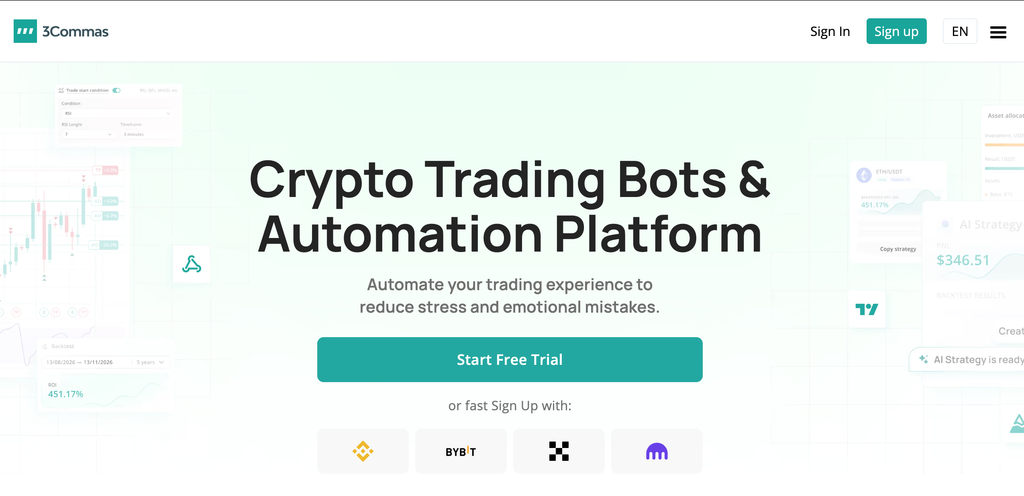
3Commas remains one of the most complete crypto bot platforms available, and it is the one we recommend most often to traders who want flexibility without needing to code.
Key Features:
- SmartTrade terminal with advanced order types, including trailing stop-loss and multiple take-profit targets
- TradingView integration so you can trigger trades from custom technical signals
- DCA, Grid, and Signal bots, plus options and futures bots on supported exchanges
- Copy-trading and strategy marketplace
Pricing: 3Commas offers a free tier for exploring the platform, with paid plans (Starter, Pro, Expert) typically starting around $15 per month annually and scaling up based on the number of active bots and exchange connections you need. Check 3Commas’ official pricing page for current rates, since the company has updated its plan structure more than once in the past year.
Exchanges Supported: 15 to 20+, including Binance, Coinbase, Kraken, Bybit, and OKX
Security: Two-factor authentication, API-only access (no withdrawal permissions needed), and improved security protocols following a 2022 incident where some users’ API keys were compromised. 3Commas has since added stronger key-handling practices.
Pros:
- Wide exchange support and a genuinely deep feature set
- Free paper trading mode to test strategies risk-free
- Active community and frequent product updates
Cons:
- Advanced features are locked behind higher-tier plans
- Some learning curve for beginners
- Past security incident, even though it has since been addressed
Best for: Traders who want one platform that can handle DCA, grid, and signal-based strategies without switching tools.
2. Cryptohopper: Best for AI-Driven Strategy Switching

Source: cryptohopper.com
Cryptohopper leans hardest into the “AI” part of AI trading bots. Its algorithm intelligence feature can switch between strategies automatically depending on what the market is doing, instead of locking you into one approach.
Key Features:
- Cloud-based, so your computer does not need to stay on
- Strategy marketplace where you can buy, sell, or copy pre-built strategies
- Visual strategy designer for building your own logic without code
- Sentiment analysis integrations
Pricing: Cryptohopper offers a free Pioneer plan (does not come with automated copy-trading bots) and paid plans (often called Explorer, Adventurer, and Hero) that scale from roughly $24.16 a month up to $108 a month depending on billing cycle and features. Confirm current tiers on Cryptohopper’s website.
Exchanges Supported: 16+, including Binance, KuCoin, and Huobi
Security: Two-factor authentication, encrypted API connections, and trading-only permission settings
Pros:
- No need to keep a computer running around the clock
- Strong marketplace for discovering and copying strategies
- Genuine machine-learning strategy switching, not just static rules
Cons:
- Higher tiers get expensive fast
- Can feel overwhelming for a first-time user
- Marketplace strategy quality varies a lot, so vet anything before copying it
Best for: Traders who want cloud-based automation and are willing to experiment with AI-driven strategy switching.
3. Pionex: Best Free Option

Source: pionex.com
Pionex is different from every other bot on this list because it is not a third-party tool that connects to your exchange. It is the exchange, with 16 free bots built directly in.
Key Features:
- Grid Trading Bot, Martingale Bot, Spot-Futures Arbitrage Bot, Rebalancing Bot, and more are all included at no extra cost
- PionexGPT AI assistant for strategy help
- 300+ trading pairs
- Liquidity aggregated from major exchanges
Pricing: All bots are free to use. Pionex makes its money from a trading fee, commonly listed around 0.05% per transaction, rather than a subscription.
Exchanges Supported: Pionex is its own exchange, so there is nothing to connect. This is convenient, but it also means you are limited to trading on Pionex itself.
Security: Licensed exchange, two-factor authentication, cold wallet storage for the bulk of user funds
Pros:
- Completely free bot access, which is rare in this space
- Low trading fees compared to subscription-based competitors
- Beginner-friendly setup with built-in education
Cons:
- You cannot use these bots with other exchanges
- Fewer customization options than premium third-party tools
- Being custodial means your funds sit on Pionex’s platform, not your own wallet
Best for: Beginners and budget-conscious traders who want to try bot trading without paying a subscription.
4. Bitsgap: Best for Managing Multiple Exchanges
Source: bitsgap.com
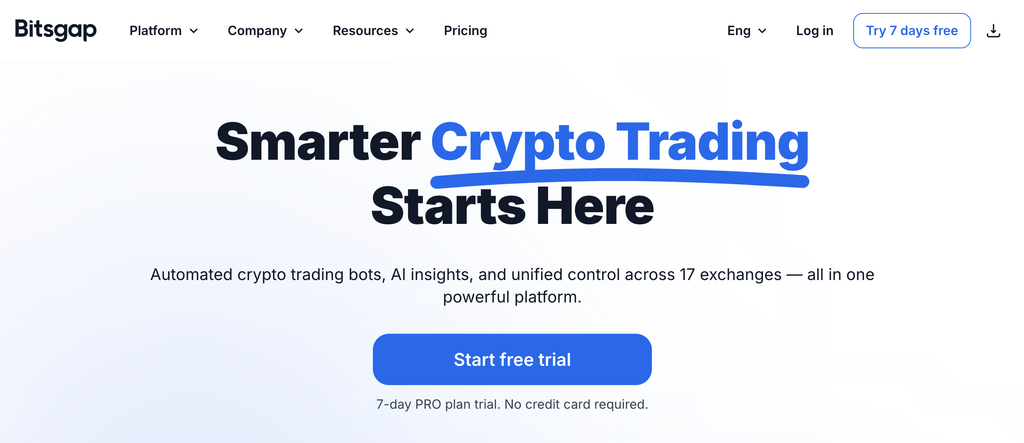
If you already hold funds across several exchanges, Bitsgap lets you manage all of them from a single dashboard instead of juggling tabs.
Key Features:
- AI Assistant that recommends bots based on your risk profile and available capital
- Smart Trade terminal with advanced order types
- Arbitrage scanner that checks price gaps across exchanges
- Demo mode with virtual funds
Pricing: Plans typically start around $23 a month for the Basic tier, with Advanced and Pro tiers priced higher based on bot limits and features. A free demo is available. Check Bitsgap’s pricing page for the latest numbers.
Exchanges Supported: 25+, including Binance, Coinbase, Kraken, and Bybit
Security: Non-custodial (your funds stay on your own exchange accounts), two-factor authentication, trading-only API permissions
Pros:
- Broad exchange support, useful if your funds are spread out
- Genuinely helpful demo mode for testing before committing real money
- Transparent, tiered pricing
Cons:
- Steep learning curve for first-time bot users
- Full feature access requires the higher-priced tiers
- The interface can feel busy at first
Best for: Traders juggling funds on multiple exchanges who want one dashboard to manage all of it.
5. Coinrule: Best for No-Code Automation
Source: coinrule.com
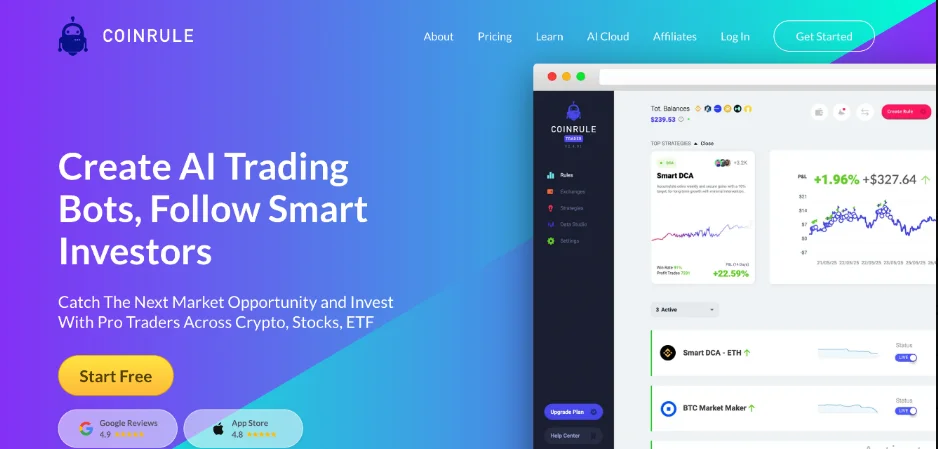
Coinrule strips away the intimidation factor. You build strategies using plain “if this happens, then do that” logic, no coding required.
Key Features:
- Drag-and-drop rule builder
- Over 250 pre-made rule templates
- AI-assisted rule optimization on higher tiers
Pricing: Coinrule has a free Starter plan, with paid tiers (often called Investor, Trader, and Fund) starting around $30 a month and scaling up for higher trading volume and more rules. See Coinrule’s pricing for current rates.
Exchanges Supported: 4 major exchanges, including Binance, Kraken, and Coinbase
Security: API-only access, two-factor authentication, no withdrawal permissions
Pros:
- Genuinely the easiest platform on this list to learn
- No coding required at any tier
- Large template library to start from
Cons:
- Fewer supported exchanges than competitors
- Limited advanced features for experienced traders
- Rule-based structure is less flexible than true AI adaptation
Best for: Complete beginners who want automation without a technical learning curve.
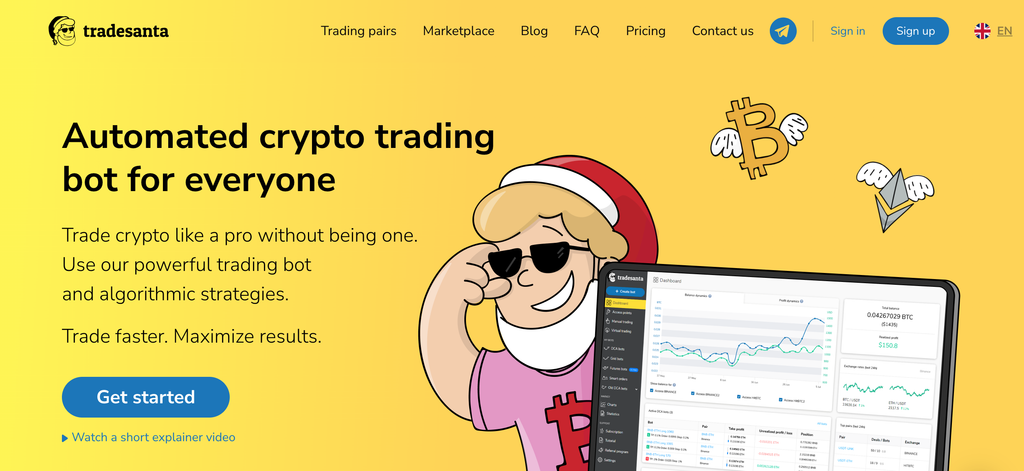
6. TradeSanta: Best for Quick Setup
Source: tradesanta.com
TradeSanta is built for traders who want to be up and running in minutes, not hours.
Key Features:
- Long and short strategy support
- Trailing stop-loss
- Custom technical indicators
- Built-in backtesting
- Copy trading
Pricing: Plans typically start around $25 a month on annual billing, scaling up with the number of active bots.
Exchanges Supported: 7, including Binance, OKX, and Bybit
Pros:
- Very fast configuration process
- Clean, uncluttered interface
- Mobile support
Cons:
- Fewer supported exchanges than most competitors
- AI features are lighter than platforms like Cryptohopper
- Not built for complex, multi-condition strategies
Best for: Traders who want a simple grid or DCA bot running quickly without a long setup process.
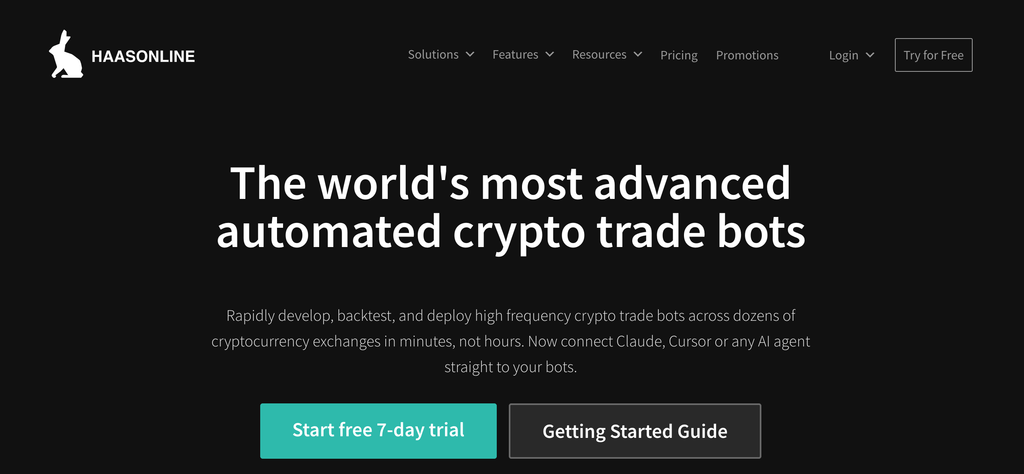
7. HaasOnline: Best for Developers
Source: haasonline.com
HaasOnline is the most technical platform on this list, built for people comfortable writing their own trading logic.
Key Features:
- HaasScript, a proprietary scripting language for custom algorithms
- Visual drag-and-drop editor as an alternative to scripting
- Market making, arbitrage, and scalping bot types
- Deep backtesting tools
Pricing: Plans generally range from roughly $11 a month at the entry level up to $59 for pro per month or more for the TradeServer feature set.
Exchanges Supported: 20+, including Binance, Kraken, KuCoin, and select decentralized exchanges
Pros:
- The most powerful customization on this list
- One of the few bots that supports decentralized exchanges
- Reasonable pricing relative to the feature depth
Cons:
- Steep learning curve, especially without coding experience
- Self-hosted options require ongoing maintenance
- Overkill for casual traders
Best for: Developers and advanced traders who want to build fully custom algorithms.
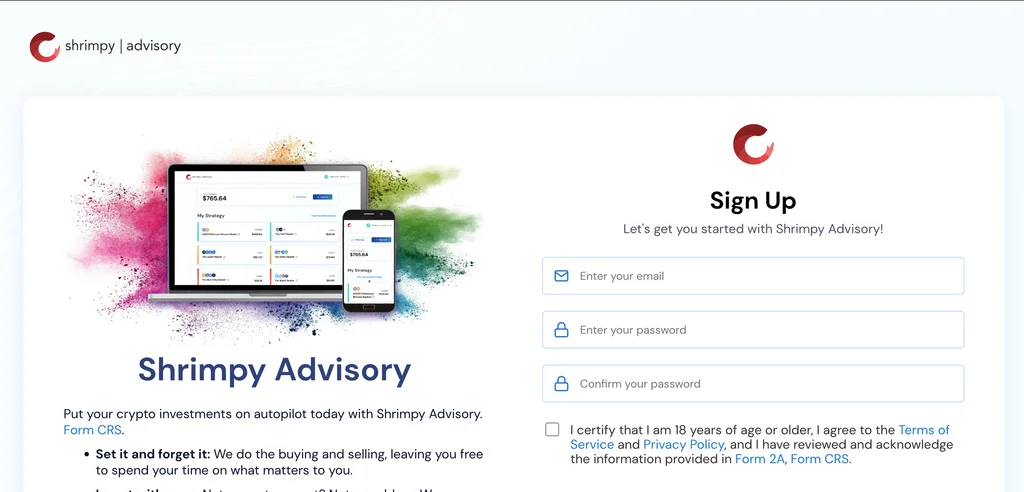
8. Shrimp: Best for Portfolio Management
Source: ria.shrimpy.io/signup
Shrimpy is less about active trading and more about keeping a long-term portfolio balanced automatically.
Key Features:
- Automated portfolio rebalancing
- Social trading and portfolio tracking
- Backtesting for rebalancing strategies
Pricing: A free plan is available, with paid tiers generally starting around $19 a month for basic to $299 for professionals.
Exchanges Supported: 16+ major exchanges
Pros:
- Simple, low-maintenance approach to portfolio management
- Good fit for a buy-and-hold style investor
- Social features let you see how others allocate
Cons:
- Not built for active day trading
- Limited bot variety compared to full trading platforms
- Better suited to long-term investors than short-term traders
Best for: Long-term investors who want a “set it and forget it” approach to keeping their portfolio balanced. If you are new to this concept, our guide to portfolio diversification strategies covers the basics.
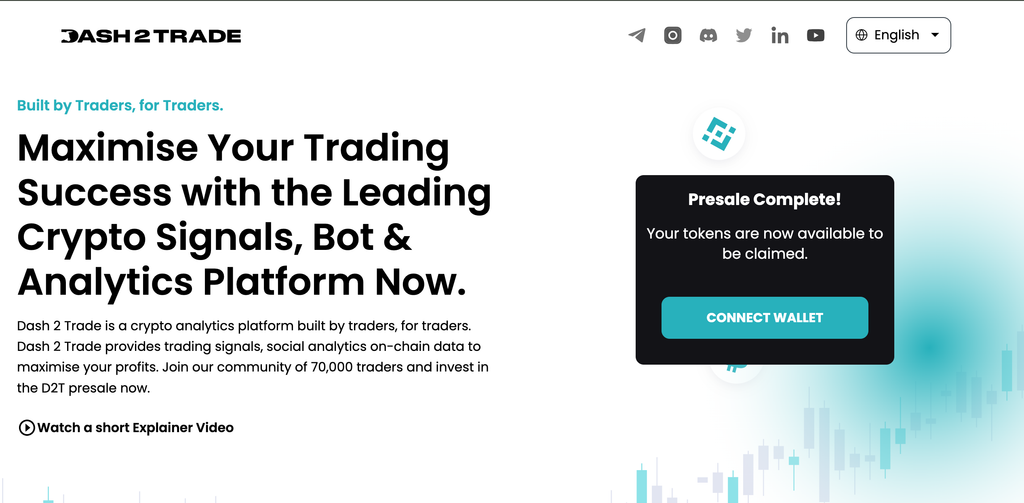
9. Dash 2 Trade: Best for Sentiment-Based Trading
Source: claim.dash2trade.com
Dash 2 Trade focuses on reading market sentiment and news flow, rather than just price charts.
Key Features:
- Sentiment analysis feeding into trade signals
- Predictive scoring for trending coins
Pricing: costs $120 per year (or about 1,000 D2T tokens per month) for the full Professional tier. A basic Free tier is available with limited features, and a Starter tier costs roughly 400 D2T tokens per month.
Exchanges Supported: Binance, OKX, and other major centralized exchanges
Pros:
- Useful for traders who follow news and social trends
- Strong performance historically in trending, bullish markets
Cons:
- Performance tends to weaken in flat, sideways markets
- Newer platform with a shorter track record than 3Commas or HaasOnline
Best for: News-driven traders who want sentiment data folded into their strategy.
10. Mizar: Best for Copy Trading
Source: mizar.com
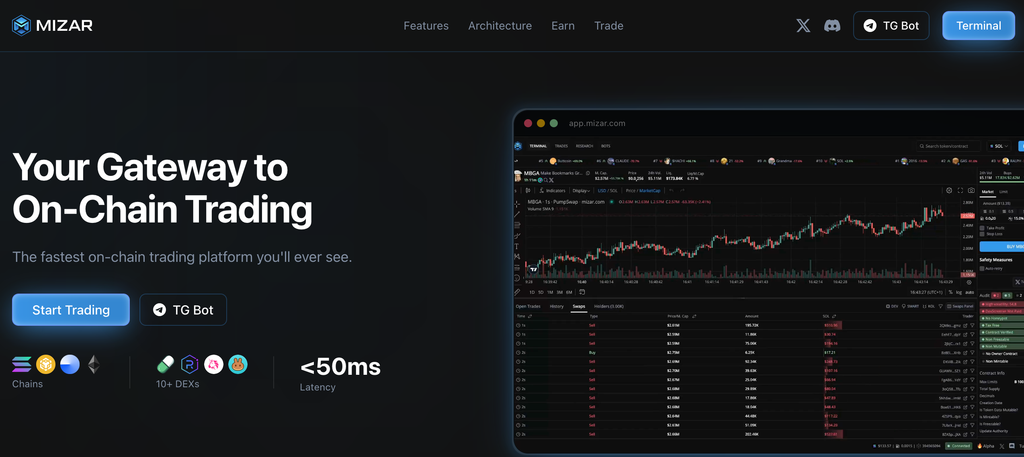
Mizar skips the subscription model entirely and instead runs on profit-sharing, so you only pay when a strategy actually makes money.
Key Features:
- Bot marketplace for copying top-performing traders
- No flat monthly fee
Pricing: No subscription; Mizar typically uses a pay-per-performance or profit-sharing model instead.
Exchanges Supported: 10+ DEX exchanges, alongside on-chain wallets
Pros:
- No fixed cost if you are not making money
- Easy way to diversify by copying multiple traders
- Transparent performance history for each strategy
Cons:
- Your results depend entirely on the quality of traders you copy
- Less control than building your own strategy
Best for: Traders who would rather copy proven strategies than build their own from scratch.
11. Altrady: Best for Technical Analysts
Source: altrady.com
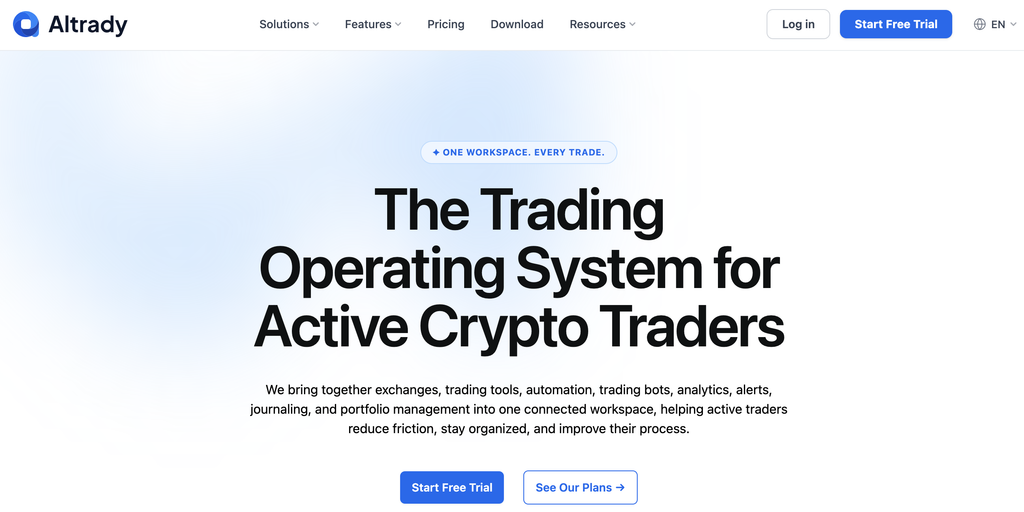
Altrady combines bot automation with a genuinely deep charting toolkit, aimed at traders who like to study price action before they automate it.
Key Features:
- Signal, Grid, and DCA bots
- Advanced technical analysis tools and trade journaling
Pricing: Basic paid plans start around $28 a month and go up to $90 for premium.
Exchanges Supported: 19+ exchanges, covering spots and futures
Pros:
- Strong educational resources built into the platform
- Comprehensive charting tools
- Competitive pricing for the feature set
Cons:
- Interface complexity can slow down beginners
- Smaller user base and community than 3Commas or Cryptohopper
Best for: Technical analysts who want charting and automation in the same place.
Benefits of Using AI Crypto Trading Bots
Here are the benefits ofusing AI crypto trading bots
1. 24/7 Market Monitoring
Crypto markets never close. Bots can continuously scan price movements, volume, volatility, and trading signals, so you don’t have to stay glued to charts or worry about missing overnight opportunities.
2. Emotion-Free Trading
Bots follow predefined rules rather than fear, greed, FOMO, or revenge trading. This helps traders maintain discipline and execute strategies consistently, even during volatile markets.
3. Faster Execution
Bots can analyze signals and submit orders far faster than manual trading. This can be especially useful for strategies that depend on short-lived market opportunities, although latency, liquidity, and slippage still affect real-world execution.
4. Backtesting Before Going Live
Traders can test strategies against historical market data before committing real capital. Backtesting helps identify weaknesses and measure metrics such as returns and maximum drawdown, but it cannot guarantee future performance.
5. Automated Risk Management
Bots can enforce rules such as:
- Stop-loss and take-profit levels
- Position-size limits
- Maximum drawdown thresholds
- Exposure limits
- Automated portfolio rebalancing
These controls can help limit losses when markets move against a strategy.
6. Process More Data
AI systems can analyze large amounts of market data, including price, volume, volatility, sentiment, and other signals, far beyond what a trader could monitor manually.
7. Diversify Across Markets and Strategies
A single bot can monitor multiple trading pairs or run different strategies simultaneously. This allows traders to spread exposure rather than relying on one asset or setup.
8. Greater Consistency and Efficiency
Once properly configured, a bot applies the same trading rules repeatedly without fatigue or hesitation. This can save time and reduce the mistakes that come from manually monitoring and executing every trade.
There's no Call To Action with the ID #0.Risks and Limitations of Trading Bots
No bot on this list guarantees profit. Anyone who tells you otherwise is selling something. In fact, the U.S. Commodity Futures Trading Commission has publicly warned that AI cannot predict the future of crypto markets and that claims of guaranteed or unusually high returns are a classic red flag of fraud.
Here is what can realistically go wrong:
A bad strategy executed well is still a bad strategy: Automation makes your strategy run faster and more consistently, but it does not make a flawed strategy good. If your rules are wrong, the bot will lose money efficiently and repeatedly.
Technical failures happen: API outages, exchange downtime, and software bugs can all interrupt a bot mid-trade, sometimes at the worst possible moment.
Security vulnerabilities are real: In 2022, 3Commas experienced an incident where API keys tied to some user accounts were compromised, reportedly leading to unauthorized trades on affected accounts. It is a useful reminder that any platform holding your API credentials is a potential target.
Princeton University researchers, working with the Sentient Foundation, found that AI trading agents built on popular frameworks like ElizaOS could be manipulated through “memory injection,” tricking the agent into executing harmful trades it was never meant to make. The researchers warned that a single planted false memory could persist across sessions, quietly causing damage until someone caught it.
Over-optimization is a trap: A strategy that looks perfect in backtesting can fall apart in live markets, because past data does not guarantee future behavior.
Bots cannot predict black swan events: No amount of AI can foresee a sudden regulatory crackdown, an exchange collapse, or a shock news event. A bot will keep following its rules right through a crash unless you have set proper stop-losses.
Hidden costs add up: Between subscription fees, exchange trading fees, and slippage (the small difference between the price you expect and the price you actually get), your real cost of running a bot is often higher than the sticker price suggests.
Setup takes real learning: Even the simplest bots require you to understand basic concepts like stop-loss, take-profit, and position sizing before you start.
Before running any bot with real capital, spend time on our crypto trading bots explained guide and make sure you understand what the bot is actually doing, not just that it is “AI-powered.”
Read Also: Crypto Trading Bots Explained: Strategies, Tips, and Tools to Trade Smarter
How to Choose the Right AI Trading Bot
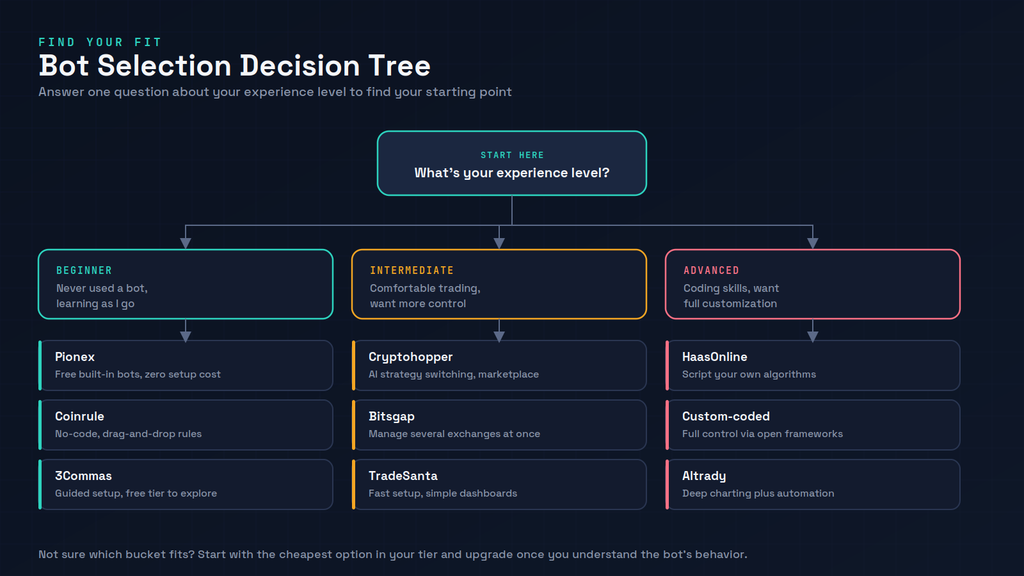
Below are the steps to choose the right AI crypto trading bot
Step 1: Define Your Goals
Are you trying to grow long-term savings, or are you actively day trading? Your answer changes everything else on this list. A DCA bot suits a long-term goal. A grid or signal bot suits active, short-term trading.
Step 2: Assess Your Risk Tolerance
- Conservative: Grid or DCA bots with low or no leverage
- Moderate: Multi-strategy bots with stop-losses set tight
- Aggressive: Futures bots, high-frequency strategies, leverage
Step 3: Set a Budget
Pionex is free. Budget-friendly options like TradeSanta and Coinrule start around $18 to $30 a month. Premium platforms like 3Commas Expert or Cryptohopper Hero can run over $100 a month.
As a rough rule, your bot subscription cost should stay well under what you realistically expect to earn from the capital you are trading with. If you would need a large, unrealistic return just to cover the subscription, the plan is too expensive for your account size.
Step 4: Match the Bot to Your Skill Level
- Beginners: Pionex, Coinrule, 3Commas
- Intermediate: Cryptohopper, Bitsgap, TradeSanta
- Advanced: HaasOnline, custom-coded solutions
Step 5: Check Exchange Compatibility
Confirm the bot actually supports the exchange you already use. Not every bot connects to every exchange, and API availability can vary by region.
Step 6: Review Security Features
Look for two-factor authentication, API-only permissions with no withdrawal access, and a track record of how the company handled any past incidents. Our guide to cryptocurrency security best practices walks through this in more detail.
Step 7: Read Independent Reviews
Check Reddit threads, TrustPilot reviews, and Discord communities before committing. Independent user feedback often surfaces problems that a company’s own marketing page will not mention.
Step 8: Test Before You Commit Real Money
Use free trials, demo modes, or paper trading wherever available. Start with a small amount of real capital before scaling up.
Getting Started: Step-by-Step Setup Guide
Here is a general walkthrough using a typical bot platform. We will reference 3Commas as an example since its setup flow is fairly standard across the industry.
Prerequisites:
- A verified account on a supported exchange (Binance, Coinbase, etc.)
- Basic understanding of how crypto trading works
- Risk capital you can genuinely afford to lose
Step 1: Choose your bot platform: Use the criteria above to pick one that matches your goals, budget, and skill level.
Step 2: Create an account: Sign up with your email, verify it, and set up two-factor authentication immediately. Do not skip this step.
Step 3: Connect your exchange through an API key.
- Go to your exchange’s API settings page
- Create a new API key
- Set permissions to trading only, and make absolutely sure withdrawal permissions are turned off
- Copy the API key and secret
- Paste them into your bot platform
- Test the connection before moving forward
This is the single most important security step in the entire process. If you only remember one thing from this guide, remember this: never enable withdrawal permissions on a bot’s API key.
If a bot platform is ever compromised, this setting is what stops an attacker from actually draining your funds. For more on this, see our crypto wallet security guide.
Step 4: Configure your first bot: Start with something simple, like a Grid or DCA bot on a major pair such as BTC/USDT. Set conservative parameters for your investment amount, take-profit percentage, and stop-loss percentage. You can always adjust these later once you understand how the bot behaves.
Step 5: Backtest your strategy if the platform allows it: Run your settings against historical data to get a rough sense of how the strategy would have performed. Treat this as a sanity check, not a guarantee.
Step 6: Start the bot: Review every setting one more time, use paper trading first if it is available, and then activate the bot and confirm it places its first trades correctly.
Step 7: Monitor performance: Check in daily at first. Watch your win rate, profit and loss, and active trades. Step in and pause the bot if you see consistent losses, a sudden change in market conditions, or behavior that does not match what you configured.
Safety Checklist
- Never grant withdrawal permissions on an API key
- Start with 1-5% of your total portfolio
- Never trade with borrowed money
- Keep the bulk of your holdings in a wallet you control, not sitting active on an exchange
- Check in on your bot daily, at least at first
- Decide your exit strategy before you start, not after
Best Practices and Pro Tips for Crypto Trading Bots
These practices will enhance your crypto trading bot’s experience.
Start Small and Diversify
- Start with 1–5% of your portfolio: Test a bot with a small allocation before increasing exposure.
- Diversify strategies: Avoid relying on a single bot or trading strategy. Different approaches can perform differently across market conditions.
- Set clear limits: Define your maximum acceptable loss and position size before the bot starts trading.
Monitor Performance and Market Conditions
- Review performance regularly: Set daily or weekly reminders to check returns, drawdowns, fees, and trade execution.
- Keep a trading journal: Record each bot’s strategy, performance, market conditions, and major changes.
- Know when to pause: Stop or adjust bots during extreme volatility, major market events, or when their strategy stops performing as expected.
- Use an exit strategy: Set predefined drawdown limits and disable a bot when it consistently breaches them.
Follow Strong Security Practices
- Use restricted API keys: Give bots only the permissions they need. Avoid withdrawal access whenever possible.
- Use strong, unique passwords and 2FA: Never reuse exchange credentials.
- Protect your API keys: Never share them with anyone or paste them into unverified platforms.
- Watch for phishing: Verify websites, apps, and bot providers before entering credentials or connecting an exchange account.
- Rotate or review API keys periodically: Remove unused keys and replace compromised credentials immediately.
Track Taxes and Records
Keep complete records of trades, fees, deposits, withdrawals, and bot activity. Tax rules vary by jurisdiction, so maintain accurate transaction histories throughout the year.
Tools such as CoinTracker can connect with supported exchanges and wallets, import transaction data, and calculate gains and losses for tax reporting. CoinTracker currently supports hundreds of integrations, including major exchanges such as Binance, Coinbase, Kraken, and Bybit.
Keep Learning
- Follow updates from your exchange and bot provider.
- Learn how your chosen strategy performs in different market conditions.
- Join reputable trading communities and educational sessions.
- Reassess your strategy instead of assuming past performance will continue.
Avoid Common Mistakes
- Over-leveraging: Excessive leverage can magnify losses quickly.
- Ignoring market conditions: No bot performs equally well in every market.
- Chasing losses: Don’t increase risk simply to recover previous losses.
- Skipping risk controls: Use appropriate stop-losses or other downside protection where supported.
- Trusting unverified bots: Research the provider, security model, track record, and user feedback before connecting an exchange account.
- Set-and-forget trading: Automated does not mean risk-free. Review your bots regularly.
Final Thoughts
Picking the right AI crypto trading bot comes down to knowing yourself first, not the software. A beginner does well with Pionex or Coinrule. Someone juggling multiple exchanges leans toward Bitsgap while a developer wants HaasOnline’s scripting freedom.
What matters most across every best AI crypto trading bot on this list is the same: start small, protect your API keys, and never expect guaranteed profits. Bots remove emotion and execute faster than any human could, but they still trade inside a market that can turn on a dime.
Test with a small amount first. Watch how the bot behaves for a few weeks. Then scale up only once you trust what you are watching. That patience is what separates traders who last from those who do not.
Frequently Asked Questions
Are crypto trading bots profitable?
Some traders profit using crypto trading bots, but no bot guarantees profit. Results depend heavily on the strategy, market conditions, and how well the bot is configured. Bots remove emotional decision-making and execute trades faster than a human, but they cannot predict sudden market crashes or guarantee a win rate.
Are AI trading bots legal?
Yes, AI trading bots are legal in most countries, including the United States, as long as you are using them on a licensed exchange and complying with local tax and securities laws. Regulators like the CFTC have warned against bots or platforms that promise guaranteed or unusually high returns, since those claims are a common sign of fraud rather than a feature of legitimate automation.
How much money do you need to start using a trading bot?
You can start with as little as $10 to $50 on a free platform like Pionex. For subscription-based bots, most experienced traders recommend having at least a few hundred to a few thousand dollars in trading capital so the monthly subscription cost does not eat too heavily into potential returns.
Can you lose money with trading bots?
Yes, you can lose money with trading bots. A bot executes your strategy exactly as configured, so if the strategy is flawed, the market moves against you, or a black swan event occurs, the bot will not protect you from losses. Bots also do not eliminate exchange fees, slippage, or technical risk. Always trade only with money you can afford to lose.
Disclaimer: This article is for educational purposes only and is not financial advice. Cryptocurrency trading, including automated trading with bots, carries significant risk of loss. Past performance of any bot or strategy does not guarantee future results. Always do your own research, start with capital you can afford to lose, and consult a licensed financial advisor before making investment decisions.