Imagine executing a million-dollar contract without lawyers, banks, or intermediaries and having it complete in seconds, not months. This isn’t science fiction; it’s happening right now through smart contracts on blockchain.
Unlike traditional contracts that rely on middlemen and lengthy legal procedures, smart contracts are revolutionizing agreements by replacing paper-based processes with self-executing code on blockchain networks like Ethereum and Solana.
They automatically verify conditions and execute transactions without intermediaries, making agreements faster, more transparent, and secure. Initially popularized by cryptocurrency and DeFi, smart contracts now power diverse applications, including supply chain management, digital royalties, insurance claims, and property records, highlighting their expanding role across industries
This guide walks through what smart contracts actually are, how they work under the hood, where they’re used, and how to avoid the mistakes that have cost people billions of dollars.
There's no Call To Action with the ID #0.Key Takeaways
- Smart contracts are self-running digital agreements. Code replaces the lawyer, the bank, and the paperwork. When the conditions are met, the deal happens automatically.
- Ethereum still leads, but it’s no longer the only choice. Solana, Cardano, BNB Chain, and Polkadot each solve a different problem: speed, cost, research rigor, or cross-chain communication.
- Security is the whole game. Hackers stole close to a billion dollars in the first half of 2026 alone. Never touch a contract that hasn’t been audited by a real firm.
- 2026 is about real-world use, not hype. Tokenized real estate, AI-assisted auditing, and easier wallets are pulling smart contracts out of the crypto bubble and into everyday finance.
- The UK, several US states, and the EU now treat smart contracts as enforceable agreements, which is opening the door to bigger institutional money.
What Are Smart Contracts?
Source: ai-generated
A smart contract is a program stored on a blockchain that runs automatically when certain conditions are met. The terms of the agreement aren’t written in legal language. They’re written in code, and that code decides what happens next.
Think of it as “if this, then that” logic:
- If a buyer sends the right payment, then the seller’s item transfers to them.
- If rent is paid on the first of the month, then a digital lock opens.
- If a flight is delayed by more than two hours, then the passenger gets an automatic payout.
There’s no person sitting in the middle approving each step. The network of computers running the blockchain checks the conditions and carries out the action.
“Vending machines offer a paradigm for security-conscious protocol design… Digital cash protocols, cryptographic key management protocols, and other financial protocols with a strong requirement of security, or property-transfer protocols with a weak requirement of trust, can be constructed on the basis of the vending machine paradigm.”
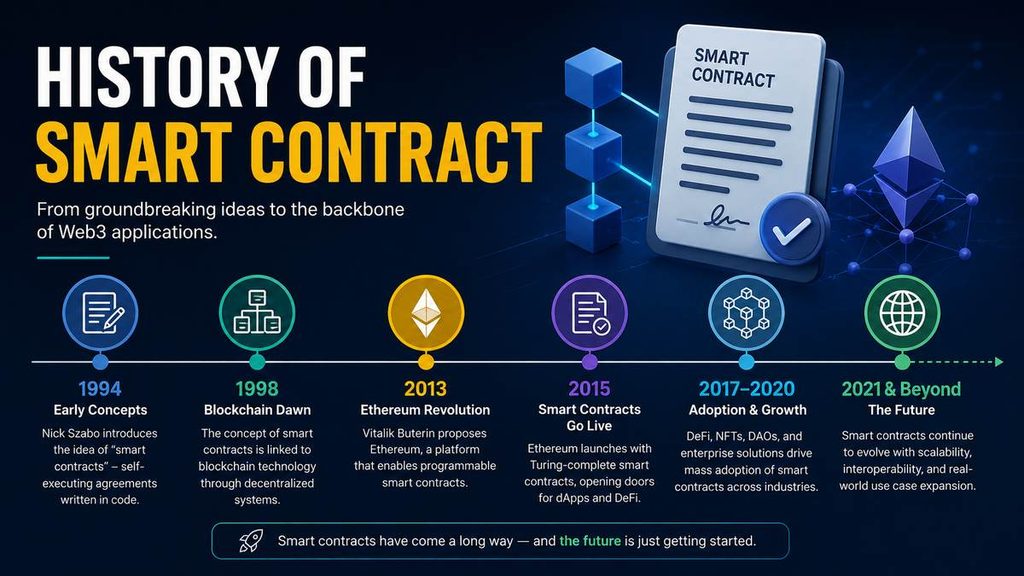
That’s the core idea computer scientist Nick Szabo laid out back in 1994, long before blockchain existed, when he first floated the term “smart contract.”
The Vending Machine Analogy
Szabo used a simple comparison that still holds up today: a vending machine.
With a normal purchase, you’d call the store, negotiate a price, hand cash to a cashier, and trust that they hand over the product. With a vending machine, you skip almost all of that. You put in $2, the machine checks that the amount is correct, and it drops your soda. No manager needs to approve it, and no handshake is required.
A smart contract works the same way, just with digital assets instead of snacks. The code enforces the deal, and you only need to trust the code, not the person on the other side of the screen.
There's no Call To Action with the ID #0.The Three Core Components of a Smart Contract
1. Digital Agreement
A smart contract begins as code that defines the rules of an agreement. Written in languages such as Solidity (for Ethereum), it specifies the parties involved, the assets exchanged, and the conditions that trigger execution; for example, automatically sending 1 ETH once a predefined condition is met.
2. Blockchain Storage
Once deployed, the contract is stored on a blockchain such as Ethereum, Solana, or Cardano. Its code is replicated across thousands of network nodes, making it immutable, transparent, and available for anyone to verify. The contract remains on the blockchain permanently unless the network itself ceases to exist.
3. Automatic Execution
Smart contracts execute automatically when their predefined conditions are satisfied. Blockchain validators process the transaction, eliminating the need for intermediaries. On networks like Ethereum, users pay gas fees to cover the computational resources required to execute the contract.
How Smart Contracts Work: A Technical Breakdown
Smart contracts rely on simple if-then logic: if a predefined condition is met, the contract automatically carries out the specified action.
For example:
- Payment: If Alice sends 1 ETH, the contract automatically transfers a digital artwork to her wallet.
- Rental: If a tenant pays rent on time, the contract grants access to a digital key. If payment is overdue, access is revoked automatically.
- Supply chain: If IoT sensors confirm a shipment arrived within the required temperature range, payment is released. Otherwise, the contract initiates a dispute process.
Modern smart contracts often combine multiple conditions using AND, OR, and NOT logic to automate more complex transactions.
Step-by-Step Execution
- Develop the contract: Developers write the smart contract using languages such as Solidity, Rust, or Vyper. The code is tested locally and on public testnets like Sepolia, then audited by security firms such as CertiK or Trail of Bits before deployment.
- Deploy to the blockchain: The compiled code is uploaded to the blockchain, where it receives a unique contract address. Once deployed, its code is generally immutable.
- User initiates a transaction: A user connects a crypto wallet (such as MetaMask), calls a contract function, signs the transaction with a private key, and pays the required gas fee.
- Network validates the transaction: Validators receive the transaction, execute the contract code, and verify that all predefined conditions are satisfied. Every computation consumes gas, and if the transaction runs out of gas, it fails while the gas fee is still charged.
- Consensus is reached: Once validators agree on the transaction, it is added to the blockchain and becomes a permanent, tamper-resistant record.
- Blockchain finalizes and updates the results: Token balances, ownership records, and contract data are updated automatically. Users can verify the completed transaction on blockchain explorers such as Etherscan or Solscan.
This all typically takes seconds to a couple of minutes, and it costs a small fee (called “gas” on Ethereum) to cover the computing power needed to run it.
Key Technical Concepts Explained
Here are some key concepts that drive smart contracts:
Gas Fees
Every transaction on Ethereum requires gas, the unit that measures the computational work needed to execute an operation. Users pay a gas fee, calculated as:
Gas fee = Gas used × Gas price
A simple ETH or token transfer typically consumes around 21,000 gas, while more complex DeFi transactions may require well over 100,000 gas.
Since Ethereum’s EIP-1559 upgrade, transaction fees consist of a base fee, which is permanently burned to reduce ETH supply, and an optional priority fee (tip) paid to validators for faster processing. Users also set a gas limit, and if a transaction exceeds it, the transaction fails while the gas spent is still lost.
Ethereum Virtual Machine (EVM)
The Ethereum Virtual Machine (EVM) is Ethereum’s decentralized execution engine that runs smart contracts identically across every network node. It operates in a secure, isolated environment, ensuring contracts cannot interfere with external systems. Because the EVM is deterministic, the same inputs always produce the same outputs, allowing every node to independently verify transactions and maintain consensus.
Oracles and Smart Contract Composability
Here’s a limitation worth knowing; smart contracts cannot directly access off-chain information, so they rely on oracles such as Chainlink, Band Protocol, and API3 to securely deliver external data like asset prices, weather reports, or election results. To avoid single points of failure, modern DeFi applications use decentralized oracle networks that aggregate data from multiple sources.
Contract-to-Contract Interactions
Ethereum also supports contract-to-contract interactions, allowing smart contracts to call one another. This composability powers complex DeFi applications, enabling platforms like 1inch to source liquidity across multiple decentralized exchanges. While this creates powerful financial ecosystems, it also introduces security risks, making rigorous smart contract audits essential.
Smart Contract Platforms: Which Blockchain Should You Use?
Ethereum isn’t the only option anymore, and picking the right platform depends on what you’re building. Here are some blockchains that you can choose:
Ethereum
Ethereum remains the biggest ecosystem by far, with the most developers, the deepest liquidity, and the strongest security track record at the protocol level. It moved from energy-heavy mining to a far more efficient system in 2022 during an upgrade known as The Merge, which cut its energy use by more than 99%.
Layer 2 networks like Arbitrum and Optimism now sit on top of Ethereum to make transactions cheaper and faster while still relying on Ethereum for security.
There's no Call To Action with the ID #0.Solana
Solana is built for speed. It can process thousands of transactions per second for a fraction of a cent each, which makes it popular for gaming, NFTs, and apps with high transaction volume. The tradeoff has been a history of network outages, though reliability has improved in recent years.
Cardano
Cardano takes a slower, research-first approach. Its contracts (written in a language called Plutus) go through academic peer review before release, which appeals to teams that want formal, mathematically verified guarantees over speed.
BNB Chain
BNB Chain is compatible with the same tools developers use on Ethereum, which makes it an easy landing spot for projects that want low fees and a large existing user base, particularly across Asia.
Polkadot
Polkadot is built around a different problem entirely: getting separate blockchains to talk to each other. Its “parachain” design let one blockchain communicate directly with another, something Ethereum and Solana can’t do without a separate bridge.
Overview Table
| Platform | Launch Year | Smart Contract Language | Consensus Mechanism | Transaction Speed (TPS) | Average Gas Fee (2025) | Key Strengths | Main Weaknesses | Best Use Cases |
| Ethereum | 2015 | Solidity, Vyper | Proof of Stake (after Merge 2022) | ~15-30 TPS (Layer 1), 2,000-4,000 TPS (Layer 2) | $1-$50 (varies by network congestion) | Largest ecosystem, most developers, strongest security, most DApps, highest TVL (over half of all DeFi value), best tooling | Expensive gas fees, slower than competitors, scaling challenges | DeFi, NFTs, DAOs, enterprise blockchain, institutional adoption |
| Solana | 2020 | Rust, C, C++ | Proof of History + Proof of Stake | ~3,000-5,000 TPS | $0.00025 per transaction | Ultra-fast, very low fees, growing ecosystem, strong for NFTs/gaming, Gulf Stream transaction forwarding | Network outages (7 major outages 2021-2023), less decentralized, lower security track record, fewer developers than Ethereum | NFT marketplaces, gaming, high-frequency trading, micropayments, consumer apps |
| Cardano | 2017 | Plutus (Haskell-based), Marlowe | Ouroboros Proof of Stake | ~250-300 TPS | $0.15-$0.30 per transaction | Research-driven (peer-reviewed), energy efficient, strong academic foundation, layer 1 + layer 2 architecture, emphasis on formal verification | Slower development, smaller ecosystem, fewer DApps, limited DeFi compared to Ethereum/Solana | Academic/research projects, government contracts, identity management, supply chain, sustainable projects |
| BNB Chain (BSC) | 2020 | Solidity (EVM-compatible) | Proof of Staked Authority | ~160-300 TPS | $0.10-$0.40 per transaction | EVM-compatible (easy Ethereum port), low fees, Binance backing, large user base, strong CEX-DEX integration | Centralized (21 validators), lower security than Ethereum, regulatory risks (Binance scrutiny) | DeFi (especially for Asian markets), gaming, NFTs for beginners, high-volume trading |
| Polkadot | 2020 | Ink! (Rust-based), Solidity (via Moonbeam) | Nominated Proof of Stake | ~1,000 TPS (relay chain), 100,000+ TPS (parachains) | $0.10-$0.80 per transaction | Cross-chain interoperability, parachain architecture, shared security, strong governance, substrate framework for custom blockchains | Complex architecture, fragmented ecosystem across parachains, harder for developers | Cross-chain DApps, bridges, interoperability solutions, custom blockchain deployment |
Real-World Uses of Smart Contracts
Let’s explore some real-world uses of smart contracts
Decentralized Finance (DeFi)
This is still the biggest use case by dollar value. Platforms like Aave and Compound let people lend and borrow crypto without a bank, with a smart contract automatically calculating interest and liquidating collateral if a loan gets too risky. Decentralized exchanges like Uniswap let people trade tokens directly through liquidity pools instead of a traditional order book.
However, DeFi has gone through a rough stretch lately. Total value locked (TVL) across DeFi protocols dropped roughly 39% over the course of 2026, falling from around $115 billion in January to about $70 billion by mid-year, driven by falling crypto prices and a string of high-profile exploits. It’s a good reminder that “trustless” doesn’t mean “risk-free.”
NFTs and Digital Ownership
Non-fungible tokens (NFTs) use smart contracts to prove who owns a specific digital item, whether that’s artwork, a music royalty, or an in-game sword. One underrated feature: Smart contracts can automatically pay the original creator a royalty every time the item resells, something that almost never happens with physical art.
Supply Chains
Walmart and IBM have used blockchain-based tracking to follow food from farm to shelf. When there’s a contamination scare, a search that used to take days can be narrowed down to seconds because every step of the journey is logged on-chain.
Real Estate
A handful of platforms now let people buy fractional shares of a property, with rental income distributed automatically to token holders. Sweden and a few other countries have also piloted blockchain-based land registries to speed up and simplify title transfers.
Insurance
Flight delay insurance is a favorite example. A smart contract connected to a flight-status oracle can pay out automatically the moment a flight is delayed past a set threshold, with no claims form required. Crop insurance works the same way, tied to weather data instead of flight data.
“Emerging technologies, such as distributed ledgers, are increasingly used to create ‘smart contracts’: computer programs that run automatically, in whole or in part, without the need for human intervention.”
That’s how the UK’s Law Commission described the technology in its 2021 advice to the government, after the country’s legal community had already spent two years working out how existing contract law applies to code-based agreements.
Voting and Organizations
Decentralized Autonomous Organizations, or DAOs, let token holders vote on decisions, with the outcome carried out automatically if a proposal passes. MakerDAO, one of the largest, manages billions of dollars in assets this way.
Smart Contract Security: What Can Go Wrong
This is the part people skip, and it’s the part that matters most.
Smart contracts are permanent once deployed. If there’s a bug, it usually can’t be quietly patched. That combination of “holds real money” and “can’t be easily fixed” makes them a constant target.
The numbers back this up. Crypto hacking losses hit roughly $2.29 billion in the first half of 2025 alone, according to security firm CertiK. Things improved somewhat in 2026 as blockchain analytics firm TRM Labs found that total losses in the first half of the year fell to about $972 million, even though the number of separate hacks more than doubled to 207.
Interestingly, most of that lost money didn’t come from flawed contract code at all. It came from stolen private keys and compromised admin access, which is a reminder that the humans running a protocol are often the weakest link, not just the code itself.
One of the clearest examples from 2025 was the Cetus exploit on the Sui network, where a faulty overflow check in the trading logic let attackers drain roughly $223 million.
There's no Call To Action with the ID #0.OWASP Smart Contract Top 10 (2026 Edition)
Source: scs.owasp.org
The OWASP Smart Contract Top 10 is a security awareness standard that helps Web3 developers, auditors, and security teams identify and mitigate the most critical smart contract vulnerabilities. The latest edition is the forward-looking 2026 release, based on real-world exploits and security incidents from 2025.
- Raise awareness: Identify the most common and high-impact smart contract vulnerabilities.
- Strengthen security: Apply proven best practices to prevent exploits before deployment.
- Support compliance: Use the framework as a benchmark for secure smart contract development, testing, and audits.
- Reduce risk: Improve code quality and protect decentralized applications (dApps) against evolving attack vectors.
| Title | Description |
| SC01 – Access Control Vulnerabilities | Flaws that allow unauthorized users or roles to execute privileged functions or modify critical contract state, potentially leading to full protocol compromise. |
| SC02 – Business Logic Vulnerabilities | Design flaws in lending, AMMs, reward systems, or governance mechanisms that allow attackers to exploit intended functionality for financial gain. |
| SC03 – Price Oracle Manipulation | Weak or insecure oracle integrations that enable attackers to manipulate asset prices, resulting in undercollateralized loans, unfair liquidations, or mispriced trades. |
| SC04 – Flash Loan–Facilitated Attacks | Exploits that use uncollateralized flash loans to amplify vulnerabilities, allowing attackers to drain funds through complex single-transaction attacks. |
| SC05 – Lack of Input Validation | Missing or inadequate validation of user, admin, or cross-chain inputs, allowing malicious data to compromise contract logic or cause fund loss. |
| SC06 – Unchecked External Calls | Unsafe interactions with external contracts or addresses that fail to properly handle errors, reverts, or callbacks, increasing the risk of reentrancy and inconsistent contract states. |
| SC07 – Arithmetic Errors | Errors in calculations, including rounding, scaling, or interest computations, that can be exploited to siphon value or create accounting inconsistencies. |
| SC08 – Reentrancy Attacks | Vulnerabilities that allow attackers to repeatedly call a function before the contract updates its state, enabling unauthorized withdrawals or repeated state changes. |
| SC09 – Integer Overflow and Underflow | Arithmetic issues caused by values exceeding or falling below allowable limits, potentially leading to incorrect balances, broken logic, or fund loss. |
| SC10 – Proxy & Upgradeability Vulnerabilities | Weaknesses in proxy contracts, initialization routines, or upgrade mechanisms that can allow attackers to gain control of contract implementations or alter critical state. |
How to Protect Yourself
Before you connect a wallet to any smart contract, check for these:
- A public audit report from a known firm like CertiK, Trail of Bits, or OpenZeppelin
- A verified, identifiable team, not an anonymous group with no track record
- Verified source code on a block explorer like Etherscan, so you can see what you’re actually interacting with
- If something promises unreasonable returns, such as 1,000% yield with no explanation, that’s a red flag, not an opportunity
- A time-locked admin function, so the team can’t silently change the rules overnight
Is It Legal? Smart Contracts and the Law
Yes, in a growing number of places, though the rules still vary. The UK’s Jurisdiction Taskforce concluded back in 2019 that smart contracts are capable of forming legally binding agreements under English law, and the Law Commission backed that up with formal advice to government in 2021.
In the US, states including Arizona, Nevada, Tennessee, and Wyoming have passed laws recognizing smart contracts as enforceable. The EU’s Markets in Crypto-Assets regulation (MiCA), which came into force in phases through 2024 and 2025, has also given crypto and blockchain-based services clearer legal footing across the bloc.
In practice, most serious projects still pair a smart contract with a traditional legal contract. The smart contract handles automatic execution; the legal document handles anything a court would need to interpret.
2026 Trends & the Future of Smart Contracts
Here are what to look forward to on the future of smart contracts
AI-Powered Smart Contracts
Artificial intelligence is making smart contracts more efficient, secure, and easier to build. AI tools can optimize gas fees by predicting the best time to execute transactions, automate code audits to detect vulnerabilities before deployment, and even generate Solidity code from plain English instructions.
Platforms such as AI-Chain are already helping developers identify logic flaws and reentrancy attacks faster. Looking ahead, AI-powered agents could autonomously manage DeFi portfolios, while self-healing contracts may detect and patch vulnerabilities automatically.
However, developers must still address AI’s probabilistic nature and thoroughly audit AI-generated code before deployment.
Real-World Asset (RWA) Tokenization
RWA tokenization is rapidly becoming one of blockchain’s biggest growth areas. Tokenized real-world assets have grown dramatically, surpassing $25 billion in on-chain value in 2026, driven by tokenized treasuries, commodities, real estate, and private credit.
Projects such as RealT, Centrifuge, Maple Finance, and Figure use smart contracts to enable fractional ownership, instant settlement, automated income distribution, and global access to traditionally illiquid assets. Despite rapid adoption, regulatory compliance, custody, and reliable oracle infrastructure remain critical challenges.
Cross-Chain Interoperability
Smart contracts are no longer confined to a single blockchain. Protocols like LayerZero, Wormhole, Chainlink CCIP, Polkadot, and Cosmos IBC enable applications to move assets and data across multiple networks.
This interoperability improves liquidity, simplifies cross-chain DeFi, and creates a smoother user experience. While bridge security remains a concern, newer intent-based architectures are reducing complexity for end users.
Account Abstraction
Account abstraction is transforming crypto wallets into smart contract accounts. Users can sign in with familiar methods, recover wallets through trusted contacts, enjoy sponsored gas fees, and bundle multiple transactions into one click. Solutions from Safe, Argent, ZeroDev, and Biconomy are making Web3 applications feel as intuitive as traditional fintech apps, removing one of blockchain’s biggest adoption barriers.
DeFi 2.0
The next generation of decentralized finance is moving beyond simple lending and token swaps. Smart contracts now power tokenized securities, programmable derivatives, liquid staking, decentralized insurance, institutional lending, and sustainable real-yield protocols.
At the same time, clearer regulations, including Europe’s MiCA framework, are encouraging greater institutional participation in compliant DeFi ecosystems.
Sustainable & Green Smart Contracts
Sustainability is becoming a core design principle for blockchain. Proof-of-Stake networks such as Ethereum, Solana, Cardano, Avalanche, and Algorand consume far less energy than Proof-of-Work systems, making smart contracts significantly more environmentally friendly.
Developers are also using smart contracts for carbon credit trading, ESG reporting, supply chain emissions tracking, and automated carbon offset purchases, positioning blockchain as a valuable tool for corporate sustainability initiatives.
Getting Started With Smart Contracts
If you’re a user: Get a wallet like MetaMask, keep your seed phrase written down somewhere offline, and only ever interact with contracts that have public audit reports. Practice on a free testnet before risking real funds.
If you’re a developer: Solidity is the most practical starting language, given how much of the ecosystem still runs on Ethereum and Ethereum-compatible chains. The free, browser-based Remix IDE is the easiest way to write and test your first contract without installing anything.
From there, tools like Hardhat and Foundry are the standard for building and testing anything beyond a simple example, and OpenZeppelin’s contract library gives you battle-tested code for common patterns instead of writing security-critical logic from scratch.
There's no Call To Action with the ID #0.The Bottom Line
Smart contracts turn agreements into code that runs itself, cutting out the delays, fees, and trust issues that come with traditional contracts. They already move billions of dollars through DeFi, power NFT ownership, track goods through supply chains, and are starting to handle real estate and insurance too.
They’re not magic, though. The code can have bugs, hacks are still common, and the technology is only as trustworthy as the team that built it and the audit behind it. If you’re going to use smart contracts, whether as an investor, a business, or a developer, treat security the same way you’d treat it with any other financial system: check the track record, read the audit, and never put in more than you can afford to lose.
Frequently Asked Questions
What is the difference between a smart contract and a traditional contract?
A traditional contract is written in plain language and enforced by courts and lawyers. A smart contract is written in code, stored on a blockchain, and enforces itself automatically once its conditions are met. Traditional contracts can flex to unusual situations; smart contracts only do exactly what their code says, nothing more and nothing less.
Are smart contracts legally binding?
In many places, yes. The UK, several US states including Wyoming and Arizona, and the EU under its MiCA framework all recognize smart contracts as capable of forming enforceable agreements. Most projects still pair them with a traditional legal contract for full protection.
Can smart contracts be hacked?
Yes. While the blockchain itself is very hard to break, the code sitting on top of it can have bugs, and hackers actively look for them. Billions of dollars have been lost to smart contract exploits and related security failures over the past few years. Sticking to audited, well-established projects is the best protection available to an everyday user.
What programming language do smart contract developers use?
Solidity is the most common choice, since it powers Ethereum and most Ethereum-compatible chains. Rust is used on Solana and Polkadot, and Vyper, a simpler and security-focused alternative to Solidity, is used by some DeFi projects like Curve Finance.
How much does it cost to deploy a smart contract?
It depends heavily on the blockchain and how complex the contract is. On Ethereum, a simple contract might cost tens of dollars in gas fees to deploy, while a complex one can run into the hundreds or thousands. Networks like Polygon or Solana cost a fraction of that. On top of deployment, a professional security audit typically costs several thousand dollars and up, depending on the contract’s complexity.
This article is for educational purposes only and isn’t financial, legal, or technical advice. Always do your own research and consult a qualified professional before making financial or legal decisions involving smart contracts or blockchain technology.