Public blockchains prioritize transparency, but that openness exposes wallet balances, transactions, and smart contract activity while limiting scalability because every node must verify each transaction. However, zero-knowledge proofs (ZKPs) solve these challenges by proving a transaction is valid without revealing sensitive details such as the sender, receiver, or amount.
They also improve scalability by allowing thousands of transactions to be verified through a single cryptographic proof instead of processing each individually. This technology powers ZK rollups, enabling faster, cheaper, and more efficient blockchain networks without compromising security.
In this guide, we’ll explore everything you should know about zero-knowledge proofs, how they work, and why they are transforming blockchain privacy and scalability.
Key Takeaways
Zero-knowledge proofs let someone prove a fact is true without showing why it’s true. No secret data ever changes hands.
They do two jobs at once. They hide private details (Zcash and Monero), and they compress huge batches of transactions into one small proof (ZK rollups).
zk-SNARKs and zk-STARKs are not rivals fighting for a single winner. SNARKs give you tiny proofs and cheap gas. STARKs skip the trusted setup and resist quantum attacks. Most networks pick based on the job, not hype.
The technology still carries real risk. A 2026 bug in Zcash’s Orchard pool and the shrinking cost of quantum attacks on elliptic curves both show why audits and upgrade plans matter more than marketing.
What Are Zero-Knowledge Proofs?
Zero-knowledge proofs are a cryptographic tool that lets one person, called the prover, convince another person, called the verifier, that a statement is true. The catch is that the verifier learns nothing else: not the password, not the private key, and not the account balance behind it. Just the fact that the statement checks out.
In blockchain, this idea does something that used to sound impossible. It lets a network confirm that a transaction is valid, that a user is old enough, or that a batch of ten thousand trades all followed the rules, without showing anyone the private details underneath.
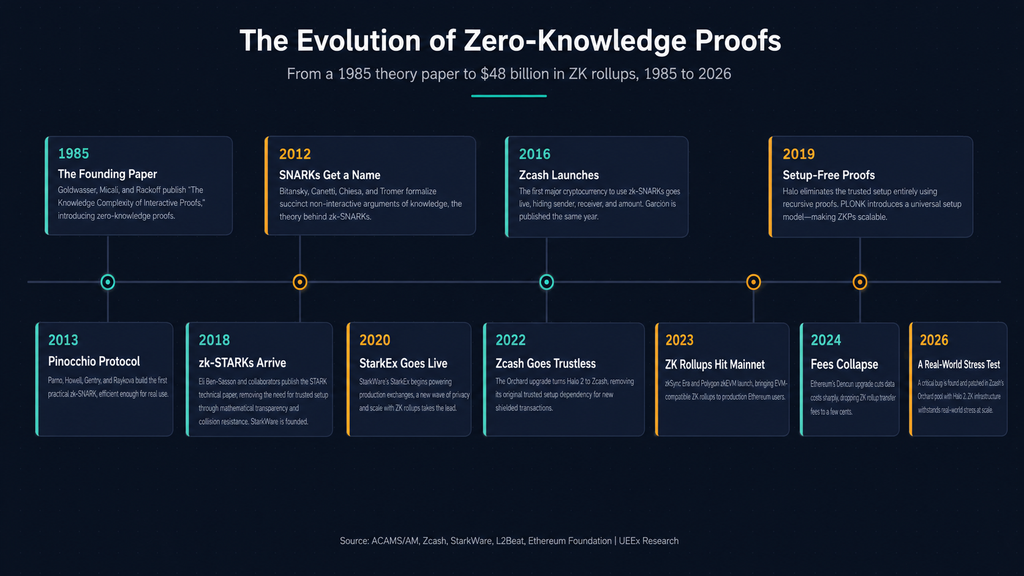
The idea was first written down in 1985 by Shafi Goldwasser, Silvio Micali, and Charles Rackoff in a paper called The Knowledge Complexity of Interactive Proof Systems. Forty years later it runs privacy coins, identity apps, and the fastest-scaling technology Ethereum has.
A blockchain that hides nothing cannot protect anyone. A blockchain that hides everything cannot be trusted by anyone. Zero-knowledge proofs are the rare tool that lets a network do both jobs with the same piece of math.
How Do Zero-Knowledge Proofs Work?
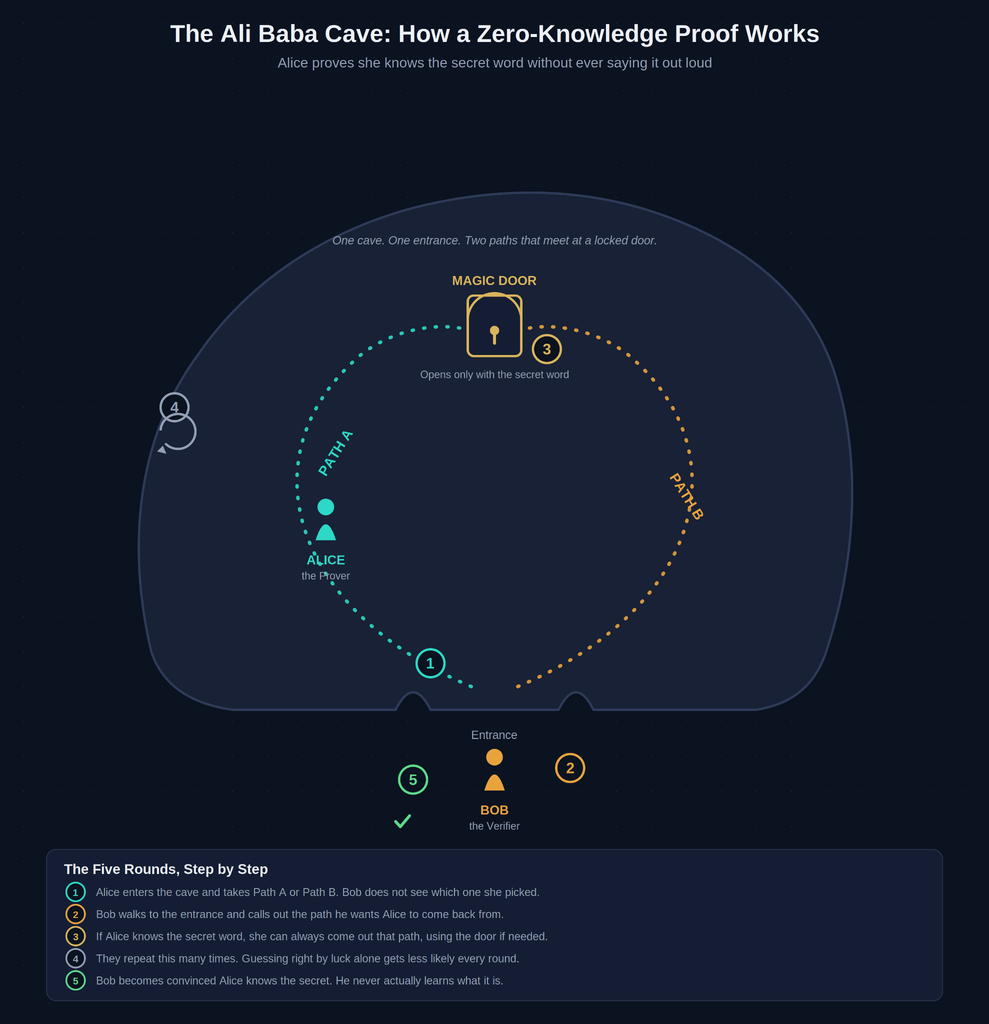
Here is a simple way to picture it, known as the Ali Baba cave problem.
Imagine a circular cave with one entrance and two paths, A and B, that meet at a locked magic door deep inside. Only someone who knows the secret word can open that door and cross from one path to the other.
Alice wants to prove to Bob that she knows the secret word, but she does not want to say the word out loud.
Here is what happens:
Bob waits outside while Alice walks into the cave and picks path A or path B, without Bob seeing which one.
Bob walks to the entrance and shouts which path he wants Alice to come back out from.
If Alice really knows the secret word, she can always come out of the path Bob asked for using the door if needed.
If Alice does not know the word, she only has a fifty-fifty shot at guessing which path Bob will ask for.
They repeat this over and over. After twenty rounds, the odds that Alice was faking it drop to about one in a million.
Bob walks away completely convinced Alice knows the secret, but he never learns what the secret actually is. That is zero-knowledge proof in a nutshell.
For a proof to count as valid, it needs to pass three tests:
Completeness: If the statement is true and both sides follow the rules, the verifier will always be convinced.
Soundness: If the statement is false, a cheating prover has almost no chance of fooling the verifier.
Zero-knowledge: The verifier learns that the statement is true and nothing else. Not the reasoning, not the secret, nothing.
Interactive vs. Non-Interactive Zero-Knowledge Proofs
Zero-knowledge proofs (ZKPs) come in two main forms: interactive and non-interactive. The key difference is how the prover and verifier communicate.
Interactive ZKPs
Interactive ZKPs require the prover and verifier to exchange multiple messages before the proof is accepted. The classic Ali Baba cave example illustrates this approach, where the verifier repeatedly challenges the prover to prove knowledge of a secret without revealing it.
Key characteristics:
Multiple rounds of communication.
Both parties must be online simultaneously.
Primarily used in cryptographic research and identification protocols.
Unsuitable for blockchains, where thousands of validators must verify transactions independently.
Non-Interactive ZKPs (NIZKs)
Non-interactive ZKPs allow the prover to generate one proof that anyone can verify later without additional communication. This makes them the standard for modern blockchain applications.
A single proof can be verified asynchronously by thousands of network nodes.
Proofs are stored permanently on-chain.
They reduce bandwidth by eliminating repeated message exchanges.
Most modern NIZKs rely on the Fiat-Shamir heuristic, introduced by Amos Fiat and Adi Shamir in 1986, which converts interactive proofs into non-interactive ones using cryptographic hash functions. This breakthrough laid the foundation for technologies such as zk-SNARKs and zk-STARKs.
Why Zero-Knowledge Proofs Matter for Blockchain
Zero-knowledge proofs solve two of blockchain’s biggest challenges: privacy and scalability, while preserving decentralization.
Privacy: Verify transactions without revealing sensitive information such as wallet addresses, balances, or transaction amounts.
Scalability: Compress thousands of transactions into a single proof, dramatically reducing on-chain data and lowering transaction costs.
Regulatory compliance: Enable selective disclosure, allowing users and businesses to satisfy AML, KYC, or GDPR requirements without exposing unnecessary data.
Enterprise adoption: Give organizations a way to use public blockchains while protecting confidential business information and intellectual property.
Trustless verification: Replace trusted intermediaries with mathematical proofs, allowing anyone to independently verify the validity of a transaction.
Join UEEx
Experience the World’s Leading Digital Wealth Management Platform
Zero-knowledge proofs (ZKPs) are built on cryptographic problems that are easy to verify but extremely difficult to solve. This imbalance allows one party (the prover) to prove they know a secret without revealing the secret itself.
Key Cryptographic Properties
Easy verification: Checking a valid proof requires minimal computing power.
Hard computation: Creating the proof involves complex mathematical calculations.
One-way functions: Converting an input into an output is straightforward, but reversing the process is computationally impractical.
A classic example is modular exponentiation:
Computing y = gˣ mod p is fast, even with very large numbers.
Given y, g, and p, determining x is extremely difficult because of the discrete logarithm problem.
This one-way property allows a prover to demonstrate knowledge of x without ever revealing its value.
Elliptic Curve Cryptography (ECC)
Many modern ZK systems, particularly zk-SNARKs, rely on elliptic curve cryptography (ECC) to produce compact, efficient proofs.
Core Concepts
Elliptic curves: Mathematical curves defined by equations such as y² = x³ + ax + b.
Point addition: Combining two points on the curve creates another valid point.
Scalar multiplication: Multiplying a point by a number is efficient, while reversing the operation is computationally infeasible.
Pairings: Specialized mathematical functions that enable fast proof verification in zk-SNARK systems.
Why It Matters
ECC allows zk-SNARKs to generate very small proofs, often only a few hundred bytes, which can be verified quickly, making them ideal for blockchain applications. However, because they rely on elliptic curve assumptions, they are not considered quantum-resistant. This is why many researchers and blockchain projects are exploring zk-STARKs and other post-quantum alternatives.
Polynomial Commitment Schemes
Polynomial commitment schemes are one of the mathematical foundations that make modern ZKPs both succinct and scalable.
How They Work
Instead of verifying every computation directly, ZK systems convert the computation into a polynomial.
The process typically follows these steps:
Convert computation: Express a statement such as “I know x where f(x) = y” as a polynomial equation.
Commit: The prover commits to the polynomial without revealing it.
Challenge: The verifier selects a random evaluation point.
Evaluate: The prover reveals the polynomial’s value at that point and proves the evaluation is correct.
Verify: The verifier confirms the mathematical relationship without executing the entire computation.
Why Polynomial Commitments Matter
Rather than checking millions of computation steps, the verifier only evaluates the polynomial at a few random points. This dramatically reduces verification time while maintaining strong security guarantees.
Polynomial commitment schemes underpin many modern zk-SNARK implementations and are also evolving toward post-quantum designs as the industry prepares for future cryptographic threats.
Cryptographic Accumulators and Hash Functions
zk-STARKs rely on hash-based cryptography instead of elliptic-curve cryptography, making them transparent, highly scalable, and resistant to future quantum attacks. This design eliminates the need for a trusted setup while enabling efficient verification of massive computations.
Hash Functions
Hash functions are one-way mathematical algorithms that convert data of any size into a fixed-length output (hash).
Key characteristics include:
One-way: It is computationally infeasible to reconstruct the original input from its hash.
Collision-resistant: Finding two different inputs that generate the same hash is practically impossible.
Post-quantum security: Unlike elliptic-curve cryptography, well-designed hash functions remain resistant to known quantum attacks, making them a core security primitive for zk-STARKs.
Modern STARK implementations commonly use optimized hash functions such as BLAKE2, Poseidon, and other ZK-friendly hashes depending on the protocol.
Merkle Trees
A Merkle tree is a cryptographic data structure that organizes hashes into a tree, where:
Each leaf represents a piece of data.
Each parent node is the hash of its two child nodes.
The Merkle root serves as a compact commitment to the entire dataset.
This allows anyone to prove that a specific piece of data belongs to a dataset using only O(log n) algorithms (whose execution time grows proportionally to the logarithm of the input size) hashes instead of downloading or verifying the entire dataset, significantly improving efficiency for large-scale blockchain applications.
Why zk-STARKs Use Hash-Based Commitments
zk-STARKs use Merkle tree commitments secured by collision-resistant hash functions. This approach provides several advantages:
No trusted setup, making the system fully transparent.
Post-quantum resistance due to its reliance on hash-based cryptography.
Excellent scalability for proving very large computations, making STARKs well suited for blockchain rollups and verifiable computation.
The primary drawback of zk-STARKs is their larger proof size.
zk-STARK proofs: typically 50–200 KB
zk-SNARK proofs: often only a few hundred bytes
While STARK proofs consume more bandwidth, they remove trusted setup assumptions and scale more efficiently for complex computations, which is why they are increasingly used in modern Layer-2 blockchain networks
zk-SNARKs: Small Proofs, Fast Checks
zk-SNARK stands for Zero-Knowledge Succinct Non-Interactive Argument of Knowledge. That is a mouthful, so break it down piece by piece:
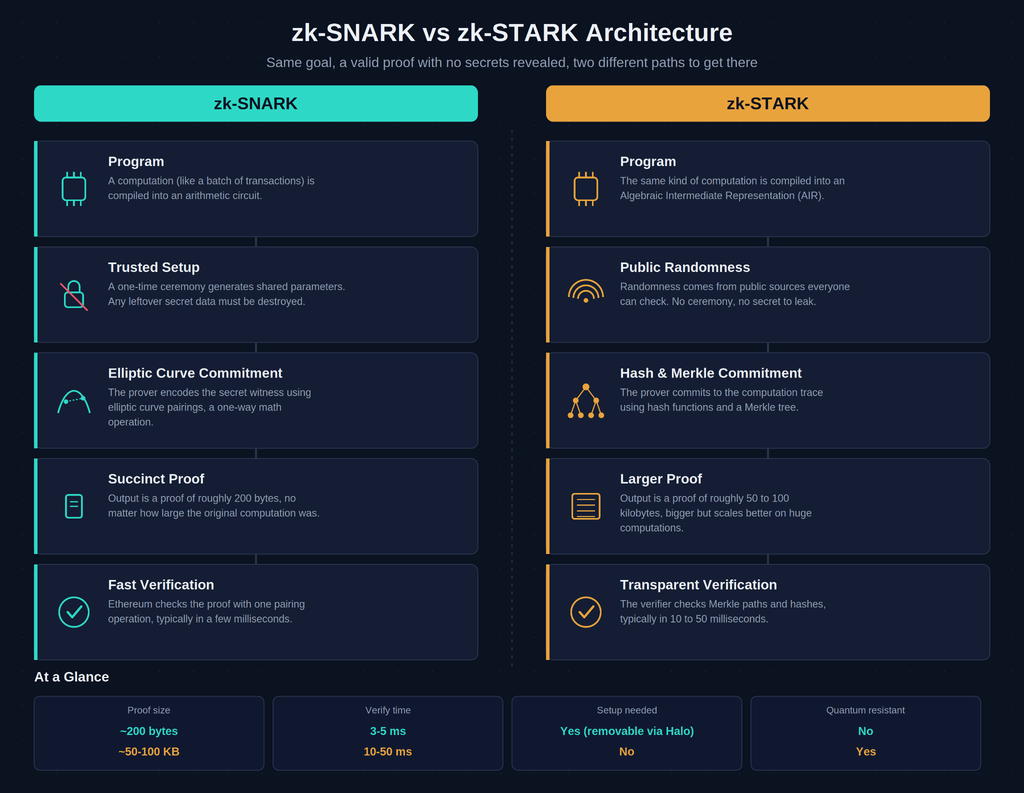
Succinct means the proof itself is tiny, often around 200 bytes, no matter how big the underlying computation was.
Non-interactive means one message does the whole job. No back and forth needed.
Argument of knowledge means the prover has to actually hold the secret information, not just get lucky.
The upside is obvious: small proofs and fast verification, which keeps gas costs down on Ethereum. The catch is something called a trusted setup.
The Trusted Setup Problem
Before a zk-SNARK system can run, someone has to generate a set of shared cryptographic parameters. During that setup, a piece of secret data gets created that must be destroyed afterward. If even one person kept a copy, they could forge fake proof, which in a cryptocurrency could mean minting coins out of thin air.
The fix is a multi-party ceremony. Hundreds of unrelated participants each contribute a random piece, and as long as just one of them genuinely deletes their part, the whole system stays safe.
Zcash ran its original ceremony this way in 2016, and later projects like PLONK made the setup reusable across many applications instead of needing a fresh ceremony every time.
A newer approach called Halo, developed in 2019 and now powering Zcash’s Orchard pool, gets rid of the trusted setup altogether by using proofs that recursively verify earlier proofs.
Where zk-SNARKs Are Used Today
Examples of where zk-SNARKs are used:
Zcash
Zcash was the first major zk-SNARK deployment, launching in 2016 with shielded transactions that hide the sender, receiver, and amount. The technology has been upgraded twice since, first to Sapling in 2018 and then to Orchard in 2022, each time making shielded transactions faster and dropping the need for a fresh trusted setup.
By early 2026, shielded ZEC (Zcash native cryptocurrency) made up close to 30 percent of the entire circulating supply, according to Zcash network data reported by Messari, a sign that privacy features had moved from a niche option to something everyday holders actually use.
zkSync Era
zkSync Era, built by Matter Labs, is an EVM-compatible ZK rollup that lets Ethereum developers deploy existing Solidity contracts with almost no changes.
Polygon zkEVM takes a similar approach at the bytecode level (bytecode is an intermediate, low-level code generated from human-readable source code), aiming for near-perfect compatibility with Ethereum’s virtual machine. Both use SNARK-based proof systems and settle their proofs on Ethereum for security.
zk-STARKs: No Trusted Setup, Built for the Quantum Era
zk-STARK stands for Zero-Knowledge Scalable Transparent Argument of Knowledge. The word “transparent” is the whole point here: STARKs need no trusted setup at all. Every random value used in the system is public and can be checked by anyone.
Developed starting in 2018 by Eli Ben-Sasson and collaborators, STARKs rely on hash functions and Merkle trees instead of elliptic curves. That single design choice has two big consequences.
First, it removes the toxic waste risk that SNARKs carry. Second, it makes STARKs resistant to quantum computers. Quantum machines threaten elliptic curve systems (an advanced form of public-key cryptography based on the algebraic math of elliptic curves over finite fields) through an algorithm called Shor’s algorithm (a breakthrough quantum algorithm that can factor large integers exponentially faster than the best known classical methods).
However, hash functions only face a much weaker quantum attack called Grover’s algorithm (a quantum algorithm for unstructured search that finds with high probability the unique input), which barely dents their security when key sizes are large enough.
The trade-off is proof size; a STARK proof typically runs tens of kilobytes, much larger than a SNARK’s 200 bytes. However, for very large computations, STARKs scale better, since their proving time grows only a little faster than the size of the computation itself, instead of growing in a straight line the way SNARK proving time does.
Starknet, built by StarkWare, is the largest production use of zk-STARKs. It uses a custom language called Cairo and, as of 2026, supports account abstraction natively at the protocol level. This means wallets can have built-in features like social recovery without extra add-ons.
zk-SNARKs vs. zk-STARKs: A Side-by-Side Look
Feature
zk-SNARKs
zk-STARKs
Trusted setup
Usually required (Halo removes it)
Not required
Proof size
About 200 bytes
Tens of kilobytes
Verification speed
A few milliseconds
Roughly ten to fifty milliseconds
Quantum resistance
Vulnerable to future quantum attacks
Resistant, hash-based
Best fit
EVM compatibility, low gas costs
Long-term security, very large computations
Well-known projects
Zcash, zkSync Era, Polygon zkEVM
Starknet
Neither one wins outright. A team building a DeFi app on Ethereum today usually wants zkSync Era or Polygon zkEVM for the smooth compatibility. Meanwhile, a team planning for decades of security or building something with genuinely enormous computation leans toward Starknet’s STARK-based approach.
Other Zero-Knowledge Tools Worth Knowing
A few other variants show up often enough to be worth a quick mention:
Bulletproofs, from Stanford researchers in 2017, need no trusted setup and specialize in range proofs, meaning proving a number falls between two values without revealing the number itself. Monero uses an upgraded version called Bulletproofs+ to hide transaction amounts.
PLONK, from 2019, introduced a universal trusted setup that works for any circuit, so a project does not need to run a brand new ceremony every time it adds a feature.
Nova and its successor, Supernova, still in early stages in 2026, focus on making recursive proofs, meaning proofs that verify other proofs, dramatically cheaper to compute.
Zero-Knowledge Rollups: How ZK Technology Scales Ethereum
A ZK rollup is a Layer 2 network that bundles thousands of transactions together, processes them off the main Ethereum chain, and then posts one cryptographic proof back to Ethereum confirming that every single transaction in the batch was valid
Here is the flow in four steps:
A sequencer collects a batch of user transactions off-chain.
The network executes those transactions and works out the new account balances.
A prover generates a single validity proof covering the entire batch.
Ethereum verifies that one proof, which mathematically guarantees every transaction in the batch was correct, and finalizes the new state.
Because the proof is checked by math rather than by a waiting period, ZK rollups offer near-instant finality. That is the biggest practical difference from optimistic rollups, which assume transactions are valid unless someone proves otherwise during a roughly seven-day challenge window.
Feature
ZK Rollups
Optimistic Rollups
Security Mechanism
Validity proofs (zero-knowledge proofs verify every transaction before finalization)
Minutes to 1 hour, depending on proof generation and settlement
Typically 7 days for Ethereum finality due to the fraud challenge period
Withdrawal Time
Minutes to a few hours
Around 7 days to Ethereum (instant liquidity available via third-party bridges)
Security Model
Cryptographic proof guarantees correctness
Economic incentives and fraud-proof challenges
Transaction Fees
Generally $0.01–$0.10 per transaction
Generally $0.02–$0.20 per transaction
Proof Costs
Higher computational cost for proof generation, lower long-term verification cost
Lower computational overhead; fraud proofs executed only when disputes arise
Technology Maturity
Rapidly evolving but more technically complex
More mature with broader adoption
EVM Compatibility
Improving through zkEVM implementations; still more complex
Native EVM compatibility and easier migration for Ethereum dApps
Scalability
Higher long-term throughput with stronger compression
High throughput but limited by fraud-proof architecture
Leading Networks (2026)
zkSync Era, Starknet, Polygon zkEVM, Scroll, Linea
Arbitrum One, Optimism, Base, Mantle
By mid-2026, the blockchain ecosystem hosts 50–80 active rollups, with L2BEAT tracking 22 canonical Layer-2 rollups holding a combined $33.81 billion in value. While optimistic rollups still dominate TVL through Arbitrum, Base, and Optimism, ZK rollups are rapidly catching up as proving costs decline and EVM compatibility improves.
Ethereum’s Dencun upgrade has also significantly reduced fees, bringing ZK rollup transactions down to just a few cents, around 50 to 100 times cheaper than Ethereum mainnet.
Privacy Applications: ZK Proofs in Cryptocurrencies
Let’s explore how zero-knowledge proofs works with privacy coins
Zcash: The Pioneer, Tested by a Real 2026 Scare
In 2026, Zcash demonstrated both the strength and challenges of zero-knowledge proofs after researchers discovered a soundness bug in its Orchard shielded pool that could theoretically have enabled counterfeit ZEC.
However, the network’s turnstile accounting mechanism prevented any increase in total supply, and no exploitation was confirmed. The Zcash team quickly deployed the Ironwood upgrade, introducing a new shielded pool with independent accounting and quantum-recoverable notes to improve future security.
The older Orchard pool was restricted to withdrawals, prompting users to migrate funds, with tens of thousands of ZEC moved on the first day. The incident highlighted that even mature, extensively audited privacy systems can contain critical flaws, underscoring the importance of continuous audits, rapid emergency upgrades, and strong security mechanisms alongside advanced cryptography.
Monero: Privacy On by Default
Monero takes a different approach than Zcash. Instead of making privacy optional, every single Monero transaction is private automatically.
It layers three technologies together: ring signatures to hide the sender, stealth addresses to hide the receiver, and Bulletproofs+ to hide the transaction amount while still proving it is not negative. That combination has made Monero one of the longest-running privacy coins still actively developed today.
Zero-Knowledge Proofs in Digital Identity
Traditional identity checks tend to overshare. Proving you are over eighteen usually means handing over your full birthdate, your address, and sometimes your entire ID photo. Zero-knowledge proofs let an app confirm just the one fact that matters and nothing else.
Real-World Implementations
World ID
World ID, developed by the World network (formerly Worldcoin), is one of the leading real-world applications of zero-knowledge proofs in 2026. Users verify their identity by scanning their iris with the Orb, which creates an encrypted identity code.
Using the Semaphore protocol, apps can confirm a user is a unique, verified human without accessing biometric data or tracking activity across platforms. The system uses app-specific nullifiers to prevent cross-app identity linking.
Polygon ID
Similar privacy-preserving approaches are used by projects like Polygon ID, enabling users to prove credentials such as citizenship, creditworthiness, or professional licenses without revealing sensitive documents.
Banks are also exploring zero-knowledge range proofs to verify applicants meet income requirements without disclosing exact earnings, balancing privacy with regulatory compliance.
Enterprise Privacy & Compliance
Zero-knowledge proofs (ZKPs) are transforming enterprise privacy by allowing organizations to verify claims without exposing sensitive data.
Banking and Financial Services
ING Bank pioneered enterprise use of Zero-Knowledge Range Proofs (ZKRP) in 2017, letting a mortgage applicant prove their salary falls within a range without revealing the exact figure. Its follow-up, Zero-Knowledge Set Membership, lets banks confirm a client resides in an EU country without revealing which one. Exchanges now use similar proofs for solvency audits, confidential settlements, and selective regulatory reporting.
Other key enterprise applications include:
Financial services: Prove solvency, enable confidential settlements, and streamline regulatory reporting with selective disclosure.
Supply chains: Verify product authenticity, trace provenance, and prove compliance (such as carbon-emission thresholds) without exposing proprietary business data.
Healthcare: Confirm patient eligibility, verify insurance coverage, and support privacy-preserving medical research on encrypted datasets.
Blockchain Analytics & Compliance
ZKPs improve privacy but also challenge traditional AML and CTF monitoring. As noted by Chainalysis, the industry is increasingly adopting selective disclosure, allowing users to prove compliance without revealing transaction details.
Emerging solutions include compliance proofs, permissioned view keys for auditors, and privacy-preserving identity systems that balance regulatory oversight with user confidentiality. This approach offers a practical middle ground between financial privacy and regulatory transparency.
Join UEEx
Experience the World’s Leading Digital Wealth Management Platform
Zero-knowledge systems are powerful, but they are not magic. A few real risks are worth understanding before you trust a project blindly.
Trusted Setup Leaks
If a SNARK ceremony’s secret parameters are not properly destroyed, whoever holds them can forge proofs. Multi-party ceremonies with hundreds of independent participants dramatically shrink this risk, and setup-free designs like Halo or STARKs remove it completely.
Quantum Computing
Elliptic curve systems, which most SNARKs depend on, are vulnerable to a quantum algorithm called Shor’s algorithm. Estimates of how soon that becomes a real threat keep shrinking.
Research from Google’s Quantum AI team published in March 2026 suggested that breaking 256-bit elliptic curve keys might need fewer than 500,000 physical qubits, roughly twenty times lower than earlier estimates.
Current quantum hardware still sits far below that number, but the gap has narrowed enough that NIST now recommends completing a shift to quantum-resistant cryptography by 2035. STARKs, built on hash functions, are already considered resistant to this kind of attack.
Circuit Bugs
The code that turns a computation into a zero-knowledge circuit is genuinely hard to get right, and a subtle mistake can let invalid proofs slip through as valid. The 2026 Zcash Orchard vulnerability is a real, recent example of exactly this kind of flaw.
Independent audits, formal verification, active bug bounty programs, and a fast emergency-upgrade path are what separate teams that catch these problems early from teams that do not.
Compliance Tension
Privacy by design can clash with anti-money-laundering rules, which is why some projects build in optional selective disclosure, letting a user prove compliance to a regulator without exposing everything to the public.
How to Evaluate a Zero-Knowledge Project
Before trusting a ZK project with real money, run through this checklist:
Check the proof system fit: Does the project need EVM compatibility and low gas costs, which points to a SNARK? Or does it need a transparent setup and long-term quantum resistance, which points to a STARK?
Look for real audit history: Multiple independent audits from firms like Trail of Bits, OpenZeppelin, or CertiK, published in full, are a much better signal than a single internal review.
Check decentralization: Who runs the sequencer? Who can generate proofs? A single centralized operator is a real risk even if the cryptography itself is sound.
Look at adoption, not just marketing: Total value locked, daily active users, and real DeFi integrations tell you more than a roadmap slide deck. You can check current numbers yourself on L2Beat or DeFiLlama.
Ask how they handle bad news: Has the project ever disclosed a vulnerability? How fast did they patch it? Zcash’s response to its 2026 Orchard bug, a fix shipped within days and full public disclosure, is closer to the standard you want to see than a team that stays quiet about it.
Frequently Asked Questions
What’s the difference between zero-knowledge proofs and encryption?
Encryption hides data so only someone with the right key can read it later. A zero-knowledge proof does not hide data to be revealed later at all. It proves a fact is true right now while keeping the underlying information secret forever.
Are zk-SNARKs or zk-STARKs better?
Neither is universally better. SNARKs give smaller proofs and lower gas costs, which suits most EVM-based apps today. STARKs skip the trusted setup and resist quantum attacks, which suits projects planning for decades of security.
Will quantum computers break zero-knowledge proofs?
They threaten SNARK systems built on elliptic curves, since those rely on math that quantum computers can eventually solve efficiently. STARKs, built on hash functions, are already considered quantum-resistant, and post-quantum SNARK research is actively underway.
Can ZK rollups be hacked or fail?
The cryptography itself is extremely hard to break, but the surrounding code, the sequencer setup, and the smart contracts that connect a rollup to Ethereum can all have bugs. That is why independent audits and decentralization progress matter as much as the proof system.
Disclaimer: This article is intended solely for informational purposes and should not be considered trading or investment advice. Nothing herein should be construed as financial, legal, or tax advice. Trading or investing in cryptocurrencies carries a considerable risk of financial loss. Always conduct due diligence before making any trading or investment decisions.
Trade with proof of Reserves
UEEx publish monthly audits and third party verification on every listed market.