Crypto regulation refers to the body of laws, rules, and administrative frameworks that governments and financial authorities impose on cryptocurrency activities including issuance, trading, custody, and transfer. As of 2025/2026, the crypto sector is subject to active regulation in every major financial jurisdiction globally, though the scope, approach, and maturity of these frameworks differ substantially between countries.
Key Takeaways
- The GENIUS Act signed July 18, 2025 is the first federal US law governing digital assets, establishing a licensing regime, 1:1 reserve requirements, and AML obligations for stablecoin issuers.
- The EU’s MiCA regulation entered full enforcement across all 27 member states in 2025, requiring CASP licensing, capital requirements, and standardised white papers the most comprehensive crypto framework yet enacted by any jurisdiction.
- Following MiCA implementation, EU crypto-related scam reports dropped by 58%, institutional crypto holdings rose by 30%, and retail participation grew by 27%.
- 55% of traditional hedge funds now allocate to crypto (up from 47% in 2024); five major US banks launched or piloted Bitcoin-backed credit products in 2025 regulatory clarity was the prerequisite for both.
- The global crypto market was valued at $3.35 trillion in 2026 and is projected to reach $6.33 trillion by 2030 the data shows regulation and market growth moving together, not in opposition.
- Genuine challenges remain: DeFi, NFTs, and self-custody wallets sit outside most regulatory perimeters, and cross-border consistency is still a work in progress across 99+ jurisdictions.
Where Does the “Crypto Is Unregulated” Myth Come From?
The belief has two roots, both historically grounded but now outdated.
The first is architectural. Cryptocurrencies were designed around decentralisation — no central bank, no single point of control, transactions peer-to-peer on a public network. This design philosophy led early participants and outside observers alike to conclude that traditional regulatory frameworks simply could not apply. If there is no company to license and no bank to supervise, how can there be regulation?
The second is historical. In Bitcoin’s first decade (2009–2018), the honest answer was that most jurisdictions had not passed crypto-specific legislation. Exchanges operated with minimal oversight. Anti-money laundering rules were unevenly applied. The collapse of Mt. Gox in 2014, Bitconnect in 2018, and FTX in 2022 all occurred in an environment of meaningful regulatory gaps. These failures were real, and they reinforced the “Wild West” narrative each time they generated headlines.
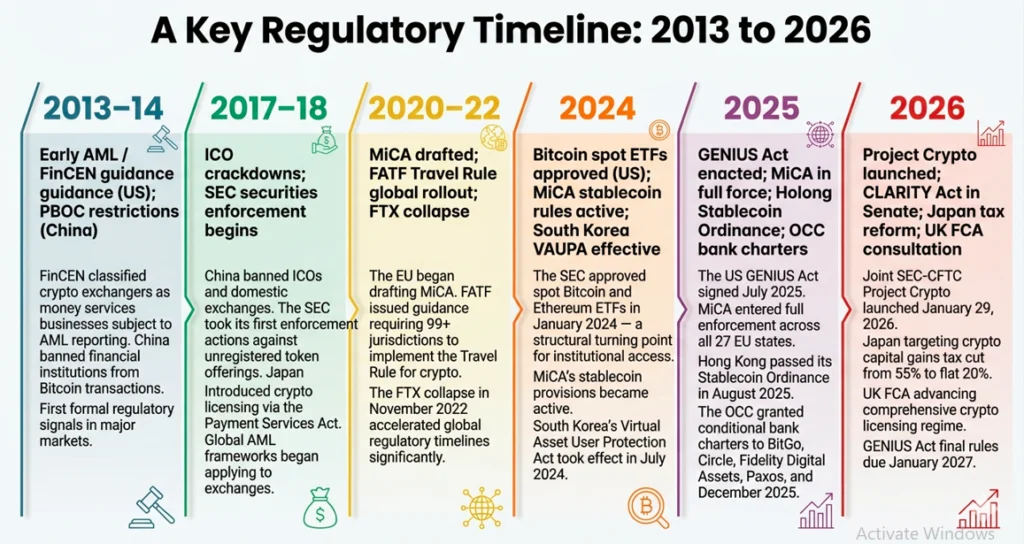
But treating that history as current fact is an error. The FTX collapse in particular accelerated regulatory action worldwide — regulators who had been cautious moved faster. The past two years have produced more consequential crypto legislation than the preceding decade combined.
“The global policy landscape today looks markedly different than it did 12 months ago. The pace of change has been remarkable, and it shows little sign of slowing.”
— Chainalysis 2025 Crypto Regulatory Round-Up
What Does the Global Crypto Regulatory Landscape Look Like in 2025/2026?
The defining characteristic of the current moment is that crypto regulation has moved from theory to active enforcement. Laws that were debated and drafted during 2022–2024 are now producing compliance obligations, licence applications, and enforcement actions.
The Two Landmark 2025 Frameworks
Two pieces of legislation define the current regulatory era and together cover the largest single-currency markets in the world.
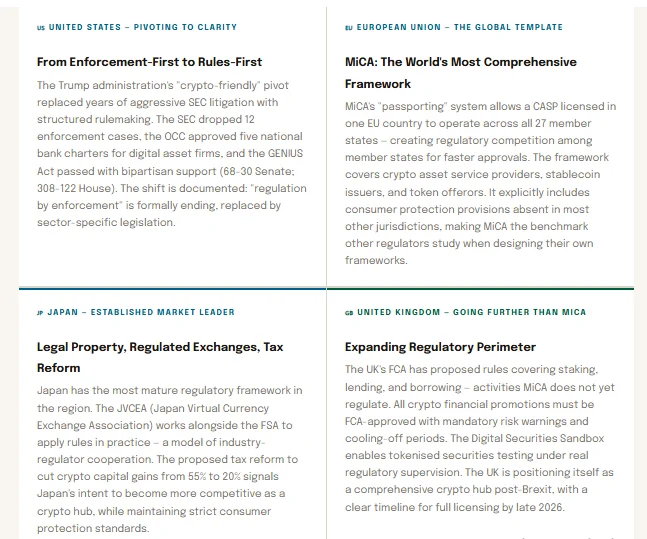
The GENIUS Act (United States, July 2025). The Guiding and Establishing National Innovation for US Stablecoins Act was signed by President Trump on July 18, 2025 — the first federal US law directly governing any segment of the digital asset market. It establishes a licensing regime for payment stablecoin issuers, requiring: 1:1 reserve backing in cash or short-term US Treasury bills; monthly reserve disclosures; independent audits; and full AML and KYC compliance under Bank Secrecy Act obligations. Only OCC-licensed entities or bank subsidiaries may issue payment stablecoins. Final implementing regulations are due by January 2027. Alongside the GENIUS Act, the House passed the CLARITY Act in July 2025 to resolve the SEC/CFTC jurisdictional division over digital asset markets — that bill remains in the Senate as of April 2026. “Project Crypto,” the joint SEC-CFTC oversight initiative, launched January 29, 2026.
MiCA (European Union, full enforcement 2025). The Markets in Crypto-Assets regulation took full effect across all 27 EU member states at the start of 2025 — the world’s most comprehensive crypto regulatory framework. Any entity offering crypto services in the EU must register as a Crypto Asset Service Provider (CASP), maintain minimum capital requirements, publish standardised white papers for token offerings, and comply with strict rules around stablecoin reserves, redemption rights, and consumer disclosures. Non-compliance carries fines of up to 12.5% of annual turnover. From January 2026, all service providers must collect sender and recipient identity information on every crypto transfer, regardless of amount.
The evidence MiCA is working: Following full MiCA implementation, crypto-related scam reports in the EU dropped by 58%. Over 30% of EU institutional investors increased digital asset holdings after MiCA’s investor protection measures took effect. Retail participation grew 27%. The number of registered VASPs in the EU rose 47% — compliant operators expanded while non-compliant ones exited.
How Does Crypto Regulation Differ by Country?
Regulatory frameworks vary enormously — from the EU’s comprehensive supranational rulebook to China’s comprehensive ban to India’s high-tax-but-no-framework ambiguity. The table below summarises the current status in ten major jurisdictions, all updated to reflect developments through April 2026.
| Jurisdiction | Status | Key 2025/2026 Developments |
|---|---|---|
| United States | Active / Developing | GENIUS Act enacted July 2025 (stablecoin framework). SEC dropped 12 enforcement cases including Binance, Coinbase, Kraken. Project Crypto (joint SEC-CFTC) launched Jan 2026. CLARITY Act (market structure) passed House; Senate deliberation ongoing. CBDC explicitly prohibited. |
| European Union | Comprehensive | MiCA in full force across all 27 member states since Jan 2025. CASP licensing mandatory; fines up to 12.5% of annual turnover. Full sender/recipient data required on all transfers from Jan 2026. Crypto scam reports fell 58%; institutional participation rose 30%. |
| United Kingdom | Active / Expanding | FCA registration required; all crypto promotions must be FCA-approved with risk warnings and cooling-off periods. Three FCA consultations in 2025 proposed rules for staking, lending, and borrowing — going further than MiCA. FCA application gateway opens September 2026. |
| Japan | Progressive | Cryptocurrencies recognised as legal property under the Payment Services Act. Exchanges must register with the FSA. 105 cryptocurrencies reclassified as regulated financial products under the FIEA. Proposed tax reform to cut crypto capital gains from 55% to flat 20% in 2026 — aligning with traditional assets. |
| Singapore | Comprehensive | MAS single-currency stablecoin framework requires high-quality reserves, redemption rights, and issuer accountability. Singapore completed FATF’s fifth round mutual evaluation in 2025. Project Guardian continues testing institutional DeFi. Crypto legal; not legal tender. |
| Hong Kong | Expanding | 12 VATP platforms licensed; retail crypto trading fully operational. Stablecoin Ordinance enacted August 2025; first licences expected early 2026. Dealer and custodian regulation planned for 2026. Staking-as-a-service treated as regulated under existing exchange licences since April 2025. |
| South Korea | Active | Virtual Asset User Protection Act (VAUPA) effective July 2024: exchanges must segregate client assets, maintain insurance, and use real-name banking. First prosecution referrals for unfair trading in 2025. Won-backed stablecoin legislation advancing. Influencer crypto disclosure bill proposed February 2026. |
| Canada | Active | Exchanges registered as money services businesses with FINTRAC since 2014. Draft stablecoin law released November 2025, mirroring GENIUS Act structure with 1:1 reserve requirements. Crypto taxed as commodity property. First crypto investment fund registered 2017. |
| Australia | Active | Crypto exchanges registered with AUSTRAC; AML/CFT compliance mandatory. ASIC oversees ICOs and investor protection. Travel Rule enforcement strengthening through 2026. New licensing framework for exchanges in development to replace current registration-only model. |
| India | Tax-Heavy / No Framework | 30% flat tax on all crypto earnings; 1% TDS on every transaction (regardless of profit). February 2025 Income-Tax Bill formally defined “virtual digital assets” but retained existing tax rates. No formal exchange licensing framework as of April 2026 — trading is taxed but not formally licensed. |
| China | Comprehensive Ban | Private cryptocurrency exchanges, trading, and mining remain banned. e-CNY (digital yuan) continues expansion into more cities and use cases. Government signals continued support for blockchain technology while maintaining restrictions on private crypto. |
The “unregulated” test: A US crypto exchange in 2026 must register with FinCEN, comply with the Bank Secrecy Act AML obligations, hold state money transmitter licences in applicable states, follow SEC or CFTC rules depending on the assets it trades, comply with GENIUS Act stablecoin requirements, and adhere to OFAC sanctions rules. Calling this unregulated would be factually incorrect by any measure.
What Do the Leading Regulatory Approaches Look Like in Practice?
What Are the Documented Benefits of Crypto Regulation?

The argument that regulation stifles crypto innovation is not supported by the 2025/2026 data. The period of greatest regulatory clarity has coincided with the highest institutional adoption, the deepest liquidity, and the lowest retail fraud rates on record in regulated markets.
Investor Protection: MiCA’s KYC requirements reduced EU crypto scam reports by 58%. In regulated markets, mandatory asset segregation means exchange collapses (like FTX) cannot take customer funds — the FTX failure occurred precisely in the absence of this requirement. Risk management frameworks depend on regulatory foundations.
Institutional Entry: 55% of traditional hedge funds now hold crypto — up from 47% in 2024. Five major US banks launched Bitcoin-backed credit products in 2025. Harvard Management Company increased its BlackRock IBIT stake by 257% in Q3 2025. Each of these institutions cited regulatory clarity as a prerequisite for participation.
Market Stability: The global crypto market was valued at $3.35 trillion in 2026 and is projected to reach $6.33 trillion by 2030 at a 17.3% CAGR. Institutional participation — enabled by regulation — reduces the retail-sentiment-driven volatility that characterised earlier cycles. The 2024/2025 cycle produced markedly less extreme retail-driven swings than 2017 or 2021.
Mainstream Adoption: Spot Bitcoin ETFs — a product that required SEC regulatory approval — held over $60 billion in AUM by early 2026. Stripe integrated stablecoin settlement in 2025. Shopify, Visa, and Mastercard all expanded crypto payment infrastructure under MiCA and GENIUS Act frameworks. Regulation made these integrations legally viable for companies with compliance obligations.
Reduced Illicit Activity: TRM Labs data shows VASPs operating under formal regulatory frameworks have significantly lower rates of illicit activity than the broader unregulated ecosystem. FATF’s 2025 asset recovery guidance enables cross-border seizure and return of criminal crypto proceeds. The US, UK, and EU coordinated sanctions against Russian sanctions evasion via crypto in 2025.
Legal Certainty for Innovation: The end of “regulation by enforcement” in the US — where businesses faced unpredictable SEC lawsuits rather than clear rules — removes a major deterrent to building crypto products for the US market. The CLARITY Act’s pending market structure legislation will formally assign regulatory authority, enabling companies to plan multi-year product roadmaps for the first time.
What Makes Regulating Crypto Genuinely Difficult?
The misconception that crypto is “unregulated” often has a mirror misconception on the other side — that comprehensive regulation is straightforwardly achievable. Three structural challenges ensure that crypto regulation will remain genuinely complex for years to come, even as frameworks mature.
Why Is Decentralisation a Regulatory Problem?
Traditional regulation targets entities: companies, exchanges, banks. Decentralised protocols — smart contracts with no owner, blockchains with no company behind them — have no legal entity to license, fine, or compel compliance from. DeFi protocols, self-custody wallets, and open-source blockchain software sit outside most regulatory frameworks by design. The SEC’s proposed “innovation exemption” and the CLARITY Act’s treatment of open-source software developers attempt to address this, but no jurisdiction has comprehensively solved it. As the FSB noted in October 2025, “significant gaps and inconsistencies” remain.
How Does Crypto’s Global Reach Create Jurisdictional Problems?
A crypto exchange can be incorporated in one country, have servers in another, and serve users in 50 others simultaneously. National regulation is inherently limited against an infrastructure with no geographic borders. Regulatory arbitrage — companies relocating to the most permissive jurisdiction — remains a live concern. The FATF Travel Rule addresses some of this by creating an international AML standard, but enforcement varies. The 2025 Chainalysis round-up found that “cross-border inconsistencies” are the primary concern for regulators entering 2026, alongside building supervisory capacity and information-sharing structures between jurisdictions.
Can Regulation Keep Pace With Crypto Innovation?
NFTs, DeFi, AI-integrated crypto protocols, and tokenised real-world assets have all emerged faster than any legislative cycle. MiCA explicitly excludes NFTs and DeFi from its scope — two of the most significant crypto use cases since 2021. The UK is more ambitious, proposing rules for lending and staking that MiCA does not cover. But regulating rapidly evolving technology always involves a lag. New products appear before rules do. The challenge for regulators is designing frameworks flexible enough to accommodate what comes next without knowing exactly what that will be.
What Role Does Industry Self-Regulation Play?
The cryptocurrency industry has developed its own standards and oversight mechanisms not as a substitute for government regulation but as a complement to it, and in some areas as a bridge while formal frameworks catch up.
Japan’s JVCEA (Japan Virtual Currency Exchange Association) is the most mature example: a self-regulatory body that works directly alongside the FSA to translate regulations into practical compliance guidance for exchanges. The JVCEA’s model, where industry practitioners help define what compliance looks like in technical terms has been influential in how other regulators approach the gap between legislative intent and market reality.
Proof-of-reserve audits, where exchanges publish cryptographic proof that they hold the assets they claim, emerged as a voluntary practice after the FTX collapse, before any regulator required them. Exchanges publishing PoR disclosures established a market norm that formal regulation is now beginning to codify. The Beacon Network, launched in 2025 as the crypto industry’s first real-time information-sharing platform for compliance purposes, represents institutional self-regulation at the infrastructure level.
Industry self-regulation is most valuable where formal rules are absent or ambiguous, and where technical expertise allows the industry to establish practices that are both practically workable and genuinely protective. Its limitation is obvious: voluntary standards are only as strong as the willingness of participants to follow them, and bad actors, the FTX-type operators who created the need for rules in the first place — are precisely those who will not.
The most productive dynamic is collaborative: industry bodies contribute technical knowledge, exchanges implement standards proactively, and regulators formalise and enforce what works. That collaboration is increasingly visible in the UK’s FCA consultation processes, the EU’s MiCA implementation working groups, and the US’s Project Crypto roundtables.
Frequently Asked Questions
Is cryptocurrency regulated?
Yes — substantially and increasingly. The US GENIUS Act (July 2025) is the first federal law governing digital assets in the US. The EU’s MiCA regulation is in full force across 27 member states. Hong Kong enacted its Stablecoin Ordinance in August 2025. Japan, Singapore, Australia, Canada, the UK, and South Korea each maintain active licensing and AML frameworks. The idea that crypto operates in a lawless space is simply not accurate in 2025/2026 — it reflects conditions that have not existed in any major financial jurisdiction for several years.
What is the GENIUS Act and what does it do?
The GENIUS Act (Guiding and Establishing National Innovation for US Stablecoins Act) was signed into law on July 18, 2025 — the first federal US law directly governing digital assets. It creates a licensing regime for payment stablecoin issuers requiring 1:1 reserves in cash or short-term US Treasuries, monthly reserve disclosures, independent audits, and full AML/KYC compliance. Only OCC-licensed entities or bank subsidiaries may issue payment stablecoins. Full rules implementing the Act are expected by January 2027. The GENIUS Act passed with strong bipartisan support: 68-30 in the Senate and 308-122 in the House.
What is MiCA and how does it regulate crypto in Europe?
MiCA is the EU’s Markets in Crypto-Assets regulation — the most comprehensive crypto regulatory framework enacted by any jurisdiction. It entered full enforcement across all 27 EU member states at the start of 2025. MiCA requires entities offering crypto services to register as CASPs (Crypto Asset Service Providers), maintain minimum capital, publish standardised white papers for token offerings, and comply with strict stablecoin reserve and redemption rules. Non-compliance carries fines up to 12.5% of annual turnover. The effects are documented: scam reports in the EU fell 58%, institutional crypto holdings rose 30%, and retail participation grew 27% following MiCA’s implementation.
Which countries have the strictest crypto regulations?
China has the most restrictive stance, banning private exchanges, trading, and mining while developing the state-controlled e-CNY. South Korea’s VAUPA (effective July 2024) imposes mandatory asset segregation, real-name banking requirements, and insurance obligations. India imposes a 30% flat capital gains tax and 1% TDS on every transaction but lacks a formal exchange licensing framework. The UK requires FCA registration for all crypto businesses and approval for all crypto financial promotions with mandatory risk warnings.
What is the Travel Rule in crypto?
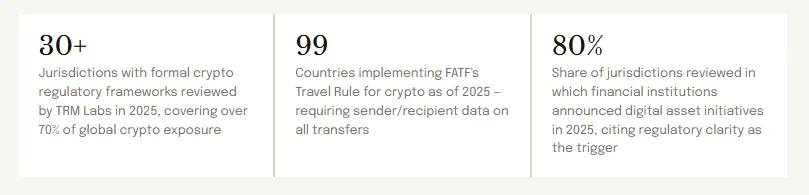
The Travel Rule is a FATF AML requirement now applied to crypto globally: exchanges and other Virtual Asset Service Providers must collect and transmit the names and account details of both the sender and recipient on any digital asset transfer. The EU’s Transfer of Funds Regulation (TFR) took effect December 2024, requiring compliance on all transfers regardless of size. The UK has enforced its version since September 2023. As of 2025, 99 jurisdictions are implementing Travel Rule requirements globally — making it one of the most widely adopted crypto-specific regulatory standards in the world.
Why do people think crypto is not regulated?
The belief has two historical roots. First, crypto’s decentralised design — no central bank, peer-to-peer transactions — created the impression that traditional regulation could not apply. Second, in crypto’s early years (2009–2018), formal regulation was genuinely sparse in most jurisdictions, creating a real regulatory gap that became generalised into a permanent perception. The FTX collapse in 2022 accelerated global regulatory action more than any other single event. Today’s landscape — GENIUS Act, MiCA, 99-jurisdiction Travel Rule, Japan FIEA, Hong Kong licensing — is unrecognisable from the pre-2020 environment.
What are the benefits of regulating cryptocurrency?
The evidence from 2025 is direct. In the EU post-MiCA: scam reports fell 58%; institutional holdings rose 30%; retail participation grew 27%. Globally: 55% of hedge funds now allocate to crypto (up from 47%), citing regulatory clarity as a prerequisite. Five major US banks launched Bitcoin-backed credit products in 2025. Bitcoin ETFs exceeded $60 billion in AUM. VASPs operating under formal regulatory frameworks show significantly lower illicit activity rates than the unregulated ecosystem. The period of greatest regulatory clarity has coincided with the deepest institutional participation in crypto’s history.
What are the main challenges in regulating crypto globally?
Three structural challenges persist. First, decentralisation: smart contracts and open-source protocols have no legal entity to regulate — DeFi and self-custody wallets sit outside most frameworks. Second, global jurisdiction: a crypto exchange can incorporate in one country and serve users in 50 others; national regulation is inherently limited. Third, innovation pace: NFTs, DeFi, AI-integrated protocols, and tokenised assets all emerged faster than legislative cycles. The FSB flagged “significant gaps and inconsistencies” in October 2025; cross-border coordination remains the primary regulatory agenda item for 2026.